Introducing G2.ai, the future of software buying.Try now

Scrum Master

by Kelly Fiorini
A scrum master ensures a smooth scrum process in agile organizations. Learn more about best practices and the responsibilities of a scrum master.

What is a scrum master?

A scrum master facilitates scrums, an agile project management methodology. The scrum master ensures that all participants complete tasks correctly within a one-to-four-week project sprint.

Several types of teams follow the agile framework, and most of them use the scrum methodology. Scrum masters have a variety of roles within a team, including the coach, mediator, and administrator. 

Scrum masters may use project management software to manage agile sprints and track task completion. These tools keep teams organized and allow for better collaboration.

Responsibilities of a scrum master

Since scrum masters work with different types of teams, their exact tasks vary. However, all scrum masters must keep a group functioning efficiently by managing the following responsibilities.

  • Coaching team members: A strong scrum master provides opportunities and resources that help team members improve their skills and capabilities. With proper coaching, collaborators can achieve better growth in the work environment. 
  • Facilitating meetings: Scrum teams participate in four different types of meetings: sprint planning to set goals and determine tasks, daily standups to share progress overviews quickly, sprint reviews to discuss accomplishments at the end of a project, and retrospectives to reflect on how to improve for the next sprint. The scrum master serves as a facilitator or mediator during all four meetings.
  • Removing obstacles: Scrum masters remove impediments or obstacles that might prevent the scrum from progressing efficiently. For example, if the team is waiting on approval from a stakeholder, the scrum master will encourage the stakeholder to respond faster. The scrum master works to minimize or eliminate any systemic roadblocks so team members can focus on moving toward the goal.
  • Fostering communication: Scrum masters listen to stakeholders and team members and ask thoughtful questions to understand their issues. They also moderate discussions among workers and help resolve any conflicts that arise. 

Benefits of a scrum master

The scrum master is an invaluable asset, helping the scrum run smoothly and achieve desired outcomes. An effective scrum master helps a team stay accountable for its success and achieve maximum efficiency. The presence of a competent scrum master can:

  • Improve collaboration skills. Since one of their primary responsibilities is to streamline communication on the team, a scrum master can help employees better their teamwork skills. 
  • Maintain agile values. Some companies commit to following agile project management, but then lose focus and fall away from agile principles and values. A scrum master promotes the five scrum values: courage, commitment, respect, focus, and openness. They also ensure that workers adhere to the three scrum pillars: transparency, adaptation, and inspection.
  • Reduce time to market. Scrum masters keep the team on track in sprints to help shorten products’ time to market. Since scrum masters mediate retrospectives, they’re periodically allowing the team to reflect and determine ways to improve in the next sprint to save even more time.

Scrum master best practices

Becoming a proficient scrum master takes time and effort. To excel in the role, a scrum master must:

  • Build a strong team. Scrum masters have to empower each team member to reach their full potential. Team members should be confident enough to make important decisions and independent enough to solve problems as they arise without always turning to the scrum master. At the same time, the scrum master ought to encourage the team to work collaboratively and cohesively. If processes aren’t running smoothly, the scrum master has to facilitate team-building activities. 
  • Prioritize scrum ceremonies. When a team is busy, their scrum ceremonies, essential meetings during key points in a sprint, can fall to the bottom of the priority list. Scrum masters should hold space for these events to keep all stakeholders and team members in the loop. The ceremonies are also a time to reflect on wins and challenges.
  • Collect feedback. A good leader always tries to improve. A scrum master should conduct surveys to receive feedback on their communication style, support skills, and facilitation capabilities.
  • Seek professional development and certifications. Many courses are available for scrum masters looking to refine their skills. Although a scrum master isn’t required to achieve professional certification, it can help them build their capacity and stand out on job applications.

Scrum master vs. project manager

Scrum masters and project managers both guide a project, but beyond that, the two positions differ considerably. 
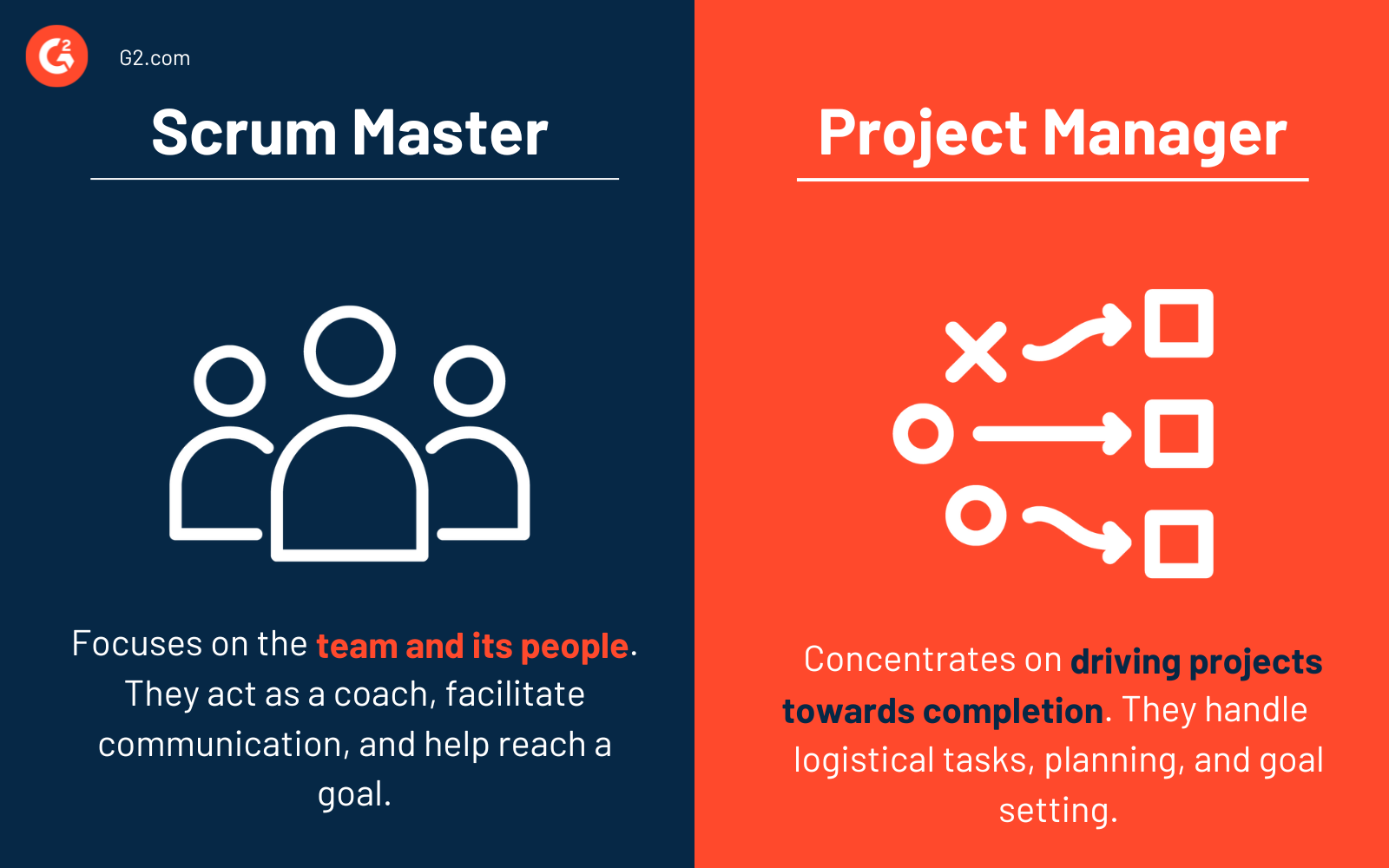
Scrum Master vs. Project Management

A scrum master focuses on the team and its people. They coach team members, facilitate communication, and ensure nothing stands in the way of their goals. Scrum masters only exist within the agile methodology called scrum.

A project manager mainly concentrates on driving projects toward completion. They often handle logistical tasks, planning, delegating, and goal setting in a leadership capacity. Businesses that use project managers are typically centered on traditional project management.

If the scrum methodology isn’t the right fit for your company, discover the waterfall methodology for project management.

Kelly Fiorini
KF

Kelly Fiorini

Kelly Fiorini is a freelance writer for G2. After ten years as a teacher, Kelly now creates content for mostly B2B SaaS clients. In her free time, she’s usually reading, spilling coffee, walking her dogs, and trying to keep her plants alive. Kelly received her Bachelor of Arts in English from the University of Notre Dame and her Master of Arts in Teaching from the University of Louisville.

Scrum Master Software

This list shows the top software that mention scrum master most on G2.

Jira is an issue and project tracker for teams building great software. Track bugs and tasks, link issues to related code, agile planning, and monitor activity.

Miro is an Innovation Workspace built to accelerate product development from insight to execution. Designed for teams operating in fast-moving, cross-functional environments, Miro brings together research, planning, prototyping, and strategy into one visual, collaborative space. Miro supports every phase of the product development lifecycle — from early discovery and journey mapping to sprint planning, design reviews, and scaled Agile workshops. And with AI features like clustering, summarization, and Sidekicks embedded directly into the canvas, teams can synthesize feedback, generate product briefs, and align on roadmaps in a fraction of the time. Two-way Jira integration and customizable Agile templates make it easy to manage end-to-end workflows, while supporting rituals like sprint planning, daily standups, and retrospectives. Whether you’re mapping product strategy or testing early prototypes, Miro helps teams collapse planning steps and drive innovation faster — all within a secure, flexible workspace.

ClickUp is one app to replace them all. It's the future of work. More than just task management - ClickUp offers docs, reminders, goals, calendars, and even an inbox. Fully customizable, ClickUp works for every type of team, so all teams can use the same app to plan, organize, and collaborate.

Pluralsight Skills provides online training courses for developers and IT professionals.

Mural is on a mission to help every go-to-market team achieve alignment. With the right tools to collaborate, ideate, and execute customer-centered strategies, organizations can break down the silos that slow success down and get results, faster. Mural offers an intuitive and interactive collaboration space with purpose-built templates, enterprise-grade security, and industry-leading methodologies for the customer-obsessed. GTM teams can come together on an infinite canvas that is flexible and visual to brainstorm ideas, plan project timelines, and execute together quickly. Mural’s Facilitation Superpowers lead to increased engagement from teams, customers, and GTM partners, which transforms every meeting into a co-creation session. Mapping and storyboarding features speed up buy-in and decision making by demonstrating an understanding of customers’ needs and how to meet them. Mural AI can summarize key takeaways from interactions, or suggest new ideas to strategize how to get to ‘yes.’ Out-of-the-box and custom templates make it easy to share best practices to level up every teammate to be customer-obsessed.

Trello is a collaboration tool that organizes your projects into cards and boards. In one glance, Trello tells you what's being worked on, who's working on it, and where something is in process.

Parabol lets your team conduct powerful guided retrospective and check-in meetings for greater transparency, accountability, and autonomy.

Automate your builds and deployments with Pipelines so you spend less time with the nuts and bolts and more time being creative

Easy-to-use remote support and access software that lets you securely connect to and monitor desktop-to-desktop, desktop-to-mobile, mobile-to-mobile, or to unattended devices like servers and IoT devices from anywhere.

Geekbot runs asynchronous standup meetings in Slack. It enables users to experience non intrusive meetings that bring transparency to their team and stay focused.

Udemy Business is Udemy's B2B learning solution. As a scalable learning solution, Udemy Business empowers organizations to address their biggest workforce challenges, by engaging employees in skills training and development using top-rated Udemy courses.

monday.com is a software company that gives anyone the power to build and improve how their organization runs.

GoRetro is an agile sprint retrospective tool making the entire retro process seamless, simple, fun, colorful, productive, and unlimited - Free Forever

Rally Software is an enterprise-class platform that’s purpose-built for scaling agile development practices. Provide a hub for teams to collaboratively plan, prioritize and track work on a synchronized cadence. Connect your development work to your company’s most important business initiatives. Measure productivity, predictability, quality and responsiveness with real-time performance metrics.

With DevOps Projects, start running your application on any Azure service in just three steps—simply select an application language, a runtime, and an Azure service including .NET, Java, PHP, Node, Python, Go and others

Perforce ALM (formerly TestTrack) is an Agile project management suite that lets you centralize and manage requirements, user stories, test cases, issues, and other development artifacts — and their relationships. Its modular design allows you to buy only what you need: Helix RM for requirements management, Helix IM for issue management and Helix TCM for test case management. As you grow, seamlessly integrate the remaining modules for end-to-end coverage and traceability. Perforce ALM also smoothly integrates with JIRA.

RedmineUP Cloud is an management application based on Redmine platform with additional extensions, hosted in the cloud.

Asana is a leading work management platform for human + AI coordination. Over 170,000 customers like Accenture, Amazon, Anthropic, Morningstar, and Suzuki rely on Asana to align teams and accelerate organizational impact. Whether it's managing strategic initiatives, cross-functional programs, or company-wide goals, Asana helps organizations bring clarity to complexity—turning plans into action with AI working alongside teams every step of the way.

The Eclipse Foundation provides our global community of individuals and organizations with a mature, scalable, and business-friendly environment for open source software collaboration and innovation.