Introducing G2.ai, the future of software buying.Try now

Discussions

by Whitney Rudeseal Peet
Discussions help businesses create a dedicated community of users and allow members to share thoughts. Learn more about the types, benefits, and more.

What are discussions?

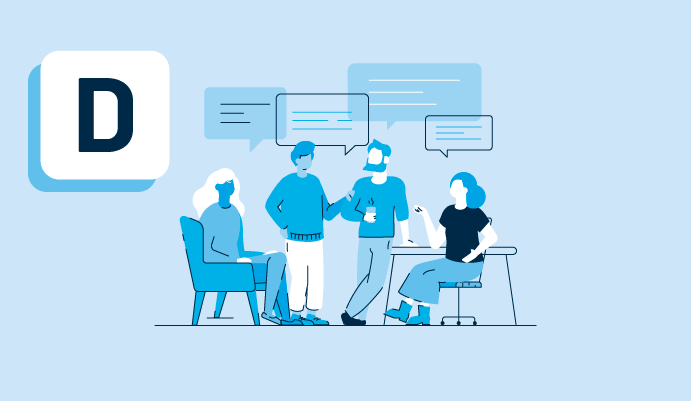
Discussions are conversations that take place online between community members, peers, employees, and even students. These conversations can be about any subject matter or discuss any issue amongst various members of the same, or similar, communities.

Discussions are important for any business looking to create a dedicated digital community around its product or service. Through online communities, discussions allow members to share their thoughts, concerns, product ideas, and even answers to other members’ questions. They help create a sense of community and camaraderie among users.

Online community management software that supports discussions between members spans nearly every industry, from local organizations to global enterprise software. Companies that use this software typically have employees dedicated to moderating these communities. 

There’s often a significant increase in customer engagement and brand dedication as a result of productive discussion through these platforms.

Effective discussions can be a valuable resource for all teams because they help identify:

  • Support tickets
  • Customer satisfaction scores
  • Common troubleshooting problems
  • Popular product feature requests
  • Communication on new and retiring features
  • Marketing content ideas
  • Loyal brand and product influencers

Types of discussions

Online discussion doesn’t always mean messaging in a web-based digital forum. Below are the four types of platforms that anyone can use to facilitate effective discussions:

  1. Slack community: Particularly used in the B2B/B2C technology space, Slack communities are a great way to provide a discussion forum for free for everyone, including the business that uses it. It’s easy to dedicate different channels to different topics and vet potential members of the community.
  2. Advocacy program: Often limited to the most loyal users of a product, an advocacy program provides both a place for users to discuss certain topics and a reward system for introducing new users to the product and business. Think of an advocacy program as an extension of the business’ sales team.
  3. Digital forum: Usually hosted in a web browser, these digital forums are similar to message boards where community members either post new topics or comment on existing topics. Typically, anyone with a login to the forum or the product has access.
  4. Discord server: Particularly used in the education and gaming spaces, Discord servers are similar to Slack communities in that it’s possible to create multiple channels and threads related to different topics and control who joins the community.

Benefits of discussions

The proliferation of asynchronous communication and social media have partially led to the success of online communities and discussions. Many businesses find benefits and success when it comes to hosting online discussions.

These benefits include:

  • Better and more readily available support to customers
  • The ability to elevate the voice of the customer
  • Relevant information delivered to everyone at the same time
  • A centralized location for questions and answers
  • The development of a global community
  • The creation and nurturing of brand and product experts and ambassadors
  • The customer support team expands to the entire user base, as active discussion members often crowdsource answers to common questions 

The challenges of discussions

Unfortunately, online discussions in communities aren’t always positive or easy to facilitate. Some of the challenges of moderating and running discussions are:

  • Written communication vs. spoken communication: Often, written communication loses much of the nuance and inflection of spoken communication. This has the potential to cause confusion and arguments among discussion participants. When communicating in a discussion on a digital platform, participants must remember to be clear, concise, and kind.
  • Conflicting opinions: Especially with regards to divisive topics, conflicting opinions can and do occur between customers and employees.
  • Incessant conversations: Certain topics appear over and over again in online discussions, whether it’s a support issue, a desired product feature, or some other consumer problem. These comments often end up with threads or discussions unrelated to the topic at hand.
  • Spamming: Spam in a digital platform for discussion comes in many forms. Someone may join the community to spam every channel or thread with their business. They might make phishing or baiting attempts, or even post nonsensical or inappropriate comments.

Discussion leaders and moderators need to be on the lookout for the above issues and respond, delete, or close certain comments. They should also establish the authority to remove or ban certain users that prove to be repeat offenders.

Discussions vs. forums vs. threads

A discussion can be between any two or more people and allows for communication between a business and its customers and users. It is an open line of communication about any specific or relevant topic.

A forum is a centralized location where the discussions are hosted. Hosting discussions on a digital forum of some kind allows for communication between people in different time zones, so contributors can respond when they are available.

A thread is a conversation on a specific discussion topic. When a conversation is threaded, anyone can see a series of messages related to one question or article. Responses to a thread are nested under the original comment, post, or question.

Whitney Rudeseal Peet
WRP

Whitney Rudeseal Peet

Whitney Rudeseal Peet is a former freelance writer for G2 and a story- and customer-centered writer, marketer, and strategist. She fully leans into the gig-based world, also working as a voice over artist and book editor. Before going freelance full-time, Whitney worked in content and email marketing for Calendly, Salesforce, and Litmus, among others. When she's not at her desk, you can find her reading a good book, listening to Elton John and Linkin Park, enjoying some craft beer, or planning her next trip to London.

Discussions Software

This list shows the top software that mention discussions most on G2.

Slack brings all your communication together in one place. It’s real-time messaging, archiving and search for modern teams.

Reimagine how your teams work with Zoom Workplace, powered by AI Companion. Streamline communications, improve productivity, optimize in-person time, and increase employee engagement, all with Zoom Workplace. Fueled by AI Companion, included at no additional cost.

Microsoft Teams is a chat-based workspace in Office 365. It brings together people, conversations and content along with the tools that teams need so they can easily collaborate to achieve more.

Trusted by millions, Basecamp is a web-based project management and collaboration tool. To-dos, files, messages, schedules, milestones and more.

Millions of businesses trust GoTo Meeting for reliable, professional online meetings and on-the-go collaboration. Gain momentum with an award-winning solution that works instantly on any device.

Miro is an Innovation Workspace built to accelerate product development from insight to execution. Designed for teams operating in fast-moving, cross-functional environments, Miro brings together research, planning, prototyping, and strategy into one visual, collaborative space. Miro supports every phase of the product development lifecycle — from early discovery and journey mapping to sprint planning, design reviews, and scaled Agile workshops. And with AI features like clustering, summarization, and Sidekicks embedded directly into the canvas, teams can synthesize feedback, generate product briefs, and align on roadmaps in a fraction of the time. Two-way Jira integration and customizable Agile templates make it easy to manage end-to-end workflows, while supporting rituals like sprint planning, daily standups, and retrospectives. Whether you’re mapping product strategy or testing early prototypes, Miro helps teams collapse planning steps and drive innovation faster — all within a secure, flexible workspace.

Google Workspace enables teams of all sizes to connect, create and collaborate. It includes productivity and collaboration tools for all the ways that we work: Gmail for custom business email, Drive for cloud storage, Docs for word processing, Meet for video and voice conferencing, Chat for team messaging, Slides for presentation building, shared Calendars, and many more.

Webex App is here to help you transform how work gets done, not just enable team chat. Webex Teams is an app for continuous teamwork that brings crystal-clear video meetings, group messaging, file sharing, calling and whiteboarding so your teams can work anytime, on any device, with anyone, across any workstream.

Front takes out the pain of shared inboxes (contact@, team@, jobs@...) by introducing collaboration in email.

Canvas LMS is built to make teaching and learning easier for everyone, from the littlest learners to college faculty to business leaders. Learn more about how Canvas works with your institution.

Fellow is a meeting productivity app designed to help you stay organized and make the most of your time in meetings. Fellow connects your meeting notes to your calendar, makes them easy to find, creates accountability with assigned action items, and ensures you’re setting a meaningful agenda for each meeting with collaborative agendas and meeting templates. Fellow also provides features that help improve the meeting experience with automated reminders, suggestions to cancel the meeting when there’s no clear agenda, meeting feedback, and a long list of integrations to ensure your meeting information communicates with your other tools.

Mural is on a mission to help every go-to-market team achieve alignment. With the right tools to collaborate, ideate, and execute customer-centered strategies, organizations can break down the silos that slow success down and get results, faster. Mural offers an intuitive and interactive collaboration space with purpose-built templates, enterprise-grade security, and industry-leading methodologies for the customer-obsessed. GTM teams can come together on an infinite canvas that is flexible and visual to brainstorm ideas, plan project timelines, and execute together quickly. Mural’s Facilitation Superpowers lead to increased engagement from teams, customers, and GTM partners, which transforms every meeting into a co-creation session. Mapping and storyboarding features speed up buy-in and decision making by demonstrating an understanding of customers’ needs and how to meet them. Mural AI can summarize key takeaways from interactions, or suggest new ideas to strategize how to get to ‘yes.’ Out-of-the-box and custom templates make it easy to share best practices to level up every teammate to be customer-obsessed.

Blackboard is a scalable, reliable foundation for a world-class learning experience. Our flexible learning platform enables you to extend online learning, increase engagement and optimize learning outcomes.

Asana is a leading work management platform for human + AI coordination. Over 170,000 customers like Accenture, Amazon, Anthropic, Morningstar, and Suzuki rely on Asana to align teams and accelerate organizational impact. Whether it's managing strategic initiatives, cross-functional programs, or company-wide goals, Asana helps organizations bring clarity to complexity—turning plans into action with AI working alongside teams every step of the way.

Chorus.ai is a leading conversation intelligence platform; it transcribes and analyzes sales meetings in real-time.

Lucidchart is an intelligent diagramming application for understanding the people, processes and systems that drive business forward.

The patented Gong Revenue Intelligence Platform™ captures and understands every customer interaction, then delivers insights at scale, empowering revenue teams to make decisions based on data instead of opinions.