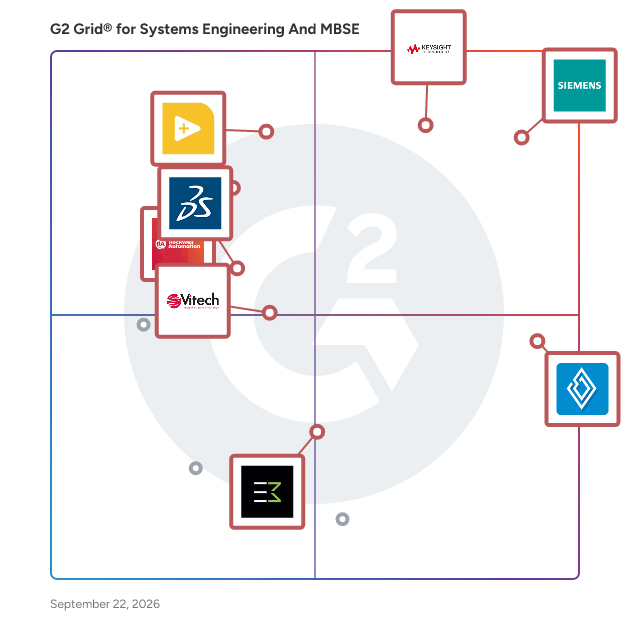
G2 takes pride in showing unbiased reviews on user satisfaction in our ratings and reports. We do not allow paid placements in any of our ratings, rankings, or reports. Learn about our scoring methodologies.
A weekly snapshot of rising stars, new launches, and what everyone's buzzing about.
PathWave System Design (SystemVue) is a multi-domain modeling environment that accelerates design, verification, and test. Standards libraries for automotive radar, 802.11ax WLAN, and NB-IoT enable re
Simcenter™ Amesim is a sophisticated mechatronic system simulation platform developed by Siemens Digital Industries Software, designed to assist design engineers in virtually assessing and optimizing
SPEC Innovations’ cloud-native solution, Innoslate, helps the world’s most innovative companies develop complex systems and products. Innoslate integrates the engineering lifecycle with Model-Based Sy
LabVIEW is systems engineering software for applications that require test, measurement, and control with rapid access to hardware and data insights. The LabVIEW programming environment simplifies ha
The Studio 5000® environment, by Rockwell Automation, combines engineering and design elements into one standard framework that enables optimized productivity and reduced commissioning time. With the
Whether you are developing an unprecedented product to open a new market, incorporating new technology to advance product capability and performance, or upgrading an existing product to meet user need
Cameo Systems Modeler ™ is an industry leading cross-platform collaborative Model-Based Systems Engineering (MBSE) environment, which provides smart, robust, and intuitive tools to define, track, and
Lightweight agile requirements tracking meets digital twin and MBSE. Flow is a purpose-built to help fast-moving agile teams iterate faster.
Epsilon3 is the first AI-powered procedure and resource management tool designed for teams that engineer, build, test, and operate advanced products and systems. ✔ Standardize & Optimize Proc
SystemLink™ software provides software deployment, systems configuration, test monitoring, and data management tools for test and measurement systems. SystemLink software can improve operational effi
Dymola is a tool for modeling and simulation of integrated and complex systems for use within automotive, aerospace, robotics, process and other applications.
Enterprise Architect is a visual platform for designing and constructing software systems, for business process modeling, and for more generalized modeling purposes. Enterprise Architect is based on
Visure offers a modern enterprise AI-powered ALM platform and requirements management software for organizations in safety-critical industries, enabling them to ease their compliance process, gain ful
Wolfram SystemModeler is a modeling and simulation software based on the Modelica language.
Keysight VEE Pro 9.33 is an easy-to-use graphical language environment that provides a quick path to measurement and analysis, replacing VEE Pro 9.3. Designed for easy expansion, flexibility and compa
Systems engineering is an interdisciplinary field of engineering that focuses on how complex engineering projects and complex industrial systems are designed and managed. When engineers build complex machinery such as smart machinery, internet of things (IoT) connected systems, or industrial systems, they must ensure that the various parts of the systems work together to create a functioning system that meets their design requirements. An example of this would be a systems engineer creating a complex system such as an aircraft. The engineer would put in all of their requirements for the aircraft such as speed, capacity, weight, and load pressure. The systems engineer would then have to execute the connection of various parts of the system such as the airframe, propulsion, navigation, and the guidance to ensure that all requirements and parts are connected so the aircraft will not only take off but also fly smoothly and safely. Since there are so many different components that go into creating a complex system such as an aircraft, systems engineers need a simple way to visualize all the necessary components and requirements of their designs. Systems engineering software helps engineers visualize all the necessary components of their designs by providing features such as model based design (diagramming), requirements analysis, and simulation.
Key Benefits of Systems Engineering Software
Systems engineering software provides a multitude of features for systems engineers to simplify and speed up complex designs. From collaboration features to drag-and-drop systems modeling, systems engineering is all about making the complex task of systems engineering as simple and intuitive as possible.
Speed up design time — Systems engineering software provides drag-and-drop modeling and diagramming features which speeds up design time and makes system visualization as easy as possible.
Collaboration — Designing a complex industrial system requires a lot of cross team collaboration. While most teams opt for sharing a spreadsheet between all workers across several teams, this is far from the ideal way of sharing and collaborating on industrial system design. Systems engineering software provides more context with model based designs, more explanations with design feedback and collaboration tags, and more alerts with emails and notifications whenever another team member needs to take a look at the design.
Systems engineering software is not only about designing complex systems but also about the management of complex systems. This revolves around teams that not only design but also teams that handle logistics, manufacturing, project management and more. It is a software that is used by any team that has to do with the design as well as implementation of a system design. Here is how both systems engineers and project managers utilize systems engineering software.
Systems engineers — Systems engineering software will most often be used by various engineers that deal with designing and implementing complex systems.These are industrial engineers, mechanical engineers, production engineers, electrical engineers, and much more. All of these job functions rely on creating systems that require various components that must work together to function. Systems engineering software helps them with diagramming features that easily displays how these components work in synergy to create one functioning system.
Project managers — Project management plays a big role in systems engineering. Various types of engineers must work on a complex system for the system to be completed. A project manager uses the diagramming features in a systems engineering software to assign roles and job functions to completing certain tasks. This will make it easier for systems engineers to visualize where they need to focus their attention.
Almost all systems engineering software will provide some sort of model-based systems engineering. Model-based systems engineering is essentially a diagramming function that allows for easy system visualization. Other systems engineering software provide a graphical programming function on top of this model-based systems engineering software which allows users to code the various functions of the systems they’re creating as well as integrate the software with hardware. Here are the differences between model-based systems engineering and graphical systems engineering.
Model-based systems engineering — Some systems engineering software are strictly model based. Model-based systems engineering software allows engineers to diagram operational systems to display the sequences of exchanges that must happen inside a given system for it to function.
Graphical systems engineering — Graphical systems engineering is a type of systems engineering software that relies more heavily on coding and hardware integration. With graphical systems engineering features, users integrate the software with hardware to dramatically simplify and speed up design. With the hardware integration users design all the electronic components and IoT signals that may need to be present within an industrial system.
Systems engineering software provides a variety of features for systems engineers to conceptualize, design, and manage the development of an industrial system.
Requirements traceability — When systems engineers begin to design industrial systems, they always start out with a list of requirements that need to be met. Once the requirements and parameters are set forth, systems engineers then must design the individual components of the design that will link together to meet those requirements. Requirements traceability features alert the systems engineer if a design requirement is not being met as they begin to design the system. This allows rapid analysis and ensures that requirements are always being met throughout the design.
Simulation — Most systems engineering tools provide simulation and model execution features. This allows users to simulate the performance of a design before it’s gone into production. This provides early design validation and eliminates the need for reworks following production.
Team and stakeholder collaboration — Most systems engineering software is accessed through a web browser. Owners grant sharing and collaboration permissions to all relevant parties so various teams and stakeholders sign in and collaborate or make comments on a design.
Reusability — Reusability features of systems engineering software allow models to be reused for future system designs. This helps speed up the design process which in turn reduces costs and saves time.
Model diagramming — Model diagramming is the cornerstone of systems engineering software. Model diagramming allows users to diagram the various components of an industrial design so the entire system is easily visualized. This shows which system functions must connect to create one functioning unit.
Debugging — Debugging features provide systems engineers with features that detect any bugs in the systems engineering code. This allows engineers to quickly identify issues and resolve them at a quicker pace.