Best Demand Planning Software

How Many Demand Planning Software Products Does G2 Track?

Total Products under this Category: 222

Category Stats (Sep 2026)

  • Average Rating: 4.44/5 The average rating of products in this category, based on all submitted ratings
  • Top Trending Product: Syncron Service Lifecycle Management (+0.74%) - Among all products in this category, Syncron Service Lifecycle Management recorded the largest rating increase compared to last month

Last updated: September 05, 2026

How Does G2 Rank Demand Planning Software Products?

Why You Can Trust G2's Software Rankings:

  • 30 Analysts and Data Experts
  • 3,800+ Authentic Reviews
  • 222+ Products
  • Unbiased Rankings

G2's software rankings are built on verified user reviews, rigorous moderation, and a consistent research methodology maintained by a team of analysts and data experts. Each product is measured using the same transparent criteria, with no paid placement or vendor influence. While reviews reflect real user experiences, which can be subjective, they offer valuable insight into how software performs in the hands of professionals. Together, these inputs power the G2 Score, a standardized way to compare tools within every category.

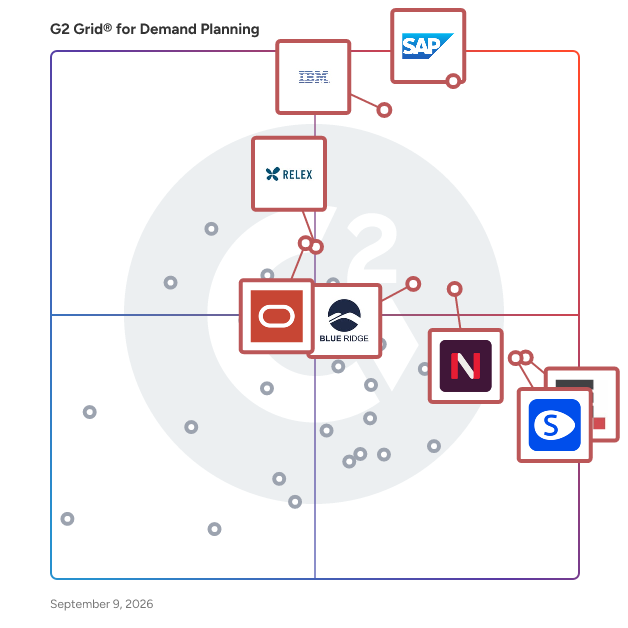
G2 Grid® for Demand Planning Software

G2 Grid® for Demand Planning Software plotting products by satisfaction and market presence

Highlighted products: SAP Integrated Business Planning, IBM Planning Analytics, StockIQ, Netstock, Streamline, Blue Ridge Global, RELEX, and Oracle Fusion Cloud Demand Management.

Underlying data: [Grid® JSON](https://www.g2.com/categories/demand-planning/grids.json?focus%5B%5D=sap-integrated-business-planning&focus%5B%5D=ibm-planning-analytics&focus%5B%5D=stockiq&focus%5B%5D=netstock&focus%5B%5D=gmdh-streamline&focus%5B%5D=blue-ridge-global&focus%5B%5D=relex-solutions-relex&focus%5B%5D=oracle-fusion-cloud-demand-management)

SAP Integrated Business Planning

Respond to new market expectations with real-time supply chain planning capabilities and fulfill future demand profitably supply chain management. Powered by in-memory computing technology within SAP HANA, this cloud-based solution combines capabilities for sales and operations; demand, response, and supply planning; and inventory optimization. - Cloud deployment - Real-time scenarios and simulation - Social collaboration - Powerful predictive Analytics KEY BENEFITS: Achieve a rapid deployment Get up and running quickly with SAP Integrated Business Planning by using preconfigured process templates for an accelerated implementation. Empower employees with intuitive features Offer a unified, intuitive user experience with SAP Fiori and planning and simulation capabilities based on Microsoft Excel. Plan resources effectively Optimize resource efficiency by creating supply plans based on prioritized demands, allocations, and supply chain constraints. KEY CAPABILITIES: Integration with SAP Supply Chain Control Tower Gain end-to-end visibility of your supply chain, decision support, and fast corrective action through integration with SAP Supply Chain Control Tower. Forecasting and demand management Get full demand transparency with short-term, mid-term, and long-term forecasting. Take advantage of best-in-class capabilities for demand sensing and statistical forecasting. Inventory optimization Establish optimal inventory targets that enable you to maximize profits, while leaving a buffer to help you meet unexpected demand. Sales and operations planning Deliver a cross-departmental sales and operations plan that balances inventory, service levels, and profitability. Response and supply planning Optimize resourcing efficiency by creating supply plans based on prioritized demands, allocations, and supply chain constraints.

Average Rating: 4.3/5.0

Total Reviews: 213

How Do G2 Users Rate SAP Integrated Business Planning?

  • Has the product been a good partner in doing business?: 8.3/10 (Category avg: 8.9/10)
  • Inventory collaboration: 8.5/10 (Category avg: 8.6/10)
  • Forecast collaboration: 8.8/10 (Category avg: 8.5/10)
  • Comprehensive Planning: 8.5/10 (Category avg: 8.5/10)

Who Is the Company Behind SAP Integrated Business Planning?

  • Seller: SAP
  • Company Website:
  • Year Founded: 1972
  • HQ Location: Walldorf
  • Twitter: @SAP
    297,052 Twitter followers
  • LinkedIn® Page: www.linkedin.com
    149,349 employees on LinkedIn®

Who Uses This Product?

  • Who Uses This: Consultant, Senior Consultant
  • Top Industries: Information Technology and Services, Consumer Goods
  • Company Size: 57% Large, 27% Medium

What Do G2 Reviewers Say About SAP Integrated Business Planning?

AI-generated summary from verified user reviews

Pros
  • Users value the high forecasting accuracy of SAP Integrated Business Planning, enabling effective and confident decision-making.
  • Users appreciate the ease of use of SAP IBP, finding it simple and efficient for planning tasks.
  • Users value the real-time data optimization of SAP Integrated Business Planning, enhancing decision-making and streamlining supply chain management.
  • Users value the unified platform of SAP IBP for seamless real-time data integration, enhancing collaboration and decision-making.
  • Users value the real-time visibility SAP Integrated Business Planning provides, enhancing decision-making and preventing inventory issues.
Cons
  • Users struggle with the complexity of SAP Integrated Business Planning, citing challenging setups and steep training requirements.
  • Users find the steep learning curve of SAP Integrated Business Planning challenging and time-consuming for new users.
  • Users find the difficult learning curve challenging, requiring extensive time and effort to master the system.
  • Users face a complex setup for SAP Integrated Business Planning, requiring significant time and expertise for effective implementation.
  • Users find the complexity of SAP Integrated Business Planning challenging, especially for newcomers navigating its many features.

What Are Recent G2 Reviews of SAP Integrated Business Planning?

What Are G2 Users Discussing About SAP Integrated Business Planning?

IBM Planning Analytics

IBM Planning Analytics is an AI-powered integrated planning solution that automates your planning, budgeting, and forecasting processes, enabling real-time analysis on a single governed platform. Eliminate manual models, spot risks sooner, and make decisions that keep your numbers ahead of the trends. Designed for finance and business operations leaders across Finance, Supply Chain, HR, Marketing, Sales, and beyond, IBM Planning Analytics helps eliminate inefficient and error-prone planning processes by connecting financial and operational plans. Automate data integration, analysis, and collaboration for greater agility across the business. Key Capabilities: Integrated Planning: Connect financial and operational plans using a governed source of truth under a single license, unifying teams and accelerating planning cycles. Performance Tracking: Monitor, analyze, and communicate performance with interactive dashboards, personalized reports, and a native spreadsheet experience for trusted, real-time insights. AI-Powered Forecasting: Improve speed and accuracy of forecasts with built-in AI, enabling smarter scenario modeling and predictive insights. Collaborative Decision-Making: Increase participation and streamline workflows by lowering the skill barrier with a generative AI assistant, driving faster, more informed decisions. Bring collaborative, AI-powered business planning to your organization starting at $825/month for 5 users.

Average Rating: 4.4/5.0

Total Reviews: 228

How Do G2 Users Rate IBM Planning Analytics?

  • Has the product been a good partner in doing business?: 8.3/10 (Category avg: 8.9/10)
  • Inventory collaboration: 8.8/10 (Category avg: 8.6/10)
  • Forecast collaboration: 8.6/10 (Category avg: 8.5/10)
  • Comprehensive Planning: 9.3/10 (Category avg: 8.5/10)

Who Is the Company Behind IBM Planning Analytics?

  • Seller: IBM
  • Company Website:
  • Year Founded: 1911
  • HQ Location: Armonk, New York, United States
  • Twitter: @IBMSecurity
    74,660 Twitter followers
  • LinkedIn® Page: www.linkedin.com
    344,328 employees on LinkedIn®

Who Uses This Product?

  • Who Uses This: Financial Analyst
  • Top Industries: Information Technology and Services, Financial Services
  • Company Size: 49% Large, 37% Medium

What Do G2 Reviewers Say About IBM Planning Analytics?

AI-generated summary from verified user reviews

Pros
  • Users value the efficiency of IBM Planning Analytics, which enhances financial planning and decision-making with speed and flexibility.
  • Users appreciate the planning efficiency of IBM Planning Analytics, benefiting from easy scalability and robust forecasting capabilities.
  • Users appreciate the flexible analytics capabilities of IBM Planning Analytics, enhancing real-time data analysis and decision-making efficiency.
  • Users value the user-friendly interface of IBM Planning Analytics, appreciating its seamless navigation and adaptability for budgeting.
  • Users admire the forecasting accuracy of IBM Planning Analytics, enhancing their planning and decision-making efficiency significantly.
Cons
  • Users face a steep initial learning curve with IBM Planning Analytics, making setup and navigation challenging.
  • Users face a steep learning curve with IBM Planning Analytics, requiring significant training for effective usage.
  • Users face a steep learning curve with IBM Planning Analytics, making setup and usage challenging for beginners.
  • Users find the difficult learning curve and complexity of IBM Planning Analytics challenging, requiring significant training and technical support.
  • Users find the complexity of setup and steep learning curve challenging, especially for newcomers to the tool.

What Are Recent G2 Reviews of IBM Planning Analytics?

What Are G2 Users Discussing About IBM Planning Analytics?

Netstock

Supply and demand planning made smarter with AI. Netstock empowers small and medium-sized businesses to optimize inventory and demand planning across 67 countries, managing over $25 billion in inventory value. Our solutions transform how companies balance supply and demand, reducing inventory levels by 25% while improving fill rates by 15% and saving 70% of time on ordering and forecasting. Why businesses choose netstock - Flexible forecasting – Forecast by product, group, sales channel, and key customers - Smart inventory planning – Balance stock levels and reduce risk with smart AI tools that quickly deliver real results - AI functionality -Quickly interpret dashboards, reports or at SKU level to spot and resolve issues before they happen - Balance risk - Factor in supplier and forecast risk every 24 hours from the order level down to the SKU level - Over 60 ERP integrations – Purpose-built to automatically convert raw ERP data into predictive insights to drive confident decision-making - Quick ROI – Free up cash tied up in slow-moving inventory from day one - Enterprise-grade security – ISO 27001-certified so your data remains secure - Complete support – Personalized onboarding, 24/7 assistance, and ongoing education With a global footprint of 2,400+ customers and 20,000+ users, Netstock empowers customers with increased visibility, faster planning, and smarter inventory decisions—ensuring they’re always prepared for disruptions or market changes. As we continue to innovate our software, we remain the trusted advisor and go-to solution for SMBs in inventory management and demand planning - making sure our customers have the right stock, in the right place at the right time.

Average Rating: 4.6/5.0

Total Reviews: 179

How Do G2 Users Rate Netstock?

  • Has the product been a good partner in doing business?: 9.3/10 (Category avg: 8.9/10)
  • Inventory collaboration: 8.7/10 (Category avg: 8.6/10)
  • Forecast collaboration: 8.6/10 (Category avg: 8.5/10)
  • Comprehensive Planning: 8.0/10 (Category avg: 8.5/10)

Who Is the Company Behind Netstock?

  • Seller: NETSTOCK
  • Company Website:
  • Year Founded: 2010
  • HQ Location: Boston, US
  • Twitter: @netstock
    18 Twitter followers
  • LinkedIn® Page: www.linkedin.com
    209 employees on LinkedIn®

Who Uses This Product?

  • Who Uses This: Supply Chain Manager, Purchasing Manager
  • Top Industries: Retail, Wholesale
  • Company Size: 54% Medium, 40% Small

What Do G2 Reviewers Say About Netstock?

AI-generated summary from verified user reviews

Pros
  • Users appreciate the ease of use of Netstock, benefiting from intuitive navigation and effective stock management.
  • Users value the accurate forecasting capabilities of Netstock, enhancing inventory management and fill rates effectively.
  • Users appreciate how Netstock’s inventory management automates processes, enhances forecasting, and identifies opportunities for improvement.
  • Users value the inventory optimization capabilities of Netstock, enhancing management and minimizing missed opportunities.
  • Users value Netstock's forecasting capabilities, enabling effective inventory management and supplier planning through precise demand insights.
Cons
  • Users are frustrated by the missing features in Netstock, including lack of inventory roll-ups and limited filtering options.
  • Users experience data inaccuracies with Netstock, requiring manual adjustments to order recommendations and filtering of suggestions.
  • Users experience data management issues with Netstock, including lack of inventory roll-ups and insufficient dataset export options.
  • Users find the difficult learning curve challenging, especially when adapting the software to specific business needs.
  • Users experience limited customization with Netstock's reporting tools, finding it difficult to tailor them to specific needs.

What Are Recent G2 Reviews of Netstock?

What Are G2 Users Discussing About Netstock?

StockIQ

StockIQ is a modern supply chain planning platform designed to help organizations improve forecast accuracy, optimize inventory levels, and strengthen cross-functional planning. It was created by former supply chain practitioners who experienced the limits of spreadsheets and legacy systems firsthand. The platform connects directly to a company’s ERP and provides analytics, recommendations, and automated planning logic that help teams make faster, more confident decisions. Today’s supply chains face constant volatility. Planners must balance cost pressure from finance, service expectations from sales, and operational constraints across supplier networks. StockIQ is built to give teams a clear view of demand, inventory, supplier performance, and replenishment needs within one system, so they can respond quickly and reduce the amount of manual analysis required. Key capabilities include advanced forecasting, automated replenishment planning, safety stock optimization, supplier monitoring, and tools for SIOP collaboration. These functions are designed to provide planners with actionable insights rather than raw data, helping organizations reduce stockouts, increase service levels, and streamline planning cycles. Core features and capabilities • AI-driven forecasting that analyzes historical sales, seasonal patterns, and demand variability for accurate predictions up to 18 months ahead • Replenishment planning with dynamic safety stock calculations and automated purchase recommendations • Inventory optimization using item classification, service-level targets, and detailed visibility into projected stockouts and fill rates • SIOP support that brings sales, finance, and operations together on a shared view of demand and inventory • Supplier performance tracking through scorecards and exception alerts • Multi-location planning with recommendations to balance inventory across the network • Promotion and pricing impact modeling using elasticity curves and scenario analysis Value for supply chain teams • Reduces manual spreadsheet work and consolidates planning processes into one integrated environment • Improves decision-making with real-time insights on demand shifts, supply risks, and order priorities • Supports fast implementations through prebuilt ERP integrations and configurable workflows • Helps teams shorten planning cycles and focus on strategic analysis instead of manual data manipulation • Provides a user experience tailored to planners, built by professionals with hands-on supply chain backgrounds StockIQ is designed to function as a long-term planning partner rather than a one-size-fits-all tool. Its flexibility and practitioner-built workflows allow organizations to adapt the platform to their supply chain structure, helping teams operate with greater accuracy, alignment, and resilience.

Average Rating: 4.5/5.0

Total Reviews: 142

How Do G2 Users Rate StockIQ?

  • Has the product been a good partner in doing business?: 9.4/10 (Category avg: 8.9/10)
  • Inventory collaboration: 9.1/10 (Category avg: 8.6/10)
  • Forecast collaboration: 9.0/10 (Category avg: 8.5/10)
  • Comprehensive Planning: 7.9/10 (Category avg: 8.5/10)

Who Is the Company Behind StockIQ?

  • Seller: StockIQ
  • Company Website:
  • Year Founded: 2015
  • HQ Location: Broomfield, Colorado
  • Twitter: @StockIQ
  • LinkedIn® Page: www.linkedin.com
    41 employees on LinkedIn®

Who Uses This Product?

  • Who Uses This: Buyer, Purchasing Manager
  • Top Industries: Consumer Goods, Retail
  • Company Size: 68% Medium, 27% Small

What Do G2 Reviewers Say About StockIQ?

AI-generated summary from verified user reviews

Pros
  • Users value the excellent customer support of StockIQ, appreciating the helpfulness and willingness to assist promptly.
  • Users find StockIQ to have a user-friendly interface, making forecasting and navigation effortless and efficient.
  • Users value the helpful support team of StockIQ for their dedication to resolving issues effectively.
  • Users value the forecasting accuracy of StockIQ, which significantly enhances the planning process and efficiency.
  • Users benefit from the enhanced efficiency in purchasing, with StockIQ simplifying inventory management and demand forecasting.
Cons
  • Users are frustrated by the missing features like a mobile app and inadequate forecasting capabilities in StockIQ.
  • Users note the forecasting limitations of StockIQ, wishing for improved models to enhance accuracy and adaptability.
  • Users face limited functionality in StockIQ, especially with dashboards, reporting, and order recommendations lacking flexibility.
  • Users express frustration over poor reporting features, wishing for more streamlined access to supplier information and custom reports.
  • Users report challenges in usage due to data issues and a need for improved dashboards and training resources.

What Are Recent G2 Reviews of StockIQ?

What Are G2 Users Discussing About StockIQ?

Streamline

Streamline is an advanced AI-powered planning platform specifically designed for the retail, wholesale, distribution, and manufacturing sectors. This innovative solution enhances decision-making processes by integrating demand planning and forecasting capabilities. With Streamline, users can collaborate effectively, monitor performance metrics, and accurately forecast demand while leveraging cutting-edge planning technologies and strategies. Targeted primarily at manufacturers, distributors, and retailers, Streamline addresses the critical need for optimized inventory management. The platform offers automated demand forecasting, replenishment execution, and multi-location planning, making it an essential tool for businesses aiming to improve operational efficiency. By accounting for seasonality and supplier management, Streamline ensures that users can adapt to changing market conditions and consumer preferences, ultimately leading to better inventory control and reduced waste. Key features of Streamline include its AI-driven demand planning, which mimics human-like behavior for more accurate forecasting. This eliminates the reliance on traditional methods such as Excel spreadsheets or data from ERP systems. The inventory planning functionality optimizes stock levels and automatically updates replenishment plans, providing users with clear insights into what to order, how much, and when. Additionally, the production planning capabilities help reduce order quantities and transportation costs, streamlining the supply chain process and enhancing overall productivity. Streamline excels in material requirements planning (MRP) by generating comprehensive plans based on demand forecasts and bill of materials (BoM). This feature is particularly beneficial for businesses facing supplier unpredictability and disruptions in historical data, as it allows for effective planning even in the absence of prior sales data. By automatically rebalancing various factors, the platform minimizes the risks of overstock and stockouts, maintaining optimal inventory levels and improving cash flow management. With its robust supply planning capabilities, Streamline provides complete visibility and control over the supply chain, empowering users to make informed decisions that can significantly reduce operating costs and enhance profitability. By integrating these advanced features, Streamline stands out as a comprehensive solution for businesses seeking to elevate their planning processes and achieve greater operational success.

Average Rating: 4.4/5.0

Total Reviews: 252

How Do G2 Users Rate Streamline?

  • Has the product been a good partner in doing business?: 8.9/10 (Category avg: 8.9/10)
  • Inventory collaboration: 8.7/10 (Category avg: 8.6/10)
  • Forecast collaboration: 8.7/10 (Category avg: 8.5/10)
  • Comprehensive Planning: 8.4/10 (Category avg: 8.5/10)

Who Is the Company Behind Streamline?

  • Seller: GMDH
  • Company Website:
  • Year Founded: 2020
  • HQ Location: New York, US
  • Twitter: @GMDH_Streamline
    1,209 Twitter followers
  • LinkedIn® Page: www.linkedin.com
    93 employees on LinkedIn®

Who Uses This Product?

  • Who Uses This: Supply Chain Manager
  • Top Industries: Retail, Consumer Goods
  • Company Size: 48% Medium, 44% Small

What Do G2 Reviewers Say About Streamline?

AI-generated summary from verified user reviews

Pros
  • Users commend Streamline for its high forecasting accuracy, enhancing operational efficiency and simplifying complex planning data.
  • Users find Streamline to be easy to navigate, making it simple to manage complex tasks efficiently.
  • Users value the rapid and accurate forecasting capabilities of Streamline, enhancing efficiency and decision-making across teams.
  • Users highlight the automation capabilities of Streamline, significantly reducing manual work and boosting overall efficiency.
  • Users value the planning efficiency of Streamline, enabling seamless collaboration and accurate forecasting for improved operations.
Cons
  • Users find limited customization in Streamline, leading to challenges in adapting to specific supply chain needs.
  • Users find the user difficulty in Streamline significant, especially with complex settings and customization needs.
  • Users face data management issues with Streamline, struggling with aggregation and frequent, poorly communicated updates.
  • Users find the implementation complexity of Streamline challenging, requiring significant IT support and change management efforts.
  • Users report slow performance with Streamline, especially during collaborative work on larger projects, leading to extended loading times.

What Are Recent G2 Reviews of Streamline?

What Are G2 Users Discussing About Streamline?

Blue Ridge Global

Blue Ridge turns data and market signals into the decisions that free capital, protect revenue, and keep supply chains ahead of demand. SUPPLY CHAIN INTELLIGENCE, BUILT ON AI FROM THE GROUND UP Blue Ridge delivers Supply Chain Intelligence, transforming planning from reactive to proactive for mid-market to large-scale operations, so the business is always ready for what's next. The platform is one system that turns a company's data and the outside signals most planning tools ignore into the informed decisions that determine performance: what to forecast, what to buy, how much to hold, and where to position it, all working together so planning teams act with confidence and stay ahead of demand. AI is the foundation Blue Ridge was built on. The company was cloud-first from its inception and put machine learning to work in its forecasting from the beginning, and that heritage now powers an entirely new AI-native platform with intelligence at its core. Blue Ridge turns raw ERP data into operational intelligence and enriches it with curated external signals before the AI ever runs, producing recommendations that perform in the real world, not just in a demo. AI-NATIVE BY DESIGN, NOT BOLTED ON Three capabilities work together on one data foundation: • Adaptive ML – A forecasting engine that learns across every SKU, location, and customer at once, factors in external signals like weather, freight markets, and economic indicators, and shows the reasoning behind every number. • Generative AI (Blu) – Conversational intelligence embedded in the workflow that explains the "why" behind any forecast or order in plain language and handles the routine, so 80 to 95 percent of items can run on automated planning while teams focus on the exceptions. • Agentic AI – Within a highly governed architecture, supply chain agents monitor conditions continuously and earn the authority to act by proving their accuracy first, with human oversight at every step. ONE PLATFORM. SIX MODULES. MULTIPLYING VALUE. Demand Planning, Replenishment Optimization, Multi-Echelon Inventory Optimization (MEIO), Integrated Business Planning, Supply Planning, and Connected Planning. Each delivers measurable results on its own. Together they form a single system where every decision informs the next. A PARTNER INVESTED IN RESULTS Every Blue Ridge customer partners closely with a team of former supply chain practitioners who monitor performance, surface opportunities before they become problems, and guide strategy as the business grows. It is a standard part of the relationship, not an add-on. PROVEN WHERE IT COUNTS • Hundreds of customer deployments • 307% average annual ROI • SOC 2 Type II certified • 40+ ERP integrations, no custom development required • Initial performance realized in weeks, fully live in months Built for mid-market to large-scale distributors, manufacturers, and retailers that need enterprise-grade intelligence delivering strong business results. Blue Ridge eliminates the guesswork, maximizes inventory performance, and backs it with a partnership that does not end at go-live. Book a demo: https://www.blueridgeglobal.com/book-a-demo

Average Rating: 4.6/5.0

Total Reviews: 123

How Do G2 Users Rate Blue Ridge Global?

  • Has the product been a good partner in doing business?: 9.3/10 (Category avg: 8.9/10)
  • Inventory collaboration: 8.4/10 (Category avg: 8.6/10)
  • Forecast collaboration: 8.3/10 (Category avg: 8.5/10)
  • Comprehensive Planning: 8.2/10 (Category avg: 8.5/10)

Who Is the Company Behind Blue Ridge Global?

  • Seller: Blue Ridge
  • Company Website:
  • Year Founded: 2007
  • HQ Location: Johns Creek, US
  • Twitter: @BlueRidgeGlobal
    836 Twitter followers
  • LinkedIn® Page: www.linkedin.com
    615 employees on LinkedIn®

Who Uses This Product?

  • Who Uses This: Buyer
  • Top Industries: Food & Beverages, Wholesale
  • Company Size: 52% Medium, 24% Large

What Do G2 Reviewers Say About Blue Ridge Global?

AI-generated summary from verified user reviews

Pros
  • Users commend the exceptional customer support at Blue Ridge Global, with responsive teams ready to assist and consult.
  • Users appreciate the ease of use of Blue Ridge Global, finding it intuitive and simple to integrate.
  • Users value the effective inventory management of Blue Ridge Global, improving service levels and reducing costs efficiently.
  • Users value the effective inventory optimization by Blue Ridge Global, enhancing service levels and reducing costs.
  • Users praise the robust reporting capabilities of Blue Ridge Global, enhancing data analysis and business intelligence effectively.
Cons
  • Users find the lack of features limits effective deal management and data filtering capabilities, hindering overall productivity.
  • Users find Blue Ridge Global's interface has complexity issues that hinder navigation and efficiency during operations.
  • Users struggle with data inaccuracy, making it hard to identify issues, requiring additional steps for resolution.
  • Users feel that Blue Ridge Global needs improvement in leveraging full capabilities for effective strategic planning and industry application.
  • Users find the inefficiency of tracking issues frustrating, often taking too long to identify root causes.

What Are Recent G2 Reviews of Blue Ridge Global?

What Are G2 Users Discussing About Blue Ridge Global?

RELEX

RELEX Solutions offers a unified, AI-native software for retail and supply chain planning that helps retailers, manufacturers, and wholesalers plan demand, inventory, merchandising, pricing, supply, and production. The platform supports end-to-end planning processes by connecting commercial, supply chain, and production decisions to improve availability, efficiency, and alignment across complex operations. Founded in Finland, RELEX Solutions operates globally with offices across Europe, North America, and Asia-Pacific. The company serves retailers, manufacturers, and wholesale distributors across grocery, convenience, specialty retail, hardlines, and consumer packaged goods, supporting both physical and digital sales channels. RELEX supports a broad range of planning use cases by reducing planning silos and enabling organizations to respond more effectively to demand variability, promotions, and supply constraints. Built on a unified data model rather than disconnected modules, RELEX lets teams align decisions across the value chain and adapt plans as conditions change. Core planning capabilities include: Demand forecasting and replenishment planning that combines machine learning-based demand forecasting with automated inventory optimization and replenishment across multiple supply chain tiers, incorporating promotions, seasonality, events, weather, and operational constraints. Pricing and promotion planning and optimization that unifies pricing strategy, promotion planning, evaluation, and scenario analysis to support coordinated pricing and promotional decisions across products, locations, and channels. Assortment and space planning to manage product ranges, planograms, and space allocation based on local demand, product performance, and store-specific constraints. Supply chain planning and optimization to align inventory, distribution, and fulfillment decisions across the end-to-end supply chain using shared data and integrated planning logic. Production planning and scheduling to connect downstream demand with master planning, detailed scheduling, capacity constraints, and scenario-based analysis. Brands like ADUSA, Camco, Carhartt, COSMOS Pharmaceutical Corporation, Circle K, Dollar Tree and Family Dollar, M&S Food, PetSmart, Rituals, The Body Shop, The Home Depot, Sun Tire & Auto Service, and Vita Coco trust RELEX to increase product availability, boost sales, deliver actionable insights, improve sustainability, and drive profitable growth.

Average Rating: 4.6/5.0

Total Reviews: 22

How Do G2 Users Rate RELEX?

  • Has the product been a good partner in doing business?: 8.8/10 (Category avg: 8.9/10)
  • Inventory collaboration: 8.9/10 (Category avg: 8.6/10)
  • Forecast collaboration: 8.7/10 (Category avg: 8.5/10)
  • Comprehensive Planning: 8.8/10 (Category avg: 8.5/10)

Who Is the Company Behind RELEX?

  • Seller: RELEX Solutions
  • Company Website:
  • Year Founded: 2005
  • HQ Location: Helsinki, Finland
  • Twitter: @RelexSolutions
    1,608 Twitter followers
  • LinkedIn® Page: www.linkedin.com
    2,309 employees on LinkedIn®

Who Uses This Product?

  • Top Industries: Retail
  • Company Size: 59% Large, 27% Medium

What Do G2 Reviewers Say About RELEX?

AI-generated summary from verified user reviews

Pros
  • Users appreciate the ease of use in RELEX, which simplifies dashboard creation and enhances clarity across regions and products.
  • Users appreciate the intuitive UI of RELEX, enabling detailed insights and customizable dashboards for effective analytics.
  • Users appreciate the intuitive dashboard design of RELEX, which provides a clear overview and customizable insights.
  • Users appreciate the intuitive UI of RELEX, enabling easy data overview and customized dashboards for effective forecasting.
  • Users value the user-friendly interface of RELEX, enabling efficient data handling and effective inventory management.
Cons
  • Users note the lack of essential features, like time-based sales and role-based access, affecting their operational efficiency.
  • Users find the missing features in RELEX, like time-based sales functionality, limit their operational efficiency.
  • Users find the manual data import tool cumbersome and outdated, hindering usability and causing frequent errors.
  • Users find the data inaccuracy issues frustrating, as mistakes are easy to make with the outdated manual import tool.
  • Users criticize the manual data import tool for its outdated design and complicated usage, causing frequent errors.

What Are Recent G2 Reviews of RELEX?

Oracle Fusion Cloud Demand Management

Sense, predict, and shape demand to improve your demand forecasting accuracy and inventory strategies. Ensure that the right product is at the right place, at the right time.

Average Rating: 4.6/5.0

Total Reviews: 10

How Do G2 Users Rate Oracle Fusion Cloud Demand Management?

  • Has the product been a good partner in doing business?: 9.2/10 (Category avg: 8.9/10)
  • Inventory collaboration: 9.3/10 (Category avg: 8.6/10)
  • Forecast collaboration: 9.3/10 (Category avg: 8.5/10)
  • Comprehensive Planning: 9.0/10 (Category avg: 8.5/10)

Who Is the Company Behind Oracle Fusion Cloud Demand Management?

  • Seller: Oracle
  • Year Founded: 1977
  • HQ Location: Austin, TX
  • Twitter: @Oracle
    827,997 Twitter followers
  • LinkedIn® Page: www.linkedin.com
    207,576 employees on LinkedIn®
  • Ownership: NYSE:ORCL

Who Uses This Product?

  • Company Size: 80% Medium, 20% Large

What Are Recent G2 Reviews of Oracle Fusion Cloud Demand Management?

APEX

APEX by LeanDNA is the factory-focused platform for AI-powered expert execution to establish command of supply planning and materials management. It powers optimized decisions and operations through materials visibility, predictive insights, supplier collaboration, and recommended actions. APEX synchronizes people, materials, and sites with data centralization, AI, and machine learning to analyze supply conditions, predict risks, connect across suppliers, and outline the best actions to protect and optimize production. With core capabilities spanning data visibility and AI, supply insights, procurement management, and inventory optimization, APEX transforms fragmented data into supply chain intelligence that drives confident, precise execution. Teams eliminate operational guesswork, respond faster to disruption, and improve performance with smarter prioritization and optimized supply strategies.

Average Rating: 4.5/5.0

Total Reviews: 128

How Do G2 Users Rate APEX?

  • Has the product been a good partner in doing business?: 9.0/10 (Category avg: 8.9/10)
  • Inventory collaboration: 8.0/10 (Category avg: 8.6/10)
  • Forecast collaboration: 8.0/10 (Category avg: 8.5/10)
  • Comprehensive Planning: 7.7/10 (Category avg: 8.5/10)

Who Is the Company Behind APEX?

  • Seller: LeanDNA
  • Company Website:
  • Year Founded: 2014
  • HQ Location: Austin, Texas, United States
  • LinkedIn® Page: www.linkedin.com
    95 employees on LinkedIn®

Who Uses This Product?

  • Who Uses This: Approvisionneur
  • Top Industries: Manufacturing, Aviation & Aerospace
  • Company Size: 51% Medium, 38% Large

What Do G2 Reviewers Say About APEX?

AI-generated summary from verified user reviews

Pros
  • Users find the ease of use of LeanDNA exceptional, enhancing efficiency with intuitive workflows and accessible support.
  • Users commend the phenomenal customer support from LeanDNA, which enhances implementation and addresses business needs effectively.
  • Users value the visibility and structure LeanDNA provides for efficient supplier performance management and communication.
  • Users appreciate the clear logic and task management features of APEX, enhancing collaboration and efficiency.
  • Users find APEX's time-saving features invaluable, enhancing efficiency with intuitive workflows and advanced analytics.
Cons
  • Users experience complex usability challenges, often struggling with frequent changes and feature limitations that hinder daily workflows.
  • Users find the limited customization options frustrating, restricting their ability to tailor the tool to specific needs.
  • Users find the missing filtering options in APEX limiting, impacting their analysis and decision-making capabilities.
  • Users note data inaccuracy in APEX, as updates are not in real-time and depend on external forecasts.
  • Users find the learning curve steep, but support helps navigate the complexity over time.

What Are Recent G2 Reviews of APEX?

Logility Solutions

Logility is a market-leading provider of AI-first supply chain management solutions engineered to help organizations build sustainable digital supply chains that improve people’s lives and the world we live in. The company’s approach is designed to reimagine supply chain planning by shifting away from traditional “what happened” processes to an AI-driven strategy that combines the power of humans and machines to predict and be ready for what’s coming. Logility’s fully integrated, end-to-end platform helps clients know faster, turn uncertainty into opportunity, and transform the supply chain from a cost center to an engine for growth.

Average Rating: 4.2/5.0

Total Reviews: 123

How Do G2 Users Rate Logility Solutions?

  • Has the product been a good partner in doing business?: 8.5/10 (Category avg: 8.9/10)
  • Inventory collaboration: 9.1/10 (Category avg: 8.6/10)
  • Forecast collaboration: 9.4/10 (Category avg: 8.5/10)
  • Comprehensive Planning: 8.1/10 (Category avg: 8.5/10)

Who Is the Company Behind Logility Solutions?

  • Seller: Aptean
  • Company Website:
  • Year Founded: 2012
  • HQ Location: Alpharetta, Georgia
  • Twitter: @Aptean
    1,620 Twitter followers
  • LinkedIn® Page: www.linkedin.com
    3,789 employees on LinkedIn®

Who Uses This Product?

  • Top Industries: Consumer Goods, Food & Beverages
  • Company Size: 54% Medium, 32% Large

What Are Recent G2 Reviews of Logility Solutions?

What Are G2 Users Discussing About Logility Solutions?

Slim4

Slim4 by Slimstock is an award‑winning, AI‑powered supply chain planning platform designed to help businesses build more efficient, resilient, and sustainable supply chains. Backed by over 30 years of global supply chain expertise, Slim4 unifies planning, execution, and data into a single connected platform, enabling faster, smarter, and more confident decision‑making across the entire value chain. The platform integrates commerce management, demand planning, inventory management, supply chain optimization, and agentic data management into one intelligent ecosystem. By combining real‑time data, advanced analytics, and AI‑driven automation, Slim4 provides full visibility and control over demand, supply, and inventory, helping organizations balance service levels, cost, and working capital with precision. Slim4 delivers measurable business value: increased sales, reduced inventory, higher operational efficiency, fewer stock‑outs, and significant waste reduction. AI‑powered automation minimizes manual planning effort, while intelligent workflows and agentic processes orchestrate decisions across products, suppliers, and master data. With a single source of truth, teams across commercial, operational, and supply chain functions work with consistent, up‑to‑date information, improving collaboration and decision quality. Core Slim4 Solution Areas: • Commerce Management: AI‑driven pricing optimization, promotion planning, and assortment strategy to improve margins and revenue. • Demand Management: Enhanced forecasting, cross‑channel demand planning, and dynamic demand sensing for highly accurate predictions. • Inventory Management: Automatic replenishment, multi‑echelon inventory optimization (MEIO), allocation, network balancing, and fresh/shelf‑life management to reduce excess stock and service gaps. • Supply Chain Planning: Integrated tools for supply planning, production scheduling, open‑to‑buy (OTB) control, scenario planning, and real‑time control tower visibility. • Agentic Data Management: AI‑orchestrated master data optimization and supplier collaboration with automated workflows to enhance data quality and operational speed. Designed for scalability and easy adoption, Slim4 features a cloud‑native architecture, enterprise‑grade security, and seamless integration with any ERP or enterprise system, including SAP, Oracle, Microsoft, and Salesforce. Implementation is supported by Slimstock’s expert consultants, ensuring rapid adoption, smooth integration, and ongoing value after go‑live. Trusted by more than 1,700 customers worldwide, Slim4 transforms supply chain planning into a competitive advantage by combining AI intelligence, advanced analytics, and decades of expertise. The result: empowered teams that eliminate waste, improve service levels, and make smarter, data‑driven decisions across the entire supply chain.

Average Rating: 4.7/5.0

Total Reviews: 18

How Do G2 Users Rate Slim4?

  • Has the product been a good partner in doing business?: 9.8/10 (Category avg: 8.9/10)
  • Inventory collaboration: 9.2/10 (Category avg: 8.6/10)
  • Forecast collaboration: 9.2/10 (Category avg: 8.5/10)
  • Comprehensive Planning: 8.9/10 (Category avg: 8.5/10)

Who Is the Company Behind Slim4?

  • Seller: Slimstock
  • Year Founded: 1993
  • HQ Location: Deventer, NL
  • Twitter: @Slimstock
    622 Twitter followers
  • LinkedIn® Page: www.linkedin.com
    639 employees on LinkedIn®

Who Uses This Product?

  • Top Industries: Retail
  • Company Size: 78% Medium, 22% Small

What Are Recent G2 Reviews of Slim4?

What Are G2 Users Discussing About Slim4?

Syncron Service Lifecycle Management

Syncron's SLM is an integrated AI-powered platform designed to help Original Equipment Manufacturers (OEMs) and distributors of complex, high-value assets enhance the growth of their aftermarket business. This comprehensive solution addresses the multifaceted needs of these organizations by offering a suite of specialized aftermarket tools, including repair management, pricing optimization, parts planning, and inventory control. By streamlining these critical functions, SLM empowers businesses to operate more efficiently and effectively within the aftermarket landscape. The target audience for Syncron's SLM primarily includes manufacturers and distributors dealing with intricate and high-value equipment, such as machinery, vehicles and energy systems. These organizations often face challenges in managing their service lifecycle due to the complexity of their products and the diverse needs of their customers. SLM provides a holistic approach to these challenges by connecting data and processes across various business silos, enabling end-to-end visibility and control. This interconnectedness allows companies to adopt innovative aftermarket strategies, such as servitization and equipment-as-a-service, which can significantly enhance their market differentiation and drive sustainable growth. Key features of Syncron's SLM include advanced AI and machine learning capabilities that deliver actionable insights and automate decision-making processes. This functionality allows manufacturers to optimize their aftermarket operations in real-time, ensuring that they can respond swiftly to changing market conditions and customer demands. By leveraging these technologies, businesses can reduce operational costs, improve service efficiency, and ultimately enhance customer satisfaction. The platform's ability to create synergies between individual point solutions further amplifies its value, driving incremental return on investment (ROI) for users. • Parts Inventory Optimisation • Parts Pricing • Contract Pricing • Warranty management • Technician Enablement In addition to its core functionalities, Syncron's SLM fosters a connected service business across multiple domains. This integration not only simplifies the management of aftermarket operations but also enhances collaboration among different departments within an organization. By breaking down barriers and facilitating seamless communication, SLM enables companies to implement powerful new business models that capitalize on the growing demand for high-margin aftermarket services. As a result, organizations can position themselves for long-term success in an increasingly competitive market, making Syncron's SLM a vital tool for any OEM or distributor aiming to thrive in the aftermarket sector.

Average Rating: 4.3/5.0

Total Reviews: 34

How Do G2 Users Rate Syncron Service Lifecycle Management?

  • Has the product been a good partner in doing business?: 8.1/10 (Category avg: 8.9/10)
  • Inventory collaboration: 7.5/10 (Category avg: 8.6/10)
  • Forecast collaboration: 7.0/10 (Category avg: 8.5/10)
  • Comprehensive Planning: 7.2/10 (Category avg: 8.5/10)

Who Is the Company Behind Syncron Service Lifecycle Management?

  • Seller: Syncron
  • Company Website:
  • Year Founded: 1999
  • HQ Location: Stockholm, SE
  • Twitter: @SyncronSCM
    1,338 Twitter followers
  • LinkedIn® Page: www.linkedin.com
    805 employees on LinkedIn®

Who Uses This Product?

  • Top Industries: Automotive, Machinery
  • Company Size: 46% Large, 34% Medium

What Do G2 Reviewers Say About Syncron Service Lifecycle Management?

AI-generated summary from verified user reviews

Pros
  • Users value the ease of use of Syncron Service Lifecycle Management, simplifying complex tasks and improving efficiency.
  • Users value the reliable customer support of Syncron Service Lifecycle Management, appreciating its prompt ticket creation and assistance.
  • Users value the efficiency improvement from Syncron Service Lifecycle Management, reducing manual tasks and enhancing strategic focus.
  • Users highlight the effective pricing optimization capabilities of Syncron, enhancing market share and gross margin significantly.
  • Users benefit greatly from the automation capabilities of Syncron Service Lifecycle Management, enhancing efficiency and strategic focus.
Cons
  • Users note the steep learning curve of Syncron Service Lifecycle Management, making initial training and onboarding challenging.
  • Users find a need for improvement in ease of use, as complexity hinders proper implementation and learning.
  • Users find the difficult learning process of Syncron Service Lifecycle Management challenging, impacting effective team onboarding and usage.
  • Users find the user difficulty of Syncron Service Lifecycle Management challenging, requiring a learning curve to navigate effectively.
  • Users find the learning curve challenging, as the software's complexity can hinder effective usage for regular users.

What Are Recent G2 Reviews of Syncron Service Lifecycle Management?

What Are G2 Users Discussing About Syncron Service Lifecycle Management?

SAP Advanced Planning and Optimization

SAP Advanced Planning and Optimization (SAP APO is a comprehensive supply chain management solution designed to enhance the efficiency and responsiveness of global supply chains. By integrating demand planning, supply network planning, production planning, and global available-to-promise functionalities, SAP APO enables businesses to balance supply and demand effectively, optimize production processes, and improve customer service levels. Its seamless integration with SAP ERP ensures real-time data exchange, facilitating synchronized planning across the entire supply chain. Key Features and Functionality: - Demand Planning (DP: Offers a robust set of forecasting tools, including configurable planning books with macro functionality, and supports lifecycle, promotion, and collaborative demand planning. - Supply Network Planning (SNP: Integrates purchasing, manufacturing, distribution, and transportation to plan product flow along the supply chain, considering constraints and penalties. It supports various planning levels and offers heuristic-, rule-, or optimization-based algorithms. - Production Planning and Detailed Scheduling (PP/DS: Facilitates multi-level production planning, capable-to-promise checks, and supports various production strategies such as make-to-stock and make-to-order. It includes features like lot quantity calculations, sourcing, and order pegging. - Global Available-to-Promise (gATP: Provides global availability checks, rules-based ATP using product or location substitution strategies, product allocation for key customers, backorder processing, and multi-level ATP for component checks. Primary Value and Problem Solving: SAP APO addresses the complexities of modern supply chain management by providing integrated tools that enhance forecasting accuracy, optimize resource utilization, and improve on-time delivery performance. By aligning mid- to long-term demand plans with overall supply capacity, businesses can reduce inventory buffers, minimize costs, and respond swiftly to market changes. The solution's ability to create optimized production plans and provide reliable sales order confirmation dates ensures that companies can meet customer demands efficiently while maintaining operational excellence.

Average Rating: 4.6/5.0

Total Reviews: 10

How Do G2 Users Rate SAP Advanced Planning and Optimization?

  • Has the product been a good partner in doing business?: 10.0/10 (Category avg: 8.9/10)
  • Inventory collaboration: 9.6/10 (Category avg: 8.6/10)
  • Forecast collaboration: 8.3/10 (Category avg: 8.5/10)
  • Comprehensive Planning: 8.0/10 (Category avg: 8.5/10)

Who Is the Company Behind SAP Advanced Planning and Optimization?

  • Seller: SAP
  • Year Founded: 1972
  • HQ Location: Walldorf
  • Twitter: @SAP
    297,052 Twitter followers
  • LinkedIn® Page: www.linkedin.com
    149,349 employees on LinkedIn®
  • Ownership: NYSE:SAP

Who Uses This Product?

  • Company Size: 80% Large, 20% Medium

What Are Recent G2 Reviews of SAP Advanced Planning and Optimization?

What Are G2 Users Discussing About SAP Advanced Planning and Optimization?

Oracle Demantra

Oracle's Demantra is a best-in-class provider of demand management, sales & operations planning, and trade promotions management solutions.

Average Rating: 3.7/5.0

Total Reviews: 46

How Do G2 Users Rate Oracle Demantra?

  • Has the product been a good partner in doing business?: 8.0/10 (Category avg: 8.9/10)
  • Inventory collaboration: 8.3/10 (Category avg: 8.6/10)
  • Forecast collaboration: 10.0/10 (Category avg: 8.5/10)
  • Comprehensive Planning: 9.2/10 (Category avg: 8.5/10)

Who Is the Company Behind Oracle Demantra?

  • Seller: Oracle
  • Year Founded: 1977
  • HQ Location: Austin, TX
  • Twitter: @Oracle
    827,997 Twitter followers
  • LinkedIn® Page: www.linkedin.com
    207,576 employees on LinkedIn®
  • Ownership: NYSE:ORCL

Who Uses This Product?

  • Top Industries: Information Technology and Services, Consumer Goods
  • Company Size: 70% Large, 24% Medium

What Do G2 Reviewers Say About Oracle Demantra?

AI-generated summary from verified user reviews

Pros
  • Users value the customization options in Oracle Demantra, enhancing flexibility and effectiveness in forecasting and planning.
  • Users highlight the effective data visualization features of Oracle Demantra, enhancing forecasting and scenario planning capabilities.
  • Users value Oracle Demantra's powerful forecasting engine and flexible customization options for effective scenario planning.
  • Users value the flexibility of Oracle Demantra, enabling effective scenario planning and customization for their needs.
  • Users value the powerful forecasting accuracy of Oracle Demantra, benefiting from its flexibility and effective scenario planning.
Cons
  • Users find Oracle Demantra's complexity and steep learning curve challenging, impacting their overall user experience.
  • Users find the difficult learning curve of Oracle Demantra to be quite challenging and often frustrating.
  • Users find Oracle Demantra's complexity and steep learning curve challenging, indicating a need for enhanced user experience.
  • Users find Oracle Demantra's complexity and steep learning curve challenging, suggesting a need for improved user experience.
  • Users find Oracle Demantra's complexity and steep learning curve challenging, impacting their overall user experience.

What Are Recent G2 Reviews of Oracle Demantra?

What Are G2 Users Discussing About Oracle Demantra?

EazyStock

EazyStock is a sophisticated inventory optimization and demand forecasting solution designed to help businesses effectively manage their stock levels and improve purchasing decisions. This tool is particularly beneficial for organizations facing challenges such as excess inventory, cash flow issues, low service levels, and frequent stockouts. By leveraging EazyStock, users can enhance their inventory visibility and streamline their operations, ultimately leading to more efficient inventory management. Primarily targeted at stock-holding businesses, EazyStock serves a wide range of industries, including retail, wholesale, and manufacturing. The software is particularly useful for companies that struggle with chaotic spreadsheets and manual processes, which can lead to errors and inefficiencies. EazyStock provides a structured approach to inventory management, allowing users to forecast demand accurately and stock the right items at the right time. This capability is essential for maintaining optimal stock levels and ensuring high service availability. EazyStock offers several key features that set it apart in the inventory management landscape. One of its standout features is its advanced demand forecasting algorithms, which factor in seasonality, promotions, and the sales lifecycle. This allows businesses to anticipate customer demand more accurately, reducing the risk of stockouts and overstock situations. Additionally, EazyStock automates the calculation of minimum and maximum stock levels, enabling users to optimize their inventory without tying up excess cash. EazyStock simplifies ordering, allowing users to place orders quickly and confidently. The software includes features such as scheduled supplier orders and an order fill-up function, which help businesses meet minimum order quantities (MOQs) while ensuring they only order stock likely to sell. This not only saves time but also minimizes waste and maximizes efficiency in the supply chain. EazyStock is committed to customer success, providing dedicated customer success managers who offer training and ongoing support to users at no extra cost. This personalized approach ensures businesses can maximize the software's benefits from day one and receive assistance whenever needed, enhancing the overall user experience. By implementing EazyStock, organizations can expect significant reductions in stock-related costs, improved service levels, and a more streamlined inventory management process. Connect your ERP Forecast demand Optimize inventory Order in seconds

Average Rating: 4.4/5.0

Total Reviews: 65

How Do G2 Users Rate EazyStock?

  • Has the product been a good partner in doing business?: 8.9/10 (Category avg: 8.9/10)
  • Inventory collaboration: 8.7/10 (Category avg: 8.6/10)
  • Forecast collaboration: 8.5/10 (Category avg: 8.5/10)
  • Comprehensive Planning: 7.6/10 (Category avg: 8.5/10)

Who Is the Company Behind EazyStock?

  • Seller: EazyStock
  • Company Website:
  • HQ Location: Stockholm, SE
  • Twitter: @EazyStock
    706 Twitter followers
  • LinkedIn® Page: www.linkedin.com
    33 employees on LinkedIn®

Who Uses This Product?

  • Who Uses This: Purchasing Manager
  • Top Industries: Wholesale, Building Materials
  • Company Size: 49% Small, 49% Medium

What Do G2 Reviewers Say About EazyStock?

AI-generated summary from verified user reviews

Pros
  • Users find EazyStock easy to use, appreciating its clear navigation and efficient daily ordering process.
  • Users praise EazyStock for its exceptional customer support, receiving prompt and helpful assistance whenever needed.
  • Users value the highly accurate forecasts from EazyStock, enhancing demand planning and order recommendations effectively.
  • Users value the easy integrations of EazyStock, enhancing efficiency and seamlessly replacing outdated systems.
  • Users highlight the efficiency of EazyStock, making ordering and stock management quick and effortless.
Cons
  • Users find the interface poorly designed, complicating usability and hindering a smooth experience with EazyStock.
  • Users find the learning curve steep for EazyStock, as the interface is not intuitive and training is essential.
  • Users face usability issues with EazyStock's interfaces, feeling constrained and overwhelmed by advanced features and training requirements.
  • Users find the user interface overwhelming and require training to navigate EazyStock effectively.
  • Users find the data management in EazyStock challenging due to delays and manual requests for certain tasks.

What Are Recent G2 Reviews of EazyStock?

What Are G2 Users Discussing About EazyStock?

Daniel Rivera
DR
Researched and written by Daniel Rivera
Updated April 9, 2026

Learn More About Demand Planning Software

What is Demand Planning Software?

Demand planning software (also known as demand forecasting software) automates the process of predicting consumer demand to optimize inventory levels. Demand forecasting entails analyzing buying behavior, seasonal patterns, and consumer trends to determine appropriate levels of stock. The ultimate goal is stock optimization—to not have too much or too little inventory. 

Achieving optimal inventory is an important business task because overstocking can lead to dead stock (or unused and unsellable products), which creates unnecessary carrying costs and sales losses. On the opposite end of the spectrum, a shortage of products can result in consumer frustration over sellouts and unavailable products. Demand planning software successfully resolves these issues using analytical tools and collecting point of sale (POS) data to anticipate the necessary size of future reserves. Forecasting metrics can thus inform supply chain management, inventory control, and sales and operations (S&Op) strategy. 

What are the Common Features of Demand Planning Software?

Demand planning software solutions carry out the tasks involved in planning future inventory levels. Thus, all features of this software will in some way automate the process.

Product portfolio management: Demand forecasting software must oversee the product lifecycle, from launch to end-of-life planning. Many products in a business’ portfolio are interdependent, so studying lifecycles in the context of an entire product mix is crucial. Understanding the portfolio mix, in turn, helps understand how demand for similar products affects the demand for another item. 

Statistical forecasting: Using historical data to create predictive models is a central feature of demand forecasting software. These algorithms are developed in a meticulous statistical process of evaluating outliers, exclusions, and assumptions. Linear regression is often used to accomplish this, and it entails taking previous demand levels, plotting them on a graph, and creating a “line of best fit” to help predict where demand will be in the future.

Demand sensing: Incorporating seasonal patterns and current events in the projection of consumer demand is also part of demand planning software. Current events could include disruptions to the supply chain due to weather, infectious diseases, government regulations, and historical trends. Artificial intelligence (AI) and machine learning help accomplish this through inputting inflowing, real-time data into computer algorithms.

Trade promotion management: Trade and marketing promotions naturally spark consumer interest and demand. Supply planning accounts for the likely increase in demand due to limited-time marketing initiatives, promotional tools, and pricing changes. Demand planning software will incorporate these into its statistical models.

AI and machine learning: The difference between pen-and-paper supply chain planning that internal teams conduct and demand forecasting software is the presence of AI and machine learning to develop algorithms and statistical models. A core feature of this software is the ability of a computer to continuously incorporate real-time data and develop insights for effective supply chain strategies. 

Metrics: The final stage of demand planning is assessing results to determine the accuracy and effectiveness of the project, often quantified as key performance indicators (KPIs). Demand planning tools help businesses track the attainment of KPIs throughout and after the forecasting process. Some key metrics include forecast accuracy, inventory turns, fill rates, costs of goods sold, and order fulfillment lead times.

What are the Benefits of Demand Planning Software?

Demand forecasting software effectively automates the process of inventory management to react to changes in consumer demand. What once was an imperfect human process can now be accomplished through computer algorithms and AI. This entails the following benefits:

Improved forecast accuracy: The most crucial aspect of demand planning is the accuracy of the forecast. Finetuned reporting means more insight into anticipated company revenue. In addition, this software can use the preciseness of a current project to improve future projects. For example, if the algorithm is repeatedly underestimating or overestimating demand, it can recalibrate until it more closely matches future consumer demand.

Effective inventory levels: Achieving the perfect balance between overstocking and understocking is the end goal of demand planning. With proper forecasting of stock demand, a business can ensure warehouses and brick-and-mortar stores have enough stock to prevent sellouts, but not too much that products pile up and become unsellable. Effective replenishment of stock, thus, leads to greater revenue. 

Efficient production scheduling: When changes in customer demand are expected, businesses can better anticipate production scheduling, warehousing, and shipping. This is crucial because more streamlined warehousing leads to greater profits.

Optimized labor scheduling: Labor is one of the most expensive costs associated with manufacturing, and planning systems help optimize this through allocating labor appropriately based on expected fluctuations in production. For example, more workers can be scheduled if a busy season is expected. On the other hand, a projection of shrinking demand would lead to fewer scheduled workers to prevent overpaying for labor. In addition, expectations on the timing of completion of projects can be set for employees to work toward when demand planning predicts a change in consumer demand.

Effective product launching: For a new product to be successfully launched, its predicted demand must also be calculated. Demand forecasting solutions accelerate the idea-to-commercialization cycle by connecting high-level ideation with feasibility models and scenario-based profitability modeling.

Who Uses Demand Planning Software?

Multiple people are involved in the supply chain forecasting process. All of these professionals will come in touch with the functionalities of demand planning software.

Demand planners: People who are trained in advanced statistical analysis and responsible for the punching of hard numbers are called demand planners. These professionals will work most closely with demand planning software, and they are responsible for logistics optimization. Demand planners are the ones who can speak the language of computers and know how to manipulate data to produce compelling insights in supply chain decisions. 

Sales and marketing: Promotional events help drive consumer demand, so people involved in sales and marketing will be looped in during the production planning process to ensure future environmental variables help inform the statistical analysis.

Buyers or supply chain managers: People involved in the purchasing process and management of the supply chain will need to be comfortable using demand planning software. When a restriction in market activity is expected, buyers can ensure fewer raw materials are purchased. On the contrary, when the market is expected to expand, buyers ensure enough tools and materials are available for replenishment and warehousing.

Product managers: Executives who are responsible for the management of product suites and high-level business strategy can speak fluently about the product mix and items of interest. They assist in the demand planning process by acting as a subject matter expert on brand strategy, lead times for components, and production times. 

Software Related to Demand Planning Software

Demand planning software is but one facet of the logistics and supply chain industry, it is related to other software solutions that optimize the comprehensive process of selling, procurement, replenishment, and inventory management.

Enterprise resource planning (ERP) systems: ERP systems integrate all aspects of a production-based or distribution business, and they contain financial management, HR, supply chain management, and manufacturing and distribution. ERPs are perhaps most crucial to demand planning software because they provide the data that will be used to develop the forecast.

Supply chain planning software: This software helps plan and organize various aspects of the supply chain. It accomplishes this through detecting issues in the supply chain and predicting supply and demand from consumers. Thus, the predictive features that accompany this software can be used directly with demand planning software.

Inventory control software: Software that assists in the maintenance of proper inventory levels is vital in the functioning of demand planning. This software often uses barcodes and radio-frequency identification when working with stock keeping units (SKUs). Thus, inventory control systems that trigger restocks or prevent overaccumulation of goods will improve the process of responding to consumer demand. 

Challenges with Demand Planning Software

Although demand planning software (and the demand planning process, in general) has the potential to significantly improve a business’ supply chain strategy, it is not without potential downsides and complications.

Complex and theoretical: Some businesses, especially small businesses, believe demand planning software overcomplicate supply chain management. They may not have the manpower to accomplish the daunting process, and the abstract nature of demand planning may not seem worth it.

Cost: The demand planning process can be very expensive, as it is the result of statisticians, warehousing, product managers, finance, and IT professionals who collaborate. Some companies simply may not have the financial resources to accomplish this.

How to Buy Demand Planning Software

Requirements Gathering (RFI/RFP) for Demand Planning Software

The first step in selecting the appropriate software for a company is to accrue a list of requirements that the software must satisfy. Buyers must begin with a long list of requirements that has more broad criteria, and then narrow down to a short list that has more urgent and industry-specific criteria.

Compare Demand Planning Software Products

Create a long list

Buyers can begin creating a long list by mapping out a business’ demand stream and demand drivers, and display the input and output, as well as any technology that is already in use for the demand planning process. The availability of the following features should be considered when creating the list:

  • Available languages and global support
  • Ease of integration
  • Multiple calendar support, such as finance and production

Create a short list

Finally, to create the short list, buyers may consider the statistical analyses the business currently relies on to forecast demand, and then choose which software best fits the existing processes.

  • Full suite of statistical forecasting methods (i.e., ARIMAX, econometric, cluster analysis)
  • Forecast generation using hierarchies, event or pricing models, and what-if scenarios
  • Error measurement protocol
  • Data visualization tools
  • POS data capabilities

Conduct demos

Next, it is crucial to schedule product demonstrations with vendors of interest. Buyers should ask them to show the process of data input, statistical tests conducted, and visualization of data.

Selection of Demand Planning Software

Choose a selection team

A selection team must be formed of various professionals throughout the business to ensure the winning software meets various criteria across organizational needs. These stakeholders include project managers, product managers, IT, and functional end users of the product.

Negotiation

Vendors will bring their strongest salespeople to the negotiating table, so one should be prepared to advocate for their business interests and needs. 

Final decision

The final decision will balance nice-to-haves with must-haves. The ultimate decision on which software to purchase should be a collaborative process with full team buy-in. Purchasing demand planning software is a major financial and human capital investment; as such, the whole planning team should approve.

What Does Demand Planning Software Cost?

Demand planning software tools are expensive, ranging anywhere from $5,000 to $30,000 per user. The number of bells and whistles and advanced features will determine the final price tag. More generally, this software costs about $5,000 to $6,000 for every $100,000 of revenue. However, a company with the resources to afford may find it to be a worthwhile investment due to  indirect cost savings and return on investment (ROI) for more effective supply chain management.

Return on Investment (ROI)

ROI is the time it takes for the cost incurred by an investment to be negated through increases in profitability and efficiency. Demand planning is a long, complicated, and expensive process, so it may take a while to reach ROI.

According to G2 data as of September 16, 2021, businesses achieved ROI in the following intervals with demand planning software:

  • 18.6% accomplished ROI in less than six months
  • 37.2% accomplished ROI between seven and 12 months
  • 20.9% accomplished ROI between 13 and 24 months
  • 4.7% accomplished ROI between 24 and 36 months
  • 4.7% accomplished ROI between 37 and 48 months
  • 9.3% accomplished ROI after 48 months
  • 4.7% never accomplished ROI