
Introducing G2.ai, the future of software buying.Try now

Provisioning

by Sagar Joshi
Provisioning sets up and delivers resources, services, or functionality to individuals or systems. Learn about its types, benefits, and best practices.

What is provisioning?

Provisioning is the process of setting up and delivering resources, services, or functionality to individuals or systems. It involves gathering and implementing the infrastructure or parts required for a specific task or function. 

Provisioning occurs in various settings, including network administration, telecommunications, and cloud computing. It’s a frequently used term in the information technology (IT) industry that describes the distribution and configuration of computing resources such as servers, storage, networking hardware, software, and applications.

It requires companies to establish software configurations, user accounts, and access privileges and then deploy and configure these resources to fulfill particular needs. The build can be manual or automated with the help of user provisioning software.

Types of provisioning

Provisioning is key in managing governance across IT resources. Organizations can make use of several types.

  • Server provisioning involves installing and configuring software, setting up physical or virtual hardware, and connecting it to storage, network, and middleware components. 
  • Cloud provisioning creates a fundamental infrastructure for a company’s cloud environment. Once the network elements and services are installed and cloud infrastructure is set up, provisioning helps make resources and services available within the cloud.
  • User provisioning concentrates on identity management. It grants users access to corporate services and applications based on their permissions and needs.
  • Network provisioning assists users with configured devices like routers, switches, and firewalls. It also allocates IP addresses, conducts health checks, and gathers information necessary for the users. In telecom, network provisioning refers to providing telecommunication services.
  • Service provisioning involves configuring IT-dependent services to end users and maintaining relevant data. For example, the system gives the new employee access to the software as a service platform, login access, and other system privileges according to their role. 

Benefits of provisioning

Organizations must ensure the correct employees have access to suitable applications and infrastructure to reap benefits and avoid security threats. Given below are some of the advantages of using provisioning.

  • Better security. Effective provisioning safeguards user privileges and protects sensitive information from data threats. Administrators can set user permissions without direct access to any of their private information, which makes the company’s overall security posture look better. Even if an employee wants to change their passwords, provisioning makes it easier and simpler to provide support.
  • Regulation enforcement. Good IT provisioning improves security by working to enforce regulatory compliance across the organization. It ensures that essential standards are understood and followed.
  • Higher productivity. As provisioning deals with managing user credentials and identities, it reduces time-consuming and ineffective procedures for handling individual application passwords and other difficulties. This means better employee productivity.
  • User-centric administration. Provisioning lets administrators centralize the management of user application accounts. Provisioning various accounts across the company’s infrastructure and automatically updating application credential changes makes admins’ work easier.  
  • Enhanced return on investment (ROI). User account management used to take a lot of time and financial commitment. Provisioning helps companies reduce these expenses, swiftly recovering their investment and transforming account management into a crucial asset. 

Best practices for provisioning

Automated provisioning is an effective method for managing user lifecycle and identities. Following some essential best practices will maintain a robust security posture.

  • Automate. Automating wherever possible means lowering the risk of inaccuracies and security threats or issues. This helps the onboarding and offboarding processes. Automated provisioning and deprovisioning allow a secure and seamless transfer whenever an employee is hired, leaves an organization or is assigned a new tool. 
  • Deprovision. Remove any access as soon as an employee leaves the organization. Unauthorized access can result in data loss or other security breaches.
  • Layer security. Give more power to IT and human resources administrators with control over roles, access, and security policies. Setting additional policies means these administrators can improve and secure applications and permissions for better system access protection.
  • Monitor. Systems remain secure as long as the system users don’t take undue advantage of it. Provisioning lets system administrators analyze the status of employees and their access. Following up ensures no individual has more privileges than required and no accounts exist for deactivated users.
  • Adopt single sign-on (SSO). User provisioning systems can be connected with SSO from the same vendor. It saves a lot of human time and errors and fosters security. 

Provisioning vs. deprovisioning 

Some may confuse provisioning and deprovisioning, but the two have key differences.
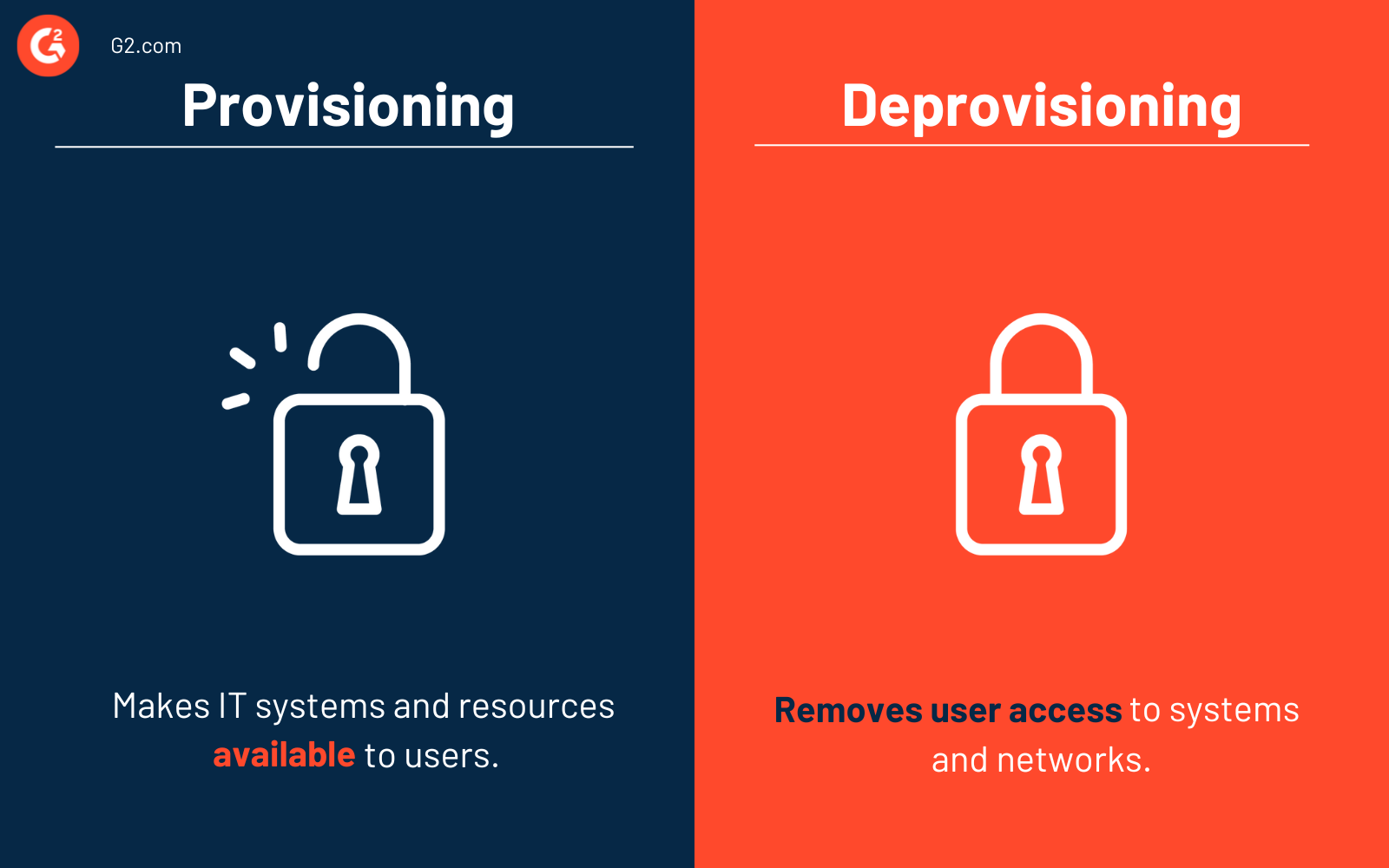
Provisioning vs. deprovisioning

Provisioning makes IT systems and resources available to users. Deprovisioning, on the other hand, removes user access to systems and networks. Both provisioning and deprovisioning are vital steps in securing IT systems and applications. 

Any organization that plans to advance its security posture should plan effective automated user provisioning and deprovisioning. They’re both an important part of the employee lifecycle. 

Learn more about identity and access management (IAM) to take care of access permissions and prove compliance at scale.

Sagar Joshi
SJ

Sagar Joshi

Sagar Joshi is a former content marketing specialist at G2 in India. He is an engineer with a keen interest in data analytics and cybersecurity. He writes about topics related to them. You can find him reading books, learning a new language, or playing pool in his free time.

Provisioning Software

This list shows the top software that mention provisioning most on G2.

The JumpCloud Directory Platform reimagines the directory as a complete platform for identity, access, and device management.

Okta is The World’s Identity Company™. As the leading independent Identity partner, we free everyone to safely use any technology — anywhere, on any device or app. The most trusted brands trust Okta to enable secure access, authentication, and automation. With flexibility and neutrality at the core of our Okta Workforce Identity and Customer Identity Clouds, business leaders and developers can focus on innovation and accelerate digital transformation, thanks to customizable solutions and more than 7,000 pre-built integrations. We’re building a world where Identity belongs to you. Learn more at okta.com.

A complete Apple management solution for IT pros to empower users and simplify the deployment, inventory, and security of Macs, iPads, and iPhones. Designed to automate device management for you while driving end-user productivity and creativity, Jamf Pro (formerly Casper Suite) is the EMM tool that delights IT pros and the users they support by delivering on the promise of unified endpoint management for Apple devices.

The Leading MDM Purpose-Built for Dedicated Devices Take full control of your Android, iOS and Linux POS systems, digital kiosks, and more with tools designed to tackle the challenges of compliance, drift, and scale — securely, effortlessly, and without compromise.

BetterCloud provides critical insights, automated management, and intelligent data security for cloud office platforms.

Extend enterprise security & compliance to all public and private cloud apps with secure single sign-on (SSO), multi-factor authentication & user provisioning.

Red Hat Ansible Automation Platform is a simple way to automate apps and infrastructure. Application Deployment + Configuration Management + Continuous Delivery.

AWS CloudFormation is a service that enables users to model, provision, and manage AWS and third-party resources in a secure and automated manner. By defining infrastructure as code through JSON or YAML templates, CloudFormation allows for consistent and repeatable deployment of resources, facilitating efficient management of complex infrastructures. Key Features and Functionality: - Infrastructure as Code: Define and provision AWS resources using JSON or YAML templates, enabling version control and repeatable deployments. - Resource Management: Manage a wide range of AWS services, including EC2 instances, S3 buckets, and Lambda functions, through a single template. - Automation and Consistency: Automate the provisioning and updating of infrastructure, ensuring consistency across multiple environments. - Scalability: Scale infrastructure globally and manage resources across multiple AWS accounts and regions through a single operation. - Extensibility: Extend infrastructure management to include third-party resources and custom applications using the AWS CloudFormation Registry. - Safety Controls: Utilize features like Rollback Triggers and Change Sets to monitor and manage stack operations, enhancing the reliability of deployments. Primary Value and Problem Solved: AWS CloudFormation simplifies the process of managing and provisioning cloud infrastructure by treating it as code. This approach reduces manual intervention, minimizes errors, and ensures consistent deployments across various environments. By automating resource management, CloudFormation accelerates the development and deployment cycles, allowing organizations to focus on building applications rather than managing infrastructure.

Hashicorp Terraform is a tool that collaborate on infrastructure changes to reduce errors and simplify recovery.

A Single, Modern System for Your Payroll, Benefits, HR & IT.

Run code without thinking about servers. Pay for only the compute time you consume.

Bandwidth is a communications platform with limitless flexibility. You need integrations, enterprise-class APIs for voice, SMS, and more, and tools to manage your communications stack intelligently. We are open where you need it most, with optionality and control. When combined with our global network, which is directly connected where it matters most, you get unmatched reliability. Bringing your customers closer. Scaling wherever your business takes you.

Oracle Identity Management is a comprehensive suite of identity and access management (IAM) solutions designed to help organizations manage the entire lifecycle of user identities and access privileges across enterprise resources, both on-premises and in the cloud. By automating user provisioning, enforcing security policies, and ensuring compliance with regulatory requirements, Oracle Identity Management enhances operational efficiency and strengthens security postures. Key Features and Functionality: - Identity Governance: Manages user provisioning and deprovisioning, enforces access policies, and provides actionable identity intelligence for rapid remediation of high-risk entitlements. - Access Management: Delivers risk-aware, end-to-end multifactor authentication (MFA) and single sign-on (SSO) capabilities, integrating identities and systems across cloud and on-premises environments. - Directory Services: Offers scalable and flexible directory solutions that support growth without unnecessary over-provisioning, facilitating seamless expansion without impacting existing services. - User Provisioning: Automates the creation and assignment of user accounts, reducing administrative overhead and minimizing human error. - Identity Analytics: Utilizes machine learning to detect and prevent suspicious identity activities, enhancing security through proactive monitoring. - Single Sign-On (SSO): Consolidates user credentials behind a single account with strong password policies, simplifying access to services and improving user experience. - Multifactor Authentication (MFA): Implements secondary authentication controls to verify user identities, reducing exposure from stolen credentials. - Risk-Based Authentication: Employs algorithms to assess the risk of user actions, blocking or reporting activities with high-risk scores. - Identity Governance and Administration (IGA): Controls entitlements to reduce risks associated with excessive access and privileges. Primary Value and Solutions Provided: Oracle Identity Management addresses critical security challenges by ensuring consistent user access rules and policies across an organization, thereby reducing the risk of data breaches and unauthorized access. By automating identity-related processes, it enhances operational efficiency, reduces administrative costs, and ensures compliance with regulatory standards. The suite's comprehensive approach to identity governance and access management enables organizations to securely manage user identities, enforce security policies, and respond swiftly to evolving security threats, ultimately safeguarding sensitive data and maintaining trust in business operations.

AWS Elastic Compute Cloud (EC2) is a web service that provides resizable compute capacity in the cloud, making web-scale computing easier for developers.

Xcode is Apple's integrated development environment (IDE) that provides a comprehensive suite of tools for developing, testing, and distributing applications across all Apple platforms, including iOS, macOS, watchOS, and tvOS. Designed to streamline the app development process, Xcode offers features like predictive code completion, advanced debugging tools, and simulators for various Apple devices, enabling developers to create high-quality applications efficiently. Key Features and Functionality: - Coding Intelligence: Xcode leverages machine learning models to offer predictive code completion tailored to Swift and Apple SDKs, enhancing coding efficiency. - Previews: Developers can visualize and interact with their app's user interface in real-time using Xcode's preview feature, facilitating rapid iteration and design refinement. - Simulator: Xcode includes a simulator that allows testing of applications across different Apple devices and OS versions directly from a Mac, supporting scenarios like location changes and network conditions. - Debugging Tools: The IDE provides robust debugging capabilities, including breakpoints, memory usage inspection, and variable monitoring, aiding in the identification and resolution of issues. - Performance Analysis: With Instruments, developers can analyze app performance metrics such as CPU, memory, and GPU usage in real-time, helping to optimize app responsiveness and efficiency. - Testing Frameworks: Xcode supports unit and UI testing through frameworks like Swift Testing and XCTest, enabling comprehensive test coverage and quality assurance. - Xcode Cloud: Integrated continuous integration and delivery service that automates building, testing, and distributing apps, enhancing collaboration and development speed. Primary Value and User Solutions: Xcode serves as a unified platform that simplifies the app development lifecycle for Apple devices. By integrating coding, testing, debugging, and deployment tools within a single environment, it reduces development time and complexity. Features like real-time previews and simulators allow developers to iterate quickly and ensure their applications perform optimally across all Apple platforms. The inclusion of Xcode Cloud further streamlines workflows by automating routine tasks, enabling teams to focus on innovation and delivering high-quality apps to users efficiently.

3CX is an open standards communications solution that replaces proprietary PBX's. Built for business connectivity and collaboration it integrates video conferencing, live chat and apps for Android, iOS, and the web. Available on premise (Windows / Linux) or hosted as a cloud solution.

Torii is a SaaS management platform allowing IT organizations to discover, optimize, and control their SaaS usage and cost from a single hub.

Nonrelational database for applications that need performance at any scale

Azure Resource Manager (ARM) is Microsoft's deployment and management service for Azure, providing a unified layer to create, update, and delete resources within your Azure account. It enables users to manage their infrastructure through declarative templates, ensuring consistent and repeatable deployments across various environments. By organizing resources into groups, ARM simplifies monitoring, access control, and billing, offering a streamlined approach to resource management. Key Features and Functionality: - Declarative Resource Deployment: Utilize ARM templates to define and deploy Azure resources in a consistent and repeatable manner, facilitating infrastructure as code practices. - Resource Grouping: Organize related resources into resource groups, allowing for collective management actions such as deployment, monitoring, and deletion. - Access Control: Implement role-based access control (RBAC) to manage permissions effectively, ensuring that only authorized users can perform specific actions on resources. - Tagging and Organization: Assign tags to resources for better categorization, aiding in cost management and operational oversight. - Consistent Management Layer: Interact with Azure resources through a consistent API, whether using the Azure portal, PowerShell, CLI, or REST APIs, ensuring uniformity across management tools. Primary Value and User Solutions: Azure Resource Manager addresses the complexities of cloud resource management by providing a centralized and consistent framework. It enhances operational efficiency by enabling infrastructure as code, which leads to faster deployments and easier scalability. The ability to group resources and apply access controls ensures better security and compliance. Additionally, ARM's tagging and organizational features simplify cost tracking and resource monitoring, empowering users to manage their Azure environments more effectively.

Amazon Relational Database Service (RDS) is a web service that makes it easy to set up, operate, and scale a relational DB in the cloud: Amazon Aurora, PostgreSQL, MySQL, MariaDB, Oracle, and Microsoft SQL Server.