Best Document Databases

How Many Document Databases Products Does G2 Track?

Total Products under this Category: 66

Category Stats (Sep 2026)

  • Average Rating: 4.23/5 The average rating of products in this category, based on all submitted ratings
  • Top Trending Product: InterSystems IRIS (+0.35%) - Among all products in this category, InterSystems IRIS recorded the largest rating increase compared to last month

Last updated: September 15, 2026

How Does G2 Rank Document Databases Products?

Why You Can Trust G2's Software Rankings:

  • 30 Analysts and Data Experts
  • 3,200+ Authentic Reviews
  • 66+ Products
  • Unbiased Rankings

G2's software rankings are built on verified user reviews, rigorous moderation, and a consistent research methodology maintained by a team of analysts and data experts. Each product is measured using the same transparent criteria, with no paid placement or vendor influence. While reviews reflect real user experiences, which can be subjective, they offer valuable insight into how software performs in the hands of professionals. Together, these inputs power the G2 Score, a standardized way to compare tools within every category.

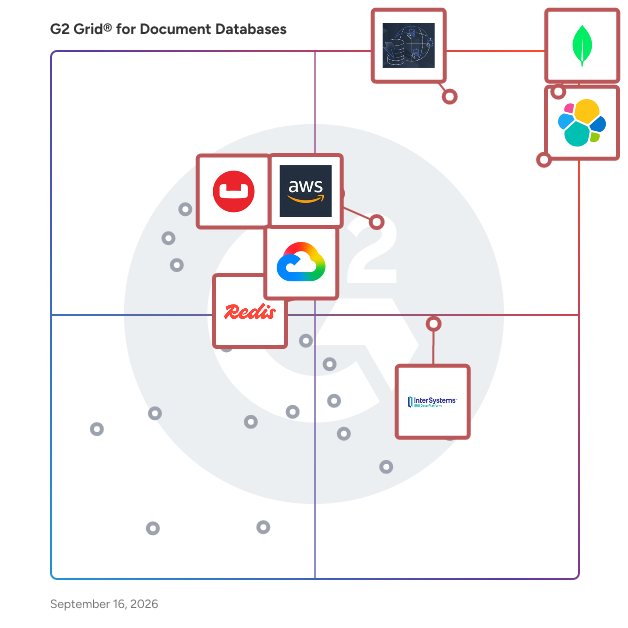
G2 Grid® for Document Databases

G2 Grid® for Document Databases plotting products by satisfaction and market presence

Highlighted products: MongoDB Atlas, Elasticsearch, Amazon DynamoDB, Amazon DocumentDB, Google Cloud Firestore, InterSystems IRIS, Redis Software, and Couchbase.

Underlying data: [Grid® JSON](https://www.g2.com/categories/document-databases/grids.json?focus%5B%5D=mongodb-atlas&focus%5B%5D=elastic-elasticsearch&focus%5B%5D=amazon-web-services-aws-amazon-dynamodb&focus%5B%5D=amazon-documentdb&focus%5B%5D=google-cloud-firestore&focus%5B%5D=intersystems-iris&focus%5B%5D=redis-software&focus%5B%5D=couchbase)

MongoDB Atlas

MongoDB Atlas is a developer data platform that provides a tightly integrated collection of data and application infrastructure building blocks to enable enterprises to quickly deploy bespoke architectures to address any application need. Atlas supports transactional, full-text search, vector search, time series and stream processing application use cases across mobile, distributed, event-driven, and serverless architectures.

Average Rating: 4.5/5.0

Total Reviews: 851

How Do G2 Users Rate MongoDB Atlas?

  • Has the product been a good partner in doing business?: 8.6/10 (Category avg: 8.5/10)
  • Query Optimization: 8.5/10 (Category avg: 8.0/10)
  • Data Model: 9.0/10 (Category avg: 8.5/10)
  • Operating Systems: 9.0/10 (Category avg: 8.3/10)

Who Is the Company Behind MongoDB Atlas?

  • Seller: MongoDB
  • Year Founded: 2007
  • HQ Location: New York
  • Twitter: @MongoDB
    503,172 Twitter followers
  • LinkedIn® Page: www.linkedin.com
    8,041 employees on LinkedIn®
  • Ownership: NASDAQ: MDB

Who Uses This Product?

  • Who Uses This: Software Engineer, Senior Software Engineer
  • Top Industries: Computer Software, Information Technology and Services
  • Company Size: 46% Small, 29% Large

What Do G2 Reviewers Say About MongoDB Atlas?

AI-generated summary from verified user reviews

Pros
  • Users appreciate the intuitive UI of MongoDB Atlas, enhancing their database management experience significantly.
  • Users appreciate the intuitive UI of MongoDB Atlas, which simplifies database management and enhances user experience.
  • Users appreciate the intuitive UI and documentation of MongoDB Atlas, enhancing user-friendly database management and efficiency.
  • Users value the scalability of MongoDB Atlas, noting its ease in managing clusters and diverse data structures.
  • Users highly value the reliability of MongoDB Atlas, consistently appreciating its excellent uptime and seamless performance.
Cons
  • Users find the pricing of MongoDB Atlas excessively high, leading to frustration with unexpected costs and poor performance.
  • Users express frustration over unclear pricing structures, leading to unexpected costs and insufficient support throughout their experience.
  • Users find MongoDB Atlas expensive, citing high costs for performance, support, and complex billing issues.
  • Users experience high memory usage with MongoDB Atlas, leading to performance issues and unexpected costs.
  • Users frequently report latency issues and unwanted slowdowns in performance during data operations with MongoDB Atlas.

What Are Recent G2 Reviews of MongoDB Atlas?

What Are G2 Users Discussing About MongoDB Atlas?

Elasticsearch

Build next generation search experiences for your customers and employees that support your organization’s technology objectives. Elasticsearch gives developers a flexible toolkit to build AI-powered search applications with an extensible platform that also provides out of the box capabilities Save development cycles and get upgraded search to market faster. Elasticsearch is the world’s most popular search engine, backed by a robust developer community. Elastic’s platform lets you ingest any data source, build modern search experiences that integrate with large language models and generative AI, and visualize analytics for data-driven decision-making and insights. Our consistent investments in machine learning help developers stay ahead of the curve with the fast, highly relevant search, at scale. -- Flexible platform and toolkit to deliver powerful search functionality regardless of development resources and technology objectives. Our open platform delivers consistent functionality for cloud, hybrid, or on-prem deployments with exceptional performance, reliability, and scalability. -- Built-in search analytics and visualization tools give teams access to search data and real-time dashboards for optimizing search results and operations. Non-tech teams can tune search experiences too–no development team needed. -- Next level search relevance using textual search, vector search, hybrid, and semantic search and machine learning model flexibility. Powerful capabilities like a vector database provide the foundation for creating, storing, and searching embeddings to capture the context of your unstructured data. Use machine-learning enabled inference at data ingestion, and bring your own model - open or proprietary - to deliver the best, industry-specific results.

Average Rating: 4.5/5.0

Total Reviews: 289

How Do G2 Users Rate Elasticsearch?

  • Has the product been a good partner in doing business?: 8.9/10 (Category avg: 8.5/10)
  • Query Optimization: 8.9/10 (Category avg: 8.0/10)
  • Data Model: 9.5/10 (Category avg: 8.5/10)
  • Operating Systems: 9.0/10 (Category avg: 8.3/10)

Who Is the Company Behind Elasticsearch?

  • Seller: Elastic
  • Company Website:
  • Year Founded: 2012
  • HQ Location: San Francisco, CA
  • Twitter: @elastic
    65,200 Twitter followers
  • LinkedIn® Page: www.linkedin.com
    10,457 employees on LinkedIn®

Who Uses This Product?

  • Who Uses This: Software Engineer, Senior Software Engineer
  • Top Industries: Computer Software, Information Technology and Services
  • Company Size: 38% Medium, 33% Large

What Do G2 Reviewers Say About Elasticsearch?

AI-generated summary from verified user reviews

Pros
  • Users highlight the ease of use of Elasticsearch, making integration and application monitoring seamless and efficient.
  • Users commend the impressive speed of Elasticsearch, allowing efficient handling of large datasets and quick queries.
  • Users love the fast search capabilities of Elasticsearch, allowing for efficient troubleshooting and real-time analytics.
  • Users appreciate the blazing fast performance of Elasticsearch, enhancing their search experiences significantly.
  • Users value Elasticsearch for its powerful search and aggregation capabilities, enhancing performance and workflow efficiency immensely.
Cons
  • Users find Elasticsearch expensive to scale, especially with high data volumes and necessary commercial licenses.
  • Users find Elasticsearch's required expertise challenging, citing complexity and resource-intensive setup as significant hurdles.
  • Users find the learning difficulty of Elasticsearch overwhelming, especially for beginners navigating its complexity and configuration.
  • Users find Elasticsearch's interface to be not user-friendly, complicating search functionality and requiring extensive tuning for performance.
  • Users find difficult learning with Elasticsearch due to its complex configuration and confusing documentation, especially for beginners.

What Are Recent G2 Reviews of Elasticsearch?

Amazon DynamoDB

Amazon DynamoDB is a pioneering NoSQL, fully managed, serverless database with limitless scalability and single-digit millisecond latency performance enabling customers to develop modern, microservice-based applications through a simple API. Customers enjoy the benefits of DynamoDB’s fully-managed service including broad compliance standards, security integration with AWS Identity and Access Management and numerous disaster recovery services. With DynamoDB Global Tables, customers have a 99.999% highly available, multi-Region, multi-active database supporting local reads and writes for globally distributed users. DynamoDB provides cost management features such as scale-to-zero, Time to Live (TTL) for aging data out, and multiple pricing models including a free tier.

Average Rating: 4.4/5.0

Total Reviews: 498

How Do G2 Users Rate Amazon DynamoDB?

  • Has the product been a good partner in doing business?: 8.9/10 (Category avg: 8.5/10)
  • Query Optimization: 8.4/10 (Category avg: 8.0/10)
  • Data Model: 8.8/10 (Category avg: 8.5/10)
  • Operating Systems: 8.4/10 (Category avg: 8.3/10)

Who Is the Company Behind Amazon DynamoDB?

  • Seller: Amazon Web Services (AWS)
  • Year Founded: 2006
  • HQ Location: Seattle, WA
  • Twitter: @awscloud
    2,232,483 Twitter followers
  • LinkedIn® Page: www.linkedin.com
    147,094 employees on LinkedIn®
  • Ownership: NASDAQ: AMZN

Who Uses This Product?

  • Who Uses This: Software Engineer, Senior Software Engineer
  • Top Industries: Computer Software, Information Technology and Services
  • Company Size: 35% Large, 34% Medium

What Do G2 Reviewers Say About Amazon DynamoDB?

AI-generated summary from verified user reviews

Pros
  • Users value the exceptional scalability of Amazon DynamoDB, enabling consistent performance during unpredictable workloads and high traffic.
  • Users appreciate the ease of use of Amazon DynamoDB, benefiting from its fully managed and scalable features.
  • Users appreciate the cost efficiency of Amazon DynamoDB, saving time and reducing operational efforts significantly.
  • Users value the low-latency performance of Amazon DynamoDB, ensuring rapid responses for high-traffic applications.
  • Users value the fully managed services of Amazon DynamoDB, significantly reducing operational burdens and enhancing efficiency.
Cons
  • Users express concerns about the expensive costs associated with DynamoDB's pay-per-request model and configuration complexities.
  • Users face challenges with query complexity, as inefficient designs can lead to high costs and throttling issues.
  • Users find Amazon DynamoDB complex for newcomers, requiring extensive learning and proper data modeling to avoid issues.
  • Users find the learning curve steep, making data modeling and queries challenging for newcomers to DynamoDB.
  • Users face cost management challenges with DynamoDB, needing careful optimization to prevent unexpected expenses.

What Are Recent G2 Reviews of Amazon DynamoDB?

What Are G2 Users Discussing About Amazon DynamoDB?

Amazon DocumentDB

Amazon DocumentDB (with MongoDB compatibility) is a database service that is purpose-built for JSON data management at scale, fully managed and integrated with AWS, and enterprise-ready with high durability. Amazon DocumentDB is designed from the ground-up to give you the scalability and durability you need when operating mission-critical MongoDB workloads. In Amazon DocumentDB, storage scales automatically up to 64TiB without any impact to your application. It supports millions of requests per second with up to 15 low latency read replicas in minutes, without any application downtime, regardless of the size of your data. Amazon DocumentDB now supports Global Clusters. Global Clusters is a new feature that provides disaster recovery from region-wide outages and enables low-latency global reads by allowing reads from the nearest Amazon DocumentDB cluster. Amazon DocumentDB is designed for 99.99% availability and replicates six copies of your data across three AWS Availability Zones (AZs). You can use AWS Database Migration Service (DMS) for free (for six months) to easily migrate your self-managed MongoDB databases to Amazon DocumentDB with virtually no downtime.

Average Rating: 4.3/5.0

Total Reviews: 42

How Do G2 Users Rate Amazon DocumentDB?

  • Has the product been a good partner in doing business?: 8.5/10 (Category avg: 8.5/10)
  • Query Optimization: 8.7/10 (Category avg: 8.0/10)
  • Data Model: 9.4/10 (Category avg: 8.5/10)
  • Operating Systems: 8.7/10 (Category avg: 8.3/10)

Who Is the Company Behind Amazon DocumentDB?

  • Seller: Amazon Web Services (AWS)
  • Year Founded: 2006
  • HQ Location: Seattle, WA
  • Twitter: @awscloud
    2,232,483 Twitter followers
  • LinkedIn® Page: www.linkedin.com
    147,094 employees on LinkedIn®
  • Ownership: NASDAQ: AMZN

Who Uses This Product?

  • Top Industries: Information Technology and Services, Computer Software
  • Company Size: 39% Small, 34% Large

What Do G2 Reviewers Say About Amazon DocumentDB?

AI-generated summary from verified user reviews

Pros
  • Users value the reliable cloud computing services provided by Amazon DocumentDB for their data management needs.
  • Users appreciate the easy integration with AWS services that enhances their experience and functionality with DocumentDB.
  • Users value the easy integration with AWS services offered by Amazon DocumentDB, enhancing overall functionality and flexibility.
  • Users value the reliable cloud computing services provided by Amazon DocumentDB, ensuring consistent performance and uptime.
Cons
  • Users find it very complicated to understand Amazon DocumentDB, which can hinder effective usage and implementation.
  • Users point out the dependency issues with Amazon DocumentDB, making migration to other databases challenging and costly.
  • Users find Amazon DocumentDB to be expensive compared to other DBaaS providers, complicating migration and increasing operational challenges.

What Are Recent G2 Reviews of Amazon DocumentDB?

What Are G2 Users Discussing About Amazon DocumentDB?

FAQs About Document Databases

Generated using AI

Last updated: June 3, 2026

Which Document Databases platforms support ACID transactions and data consistency guarantees at scale

Based on G2 reviews, these products are most often mentioned for consistency, transactions, or reliable scaling needs.

  • MongoDB — flexible schema with replication and sharding.
  • Amazon DynamoDB — transactional workloads with managed high availability.
  • Elasticsearch — resilient distributed indexing and scalable search.
  • MongoDB Atlas — managed clusters with backups and autoscaling.

Which Document Databases platforms offer the fastest query performance and automatic sharding capabilities

Based on G2 reviews, these products stand out for fast retrieval, scaling behavior, and distributed data handling.

Finding Document Databases platforms that handle unstructured JSON data and eliminate the need for complex schema redesigns

According to verified users, this is one of the clearest strengths of document databases. Reviewers repeatedly describe storing JSON-like or semi-structured data without rigid tables, which helps teams move faster when requirements change. Across the recent reviews, buyers highlight easier iteration, fewer schema migrations, simpler API alignment, and less time spent reshaping application data. They also mention tradeoffs: governance can become harder without strong validation, joins may feel less natural than in relational systems, and indexing still matters for performance. For teams working with evolving application data, logs, profiles, events, or mixed document structures, flexibility is the most consistent benefit described.

What are document databases

Document databases are systems built to store data as flexible documents rather than fixed tables. In the recent G2 reviews for this category, users most often describe working with JSON-like or BSON-style records that can evolve without constant schema redesign. That makes them useful when application data changes frequently, when teams want faster development cycles, or when they need to store semi-structured and unstructured information more naturally. Reviewers also connect document databases with horizontal scaling, replication, indexing, aggregation, and easier alignment between application objects and stored data. At the same time, users note they can require careful indexing, data governance, and planning for relationships or strict consistency needs.

How do teams use Document Databases for real-time analytics

G2 reviewers mention using document databases for real-time analytics by storing operational data in flexible document formats and then querying it quickly with indexes, aggregations, or search features. Recent reviews describe teams analyzing logs, event streams, dashboards, API data, customer activity, and application records without repeatedly redesigning schemas as inputs change. Buyers also highlight faster iteration because data can stay close to the structures used in code, which reduces transformation work before analysis. Across the review set, real-time analytics use cases are usually tied to quick retrieval, scalable clustering or sharding, and support for evolving datasets. The main caution reviewers raise is that sustained performance depends on thoughtful indexing and query design.

Google Cloud Firestore

Cloud Firestore is a NoSQL document database that lets you easily store, sync, and query data for your mobile and web apps—at global scale.

Average Rating: 4.2/5.0

Total Reviews: 96

How Do G2 Users Rate Google Cloud Firestore?

  • Has the product been a good partner in doing business?: 8.4/10 (Category avg: 8.5/10)
  • Query Optimization: 7.9/10 (Category avg: 8.0/10)
  • Data Model: 8.7/10 (Category avg: 8.5/10)
  • Operating Systems: 8.9/10 (Category avg: 8.3/10)

Who Is the Company Behind Google Cloud Firestore?

  • Seller: Google
  • Year Founded: 1998
  • HQ Location: Mountain View, CA
  • Twitter: @google
    31,899,995 Twitter followers
  • LinkedIn® Page: www.linkedin.com
    301,144 employees on LinkedIn®
  • Ownership: NASDAQ:GOOG

Who Uses This Product?

  • Top Industries: Computer Software, Information Technology and Services
  • Company Size: 53% Small, 30% Medium

What Do G2 Reviewers Say About Google Cloud Firestore?

AI-generated summary from verified user reviews

Pros
  • Users find the API integration fast and efficient, allowing seamless app connections and real-time updates.
  • Users value the scalability and wide service offerings of Google Cloud Firestore, enhancing flexibility for diverse applications.
  • Users value the flexibility of Google Cloud Firestore, enabling customized solutions for diverse application needs.
  • Users highlight the commitment to innovation in Google Cloud Firestore, enhancing their development experience and efficiency.
  • Users benefit from the seamless integration with Google products, enhancing their overall workflow and productivity.
Cons
  • Users find the pricing expensive, especially when needing to upgrade beyond the free tier of Firestore.
  • Users find the unclear pricing of Firestore confusing, especially when costs increase after the free tier.

What Are Recent G2 Reviews of Google Cloud Firestore?

What Are G2 Users Discussing About Google Cloud Firestore?

InterSystems IRIS

InterSystems IRIS is a complete cloud-first data platform that includes a multi-model transactional data management engine, an application development platform, and interoperability engine, and an open analytics platform. It is the next generation of our proven data management software.It includes the capabilities of InterSystems Cache and Ensemble, plus a wealth of exciting new capabilities to make it easy to build and deploy cloud based, analytics-intensive enterprise applications with even greater performance and scalability. InterSystems IRIS provides a set of APIs to operate with transactional persistent data simultaneously: key-value, relational, object, document, multidimensional. Data can be managed by SQL, Java, node.js, .NET, C++, Python, and native server-side ObjectScript language. InterSystems IRIS includes an Interoperability engine and modules to build AI solutions. InterSystems IRIS provides features for horizontal scalability (sharding, ECP) and provides High Availability features, Business intelligence, transaction support, and backup.

Average Rating: 4.6/5.0

Total Reviews: 60

How Do G2 Users Rate InterSystems IRIS?

  • Has the product been a good partner in doing business?: 8.8/10 (Category avg: 8.5/10)
  • Query Optimization: 9.7/10 (Category avg: 8.0/10)
  • Data Model: 9.4/10 (Category avg: 8.5/10)
  • Operating Systems: 8.9/10 (Category avg: 8.3/10)

Who Is the Company Behind InterSystems IRIS?

  • Seller: InterSystems
  • Year Founded: 1978
  • HQ Location: Cambridge, MA
  • Twitter: @InterSystems
    61,310 Twitter followers
  • LinkedIn® Page: www.linkedin.com
    2,151 employees on LinkedIn®

Who Uses This Product?

  • Top Industries: Computer Software, Hospital & Health Care
  • Company Size: 47% Small, 31% Medium

What Do G2 Reviewers Say About InterSystems IRIS?

AI-generated summary from verified user reviews

Pros
  • Users value the powerful features and flexibility of InterSystems IRIS, enhancing overall performance and user experience.
  • Users find InterSystems IRIS to be very easy to use, with a clean interface and helpful documentation.
  • Users commend the excellent performance and resource efficiency of InterSystems IRIS, enhancing reliability and speed in data handling.
  • Users praise the excellent customer support from InterSystems IRIS, appreciating timely responses and helpful assistance.
  • Users value the easy integrations of InterSystems IRIS, enabling seamless connectivity with various systems and flexibility.
Cons
  • Users find the difficult learning curve of InterSystems IRIS challenging, particularly for those new to the platform.
  • Users note that IRIS is not cheap, with licensing costs and hardware requirements posing challenges for smaller projects.
  • Users find the insufficient documentation for advanced scenarios complicates learning and effective use of InterSystems IRIS.
  • Users find the learning curve steep, particularly with advanced features and complex configurations, which can hinder initial experiences.
  • Users find the poor documentation for advanced scenarios challenging, making it hard to navigate complex features.

What Are Recent G2 Reviews of InterSystems IRIS?

What Are G2 Users Discussing About InterSystems IRIS?

Couchbase

Couchbase’s operational data platform for AI is a scalable foundation for enterprise operational, analytical, mobile and AI workloads that replaces legacy infrastructure and data services.

Average Rating: 4.3/5.0

Total Reviews: 142

How Do G2 Users Rate Couchbase?

  • Has the product been a good partner in doing business?: 8.3/10 (Category avg: 8.5/10)
  • Query Optimization: 8.8/10 (Category avg: 8.0/10)
  • Data Model: 8.8/10 (Category avg: 8.5/10)
  • Operating Systems: 8.6/10 (Category avg: 8.3/10)

Who Is the Company Behind Couchbase?

  • Seller: Couchbase
  • Company Website:
  • Year Founded: 2009
  • HQ Location: San Jose, CA
  • Twitter: @couchbase
    136,110 Twitter followers
  • LinkedIn® Page: www.linkedin.com
    849 employees on LinkedIn®

Who Uses This Product?

  • Who Uses This: Senior Software Engineer, Software Engineer
  • Top Industries: Computer Software, Information Technology and Services
  • Company Size: 39% Small, 34% Large

What Do G2 Reviewers Say About Couchbase?

AI-generated summary from verified user reviews

Pros
  • Users find Couchbase easy to use, appreciating its simple implementation and fast real-time data access.
  • Users appreciate the scalability of Couchbase, enabling efficient data management and exceptional performance across applications.
  • Users love the incredible speed of Couchbase, significantly enhancing performance for large datasets and transactions.
  • Users value the flexibility of Couchbase, enabling diverse data storage and seamless integration for various applications.
  • Users value the MongoDB compatibility of Couchbase, appreciating its ease of use and smooth integration.
Cons
  • Users find the complex configuration of Couchbase challenging, especially without dedicated database administrators or expertise.
  • Users find the difficult learning curve of Couchbase challenging, which can complicate setup and usage for novices.
  • Users find the complexity of setup and management in Couchbase to be a significant challenge and hurdle.
  • Users find the limited community growth of Couchbase hampers support and implementation efforts for new users.
  • Users feel the UI is complicated, highlighting a need for improvements to enhance the overall user experience.

What Are Recent G2 Reviews of Couchbase?

What Are G2 Users Discussing About Couchbase?

Redis Software

Redis Software is our advanced solution delivering unmatched speed and reliability for on-prem and private cloud environments. It gives you full control over your deployment, ensuring high performance and scalability to meet your specific needs. Redis Software builds on the speed and reliability of Redis Community Edition with advanced features like active-active geo-distribution, advanced query and search capabilities, automated data synchronization, and superior security features. These enhancements provide enterprise-grade performance, reliability, and security, making Redis Software the ideal choice for production-grade applications.

Average Rating: 4.5/5.0

Total Reviews: 132

How Do G2 Users Rate Redis Software?

  • Has the product been a good partner in doing business?: 8.5/10 (Category avg: 8.5/10)
  • Query Optimization: 9.2/10 (Category avg: 8.0/10)
  • Data Model: 8.3/10 (Category avg: 8.5/10)
  • Operating Systems: 8.8/10 (Category avg: 8.3/10)

Who Is the Company Behind Redis Software?

  • Seller: Redis
  • Year Founded: 2011
  • HQ Location: San Francisco, CA
  • Twitter: @Redisinc
    44,002 Twitter followers
  • LinkedIn® Page: www.linkedin.com
    1,542 employees on LinkedIn®

Who Uses This Product?

  • Who Uses This: Software Engineer, Senior Software Engineer
  • Top Industries: Computer Software, Information Technology and Services
  • Company Size: 54% Small, 26% Medium

What Do G2 Reviewers Say About Redis Software?

AI-generated summary from verified user reviews

Pros
  • Users love Redis Software as a main cache provider, highlighting its ease of implementation in various projects.
  • Users appreciate the cost efficiency of Redis Software, benefiting from reduced RAM usage and smooth setup processes.
  • Users appreciate the customizability of Redis Software, allowing seamless integration and efficient management of resources and traffic.
  • Users appreciate the efficient data storage capabilities of Redis Software, enabling seamless handling of high traffic and large datasets.
  • Users find the ease of setup with Redis Software ideal for Python, Data, and Large Language Model projects.
Cons
  • Users express concerns over data size limitations in Redis, affecting backup capabilities and large-scale application performance.
  • Users find the expensive licensing fees of Redis Software challenging for SMBs compared to open-source alternatives.
  • Users find limited chart features hinder effective data visualization and analysis within Redis Software.
  • Users find the poor UI of Redis Software struggles with scalability, impacting deployment efficiency and requiring additional tools.
  • Users report slow performance during embedding with large data sets, impacting the efficiency of semantic search.

What Are Recent G2 Reviews of Redis Software?

What Are G2 Users Discussing About Redis Software?

AceBase realtime database

A fast, low memory, transactional, index & query enabled NoSQL database engine and server for node.js and browser with realtime data change notifications.

Average Rating: 4.6/5.0

Total Reviews: 17

How Do G2 Users Rate AceBase realtime database?

  • Has the product been a good partner in doing business?: 8.3/10 (Category avg: 8.5/10)
  • Query Optimization: 8.8/10 (Category avg: 8.0/10)
  • Data Model: 9.2/10 (Category avg: 8.5/10)
  • Operating Systems: 9.4/10 (Category avg: 8.3/10)

Who Is the Company Behind AceBase realtime database?

Who Uses This Product?

  • Top Industries: Computer Software
  • Company Size: 44% Medium, 39% Small

What Are Recent G2 Reviews of AceBase realtime database?

What Are G2 Users Discussing About AceBase realtime database?

RavenDB

RavenDB is a fully ACID-compliant, multi-model NoSQL document database designed for developers building high-performance, distributed applications. It delivers fast reads and writes, native full-text and vector search for AI workloads, and automatic indexing for low-latency queries. With real-time data replication, horizontal scaling, built-in data encryption, and seamless cloud or on-premise deployment options, RavenDB supports mission-critical systems with minimal operational overhead. Trusted by over 12,000 organizations—including Toyota, Verizon, and Rakuten Kobo—RavenDB is ideal for teams that need a reliable, developer-friendly database for microservices, cloud-native architectures, and AI-powered search.

Average Rating: 4.4/5.0

Total Reviews: 13

How Do G2 Users Rate RavenDB?

  • Has the product been a good partner in doing business?: 8.6/10 (Category avg: 8.5/10)
  • Query Optimization: 8.0/10 (Category avg: 8.0/10)
  • Data Model: 8.7/10 (Category avg: 8.5/10)
  • Operating Systems: 8.3/10 (Category avg: 8.3/10)

Who Is the Company Behind RavenDB?

  • Seller: RavenDB
  • Year Founded: 2008
  • HQ Location: Caesarea, Israel
  • Twitter: @RavenDB
    2,159 Twitter followers
  • LinkedIn® Page: www.linkedin.com
    61 employees on LinkedIn®

Who Uses This Product?

  • Company Size: 57% Small, 21% Medium

What Do G2 Reviewers Say About RavenDB?

AI-generated summary from verified user reviews

Pros
  • Users find that RavenDB's speed significantly enhances development efficiency and reduces system complexity.
  • Users appreciate the well-designed features of RavenDB, which simplify development and reduce stack complexity.

What Are Recent G2 Reviews of RavenDB?

What Are G2 Users Discussing About RavenDB?

Amazon WorkDocs

Amazon WorkDocs is a secure enterprise storage and sharing service with strong administrative controls and feedback capabilities that improve user productivity, users can comment on files, send to others for feedback, and upload new versions without having to resort to emailing multiple versions of files as attachments.

Average Rating: 4.1/5.0

Total Reviews: 36

How Do G2 Users Rate Amazon WorkDocs?

  • Has the product been a good partner in doing business?: 6.7/10 (Category avg: 8.5/10)
  • Query Optimization: 10.0/10 (Category avg: 8.0/10)
  • Data Model: 10.0/10 (Category avg: 8.5/10)
  • Operating Systems: 10.0/10 (Category avg: 8.3/10)

Who Is the Company Behind Amazon WorkDocs?

  • Seller: Amazon Web Services (AWS)
  • Year Founded: 2006
  • HQ Location: Seattle, WA
  • Twitter: @awscloud
    2,232,483 Twitter followers
  • LinkedIn® Page: www.linkedin.com
    147,094 employees on LinkedIn®
  • Ownership: NASDAQ: AMZN

Who Uses This Product?

  • Company Size: 45% Small, 29% Medium

What Are Recent G2 Reviews of Amazon WorkDocs?

What Are G2 Users Discussing About Amazon WorkDocs?

IBM Cloudant

Fully Managed — IBM Cloud service provides a fully managed, distributed JSON document database. Instantly deploy an instance, create databases, and independently scale throughput capacity and data storage to meet your application requirements. IBM expertise takes away the pain of hardware and software provisioning, patching and upgrades, while offering a 99.95 percent SLA. Secure — Cloudant is ISO27001, SOC 2 Type 2 compliant and HIPAA ready. All data is encrypted over the wire and at rest with optional user-defined key management through IBM Key Protect. Cloudant also offers an EU-managed service, that ensures all data and operations are handled solely by EU citizens. Global Availability — Available in all IBM Cloud regions and 55+ data centers across the world, Cloudant can easily be set up for disaster recovery between continents or scaling an app for a global release through a horizontal scaling architecture that can handle millions of users and terabytes of data to grow seamlessly alongside your business. All Cloudant instances are deployed on clusters that span availability zones in regions that support them, for added durability at no extra cost. Data flexibility — Leverage a flexible JSON schema and powerful API that is compatible with Apache CouchDB™, enabling you to access an abundance of language libraries and tools to rapidly build new applications and features. Durable replication — Move application data closer to all the places it needs to be — for uninterrupted data access, offline or on. Cloudant helps teams build Progressive Web Apps, develop with an offline-first architecture or manipulate data on edge devices. Powerful serverless API — Enhance your applications with built-in key-value, MapReduce, full-text search and geospatial querying that go beyond simple bounding boxes. Stream the changes feed for seamless integration with event-driven applications and IBM Cloud functions.

Average Rating: 3.8/5.0

Total Reviews: 39

How Do G2 Users Rate IBM Cloudant?

  • Has the product been a good partner in doing business?: 8.2/10 (Category avg: 8.5/10)
  • Query Optimization: 8.8/10 (Category avg: 8.0/10)
  • Data Model: 9.0/10 (Category avg: 8.5/10)
  • Operating Systems: 9.0/10 (Category avg: 8.3/10)

Who Is the Company Behind IBM Cloudant?

  • Seller: IBM
  • Year Founded: 1911
  • HQ Location: Armonk, New York, United States
  • Twitter: @IBMSecurity
    74,660 Twitter followers
  • LinkedIn® Page: www.linkedin.com
    344,328 employees on LinkedIn®
  • Ownership: SWX:IBM

Who Uses This Product?

  • Top Industries: Computer Software, Information Technology and Services
  • Company Size: 48% Small, 31% Large

What Are Recent G2 Reviews of IBM Cloudant?

What Are G2 Users Discussing About IBM Cloudant?

Progress MarkLogic

Progress MarkLogic is an enterprise-grade multi-model data management platform that unlocks value from complex data. It works with the full breadth of a company's information and makes it easily discoverable and ready to power high-value applications, decision intelligence and trustworthy AI. Organizations leverage integrated capabilities to integrate, harmonize, search and visualize multi-model data to build a connected data ecosystem as the secure and scalable foundation for the AI era.

Average Rating: 4.3/5.0

Total Reviews: 65

How Do G2 Users Rate Progress MarkLogic?

  • Has the product been a good partner in doing business?: 8.7/10 (Category avg: 8.5/10)
  • Query Optimization: 8.1/10 (Category avg: 8.0/10)
  • Data Model: 8.3/10 (Category avg: 8.5/10)
  • Operating Systems: 8.3/10 (Category avg: 8.3/10)

Who Is the Company Behind Progress MarkLogic?

  • Seller: Progress Software
  • Company Website:
  • Year Founded: 1981
  • HQ Location: Burlington, MA.
  • Twitter: @ProgressSW
    48,773 Twitter followers
  • LinkedIn® Page: www.linkedin.com
    4,242 employees on LinkedIn®

Who Uses This Product?

  • Top Industries: Information Technology and Services, Computer Software
  • Company Size: 53% Large, 24% Small

What Are Recent G2 Reviews of Progress MarkLogic?

What Are G2 Users Discussing About Progress MarkLogic?

Arango

Arango provides a trusted data foundation for Contextual AI — transforming enterprise data into a System of Context that truly represents the business, so LLMs can deliver better outcomes with unlimited scale and cost efficiency. The Arango AI Data Platform gives developers a single, integrated environment to build and scale AI-powered applications without the complexity of stitching together multiple databases and tools. At its core is a massively scalable multi-model database that unifies graph, vector, document, and key-value data with full-text, geospatial, and vector search — creating the System of Context, the bridge between enterprise data and LLMs. The Arango AI Suite includes automated data pipelines, multimodal data ingestion, AIOps and MLOps, LLM integrations, Graph Analytics, agentic frameworks for context-aware Hybrid/GraphRAG, GraphML, natural-language support, and GPU acceleration — enabling repeatable ROI and faster innovation. Trusted by NVIDIA, HPE, the London Stock Exchange, the U.S. Air Force, NIH, Siemens, Synopsys and Articul8, Arango powers enterprise AI with context, confidence, and scale. We are a proud member of the NVIDIA Inception Program and the AWS ISV Accelerate Program. Learn more at arango.ai, LinkedIn, YouTube, and G2.

Average Rating: 4.6/5.0

Total Reviews: 115

How Do G2 Users Rate Arango?

  • Has the product been a good partner in doing business?: 9.0/10 (Category avg: 8.5/10)
  • Query Optimization: 8.4/10 (Category avg: 8.0/10)
  • Data Model: 9.2/10 (Category avg: 8.5/10)
  • Operating Systems: 8.4/10 (Category avg: 8.3/10)

Who Is the Company Behind Arango?

  • Seller: Arango
  • Year Founded: 2015
  • HQ Location: San Francisco, CA
  • LinkedIn® Page: www.linkedin.com
    128 employees on LinkedIn®

Who Uses This Product?

  • Who Uses This: Senior Software Engineer
  • Top Industries: Information Technology and Services, Computer Software
  • Company Size: 57% Small, 23% Medium

What Do G2 Reviewers Say About Arango?

AI-generated summary from verified user reviews

Pros
  • Users value Arango's seamless data handling, combining graph, document, and key-value seamlessly with excellent documentation.
  • Users find Arango remarkably easy to use, appreciating its intuitive interface and quick learning curve for AQL.
  • Users appreciate the flexibility of Arango, enabling seamless integration of various data models in one engine.
  • Users value the customization potential of Arango DB, appreciating its flexible query language and versatile design.
  • Users value the comprehensive and well-organized documentation that simplifies learning and managing Arango's features.
Cons
  • Users find the improvement needed for the graphical interface and setup process, wishing for a more intuitive experience.
  • Users find the difficult learning process challenging, particularly with complex queries and limited community support.
  • Users find the lack of detailed documentation frustrating, often struggling to locate necessary information for complex use cases.
  • Users find the learning curve steep, especially for complex queries and building new databases with limited support.
  • Users find the steep learning curve challenging, particularly for building complex queries and databases.

What Are Recent G2 Reviews of Arango?

What Are G2 Users Discussing About Arango?

Azure Cosmos DB

Azure Cosmos DB is a fully managed, globally distributed NoSQL and vector database service designed to support mission-critical applications with ultra-low latency and elastic scalability. It enables developers to build AI-powered applications and agents by providing seamless integration with AI services, allowing for efficient storage and querying of both NoSQL data and vectors. With its schema-agnostic JSON document model, Azure Cosmos DB simplifies the development process by automatically indexing all data, eliminating the need for manual schema or index management. The service offers comprehensive Service Level Agreements (SLAs), ensuring less than 10-millisecond read and write latencies and 99.999% availability, making it a reliable choice for applications requiring high performance and global reach. Key Features and Functionality: - Global Distribution: Azure Cosmos DB allows for turnkey global distribution, enabling data to be replicated across multiple regions worldwide, providing high availability and low latency access to data. - Elastic Scalability: The service offers elastic scaling of throughput and storage, allowing developers to scale resources up or down based on demand without downtime. - Multi-Model Support: It natively supports multiple data models, including document, key-value, graph, and column-family, catering to diverse application needs. - AI Integration: Built-in vector search capabilities simplify the development of AI applications by efficiently storing and querying vectors alongside NoSQL data. - Automatic Indexing: All data is automatically indexed, facilitating fast and efficient queries without the need for manual index management. - Comprehensive SLAs: Azure Cosmos DB provides industry-leading SLAs covering throughput, latency, availability, and consistency, ensuring predictable performance. Primary Value and Solutions Provided: Azure Cosmos DB addresses the challenges of building and managing globally distributed applications by offering a fully managed database service that ensures high availability, low latency, and elastic scalability. Its integration with AI services and support for multiple data models empower developers to create intelligent, responsive applications without the complexity of managing infrastructure. By automatically handling data distribution, scaling, and indexing, Azure Cosmos DB allows organizations to focus on innovation and delivering value to their users, making it an ideal solution for applications requiring real-time data access and global reach.

Average Rating: 4.2/5.0

Total Reviews: 59

How Do G2 Users Rate Azure Cosmos DB?

  • Has the product been a good partner in doing business?: 8.3/10 (Category avg: 8.5/10)
  • Query Optimization: 6.7/10 (Category avg: 8.0/10)
  • Data Model: 8.3/10 (Category avg: 8.5/10)
  • Operating Systems: 7.8/10 (Category avg: 8.3/10)

Who Is the Company Behind Azure Cosmos DB?

  • Seller: Microsoft
  • Year Founded: 1975
  • HQ Location: Redmond, Washington
  • Twitter: @microsoft
    13,091,739 Twitter followers
  • LinkedIn® Page: www.linkedin.com
    232,750 employees on LinkedIn®
  • Ownership: MSFT

Who Uses This Product?

  • Top Industries: Information Technology and Services, Computer Software
  • Company Size: 44% Large, 28% Medium

What Do G2 Reviewers Say About Azure Cosmos DB?

AI-generated summary from verified user reviews

Pros
  • Users appreciate the ease of use of Azure Cosmos DB, finding it simple to configure and effective for teams.
  • Users praise the fast performance and vast features of Azure Cosmos DB, enhancing flexibility and integration options.
  • Users find Azure Cosmos DB offers seamless integrations, making it easy to connect with various Microsoft services and APIs.
  • Users value the seamless scalability of Azure Cosmos DB, allowing instant resource management without hassle.
  • Users appreciate the customization options of Azure Cosmos DB, allowing tailored experiences and integration with various APIs.
Cons
  • Users find Azure Cosmos DB to be expensive, often leading to high costs if not managed properly.
  • Users are concerned about the high costs of Azure Cosmos DB, especially with unoptimized storage and partitioning.
  • Users find the complexity issues of Azure Cosmos DB challenging, especially with confusing cost structures and limitations.
  • Users find the complex usage of Azure Cosmos DB challenging, especially for those without advanced database skills.
  • Users find that Azure Cosmos DB can become expensive if storage is not optimized and partitioned effectively.

What Are Recent G2 Reviews of Azure Cosmos DB?

What Are G2 Users Discussing About Azure Cosmos DB?

Shalaka Joshi
SJ
Researched and written by Shalaka Joshi
Updated October 3, 2024