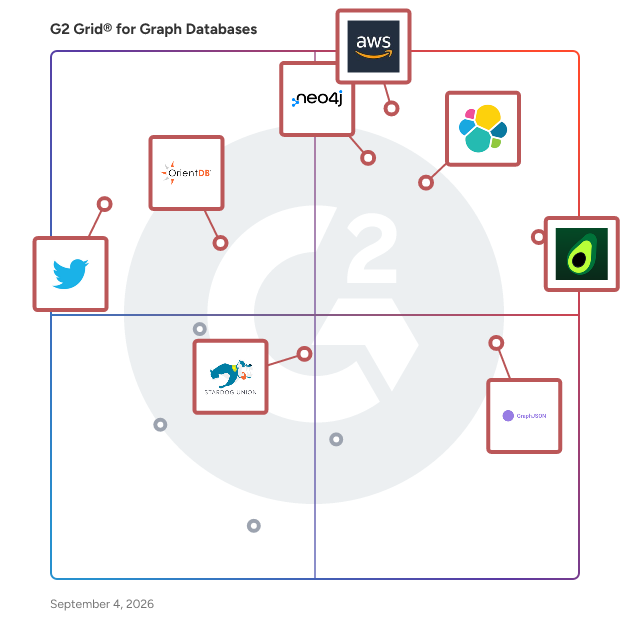
G2 takes pride in showing unbiased reviews on user satisfaction in our ratings and reports. We do not allow paid placements in any of our ratings, rankings, or reports. Learn about our scoring methodologies.
A weekly snapshot of rising stars, new launches, and what everyone's buzzing about.
Amazon Neptune is a fast, reliable, fully-managed graph database service that makes it easy to build and run applications that work with highly connected datasets. The core of Amazon Neptune is a purp
Arango provides a trusted data foundation for Contextual AI — transforming enterprise data into a System of Context that truly represents the business, so LLMs can deliver better outcomes with unlimit
See the Value in Your Data. Flexible analytics and visualization platform. Real-time summary and charting of streaming data. Intuitive interface for a variety of users. Instant sharing and embedding o
Serverless, self-serve and affordable analytics designed to help you get the most out of your data.
The fastest path to graph. Centered around the leading native graph database, today's Neo4j Graph Data Platform is a suite of applications and tools helping the world make sense of data. The Platfor
DataStax is the company that powers generative AI applications with real-time, scalable data and production-ready vector data tools that generative AI applications need, and seamless integration with
OrientDB is the first Multi-Model Distributed DBMS with a True Graph Engine. Multi-Model means 2nd generation NoSQL able to manage complex domain with incredible performance. OrientDB manages relation
TigerGraph is the only scalable graph database for the enterprise. Based on the industry’s first Native and Parallel Graph technology, TigerGraph unleashes the power of interconnected data, offering o
FlockDB is simpler than other graph databases because it tries to solve fewer problems. It scales horizontally and is designed for on-line, low-latency, high throughput environments such as web-sites.
Dgraph is the world's most advanced GraphQL database with a graph backend. The number one graph database on GitHub and over 500,000 downloads every month, Dgraph is built for performance and scalabili
Discover powerful SharePoint Solutions for your business needs. From document management to team collaboration, our expert team can customize SharePoint to fit your unique requirements. Contact us t
GraphQL is a query language for APIs and a runtime for fulfilling those queries with your existing data. GraphQL provides a complete and understandable description of the data in your API, gives clien
GraphBase is a second generation Graph Database Management System (DBMS). Built for 21st Century data problems, GraphBase is a game-changer when it comes to handling large, complex data structures.
Stardog is a reusable, scalable knowledge graph platform that enables enterprises to unify all their data, including data sources and databases of every type, to get the answers needed to drive busine
Cayley is an open-source graph written in Go inspired by the graph database behind Freebase and Google's Knowledge Graph.
Graph databases are designed for depicting relationships (edges) between data points (nodes). Less structurally rigid than relational databases, graph databases allow nodes to have a multitude of edges; that is, there’s no limit on the number of relationships a node can have. (An example of this is in the following section.) Additionally, each edge can have multiple characteristics which define it. There is no formal limit—nor standardization—on how many edges each node can have, nor how many characteristics an edge can have. Graph databases can also contain many different pieces of information that would not necessarily be normally related.
Each node is defined by pieces of information called properties. Properties could be names, dates, identification numbers, basic descriptors, or other information—anything that would describe the node itself. Nodes are connected by edges, which can be directed or undirected. Like in mathematical graph theory, an undirected edge is bidirectional; that is, a relationship can be carried from node A to node B, and from node B to node A. A directed edge, however, only carries meaning in one direction, say from node B to node A.
Key Benefits of Graph Databases
Graph databases are ideal for storing and retrieving information that is independent but related in multiple ways. For example, say a user wanted to map a group of friends. Each friend would be a node, with edges between each friend with a characteristic “friends." But, say two of those friends are coworkers; then, their edge would also have a characteristic “coworkers." Edges can get further definition by adding common interests, personal experiences, and so on.
Because graph databases are, by design, most conducive to organizing broad sets of data through which there are not uniform relationships or kinds of data, they can be invaluable tools for social mapping, master data management, knowledge graphing/ontology, infrastructure mapping, recommendation engines, and more. A business could set each node to be one of their products, and let edges draw recommendation relationships based on what product a consumer might buy. It could also map relationships between contacts, departments, and more.
Graph databases are flexible and scalable by design, so a business user would not need to know an exact or complete use case for a graph database before creating it. Expanding a graph database is a matter of adding new nodes and any potential edges which might be associated with them.
Like other databases, graph databases are primarily maintained by a database administrator or team. That said, because of their wide range of coverage, graph databases are often accessed by several organizations within a company. Development, IT, billing, and more would all have valid reasons for needing access to graph databases, pending their assigned uses within the company.
Graph database solutions will typically have the following features.
Database creation and maintenance — Graph databases allow users to easily build and maintain a database(s).
CRUD operations — An acronym for create, read, update, and delete, CRUD operations delineate basic operations of many databases. Graph databases should be able to perform these operations and usually can with similar capability to the most notable CRUD-oriented database type, relational.
Scalability and flexibility — Graph databases can grow and expand with business requirements. Unlike some other database solutions, they can scale more quickly with less worry about strict data organization, relying instead on developing relationships between new and existing nodes.
Simplified querying — Graph databases can skip some larger query complexities, bypassing things like foreign keys, nested queries, and join statements in favor of direct or transitive relationships.
OS compatibility — Graph databases do not require any one specific operating system to run, making them a flexible choice for any operating system.
Security and privacy — As alluded to above, graph databases can struggle with security and privacy situations. They require more strict implementations of security and access measures. Since graph databases are more oriented toward mapping relationships, that structure can also be utilized in ways that could raise privacy concerns, such as revealing a more laid-bare view of a client or customer—and every other potential client or customer to which they are related. Businesses implementing graph databases should take extra care to secure both how these databases are accessed, and the databases themselves.
Data integrity implications — Graph databases simplify the ways in which information relates to other information. In doing so, by shortening or condensing the relationship (as compared to, say, traversing numerous tables in a relational database), it’s particularly vital that all data in a graph database is accurate. One improperly aligned relationship can directly lead to incorrect data, unlike in a relational database where improper data might hit a snag during a nested query, throw an error, and out the issue. So, in using graph databases, data integrity is of particularly high importance.