BUFFL
Who Is the Company Behind BUFFL?
- Seller: Landing Partners
- HQ Location: Zwijnaarde, BE
-
LinkedIn® Page: www.linkedin.com
14 employees on LinkedIn®
Total Products under this Category: 124
Last updated: September 01, 2026
Why You Can Trust G2's Software Rankings:
G2's software rankings are built on verified user reviews, rigorous moderation, and a consistent research methodology maintained by a team of analysts and data experts. Each product is measured using the same transparent criteria, with no paid placement or vendor influence. While reviews reflect real user experiences, which can be subjective, they offer valuable insight into how software performs in the hands of professionals. Together, these inputs power the G2 Score, a standardized way to compare tools within every category.
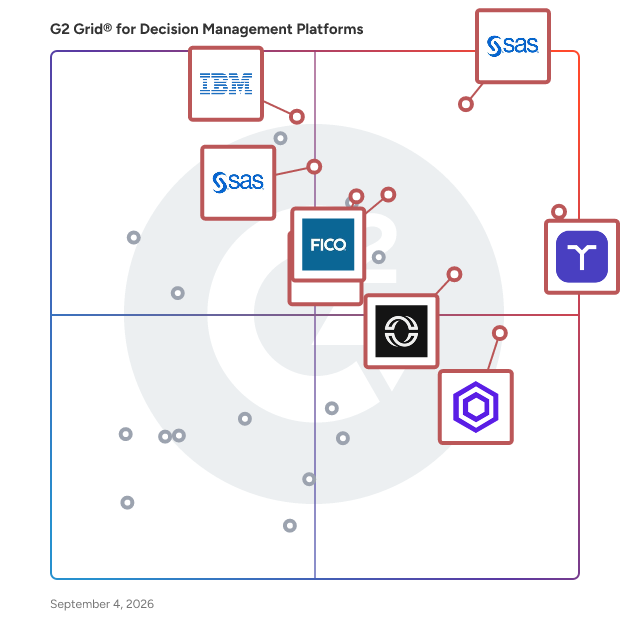
Highlighted products: SAS Viya, Taktile, FICO Decision Management Platform, IBM Operational Decision Manager (ODM), Oscilar, IBM Decision Optimization, DecisionRules, and SAS Intelligent Decisioning.
Underlying data: [Grid® JSON](https://www.g2.com/categories/decision-management-platforms/grids.json?focus%5B%5D=sas-sas-viya&focus%5B%5D=taktile&focus%5B%5D=fico-decision-management-platform&focus%5B%5D=ibm-operational-decision-manager-odm&focus%5B%5D=oscilar&focus%5B%5D=ibm-decision-optimization&focus%5B%5D=decisionrules&focus%5B%5D=sas-intelligent-decisioning)
Leaders in causal AI multi-horizon prediction tools.
Code Effects is a commercial business rules engine built for .NET applications, in production since 2009. It's designed for teams that need business logic — eligibility, pricing, approvals, compliance, routing — to be editable by non-developers without sacrificing the reproducibility and auditability that regulated environments require. Rules are authored through a visual, no-code rule editor and compiled to RuleXML, which the engine evaluates deterministically inside your own .NET runtime: the same rule and the same data always produce the same result, with no dependency on external services, model versions, or inference costs. Every condition, calculation, and action is traceable at evaluation time via a TracerDelegate, which teams can run in production as a self-hosted audit log. Code Effects v6 adds AI-assisted rule authoring: Prompted rule elements let an LLM (OpenAI, Anthropic, Gemini, or a self-hosted model) contribute a value — a fraud-probability estimate, a document classification, a sentiment score — that becomes a field the rest of the rule evaluates deterministically. This lets teams combine the pattern-recognition strengths of AI with the reproducibility guarantees a rules engine provides, rather than choosing one or the other. The engine's schema discovery (Adaptive Source) builds the rule editor's available fields, methods, and datasources directly from your application's own object model via reflection, so the UI stays in sync with your codebase without manual configuration. The same compiled rule can also generate a real LINQ or EF Core SQL WHERE clause for data filtering, reusing rule logic beyond simple pass/fail evaluation. Code Effects is licensed perpetually, by subscription, or as source code, and runs entirely inside your own application — there's no per-evaluation fee, no cloud dependency, and no vendor lock-in tied to a specific AI provider. Best fit for: .NET teams in regulated or compliance-sensitive industries (financial services, insurance, healthcare, government, tax) that need business users to own rule logic without developer involvement for every change, and need to prove exactly why a decision was made — potentially years after the fact.
CO-FOUNDR is a specialized consultancy firm dedicated to empowering founders and board members with advanced AI strategy consulting and decision intelligence services. By integrating cutting-edge artificial intelligence methodologies, CO-FOUNDR assists organizations in navigating complex business landscapes, optimizing decision-making processes, and driving sustainable growth. Key Features and Functionality: - AI Strategy Development: Crafting tailored AI strategies that align with organizational goals and market dynamics. - Decision Intelligence: Enhancing decision-making capabilities through data-driven insights and predictive analytics. - Customized Consulting Services: Providing bespoke solutions to address unique challenges faced by founders and boards. - Implementation Support: Assisting in the seamless integration of AI solutions into existing business processes. - Continuous Learning: Offering ongoing education and resources to keep clients abreast of AI advancements. Primary Value and Solutions Provided: CO-FOUNDR addresses the critical need for informed, strategic decision-making in today's rapidly evolving business environment. By leveraging AI-driven insights, the firm enables leaders to make data-backed decisions, identify growth opportunities, and mitigate risks effectively. This approach not only enhances operational efficiency but also fosters innovation and competitive advantage, ensuring long-term success for organizations.
Corridor Platforms is a leading decision workflow governance and automation capability designed by industry veterans to rapidly transform risk and marketing decisioning at banks, enabling them to leverage new data, AI and automation to create competitive excellence in revenue growth, risk control and operating efficiency in the age of digitization.
CoSt is an AI-driven Growth Decision Engine designed to help businesses identify and prioritize their most impactful growth opportunities within a 30-day timeframe. Unlike traditional audits that often present extensive lists of recommendations without clear prioritization, CoSt delivers a single, high-leverage action plan tailored to a company's specific needs. This approach streamlines decision-making and accelerates the implementation of strategies that drive measurable results. The core functionality of CoSt revolves around its ability to analyze a company's existing audits, consultant reports, or heatmap reviews and distill them into one decisive action. This process is completed in approximately six minutes, providing a rapid yet thorough evaluation. The output includes: - **Primary Bet**: A prioritized recommendation that represents the highest-impact action to be taken in the next 30 days. This recommendation is backed by a detailed rationale, ensuring that businesses understand the reasoning behind the suggested action. - **Kill List**: A comprehensive list of alternative strategies that were considered and rejected, accompanied by specific reasons for their exclusion. This feature ensures transparency and helps businesses avoid less effective or potentially detrimental actions. - **Execution Assets**: Ready-to-use materials such as rewritten hero copy, ad variants, email content, and landing page copy. These assets are designed to facilitate immediate implementation of the recommended strategy, saving time and resources. CoSt's analysis is structured into an 11-stage pipeline that includes: 1. **ICP (Ideal Customer Profile) and Brand Analysis**: Identifying the target audience and understanding the brand's positioning. 2. **Market and Diagnosis**: Evaluating competitive landscapes and diagnosing growth blockers, messaging failures, and trust gaps. 3. **Roadmap and Opportunities**: Scoring and ranking potential opportunities based on impact, feasibility, speed, and confidence. 4. **Scoring and Bets**: Selecting the primary bet with considerations for urgency and potential downsides if the action is incorrect. 5. **Execution and Allocation**: Providing execution assets and budget allocation recommendations to support the implementation of the primary bet. CoSt is particularly beneficial for businesses that have undergone extensive audits or consultations but remain uncertain about the next steps. By focusing on a single, high-impact action and providing the necessary tools for execution, CoSt simplifies the decision-making process and enhances the likelihood of achieving significant growth within a short period. For agencies, CoSt offers an Agency Pack that includes multiple runs at a discounted rate, allowing them to deliver high-quality strategic decisions to their clients efficiently. Each run provides a full analysis, including execution assets, making it a valuable tool for agencies managing multiple client accounts. In summary, CoSt stands out by transforming complex and often overwhelming audit findings into a clear, actionable strategy. Its emphasis on prioritization, transparency through the Kill List, and provision of execution assets make it a practical solution for businesses seeking to implement effective growth strategies promptly.
Decisimo simplifies business decision-making with its intuitive platform. Create, update, and deploy rule sets or decision tables tailored to your needs using a drag-and-drop builder. Key features include incorporating AI, machine learning models, and external data via REST APIs. It excels in batch processing tasks like client segmentation, prescoring, and can fetch data from various sources including FTP, Google Cloud, or S3 buckets. Regional endpoint deployment ensures fast responses while adhering to data protection laws. Robust unit testing ensures reliability in decisions.
decision.ezee is a configurable business rules and decision engine that centralizes rule management and automates operational decisioning across customer-facing and back-office workflows for enterprises and regulated organizations. With a zero-code/low-code rule authoring interface, versioning, testing, and audit trails, business teams can author, simulate, and deploy business rules and policies without heavy engineering effort, ensuring decisions remain aligned with evolving regulations. The platform embeds decision automation via APIs and data integrations to deliver real-time recommendations, automated routing, scoring, and policy checks as native process steps, reducing manual intervention and operational risk. Designed to scale with transaction volume and complex use cases, decision.ezee preserves consistency and explainability while offering role-based access, compliance controls, and financial-grade security. Common applications include credit and underwriting rules, fraud scoring, eligibility and pricing logic, and workflow triage. By turning policy into enforceable, auditable automation, decision.ezee accelerates processing, improves decision quality, and strengthens governance.
decisionpoint.io is a web-based implementation of the Analytic Hierarchy Process, the structured decision-making method developed by Thomas Saaty. Define a goal, criteria, and alternatives; work through pairwise comparisons on the standard 1–9 scale (fractional values supported); and get calculated priorities with consistency ratios, including automated suggestions for fixing inconsistent judgments. Group AHP works in two modes. Workshop mode lets invited participants each enter their own judgments and see the combined result (geometric-mean aggregation) — suited to teams and expert panels. Survey mode generates a single shareable link that respondents can open without creating an account; respondents answer once and never see other responses or results, and the researcher gets per-respondent consistency ratios and aggregated weights — suited to community engagement and multi-expert studies. Criteria-only surveys are supported for studies that need weights without alternatives. Results include priority charts, sensitivity analysis, and downloadable tables and figures. Decisions can be shared publicly via a link. Free tier for individual use; paid plan adds collaboration, group/survey features, sensitivity analysis, and exports. Runs in the browser; no installation.
Real-time operational AI engine that transforms raw enterprise data into actionable decisions, automating complex business logic and driving strategic workflows instantly.
Decision AI for Chiefs of Staff, Strategy, and Leadership Teams - purpose-built for Consumer Businesses. Bad decisions are the most expensive line item in any organisation. And yet, there is no infrastructure built for the decision itself. In most organisations, context lives in CRMs, decks, dashboards, and people's heads. Strategy teams spend marathons of meetings and analyst sprints stitching it together — reconstructing the same picture, every time. By the time clarity arrives, the window is gone. Signals surface late. We're building Decision AI - the infrastructure that helps organisations make high-quality decisions, faster. Self-learning, with a Unified Context Layer and Multi-Agent Architecture that gets smarter with every decision your organisation makes. Over 26,000 + decisions across consumer businesses powered. We're just getting started.
