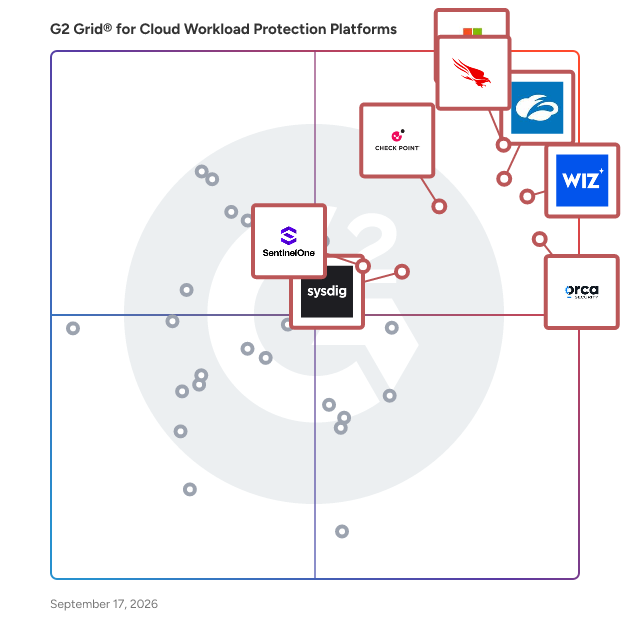
G2 takes pride in showing unbiased reviews on user satisfaction in our ratings and reports. We do not allow paid placements in any of our ratings, rankings, or reports. Learn about our scoring methodologies.
A weekly snapshot of rising stars, new launches, and what everyone's buzzing about.
Wiz transforms cloud security for customers – including more than 50% of the Fortune 100 – by enabling a new operating model. With Wiz, organizations can democratize security across the developme
Sysdig Secure is the real-time cloud-native application protection platform (CNAPP) trusted by organizations of all sizes around the world.. Built by the creators of Falco and Wireshark, Sysdig unique
The Orca Cloud Security Platform identifies, prioritizes, and remediates risks and compliance issues in workloads, configurations, and identities across your cloud estate spanning AWS, Azure, Google C
CloudGuard Network Security is a comprehensive cloud security solution designed to protect public, private, and hybrid cloud environments from a wide array of cyber threats. This platform focuses on d
In today's complex digital landscape, securing your cloud environment is paramount. The management and security of your hybrid and multi-cloud setup pose increasing challenges. Trend's Cloud Security
CloudGuard CNAPP provides you with more context to drive actionable security and smarter prevention, from code-to-cloud, across the application lifecycle. CloudGuard’s prevention-first approach prote
Microsoft Defender for Cloud is a cloud native application protection platform for multicloud and hybrid environments with comprehensive security across the full lifecycle, from development to runtime
Falcon Cloud Security unifies visibility and posture with AI-driven insights, empowering you to quickly investigate threats, prioritize risk with precision, and stop breaches before they happen. -
Cloud Platform Security Overview allows users to deploy on an infrastructure protected by top experts in information, application, and network security.
Singularity Cloud Security is SentinelOne’s comprehensive, cloud-native application protection platform (CNAPP). It combines the best of agentless insights with AI-powered threat protection, to secure
Simplify your data infrastructure—from the edge to the core to the cloud—with the industry's leading enterprise data management software.
FortiCNAPP (formerly Lacework) is an AI-powered Cloud-Native Application Protection Platform that delivers unified security across your multi-cloud and hybrid environments. Built to protect the entire
ARMO Platform is the only runtime-driven, open-source first, cloud security platform. It is the only security platform that continuously minimizes cloud attack surface based on runtime insights, while
AWS Control Tower automates the set-up of a baseline environment, or landing zone, that is a secure, well-architected multi-account AWS environment. The configuration of the landing zone is based on b
InsightVM is Rapid7’s vulnerability risk management offering that advances security through cross-department clarity, a deeper understanding of risk, and measurable progress. By informing and aligning
Cloud workload protection is not a very intuitive term and likely sounds alien to people who do not operate cloud infrastructure. However, individuals that work frequently with cloud infrastructure are probably somewhat familiar with cloud workload protection. For context, cloud workload protection is typically described as a family of workload-centric security solutions designed to secure on-premises, physical, and virtual servers along with a range of infrastructure as a service (IaaS) providers and applications. Cloud workload protection platforms are an evolution of endpoint protection solutions designed specifically for server workloads.
Cloud workload protection solutions provide users with automated discovery and broad visibility of workloads deployed across cloud service providers. In addition to providing visibility, these tools protect individual workloads with malware protection, vulnerability scanning, access control, and anomaly detection features. Malware and vulnerability scanning are often paired with automated remediation or patching features to simplify and scale workload management. The platforms also provide access control through privilege management and micro-segmentation. However, their most interesting feature might be behavior monitoring powered by machine learning that discovers errors or unexpected changes. This makes it harder for threat actors and nefarious insiders to alter workloads, policies, or privileges. Once detected, access can be automatically restricted and reverted to its previous state.
Key Benefits of Cloud Workload Protection Platforms
Cloud workload protection platforms provide numerous benefits, the most important being automated scaling, workload hardening, cross-cloud security management, anomaly detection, and response functionality.
Automation and efficiency — Cloud workload protection platforms automate a number of security operations related to the cloud. The first is discovery; after workloads are discovered, these platforms scale to protect large numbers of workloads and identify their unique security requirements. These platforms automatically detect new workloads and scan them for vulnerabilities. They can also automate the detection and response of security incidents.
Automation can save significant time for security teams, especially those that are tasked with protecting DevOps pipelines. These environments are constantly changing and need adaptable security solutions to protect them no matter their state. Some automation features may only be available through APIs and other integrations, but nonetheless simplify numerous tasks for IT professionals, engineers, and security teams.
Multicloud management — No two multicloud environments are alike. Multicloud architectures are complex, intricate environments that span across on-premises servers and cloud providers to deliver powerful, scalable, and secure infrastructure. Still, their inherent complexity can present challenges to security teams. Each workload has its own requirements and cloud workload protection platforms provide a single pane of glass and automated discovery to ensure no workload goes unprotected or unnoticed.
Different workloads may run on different operating systems or possess different compliance requirements. Regardless of the countless variations in security needs, these platforms can adapt to changes and enable highly customizable policy enforcement to protect a wide range of workloads.
Monitoring and detection — Workload discovery is not the only monitoring feature provided by cloud workload protection platforms. Their most important monitoring capability is behavioral monitoring used to detect changes, misuse, and other anomalies automatically. These platforms can harden workloads by detecting exploits, scanning for vulnerabilities, and providing next-generation firewalls. Still, prevention is only the first phase of cybersecurity. Once protection is in place, baselines must be measured and privileges must be distributed.
Any activity deviating from the established baselines should be detected and administrators should be alerted. Depending on the nature of the threat, various response workflows can be established to remedy the issue. Servers might require endpoint detection and response while applications require processes to be blocked. Regardless of the issue, threats should be modeled and workflows should be designed accordingly.
Cloud workload protection platforms can provide a wide range of features, but here are a few of the most common found in the market.
Cloud gap analytics — This feature analyzes data associated with denied entries and policy enforcement, giving information for better authentication and security protocols.
Cloud registry — Cloud registries detail the range of cloud service providers a product can integrate with and provide security for.
Asset discovery — Asset discovery features unveil applications in use and trends associated with traffic, access, and usage.
Governance — User provisioning and governance features allow users to create, edit, and relinquish user access privileges.
Logging and reporting — Log documentation and reporting provides required reports to manage business. Provides adequate logging to troubleshoot and support auditing.
Data security — Data protection and security features help users manage policies for user data access and data encryption.
Data loss prevention (DLP) — DLP stores data securely either on-premise or in an adjacent cloud database to prevent loss of data.
Security auditing — Auditing helps users analyze data associated with security configurations and infrastructure to provide vulnerability insights and best practices.
Anomaly detection — Anomaly detection is conducted by constantly monitoring activity related to user behavior and compares activity to benchmarked patterns.
Workload diversity — Diverse workload support would imply a cloud security solution that supports a range of instance types from any number of cloud service providers.
Analytics and machine learning — Analytics and machine learning improve security and protection across workloads by automating network segmentation, malware protection, and incident response.