
Introducing G2.ai, the future of software buying.Try now

Ad Creation

by Kelly Fiorini
Ad creation is the process of designing ads to promote a brand or product. Learn more about the steps involved and why it’s important to create ads.

What is ad creation?

Ad creation is the process of developing advertisements to promote a company or its products. Once created, ads can help a business promote a brand, generate leads and sales, and shape its image.

Many types of advertisements can be created. Traditional print ads typically appear in magazines, newspapers, directories, mailers, and brochures. Digital ads are shown on television and the internet. Types of digital ads include image ads, video ads, text ads, and search ads.

Once a company has a marketing strategy in place, it can begin to work on creating ads. In today’s digital world, software exists to help with both ad design and social media advertisement creation. Social media advertising software assists companies in placing ads on sites such as Facebook, Twitter, and LinkedIn to quickly and easily design and create personalized advertisements.

Ad creation steps

There are eight main steps involved in effective ad creation. These steps are:

  • Identify a target customer. Be as specific as possible about who the audience is. Many companies create a “buyer persona,” a profile of a target customer based on research and data. For example, if you are a home security company, a target customer might be a single person who lives in a high-crime area or a high-income family in a suburb.
  • Conduct market research. Thoroughly research the target audience’s demographics, preferences, and habits. With this audience analysis, a business can create better ad campaigns.
  • Select an ad type. Multiple types of ads exist across various platforms. For example, on some social network platforms, a company can create image ads, video ads, text ads, carousel ads, or banner ads. Choose an ad type to appeal to the target customer.
  • Craft a message. A powerful message establishes a brand as a unique voice in the marketplace. Consider how to make the message memorable and a driving force to achieve campaign objectives.
  • Choose creative elements. The right promotional text, images, and videos will grab the audience’s attention. A company may want to enlist the help of a copywriter and a graphic designer to create a custom advertisement.  
  • Add a call-to-action. The call-to-action (CTA) tells the customer what to do next. For instance, the CTA can direct the customer to click to learn more or call to purchase. A CTA should contain clear, concise, and persuasive language.
  • Publish the ad. Once the ad has been created, launch the ad across intended platforms.
  • Monitor and assess performance. Finally, a crucial step in the ad creation process is monitoring the ad’s performance. Analyze whether it is meeting campaign objectives, and make changes to the ad as necessary.

Basic elements of ad creation

A few guiding principles are important to keep in mind when creating ads that appeal to the audience and drive sales.
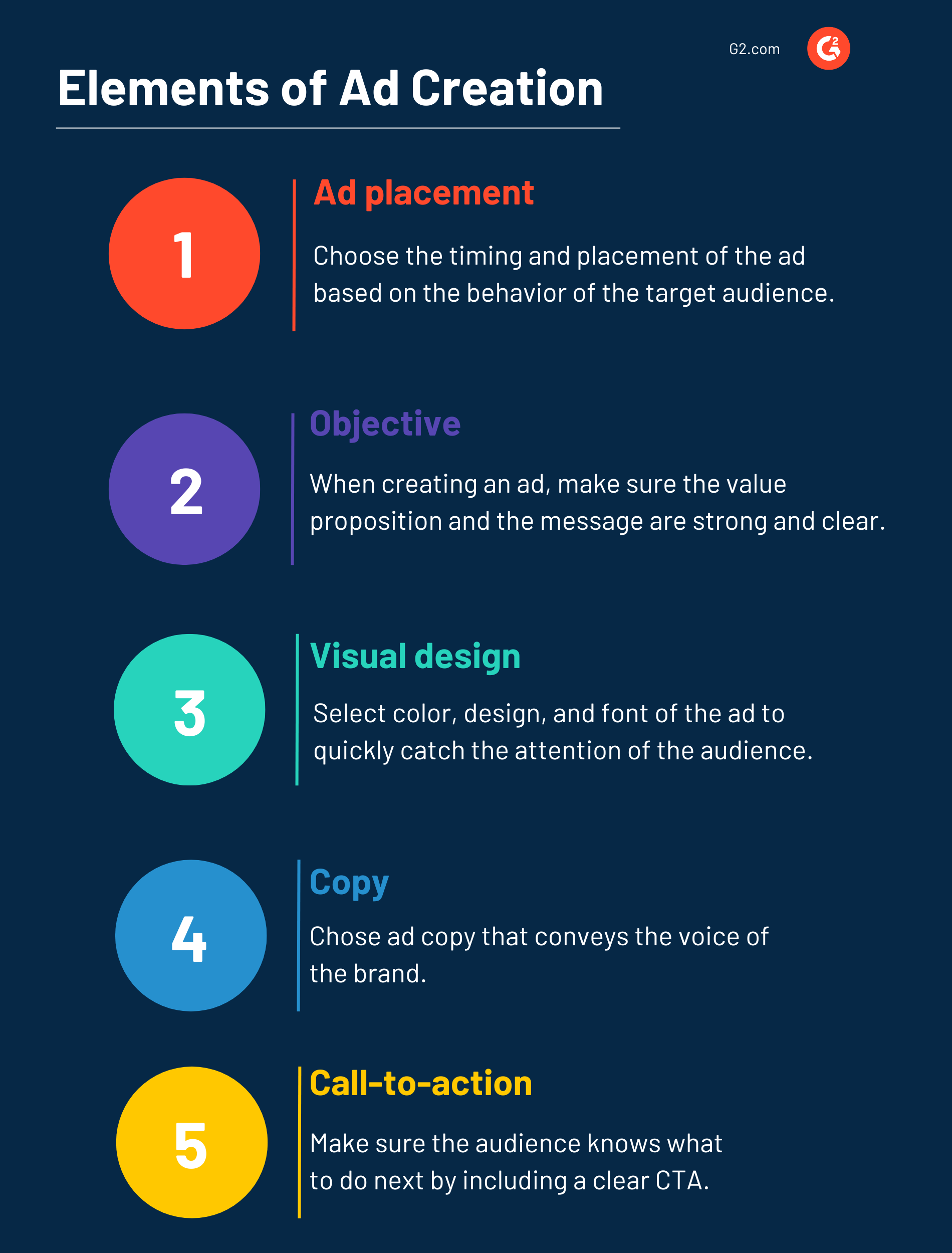
Elements of Ad Creation

These elements include:

  • Ad placement: For an ad to be successful, it must be seen or heard by as many potential customers as possible. Consider the target customer’s likes, habits, and patterns. Then choose a platform—and timing—accordingly.
  • Objective: The best ads quickly convey their message. When creating an ad, make sure the value proposition is strong and clear.
  • Visual design: The design and layout of visual ads should catch the audience’s attention quickly. Select colors, images, fonts, and media that will appeal to the viewers and draw them into the ad.
  • Copy: Word choice is important in ad creation. The ad’s copy should convey the brand’s voice. Make each word count and write in a voice suitable for the brand.
  • Call-to-action: As stated, an ad isn’t complete without a CTA. Make sure the audience knows what to do next. This may be a button to click or a number to call.

Benefits of ad creation

With time and effort, ad creation can lead to many benefits for a company in brand recognition and reach and product sales. Notably, ad creation:

  • Increases brand recognition. Creating and publishing ads helps increase brand awareness in the marketplace. Every time viewers see an ad, the brand’s name, message, and logo becomes more ingrained in their minds. 
  • Helps showcase new products and services. When a company starts offering new products or services, it will often design ads to let the target audience know. Showcasing new products and services is important for both gaining new customers and piquing the interest of existing ones.
  • Attracts new customers. Without awareness of a product or service, potential customers may not know that the solution exists. Ad creation lets audiences know what a company has to offer. 
  • Boosts sales. Because ad creation helps a business attract new customers, it can also increase sales volume. A well-designed ad with smart placement can increase a company’s return on investment (ROI).
  • Makes a company stand out from competitors. A product from one brand might have important features that set it apart from similar products in the marketplace. Ad creation can help a company highlight these features.

Ad creation best practices

To make sure that ad creation is successful, it is important to keep best practices in mind to ensure the best return on investment. Some of these best practices include:

  • Focus on goals. Keep the campaign’s objectives at the forefront. Create ads that will result in the company’s desired outcome.
  • Favor minimalistic design. Many consumers today skim ads in just seconds. Avoid wordy, complicated language and cluttered visuals. 
  • Stay on-brand. Consider using brand colors, fonts, and messaging that the audience will identify as fitting with the company’s image.
Kelly Fiorini
KF

Kelly Fiorini

Kelly Fiorini is a freelance writer for G2. After ten years as a teacher, Kelly now creates content for mostly B2B SaaS clients. In her free time, she’s usually reading, spilling coffee, walking her dogs, and trying to keep her plants alive. Kelly received her Bachelor of Arts in English from the University of Notre Dame and her Master of Arts in Teaching from the University of Louisville.

Ad Creation Software

This list shows the top software that mention ad creation most on G2.

Artificial Intelligence powered ad creative and banner generator for better conversion rates.

BannerBoo is a graphic design software that helps users to create professional looking display banners in multiple sizes.

The marketing platform that helps you create and optimize ads in minutes so you can focus on what really matters - your business.

The best way to automate social media advertising.

upRive is a Facebook marketing platform that utilizes reusable marketing tactics and automation to create ads, audiences and campaigns more efficiently to drastically improve your Facebook marketing long term results.

Google Ads is an online advertising platform developed by Google that enables businesses to display brief advertisements, service offerings, product listings, and videos to web users. These ads can appear across various Google properties, including search results, partner sites, mobile apps, and videos. Operating primarily on a pay-per-click (PPC) and cost-per-view (CPV) pricing model, Google Ads allows advertisers to target specific audiences based on keywords, demographics, and user behavior. Key Features and Functionality: - Diverse Ad Formats: Offers text ads, image ads, video ads, and shopping ads, allowing businesses to choose the format that best suits their marketing objectives. - Targeting Capabilities: Enables precise targeting through keywords, location, language, device type, and audience interests, ensuring ads reach the most relevant users. - Performance Tracking: Provides detailed analytics and reporting tools to monitor ad performance, measure return on investment (ROI), and optimize campaigns accordingly. - Budget Control: Allows advertisers to set daily budgets and adjust bids, offering flexibility to manage advertising expenses effectively. - Integration with Google Services: Seamlessly integrates with other Google services like Google Analytics and Google Merchant Center, enhancing campaign management and performance insights. Primary Value and User Solutions: Google Ads empowers businesses to increase their online visibility, attract potential customers, and drive sales by placing their offerings in front of users actively searching for related products or services. By leveraging Google's extensive network and advanced targeting options, advertisers can reach a broad yet relevant audience, leading to higher engagement and conversion rates. The platform's comprehensive analytics enable continuous optimization, ensuring marketing efforts are both effective and cost-efficient.

The Brief is an AI-driven creative automation platform that helps businesses and agencies easily create, personalize, scale, and serve effective ads.

Metadata is the only AI campaign execution platform for B2B marketers. Metadata’s patented technology executes thousands of B2B campaigns in a matter of hours, automatically optimizing campaigns for pipeline impact at a velocity that is not humanly possible.

Google Web Designer is a free, professional-grade tool developed by Google for creating interactive HTML5-based designs and motion graphics that can run seamlessly across various devices. It empowers users to design and build engaging content, such as advertisements and web pages, without requiring extensive coding knowledge. The platform offers a user-friendly interface that combines visual design tools with the flexibility to edit HTML, CSS, and JavaScript directly, catering to both designers and developers. Key Features and Functionality: - Animation Tools: Users can create animations using two modes: Quick mode for scene-based animations and Advanced mode for timeline-based animations with layers. Motion paths and custom easing provide precise control over animations. - 3D Content Creation: The tool supports the creation and manipulation of 3D content using CSS3, allowing for the rotation and transformation of objects along any axis. - Responsive Design: Google Web Designer enables the creation of responsive ads and web content that adapt to different screen sizes and orientations, ensuring a consistent user experience across devices. - Interactive Components: The platform includes a variety of built-in components, such as image galleries, video players, and maps, which can be easily integrated to enhance interactivity. - Google Integrations: Seamless integration with other Google products, including Google Ads, Display & Video 360, and Google Drive, facilitates efficient workflows and direct publishing of content. - Code Editing: For users with coding expertise, the Code View allows direct editing of HTML, CSS, and JavaScript, with features like syntax highlighting and code autocompletion to streamline the coding process. Primary Value and User Solutions: Google Web Designer addresses the need for a versatile and accessible tool to create rich, interactive web content without the steep learning curve associated with traditional coding. By offering a blend of visual design capabilities and code editing flexibility, it caters to both designers seeking intuitive design tools and developers requiring precise control over code. The platform's support for responsive design ensures that content is optimized for various devices, enhancing user engagement. Additionally, its integration with Google's advertising and cloud services streamlines the creation, management, and deployment of digital marketing materials, making it a valuable asset for businesses aiming to produce high-quality, interactive web content efficiently.

Creative Automation for Marketing and Advertising allows brands and agencies to efficiently scale content production for global toolkits, performance creative, and market-specific campaigns. Creative Automation for Media is a product for publishers and platforms (such as ad networks and DSPs). It allows media owners and operators to create and activate premium and creative-first ad products.

Software delivers even more imaging magic, new creative options, and the Adobe Mercury Graphics Engine for blazingly fast performance.

Marketing automation software to help you attract the right audience, convert more visitors into customers, and run complete inbound marketing campaigns at scale — all on one powerful, easy-to-use CRM platform.

Facebook for Business is a comprehensive suite of tools and services designed to help businesses of all sizes establish a strong online presence, engage with their target audience, and drive growth through the Facebook platform. By leveraging Facebook's vast user base, businesses can create customized pages, run targeted advertising campaigns, and utilize various features to showcase their products and services effectively. Key Features and Functionality: - Business Pages: Create and manage dedicated pages to represent your brand, share updates, and interact with customers. - Advertising Tools: Develop and execute targeted ad campaigns using Facebook's advanced targeting options to reach specific demographics and interests. - Facebook Shops: Set up an online storefront directly on Facebook, allowing customers to browse and purchase products without leaving the platform. - Messenger Integration: Communicate with customers in real-time through Facebook Messenger, providing support and building relationships. - Analytics and Insights: Access detailed performance metrics to understand audience behavior and optimize marketing strategies. Primary Value and Solutions: Facebook for Business empowers companies to connect with a global audience, increase brand visibility, and drive sales through a user-friendly platform. It addresses common business challenges such as limited reach, customer engagement, and online sales by providing tools that facilitate targeted marketing, direct communication, and seamless e-commerce integration. By utilizing Facebook for Business, companies can effectively promote their offerings, engage with customers, and achieve their business objectives in a cost-effective manner.

LinkedIn Marketing Solutions is a comprehensive suite of advertising tools designed to help businesses effectively reach and engage a professional audience on the world's largest professional network. By leveraging LinkedIn's unique data and targeting capabilities, companies can generate leads, drive website traffic, and build brand awareness among a community of over 1 billion professionals worldwide. Key Features and Functionality: - Sponsored Content: Create media-rich ads that appear directly in the LinkedIn feed, allowing for seamless integration with users' professional content consumption. - Sponsored Messaging: Send personalized messages to your target audience through LinkedIn Messaging, facilitating direct and meaningful engagement. - Dynamic Ads: Utilize LinkedIn profile data to deliver personalized ads at scale, featuring elements like the recipient's company name or job title for increased relevance. - Text Ads: Develop self-service, pay-per-click desktop ads that can be created quickly, offering a cost-effective way to reach your audience. - Advanced Targeting: Reach the right professionals based on industry, seniority, job function, and more, ensuring your message resonates with the intended audience. - Analytics and Reporting: Measure the true impact of your LinkedIn ads with comprehensive analytics, allowing for optimization and improved return on investment. Primary Value and Solutions Provided: LinkedIn Marketing Solutions empowers businesses to connect with a highly qualified and engaged professional audience, making it particularly effective for B2B marketing efforts. By offering precise targeting options and a variety of ad formats, it enables companies to tailor their campaigns to specific objectives, whether it's lead generation, brand awareness, or driving website traffic. The platform's integration with LinkedIn's extensive professional data ensures that marketing efforts are directed toward the most relevant and valuable prospects, enhancing the efficiency and effectiveness of advertising campaigns.

AdScale is an AI-driven advertising platform designed to empower eCommerce businesses by automating and optimizing their advertising campaigns across major channels like Google and Meta. By integrating directly with platforms such as Shopify and BigCommerce, AdScale leverages real-time data to enhance targeting, creative generation, and budget allocation, enabling merchants to achieve higher returns on ad spend with reduced manual effort. Key Features and Functionality: - Automated Campaign Creation: AdScale simplifies the process of launching campaigns by automatically generating ads across Google, Facebook, and Instagram, utilizing content and data directly from the merchant's store. - AI-Powered Optimization: The platform continuously monitors and adjusts campaigns 24/7, optimizing bids, budgets, and audience targeting to maximize performance and minimize waste. - Predictive Budget Allocation: AdScale employs predictive modeling to dynamically allocate budgets between Google and Meta, focusing spend where it is expected to yield the highest returns. - Creative Automation: The system generates and tests multiple ad variations, including images, videos, and copy, selecting the best-performing creatives for each placement. - Smart Audience Building: By analyzing store data and customer behavior, AdScale constructs targeted audience segments, enhancing the relevance and effectiveness of advertising efforts. - Unified Reporting Dashboard: Merchants gain access to a comprehensive dashboard that consolidates performance metrics from all advertising channels, providing clear insights into campaign effectiveness. Primary Value and Solutions Provided: AdScale addresses the complexities of managing multi-channel advertising campaigns by offering an all-in-one solution that automates critical tasks such as campaign creation, optimization, and reporting. This automation not only saves time and reduces the need for extensive marketing expertise but also enhances the efficiency and effectiveness of advertising efforts. By leveraging AI to analyze data and make informed decisions, AdScale helps eCommerce businesses increase their return on ad spend, reach the right audience at the right time, and scale their operations more effectively.

Mailchimp is the #1 Email Marketing and Automations platform for growing businesses. More than 12 Million businesses including TEDTalks, Shutterstock, Boston Market, Nikon India trust Mailchimp to turn their emails into revenue.

Skai is a global software platform for brands and agencies looking to manage, automate, and optimize digital advertising at scale across paid search, paid social, retail media, and apps.