Codility is a technical and AI skills assessment platform built on documented assessment science. For almost two decades it has helped engineering and talent teams answer one question with evidence: who can actually do the work. Every task is designed by occupational psychologists, mapped to the Codility Engineering Skills Model, and monitored for adverse impact at every measured cut score. When a result is challenged, the methodology behind it is documented and reviewable.
Three products run on that foundation. Screen delivers standardized early technical signal at scale. Interview runs structured live technical interviews in a real engineering environment. Skills Intelligence maps and grows verified technical capability across the engineers an organization already employs. Hiring and workforce share one evaluation model, so an external candidate and an internal engineer are measured the same way.
Screen assesses candidates asynchronously against a library of 1,300+ validated tasks spanning real-world work simulations, project-based work, algorithmic problems, coding, and SQL, across 80+ languages and frameworks including Python, Java, JavaScript, TypeScript, C#, Go, Rust, Kotlin, React, Angular, Vue.js, Spring Boot, Django, Terraform, Kubernetes, Spark, and TensorFlow. Scoring is automatic on supported task types, with candidate comparison, configurable time limits, and role-specific weighting.
Interview runs live technical interviews in a shared VS Code environment with terminal access, sidecar services for databases, caching, and message queues, a collaborative whiteboard, rubric scoring, and a full session transcript and recording. Engineering teams watch a candidate think, debug, and build. Talent teams get a repeatable process and session playback after every interview.
Skills Intelligence assesses the engineers an organization already has, on the same engine used for hiring. Teams use it to find capability gaps, benchmark proficiency across teams, guide internal mobility, and plan workforce deployment on assessed evidence rather than self-reporting. It runs on the Codility Engineering Skills Model, which covers 30 skills and 180 subskills across five categories and maps to SWEBOK v4, SFIA v9, O*NET, the NIST AI Risk Management Framework, and ISO/IEC 42001, validated by engineering leaders.
AI is part of engineering work now, so Codility assesses how people work with it. The in-assessment AI Assistant is enabled or disabled per assessment, and every candidate interaction is captured as reviewable AI activity. Anthropic's Claude Code runs in the terminal of the Codility assessment environment across Screen, Interview, and Skills Intelligence, with the full interaction saved to the candidate record, so candidates work with the agentic tool they would actually use and the prompts, edits, and corrections stay reviewable afterwards. AI-native tasks put an assistant into the work itself, including tasks where it makes deliberately seeded mistakes the candidate has to catch, verify, and correct, which surfaces judgment about AI output rather than raw code volume. AI Follow-Up Questions check whether a candidate understands the code they submitted, and are deliberately not scored to avoid introducing bias. Model-level and more granular AI controls are on the roadmap.
AI for Business extends the same methodology to every role beyond engineering, and it is available now in Preview. It runs inside Screen or Skills Intelligence on the same assessment engine, scoring, reporting, integrations, and compliance posture, with no separate product to buy. Only the candidate experience and the task library change. A person works alongside the AI Assistant in a simplified writing environment, no code involved, to produce a real deliverable such as a verified report, a prioritization call, or an account brief. The deliverable is scored deterministically against an answer space defined by experts, so no AI grades AI, and every prompt and response is captured as a reviewable record. Tasks run from 20 to 60 minutes and cover marketing, sales, finance, operations, customer support, and product management roles, plus general tasks any employee in any function can take for an organization-wide AI skills baseline.
Integrity controls are layered so a hiring decision holds up when it is questioned. They include identity verification, behavioral signals, deterministic integrity risk scoring, similarity detection, solution paste volume measurement, browser absence and tab switching signals, and code evolution playback. Typing pattern detection, which flags line-by-line retyping from a second screen, and cheating apps detection, which surfaces helper applications that hide from screen capture, are available in Preview. Reviewers see which signals contributed to a risk band, signals route to a human reviewer, and nothing auto-rejects a candidate.
Codility is SOC 2 Type II audited, ISO 27001 certified, GDPR and CCPA compliant, WCAG 2.2 AA accessible, and aligned with EU AI Act requirements for high-risk AI classification. Methodology is documented in a 92-page Technical Manual structured to APA Standards, with adverse impact data at every cut score, the EEOC four-fifths threshold met at every measured cut score, and an independent cApStAn linguistic audit supporting fairness for non-native English speakers. No AI or machine learning is used in automated hiring decisions. Data is hosted in either EU or US regions.
Codility integrates with more than 20 applicant tracking systems (ATS) and scheduling tools including Greenhouse, Workday, SAP SuccessFactors, iCIMS, SmartRecruiters, Lever, Eightfold, and Ashby, with results flowing back into the ATS, plus 80+ human resources information systems (HRIS) integrations for Skills Intelligence. It supports single sign-on (SSO) via SAML 2.0 and offers API access for custom workflows. Codility Professional Services supports taxonomy mapping, rollout design, and pass-score governance for large deployments.
Founded in 2009, Codility is used by engineering, talent, and business teams at Barclays, BMW, Deutsche Bank, GitHub, Samsung, SpaceX, and other organizations assessing technical and AI skills across hiring and existing workforces.
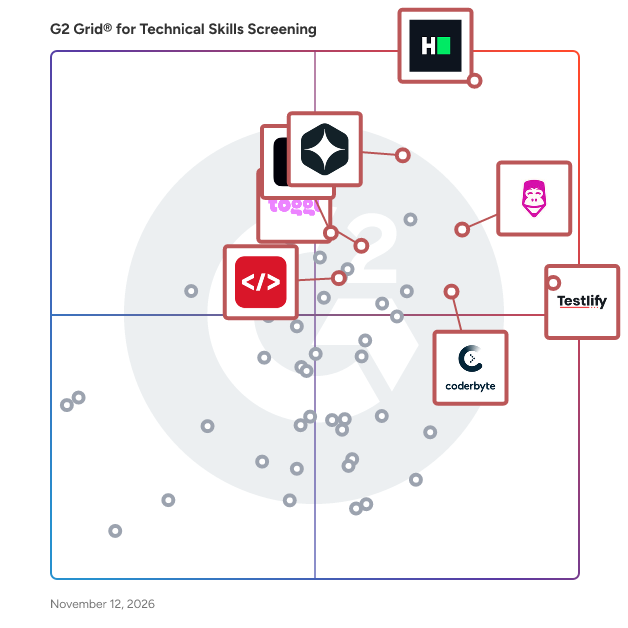
Average Rating: 4.6/5.0
Total Reviews: 494
How Do G2 Users Rate Codility?
-
Has the product been a good partner in doing business?: 9.2/10 (Category avg: 9.3/10)
-
Content Library: 8.5/10 (Category avg: 8.8/10)
-
Technical Screening: 9.2/10 (Category avg: 9.0/10)
-
Coding Development: 8.9/10 (Category avg: 8.7/10)
Who Is the Company Behind Codility?
Who Uses This Product?
-
Who Uses This: Software Engineer, Senior Software Engineer
-
Top Industries: Computer Software, Information Technology and Services
-
Company Size: 39% Large, 32% Small
What Do G2 Reviewers Say About Codility?
AI-generated summary from verified user reviews
Pros
- Users value the ease of use of Codility, appreciating its intuitive interface and seamless setup for coding interviews.
- Users value Codility for its user-friendly coding interface, enhancing the efficiency of technical hiring processes.
- Users value the user-friendly interface of Codility, enhancing the coding interview experience with ease and efficiency.
- Users appreciate Codility for its objective assessments, enhancing confidence in evaluating candidate technical skills accurately.
- Users value the customizability of Codility, tailoring tests and workflows to meet specific business needs seamlessly.
Cons
- Users find difficult navigation in Codility, struggling to locate interview questions and essential features easily.
- Users struggle with the lack of clarity in Codility, complicating the debugging and interview preparation processes.
- Users find difficulty adjusting configurations in Codility's VS Code integration, leading to stress during time-sensitive interviews.
- Users feel that Codility needs to improve on providing a more comprehensive coding experience for real-world tasks.
- Users feel that Codility lacks a Recently Viewed page, making it difficult to find specific interview questions.
What Are G2 Users Discussing About Codility?