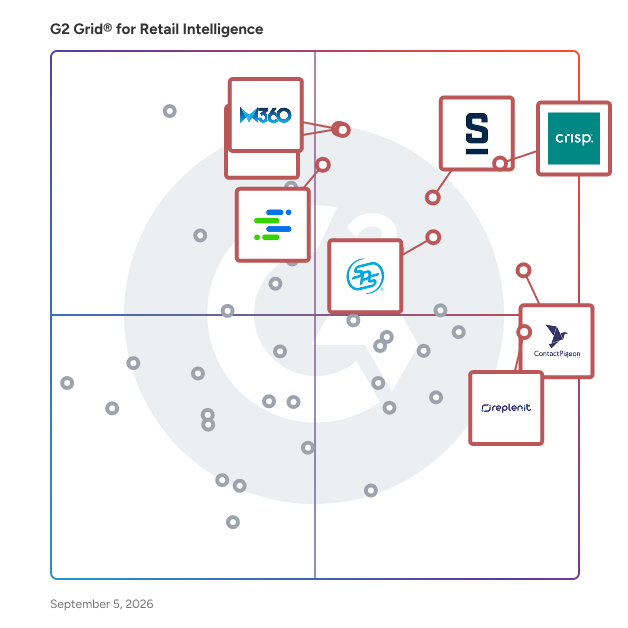
Retail intelligence software helps retailers improve revenue and operations by delivering insights and advanced analytics. This software gathers, manages, and analyzes retail and e-commerce data from multiple sources, such as internal (software such as e-commerce platforms), external (e-commerce marketplaces), and industry benchmarking data provided by third parties.
The data is obtained through integration, parsing, and scraping. Artificial intelligence (AI) and machine learning (ML) are used to clean and analyze data for competitive intelligence, market analysis, brand protection, and pricing optimization.
This type of software is used by retailers that sell online, in-store, and through distribution networks. It can be used in consumer packaged goods (CPG) and durable goods to navigate the high volume of products and transactions.
Retail intelligence software integrates with business intelligence software to help users further analyze the data and create personalized visualizations.
To qualify for inclusion in the Retail Intelligence category, a product must:
- Ingest retail data from sources like POS, ERP, e-commerce, and market data
- Use AI, ML, or advanced analytics to deliver predictive, prescriptive, or autonomous recommendations on pricing, performance, consumer behavior, and competition
- Support real-time or near real-time processing for timely retail decision-making
- Enable or integrate with retail operations systems to drive actions like pricing, staffing, and inventory
- Deliver dashboards and customizable reports to monitor performance
- Optionally include multi-source data fusion, such as IoT, video, or in-store sensors