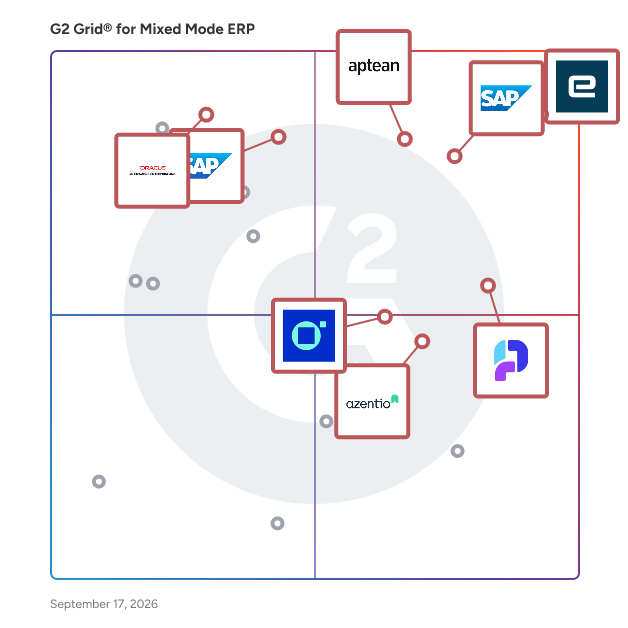
# Best Enterprise Mixed Mode ERP Software

  *By [Nathan Calabrese](https://research.g2.com/insights/author/nathan-calabrese)*

   Products classified in the overall Mixed Mode ERP category are similar in many regards and help companies of all sizes solve their business problems. However, enterprise business features, pricing, setup, and installation differ from businesses of other sizes, which is why we match buyers to the right Enterprise Business Mixed Mode ERP to fit their needs. Compare product ratings based on reviews from enterprise users or connect with one of G2&#39;s buying advisors to find the right solutions within the Enterprise Business Mixed Mode ERP category.

In addition to qualifying for inclusion in the Mixed Mode ERP Software category, to qualify for inclusion in the Enterprise Business Mixed Mode ERP Software category, a product must have at least 10 reviews left by a reviewer from an enterprise business.


## Category Overview

**Total Products under this Category:** 35


## Trust & Credibility Stats

**Why You Can Trust G2's Software Rankings:**

- 30 Analysts and Data Experts
- 3,800+ Authentic Reviews
- 35+ Products
- Unbiased Rankings

G2's software rankings are built on verified user reviews, rigorous moderation, and a consistent research methodology maintained by a team of analysts and data experts. Each product is measured using the same transparent criteria, with no paid placement or vendor influence. While reviews reflect real user experiences, which can be subjective, they offer valuable insight into how software performs in the hands of professionals. Together, these inputs power the G2 Score, a standardized way to compare tools within every category.


## Top-Rated Products (Ranked by G2 Score)
  ### 1. [SAP ECC](https://www.g2.com/products/sap-ecc/reviews)
  Leverage world-class ERP software. Sharpen your competitive edge and drive growth with enterprise resource planning from SAP. With more than 40 years of experience and nearly 50,000 customers, our market-leading enterprise resource planning (ERP) software is a proven, trusted foundation built to support the world۪s largest organizations as well as small and midsize companies in 25 different industries. Leverage role-based access to critical data, applications, and analytical tools and streamline your processes across procurement, manufacturing, service, sales, finance, and HR.


  **Average Rating:** 4.2/5.0
  **Total Reviews:** 857

**User Satisfaction Scores:**

- **Cash Management:** 8.7/10 (Category avg: 8.0/10)
- **Inspections:** 8.6/10 (Category avg: 8.1/10)
- **Quality of Support:** 7.9/10 (Category avg: 7.3/10)
- **Demand:** 8.4/10 (Category avg: 8.3/10)


**Seller Details:**

- **Seller:** [SAP](https://www.g2.com/sellers/sap)
- **Year Founded:** 1972
- **HQ Location:** Walldorf
- **Twitter:** @SAP (297,227 Twitter followers)
- **LinkedIn® Page:** https://www.linkedin.com/company/sap/ (141,341 employees on LinkedIn®)
- **Ownership:** NYSE:SAP

**Reviewer Demographics:**
  - **Who Uses This:** Consultant, Assistant Manager
  - **Top Industries:** Information Technology and Services, Accounting
  - **Company Size:** 64% Enterprise, 29% Mid-Market


#### Pros & Cons

**Pros:**

- Ease of Use (27 reviews)
- Functionality (27 reviews)
- Module Integration (22 reviews)
- Integrations (21 reviews)
- Integration Features (19 reviews)

**Cons:**

- Time-Consuming (21 reviews)
- Complex Setup (19 reviews)
- Learning Curve (19 reviews)
- User Unfriendliness (18 reviews)
- Expensive (17 reviews)

  ### 2. [SAP Cloud ERP (SAP S/4HANA Cloud)](https://www.g2.com/products/sap-cloud-erp-sap-s-4hana-cloud/reviews)
  SAP Cloud ERP (SAP S/4HANA Cloud) is a modular ERP designed for every business need, powered by AI and analytics. SAP Cloud ERP enables users to run mission-critical operations in real time from anywhere, introduce new business models in any industry, and expand globally. SAP Cloud ERP is a SaaS product and can also be deployed in a hybrid landscape for quicker time to value.​ SAP Cloud ERP is the foundational component of the SAP Business Suite, a seamlessly integrated system of applications, data, and AI that connects and optimizes every part of your business, enabling smarter decisions, real-time insights, and intelligent automation.​


  **Average Rating:** 4.4/5.0
  **Total Reviews:** 827

**User Satisfaction Scores:**

- **Cash Management:** 9.1/10 (Category avg: 8.0/10)
- **Inspections:** 8.9/10 (Category avg: 8.1/10)
- **Quality of Support:** 8.7/10 (Category avg: 7.3/10)
- **Demand:** 8.8/10 (Category avg: 8.3/10)


**Seller Details:**

- **Seller:** [SAP](https://www.g2.com/sellers/sap)
- **Company Website:** https://www.sap.com/
- **Year Founded:** 1972
- **HQ Location:** Walldorf
- **Twitter:** @SAP (297,227 Twitter followers)
- **LinkedIn® Page:** https://www.linkedin.com/company/sap/ (141,341 employees on LinkedIn®)

**Reviewer Demographics:**
  - **Who Uses This:** Consultant, Senior Consultant
  - **Top Industries:** Information Technology and Services, Accounting
  - **Company Size:** 47% Enterprise, 35% Mid-Market


#### Pros & Cons

**Pros:**

- Ease of Use (99 reviews)
- Cloud-Based (76 reviews)
- Functionality (73 reviews)
- Efficiency (71 reviews)
- Real-Time Data (69 reviews)

**Cons:**

- Complexity (68 reviews)
- Learning Curve (63 reviews)
- Learning Difficulty (59 reviews)
- Complex Setup (52 reviews)
- Limited Customization (48 reviews)

  ### 3. [Oracle JD Edwards EnterpriseOne](https://www.g2.com/products/oracle-jd-edwards-enterpriseone/reviews)
  Oracle JD Edwards EnterpriseOne is a comprehensive, fully integrated enterprise resource planning (ERP) software suite designed to meet the diverse needs of businesses across various industries. Offering over 80 application modules, it provides flexibility in deployment options, including on-premises, private cloud, public cloud, or hybrid cloud environments, ensuring adaptability to different organizational requirements. The suite combines business value with standards-based technology and deep industry functionality, aiming to transform business operations and enhance productivity. Key Features and Functionality: - Comprehensive Application Modules: EnterpriseOne includes modules for financial management, human capital management, manufacturing, supply chain management, project management, and more, catering to a wide range of business processes. - Flexible Deployment Options: Organizations can choose from on-premises, private cloud, public cloud, or hybrid cloud deployments, allowing for tailored solutions that align with specific business needs. - User Experience and Mobility: The software offers a personalizable user experience with out-of-the-box mobile applications, enabling users to access critical business functions on various devices, enhancing productivity and responsiveness. - Integration Capabilities: EnterpriseOne supports integration with other Oracle applications and third-party systems, facilitating seamless data flow and process automation across the enterprise. - Industry-Specific Solutions: The suite provides deep industry functionality, addressing the unique challenges and requirements of sectors such as manufacturing, distribution, consumer goods, and asset-intensive industries. Primary Value and Solutions Provided: JD Edwards EnterpriseOne delivers significant value by streamlining complex business processes, reducing operational costs, and improving decision-making through real-time data access and analytics. Its flexible deployment options and comprehensive functionality enable organizations to adapt to changing market conditions and scale operations effectively. By integrating various business functions into a single, cohesive system, EnterpriseOne enhances collaboration, increases efficiency, and supports strategic growth initiatives.


  **Average Rating:** 3.8/5.0
  **Total Reviews:** 96

**User Satisfaction Scores:**

- **Cash Management:** 8.9/10 (Category avg: 8.0/10)
- **Inspections:** 7.2/10 (Category avg: 8.1/10)
- **Quality of Support:** 7.7/10 (Category avg: 7.3/10)
- **Demand:** 8.3/10 (Category avg: 8.3/10)


**Seller Details:**

- **Seller:** [Oracle](https://www.g2.com/sellers/oracle)
- **Year Founded:** 1977
- **HQ Location:** Austin, TX
- **Twitter:** @Oracle (827,310 Twitter followers)
- **LinkedIn® Page:** https://www.linkedin.com/company/1028/ (199,301 employees on LinkedIn®)
- **Ownership:** NYSE:ORCL

**Reviewer Demographics:**
  - **Top Industries:** Information Technology and Services, Accounting
  - **Company Size:** 61% Enterprise, 37% Mid-Market


#### Pros & Cons

**Pros:**

- Customization (1 reviews)
- Ease of Use (1 reviews)
- Easy Navigation (1 reviews)
- ERP Quality (1 reviews)
- Integrations (1 reviews)

**Cons:**

- Customization Difficulty (1 reviews)
- Difficult Customization (1 reviews)
- Error Handling (1 reviews)
- Lack of Features (1 reviews)
- Limited Customization (1 reviews)

  ### 4. [Microsoft Dynamics 365 Supply Chain Management](https://www.g2.com/products/microsoft-dynamics-365-supply-chain-management/reviews)
  Microsoft Dynamics AX is the complete ERP solution for enterprises that provides a purpose-built foundation across five industries (manufacturing, distribution, retail, services, and public sector), along with comprehensive, core ERP functionality for financial, human resources and operations management. It empowers your people to anticipate and embrace change so your business can thrive. All of this is packaged in a single global solution giving you rapid time to value.


  **Average Rating:** 3.7/5.0
  **Total Reviews:** 98

**User Satisfaction Scores:**

- **Cash Management:** 10.0/10 (Category avg: 8.0/10)
- **Inspections:** 10.0/10 (Category avg: 8.1/10)
- **Quality of Support:** 7.5/10 (Category avg: 7.3/10)
- **Demand:** 7.5/10 (Category avg: 8.3/10)


**Seller Details:**

- **Seller:** [Microsoft](https://www.g2.com/sellers/microsoft)
- **Year Founded:** 1975
- **HQ Location:** Redmond, Washington
- **Twitter:** @microsoft (13,105,844 Twitter followers)
- **LinkedIn® Page:** https://www.linkedin.com/company/microsoft/ (227,697 employees on LinkedIn®)
- **Ownership:** MSFT

**Reviewer Demographics:**
  - **Top Industries:** Information Technology and Services, Computer Software
  - **Company Size:** 47% Mid-Market, 33% Enterprise


#### Pros & Cons

**Pros:**

- Accurate Data (1 reviews)
- Customizability (1 reviews)
- Data Management (1 reviews)
- Features (1 reviews)
- Functionality (1 reviews)

**Cons:**

- Expensive (1 reviews)
- Lacking Features (1 reviews)
- Lack of Features (1 reviews)
- Missing Features (1 reviews)
- Small Businesses (1 reviews)

  ### 5. [IFS Cloud](https://www.g2.com/products/ifs-cloud/reviews)
  IFS Cloud is a fully composable AI-powered platform designed to provide businesses with the flexibility and adaptability necessary to meet their specific requirements and navigate ongoing business evolution. This comprehensive solution encompasses a wide range of functionalities, including Enterprise Resource Planning (ERP), Enterprise Asset Management (EAM), Supply Chain Management (SCM), Information Technology Service Management (ITSM), Asset Investment Planning (AIP), and Field Service Management (FSM). By integrating advanced technologies such as artificial intelligence, machine learning, and real-time data analytics, IFS Cloud empowers organizations to make informed strategic decisions and excel at their critical operational moments. Targeted primarily at businesses that manufacture goods, maintain complex assets, and manage service-oriented operations, IFS Cloud addresses the unique challenges faced by these industries. The platform is particularly beneficial for organizations looking to enhance productivity, efficiency, and sustainability through the transformative power of Industrial AI™. By leveraging real-time insights and predictive analytics, users can optimize their operations, streamline processes, and improve service delivery, ultimately leading to better customer satisfaction and business outcomes. Key features of IFS Cloud include its modular architecture, which allows organizations to customize their solutions based on specific needs and growth trajectories. This composable nature ensures that businesses can adapt their systems as they evolve, integrating new functionalities without the need for extensive overhauls. Furthermore, the platform’s AI capabilities enable predictive maintenance and intelligent resource allocation, which can significantly reduce downtime and operational costs. The seamless integration of various management functions into a single platform also facilitates better collaboration across departments, enhancing overall organizational efficiency. The platform’s commitment to customer-centricity is rooted in IFS&#39;s history, which began in 1983 when the founders prioritized customer needs above all else. This foundational value continues to drive IFS as it has grown into a global leader with a workforce of over 7,000 employees across 80 countries. Recognized for its agility and trustworthiness, IFS is often recommended as a top supplier in its sector, reflecting its dedication to delivering value and supporting strategic transformations for its clients. Through IFS Cloud, businesses can harness the full potential of their operations, ensuring they remain competitive in an ever-evolving market landscape.


  **Average Rating:** 4.0/5.0
  **Total Reviews:** 267

**User Satisfaction Scores:**

- **Cash Management:** 7.6/10 (Category avg: 8.0/10)
- **Inspections:** 8.3/10 (Category avg: 8.1/10)
- **Quality of Support:** 6.4/10 (Category avg: 7.3/10)
- **Demand:** 8.0/10 (Category avg: 8.3/10)


**Seller Details:**

- **Seller:** [IFS](https://www.g2.com/sellers/ifs)
- **Company Website:** https://www.ifs.com/
- **Year Founded:** 1983
- **HQ Location:** Linkoping , Sweden
- **Twitter:** @ifs (17,952 Twitter followers)
- **LinkedIn® Page:** https://www.linkedin.com/company/164301/ (9,278 employees on LinkedIn®)

**Reviewer Demographics:**
  - **Top Industries:** Automotive, Oil &amp; Energy
  - **Company Size:** 64% Mid-Market, 31% Enterprise


#### Pros & Cons

**Pros:**

- Ease of Use (9 reviews)
- Functionality (8 reviews)
- Flexibility (7 reviews)
- User-Friendly (7 reviews)
- Easy Access (6 reviews)

**Cons:**

- Improvement Needed (10 reviews)
- Poor Customer Support (8 reviews)
- Complex Setup (6 reviews)
- Missing Features (6 reviews)
- Poor Support (6 reviews)

  ### 6. [Kinetic](https://www.g2.com/products/epicor-kinetic/reviews)
  Epicor Kinetic is a global, cloud-focused cognitive ERP solution built for manufacturers, driving profitability through real-time insights, people-centric AI, and seamless collaboration. Positioned at the core of your business applications, Kinetic leverages artificial intelligence to extract maximum value from your enterprise data, processes, and decision-making information. Purposely designed with deep industry expertise, it offers end-to-end capabilities for discrete, make-to-order, and mixed-mode manufacturers in the small and mid-market space. Kinetic supports the needs of leading manufacturers across multiple industries, including Industrial Machinery, Fabricated Metals, Electronics and High Tech, Plastics and Rubber, Automotive, Aerospace and Defense, Medical Device, Consumer Products, Furniture and Fixtures, Measuring and Controlling Devices, and more. Embrace future-ready business, digital transformation, and flexible deployment with this singular, AI-powered ERP solution.


  **Average Rating:** 3.9/5.0
  **Total Reviews:** 559

**User Satisfaction Scores:**

- **Cash Management:** 7.7/10 (Category avg: 8.0/10)
- **Inspections:** 7.1/10 (Category avg: 8.1/10)
- **Quality of Support:** 6.3/10 (Category avg: 7.3/10)
- **Demand:** 7.2/10 (Category avg: 8.3/10)


**Seller Details:**

- **Seller:** [Epicor](https://www.g2.com/sellers/epicor)
- **Company Website:** https://www.epicor.com
- **Year Founded:** 1972
- **HQ Location:** Austin, TX
- **Twitter:** @Epicor (9,311 Twitter followers)
- **LinkedIn® Page:** https://www.linkedin.com/company/4617/ (6,273 employees on LinkedIn®)

**Reviewer Demographics:**
  - **Who Uses This:** Controller, IT Manager
  - **Top Industries:** Manufacturing, Electrical/Electronic Manufacturing
  - **Company Size:** 78% Mid-Market, 15% Small-Business


#### Pros & Cons

**Pros:**

- Ease of Use (47 reviews)
- Customization (28 reviews)
- Customizability (27 reviews)
- Customization Flexibility (27 reviews)
- Features (27 reviews)

**Cons:**

- Learning Curve (26 reviews)
- Not User-Friendly (22 reviews)
- Learning Difficulty (19 reviews)
- Missing Features (19 reviews)
- Navigation Difficulty (19 reviews)


## Parent Category

[ERP Software](https://www.g2.com/categories/erp)


## Related Categories

- [Accounting Software](https://www.g2.com/categories/accounting)
- [ERP Systems](https://www.g2.com/categories/erp-systems)
- [Discrete ERP Software](https://www.g2.com/categories/discrete-erp)


---

## Buyer Guide

### What You Should Know About Mixed Mode ERP Software

### What is Mixed Mode ERP Software?

Mixed-mode ERP software helps production managers plan, implement, and monitor manufacturing operations. Employees responsible for quality control use this type of software to ensure that the finished products comply with regulations and customer requirements. Mixed-mode ERP software is used by manufacturing companies that need to manage multiple types of production, such as discrete, process, and engineering to order (ETO). This type of software allows manufacturers to switch from one product type to another to diversify their product portfolio and attract customers from multiple industries. Other departments such as sales, purchasing, and warehousing also benefit from using mixed-mode ERP solutions by identifying the resources required to fulfill demand, manage inventory, and deliver the finished products to customers. Accountants also use mixed-mode ERP systems to track costs and manage financial transactions and reporting.

Mixed-mode ERP software is usually implemented as a standalone solution that includes modules for production, operations, and front and back office. Some vendors provide light functionality for finance, CRM, and HR. It also integrates with accounting software, CRM all-in-one software, or HR management suites for advanced features. Integration with product lifecycle management (PLM) software or computer-aided design (CAD) software is also required for product design and development.

Key Benefits of Mixed Mode ERP Software

- Provides a single data repository for all operations (manufacturing, back office, and front office)
- Offers an integrated system for multiple types of manufacturing, instead of separate systems
- Improves the customer experience by delivering the right product at the right time
- Manages materials, human resources, and shop floor capacity for multiple types of manufacturing
- Provides advanced product configuration features for discrete, process, and ETO manufacturing
- Tracks KPIs and performance across multiple locations or business units

### Why Use Mixed Mode ERP Software?

There are several reasons why a manufacturing company would use mixed mode ERP software. This software gives organizations the ability to better anticipate and quickly respond to fluctuations in market demand. It helps bring products to the market at the right price in the shortest span of time, while adhering to the customer’s specifications. Additional reasons are listed below:

**Plan and track production across the company and its locations —** Mixed-mode ERP software enables manufacturers to increase flexibility in production planning and execution and allows for various production strategies and supply mix regardless of how the supply chain is modeled. This software gives companies the ability to optimize production forecasting and scheduling along with materials planning. It allows the system to find the resources for different types of manufacturing, such as discrete, process, and ETO.

**Manage costs and profitability for all operations —** This software offers cost management tools and reporting for both completed and work-in-progress jobs. It helps to accurately capture labor time and log material costs back to each job and item to identify which products are making or losing money. It also helps companies create quotes and proposals customized for the specific needs of each customer. Mixed-mode ERP software can project profitability on similar orders in the future and help keep costs in line with customer expectations.

**Track logistics operations for sales, shipping, and returns —** Mixed-mode ERP software uses reporting and analytics for sales, procurement, and production to fulfill demand. It can also manage shipping, delivery reports, third-party shipper integration, warehouse and inventory management, and many other logistics components.

**Monitor product quality —** Manufacturing management teams can isolate and measure the quality of components and finished products manufactured and purchased. This allows them to focus on improving quality in the areas that will impact their business the most.

### Who Uses Mixed Mode ERP Software?

**Manufacturing managers and employees —** Manufacturing managers use this software to identify demand and plan production accordingly, while tracking product quality and production disruptions.

**Procurement and supply chain —** Procurement teams use mixed-mode ERP to source raw materials at optimal cost and quality and then deliver finished products to customers.

**Accounting —** Accounting and finance teams use this software to track costs (labor, raw materials, utilities, etc.), revenues, and profitability (by business unit, product or family of products, customer segment).

**Executives —** Executives use mixed-mode ERP software to track the overall performance of the company and to define and improve strategies for product development, market expansion, sales, and marketing.

### Kinds of Mixed Mode ERP Software

**All-in-one mixed-mode ERP software —** Delivers features for manufacturing, logistics, CRM, marketing, sales, accounting, HR, and payroll. All these features can be delivered as a suite or a mix of multiple modules, which can be bought and used independently.

**Best-of-breed mixed-mode ERP software —** Focuses on manufacturing and logistics features which are part of the same software product and cannot be bought separately. Accounting functionality or integration with accounting systems is usually provided. Front office and back office are “light&quot; and integration is provided with HR, CRM, and payroll products from the same vendor or partners.

### Mixed Mode ERP Software Features

**Product management —** This feature defines ingredients and raw materials for each product, organizes them, and manages how they are used to make the product.

**Quality management —** Manufacturing management teams need to measure the quality of components and finished products manufactured and purchased. Mixed-mode ERP allows them to focus on improving quality in the areas that will impact customer satisfaction and improve revenues. Quality management also helps mixed-mode manufacturers comply with health and safety regulations.

**Accounting —** Accounting features help to eliminate redundant data entry that wastes time, increases chance of errors, and raises administrative costs with a single-point entry process. Using real-time, accurate data from integrated ERP software, end-of-month closing can be completed faster to achieve a more streamlined accounting process.

**Front office —** This module helps streamline sales and marketing processes and ensure all business units operate under the same vision and have the same goals. Front office needs to integrate with the shop floor and manufacturing operations modules to achieve greater control and visibility over the entire business.

**Back office —** Back office features offer visibility and flexible control over back office operations, from job costing and finance to engineering change management, materials management, and production. Back office may also include features for HR, workforce management, and payroll.

**Logistics —** Logistic features help mixed-mode manufacturers manage procurement and delivery operations. They can be beneficial to any manufacturing business that is looking to increase efficiency, speed, and customer satisfaction across all of its operations. It also helps in managing business information, integrating numerous systems, streamlining workflows, and achieving efficiency.

Other Features of Mixed Mode ERP Software: [Batch Management Capabilities](https://www.g2.com/categories/mixed-mode-erp/f/batch-management), [BOM Capabilities](https://www.g2.com/categories/mixed-mode-erp/f/bom), [Credit Limits Capabilities](https://www.g2.com/categories/mixed-mode-erp/f/credit-limits), [Demand Capabilities](https://www.g2.com/categories/mixed-mode-erp/f/demand), [Engineering Capabilities](https://www.g2.com/categories/mixed-mode-erp/f/engineering), [Field Service Capabilities](https://www.g2.com/categories/mixed-mode-erp/f/field-service), [Formulas &amp; Recipes Capabilities](https://www.g2.com/categories/mixed-mode-erp/f/formulas-recipes), [Inspections Capabilities](https://www.g2.com/categories/mixed-mode-erp/f/inspections), [Integrations Capabilities](https://www.g2.com/categories/mixed-mode-erp/f/integrations), [Inventory Forecasting Capabilities](https://www.g2.com/categories/mixed-mode-erp/f/inventory-forecasting), [Payment Settlements Capabilities](https://www.g2.com/categories/mixed-mode-erp/f/payment-settlements), [Rework Capabilities](https://www.g2.com/categories/mixed-mode-erp/f/rework), [Warranty Management Capabilities](https://www.g2.com/categories/mixed-mode-erp/f/warranty-management)

### Potential Issues with Mixed Mode ERP Software

**Integration —** Integration with back office and front office is often required,as ERP doesn’t always provide advanced features for marketing, sales, HR, or payroll. Also, mixed-mode ERP integrates with PLM for product design and with supply chain management for logistics activities. All these integrations is expensive, complex, and may generate errors and duplicate data when not performed properly.

**Market consolidation —** Only a handful of vendors provide mixed-mode ERP which means that buyers don’t have many options to choose from. The alternative is to combine two or more ERP systems which are sold separately by different vendors.

**Alternatives —** Suites and point solutions can be good alternatives but they have their limitations. Suites are a mix of products which makes them more complex and expensive. Point solutions focus more on manufacturing and offer negligible help for back office, front office, and logistics.

### Software and Services Related to Mixed Mode ERP Software

[**Product lifecycle management (PLM)**](https://www.g2.com/categories/plm) **—** PLM software manages data during the development of a product, from inception through the manufacturing, servicing, and disposal processes. Companies use PLM software to increase productivity and collaboration, improve quality, bolster creativity, and shorten time to market for a product. It is used across various industries, helping integrate data and documents, business systems, and people involved in the product creation process. It allows those involved to systematically track all the changes a product goes through during its development.

[**Quality management software (QMS)**](https://www.g2.com/categories/quality-management-qms) **—** QMS helps businesses assess and maintain the integrity of produced goods and customer experiences. A QMS typically delivers features such as inventory inspection records, documentation, and reporting related to undesirable events (e.g., complaints, defective merchandise), corrective or preventive action forms, and process automation assistance to minimize deviation. Manufacturing and supply companies can use QMS products to audit the production process from start to finish, avoid a wide variety of potential hazards and issues, and increase revenue through repeat business from satisfied clients.

[**Suppy chain management (SCM) software**](https://www.g2.com/categories/supply-chain-management) **—** SCM software helps control business processes along the supply chain, manage supplier relationships, and assist in forecasting and planning. This software helps companies in managing and planning the unpredictable movements of supply and demand by utilizing consumer analysis, buyer history, and complex algorithms. It also assists in planning for the future and increasing production efficiency.

[**Workforce management software**](https://www.g2.com/categories/workforce-management) **—** Workforce management software helps organizations plan, manage, and track employee work, including labor requirements, employee schedules, and paid time off (PTO). Workforce management platforms offer a variety of features that enable users to optimize workforce efforts. Companies use workforce management software to forecast labor demand, create and assign employee schedules, track attendance, and report on workforce efficiency.

[**Payroll software**](https://www.g2.com/categories/payroll) **—** Payroll software allows companies to manage and streamline payroll processes and ensure employees are paid timely and accurately. These systems help HR and accounting teams automate payroll processes and support accurate bookkeeping. This software also calculates wages, taxes, and pre- and post-tax deductions, along with helping organizations comply with various state and federal taxes and social security requirements.