# Best Application Portfolio Management Software - Page 3

*By [Tian Lin](https://research.g2.com/insights/author/tian-lin)*


Application portfolio management software allows administrative users to unify on-premises and SaaS applications to eliminate redundant systems and improve organization and efficiency. These tools provide a console for mapping an organization’s application landscape. The software helps users standardize technologies, rationalize use cases, and align service level agreements. They integrate with data from the applications in use to help IT managers identify an application’s value, reduce technology overlap, and mitigate risks. The tools present the landscape in a workflow or mapping model, which allows users to group technologies by use or department and visualize their entire company’s software and service stack.

There is a strong relationship between application portfolio management solutions and [enterprise architecture software](https://www.g2.com/categories/enterprise-architecture). The difference lies in the fact that application portfolio management tools are geared toward aligning technologies in place, while enterprise architecture tools are inclined toward project planning and managing technological execution, policies, and organization.

To qualify for inclusion in the Application Portfolio Management category, a product must:

- Visually map out applications in use
- Track application usage for each team
- Rank applications based on their value to the business goals
- Identify redundancies, overlap, and organizational inefficiencies


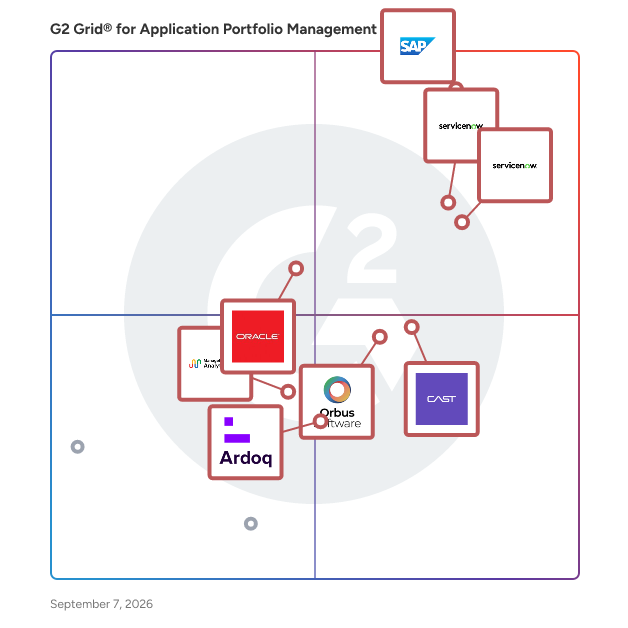
## G2 Grid® for Application Portfolio Management Software
![G2 Grid® for Application Portfolio Management Software plotting products by satisfaction and market presence](https://www.g2.com/categories/application-portfolio-management/grids.png?focus%5B%5D=53230&focus%5B%5D=152660&focus%5B%5D=1832354&focus%5B%5D=58553&focus%5B%5D=53210&focus%5B%5D=71027&focus%5B%5D=63557&focus%5B%5D=53218)
Highlighted products: SAP LeanIX, ServiceNow Strategic Portfolio Management, ServiceNow Enterprise Architecture, CAST Highlight, Orbus Software, Oracle IT Analytics Cloud Service, ManageEngine Analytics Plus, and Ardoq.
Underlying data: [Grid® JSON](https://www.g2.com/categories/application-portfolio-management/grids.json?focus%5B%5D=sap-leanix&amp;focus%5B%5D=servicenow-strategic-portfolio-management&amp;focus%5B%5D=servicenow-enterprise-architecture&amp;focus%5B%5D=cast-highlight&amp;focus%5B%5D=orbus-software&amp;focus%5B%5D=oracle-it-analytics-cloud-service&amp;focus%5B%5D=manageengine-analytics-plus&amp;focus%5B%5D=ardoq)


## How Many Application Portfolio Management Software Products Does G2 Track?
**Total Products under this Category:** 48

### Category Stats (Jul 2026)
- **Average Rating**: 4.43/5 The average rating of products in this category, based on all submitted ratings
- **Top Trending Product**: Planview PPM Pro (+1.1%) - Among all products in this category, Planview PPM Pro recorded the largest rating increase compared to last month
*Last updated: July 10, 2026*


## How Does G2 Rank Application Portfolio Management Software Products?

**Why You Can Trust G2's Software Rankings:**

- 30 Analysts and Data Experts
- 900+ Authentic Reviews
- 48+ Products
- Unbiased Rankings

G2's software rankings are built on verified user reviews, rigorous moderation, and a consistent research methodology maintained by a team of analysts and data experts. Each product is measured using the same transparent criteria, with no paid placement or vendor influence. While reviews reflect real user experiences, which can be subjective, they offer valuable insight into how software performs in the hands of professionals. Together, these inputs power the G2 Score, a standardized way to compare tools within every category.


## Which Application Portfolio Management Software Is Best for Your Use Case?

- **Leader:** [SAP LeanIX](https://www.g2.com/products/sap-leanix/reviews)
- **Highest Performer:** [Orbus Software](https://www.g2.com/products/orbus-software/reviews)
- **Easiest to Use:** [Orbus Software](https://www.g2.com/products/orbus-software/reviews)
- **Top Trending:** [ServiceNow Strategic Portfolio Management](https://www.g2.com/products/servicenow-strategic-portfolio-management/reviews)
- **Best Free Software:** [CAST Highlight](https://www.g2.com/products/cast-highlight/reviews)


---

**Sponsored**

### CAST Highlight

Portfolio-level insights for app modernization, AI readiness, tech debt, OSS risks CAST Highlight is a SaaS software intelligence technology that delivers rapid, fact-based insights across your entire application portfolio. By automatically analyzing the source code of hundreds or thousands of applications, CAST Highlight helps organizations assess cloud maturity, AI &amp; Agentic readiness, software health, open source risk, resiliency, technical debt, and sustainability from a single lightweight scan. CAST Highlight is designed for CIOs, CTOs, enterprise architects, cloud leaders, application owners, security teams, and modernization teams that need a fact-based way to prioritize modernization, cloud, and AI adoption decisions at scale. It helps teams identify which applications are ready to move quickly, which require remediation, and where hidden software risks may affect transformation cost, timelines, security, resilience, or business outcomes. Unlike traditional manual or survey-based assessments, CAST Highlight analyzes application source code directly to rapidly segment portfolios, prioritize modernization paths, and uncover risks before they impact transformation programs. Organizations use CAST Highlight to: - Accelerate cloud migration and modernization planning - Segment applications by cloud maturity and transformation path - Identify high-value AI adoption opportunities - Assess Agentic Readiness across application portfolios - Prioritize technical debt, resiliency, and maintainability improvements - Assess open source vulnerabilities and IP / license exposure - Evaluate software sustainability with Green Impact insights - Reduce complexity, cost, and risk across transformation programs Businesses move faster using CAST to understand, improve, and transform their software. Through semantic analysis of source code, CAST generates dashboards and 3D maps for executives, technologists, and AI to navigate inside individual applications and across entire portfolios. This intelligence enables companies to steer, speed, and report on initiatives such as technical debt, modernization, and cloud. As the pioneer of the software intelligence field, CAST is trusted by the world’s leading companies and governments, their consultancies and cloud providers. See it all at castsoftware.com.


[Visit website](https://www.g2.com/external_clickthroughs/record?secure%5Bad_program%5D=ppc&amp;secure%5Bad_slot%5D=category_product_list&amp;secure%5Bcategory_id%5D=1203&amp;secure%5Bchosen_at%5D=2026-07-10T13%3A12%3A22Z&amp;secure%5Bdisplayable_resource_id%5D=1203&amp;secure%5Bdisplayable_resource_type%5D=Category&amp;secure%5Bmedium%5D=sponsored&amp;secure%5Bplacement_reason%5D=page_category&amp;secure%5Bplacement_resource_ids%5D%5B%5D=1203&amp;secure%5Bprioritized%5D=false&amp;secure%5Bproduct_id%5D=58553&amp;secure%5Bresource_id%5D=1203&amp;secure%5Bresource_type%5D=Category&amp;secure%5Bsource_type%5D=category_page&amp;secure%5Bsource_url%5D=https%3A%2F%2Fwww.g2.com%2Fcategories%2Fapplication-portfolio-management%3Fpage%3D2&amp;secure%5Btoken%5D=9d7ee8baeed08df55c37bc4c40598fef92bca58e00ff0aaecb5cf2f7b9e43fec&amp;secure%5Burl%5D=https%3A%2F%2Fwww.castsoftware.com%2Ftryhighlight%3Futm_campaign%3Dg2_clicks_ads%26utm_source%3Dcast_highlight%26utm_medium%3Dtrial_request&amp;secure%5Burl_type%5D=free_trial)

---


## What Is Application Portfolio Management Software?

[IT Management Software](https://www.g2.com/categories/it-management)

## What Software Categories Are Similar to Application Portfolio Management Software?

- [Enterprise Architecture Tools](https://www.g2.com/categories/enterprise-architecture-tools)


---

## How Do You Choose the Right Application Portfolio Management Software?

### What You Should Know About Application Portfolio Management Software

### What is Application Portfolio Management Software?

Application portfolio management software allows companies to see what kinds of software applications are in their enterprise architecture to reduce redundancy and cost. Companies use a collection of software to optimize their business capabilities such as improving operational efficiency, winning key markets, or streamlining costs. Application portfolio management is the practice of identifying, monitoring, and managing the application lifecycle to achieve business objectives and maximize return on investment (ROI) for the IT budget.&amp;nbsp;

The term application portfolio management, also known as IT portfolio management, is very similar to investment portfolio management. Financial firms actively manage their investment portfolio so they reduce the risk of huge financial losses. Similarly, companies need to actively manage their business application portfolio to avoid software cost overrun and resource wastage. It is important to build and maintain a cost-saving technology portfolio that actively contributes to the business objectives. As software demand continues to increase, application portfolio management software helps companies to remove underutilized software and prioritize mission-critical applications.

### What are the Common Features of Application Portfolio Management Software?

The following are some core features within IT portfolio management that can help users manage their software inventory:

**Software discovery:** Application portfolio management solutions need to automatically discover every software on all devices and the cloud. This includes on-premises software and SaaS applications. Manual entry of software is inefficient and doesn’t reflect real-time data.&amp;nbsp;

**Software categorization:** While the user can categorize software manually, application portfolio management tools should auto tag software into different categories. This allows businesses to identify redundancy and gaps for each type of software.&amp;nbsp;

**Software mapping:** There is no better way to understand IT stacks than mapping out all software and connecting to projects and teams. Visualization allows IT managers to see which software is used, who is using the software, and for what purpose.&amp;nbsp;

**Software utilization:** IT managers need to understand how each software is being used and for how much time it is being used. Underused software might be outdated or not enough training is provided to use the software. Overused software may risk license compliance issues. These issues can’t be managed without utilization data.&amp;nbsp;

**Software benchmark:** Advanced application portfolio management software collects comparison data and sends surveys to users to rank all software based on user satisfaction, performance, and contribution to the business objectives. This allows IT managers to see which software is important and which one is not.

**Financial analysis:** Some solutions have software asset management capabilities that account for the total cost of ownership (TCO). This is the sum of all direct and indirect costs incurred by that software and is a critical part of the ROI calculation. Companies can identify the true cost of software by analyzing starting cost (software, hardware, migration, training, implementation, license, customization), operating costs (maintenance, upgrades, depreciation, downtime, support, security), and retirement cost (data export, data archiving, inactive licenses). A successful digital transformation must have risk management to prevent cost overruns.&amp;nbsp;

**Opportunity identification:** After collecting and analyzing all the data, technology portfolio management software will provide reports with areas where companies can save money, reinvest in existing software, or buy new software that fills the capability gap. The ultimate goal is to align the software stack to the business objectives, not just getting chargeback and cutting the underutilized software.

### What are the Benefits of Application Portfolio Management Software?

**Increase visibility:** Decision makers have immediate access to real-time data on the IT landscape from a single source of truth. Most solutions also have prebuilt reports and diagrams on a central dashboard to show the current status of all the software. This not only speeds up the decision-making process but allows for clear communication.&amp;nbsp;

**Reduce risk:** IT portfolio management solutions reduce transformational risks by understanding when, where, how, and why to make changes in the software portfolio. Visual mapping and dependency reports allow consistent and transparent changes.

**Lower IT costs:** A well-established application portfolio management practice will align IT spending to business strategy, maintain required capabilities, and discover new demands. By avoiding investing in redundant systems and software, IT managers free up resources that can be used to acquire new capabilities.

### Who Uses Application Portfolio Management Software?

**IT managers:** The team that uses the application portfolio management solution the most would be the IT team since they manage software inventory. They will know which software to purchase, retire, and reinvest in. Also, they can use the IT portfolio management reports to better communicate software inventory status with other stakeholders.&amp;nbsp;

**Purchasing team:** Purchasing team use application portfolio management software for software purchase negotiation. For example, by understanding which software is underused, the purchasing team can negotiate for the chargeback or lower price.&amp;nbsp;

#### Software Related to Application Portfolio Management Software

Related solutions that can be used together with technology portfolio management tools include:

**Software asset management (SAM) software:** This type of software documents and manages on-premises software licenses used by a business. Companies use SAM software to complement application portfolio management for contract management and license management.

**SaaS operations management software:** SaaS operations management software manages SaaS products to provide businesses with greater control and visibility over their SaaS portfolios.

### Challenges with Application Portfolio Management Software

Software solutions can come with their own set of challenges.&amp;nbsp;

**Long-term management:** IT portfolio management is not a one-shot application rationalization that focuses on cost and short-term technical problems. Cleaning up the software landscape just once and then forgetting about it will result in the same problems reappearing in the future. Companies need to take a lifecycle approach. Regular monitoring of technical and business use of applications and assessing future options are necessary to align the portfolio to business goals.&amp;nbsp;

**Understanding dependencies:** Applications should not be judged as standalone but as a landscape. IT managers need to consider dependencies between applications and businesses they support. Dependency analysis will show the complexity, risks, and business value of the application landscape. Replacing or retiring an application in isolation results in unintended consequences that impact other teams and applications.

**Determining objective metrics:** There is no one strategy or metric that can accurately reflect the value of every application. But on the other end, asking the users how valuable each application is extremely biased. Instead, IT managers need to study use cases that identify the value chains and workflows of the application. This shows how the applications support business and technical functionalities for products and customers. Then the IT team can assess the application with proper metrics that are relevant to these functionalities and may also discover new potential uses.

### How to Buy Application Portfolio Management Software

Buying an application portfolio management solution can be complicated based on existing infrastructure and software compatibility. Many times when buying application portfolio management solutions, companies have encountered software cost overrun problems, so the desire to make a quick purchase while there is corporate interest and pressure can be strong. However, enterprise software purchasing requires dedication and time. If the company doesn’t like the software after the purchase, changing to another software is costly and time-consuming.&amp;nbsp;

#### Requirements Gathering (RFI/RFP) for Application Portfolio Management Software

Companies should have a good understanding of why they need IT portfolio management solutions. Other than simple reasons such as gaining visibility into the application landscape, there are usually deeper reasons why the company needs this capability.&amp;nbsp;

An application portfolio management solution dedicated to the finance team could be much different than the one dedicated to the purchasing team—and their assumption as to why they need this capability could be wrong too. The finance team may think that an application portfolio management tool would help significantly with their messy budgeting process for new software, but the software can do much more than that, so the value and budget of the application should be higher than before. The best way to see a clear picture of the situation is to work with all the stakeholders for use cases to answer who wants to do what, and why is that important for the business.&amp;nbsp;

With use cases, buyers can formulate desired features requirements and rank them objectively. Buyers should make a ranked list of the application portfolio management features that most directly address the problems they’re trying to solve, then reference that in the RFP. Prioritizing the desired feature set can help narrow down the potential pool of technology portfolio management tools, allowing teams to then apply further considerations for budget, ease of integration with other systems, security requirements, and more. This holistic approach empowers buyers to move forward with a focused checklist, which can be used in conjunction with G2 scores to select the best application portfolio management product for the business.

#### Compare Application Portfolio Management Software Products

**Create a long list**

Buyers should start with a large pool of application portfolio management software vendors and inform the desired must-have features and budget, so they can respond if they are a good fit or not at the start. The goal is to have at least 5 to 10 vendors that fit the general criteria.&amp;nbsp;

**Create a shortlist**

Now is the time to cross reference the results of initial vendor evaluations with G2 reviews from other buyers, the combination of which will help to narrow in on a short three to five product list. From there, buyers can compare pricing and features to determine the best fit.

**Conduct demos**

Demos are the most important part of the RFP process because the buyer must make sure that their software is compatible with the vendor’s application portfolio management solution. Companies must inform vendors upfront that they need to see the data in their system and understand how that will work. Sometimes, vendors may take the buyer’s data and work quickly in the background and then come back with results for the buyer to explore. This is a mini implementation so not all the issues and capabilities are addressed in this type of demo. So, buyers must be sure to discuss the limitation with key stakeholders. Then the buyer should have the selected data ready to give to the vendor. Giving the vendors raw data is time-consuming and risky so it is not recommended.&amp;nbsp;

During demos, buyers should ask specific questions related to the functionalities they care most about; for example, one might ask to be walked through an application dependency analysis by building an application landscape map to determine the value of the whole landscape.&amp;nbsp;

#### Selection of Application Portfolio Management Software

**Choose a selection team**

Regardless of a company’s size, it’s important to involve the most relevant personas when beginning the application portfolio management software selection process. Larger companies may include individual team members to fill roles such as project manager, decision maker, system owner, and IT professionals and developers who will be working with the software most closely. Smaller companies with fewer employees might overlap roles.&amp;nbsp;

**Negotiation**

It is very likely that the buyer will choose SaaS-based technology portfolio management software. In this case, buyers must determine what kind of relationship the buyer and the vendor might have. SaaS vendors will be installing, configuring, upgrading, and interacting with the buyer in the long term, whereas with on-premises software vendors, it is more likely to be a one-time interaction. The buyer needs to determine the SaaS vendor’s customer service’s domain knowledge level, quality of support, and fitment to the stakeholders. There are also specific functionality and packages that the buyer might not need. These can all be negotiated.&amp;nbsp;

**Final decision**

After this stage, it is important to perform a trial run if possible with the stakeholder team. If the application portfolio management tool is well liked and well utilized, the buyer can take that as a sign that their selection is the right one. If not, reevaluation of the options may be necessary.&amp;nbsp;

Before the final purchase, the buyer should also know what happens if the contract ends early. Application portfolio management solutions are evolving very fast so players are changing every year with new functionalities. The perfect fit may be the case for today but not for the next three to five years. Since the buyer will bring valuable data to the vendor, the buyer needs to know how the data will be handled if the contract ends early. What process and format will the data be extracted from? What rules do both parties have to follow? What are the costs and penalties? It is best to have clarity on these topics at the early stages of the buying process than when things go unplanned.


---
## What Are the Most Common Questions About Application Portfolio Management Software?
*AI-generated · Last updated: June  3, 2026*
### Which Application Portfolio Management solutions help identify technical debt and rationalization targets across large portfolios quickly
Based on G2 reviews, these products are frequently associated with technical debt visibility and portfolio rationalization.

- [SAP LeanIX](https://www.g2.com/products/sap-leanix) — application rationalization and landscape visibility.
- [ServiceNow Enterprise Architecture](https://www.g2.com/products/servicenow-enterprise-architecture) — technical debt reduction and app inventory.
- [CAST Highlight](https://www.g2.com/products/cast-highlight) — rapid code analysis for tech debt.
- [Orbus Software](https://www.g2.com/products/orbus-software) — architecture evidence for rationalization planning.


### Application Portfolio Management platforms with flexible metamodels that adapt to your organizational structure without heavy customization
According to verified users, flexibility in the underlying model is a meaningful differentiator, but reviews also show tradeoffs. Ardoq reviewers highlight extendable metamodels that let teams fit architecture data to their own context while still using packaged starting points. SAP LeanIX reviews more often emphasize a clear repository and faster adoption, though some users describe its metamodel as more rigid for highly specific modeling needs. ServiceNow Enterprise Architecture users similarly mention strong structure, but note that customization can require more effort and platform expertise. Across recent reviews, buyers should weigh model flexibility against governance, onboarding complexity, and how easily stakeholders can maintain accurate data over time.


### Application Portfolio Management tools that consolidate siloed application data and enable impact analysis without requiring a six-month setup
According to verified users, several products in this category are valued for bringing fragmented application and technology data into a single view while still being relatively approachable to implement. SAP LeanIX reviews repeatedly mention centralized inventories, strong visibility into dependencies, and quicker time to useful insights. ServiceNow Enterprise Architecture reviewers describe a connected platform for applications, technologies, and operational relationships that supports impact analysis, though setup and governance can still be demanding in complex environments. Orbus Software reviews also stress a central repository, relationship mapping, and simple stakeholder views. Recent feedback suggests buyers should look for fast initial setup, strong visualization, and practical data maintenance workflows after rollout.


### What are the most important features in application portfolio management tools
According to verified users, the most important features in application portfolio management tools center on visibility, rationalization, and decision support. Reviews repeatedly highlight centralized application inventories, dependency mapping, lifecycle tracking, dashboards, and reporting that make it easier to understand the current landscape. Buyers also value business capability mapping, impact analysis, roadmap planning, and the ability to identify redundant systems or technical debt. Integrations matter when teams want architecture data connected with project, operational, or documentation workflows. Across recent reviews, ease of setup and data upkeep also stand out because a tool is only useful when teams can keep records current and use the information to guide modernization, governance, and investment planning.


### How do teams use Application Portfolio Management for impact analysis
According to verified users, teams use Application Portfolio Management for impact analysis by connecting applications to business capabilities, processes, technologies, and dependencies in one shared model. That structure helps them see what may be affected before changing or retiring a system. Reviews describe using these tools to assess modernization priorities, understand ripple effects across portfolios, reduce duplicate applications, and communicate likely business consequences to stakeholders. Visualization and reporting are especially useful when architecture teams need to explain why a change matters beyond IT. Recent feedback also shows that impact analysis works best when application data stays current, ownership is clear, and relationships between systems are maintained consistently rather than treated as one-time documentation.


