Best API Management Tools

How Many API Management Tools Products Does G2 Track?

Total Products under this Category: 150

Category Stats (Sep 2026)

  • Average Rating: 4.5/5 (↑0.02 vs Aug 2026) The average rating of products in this category, based on all submitted ratings
  • Top Trending Product: Gravitee.io (+0.9%) - Among all products in this category, Gravitee.io recorded the largest rating increase compared to last month

Last updated: September 01, 2026

How Does G2 Rank API Management Tools Products?

Why You Can Trust G2's Software Rankings:

  • 30 Analysts and Data Experts
  • 11,600+ Authentic Reviews
  • 150+ Products
  • Unbiased Rankings

G2's software rankings are built on verified user reviews, rigorous moderation, and a consistent research methodology maintained by a team of analysts and data experts. Each product is measured using the same transparent criteria, with no paid placement or vendor influence. While reviews reflect real user experiences, which can be subjective, they offer valuable insight into how software performs in the hands of professionals. Together, these inputs power the G2 Score, a standardized way to compare tools within every category.

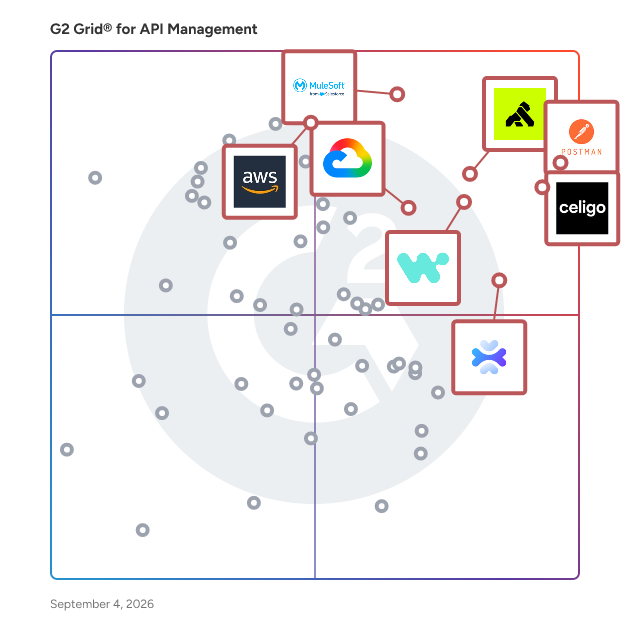
G2 Grid® for API Management Tools

G2 Grid® for API Management Tools plotting products by satisfaction and market presence

Highlighted products: Postman, Celigo, MuleSoft Anypoint Platform, Kong Konnect, Workato, Apidog, Apigee Edge, and Amazon API Gateway.

Underlying data: [Grid® JSON](https://www.g2.com/categories/api-management/grids.json?focus%5B%5D=postman&focus%5B%5D=celigo&focus%5B%5D=mulesoft-anypoint-platform&focus%5B%5D=kong-inc-kong-konnect&focus%5B%5D=workato&focus%5B%5D=apidog&focus%5B%5D=apigee-edge&focus%5B%5D=amazon-api-gateway)

Postman

Postman is the world’s leading API platform, used by more than 40 million developers and 500,000 organizations to build, test, and manage APIs at scale. With Postman, teams collaborate efficiently across the entire API lifecycle, including design, development, testing, security, documentation, and governance. The platform helps ensure consistency, quality, and enterprise-grade control. Postman also offers Agent Mode (beta), built on AWS Bedrock and trained with AWS SageMaker. Agent Mode enables developers to use natural language to debug requests, organize collections, document APIs, and automate workflows without switching tools or writing custom scripts.

Average Rating: 4.6/5.0

Total Reviews: 1,755

How Do G2 Users Rate Postman?

  • Has the product been a good partner in doing business?: 9.0/10 (Category avg: 8.9/10)
  • Scalability: 8.7/10 (Category avg: 9.0/10)
  • API Testing: 9.5/10 (Category avg: 8.8/10)
  • Orchestration: 8.6/10 (Category avg: 8.7/10)

Who Is the Company Behind Postman?

  • Seller: Postman
  • Year Founded: 2014
  • HQ Location: San Francisco, CA
  • Twitter: @getpostman
    55,430 Twitter followers
  • LinkedIn® Page: www.linkedin.com
    3,554 employees on LinkedIn®

Who Uses This Product?

  • Who Uses This: Software Engineer, Software Developer
  • Top Industries: Computer Software, Information Technology and Services
  • Company Size: 39% Medium, 35% Small

What Do G2 Reviewers Say About Postman?

AI-generated summary from verified user reviews

Pros
  • Users appreciate the ease of use of Postman for testing APIs, enabling quick requests and seamless collaboration.
  • Users appreciate the ease of API testing with Postman, enabling quick requests, responses, and debugging without extra code.
  • Users value the ease of API testing with Postman, appreciating its intuitive interface and comprehensive features.
  • Users appreciate the ease of testing APIs with Postman, benefiting from its intuitive interface and collaboration features.
  • Users value the testing efficiency of Postman, enjoying quick debugging and seamless API management across environments.
Cons
  • Users often face slow performance with Postman, especially when dealing with large projects or validation processes.
  • Users often face performance issues with Postman, experiencing slowdowns and unexpected bugs that disrupt their workflow.
  • Users find Postman slow to load at times, especially with large collections and multiple tabs open, affecting performance.
  • Users experience resource limitations with Postman, as the app can slow down and consume significant memory during use.
  • Users find the limited features in Postman's free tier challenging, especially for smaller teams needing advanced tools.

What Are Recent G2 Reviews of Postman?

What Are G2 Users Discussing About Postman?

Celigo

Celigo puts intelligent automation in the hands of every team, unifying workflows from the predictable to the fully agentic in a single platform through a first-of-its-kind natural language interface. The platform is recognized by G2 as #1 in iPaaS and a Leader in API Management, API Marketplace, and EDI and is the only vendor named a 2025 Gartner® Peer Insights™ Customers’ Choice for iPaaS. Learn more at: celigo.com.

Average Rating: 4.6/5.0

Total Reviews: 1,068

How Do G2 Users Rate Celigo?

  • Has the product been a good partner in doing business?: 9.2/10 (Category avg: 8.9/10)
  • Scalability: 9.1/10 (Category avg: 9.0/10)
  • API Testing: 9.3/10 (Category avg: 8.8/10)
  • Orchestration: 9.2/10 (Category avg: 8.7/10)

Who Is the Company Behind Celigo?

  • Seller: Celigo
  • Company Website:
  • Year Founded: 2011
  • HQ Location: Redwood City, California
  • Twitter: @celigoinc
    1,418 Twitter followers
  • LinkedIn® Page: www.linkedin.com
    786 employees on LinkedIn®

Who Uses This Product?

  • Who Uses This: NetSuite Administrator, IT Manager
  • Top Industries: Retail, Consumer Goods
  • Company Size: 58% Medium, 37% Small

What Do G2 Reviewers Say About Celigo?

AI-generated summary from verified user reviews

Pros
  • Users value the ease of use in Celigo, appreciating its intuitive interface and effective connectivity options.
  • Users value the comprehensive integrations offered by Celigo, enabling seamless connections with various business systems effortlessly.
  • Users appreciate the comprehensive integration capabilities of Celigo, facilitating connections with various partners seamlessly.
  • Users praise the easy integrations offered by Celigo, especially with NetSuite, appreciating the prebuilt connectors and solid support.
  • Users praise the responsive and helpful customer support from Celigo, making issue resolution seamless.
Cons
  • Users find that error handling is unclear, making it challenging to resolve issues and track discrepancies efficiently.
  • Users note that Celigo can be expensive, especially for small businesses needing multiple managed modules.
  • Users face a notable learning curve with Celigo, making initial navigation and understanding of flows challenging.
  • Users report that Celigo’s complexity can lead to frustration, especially when debugging and understanding data flows.
  • Users find pricing issues with Celigo, noting that costs increase with additional features and managed modules.

What Are Recent G2 Reviews of Celigo?

What Are G2 Users Discussing About Celigo?

MuleSoft Anypoint Platform

MuleSoft Anypoint Platform is the industry-leading integration and governance solution designed to connect any application, API, and AI agent across hybrid and multi-cloud environments. For nearly two decades, we have served as the integration backbone for the world’s most complex enterprises. Today, we are extending to the AI era. We allow organizations to move beyond AI sprawl into a unified architecture where legacy systems, modern APIs, and autonomous agents interact securely on a single, trusted foundation. Key capabilities and components include: Hybrid integration and connectivity, utilizing a library of hundreds of pre-built connectors and support for new AI protocols like MCP and A2A to provide AI agents with the tools they need to access and act within legacy ERPs, CRMs, and on-premise databases. MuleSoft Agent Fabric: Unified API and agent governance, applying the same rigorous security policies, cost controls, and traffic enforcement to AI models and agents that organizations already trust for their global API ecosystems through a single, federated control plane. Fabric also includes agent visibility and registry, offering a single source of truth to discover and observe any cross-ecosystem agent, ensuring complete transparency and the elimination of shadow AI. MuleSoft Vibes: Natural language design and management, providing a revamped experience where teams can use native natural language prompts to scaffold integrations, manage lifecycles, and stay ahead of technical sprawl using the AI tools they already prefer. Trusted runtime and compliance, delivering a fully managed, hybrid, or on-prem foundation that has been proven at scale for years, ensuring that every interaction is backed by enterprise-grade monitoring and human-in-the-loop security. Overall, MuleSoft Anypoint Platform is the enterprise platform for organizations seeking to bring visibility, trust, and orchestration to their APIs and AI agents.

Average Rating: 4.5/5.0

Total Reviews: 667

How Do G2 Users Rate MuleSoft Anypoint Platform?

  • Has the product been a good partner in doing business?: 8.8/10 (Category avg: 8.9/10)
  • Scalability: 8.7/10 (Category avg: 9.0/10)
  • API Testing: 8.5/10 (Category avg: 8.8/10)
  • Orchestration: 8.6/10 (Category avg: 8.7/10)

Who Is the Company Behind MuleSoft Anypoint Platform?

  • Seller: Salesforce
  • Company Website:
  • Year Founded: 1999
  • HQ Location: San Francisco, CA
  • Twitter: @salesforce
    579,511 Twitter followers
  • LinkedIn® Page: www.linkedin.com
    89,711 employees on LinkedIn®

Who Uses This Product?

  • Who Uses This: Software Engineer, Senior Software Engineer
  • Top Industries: Information Technology and Services, Computer Software
  • Company Size: 57% Large, 31% Medium

What Do G2 Reviewers Say About MuleSoft Anypoint Platform?

AI-generated summary from verified user reviews

Pros
  • Users appreciate the ease of use of MuleSoft Anypoint Platform, finding it ideal for their data loading needs.
  • Users value the integration capabilities of MuleSoft Anypoint Platform, enabling seamless connections across various systems and APIs.
  • Users value the ease of integration with MuleSoft Anypoint Platform, benefiting from its comprehensive API management features.
  • Users appreciate the clean UI and comprehensive features of MuleSoft Anypoint Platform for efficient API management.
  • Users value the easy integrations of MuleSoft Anypoint Platform, simplifying the connection of various systems seamlessly.
Cons
  • Users express concern over the high cost of MuleSoft Anypoint Platform, making it less accessible for smaller projects.
  • Users express concern over the high pricing issues of MuleSoft Anypoint Platform, making it less accessible for smaller organizations.
  • Users find the learning curve steep for MuleSoft Anypoint Platform, especially for those transitioning from other tools.
  • Users find learning difficulty with MuleSoft Anypoint Platform, requiring advanced skills and complicating transitions from familiar tools.
  • Users experience a steep learning curve with MuleSoft Anypoint, often requiring extensive training and adjustment time.

What Are Recent G2 Reviews of MuleSoft Anypoint Platform?

What Are G2 Users Discussing About MuleSoft Anypoint Platform?

Kong Konnect

Kong is an AI and API connectivity platform designed to help platform engineering teams, DevOps organizations, and enterprise architects deploy, secure, observe, and govern API traffic across cloud, on-premises, and hybrid environments. Built on open-source foundations, Kong facilitates the management of the entire lifecycle of APIs and AI traffic at scale, encompassing everything from development and deployment to runtime policy enforcement and observability. Targeted primarily at mid-market and enterprise organizations with complex distributed architectures, Kong is particularly beneficial for those utilizing microservices, multi-cloud deployments, and AI-powered applications. The platform caters to a diverse audience, including platform engineers, API program managers, security architects, and development teams that require consistent and governed API access across both internal and external systems. By addressing the challenges of API sprawl, inconsistent security enforcement, and observability gaps, Kong provides a robust solution for organizations navigating the complexities of modern infrastructure. Kong's capabilities are extensive and designed to tackle several recurring infrastructure challenges. The platform's API Gateway and Lifecycle Management features enable efficient routing, load balancing, authentication, authorization, rate limiting, and transformation for various API types, including REST, GraphQL, gRPC, and event-based APIs. Additionally, with the rise of generative AI, Kong has developed an AI Gateway specifically for managing traffic to large language models (LLMs) and AI agents. This includes functionalities such as prompt and response management, semantic caching, and token-based rate limiting, ensuring that organizations can effectively govern their AI workloads. Another significant feature of Kong is its Service Mesh, which provides east-west traffic management between services within a cluster or across clusters. This includes support for mutual TLS (mTLS), traffic policies, and observability at the service level, enhancing security and monitoring capabilities. The Konnect SaaS Control Plane further streamlines the management of Kong deployments globally, offering centralized analytics, developer portal capabilities, and API catalog management. Kong's extensibility is another key differentiator, featuring a plugin architecture with over 100 pre-built integrations that cover a wide range of functionalities, including logging, authentication providers, observability backends, and AI providers. Available as open-source software, an enterprise distribution, or a fully managed SaaS offering, Kong integrates seamlessly with Kubernetes and supports deployment on major cloud platforms such as AWS, Azure, and GCP. This flexibility allows organizations to leverage Kong across heterogeneous environments without necessitating a complete infrastructure overhaul.

Average Rating: 4.4/5.0

Total Reviews: 346

How Do G2 Users Rate Kong Konnect?

  • Has the product been a good partner in doing business?: 8.8/10 (Category avg: 8.9/10)
  • Scalability: 9.1/10 (Category avg: 9.0/10)
  • API Testing: 8.5/10 (Category avg: 8.8/10)
  • Orchestration: 8.3/10 (Category avg: 8.7/10)

Who Is the Company Behind Kong Konnect?

  • Seller: Kong Inc
  • Company Website:
  • Year Founded: 2017
  • HQ Location: San Francisco, CA
  • LinkedIn® Page: www.linkedin.com
    1,044 employees on LinkedIn®

Who Uses This Product?

  • Who Uses This: Software Engineer, Senior Software Engineer
  • Top Industries: Computer Software, Information Technology and Services
  • Company Size: 41% Medium, 30% Small

What Do G2 Reviewers Say About Kong Konnect?

AI-generated summary from verified user reviews

Pros
  • Users appreciate the ease of use of Kong Konnect, complemented by excellent documentation and simple configuration options.
  • Users appreciate the centralized control plane of Kong Konnect, which enhances API management and reduces operational overhead.
  • Users appreciate the ease of integration and customization of Kong Konnect, benefiting from its modular plugin system.
  • Users appreciate the scalability of Kong Konnect, enabling efficient management of APIs in distributed environments.
  • Users commend the robust security measures of Kong Konnect, ensuring reliable protection and performance of APIs.
Cons
  • Users find the limited documentation for plugins in Kong Konnect challenging, affecting their overall experience.
  • Users express concern over the limited features of Kong Konnect, noting missing essential functionalities and advanced options.
  • Users find that Kong Konnect has missing features, particularly in AI capabilities and limited plugin support.
  • Users face a steep learning curve for configuration and advanced features, complicating initial use of Kong Konnect.
  • Users find the expensive features of Kong Konnect limiting, especially with essential tools locked behind paywalls.

What Are Recent G2 Reviews of Kong Konnect?

What Are G2 Users Discussing About Kong Konnect?

Workato

Workato is the #1-rated iPaaS and the leader in Enterprise MCP — the platform enterprises trust to unify integration, automation, and AI in one secure, cloud-native runtime. Trusted by over 12,000 customers including half the Fortune 500, Workato connects every system, process, and data source with 14,000+ pre-built connectors. What sets Workato apart: Enterprise MCP turns proven business processes into governed, agent-ready skills that any AI agent — Claude, ChatGPT, Cursor, or custom-built — can execute safely and predictably. No rip-and-replace required. Whether modernizing legacy integrations or deploying agentic AI at scale, Workato delivers the orchestration, governance, and trust needed in the enterprise.

Average Rating: 4.7/5.0

Total Reviews: 748

How Do G2 Users Rate Workato?

  • Has the product been a good partner in doing business?: 9.4/10 (Category avg: 8.9/10)
  • Scalability: 9.0/10 (Category avg: 9.0/10)
  • API Testing: 8.8/10 (Category avg: 8.8/10)
  • Orchestration: 8.9/10 (Category avg: 8.7/10)

Who Is the Company Behind Workato?

  • Seller: Workato
  • Company Website:
  • Year Founded: 2013
  • HQ Location: Mountain View, California
  • Twitter: @Workato
    3,641 Twitter followers
  • LinkedIn® Page: www.linkedin.com
    1,466 employees on LinkedIn®

Who Uses This Product?

  • Who Uses This: Software Engineer, Senior Software Engineer
  • Top Industries: Computer Software, Information Technology and Services
  • Company Size: 43% Medium, 33% Large

What Do G2 Reviewers Say About Workato?

AI-generated summary from verified user reviews

Pros
  • Users appreciate the ease of use of Workato, enabling quick automation without needing technical expertise.
  • Users love the easy integrations with Workato, allowing quick automation of tools like Salesforce and Slack.
  • Users love how Workato's easy integrations simplify automation, saving them hours and making processes seamless.
  • Users value the user-friendly and low-code interface of Workato, making business process automation seamless and efficient.
  • Users appreciate the ease of automation with Workato, enabling seamless integrations and saving significant time on repetitive tasks.
Cons
  • Users often find the complexity of Workato overwhelming, particularly regarding pricing and onboarding, leading to confusion.
  • Users find the learning curve steep, with complexity and confusion hindering smooth onboarding and workflow management.
  • Users are frustrated by data limitations in Workato, impacting email sends, job reporting, and large file transfers.
  • Users find the missing features in Workato's connector library limit their integration capabilities with lesser-known applications.
  • Users find the steep learning curve of Workato daunting, especially during onboarding and initial usage.

What Are Recent G2 Reviews of Workato?

What Are G2 Users Discussing About Workato?

Apidog

Apidog Inc. is a US development platform company founded in 2022. The company operates internationally, serving clients ranging from small teams to enterprise-level organizations with flexible pricing based on team size. Apidog offers an integrated platform that combines API design, debugging, testing, documentation, and mocking in a single interface. Key features include visual OpenAPI design tools, automated testing with CI/CD integration, professional documentation generation, smart mock servers, and multi-protocol support—all working seamlessly together with branch-based development capabilities. Apidog solves the challenge of fragmented API development by replacing multiple specialized tools with one cohesive platform, eliminating inefficient context switching between applications. By implementing a true API Design-first approach, the platform ensures a single source of truth throughout development, accelerating development cycles while improving collaboration, quality, and time-to-market for API deliveries.

Average Rating: 4.8/5.0

Total Reviews: 225

How Do G2 Users Rate Apidog?

  • Has the product been a good partner in doing business?: 9.3/10 (Category avg: 8.9/10)
  • Scalability: 9.7/10 (Category avg: 9.0/10)
  • API Testing: 9.8/10 (Category avg: 8.8/10)
  • Orchestration: 9.8/10 (Category avg: 8.7/10)

Who Is the Company Behind Apidog?

  • Seller: Apidog
  • Company Website:
  • Year Founded: 2023
  • HQ Location: Middletown, US
  • LinkedIn® Page: www.linkedin.com
    6 employees on LinkedIn®

Who Uses This Product?

  • Who Uses This: Software Engineer, Senior Software Engineer
  • Top Industries: Computer Software, Information Technology and Services
  • Company Size: 48% Small, 30% Medium

What Do G2 Reviewers Say About Apidog?

AI-generated summary from verified user reviews

Pros
  • Users appreciate the user-friendly interface of Apidog, which simplifies API documentation and development processes effectively.
  • Users praise APIDOG for its seamless API management, enhancing efficiency in testing, debugging, and integration processes.
  • Users appreciate the multifunctionality of Apidog, effectively consolidating tools and enhancing collaboration in API development.
  • Users value the seamless API integration of Apidog, enhancing efficiency in connecting multiple applications effortlessly.
  • Users love the clear and objective user interface of Apidog, enhancing collaboration and documentation efficiency.
Cons
  • Users experience API limitations with Apidog, particularly a hard limit on execution time affecting long-running processes.
  • Users note that the learning curve can be challenging initially, but responsive support helps ease the process.
  • Users note a challenging learning curve with Apidog, particularly when transitioning from Postman, which can hinder initial usage.
  • Users find the poor UI of Apidog frustrating, as it complicates navigation and understanding of API interactions.
  • Users find the limited customization options for advanced features a drawback, affecting their API gateway experience.

What Are Recent G2 Reviews of Apidog?

Apigee Edge

Manage, secure, scale, and analyze your APIs with Apigee Edge

Average Rating: 4.4/5.0

Total Reviews: 24

How Do G2 Users Rate Apigee Edge?

  • Has the product been a good partner in doing business?: 8.5/10 (Category avg: 8.9/10)
  • Scalability: 9.3/10 (Category avg: 9.0/10)
  • API Testing: 9.4/10 (Category avg: 8.8/10)
  • Orchestration: 9.4/10 (Category avg: 8.7/10)

Who Is the Company Behind Apigee Edge?

  • Seller: Google
  • Year Founded: 1998
  • HQ Location: Mountain View, CA
  • Twitter: @google
    31,899,995 Twitter followers
  • LinkedIn® Page: www.linkedin.com
    301,144 employees on LinkedIn®
  • Ownership: NASDAQ:GOOG

Who Uses This Product?

  • Top Industries: Information Technology and Services
  • Company Size: 66% Large, 21% Medium

What Are Recent G2 Reviews of Apigee Edge?

What Are G2 Users Discussing About Apigee Edge?

Amazon API Gateway

Amazon API Gateway is a fully managed service that enables developers to create, publish, maintain, monitor, and secure APIs at any scale. It acts as the "front door" for applications to access data, business logic, or functionality from backend services. With API Gateway, you can build RESTful APIs and WebSocket APIs that support real-time two-way communication applications. The service is designed to handle the heavy lifting involved in processing up to hundreds of thousands of concurrent API calls, including tasks such as traffic management, authorization and access control, throttling, monitoring, and API version management. API Gateway supports containerized and serverless workloads, as well as web applications, and offers developer portals to centrally discover, document, and govern your REST APIs across your AWS infrastructure. Key Features and Functionality: - Efficient API Development: Run multiple versions of the same API simultaneously, allowing for quick iteration, testing, and release of new versions. - Performance at Any Scale: Leverage a global network of edge locations using Amazon CloudFront to provide low-latency API requests and responses. - Cost Savings at Scale: Benefit from a tiered pricing model that reduces costs as API usage increases, with prices as low as $0.90 per million requests at the highest tier. - Easy Monitoring: Monitor performance metrics, including API calls, data latency, and error rates, through the API Gateway dashboard integrated with Amazon CloudWatch. - Flexible Security Controls: Authorize access to APIs using AWS Identity and Access Management (IAM) and Amazon Cognito, with support for OAuth tokens and custom authorization requirements via AWS Lambda authorizers. - RESTful API Options: Create RESTful APIs using HTTP APIs or REST APIs, with HTTP APIs being up to 71% cheaper than REST APIs for most use cases. Primary Value and Problem Solved: Amazon API Gateway simplifies the process of building and managing APIs by handling the complexities of API development, including traffic management, security, monitoring, and version control. It enables developers to focus on building applications without worrying about the underlying infrastructure. By providing a scalable, cost-effective, and secure platform for API management, API Gateway helps organizations efficiently connect their applications to backend services, ensuring high performance and reliability.

Average Rating: 4.3/5.0

Total Reviews: 129

How Do G2 Users Rate Amazon API Gateway?

  • Has the product been a good partner in doing business?: 8.8/10 (Category avg: 8.9/10)
  • Scalability: 9.3/10 (Category avg: 9.0/10)
  • API Testing: 8.7/10 (Category avg: 8.8/10)
  • Orchestration: 8.3/10 (Category avg: 8.7/10)

Who Is the Company Behind Amazon API Gateway?

  • Seller: Amazon Web Services (AWS)
  • Year Founded: 2006
  • HQ Location: Seattle, WA
  • Twitter: @awscloud
    2,232,483 Twitter followers
  • LinkedIn® Page: www.linkedin.com
    147,094 employees on LinkedIn®
  • Ownership: NASDAQ: AMZN

Who Uses This Product?

  • Who Uses This: Senior Software Engineer, Software Engineer
  • Top Industries: Computer Software, Information Technology and Services
  • Company Size: 37% Large, 34% Small

What Do G2 Reviewers Say About Amazon API Gateway?

AI-generated summary from verified user reviews

Pros
  • Users appreciate the strong security features of Amazon API Gateway, ensuring safe and efficient API management.
  • Users appreciate the secure and consistent routing of APIs via Amazon API Gateway, simplifying backend integration and scaling.
  • Users love the ease of use of Amazon API Gateway, simplifying API management without infrastructure worries.
  • Users value the secure and streamlined authentication capabilities of Amazon API Gateway for managing serverless APIs effectively.
  • Users value the monitoring capabilities of Amazon API Gateway, providing clear logs and metrics for performance management.
Cons
  • Users find the pricing structure of API Gateway expensive with costs rising steeply for high request volumes and multiple environments.
  • Users find the complexity and high costs of managing API Gateway burdensome, particularly at scale and during initial setup.
  • Users find the difficult configuration of Amazon API Gateway overwhelming, especially when dealing with multiple stages and integrations.
  • Users find the complexity in managing integrations and settings of Amazon API Gateway can complicate their workflow.
  • Users find the pricing model complex and potentially expensive at scale, particularly for high-volume or chatty APIs.

What Are Recent G2 Reviews of Amazon API Gateway?

What Are G2 Users Discussing About Amazon API Gateway?

Boomi

Boomi, the data activation company for AI, powers the agentic enterprise by bringing data to life across the business. The Boomi Enterprise Platform is the active data foundation that delivers essential agentic infrastructure to drive agentic transformation. By unifying agent design and governance, API and MCP management, integration and automation, and data management into a single platform, Boomi enables organizations to harness the power of AI with secure, scalable connectivity. Trusted by over 30,000 customers and supported by a network of 800+ partners, Boomi helps organizations of all sizes achieve agility, efficiency, and innovation at scale.

Average Rating: 4.4/5.0

Total Reviews: 454

How Do G2 Users Rate Boomi?

  • Has the product been a good partner in doing business?: 8.8/10 (Category avg: 8.9/10)
  • Scalability: 8.8/10 (Category avg: 9.0/10)
  • API Testing: 8.6/10 (Category avg: 8.8/10)
  • Orchestration: 8.7/10 (Category avg: 8.7/10)

Who Is the Company Behind Boomi?

  • Seller: Boomi
  • Company Website:
  • Year Founded: 2000
  • HQ Location: Conshohocken, PA
  • Twitter: @boomi
    101,014 Twitter followers
  • LinkedIn® Page: www.linkedin.com
    3,071 employees on LinkedIn®

Who Uses This Product?

  • Who Uses This: Software Engineer, Senior Software Engineer
  • Top Industries: Information Technology and Services, Computer Software
  • Company Size: 45% Large, 39% Medium

What Do G2 Reviewers Say About Boomi?

AI-generated summary from verified user reviews

Pros
  • Users value the powerful integrations Boomi provides, enabling seamless connectivity with multiple cloud providers and tools.
  • Users appreciate the ease of use of Boomi, making integrations quick and straightforward with strong support.
  • Users value the easy integrations Boomi offers, simplifying connections with multiple systems and enhancing overall functionality.
  • Users value Boomi's seamless integration features, enhanced documentation, and robust support for deployment and monitoring.
  • Users value the robust integration capabilities of Boomi, facilitating seamless connections with multiple systems and tools.
Cons
  • Users find that complexity in implementation leads to increased effort and performance issues with Boomi's integrations.
  • Users find the initial learning curve of Boomi challenging, particularly with complex scenarios before implementation.
  • Users report that Boomi can be difficult to learn initially, especially with complex scenarios and intricacies.
  • Users face integration issues with Boomi, highlighting the need for more connectors and improved user interface simplicity.
  • Users face complex coding challenges with Boomi, requiring significant effort for integrating intricate business logic.

What Are Recent G2 Reviews of Boomi?

What Are G2 Users Discussing About Boomi?

SAP Integration Suite

SAP Integration Suite (formerly SAP Cloud Platform Integration Suite) is an integration platform as a service (iPaaS) that allows the user to integrate on-premise and cloud-based applications and processes with tools and prebuilt content managed by SAP. With SAP Integration Suite, you can become future ready and scale up your integration capabilities to connect and contextualize experiences for customers, partners, and employees across the enterprise and extended ecosystems.

Average Rating: 4.3/5.0

Total Reviews: 261

How Do G2 Users Rate SAP Integration Suite?

  • Has the product been a good partner in doing business?: 8.3/10 (Category avg: 8.9/10)
  • Scalability: 8.6/10 (Category avg: 9.0/10)
  • Orchestration: 8.2/10 (Category avg: 8.7/10)

Who Is the Company Behind SAP Integration Suite?

  • Seller: SAP
  • Company Website:
  • Year Founded: 1972
  • HQ Location: Walldorf
  • Twitter: @SAP
    297,052 Twitter followers
  • LinkedIn® Page: www.linkedin.com
    149,349 employees on LinkedIn®

Who Uses This Product?

  • Who Uses This: Consultant, Senior Consultant
  • Top Industries: Information Technology and Services, Computer Software
  • Company Size: 51% Large, 25% Medium

What Do G2 Reviewers Say About SAP Integration Suite?

AI-generated summary from verified user reviews

Pros
  • Users appreciate the ease of use of SAP Integration Suite, enabling quick setup and seamless integrations effortlessly.
  • Users value the seamless integration capabilities of SAP Integration Suite, enhancing efficiency through centralized API and process management.
  • Users commend the easy integrations of SAP Integration Suite, enabling seamless connections across various applications and systems.
  • Users laud the integration capabilities of SAP Integration Suite, which streamline processes and enhance B2B management significantly.
  • Users love the ease of API integration with SAP Integration Suite, simplifying system connectivity across different platforms.
Cons
  • Users find the complexity of SAP Integration Suite overwhelming, making it difficult for new users to adapt quickly.
  • Users find the licensing costs of SAP Integration Suite to be high, especially for smaller organizations or projects.
  • Users find the steep learning curve of SAP Integration Suite challenging, especially for those new to SAP integration tools.
  • Users find the learning curve challenging, often feeling overwhelmed and requiring significant time to master the SAP Integration Suite.
  • Users face difficult debugging issues in SAP Integration Suite, leading to inefficiencies and frustrating troubleshooting experiences.

What Are Recent G2 Reviews of SAP Integration Suite?

What Are G2 Users Discussing About SAP Integration Suite?

SnapLogic Agentic Integration and Applied AI Platform

The SnapLogic Platform is an agentic integration and automation solution designed to assist enterprise teams in connecting applications, data sources, and APIs while orchestrating AI-powered workflows across both cloud and on-premises environments. Established in 2006 and headquartered in San Mateo, California, SnapLogic serves a diverse range of industries, including financial services, pharmaceuticals, manufacturing, software, and higher education, with a global presence across North America, Europe, and Asia Pacific. Targeted primarily at IT teams, data engineers, and integration specialists, the SnapLogic Platform addresses the critical need for seamless data movement between systems, automation of business processes, and governance of AI agent activities at scale. The platform supports various use cases, including application integration, data pipeline management, API lifecycle management, legacy system modernization, and enterprise AI orchestration. This versatility makes it a valuable tool for organizations looking to enhance their operational efficiency and data accessibility. Key features of the SnapLogic Platform include a visual, low-code pipeline builder that allows teams to create, test, and deploy integrations without the need for extensive coding knowledge. This drag-and-drop designer significantly reduces reliance on developer resources, enabling quicker project turnaround. Additionally, the platform boasts a pre-built Snaps connector library, offering over 1,000 reusable connectors for various enterprise applications, databases, cloud services, and data platforms. This extensive library supports both simple and complex integration patterns, streamlining the integration process. Another notable feature is SnapGPT, an AI co-pilot integrated into the platform that assists users in generating integration pipelines, suggesting data mappings, and troubleshooting issues using natural language inputs. This innovative tool enhances user experience and efficiency, making it easier for teams to navigate the complexities of integration. The platform also includes robust API management tools for creating, publishing, securing, and monitoring APIs, facilitating the exposure and consumption of data services across internal and external systems. Moreover, SnapLogic enables agentic workflow automation, allowing users to design and orchestrate AI agents that execute multi-step business processes. With built-in support for the Model Context Protocol (MCP), organizations can effectively manage agent interactions across various models and tools. The platform also supports data integration and transformation for batch, real-time, and streaming data pipelines, equipped with capabilities for mapping, enrichment, and transformation of both structured and unstructured data. Centralized monitoring and governance features provide a unified dashboard for tracking pipeline performance, managing access controls, and ensuring auditability across all integration and automation activities. The SnapLogic Platform addresses common challenges organizations face when scaling their technology operations: fragmented data across disconnected systems, high integration development costs, and the complexity of deploying AI in regulated or mission-critical environments. By providing a unified platform for both traditional integration and agentic automation, it reduces reliance on custom-coded connectors and enables teams to build and manage integrations without requiring deep software engineering expertise.

Average Rating: 4.4/5.0

Total Reviews: 380

How Do G2 Users Rate SnapLogic Agentic Integration and Applied AI Platform?

  • Has the product been a good partner in doing business?: 8.8/10 (Category avg: 8.9/10)
  • Scalability: 8.3/10 (Category avg: 9.0/10)
  • API Testing: 8.7/10 (Category avg: 8.8/10)
  • Orchestration: 8.7/10 (Category avg: 8.7/10)

Who Is the Company Behind SnapLogic Agentic Integration and Applied AI Platform?

  • Seller: SnapLogic
  • Company Website:
  • Year Founded: 2006
  • HQ Location: San Mateo, CA
  • Twitter: @SnapLogic
    7,348 Twitter followers
  • LinkedIn® Page: www.linkedin.com
    306 employees on LinkedIn®

Who Uses This Product?

  • Who Uses This: Data Engineer, Consultant
  • Top Industries: Information Technology and Services, Computer Software
  • Company Size: 46% Large, 36% Medium

What Do G2 Reviewers Say About SnapLogic Agentic Integration and Applied AI Platform?

AI-generated summary from verified user reviews

Pros
  • Users appreciate the ease of use of SnapLogic IIP, enabling quick connections and streamlined workflows without extensive coding.
  • Users highly value the easy integrations offered by SnapLogic, making complex data management tasks simple and efficient.
  • Users appreciate the easy integration capability of SnapLogic, enabling seamless connections between various tools and systems.
  • Users appreciate the intuitive user interface of SnapLogic IIP, enabling easy and efficient complex integrations.
  • Users value the automation capabilities of SnapLogic IIP, streamlining complex integrations and enhancing workflow efficiency.
Cons
  • Users face performance issues with slow loading and frequent memory problems when handling large datasets in SnapLogic.
  • Users find technical difficulties with SnapLogic, including complex transformations, debugging challenges, and performance issues.
  • Users experience poor performance when processing large workloads, leading to frustration and inefficiency during integration tasks.
  • Users find the debugging complexity challenging, leading to confusion and impacting their overall experience with SnapLogic IIP.
  • Users find that error reporting lacks detail, making troubleshooting a time-consuming and confusing process.

What Are Recent G2 Reviews of SnapLogic Agentic Integration and Applied AI Platform?

What Are G2 Users Discussing About SnapLogic Agentic Integration and Applied AI Platform?

HAProxy

HAProxy is an open-source software load balancer and reverse proxy for TCP, QUIC, and HTTP-based applications. It provides high availability, load balancing, and best-in-class SSL processing. HAProxy One is an application delivery and security platform that combines the HAProxy core with enterprise-grade security layers, management and orchestration, cloud-native integration, and more. Platform components: HAProxy Enterprise: a flexible data plane layer for TCP, UDP, QUIC, and HTTP-based applications that provides high-performance load balancing, high availability, an API/AI gateway, container networking, SSL processing, DDoS protection, bot detection and mitigation, global rate limiting, and a web application firewall (WAF). HAProxy Fusion: a scalable control plane that provides full-lifecycle management, observability, and automation of multi-cluster, multi-cloud, and multi-team HAProxy Enterprise deployments, with infrastructure integration for AWS, Kubernetes, Consul, and Prometheus. HAProxy Edge: a globally distributed application delivery network that provides fully managed application delivery and security services, a secure partition between external traffic and origin networks, and threat intelligence enhanced by machine learning that powers the security layers in HAProxy Fusion and HAProxy Enterprise. Learn more at HAProxy.com

Average Rating: 4.7/5.0

Total Reviews: 905

How Do G2 Users Rate HAProxy?

  • Has the product been a good partner in doing business?: 9.1/10 (Category avg: 8.9/10)
  • Scalability: 9.3/10 (Category avg: 9.0/10)
  • API Testing: 8.9/10 (Category avg: 8.8/10)
  • Orchestration: 9.1/10 (Category avg: 8.7/10)

Who Is the Company Behind HAProxy?

  • Seller: HAProxy
  • Company Website:
  • Year Founded: 2013
  • HQ Location: Newton, MA
  • Twitter: @HAProxy
    21,218 Twitter followers
  • LinkedIn® Page: www.linkedin.com
    125 employees on LinkedIn®

Who Uses This Product?

  • Who Uses This: DevOps Engineer, Software Engineer
  • Top Industries: Information Technology and Services, Computer Software
  • Company Size: 42% Medium, 35% Large

What Do G2 Reviewers Say About HAProxy?

AI-generated summary from verified user reviews

Pros
  • Users appreciate the ease of use of HAProxy, finding its intuitive setup and stats page very helpful.
  • Users appreciate the easy implementation and effective workload balancing capabilities of HAProxy for traffic management.
  • Users find HAProxy to be exceptionally reliable and fast, enhancing their data security and operational efficiency.
  • Users highlight HAProxy's high performance, appreciating its robust data transmission and seamless operations for reliable web management.
  • Users value the easy configuration of HAProxy, enabling seamless management of traffic and services.
Cons
  • Users face difficult configuration challenges with HAProxy, struggling with complex syntax and readability of files.
  • Users find HAProxy's steep learning curve challenging, particularly for beginners in load balancing or networking.
  • Users find the complex setup of HAProxy challenging, requiring time and effort to overcome initial difficulties.
  • Users find the complex configuration of HAProxy to be challenging, particularly for newcomers to load balancing.
  • Users find HAProxy's complexity daunting, especially regarding configuration and debugging in advanced environments.

What Are Recent G2 Reviews of HAProxy?

What Are G2 Users Discussing About HAProxy?

Apigee API Management

Apigee API Management is Google's comprehensive platform designed to build, manage, and secure APIs across various environments and scales. It provides a robust API proxy layer that sits between backend services and clients, offering granular control over security, rate limiting, quotas, and analytics. Apigee supports multiple API styles, including REST, gRPC, SOAP, and GraphQL, ensuring flexibility in implementing diverse architectural designs. Key Features and Functionality: - API Security and Access Control: Apigee employs multiple security protocols such as OAuth 2.0, two-way TLS, and SAML to protect API traffic. It also offers policies for rate limiting, data masking, and threat detection to safeguard against misuse. - Traffic Management: The platform allows control over API traffic through rate limiting, quotas, and caching, ensuring consistent performance even under heavy loads. - Analytics and Monitoring: Apigee provides real-time insights into API usage, error rates, and performance metrics, aiding in optimization and issue diagnosis. - Developer Portal Integration: An integrated developer portal enables the publication of API documentation and interactive tools, facilitating efficient onboarding and engagement for developers. - Policy Enforcement: Apigee allows the application of reusable policies for security, transformation, and traffic management, ensuring consistent enforcement across APIs. - Lifecycle Management: The platform simplifies the API lifecycle by offering tools to manage APIs from design through deployment and deprecation. Primary Value and Solutions Provided: Apigee addresses the complexities of API management by offering a unified platform that enhances security, scalability, and developer engagement. It enables organizations to modernize legacy systems by exposing backend services through API proxies, facilitating rapid development and agile microservices architectures. By consolidating APIs into a universal catalog and publishing them via developer portals, Apigee accelerates partner onboarding and opens new revenue channels through strategic monetization. Additionally, its comprehensive security features and real-time analytics ensure that APIs are protected against evolving cyber threats and optimized for performance, thereby enhancing the overall digital experience for both API providers and consumers.

Average Rating: 4.5/5.0

Total Reviews: 17

How Do G2 Users Rate Apigee API Management?

  • Has the product been a good partner in doing business?: 8.8/10 (Category avg: 8.9/10)
  • Scalability: 8.3/10 (Category avg: 9.0/10)
  • API Testing: 8.3/10 (Category avg: 8.8/10)
  • Orchestration: 10.0/10 (Category avg: 8.7/10)

Who Is the Company Behind Apigee API Management?

  • Seller: Google
  • Year Founded: 1998
  • HQ Location: Mountain View, CA
  • Twitter: @google
    31,899,995 Twitter followers
  • LinkedIn® Page: www.linkedin.com
    301,144 employees on LinkedIn®
  • Ownership: NASDAQ:GOOG

Who Uses This Product?

  • Top Industries: Information Technology and Services
  • Company Size: 45% Medium, 40% Large

What Do G2 Reviewers Say About Apigee API Management?

AI-generated summary from verified user reviews

Pros
  • Users appreciate the robust security features of Apigee API Management, ensuring stability and reliability during traffic spikes.
  • Users appreciate the clear and insightful analytics dashboard of Apigee, enhancing their understanding of API usage.
  • Users highly value the pre-flow and post-policy features of Apigee API Management for effective request and response handling.
  • Users commend the excellent customer support of Apigee API Management, highlighting their eagerness to assist effectively.
  • Users appreciate the ease of use in Apigee API Management, facilitated by a well-designed user interface.
Cons
  • Users find the complexity of Apigee API Management overwhelming, particularly during the initial setup phase.
  • Users experience deployment difficulties with Apigee, as the process often takes too long and feels immature.
  • Users find the difficult configuration of Apigee API Management to be a steep learning curve that complicates initial setup.
  • Users find Apigee API Management expensive, especially for smaller teams compared to simpler, more affordable alternatives.
  • Users are frustrated with slow loading times during API proxy deployment, impacting their development efficiency.

What Are Recent G2 Reviews of Apigee API Management?

What Are G2 Users Discussing About Apigee API Management?

WSO2 API Platform

WSO2 API Platform is an open source, unified control plane for managing APIs, AI, and event-driven traffic across cloud, hybrid, and on-prem environments. It enables organizations to design, secure, govern, and productize APIs while scaling agentic and LLM-based workloads with built-in governance and security controls. Teams use WSO2 to prepare APIs for AI agents with auto-generated MCP servers, centrally manage outbound LLM traffic, and gain full visibility into API and AI usage, performance, and cost. The platform supports bi-directional AI governance, covering both inbound agent-to-tool traffic via MCP and outbound app-to-LLM traffic from one control plane. Unlike traditional API management tools, WSO2 API Platform supports both human and agentic consumers from a single platform. It manages APIs across WSO2 and third-party gateways, including Kong, AWS, Azure, Envoy, and Apigee, with federated policy enforcement from a single control plane. Built-in monetization (powered by Moesif) lets teams meter, bill, and productize API calls and LLM token usage through connectors for Stripe, Zuora, Chargebee, and more. Key capabilities include: ➡️ Full lifecycle API management with MCP Gateway (auto-generates MCP servers from ➡️ OpenAPI specs) and LLM Gateway (routing, semantic caching, guardrails, PII masking, and token cost control). ➡️ Deep analytics for API and AI usage powered by Moesif. ➡️ Compliance support for HIPAA, PCI-DSS, FedRAMP, GDPR, DORA, SOX, ITAR, and EU AI Act, with integration for Azure Content Safety and AWS Bedrock Guardrails. ➡️ Flexible deployment: SaaS, Kubernetes, hybrid, and self-hosted. ➡️ 100% open source with zero vendor lock-in. WSO2 API Platform helps enterprises modernize their API programs, adopt AI responsibly, and turn APIs and AI services into secure, scalable digital products.

Average Rating: 4.5/5.0

Total Reviews: 135

How Do G2 Users Rate WSO2 API Platform?

  • Has the product been a good partner in doing business?: 8.9/10 (Category avg: 8.9/10)
  • Scalability: 9.0/10 (Category avg: 9.0/10)
  • API Testing: 8.5/10 (Category avg: 8.8/10)
  • Orchestration: 8.3/10 (Category avg: 8.7/10)

Who Is the Company Behind WSO2 API Platform?

  • Seller: WSO2
  • Company Website:
  • Year Founded: 2005
  • HQ Location: Mountain View, CA
  • Twitter: @wso2
    12,751 Twitter followers
  • LinkedIn® Page: www.linkedin.com
    1,290 employees on LinkedIn®

Who Uses This Product?

  • Who Uses This: Software Engineer, Senior Software Engineer
  • Top Industries: Computer Software, Information Technology and Services
  • Company Size: 35% Small, 32% Large

What Do G2 Reviewers Say About WSO2 API Platform?

AI-generated summary from verified user reviews

Pros
  • Users appreciate the full API lifecycle management of WSO2 API Platform, ensuring seamless creation, deployment, and governance.
  • Users value the flexible deployment options and AI-driven features of WSO2 API Platform for efficient API management.
  • Users value the speed and efficiency of WSO2 API Platform, enhancing productivity in API management and development.
  • Users value the deep customization options of WSO2 API Platform, enabling tailored solutions for their needs.
  • Users commend the comprehensive documentation of WSO2 API Platform, enhancing their understanding and usability of the product.
Cons
  • Users experience API limitations with errors in the developer portal and lack of RAML support causing frustration.
  • Users find the complex upgrade process of WSO2 API Platform time-consuming and challenging, especially with multiple configurations.
  • Users find the difficult configuration of WSO2 API Platform frustrating, as it demands significant time and expertise.
  • Users encounter technical issues and time-consuming policy management on the WSO2 API Platform, impacting the developer experience.
  • Users report encountering bugs and confusion due to the complex UI and various technical issues in WSO2 API Platform.

What Are Recent G2 Reviews of WSO2 API Platform?

What Are G2 Users Discussing About WSO2 API Platform?

Google Apigee Sense

Apigee Sense works in conjunction with the Apigee Edge API Management Platform to give API teams a powerful weapon to protect APIs from attacks

Average Rating: 4.9/5.0

Total Reviews: 19

How Do G2 Users Rate Google Apigee Sense?

  • Has the product been a good partner in doing business?: 8.9/10 (Category avg: 8.9/10)

Who Is the Company Behind Google Apigee Sense?

  • Seller: Google
  • Year Founded: 1998
  • HQ Location: Mountain View, CA
  • Twitter: @google
    31,899,995 Twitter followers
  • LinkedIn® Page: www.linkedin.com
    301,144 employees on LinkedIn®
  • Ownership: NASDAQ:GOOG

Who Uses This Product?

  • Top Industries: Electrical/Electronic Manufacturing, Information Technology and Services
  • Company Size: 65% Small, 35% Medium

What Are Recent G2 Reviews of Google Apigee Sense?

Adam Crivello
AC
Researched and written by Adam Crivello
Updated February 24, 2026

Learn More About API Management Tools

What are API management tools?

Application programming interfaces, or APIs, are sets of communication protocols, subroutines, and other tools that help programmers develop and integrate software. APIs can allow web services, applications, libraries, operating systems, and more to perform certain functions through abstraction, especially those concerned with communication and integration with other systems. This allows programmers to add further functionalities when building applications through the use of APIs without the need to understand the full extent of operations going on behind the scenes of a function. For example, developers can pull data from a communication API to integrate text or voice communication functionality in their applications. APIs are often used to successfully build microservices or collections of individual services that make up an application. Developers can arrange loosely connected microservices instead of building monolithic programs to create more efficient and lightweight applications. This creates an application structure by which each microservice needs only to store data if that data is relevant to its exact function. Then, it can pass off that data to another microservice within the application or pull data from another microservice using APIs.

Of course, many companies and development teams build APIs for external developers. Upon publishing, these APIs can then be monetized and analyzed to benefit the API provider. API management platforms enable companies to maximize the value of their published APIs. 

API management software picks up after API design software, which allows users to handle the preproduction and development of APIs on the backend, to enable developers to monitor, control, and monetize their APIs once they are created and published. In the same functional vein as other management solutions, API management platforms allow users to control which of their APIs are accessible, permit edits to APIs when they are needed, assess user analytics, and more. These software tools also provide an API gateway that handles any incoming API calls from users and returns relevant results to those users. In conjunction with API design software, API management solutions go beyond backend control to allow users to maintain full lifecycle API management.

What are the common features of API management platforms?

The following are some core features within API management software that can help users:

API editing: API management platforms let developers oversee live APIs, give them editing tools when small changes need to be made, and provide the ability to delete any no longer needed APIs. This gives teams complete lifecycle API management and helps keep company strategies in sync by ensuring that current focuses are reflected by relevant APIs, uncluttered by redundancies or outdated interfaces. In many cases, user feedback and usage analytics are crucial for getting an API to the best possible state, meaning post-publishing editing capabilities are vital.

API monitoring: API management tools constantly monitor a provider’s APIs, tracking metrics such as performance, functionality, user accessibility, traffic, and signs of security threats. For example, the software will monitor an API’s response time when called to perform a function, comparing it against benchmarks set by the API provider. The software monitors this response time as a constant average over time based on the many calls that can occur. Often, correlations between performance slips and possible causes, such as increased traffic, can be monitored to provide teams with the most relevant information regarding their APIs’ status. 

Data transformation: Many API management platforms include functionality for translating complex datasets and backend systems into formats that applications can interpret. This ensures that clients’ API calls can be completed successfully and that the data they seek is returned to them in a useful state. With API management platforms handling this translation, the burden is shifted off developers’ shoulders when building each API. Developers don’t have to include scripting to handle this data translation, as they can get their APIs up and running more efficiently.

Documentation: API management solutions allow teams to create documentation around their APIs, including action items, issue logs, etc. These software tools’ documentation functions work with monitoring tools to ensure that everyone understands what’s going on with their APIs. For example, if a published API dips below performance benchmarks, relevant team members will see that reflected in documentation and can take steps to remediate the issue. This keeps development teams informed and allows for quick turnarounds when potentially costly problems arise. 

Reporting and analytics: API management tools offer reporting and analytics around each API’s usage. This helps developers see how their APIs are being used and with what frequency. API management software grants companies finer control over the value and data streams their published APIs generate. User analytics such as API traffic provide essential data that can help inform future product decisions, for example, and API management solutions give companies a toolset to perform comprehensive analysis. Via dashboards and custom metrics, development teams can keep tabs on API usage and even explore the demographic trends behind API calls. 

Automation: API management platforms automate many processes and tasks necessary for effective and efficient API management. Monitoring, for example, occurs constantly and automatically to provide teams with real-time updates whenever an issue arises or other relevant information becomes available. Sometimes, teams can even set custom alert events based on certain API activities. API management tools can also automatically produce actionable documentation around API activity, such as traffic trends and errors, giving developers a starting point to act on new information or remediate problems. The automated functionality of API management software gives development teams peace of mind while freeing them to focus on other tasks.

Traffic control: Many API management products go beyond traffic monitoring to grant teams full traffic control. This gives companies the tools necessary to keep their APIs more secure. For example, API management platforms can monitor for abnormal traffic spikes and then limit access to prevent overloads like DDoS attacks. This software also allows administrators to control API access to keep out suspicious visitors—this level of control grants API providers security and proactive tools to maintain smooth operations. 

What are the benefits of API management software?

Convenience: API management tools save users time and effort by simplifying and automating processes like monitoring, analytics, documentation, and more. These solutions bring a development team’s published APIs under one dashboard, allowing them to drill down, manage, and edit APIs as needed. Automation frees development teams to focus on other tasks without being bogged down in near-constant upkeep, relying instead on the monitoring and alerting capabilities provided by the software. 

Transparency: These solutions allow users to monitor every aspect of their APIs. Between reports and analytics, documentation, and tagging, team members are aware of exactly what’s happening with their APIs at all times. Via dashboards, development teams gain a holistic view of the statuses, traffic, trends, and issues related to their APIs. Teams can then collaborate on action items using clear, consistent documentation tools.

Comprehensive management: The automation, monitoring, and documentation functionalities employed by API management platforms add up to a comprehensive management strategy that can be quite difficult to replicate without this software. API managers help by constantly parsing API data to present teams with relevant information and mitigate opportunities for human error.

Value addition: API management tools help companies that publish APIs to get the most value out of them. Enterprise-grade monetization tools lay the foundation for such value, allowing businesses to profit effectively when clients call their APIs. Actionable API usage metrics such as traffic trends, issue reporting, and more give teams crucial data, which can then be leveraged to inform product development and improvement. Some API management tools also include features that can help attract developers, like intuitive developer portals.   

Who uses API management tools?

Developers: A company’s API will typically be written and managed by its developers and development teams. Thus, developers will be the ones making the most of API management solutions. API management software offers full lifecycle control over managing APIs, so developers shouldn’t need to work outside the solution to oversee their published APIs.

Development managers: Development managers can benefit from API management software's reporting and analytics features. These solutions offer insights that can help managers make more informed decisions, driving current and future projects toward greater success.

Challenges with API management software

Software solutions can come with their own set of challenges. 

Security: API management solutions must either include or be paired with security solutions to verify no security holes with API code, implementation, or use. Following API security protocols when implementing an API management solution is essential. Authorization checks must be used when necessary.

Other DevOps integrations: API development must be considered part of a company’s other DevOps efforts. In line with this consideration, API management tools need to be able to integrate with whatever other DevOps software the company uses. It’s important to check if these integrations exist. If they don’t, companies must find a workaround or consider a different solution entirely.

Which companies should buy API management software?

Software development companies: Any software development company that offers access to custom-built APIs benefits from the use of API management software. The number of APIs a company oversees can grow quickly, so the ability to manage them all within a single dashboard ensures proper oversight and efficient monetization. API management tools help software development companies of all sizes by improving operational efficiency and organization. 

How to choose the best API management tool

Requirements Gathering (RFI/RFP) for API Management Software

G2.com can assist buyers in finding the best API management software tool, whether a buyer is searching for API management tools for the first time or looking to replace legacy software.

Generally, the most important considerations are price, feature set, and ease of integration. One of the main purposes of API management software is to make API management more convenient, so ensuring that the tool of choice integrates well with the company’s existing software stack is often essential. Using G2 reviews as a reference, buyers can determine the features that will best help them manage their APIs effectively, ensuring a pain-free integration with their existing tools. 

After narrowing down a potential pool of products, teams can then apply further considerations for budget, security requirements, and more. Using this approach, buyers can confidently move forward in the buying process, referencing their checklist in conjunction with G2 scores to find the right solution for their needs.

Compare API Management Software Products

Create a long list

Buyers should consider the many API management solutions on the market. Some include API design functionality to provide users with a complete API lifecycle solution, while others exist separately from the preproduction process and instead integrate with other API design tools. Buyers should consider options like these to produce a long list of potentially viable products.

Create a short list

Once a long list is created, buyers should employ a more granular approach to trim it down. Along with a matrix of must-have functionality and pricing, buyers can use G2 reviews to explore any potential advantages and disadvantages among the products they’re considering. With these factors in mind, buyers should narrow their search to three to five products.

Conduct demos

All software products on a company’s short list need to be investigated firsthand via demos to ensure that real-time functionality matches on-paper expectations. During demos, buyers should make inquiries based on the requirements gathering they’ve done prior; for example, one might ask to be walked through an API management tool’s security features to ensure the company’s needs will be met. 

Selection of API Management Software

Choose a selection team

Companies of any size should try to involve the most relevant personas when beginning the API management software selection process. Large companies might have the resources to include individual team members to fill roles such as project manager, decision maker, system owner, and developer. Smaller companies can overlap roles to compensate for their relatively fewer employees. 

Negotiation

Some vendors offer API management platforms that can do far more than what the buyer requires, such as API design or a hosted API marketplace. While some vendors may only offer an all-or-nothing package, buyers who want to optimize spending should try to negotiate a fairly priced package that includes only the functionalities that matter to them. For example, a product’s pricing page could show that the buyer’s must-have features are only included with an expensive all-in-one package, whereas a sales conversation may prove otherwise. 

Final decision

To conclude the process, performing a trial run with a small pool of developers is essential. This will aid buyers in making sure that their chosen API management software integrates well with a developer’s workflow. If the API management tool is received well and utilized often, the buyer’s selection is probably the right one. If not, it may be time to try another product from the short list.