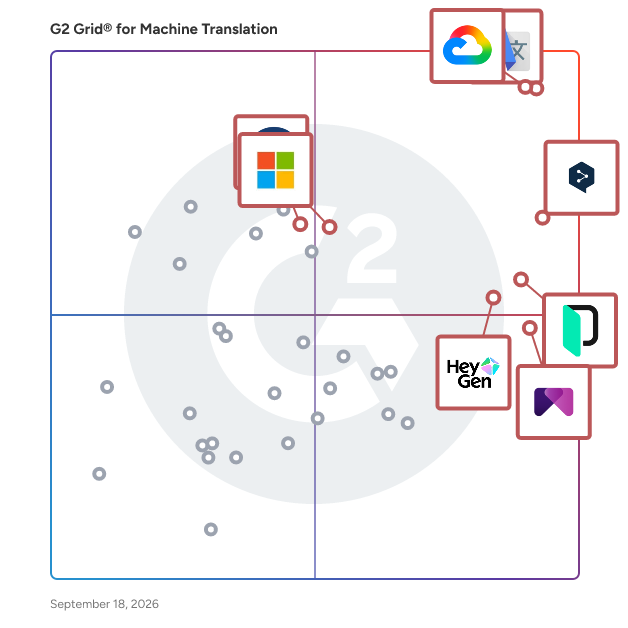
Total Products under this Category: 111
Last updated: July 26, 2026
Why You Can Trust G2's Software Rankings:
G2's software rankings are built on verified user reviews, rigorous moderation, and a consistent research methodology maintained by a team of analysts and data experts. Each product is measured using the same transparent criteria, with no paid placement or vendor influence. While reviews reflect real user experiences, which can be subjective, they offer valuable insight into how software performs in the hands of professionals. Together, these inputs power the G2 Score, a standardized way to compare tools within every category.
What do users say?
Users consistently praise the ease of use and speed of Google Translate, highlighting its ability to quickly translate text, speech, and images across a wide range of languages. Many find it invaluabl
Pros and Cons
What do users say?
Users consistently praise the Google Cloud Translation API for its ease of integration and high accuracy across a wide range of languages, making it a reliable choice for multilingual applications. Ma
Pros and Cons
What do users say?
Users consistently praise the accuracy and natural-sounding translations provided by DeepL, making it a reliable choice for professional communication. The tool's ease of use and seamless integration
Pros and Cons
What do users say?
Users consistently praise the intuitive interface and ease of use of Phrase, highlighting how it simplifies translation tasks and enhances productivity. Many appreciate the platform's ability to strea
Pros and Cons
What do users say?
Users consistently praise the ease of use and realistic avatars offered by HeyGen, which allow for quick and professional video creation without technical expertise. The platform's intuitive interface
Pros and Cons
What do users say?
Users consistently praise the product for its fast, accurate translations and user-friendly interface, which streamline the translation process and enhance productivity. The ability to compare multipl
Pros and Cons
What do users say?
Users consistently praise the Azure Translator Text API for its seamless integration and extensive language support, which enhance application development and global communication. The API is noted fo
What do users say?
Users consistently praise the ease of use and accuracy of translations provided by Microsoft Translator, making it a reliable tool for both personal and professional communication. Many appreciate its
What do users say?
Users consistently praise the ease of use and accuracy of Amazon Translate, highlighting its ability to handle multiple languages effectively. Many find it a reliable tool for both personal and profes
What do users say?
Users consistently praise the ease of use and powerful automation features of GlobalLink, which streamline translation and localization processes. The integration with various platforms enhances effic
Pros and Cons
What do users say?
Users consistently praise the platform for its ease of use and ability to create high-quality videos quickly, making it ideal for both beginners and experienced creators. The intuitive interface allow
Pros and Cons
What do users say?
Users consistently praise Claude for its clear, thoughtful responses and strong reasoning capabilities, which enhance productivity across various tasks. Many appreciate its ability to handle complex i
Pros and Cons
What do users say?
Users consistently praise the ease of use and quick setup of Localize, highlighting how it simplifies the translation process and reduces the need for technical involvement. The intuitive interface an
Pros and Cons
What do users say?
Users consistently praise the ease of use and powerful features of memoQ, highlighting its intuitive interface and robust translation memory capabilities that enhance productivity. Many appreciate the
Pros and Cons
What do users say?
Users consistently praise the real-time translation capabilities of Langfinity, highlighting its accuracy and speed in facilitating communication across diverse teams. This software significantly enha
Pros and Cons
Machine translation (MT) is the process of translating one text to another with the help of artificial intelligence and without any human involvement.
A large amount of source and target languages are involved in machine translation. Machine translation software compares and matches source and target languages. Some common examples of machine translation software are mobile apps that help in translating content.
Machine translation software comes with embedded artificial intelligence that helps in real-time translation management. Machine translation solutions help in accurate translations. Translation services providers use machine translation software for better translation management of their projects. This software also helps in translating web pages. The best machine translation platforms for teams pursuing digital transformation pair translation quality with the onboarding speed and integrations that let non-specialists produce usable output from day one. Based on G2 reviews, operations teams and localization managers evaluate machine translation software by comparing translation accuracy on their real language pairs, how quickly new users get up and running, and whether the platform connects to the tools where their content already lives.
Machine translation software has developed over time. There are three major types of machine translation solutions:
Rule-based machine translation
This is the earliest form of machine translation. It is very rarely used today. It requires the manual addition of languages and human post-editing. It depends on a predefined set of rules that help transfer the meaning of text between different languages or any given language pairs.
Statistical machine translation
This type of machine translation tool builds a statistical model of the relationship between words and phrases in a text. This model is then applied to a second language to convert those elements into a new language. Nowadays, this MT software is replaced by neural machine translation.
Neural machine translation (NMT)
NMT uses AI to learn languages constantly to upgrade knowledge like neural networks in the brain. This MT software encodes and decodes the source text. Deep neural machine translation is an advanced version of neural machine translation. It has deep learning as its base technology.
Cloud-based translation
Many translation services vendors provide cloud-based translation systems where there is a pre-trained machine learning model to do the text translation.
The following are some core features within the machine translation platform that can help users in various ways:
Translation memory: A translation memory is a database of sentences that can be used to translate similar content.
Quality assurance: This tool goes over the translated content to detect any errors, resulting in high-quality translations.
Import or export: This functionality supports multiple file formats and helps in smooth translation management.
Glossaries: Glossary is a dictionary of terms used by a company and is translated consistently.
Automated translation workflows: This helps teams collaborate and effectively review the translations.
Enterprise machine translation solutions win on integration with technology stacks when translation happens inside existing workflows instead of alongside them. Based on G2 reviews, Google Cloud Translation API users describe integration with other Google Cloud services and applications as straightforward, with documentation that makes setup fast and an API that stays reliable while handling a large number of requests. The honest counterweight comes from reviewers too: some flag that deepening reliance on a single vendor's ecosystem is a strategic tradeoff worth weighing before standardizing. Phrase reviewers describe centralizing translation memories, glossaries, and project workflows in one platform after years of spreadsheets and manual updates, with freelance linguists noting that so many agencies run Phrase that familiarity lets them plug into client workflows from day one. DeepL Translate users highlight integrations where work already happens, with reviewers citing Windows integration, browser extensions, and Microsoft Teams support for its voice features.
Machine translation tools have greatly improved over the years with AI translation and neural networks, which learn and improve by themselves. The post-edit translations by translators can help enhance the quality of translated content.
Speed and saves time: The machine translation process does not require human intervention or support to translate the text. Thus, machine translation software can translate the content quickly and in some cases, the text translation can be done almost instantly. Machine translation tools can translate text in seconds and hence save time.
Cost-effective: With an implemented post-edit translation step or a translation memory, machine translation is cost-effective since it involves no human contribution. Machine learning makes it even more efficient. It thus helps agencies complete translation projects faster.
The machine translation platforms with the fastest time to value for distributed remote teams are the ones producing usable translations the same day they are adopted. Based on G2 reviews, DeepL Translate draws the strongest distributed-team evidence, with reviewers at companies working across Asian and Western offices describing daily English-Japanese file conversion, and others crediting quick onboarding and instant translation for cross-cultural collaboration. Google Translate reviewers in customer support describe pasting a message and responding within seconds, removing the language barrier from response times entirely. The tradeoff appears at the platform end of the category: Phrase reviewers note that advanced settings and workflows take new users time to learn, so teams buying a full localization platform should expect value to arrive in weeks rather than the same afternoon.
Machine translation tools have various use cases in different departments and industries alike.
Customer support executives: Machine translation tools help in solving customers' queries by providing multilingual support. Machine translation software can translate the content or queries of customers into their language for faster and better communication. Thus it is possible to obtain high-quality translations.
Language service providers (LSPs): Language service providers use machine translation tools to increase productivity and achieve high-quality translation. Thus, the machine translation platform improves productivity. An API translation software also helps the developers and translators translate text into different languages.
The best machine translation tools for small teams without dedicated IT support run entirely in the browser, with nothing to install and nothing to administer. Based on G2 reviews, DeepL Translate users describe onboarding as needing only a login to the page with no software on the machine, and an interface that allows immediate handling without specific training. Comparing DeepL against Google Translate, reviewers weigh DeepL's translation quality and glossary control against Google Translate's free access and reach, with Google Translate users describing one paste and click getting the job done across 250 languages at no cost. Google Cloud Translation API extends the same pattern for small teams with a developer on hand, with reviewers calling pay-per-use pricing a good value for small projects and documentation that makes getting started easy.
Although machine translation is beneficial for various projects and translates the content to different languages, the technology has its own set of challenges as follows:
Relevance: While the machine translation platform can convert content into various languages, the challenge is to translate relevant content. It is not only about localization of the content or a simple language translation but getting relevant translated content that can communicate a marketing message to a completely new target audience. If a marketing message for a completely new geographical location has to be translated, the text can get translated as is with local references taken into consideration.
Lack of sensitivity to the culture: Communication varies according to different cultures. Some words can be used and some words cannot. However, machine translation, while providing high-quality translations, could fail at understanding prohibited words and may even use them while translating.
Overall quality: With common concerns like the usage of relevant words, the context of the translated content, and so on, machine translation can further impact the overall quality of the translated text.
The best machine translation tools for enterprise deployment pair scale with strong support, and reviews separate the machine translation vendors with responsive customer support from those that leave teams reading documentation alone. Based on G2 reviews, Phrase anchors the enterprise deployment side, with language service providers describing the platform as something their teams rely on daily, quality assurance features that reduce manual checks, and centralized workflows that shortened turnaround times across multilingual projects. Google Cloud Translation API reviewers point to support resources and documentation that help during setup, with the API staying reliable and responsive under a large number of requests, the closest evidence this category offers on behavior during critical production incidents. Google Translate users note a reachable support service and responsiveness over email. One honest gap for buyers: reviewers in this category rarely describe vendor behavior during production outages directly, so teams running translation in critical paths should test support SLAs and incident response commitments during evaluation rather than assuming them.
Machine translation platforms come with various features that cater to the different translation needs of an organization. It is essential to understand the company's requirements before searching for the right software.
If the organization needs MT software to keep learning languages on its own, then it should choose neural machine translation software. However, if the organization operates on a statistical model, it would need statistical MT software. RFP or RFIs can help the buyer understand the pricing plans, agreement guidelines, and product features.
Create a long list
The process begins with making a list of all the potential vendors. The product can be evaluated based on features, pricing, customer support, and also verified reviews on G2.
Create a short list
After a thorough analysis of the vendors and their products, a few products are shortlisted depending on which one fits the bill and fits the organizational needs.
Conduct demos
Demos are an essential measure to evaluate the MT engines. Vendors can give demos in order to help organizations make better decisions. For example, a statistical translation tool may also have an artificial intelligence (AI) feature helping in obtaining results in natural language. An NMT feature can also be available within a machine translation tool. A demo can help understand the features better, the pricing of the product, and performance expectations from the product.
Choose a selection team
A team including technical personnel, a business user, a decision maker, and an IT professional is a good mix to test or evaluate different MT engines.
Negotiation
This step occurs after a certain price is quoted by the vendor. The team from the organization negotiates depending on their budget and up to what extent the product fulfills their criteria.
Final decision
Generally, a chief marketing officer (CMO) can make decisions depending on how effectively the product will help the internal teams.
Which Machine Translation software has the best reviews?
Based on verified user ratings, these platforms consistently earn top marks:
What is machine translation post-editing (MTPE)?
Machine translation post-editing is the workflow where a human translator reviews and corrects machine-translated output rather than translating from scratch. It is the standard way businesses balance MT speed with publication-grade quality, and reviewer behavior reflects it: users of even the highest-rated engines describe reviewing output before using it, especially for complex sentences, industry terminology, and gendered or stylistic edge cases. MTPE typically costs less and moves faster than full human translation while catching the errors machines still make.
Which machine translation solutions reduce manual work for operations teams?
What are the most reliable machine translation platforms according to reviews?
Can machine translation replace human translators?
Not for content where accuracy carries consequences. Machine translation predicts likely translations without understanding meaning, so fluent-sounding output can still be wrong, and reviewers of even top-rated tools describe double-checking medical phrases, complex sentences, and cultural nuances. The practical answer most businesses land on is a hybrid: machine translation for speed and volume, human post-editing for anything customer-facing, legal, or high-stakes. That is why post-editing workflows and human-in-the-loop review remain standard even as translation engines improve.
For smaller teams, you can compare options on the small business Machine Translation software page.
What is the most affordable Machine Translation software for SMBs?
What is the best machine translation software for startups?
Which machine translation software is the most user-friendly?
Which machine translation tools translate documents and files directly?
Which machine translation software works in the browser without installing anything?
For larger deployments, you can compare options on the enterprise Machine Translation software page.
What is the top-rated Machine Translation software for enterprises?
What is the most reliable machine translation platform for enterprises?
What is the best-reviewed machine translation software for enterprise app integration?
Which machine translation platforms keep terminology consistent across large projects?
Which machine translation tools handle high translation volumes for enterprises?