Best Cloud Platform as a Service (PaaS) Software

How Many Cloud Platform as a Service (PaaS) Software Products Does G2 Track?

Total Products under this Category: 367

Category Stats (Nov 2026)

  • Average Rating: 4.42/5 The average rating of products in this category, based on all submitted ratings
  • Top Trending Product: Bunnyshell (+6.36%) - Among all products in this category, Bunnyshell recorded the largest rating increase compared to last month

Last updated: November 01, 2026

How Does G2 Rank Cloud Platform as a Service (PaaS) Software Products?

Why You Can Trust G2's Software Rankings:

  • 30 Analysts and Data Experts
  • 21,100+ Authentic Reviews
  • 367+ Products
  • Unbiased Rankings

G2's software rankings are built on verified user reviews, rigorous moderation, and a consistent research methodology maintained by a team of analysts and data experts. Each product is measured using the same transparent criteria, with no paid placement or vendor influence. While reviews reflect real user experiences, which can be subjective, they offer valuable insight into how software performs in the hands of professionals. Together, these inputs power the G2 Score, a standardized way to compare tools within every category.

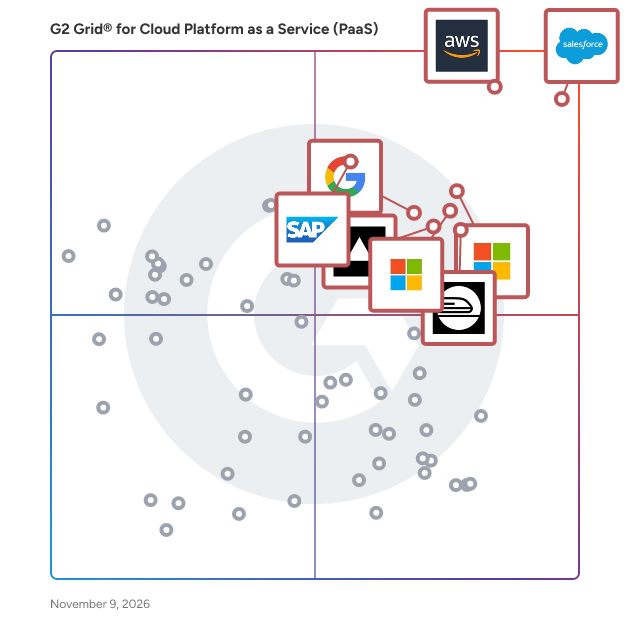
G2 Grid® for Cloud Platform as a Service (PaaS) Software

G2 Grid® for Cloud Platform as a Service (PaaS) Software plotting products by satisfaction and market presence

Highlighted products: Salesforce Platform, AWS Lambda, Azure Functions, Azure OpenAI Service, Railway, Vercel, Google Cloud TPU, and SAP Business Technology Platform.

Underlying data: [Grid® JSON](https://www.g2.com/categories/cloud-platform-as-a-service-paas/grids.json?focus%5B%5D=agentforce-360-platform-formerly-salesforce-platform&focus%5B%5D=aws-lambda&focus%5B%5D=azure-functions&focus%5B%5D=azure-openai-service&focus%5B%5D=railway&focus%5B%5D=vercel&focus%5B%5D=google-cloud-tpu&focus%5B%5D=sap-business-technology-platform)

Salesforce Platform

The Salesforce Platform helps IT and security teams innovate fast, deploy securely, and protect their data. With our development and security tools built into the entire agent and app lifecycle on Salesforce, organizations can dive into AI innovation without compromising on security and compliance. And by building on Salesforce, development teams get a head start on AI projects by using the apps, workflows, data streams, and agents they've already built. Developers can develop agents and apps quickly, securely, and reliably, and IT can customize and extend Salesforce across the enterprise. And every customer can protect their data with security and compliance.

Average Rating: 4.5/5.0

Total Reviews: 4,406

How Do G2 Users Rate Salesforce Platform?

  • Has the product been a good partner in doing business?: 8.8/10 (Category avg: 9.0/10)
  • Application Deployment: 8.7/10 (Category avg: 9.0/10)
  • Database Management: 9.0/10 (Category avg: 8.5/10)
  • Networking: 8.5/10 (Category avg: 8.4/10)

Who Is the Company Behind Salesforce Platform?

  • Seller: Salesforce
  • Company Website:
  • Year Founded: 1999
  • HQ Location: San Francisco, CA
  • LinkedIn® Page: www.linkedin.com
    89,711 employees on LinkedIn®
  • Ownership: NYSE:CRM

Who Uses This Product?

  • Who Uses This: Salesforce Developer, Account Executive
  • Top Industries: Information Technology and Services, Computer Software
  • Company Size: 44% Medium, 35% Large

What Do G2 Reviewers Say About Salesforce Platform?

AI-generated summary from verified user reviews

Pros
  • Users appreciate the ease of use of Salesforce Platform, especially its intuitive drag-and-drop interface and ongoing feature updates.
  • Users value the versatile features of Salesforce Platform, enjoying its comprehensive capabilities and smooth onboarding process.
  • Users value the customization capabilities of Salesforce Platform, facilitating integration and enhancing development efficiency.
  • Users value the customizability of Salesforce Platform, enabling tailored applications and seamless integration with external tools.
  • Users value the extensive customization options of Salesforce Platform, enabling seamless integration and tailored applications.
Cons
  • Users find the learning curve steep due to the platform's complexity and overlapping tools, impacting navigation and usage.
  • Users find the complexity of the Salesforce Platform overwhelming, particularly due to its numerous overlapping features and settings.
  • Users find the pricing steep, with high costs for licensing and add-ons, making it hard for small businesses.
  • Users find that the difficult learning curve and complex navigation hinder their efficiency with the Salesforce Platform.
  • Users are frustrated by missing features like limited access to standard objects and reporting on sibling-level records.

What Are Recent G2 Reviews of Salesforce Platform?

What Are G2 Users Discussing About Salesforce Platform?

AWS Lambda

AWS Lambda lets you run code without provisioning or managing servers. You pay only for the compute time you consume - there is no charge when your code is not running. With Lambda, you can run code for virtually any type of application or backend service - all with zero administration. Just upload your code and Lambda takes care of everything required to run and scale your code with high availability. You can set up your code to automatically trigger from other AWS services or call it directly from any web or mobile app.

Average Rating: 4.6/5.0

Total Reviews: 940

How Do G2 Users Rate AWS Lambda?

  • Has the product been a good partner in doing business?: 8.9/10 (Category avg: 9.0/10)
  • Application Deployment: 9.0/10 (Category avg: 9.0/10)
  • Database Management: 8.3/10 (Category avg: 8.5/10)
  • Networking: 8.6/10 (Category avg: 8.4/10)

Who Is the Company Behind AWS Lambda?

Who Uses This Product?

  • Who Uses This: Software Engineer, Senior Software Engineer
  • Top Industries: Computer Software, Information Technology and Services
  • Company Size: 43% Large, 36% Medium

What Do G2 Reviewers Say About AWS Lambda?

AI-generated summary from verified user reviews

Pros
  • Users appreciate the ease of use of AWS Lambda, allowing for quick implementations without server management hassles.
  • Users value the remarkable scalability of AWS Lambda, allowing effortless handling of increased loads and performance enhancements.
  • Users value the cost-effective nature of AWS Lambda, enjoying savings while efficiently handling high loads and tasks.
  • Users appreciate the serverless execution of AWS Lambda, allowing focus on code without server management worries.
  • Users appreciate the seamless integrations of AWS Lambda, enabling efficient event-driven architectures with other AWS services.
Cons
  • Users find resource limitations with AWS Lambda challenging, particularly regarding execution time and memory constraints.
  • Users find debugging challenges in AWS Lambda frustrating, as local testing and attaching debuggers are complex tasks.
  • Users experience slow performance due to cold starts and latency, impacting response times and overall efficiency.
  • Users experience lagging performance with AWS Lambda due to cold starts and execution time limits affecting critical applications.
  • Users find AWS Lambda expensive, especially when functions run frequently or for long periods, complicating budgeting.

What Are Recent G2 Reviews of AWS Lambda?

What Are G2 Users Discussing About AWS Lambda?

Azure Functions

Azure Functions is a serverless compute service that enables developers to build and deploy event-driven applications without the need to manage infrastructure. By automatically scaling resources based on demand, it allows for efficient execution of code in response to various triggers, such as HTTP requests, database changes, or messages from other Azure services. This approach simplifies the development process, reduces operational overhead, and supports a wide range of programming languages, including C#, JavaScript, Python, and Java. Key Features and Functionality: - Event-Driven Execution: Functions can be triggered by a variety of events, including HTTP requests, changes in data, or messages from services like Azure Service Bus. - Automatic Scaling: The service scales resources automatically based on the number of incoming events, ensuring optimal performance without manual intervention. - Multiple Language Support: Developers can write functions in languages such as C#, JavaScript, Python, and Java, allowing flexibility in development. - Integrated Development Tools: Azure Functions integrates with tools like Visual Studio and Visual Studio Code, providing a seamless development and debugging experience. - Flexible Hosting Options: Offers various hosting plans, including Consumption, Premium, and Dedicated (App Service) plans, to meet different performance and cost requirements. Primary Value and Problem Solving: Azure Functions addresses the challenge of managing infrastructure for event-driven applications by providing a fully managed, serverless environment. This allows developers to focus on writing code that responds to events without worrying about provisioning or maintaining servers. The automatic scaling feature ensures that applications can handle varying loads efficiently, while the pay-per-execution pricing model offers cost-effectiveness by charging only for the compute resources used during function execution. This combination of features accelerates development, reduces operational complexity, and enables rapid deployment of scalable applications.

Average Rating: 4.4/5.0

Total Reviews: 198

How Do G2 Users Rate Azure Functions?

  • Has the product been a good partner in doing business?: 9.0/10 (Category avg: 9.0/10)
  • Application Deployment: 8.9/10 (Category avg: 9.0/10)
  • Database Management: 8.6/10 (Category avg: 8.5/10)
  • Networking: 8.7/10 (Category avg: 8.4/10)

Who Is the Company Behind Azure Functions?

  • Seller: Microsoft
  • Year Founded: 1975
  • HQ Location: Redmond, Washington
  • LinkedIn® Page: www.linkedin.com
    232,750 employees on LinkedIn®
  • Ownership: MSFT
  • Phone: +1 (877) 276-2464

Who Uses This Product?

  • Who Uses This: Software Engineer, Senior Software Engineer
  • Top Industries: Information Technology and Services, Computer Software
  • Company Size: 40% Large, 33% Medium

What Do G2 Reviewers Say About Azure Functions?

AI-generated summary from verified user reviews

Pros
  • Users find Azure Functions to be extremely easy to use, appreciating its user-friendly interface and seamless integration options.
  • Users appreciate the automation flexibility of Azure Functions, seamlessly integrating event-driven code and scheduled services.
  • Users value the automatic scaling and cost-efficiency of Azure Functions, making it suitable for various organizations.
  • Users appreciate the strong security options in Azure Functions, ensuring robust protection for their applications.
  • Users praise the excellent cloud storage options in Azure Functions, facilitating seamless project management and collaboration.
Cons
  • Users find the complexity of Azure Functions pricing and dashboard challenging, impacting both understanding and costs.
  • Users find the cost issues of Azure Functions challenging, with potential confusion leading to higher expenses.
  • Users experience slow performance with Azure Functions, noting long execution times and frustrating cold start delays.
  • Users find the complex pricing of Azure Functions confusing, leading to potential overspending on unnecessary services.
  • Users find Azure Functions expensive to manage and experience some confusion during the initial installation process.

What Are Recent G2 Reviews of Azure Functions?

What Are G2 Users Discussing About Azure Functions?

AI can help you find the answers. G2 helps you trust them.

Connect G2 to Claude or ChatGPT for answers grounded in G2's trusted reviews, comparisons, and pricing from real user insights.

How it works

Azure OpenAI Service

Azure OpenAI Service is a cloud-based platform that provides access to OpenAI's advanced artificial intelligence models, including GPT-3.5, Codex, and DALL·E 2. This service enables developers and businesses to integrate powerful AI capabilities into their applications, facilitating tasks such as natural language processing, code generation, and image creation. By leveraging Azure's enterprise-grade infrastructure, users benefit from enhanced security, compliance, and scalability, making it suitable for a wide range of industries and use cases. Key Features and Functionality: - Access to Advanced AI Models: Utilize state-of-the-art models like GPT-3.5 for natural language understanding, Codex for code generation, and DALL·E 2 for image creation. - Enterprise-Grade Security and Compliance: Benefit from Azure's robust security measures, ensuring data privacy and compliance with industry standards. - Scalability and Reliability: Deploy AI solutions at scale with high availability, leveraging Azure's global infrastructure. - Customization and Fine-Tuning: Tailor AI models to specific business needs through fine-tuning capabilities, enhancing performance for particular tasks. - Integrated Responsible AI Tools: Implement AI solutions responsibly with built-in tools designed to detect and mitigate harmful content, ensuring ethical AI usage. Primary Value and Solutions Provided: Azure OpenAI Service empowers organizations to accelerate innovation by integrating cutting-edge AI models into their products and services. It addresses challenges such as automating complex tasks, enhancing customer interactions through natural language understanding, and generating high-quality content efficiently. By providing a secure and scalable environment, the service enables businesses to harness the full potential of AI while maintaining control over their data and compliance requirements.

Average Rating: 4.6/5.0

Total Reviews: 57

How Do G2 Users Rate Azure OpenAI Service?

  • Has the product been a good partner in doing business?: 9.4/10 (Category avg: 9.0/10)

Who Is the Company Behind Azure OpenAI Service?

  • Seller: Microsoft
  • Year Founded: 1975
  • HQ Location: Redmond, Washington
  • LinkedIn® Page: www.linkedin.com
    232,750 employees on LinkedIn®
  • Ownership: MSFT
  • Phone: +1 (877) 276-2464

Who Uses This Product?

  • Top Industries: Information Technology and Services, Computer Software
  • Company Size: 34% Large, 33% Small

What Do G2 Reviewers Say About Azure OpenAI Service?

AI-generated summary from verified user reviews

Pros
  • Users appreciate the intuitive ease of use of Azure OpenAI Service, simplifying tasks with seamless Azure integration.
  • Users appreciate the seamless integrations of Azure OpenAI Service with other Azure services, enhancing usability and efficiency.
  • Users value the scalability of Azure OpenAI Service, enabling effective management of enterprise-wide data infrastructure securely.
  • Users value the reliability of Azure OpenAI Service, praising its seamless integration and strong security features.
  • Users appreciate the seamless integration and strong security of Azure OpenAI Service for enterprise AI deployment.
Cons
  • Users find the pricing confusing and feel that it complicates their ability to experiment effectively.
  • Users find the setup process overly complex, requiring advanced knowledge of Azure networking and security protocols.
  • Users feel the limited features of Azure OpenAI Service restrict their experience and access to newer models.
  • Users find the complexity of Azure OpenAI Service poses significant challenges in usage and management, causing frustration.
  • Users face time consumption issues due to slow quota approvals and regional feature rollouts impacting experimentation.

What Are Recent G2 Reviews of Azure OpenAI Service?

Railway

Railway simplifies your infrastructure stack from servers to observability with a single, scalable, easy-to-use platform. Build and Deploy: Craft a complete full-stack application with a powerful visual canvas. Network and Connect: Interconnect your application seamlessly with highly performant networking. Scale and Grow: Scale your applications with intuitive vertical and horizontal scaling. Monitor and Observe: Fix code faster with fully configurable observability. Manage Development Environments: Accelerate your development lifecycle with isolated environments, staged changes, and pull request deploys.

Average Rating: 4.4/5.0

Total Reviews: 95

How Do G2 Users Rate Railway?

  • Has the product been a good partner in doing business?: 9.1/10 (Category avg: 9.0/10)
  • Application Deployment: 9.4/10 (Category avg: 9.0/10)
  • Database Management: 8.8/10 (Category avg: 8.5/10)
  • Networking: 8.8/10 (Category avg: 8.4/10)

Who Is the Company Behind Railway?

  • Seller: Railway
  • Year Founded: 2020
  • HQ Location: San Francisco, US
  • LinkedIn® Page: www.linkedin.com
    11,388 employees on LinkedIn®

Who Uses This Product?

  • Who Uses This: CTO
  • Top Industries: Computer Software, Information Technology and Services
  • Company Size: 83% Small, 13% Medium

What Do G2 Reviewers Say About Railway?

AI-generated summary from verified user reviews

Pros
  • Users like the clean, intuitive interface, which makes the platform easy to navigate and use day to day.
  • Users find project and service setup quick and straightforward, with little configuration needed to get started.
  • Users like how straightforward deployment is, with little setup or effort.
  • Users appreciate automated infrastructure and server management, which reduces setup and DevOps work so they can focus on their applications.
  • Users value fast deployments that take projects from code to live, accessible services quickly.
Cons
  • Users find usage-based pricing confusing and want clearer cost breakdowns and estimates as projects grow.
  • Users miss fine-grained control over infrastructure and server configurations, including resource allocation and access to deeper settings.
  • Users find costs rise as projects, applications, and workloads scale, especially with heavier resource use.
  • Users find costs unpredictable as usage and traffic grow, with bills rising more than expected.
  • Users find deployment setup less straightforward for complex apps, with templates sometimes requiring customization and improvements.

What Are Recent G2 Reviews of Railway?

Vercel

Vercel is the agentic infrastructure company. As the team behind Next.js, AI SDK, AI Gateway and v0, Vercel is the platform where humans and AI agents build, ship, and scale software together. We are trusted by OpenAI, Ramp, Supreme, and millions of developers worldwide to ship what's next.

Average Rating: 4.6/5.0

Total Reviews: 88

How Do G2 Users Rate Vercel?

  • Has the product been a good partner in doing business?: 9.3/10 (Category avg: 9.0/10)
  • Application Deployment: 9.8/10 (Category avg: 9.0/10)
  • Database Management: 9.0/10 (Category avg: 8.5/10)
  • Networking: 9.4/10 (Category avg: 8.4/10)

Who Is the Company Behind Vercel?

  • Seller: Vercel
  • Year Founded: 2015
  • HQ Location: San Francisco, California, United States
  • LinkedIn® Page: www.linkedin.com
    1,013 employees on LinkedIn®

Who Uses This Product?

  • Who Uses This: Founder
  • Top Industries: Information Technology and Services, Computer Software
  • Company Size: 84% Small, 16% Medium

What Do G2 Reviewers Say About Vercel?

AI-generated summary from verified user reviews

Pros
  • Users value the ease of use of Vercel, enjoying fast deployment and a straightforward setup process.
  • Users find Vercel's easy setup impressive, enabling quick deployment without the hassle of complex configurations.
  • Users appreciate the ease of use and seamless integrations of Vercel, enabling fast and reliable website deployments.
  • Users value the tool efficiency of Vercel, enjoying streamlined deployment and seamless integration with GitHub.
  • Users praise the deployment ease of Vercel, highlighting its speed and simplicity for modern web apps.
Cons
  • Users find Vercel's pricing to be too expensive, charging $20 regardless of actual resource usage and limiting accessibility.
  • Users express frustration with Vercel's pricing strategy, finding it inflexible and costly for lower usage levels.
  • Users find the execution time limits and restrictions on the free tier of Vercel challenging for larger projects.
  • Users find Vercel's limited features restrictive, particularly regarding serverless function execution and backend services.
  • Users wish for expanded backend services in Vercel, finding the current limits restrictive for larger projects.

What Are Recent G2 Reviews of Vercel?

What Are G2 Users Discussing About Vercel?

Google Cloud TPU

Cloud TPU empowers businesses everywhere to access this accelerator technology to speed up their machine learning workloads on Google Cloud

Average Rating: 4.5/5.0

Total Reviews: 33

How Do G2 Users Rate Google Cloud TPU?

  • Has the product been a good partner in doing business?: 9.2/10 (Category avg: 9.0/10)

Who Is the Company Behind Google Cloud TPU?

  • Seller: Google
  • Year Founded: 1998
  • HQ Location: Mountain View, CA
  • LinkedIn® Page: www.linkedin.com
    301,144 employees on LinkedIn®
  • Ownership: NASDAQ:GOOG
  • Phone: +1 (650) 253-0000

Who Uses This Product?

  • Company Size: 42% Small, 36% Medium

What Do G2 Reviewers Say About Google Cloud TPU?

AI-generated summary from verified user reviews

Pros
  • Users find Google Cloud TPU to be highly effective and easy to work with, enhancing their project experience efficiently.
  • Users value the massive scalability of Google Cloud TPU, enhancing performance for large-scale AI workloads effortlessly.
  • Users admire the high-speed training and seamless integration of Google Cloud TPU for efficient deep learning workloads.
  • Users value the seamless integration of Google Cloud TPU with models like TensorFlow and PyTorch, enhancing their workflows.
  • Users appreciate the strong performance for large-scale machine learning training, making workloads faster and easier to manage.
Cons
  • Users find the difficult learning curve and complexities of Google Cloud TPU challenging, especially for beginners.
  • Users find Google Cloud TPU to be expensive, particularly for smaller projects and long-running training jobs.
  • Users face a complex setup with Google Cloud TPU, making it challenging for teams familiar with GPUs.
  • Users find the limited diversity of supported frameworks on Google Cloud TPU restrictive for broader projects.
  • Users report a steep learning curve with Google Cloud TPU, particularly for those accustomed to GPUs and existing tools.

What Are Recent G2 Reviews of Google Cloud TPU?

SAP Business Technology Platform

SAP Business Technology Platform (SAP BTP) is a multi-cloud platform-as-a-Service optimized to work with SAP solutions. It is a unified platform of technologies SAP uses for its own innovation, to extend and integrate business applications, and to infuse artificial intelligence and context-aware business data. SAP BTP brings together intelligent enterprise applications with database and data management, analytics, integration and extension capabilities into one platform for both cloud and hybrid environments, including hundreds of prebuilt business content and integrations for faster time-to-value. It can be used to create personalized experiences across business processes, build applications, analytics, and integrations faster, and to run mission-critical innovation confidently on major cloud providers' infrastructure fully managed by SAP. SAP BTP offers a range of capabilities and services that: - offers fit-for-purpose tools and services that are optimized for SAP applications along with composable bespoke business processes - provides an open environment with pre-built connectors to 3rd party apps and the availability to run on leading hyperscaler IaaS Clouds (AWS, Azure, GCP, etc.) connects AI & ML into business processes to enhance intelligence, automation, and productivity - delivers security and improved insights by keeping contextual data close to core business processes and applications - enables future-proofing by keeping core systems clean, greatly reducing technical debt to take advantage of cloud economics

Average Rating: 4.4/5.0

Total Reviews: 397

How Do G2 Users Rate SAP Business Technology Platform?

  • Has the product been a good partner in doing business?: 8.6/10 (Category avg: 9.0/10)
  • Application Deployment: 8.5/10 (Category avg: 9.0/10)
  • Database Management: 8.9/10 (Category avg: 8.5/10)
  • Networking: 8.4/10 (Category avg: 8.4/10)

Who Is the Company Behind SAP Business Technology Platform?

  • Seller: SAP
  • Year Founded: 1972
  • HQ Location: Walldorf
  • LinkedIn® Page: www.linkedin.com
    149,349 employees on LinkedIn®
  • Ownership: NYSE:SAP
  • Phone: +1 (800) 872-1727

Who Uses This Product?

  • Who Uses This: Software Engineer, System Engineer
  • Top Industries: Information Technology and Services, Computer Software
  • Company Size: 39% Large, 36% Medium

What Do G2 Reviewers Say About SAP Business Technology Platform?

AI-generated summary from verified user reviews

Pros
  • Users appreciate the ease of use of SAP Business Technology Platform for its integration and streamlined operations.
  • Users appreciate the seamless integrations offered by SAP Business Technology Platform, enhancing efficiency and simplifying their workflows.
  • Users value the easy integrations of SAP Business Technology Platform, streamlining workflows and enhancing productivity significantly.
  • Users value the accelerated integration and innovation SAP BTP offers, making it a vital tool for modern businesses.
  • Users value the unified platform of SAP Business Technology Platform for seamless integration and efficient data management.
Cons
  • Users find the steep learning curve challenging, especially for those lacking prior experience, complicating the initial setup.
  • Users experience a steep learning curve and complexity that can hinder initial use and navigation of SAP BTP.
  • Users find the high costs of SAP Business Technology Platform to be a significant drawback of the overall experience.
  • Users struggle with the steep learning curve of SAP Business Technology Platform, complicating initial setup and usage.
  • Users often find the difficult learning curve of SAP BTP to be a significant barrier for newcomers.

What Are Recent G2 Reviews of SAP Business Technology Platform?

What Are G2 Users Discussing About SAP Business Technology Platform?

DigitalOcean

DigitalOcean is a cloud computing platform designed to assist businesses and developers in creating, deploying, and scaling applications efficiently. This infrastructure-as-a-service (IaaS) solution caters primarily to startups and growing digital enterprises, providing them with the essential tools and resources needed to establish a robust digital presence or develop innovative software products. By focusing on simplicity and user-friendliness, DigitalOcean enables users to navigate the complexities of cloud computing with ease. The target audience for DigitalOcean includes developers, entrepreneurs, and small to medium-sized businesses seeking reliable cloud solutions without the overhead of managing intricate infrastructure. The platform is particularly beneficial for those who prioritize rapid deployment and scalability, allowing them to focus on their core competencies—building and enhancing their applications. DigitalOcean's offerings are tailored to meet the needs of users at various stages of their development journey, from initial project setup to full-scale production environments. Key features of DigitalOcean include its straightforward user interface, which simplifies the process of launching virtual servers, known as Droplets. Users can choose from a variety of pre-configured images, including popular programming languages and frameworks, to expedite their development process. Additionally, DigitalOcean provides managed services such as databases and Kubernetes, allowing users to offload operational tasks and concentrate on application development. The platform also emphasizes security, offering features like automated backups, monitoring, and firewalls to protect user data and applications. Another significant benefit of DigitalOcean is its strong community support and extensive documentation. Users can access a wealth of tutorials, guides, and forums that facilitate knowledge sharing and problem-solving. This community-driven approach not only enhances the user experience but also fosters collaboration among developers, enabling them to learn from one another and share best practices. By combining powerful infrastructure with a supportive ecosystem, DigitalOcean stands out as a valuable resource for those looking to innovate in the digital landscape.

Average Rating: 4.6/5.0

Total Reviews: 747

How Do G2 Users Rate DigitalOcean?

  • Has the product been a good partner in doing business?: 9.1/10 (Category avg: 9.0/10)
  • Application Deployment: 8.9/10 (Category avg: 9.0/10)
  • Database Management: 8.7/10 (Category avg: 8.5/10)
  • Networking: 8.8/10 (Category avg: 8.4/10)

Who Is the Company Behind DigitalOcean?

  • Seller: DigitalOcean
  • Year Founded: 2012
  • HQ Location: New York
  • LinkedIn® Page: www.linkedin.com
    2,476 employees on LinkedIn®
  • Ownership: NYSE: DOCN

Who Uses This Product?

  • Who Uses This: Software Engineer, Founder
  • Top Industries: Computer Software, Information Technology and Services
  • Company Size: 83% Small, 12% Medium

What Do G2 Reviewers Say About DigitalOcean?

AI-generated summary from verified user reviews

Pros
  • Users commend the ease of use of DigitalOcean, appreciating its intuitive design and straightforward setup for cloud hosting.
  • Users appreciate the cost-effective solutions of DigitalOcean, enjoying flexible payments and transparent pricing for startups.
  • Users appreciate the simplicity and intuitive interface of DigitalOcean, making cloud hosting easy and efficient for all.
  • Users appreciate the affordable pricing of DigitalOcean, making cloud hosting accessible without breaking the bank.
  • Users love the easy setup of DigitalOcean, enabling quick deployment of resources with a user-friendly interface.
Cons
  • Users find DigitalOcean to have limited features that fall short for advanced or enterprise-level needs compared to competitors.
  • Users find DigitalOcean expensive compared to competitors, wishing for more flexible pricing options to enhance value.
  • Users note a lack of detailed features and support, hindering effective use of DigitalOcean's capabilities.
  • Users find resource limitations frustrating, as they struggle with droplet caps and inadequate hardware updates.
  • Users experience limited functionality in DigitalOcean, especially regarding advanced features and detailed analytics for resource management.

What Are Recent G2 Reviews of DigitalOcean?

What Are G2 Users Discussing About DigitalOcean?

Kinsta

Kinsta: Simply better hosting for WordPress. Experience hosting that's fast, secure, and built to scale, backed by expert support you can trust. Kinsta delivers top-tier performance with daily backups, Cloudflare integration, and 24/7 human-only support available in 10 languages. Trusted by more than 230,000 businesses in over 128 countries, Kinsta keeps sites running smoothly wherever they're accessed and is SOC 2 audited and ISO 27001 certified to meet rigorous standards for security and data protection.

Average Rating: 4.8/5.0

Total Reviews: 1,693

How Do G2 Users Rate Kinsta?

  • Has the product been a good partner in doing business?: 9.5/10 (Category avg: 9.0/10)
  • Application Deployment: 8.7/10 (Category avg: 9.0/10)
  • Database Management: 8.7/10 (Category avg: 8.5/10)
  • Networking: 9.2/10 (Category avg: 8.4/10)

Who Is the Company Behind Kinsta?

  • Seller: Kinsta
  • Company Website:
  • Year Founded: 2013
  • HQ Location: West Hollywood, California
  • LinkedIn® Page: www.linkedin.com
    232 employees on LinkedIn®

Who Uses This Product?

  • Who Uses This: Owner, CEO
  • Top Industries: Marketing and Advertising, Computer Software
  • Company Size: 93% Small, 6% Medium

What Do G2 Reviewers Say About Kinsta?

AI-generated summary from verified user reviews

Pros
  • Users praise Kinsta's responsive customer support, consistently receiving quick and effective assistance for their hosting needs.
  • Users value the exceptional customer support from Kinsta, ensuring quick resolutions and user-friendly service.
  • Users commend Kinsta's reliability, noting fast performance and excellent support that enhances their hosting experience.
  • Users value the ease of use of Kinsta, with quick access to features and excellent support readily available.
  • Users praise the 24/7 support from Kinsta, highlighting their helpfulness and prompt assistance when issues arise.
Cons
  • Users find Kinsta a bit too expensive, especially for staging sites and wish for loyal customer discounts.
  • Users find Kinsta's pricing to be higher than many shared hosting options, making it less accessible for some users.
  • Users experience poor customer support, often needing assistance for issues that could be resolved independently.
  • Users express concerns about resource limitations, feeling forced into higher pricing tiers despite unchanged performance expectations.
  • Users find the cost issues with Kinsta significant, especially for additional websites and loyalty rewards.

What Are Recent G2 Reviews of Kinsta?

What Are G2 Users Discussing About Kinsta?

Azure App Service

Azure App Service is a fully managed platform-as-a-service (PaaS) offering from Microsoft Azure that enables developers to build, deploy, and scale web applications, APIs, and mobile backends efficiently. Supporting a wide range of programming languages and frameworks—including .NET, Java, Python, Node.js, PHP, and Ruby—Azure App Service allows for the creation of enterprise-grade applications without the complexities of managing the underlying infrastructure. It provides built-in capabilities such as automatic scaling, high availability, and security compliance, facilitating rapid development and deployment of applications on a reliable cloud infrastructure. Key Features and Functionality: - Multiple Language and Framework Support: Develop applications using various languages and frameworks, including .NET, Java, Python, Node.js, PHP, and Ruby, catering to diverse development needs. - Automatic Scaling and High Availability: Scale applications up or out automatically or manually to meet demand, with a 99.95% high availability commitment, ensuring consistent performance. - Integrated Security and Compliance: Benefit from built-in security features, including ISO, SOC, and PCI compliance, IP address restrictions, and native integration with Microsoft Defender for Cloud, enhancing application security. - Continuous Integration and Deployment (CI/CD): Integrate seamlessly with development tools like Azure DevOps and GitHub to enable continuous integration and deployment, streamlining the development lifecycle. - Custom Domains and SSL/TLS Certificates: Easily configure custom domain names and secure applications with SSL/TLS certificates, ensuring secure communication. - Deployment Slots: Utilize deployment slots to manage staging, testing, and production environments, allowing for zero-downtime deployments and efficient application updates. - Built-in Authentication and Authorization: Implement authentication with built-in support for identity providers such as Microsoft Entra ID, Google, Facebook, and Twitter, simplifying user management. - Monitoring and Diagnostics: Leverage tools like Application Insights, log streaming, and the Kudu console for real-time monitoring and diagnostics, aiding in application performance optimization. Primary Value and Problem Solved: Azure App Service addresses the challenges of developing, deploying, and managing web applications by providing a comprehensive, fully managed platform that abstracts the complexities of infrastructure management. Developers can focus on writing code and delivering value to users without worrying about server maintenance, scaling, or security patches. The platform's support for multiple languages and frameworks, combined with its robust features like automatic scaling, high availability, and integrated security, enables organizations to build and deploy applications faster and more efficiently. This accelerates time-to-market, reduces operational overhead, and ensures that applications are secure, reliable, and capable of meeting varying user demands.

Average Rating: 4.5/5.0

Total Reviews: 87

How Do G2 Users Rate Azure App Service?

  • Has the product been a good partner in doing business?: 8.9/10 (Category avg: 9.0/10)
  • Application Deployment: 9.4/10 (Category avg: 9.0/10)
  • Database Management: 8.7/10 (Category avg: 8.5/10)
  • Networking: 8.5/10 (Category avg: 8.4/10)

Who Is the Company Behind Azure App Service?

  • Seller: Microsoft
  • Year Founded: 1975
  • HQ Location: Redmond, Washington
  • LinkedIn® Page: www.linkedin.com
    232,750 employees on LinkedIn®
  • Ownership: MSFT
  • Phone: +1 (877) 276-2464

Who Uses This Product?

  • Who Uses This: Software Engineer
  • Top Industries: Information Technology and Services, Computer Software
  • Company Size: 44% Large, 40% Small

What Do G2 Reviewers Say About Azure App Service?

AI-generated summary from verified user reviews

Pros
  • Users find Azure App Service to be extremely easy to use, allowing focus on development without infrastructure concerns.
  • Users value the seamless integration with Azure services, allowing focus on development without infrastructure concerns.
  • Users appreciate the intuitive user interface of Azure App Service, enhancing deployment and management of applications effortlessly.
  • Users value the comprehensive cloud storage options of Azure App Service, simplifying web app and database deployment.
  • Users commend the deployment ease of Azure App Service, allowing them to focus on development without infrastructure worries.
Cons
  • Users find the cost issues of Azure App Service complex and high, especially for small businesses.
  • Users find the costs associated with Azure App Service to be quite expensive, especially for small businesses.
  • Users find the complexity of Azure App Service challenging due to the overwhelming options and navigational difficulties.
  • Users find the complex pricing of Azure App Service challenging, hindering their ability to predict costs accurately.
  • Users find limited customization options on Azure App Service, which hampers flexibility in integrating specific tools.

What Are Recent G2 Reviews of Azure App Service?

What Are G2 Users Discussing About Azure App Service?

Render

Render is a unified platform to build and run all your apps and websites with free SSL, a global CDN, private networks and auto deploys from Git.

Average Rating: 4.7/5.0

Total Reviews: 81

How Do G2 Users Rate Render?

  • Has the product been a good partner in doing business?: 8.6/10 (Category avg: 9.0/10)
  • Application Deployment: 9.7/10 (Category avg: 9.0/10)
  • Database Management: 9.2/10 (Category avg: 8.5/10)
  • Networking: 8.3/10 (Category avg: 8.4/10)

Who Is the Company Behind Render?

  • Seller: Render
  • Year Founded: 2018
  • HQ Location: San Francisco, California
  • LinkedIn® Page: www.linkedin.com
    219 employees on LinkedIn®

Who Uses This Product?

  • Who Uses This: Software Engineer, Founder
  • Top Industries: Computer Software, Information Technology and Services
  • Company Size: 91% Small, 6% Medium

What Do G2 Reviewers Say About Render?

AI-generated summary from verified user reviews

Pros
  • Users appreciate the ease of deployment with Render, making frontend and backend integration straightforward and efficient.
  • Users value Render's cost-effective services, offering efficient deployment solutions at an attractive price point.
  • Users appreciate the deployment ease of Render, enabling effortless frontend and backend deployment for free.
  • Users love the easy frontend and backend deployment on Render, allowing free testing and simple upgrades.
  • Users praise Render's responsive and high-quality customer support, highlighting their genuine care for customer needs.
Cons
  • Users express concerns about resource limitations affecting performance, especially during high traffic and build times.
  • Users feel that the product is expensive and suggest lower pricing for additional web services and greater allowances.

What Are Recent G2 Reviews of Render?

What Are G2 Users Discussing About Render?

Red Hat OpenShift

Red Hat OpenShift Container Platform is an open source, enterprise-grade Kubernetes platform for building, deploying, and managing containerized applications across on-premise, private cloud and public cloud infrastructure.

Average Rating: 4.5/5.0

Total Reviews: 292

How Do G2 Users Rate Red Hat OpenShift?

  • Has the product been a good partner in doing business?: 8.7/10 (Category avg: 9.0/10)
  • Application Deployment: 9.2/10 (Category avg: 9.0/10)
  • Database Management: 8.3/10 (Category avg: 8.5/10)
  • Networking: 8.7/10 (Category avg: 8.4/10)

Who Is the Company Behind Red Hat OpenShift?

  • Seller: Red Hat
  • Year Founded: 1993
  • HQ Location: Raleigh, NC
  • LinkedIn® Page: www.linkedin.com
    19,487 employees on LinkedIn®

Who Uses This Product?

  • Who Uses This: DevOps Engineer, Senior Software Engineer
  • Top Industries: Information Technology and Services, Financial Services
  • Company Size: 48% Large, 27% Medium

What Do G2 Reviewers Say About Red Hat OpenShift?

AI-generated summary from verified user reviews

Pros
  • Users value the ease of use of Red Hat OpenShift, thanks to its intuitive dashboard and seamless integration with existing tools.
  • Users value the strong security features of Red Hat OpenShift, which ensure protection and compliance without added complexity.
  • Users value the streamlined developer workflows of Red Hat OpenShift, enhancing efficiency and simplifying application management across platforms.
  • Users value the seamless integration capabilities of Red Hat OpenShift, enhancing workflow management across diverse environments.
  • Users value the scalability of Red Hat OpenShift, facilitating effective management of applications across diverse environments.
Cons
  • Users experience a steep learning curve with Red Hat OpenShift, particularly for smaller teams and simpler workloads.
  • Users find the complexity of Red Hat OpenShift overwhelming, especially during initial setup and for smaller teams.
  • Users often struggle with configuration complexity in Red Hat OpenShift, finding it challenging for smaller teams and simpler tasks.
  • Users face a complex setup with Red Hat OpenShift, requiring extensive knowledge and resources, which can overwhelm smaller teams.
  • Users find Red Hat OpenShift not user-friendly, often overwhelmed by its complexity and lack of beginner support.

What Are Recent G2 Reviews of Red Hat OpenShift?

What Are G2 Users Discussing About Red Hat OpenShift?

spring.io

Spring is the most popular application development framework for enterprise Java™. Millions of developers use Spring to create high performing, easily testable, reusable code without any vendor lock-in. Spring helps Java, Groovy and Kotlin software development teams everywhere build simple, portable, fast and flexible JVM-based systems and applications.

Average Rating: 4.5/5.0

Total Reviews: 291

How Do G2 Users Rate spring.io?

  • Has the product been a good partner in doing business?: 8.6/10 (Category avg: 9.0/10)
  • Application Deployment: 9.6/10 (Category avg: 9.0/10)
  • Database Management: 9.5/10 (Category avg: 8.5/10)
  • Networking: 8.9/10 (Category avg: 8.4/10)

Who Is the Company Behind spring.io?

  • Seller: Broadcom
  • Year Founded: 1991
  • HQ Location: San Jose, CA
  • LinkedIn® Page: www.linkedin.com
    44,602 employees on LinkedIn®
  • Ownership: NASDAQ: CA
  • Phone: +1 800 225-5224

Who Uses This Product?

  • Who Uses This: Software Engineer, Senior Software Engineer
  • Top Industries: Computer Software, Information Technology and Services
  • Company Size: 44% Large, 34% Medium

What Do G2 Reviewers Say About spring.io?

AI-generated summary from verified user reviews

Pros
  • Users benefit from the extensive documentation of spring.io, simplifying the learning and implementation of complex features.
  • Users value the ease of use of spring.io, thanks to extensive documentation and project configuration tools.
  • Users appreciate the coding simplicity of spring.io, thanks to its extensive documentation and project setup tools.
  • Users appreciate the comprehensive information provided by spring.io, aiding in learning and project configuration.
  • Users appreciate the deployment ease of spring.io, finding setup fast and straightforward thanks to excellent documentation.
Cons
  • Users find the steep learning curve of spring.io overwhelming, making it challenging for newcomers to navigate effectively.
  • Users often face frequent version changes and vulnerabilities that disrupt consistency and security in spring.io.
  • Users find the steep learning curve of spring.io challenging, making it difficult for newcomers to adapt quickly.

What Are Recent G2 Reviews of spring.io?

What Are G2 Users Discussing About spring.io?

AWS Elastic Beanstalk

AWS Elastic Beanstalk is a fully managed service that simplifies the deployment and scaling of web applications and services. It supports applications developed in various languages, including Java, .NET, PHP, Node.js, Python, Ruby, Go, and Docker. By uploading your code, Elastic Beanstalk automatically handles the provisioning of resources, load balancing, auto-scaling, and monitoring, allowing developers to focus on writing code without managing the underlying infrastructure. Key Features and Functionality: - Simplified Deployment: Deploy applications by uploading code without the need to provision resources or manage configurations. - Automated Management: Handles platform updates, security patches, and health monitoring automatically. - Scalability and Availability: Provides built-in high availability, automatic scaling, and integrated security controls to ensure applications are secure and can handle varying loads. - Cost Efficiency: Operates as a managed service with no additional cost; users pay only for the AWS resources consumed. Primary Value and Problem Solved: AWS Elastic Beanstalk addresses the complexity of deploying and managing web applications by automating infrastructure tasks. This enables developers to concentrate on business logic and application development, reducing operational overhead and accelerating time-to-market. It is particularly beneficial for organizations migrating traditional applications to the cloud or those seeking a straightforward solution for deploying containerized applications without delving into complex container orchestration.

Average Rating: 4.2/5.0

Total Reviews: 179

How Do G2 Users Rate AWS Elastic Beanstalk?

  • Has the product been a good partner in doing business?: 8.2/10 (Category avg: 9.0/10)
  • Application Deployment: 8.8/10 (Category avg: 9.0/10)
  • Database Management: 8.1/10 (Category avg: 8.5/10)
  • Networking: 8.5/10 (Category avg: 8.4/10)

Who Is the Company Behind AWS Elastic Beanstalk?

Who Uses This Product?

  • Who Uses This: Software Engineer, Senior Software Engineer
  • Top Industries: Computer Software, Information Technology and Services
  • Company Size: 35% Large, 33% Small

What Do G2 Reviewers Say About AWS Elastic Beanstalk?

AI-generated summary from verified user reviews

Pros
  • Users appreciate the deployment ease of AWS Elastic Beanstalk, allowing rapid application launches without extensive infrastructure knowledge.
  • Users appreciate the ease of use of AWS Elastic Beanstalk, facilitating quick application deployment and management.
  • Users value the automation features of AWS Elastic Beanstalk, allowing teams to concentrate on development and client solutions.
  • Users value the easy integrations with AWS Elastic Beanstalk, streamlining deployment processes and enhancing productivity.
  • Users appreciate the easy setup of AWS Elastic Beanstalk, allowing quick deployments without needing DevOps support.
Cons
  • Users find the learning curve steep, indicating a need for more intuitive tools and simplified setup processes.
  • Users experience resource limitations with AWS Elastic Beanstalk, often hindering advanced configurations and customization options.
  • Users find the setup complex, especially beginners, needing deeper AWS expertise for troubleshooting and configuration.
  • Users find the costing of AWS Elastic Beanstalk challenging, noting charges even for idle systems.
  • Users find the setup complex for beginners, requiring deeper AWS expertise for troubleshooting and configuration.

What Are Recent G2 Reviews of AWS Elastic Beanstalk?

What Are G2 Users Discussing About AWS Elastic Beanstalk?

Adam Crivello
AC
Researched and written by Adam Crivello
Updated April 9, 2026

Learn More About Cloud Platform as a Service (PaaS) Software

What is Cloud Platform as a Service (PaaS) Software?

The advent of cloud computing brought with it a slew of “as a service" (aaS) offerings. These solutions aim to simplify aspects of the business infrastructure by offering complete cloud platforms to handle databases, IT infrastructure, disaster recovery, and more.

Platform as a service (PaaS) may sound generic—especially since most cloud service offerings are platforms—but in reality, PaaS solutions serve a very specific purpose: they enable companies to develop, deploy, and maintain software and applications from the cloud. By building in the cloud, companies don’t need to possess their own infrastructure. Instead, they rely on the PaaS provider’s infrastructure or public, distributed cloud. PaaS software is built to bring equal or greater power than their on-premises counterparts, while also supplying convenient accessibility and better overall cost management for the development lifecycle. These products are ideal for companies who either lack the immediate infrastructure to build and deploy applications or anticipate significant scaling for their developed products. 

What are the Common Features of Cloud Platform as a Service (PaaS) Software?

The following are some core features within PaaS software that can help users save money and time:

Prebuilt backend infrastructure: A key part of what makes PaaS solutions popular is that they significantly cut the setup time and cost needed for building software and applications. PaaS software takes care of all the prebuilt infrastructure requirements, empowering users to start coding right away.

Development tools: This can involve a wide array of features, including but not limited to text editors, code libraries, code snippets, frameworks, and more. When looking for a PaaS solution, it’s important to ensure the software in question can handle the company’s language requirements.

Diverse development capabilities: PaaS solutions can be used to create diverse products, ranging from solutions to databases to applications and beyond. Regardless of what the buyer is developing, PaaS software needs to be able to handle it.

Management: PaaS software needs to provide high-level management capabilities for pre-, mid-, and post-development stages. These might include reporting, code management, tracking, and other functions.

Deployment: The software that is developed with a PaaS solution is only useful if the user can actually deploy it. PaaS software gives companies the capability to deploy their software where they need it and then maintain that software with management features once deployed.

What are the Benefits of Cloud Platform as a Service (PaaS) Software?

Development speed: PaaS solutions allow developers to build software more quickly since they provide developers with prebuilt backend infrastructure. Developers spend less time setting up the framework for their software or applications, so they can use that saved time to strengthen the software’s performance and features. PaaS software typically includes staging and testing tools as well, which also improves development speed by consolidating these functions into one platform.

Scalability: PaaS software is designed to scale with a company’s needs. Reaching larger, or even international audiences can put a lot of strain on companies that might not have the necessary infrastructure in place to handle such growth. PaaS solutions, because they are cloud-based, can scale development and hosting according to a business’ needs without putting the infrastructure burden on the business itself.

Reduced costs: Most PaaS solutions will offer pay-as-you-grow pricing options based on usage levels, making them particularly beneficial for companies that might not be able to afford extensive development solutions. This gives companies a huge opportunity to build at a low cost and then scale as the need or demand rises.

Who Uses Cloud Platform as a Service (PaaS) Software?

Developers: Software and application developers will be the primary users of PaaS software in a company. Since these solutions are built for helping specifically to build, deploy, and maintain software and applications, these personas find the most value in this software.

Security professionals: Security professionals won’t typically be utilizing PaaS software to perform their day-to-day tasks. However, many PaaS solutions integrate with a company’s security systems, meaning security teams may need to access PaaS software to ensure a high quality of security throughout the company.

Software Related to Cloud Platform as a Service (PaaS) Software

Related solutions that can be used together with PaaS software include:

Infrastructure as a service (IaaS): As the name may suggest, infrastructure as a service software offers companies virtual infrastructure (e.g., servers, networks, and desktops) necessary for a company’s computing goals. What IaaS offers in general virtual infrastructure, it tends to lack in software development capabilities.

Software as a service (SaaS): SaaS is the cloud offering of a completed software solution. SaaS products are convenient for companies who would like remote access to that software and the information contained in it. PaaS software has the capability of developing such solutions.

Mobile backend as a service (mBaaS): Focused distinctly on backend functionality, mBaaS software provides companies with the ability to connect their application’s cloud storage and other cloud resources with the application’s backend resources. These solutions, as the name suggests, specialize with mobile platforms, gaining an advantage on PaaS products specifically in that domain.

Challenges with Cloud Platform as a Service (PaaS) Software

Software solutions can come with their own set of challenges. 

Lack of control: As is the common concern with other cloud service software, anything offered as a service is vulnerable to outages or downtime from the provider. While downtime might be helpful to improve the service platform, it still puts a blip in the PaaS tool functionality, which can be painful for developers. If the service goes down unexpectedly, a business doesn’t have the power to help bring it back online either—that responsibility falls to the platform provider.

Vendor lock-in: What if, after building the software and platform through a PaaS solution, the company needs to switch solution providers? This isn’t an easy task. Switching providers from one PaaS software to another involves a huge amount of work and expense, requiring the coordination of data migration, security changes, configuration changes, and more. It’s important to spend a lot of time researching before choosing PaaS software to avoid potentially significant costs and time consumption.

Which Companies Should Buy Cloud Platform as a Service (PaaS) Software?

Any company with a development team can benefit from PaaS software. Below are a few major examples.

SaaS companies: SaaS companies build and maintain one or multiple SaaS products. As these companies scale, they can reuse existing APIs and components in the cloud to streamline their development process.

Tech startups: Tech startups tend to develop and sell great software, but may be lacking the budget and resources necessary to maintain a development infrastructure. These companies benefit greatly from the pay-as-you-go nature of many PaaS offerings, which eases the burden of infrastructure maintenance without breaking the bank.

Mature enterprise companies: Many enterprise companies looking to replace a tangled web of legacy software can do so with PaaS offerings. PaaS software offers an all-in-one package that can replace multiple disparate software tools in one swoop.

How to Buy Cloud Platform as a Service (PaaS) Software

Requirements Gathering (RFI/RFP) for Cloud Platform as a Service (PaaS) Software

Companies looking for PaaS software, whether for the first time or to replace existing tools, can move forward with confidence using g2.com reviews as a guide.

When searching for PaaS software, buyers must consider their “must-haves” when it comes to things like pricing structure, feature set, and integrations. For example, a company may be looking for a straightforward cloud-hosted development environment rather than paying for a robust, multifaceted platform to handle everything from deployment to performance monitoring. Buyers should zero-in on the features they need to begin developing on a hosted platform, then reference G2 reviews to find the right fit and ensure proper integration with their other tools. 

Narrowing down the pool of PaaS solutions by clearly defining a company’s needs allows decision making teams to then perform more direct comparisons to find the best tool for their needs. G2 reviews can make this process even easier by providing authentic insights from similar buyers. 

Compare Cloud Platform as a Service (PaaS) Software Products

Create a long list

At first, buyers should keep their options open to consider the full range of PaaS tools available to them. Using their predefined must-have features, buyers can explore the many offerings on the market to get a feel for what might be viable. 

Create a short list

Along with a company’s must-have features and pricing matrix, G2 reviews can help to narrow in on a short three to five product list. At that point, buyers can begin to make more granular comparisons and reference specific pros and cons to make an informed decision.

Conduct demos

All of the products that wind up on a company’s short list should be demoed. During demos, buyers should seek out specific information related to their must-haves; for example, one might ask to be walked through the ease of integration between the PaaS product and a security solution. 

Selection of Cloud Platform as a Service (PaaS) Software

Choose a selection team

Companies of all sizes should involve any relevant personas when conducting the PaaS software selection process. Large companies might have the resources to assign individual team members to fill roles such as decision maker, project manager, system owner, and developers. Smaller companies with fewer employees might overlap roles make the best assessment. 

Negotiation

Many companies offer PaaS solutions that go beyond certain companies’ needs to include application performance monitoring, monetization tools, and more. While some companies will not budge on the configurations of their packages, buyers looking to trim costs should try to negotiate down to the specific functions that matter to them in order to get the best price. For example, a vendor’s pricing page might indicate that the buyer’s desired functionality is only included with a robust all-in-one package, whereas a sales conversation may prove otherwise. 

Final decision

After this stage, it is important to perform a trial run if possible with a small selection of developers. This will help to ensure that the PaaS software of choice integrates well with a developers’ day-to-day work. If the PaaS tool is well liked and well utilized, the buyer can take that as a sign that their selection is the right one. If not, reevaluation of the options may be necessary.