Best Enterprise Relational Databases

How Many Relational Databases Products Does G2 Track?

Total Products under this Category: 185

Category Stats (Sep 2026)

  • Average Rating: 4.26/5 The average rating of products in this category, based on all submitted ratings
  • Top Trending Product: ER/Studio (+2.77%) - Among all products in this category, ER/Studio recorded the largest rating increase compared to last month

Last updated: September 01, 2026

How Does G2 Rank Relational Databases Products?

Why You Can Trust G2's Software Rankings:

  • 30 Analysts and Data Experts
  • 12,500+ Authentic Reviews
  • 185+ Products
  • Unbiased Rankings

G2's software rankings are built on verified user reviews, rigorous moderation, and a consistent research methodology maintained by a team of analysts and data experts. Each product is measured using the same transparent criteria, with no paid placement or vendor influence. While reviews reflect real user experiences, which can be subjective, they offer valuable insight into how software performs in the hands of professionals. Together, these inputs power the G2 Score, a standardized way to compare tools within every category.

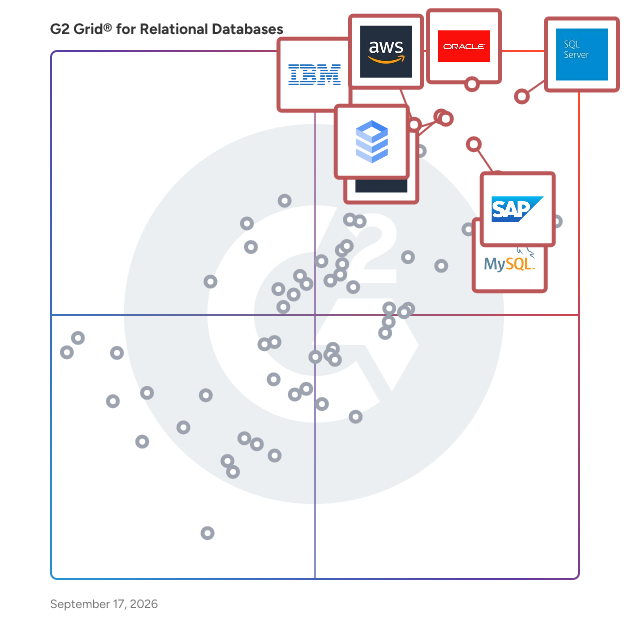
G2 Grid® for Relational Databases

G2 Grid® for Relational Databases plotting products by satisfaction and market presence

Highlighted products: Oracle Database, Microsoft SQL Server, SAP HANA Cloud, Google Cloud SQL, Amazon Relational Database Service (RDS), MySQL, Amazon Aurora, and IBM Db2.

Underlying data: [Grid® JSON](https://www.g2.com/categories/relational-databases/grids.json?focus%5B%5D=oracle-database&focus%5B%5D=microsoft-sql-server&focus%5B%5D=sap-hana-cloud-2025-10-01&focus%5B%5D=google-cloud-sql&focus%5B%5D=amazon-relational-database-service-rds&focus%5B%5D=mysql&focus%5B%5D=amazon-aurora&focus%5B%5D=ibm-db2&segment=enterprise)

Oracle Database

Oracle Database is a comprehensive, multi-model database management system developed by Oracle Corporation. It is designed to handle various data types and workloads, including online transaction processing (OLTP), data warehousing, and mixed database operations. With its robust architecture, Oracle Database supports deployment across on-premises environments, cloud platforms, and hybrid configurations, offering flexibility and scalability to meet diverse business needs. Key Features and Functionality: - Multi-Model Support: Oracle Database accommodates various data models, including relational, document, graph, and key-value, enabling developers to work with diverse data types within a single platform. - Advanced Analytics: The database integrates advanced analytics capabilities, such as in-database machine learning and AI Vector Search, allowing users to perform complex analyses directly within the database environment. - High Availability and Scalability: Designed for mission-critical applications, Oracle Database offers features like data replication, backup, server clustering, and automatic storage management to ensure high availability and seamless scalability. - Security: With comprehensive security measures, including encryption, SQL Firewall, and data masking, Oracle Database safeguards sensitive information and maintains data integrity. - Multicloud Deployment: Oracle Database supports deployment across various cloud platforms, including Oracle Cloud Infrastructure, AWS, Microsoft Azure, and Google Cloud, providing flexibility and compliance with data residency requirements. Primary Value and Solutions Provided: Oracle Database addresses the complex data management needs of modern enterprises by offering a unified platform that supports multiple data models and workloads. Its integration of AI and machine learning capabilities enables organizations to derive actionable insights directly from their data, enhancing decision-making processes. The database's high availability and scalability ensure that businesses can maintain continuous operations and adapt to growing data demands. Additionally, its robust security features protect against data breaches and ensure compliance with regulatory standards. By supporting multicloud deployments, Oracle Database provides the flexibility to operate in various cloud environments, facilitating seamless integration and innovation across different platforms.

Average Rating: 4.3/5.0

Total Reviews: 939

How Do G2 Users Rate Oracle Database?

  • Ease of Use: 8.3/10 (Category avg: 8.5/10)
  • Workload Management: 8.6/10 (Category avg: 8.3/10)
  • Data Schema: 9.0/10 (Category avg: 8.6/10)
  • Query Language: 8.9/10 (Category avg: 8.6/10)

Who Is the Company Behind Oracle Database?

  • Seller: Oracle
  • Year Founded: 1977
  • HQ Location: Austin, TX
  • Twitter: @Oracle
    827,997 Twitter followers
  • LinkedIn® Page: www.linkedin.com
    207,576 employees on LinkedIn®
  • Ownership: NYSE:ORCL

Who Uses This Product?

  • Who Uses This: Software Engineer, Software Developer
  • Top Industries: Information Technology and Services, Computer Software
  • Company Size: 61% Large, 27% Medium

What Do G2 Reviewers Say About Oracle Database?

AI-generated summary from verified user reviews

Pros
  • Users appreciate the outstanding performance of Oracle Database, effectively handling large workloads with stability and speed.
  • Users value the robust security features of Oracle Database, ensuring reliable performance for large data projects.
  • Users praise the ease of use of Oracle Database, making it simple to implement and integrate.
  • Users value the easy integrations of Oracle Database, facilitating seamless connectivity with other technologies.
  • Users value the reliability of Oracle Database, praising its stability and performance for mission-critical applications.
Cons
  • Users often mention the high cost of Oracle Database, making it challenging for smaller teams to manage effectively.
  • Users find the complexity of Oracle Database challenging, particularly regarding licensing and high maintenance requirements.
  • Users face a difficult learning curve due to complex tasks and the need for skilled DBAs to manage Oracle Database.
  • Users face a steep learning curve with Oracle Database, requiring experienced DBAs to utilize its advanced features effectively.
  • Users find Oracle Database to have poor usability, often struggling with its complexity and lack of user-friendliness.

What Are Recent G2 Reviews of Oracle Database?

What Are G2 Users Discussing About Oracle Database?

Microsoft SQL Server

SQL Server 2017 brings the power of SQL Server to Windows, Linux and Docker containers for the first time ever, enabling developers to build intelligent applications using their preferred language and environment. Experience industry-leading performance, rest assured with innovative security features, transform your business with AI built-in, and deliver insights wherever your users are with mobile BI.

Average Rating: 4.4/5.0

Total Reviews: 2,131

How Do G2 Users Rate Microsoft SQL Server?

  • Ease of Use: 8.6/10 (Category avg: 8.5/10)
  • Workload Management: 8.7/10 (Category avg: 8.3/10)
  • Data Schema: 9.1/10 (Category avg: 8.6/10)
  • Query Language: 9.2/10 (Category avg: 8.6/10)

Who Is the Company Behind Microsoft SQL Server?

  • Seller: Microsoft
  • Year Founded: 1975
  • HQ Location: Redmond, Washington
  • Twitter: @microsoft
    13,091,739 Twitter followers
  • LinkedIn® Page: www.linkedin.com
    232,750 employees on LinkedIn®
  • Ownership: MSFT

Who Uses This Product?

  • Who Uses This: Software Engineer, Software Developer
  • Top Industries: Information Technology and Services, Computer Software
  • Company Size: 45% Large, 38% Medium

What Do G2 Reviewers Say About Microsoft SQL Server?

AI-generated summary from verified user reviews

Pros
  • Users appreciate the ease of use of Microsoft SQL Server, highlighting its seamless integration and simplicity in management.
  • Users appreciate the robust database management of Microsoft SQL Server, enhancing performance and simplifying data handling.
  • Users appreciate the powerful performance of Microsoft SQL Server, recognizing it as an industry standard for databases.
  • Users appreciate the easy integrations of Microsoft SQL Server, enhancing their reporting and data management experience.
  • Users value the enterprise-grade security of Microsoft SQL Server, ensuring safety for sensitive data is prioritized.
Cons
  • Users find Microsoft SQL Server's high licensing costs a burden, especially for small businesses and budget constraints.
  • Users express concern about the high licensing costs of Microsoft SQL Server, making it tough for small businesses.
  • Users find the high licensing costs of Microsoft SQL Server a barrier for small businesses and budget constraints.
  • Users find the licensing costs steep, making Microsoft SQL Server less accessible for small businesses and limiting flexibility.
  • Users report slow performance of Microsoft SQL Server, especially when multitasking, affecting overall efficiency and usability.

What Are Recent G2 Reviews of Microsoft SQL Server?

What Are G2 Users Discussing About Microsoft SQL Server?

SAP HANA Cloud

SAP HANA Cloud is a modern database-as-a-service (DBaaS) powering the next generation of intelligent data applications. SAP HANA Cloud offers a competitive edge by incorporating advanced machine learning and predictive tools grounded in modern data science. Its powerful in-memory performance safeguards efficient data processing. By securely storing vast amounts of data with its integrated multitier storage and handling various types on a single copy in its native multi-model database, SAP HANA Cloud simplifies data management and connects to other data sources. The seamless integration of these capabilities in a reliable, unified foundation makes it easier for developers to build high-demand intelligent data apps.

Average Rating: 4.3/5.0

Total Reviews: 521

How Do G2 Users Rate SAP HANA Cloud?

  • Ease of Use: 8.2/10 (Category avg: 8.5/10)
  • Workload Management: 8.6/10 (Category avg: 8.3/10)
  • Data Schema: 8.5/10 (Category avg: 8.6/10)
  • Query Language: 8.3/10 (Category avg: 8.6/10)

Who Is the Company Behind SAP HANA Cloud?

  • Seller: SAP
  • Year Founded: 1972
  • HQ Location: Walldorf
  • Twitter: @SAP
    297,052 Twitter followers
  • LinkedIn® Page: www.linkedin.com
    149,349 employees on LinkedIn®
  • Ownership: NYSE:SAP

Who Uses This Product?

  • Who Uses This: Consultant, SAP Consultant
  • Top Industries: Information Technology and Services, Computer Software
  • Company Size: 61% Large, 26% Medium

What Do G2 Reviewers Say About SAP HANA Cloud?

AI-generated summary from verified user reviews

Pros
  • Users appreciate the exceptional ease of use of SAP HANA Cloud, contributing to improved decision-making and collaboration.
  • Users appreciate the seamless integration capabilities of SAP HANA Cloud, enhancing data management and reporting efficiencies.
  • Users appreciate the easy integrations of SAP HANA Cloud, enhancing data management and reporting efficiency seamlessly.
  • Users praise SAP HANA Cloud for its exceptional real-time performance, enhancing usability and driving significant business value.
  • Users commend the scalability of SAP HANA Cloud, enabling flexibility and efficiency in managing large, complex datasets.
Cons
  • Users often struggle with the complexity of setup and configuration, making it challenging for new users to navigate.
  • Users feel that the cost can be prohibitive for smaller organizations, particularly with premium features and usage growth.
  • Users note a steep learning curve for SAP HANA Cloud, which may require specialized training to navigate effectively.
  • Users find the difficult learning curve of SAP HANA Cloud challenging, particularly for those new to SAP technologies.
  • Users point out the complex setup of SAP HANA Cloud, which can be challenging for specialized applications and users.

What Are Recent G2 Reviews of SAP HANA Cloud?

Google Cloud SQL

Cloud SQL is a fully-managed managed relational database service for MySQL, PostgreSQL, and SQL Server with rich extension collections, configuration flags, and developer ecosystems.

Average Rating: 4.5/5.0

Total Reviews: 355

How Do G2 Users Rate Google Cloud SQL?

  • Ease of Use: 9.2/10 (Category avg: 8.5/10)
  • Workload Management: 9.0/10 (Category avg: 8.3/10)
  • Data Schema: 9.1/10 (Category avg: 8.6/10)
  • Query Language: 9.3/10 (Category avg: 8.6/10)

Who Is the Company Behind Google Cloud SQL?

  • Seller: Google
  • Year Founded: 1998
  • HQ Location: Mountain View, CA
  • Twitter: @google
    31,899,995 Twitter followers
  • LinkedIn® Page: www.linkedin.com
    301,144 employees on LinkedIn®
  • Ownership: NASDAQ:GOOG

Who Uses This Product?

  • Who Uses This: Data Engineer, Software Engineer
  • Top Industries: Information Technology and Services, Computer Software
  • Company Size: 41% Medium, 34% Small

What Do G2 Reviewers Say About Google Cloud SQL?

AI-generated summary from verified user reviews

Pros
  • Users appreciate the efficiency and automation of Google Cloud SQL for hassle-free database management and maintenance.
  • Users value the seamless integration of Google Cloud SQL with Google Cloud services, enhancing scalability and performance.
  • Users appreciate the ease of use of Google Cloud SQL, simplifying database management without infrastructure worries.
  • Users value the easy integrations of Google Cloud SQL, enhancing efficiency and convenience for database management.
  • Users commend the scalability of Google Cloud SQL, appreciating its seamless integration and efficient management of databases.
Cons
  • Users find Google Cloud SQL to be expensive, especially for storage and smaller projects, making it less accessible.
  • Users find Google Cloud SQL to be expensive, especially as workloads increase, straining budgets and resources.
  • Users face scaling issues with Google Cloud SQL due to slow support and manual adjustments for changing workloads.
  • Users find the complex pricing of Google Cloud SQL challenging, leading to confusion and difficulty in cost prediction.
  • Users find Google's pricing to be confusing, especially with unexpected usage spikes affecting cost predictions.

What Are Recent G2 Reviews of Google Cloud SQL?

What Are G2 Users Discussing About Google Cloud SQL?

Amazon Relational Database Service (RDS)

Amazon Relational Database Service (Amazon RDS) makes it easy to set up, operate, and scale a relational database in the cloud. It provides cost-efficient and resizable capacity while managing time-consuming database administration tasks such as hardware provisioning, database setup, patching and backups. It frees you up to focus on your apps so you can give them the better performance, availability, security, and compatibility they need. Amazon RDS is available on 6 familiar database instances: Amazon Aurora, MySQL, PostgreSQL, MariaDB, Oracle Database and SQL Server engines. This means that the code, applications, and tools you already use today with your existing databases can be used with Amazon RDS. Amazon RDS automatically patches the database software and backs up your database, storing the backups for a user-defined retention period and enabling point-in-time recovery. You benefit from the flexibility of being able to scale the compute resources or storage capacity associated with your relational database instance via a single API call. In addition, Amazon RDS makes it easy to use replication to enhance availability and reliability for production databases. Amazon RDS for MySQL also enables you to scale out beyond the capacity of a single database deployment for read-heavy database workloads. As with all Amazon Web Services, there are no up-front investments required, and you pay only for the resources you use.

Average Rating: 4.5/5.0

Total Reviews: 866

How Do G2 Users Rate Amazon Relational Database Service (RDS)?

  • Ease of Use: 8.8/10 (Category avg: 8.5/10)
  • Workload Management: 8.7/10 (Category avg: 8.3/10)
  • Data Schema: 8.8/10 (Category avg: 8.6/10)
  • Query Language: 8.9/10 (Category avg: 8.6/10)

Who Is the Company Behind Amazon Relational Database Service (RDS)?

  • Seller: Amazon Web Services (AWS)
  • Year Founded: 2006
  • HQ Location: Seattle, WA
  • Twitter: @awscloud
    2,232,483 Twitter followers
  • LinkedIn® Page: www.linkedin.com
    147,094 employees on LinkedIn®
  • Ownership: NASDAQ: AMZN

Who Uses This Product?

  • Who Uses This: DevOps Engineer, Software Engineer
  • Top Industries: Information Technology and Services, Computer Software
  • Company Size: 38% Medium, 34% Large

What Do G2 Reviewers Say About Amazon Relational Database Service (RDS)?

AI-generated summary from verified user reviews

Pros
  • Users find Amazon RDS to be extremely easy to use, streamlining deployment and saving valuable setup time.
  • Users appreciate the effortless scalability of Amazon RDS, enhancing application performance during unexpected traffic spikes.
  • Users appreciate the easy setup of Amazon RDS, enabling quick deployment and hassle-free management for their applications.
  • Users appreciate the automated backup services of Amazon RDS, allowing them to focus on application development without data loss worries.
  • Users appreciate the high availability and reliability of Amazon RDS, simplifying management and ensuring data safety.
Cons
  • Users find the cost of Amazon RDS quite high, especially with charges accruing for unused instances.
  • Users find the complex naming conventions in AWS services frustrating, making it hard for newcomers to navigate.
  • Users experience performance issues with Amazon RDS, including latency and variability in multi-tenant environments.
  • Users note that cost issues can escalate quickly, with unexpected charges making budgeting challenging.
  • Users experience latency issues with Amazon RDS, especially noticeable during replication and with larger databases.

What Are Recent G2 Reviews of Amazon Relational Database Service (RDS)?

What Are G2 Users Discussing About Amazon Relational Database Service (RDS)?

Amazon Aurora

Amazon Aurora is a fully managed relational database service that combines the performance and availability of high-end commercial databases with the simplicity and cost-effectiveness of open-source databases. Compatible with MySQL and PostgreSQL, Aurora delivers up to five times the throughput of standard MySQL databases and up to three times that of standard PostgreSQL databases. It is designed for high availability, offering up to 99.99% availability within a single region and up to 99.999% across multiple regions. Aurora's architecture includes a distributed, fault-tolerant storage system that automatically scales up to 128 tebibytes, ensuring continuous data access and durability. Additionally, Aurora provides serverless configurations, allowing automatic scaling based on application needs, and integrates seamlessly with other AWS services for machine learning and analytics. Key Features and Functionality: - High Performance: Delivers up to five times the throughput of MySQL and three times that of PostgreSQL, enabling efficient handling of demanding workloads. - High Availability: Designed for up to 99.99% availability within a single region and up to 99.999% across multiple regions, ensuring continuous data access. - Scalability: Automatically scales storage up to 128 tebibytes and supports up to 15 read replicas for read-intensive applications. - Serverless Configuration: Offers Aurora Serverless, which automatically adjusts capacity based on application demand, eliminating the need for manual provisioning. - Machine Learning Integration: Integrates with Amazon SageMaker and Amazon Comprehend, allowing for in-database machine learning capabilities without data movement. - Security: Provides multiple layers of security, including network isolation, encryption at rest and in transit, and compliance with various industry standards. Primary Value and Solutions Provided: Amazon Aurora addresses the need for a high-performance, highly available, and scalable relational database service that is cost-effective and easy to manage. By offering compatibility with MySQL and PostgreSQL, it allows organizations to migrate existing applications without significant code changes. Aurora's automatic scaling and serverless options cater to applications with variable workloads, reducing operational overhead and costs. Its integration with AWS machine learning services enables real-time analytics and predictive capabilities directly within the database, enhancing application functionality. Overall, Aurora simplifies database management while delivering enterprise-grade performance and reliability.

Average Rating: 4.5/5.0

Total Reviews: 435

How Do G2 Users Rate Amazon Aurora?

  • Ease of Use: 8.7/10 (Category avg: 8.5/10)
  • Workload Management: 8.8/10 (Category avg: 8.3/10)
  • Data Schema: 8.7/10 (Category avg: 8.6/10)
  • Query Language: 8.6/10 (Category avg: 8.6/10)

Who Is the Company Behind Amazon Aurora?

  • Seller: Amazon Web Services (AWS)
  • Year Founded: 2006
  • HQ Location: Seattle, WA
  • Twitter: @awscloud
    2,232,483 Twitter followers
  • LinkedIn® Page: www.linkedin.com
    147,094 employees on LinkedIn®
  • Ownership: NASDAQ: AMZN

Who Uses This Product?

  • Who Uses This: DevOps Engineer, Software Engineer
  • Top Industries: Information Technology and Services, Computer Software
  • Company Size: 38% Small, 34% Medium

What Do G2 Reviewers Say About Amazon Aurora?

AI-generated summary from verified user reviews

Pros
  • Users value the auto-scaling and high performance of Amazon Aurora, enhancing manageability and efficiency for applications.
  • Users value the high availability and auto-scaling of Amazon Aurora, ensuring seamless performance for scalable applications.
  • Users appreciate the ease of use in Amazon Aurora, enjoying seamless management and integration with AWS services.
  • Users highlight the impressive performance and scalability of Amazon Aurora, making it ideal for heavy batch jobs.
  • Users value the high availability of Amazon Aurora, which ensures reliable performance and seamless workload management.
Cons
  • Users find Amazon Aurora expensive, with unpredictable costs that increase significantly for larger datasets and storage needs.
  • Users face a significant dependency on the AWS ecosystem, limiting integration with external systems and flexibility.
  • Users report feature limitations in Aurora, especially compared to self-managed databases and other cloud providers.
  • Users find that the cost issues with Amazon Aurora can accumulate unexpectedly, especially with large datasets.
  • Users often find the learning curve steep, especially when transitioning from basic database solutions to Aurora.

What Are Recent G2 Reviews of Amazon Aurora?

What Are G2 Users Discussing About Amazon Aurora?

MySQL

MySQL is the world's most popular open-source database, renowned for its reliability, performance, and ease of use. It serves as the backbone for many high-profile web applications, including those of Facebook, Twitter, and YouTube. MySQL offers a comprehensive suite of features that cater to the needs of modern web, mobile, embedded, and cloud applications. Key Features and Functionality: - Transactional Data Dictionary: Implemented as a set of SQL tables stored in a single InnoDB tablespace, enhancing data management efficiency. - Common Table Expressions (CTEs): Also known as WITH queries, CTEs simplify complex queries and improve readability. - Window Functions: These functions reduce code complexity and boost developer productivity by allowing calculations across sets of table rows related to the current row. - Invisible Indexes: Facilitate better management of software upgrades and database changes for applications that require continuous operation. - Descending Indexes: Eliminate the need for sorting results, leading to performance improvements. - JSON Support: Includes the JSON_TABLE() function, which accepts JSON data and returns it as a relational table, enhancing flexibility in data handling. - Document Store: Allows the development of both SQL and NoSQL document applications using a single database, providing versatility in application design. - SQL Roles: Simplify permission management by granting and denying permissions to groups of users, thereby reducing the security workload. - OpenSSL Integration: Utilizes OpenSSL as the default TLS/SSL library, ensuring secure data transmission. - Default to utf8mb4 Character Set: Supports richer mobile applications and international character sets, accommodating a global user base. - Geographic Information System (GIS) Enhancements: Supports geography and Spatial Reference Systems (SRS), enabling advanced spatial data analysis. - InnoDB Cluster: Provides improved high availability through integrated solutions. - InnoDB ClusterSet: Offers cross-region disaster recovery capabilities, ensuring data resilience. - Replication: Provides flexible topologies for scale-out and high availability, enhancing system robustness. - Reliability: Requires minimal intervention to achieve continuous uptime, ensuring consistent performance. - Partitioning: Improves performance and management of very large database environments by dividing tables into smaller, more manageable pieces. - ACID Transactions: Ensures reliable and secure business-critical applications by supporting Atomicity, Consistency, Isolation, and Durability. - Stored Procedures and Triggers: Enhance developer productivity and enforce complex business rules at the database level. - Views: Ensure sensitive information is not compromised by providing controlled access to data. - Ease of Use: Offers a "3 minutes from download to development" installation and configuration process, facilitating quick deployment. - Low Administration: Requires very little database maintenance, reducing operational overhead. Primary Value and User Solutions: MySQL delivers a robust, scalable, and secure database solution that addresses the needs of developers and enterprises alike. Its comprehensive feature set supports the development of high-performance applications across various platforms, including web, mobile, embedded, and cloud environments. By offering advanced functionalities such as ACID compliance, high availability, and flexible replication, MySQL ensures data integrity and reliability. Its ease of use and low administrative requirements enable organizations to reduce operational costs and accelerate time-to-market for their applications. Furthermore, MySQL's support for modern development practices, including JSON and NoSQL capabilities, allows developers to build versatile and future-proof applications.

Average Rating: 4.4/5.0

Total Reviews: 1,584

How Do G2 Users Rate MySQL?

  • Ease of Use: 8.7/10 (Category avg: 8.5/10)
  • Workload Management: 8.5/10 (Category avg: 8.3/10)
  • Data Schema: 9.1/10 (Category avg: 8.6/10)
  • Query Language: 9.2/10 (Category avg: 8.6/10)

Who Is the Company Behind MySQL?

  • Seller: Oracle
  • Year Founded: 1977
  • HQ Location: Austin, TX
  • Twitter: @Oracle
    827,997 Twitter followers
  • LinkedIn® Page: www.linkedin.com
    207,576 employees on LinkedIn®
  • Ownership: NYSE:ORCL

Who Uses This Product?

  • Who Uses This: Software Engineer, Software Developer
  • Top Industries: Information Technology and Services, Computer Software
  • Company Size: 37% Small, 33% Large

What Do G2 Reviewers Say About MySQL?

AI-generated summary from verified user reviews

Pros
  • Users find MySQL to be easy to use, enhancing their experience with straightforward setup and functionality.
  • Users appreciate MySQL for its reliability, ensuring data consistency and efficiency for various projects and datasets.
  • Users appreciate the easy integrations of MySQL, enhancing its versatility for a variety of projects.
  • Users praise MySQL for its exceptional performance, ensuring fast queries and robust scalability for various projects.
  • Users appreciate the impressive querying and indexing capabilities of MySQL, enhancing their database management efficiency.
Cons
  • Users note the feature limitations of MySQL, particularly for complex data types and high-demand analytics.
  • Users find limited database support in MySQL, particularly in complex queries and advanced analytical features.
  • Users encounter performance issues with MySQL in large-scale analytics, complex joins, and heavy write operations.
  • Users experience slow performance in MySQL, particularly with large datasets and complex queries that hinder efficiency.
  • Users experience scaling issues with MySQL, finding it complex to handle large databases and integrate advanced features.

What Are Recent G2 Reviews of MySQL?

What Are G2 Users Discussing About MySQL?

IBM Db2

Built to run the world’s mission-critical workloads. Designed by the world’s leading database experts, IBM Db2 empowers developers, enterprise architects, and data engineers to run low-latency transactions and real-time analytics equipped for the most demanding workloads. From microservices to AI workloads, Db2 is the tested, resilient, and hybrid database providing the extreme availability, built-in refined security, effortless scalability, and intelligent automation for systems that run the world.

Average Rating: 4.1/5.0

Total Reviews: 600

How Do G2 Users Rate IBM Db2?

  • Ease of Use: 8.0/10 (Category avg: 8.5/10)
  • Workload Management: 8.5/10 (Category avg: 8.3/10)
  • Data Schema: 8.6/10 (Category avg: 8.6/10)
  • Query Language: 8.4/10 (Category avg: 8.6/10)

Who Is the Company Behind IBM Db2?

  • Seller: IBM
  • Year Founded: 1911
  • HQ Location: Armonk, New York, United States
  • Twitter: @IBMSecurity
    74,660 Twitter followers
  • LinkedIn® Page: www.linkedin.com
    344,328 employees on LinkedIn®
  • Ownership: SWX:IBM

Who Uses This Product?

  • Who Uses This: Software Engineer, Senior Software Engineer
  • Top Industries: Information Technology and Services, Banking
  • Company Size: 66% Large, 21% Medium

What Do G2 Reviewers Say About IBM Db2?

AI-generated summary from verified user reviews

Pros
  • Users highlight the high performance of IBM Db2, appreciating its reliability and efficiency in managing large datasets.
  • Users praise IBM Db2 for its exceptional reliability, consistently delivering strong performance even under heavy workloads.
  • Users commend the scalability of IBM Db2, ensuring excellent performance even with large datasets and enterprise workloads.
  • Users highlight the strong security of IBM Db2, making it a reliable choice for critical workloads across industries.
  • Users find IBM Db2 to be easy to use and integrate, enhancing daily tasks and overall efficiency.
Cons
  • Users often find the complex setup of IBM Db2 challenging, requiring significant time and effort to manage effectively.
  • Users find IBM Db2 to be expensive, with high licensing costs and significant resource demands impacting their budget.
  • Users face a steep learning curve with IBM Db2, making setup and administration challenging for newcomers.
  • Users find IBM Db2's setup complex, facing high costs and limited documentation that complicate the user experience.
  • Users find the difficult setup of IBM Db2 challenging, often leading to frustration during initial configuration and administration.

What Are Recent G2 Reviews of IBM Db2?

What Are G2 Users Discussing About IBM Db2?

EDB Postgres AI Database

EDB delivers an always-on, multi-model Postgres engine built on open source and extended with the enterprise capabilities that mission-critical workloads demand. It powers transactional, analytical, and AI workloads with support for relational, vector, document, and time-series data, so teams work with one engine and one set of Postgres skills instead of maintaining specialized systems for each data type. That consolidation removes the operational drag of stitching together separate databases, cutting the cost, complexity, and risk that come with a fragmented data estate and freeing teams to focus on building rather than integrating. EDB Postgres AI adds Oracle compatibility, transparent data encryption, distributed high availability, and native vector support for agentic and AI applications, all backed by the largest enterprise contributor to Postgres. Organizations use EDB Postgres AI Database to consolidate fragmented data infrastructure, cut licensing costs when migrating off Oracle, and build AI-ready applications without a separate vector database. Native vector support means retrieval, semantic search, and agentic workflows run right next to your operational data, so there is no extra system to sync, secure, or scale. It is built for the teams who run, build on, and extend Postgres: DBAs, agentic app developers, platform engineers, and AI engineers. Whether you are modernizing a legacy Oracle estate, standing up a new AI application, or scaling a platform that thousands of developers depend on, one engine handles the full range of work without forcing you to trade performance for flexibility. Independent benchmarks show up to 6x better price-performance than SQL Server and up to 80x faster query performance than specialized vector databases for agentic workloads. Get up to 99.999% uptime with active-active architecture, and up to 95% fewer application rewrites when migrating from Oracle. The result is one platform, enterprise-ready and open at its core, built to run your most demanding workloads today and scale with whatever comes next.

Average Rating: 4.4/5.0

Total Reviews: 158

How Do G2 Users Rate EDB Postgres AI Database?

  • Ease of Use: 8.8/10 (Category avg: 8.5/10)
  • Workload Management: 9.0/10 (Category avg: 8.3/10)
  • Data Schema: 9.3/10 (Category avg: 8.6/10)
  • Query Language: 9.2/10 (Category avg: 8.6/10)

Who Is the Company Behind EDB Postgres AI Database?

  • Seller: EnterpriseDB (EDB)
  • Company Website:
  • Year Founded: 2004
  • HQ Location: Bedford, US
  • Twitter: @EDBPostgres
    8,631 Twitter followers
  • LinkedIn® Page: www.linkedin.com
    1,537 employees on LinkedIn®

Who Uses This Product?

  • Who Uses This: Software Engineer, Database Administrator
  • Top Industries: Information Technology and Services, Computer Software
  • Company Size: 41% Medium, 29% Large

What Do G2 Reviewers Say About EDB Postgres AI Database?

AI-generated summary from verified user reviews

Pros
  • Users commend the fantastic support from EDB, noting its 24/7 availability and assistance with critical workloads.
  • Users praise EDB Postgres AI Database for its superior performance tuning and monitoring, optimizing workloads efficiently.
  • Users value the easy migration support of EDB Postgres AI Database, simplifying transitions from other platforms like Oracle.
  • Users value the robust security features of EDB Postgres AI Database, especially against SQL injection threats.
  • Users value the strong security features of EDB Postgres AI Database, enhancing enterprise-level protection in production environments.
Cons
  • Users find the licensing and support costs of EDB Postgres AI Database to be quite high compared to alternatives.
  • Users face a steep learning curve with advanced features, making it challenging for teams new to PostgreSQL.
  • Users find feature limitations in EDB Postgres AI Database, especially regarding complexity and licensing costs for smaller teams.
  • Users feel that the poor documentation hinders their learning process and slows down the adoption of new features.
  • Users find the pricing confusion and licensing details of EDB Postgres AI challenging, complicating initial setup and understanding.

What Are Recent G2 Reviews of EDB Postgres AI Database?

Azure SQL Database

Azure SQL Database is a fully managed, intelligent relational database service built on the Microsoft SQL Server engine, designed to support modern cloud applications. It offers scalability, high availability, and robust security features, enabling developers to build and maintain applications without the complexities of infrastructure management. Key Features and Functionality: - Hyperscale Storage: Rapidly scale storage resources to meet demand, supporting large databases with up to 100 TB capacity. - Serverless Compute: Automatically adjust compute resources based on workload needs, optimizing performance and cost. - Built-in Intelligence: Utilize AI-driven features for performance tuning, threat detection, and advanced security measures. - High Availability: Ensure business continuity with automatic backups, geo-replication, and a 99.99% uptime SLA. - Advanced Security: Protect data with multi-layered security, including encryption, access controls, and compliance with over 100 certifications. Primary Value and Solutions Provided: Azure SQL Database simplifies database management by automating routine tasks such as patching, backups, and monitoring, allowing developers to focus on application development. Its scalability and performance capabilities support applications of varying sizes, from small web apps to large enterprise solutions. The integration with Azure services and support for AI and machine learning workloads enable the creation of intelligent applications. Additionally, its comprehensive security and compliance features ensure data protection and regulatory adherence, making it a reliable choice for businesses seeking a robust cloud-based database solution.

Average Rating: 4.5/5.0

Total Reviews: 232

How Do G2 Users Rate Azure SQL Database?

  • Ease of Use: 8.8/10 (Category avg: 8.5/10)
  • Workload Management: 8.7/10 (Category avg: 8.3/10)
  • Data Schema: 8.9/10 (Category avg: 8.6/10)
  • Query Language: 9.3/10 (Category avg: 8.6/10)

Who Is the Company Behind Azure SQL Database?

  • Seller: Microsoft
  • Year Founded: 1975
  • HQ Location: Redmond, Washington
  • Twitter: @microsoft
    13,091,739 Twitter followers
  • LinkedIn® Page: www.linkedin.com
    232,750 employees on LinkedIn®
  • Ownership: MSFT

Who Uses This Product?

  • Who Uses This: Software Engineer
  • Top Industries: Information Technology and Services, Computer Software
  • Company Size: 40% Large, 33% Medium

What Do G2 Reviewers Say About Azure SQL Database?

AI-generated summary from verified user reviews

Pros
  • Users value the automatic scaling of Azure SQL Database, enhancing database management without needing additional hardware.
  • Users value the seamless integrations of Azure SQL Database, enhancing connectivity and functionality across various technologies.
  • Users appreciate the ease of use of Azure SQL Database, enabling seamless integration with various technologies.
  • Users appreciate the easy integrations of Azure SQL Database, enabling seamless connectivity across various technologies effortlessly.
  • Users appreciate the ease of use and rich features of Azure SQL Database, making data management straightforward and efficient.
Cons
  • Users find Azure SQL Database expensive, especially for large databases and high-performance needs.
  • Users face significant complexity issues with Azure SQL Database, particularly when managing billing and unexpected costs.
  • Users find cost management complexity and confusing product naming in Azure SQL Database challenging, especially for newcomers.
  • Users find Azure SQL Database a challenge due to limited database support, especially in cross-database querying and features.
  • Users experience a steep learning curve with Azure SQL Database, especially due to complexity in pricing and advanced features.

What Are Recent G2 Reviews of Azure SQL Database?

What Are G2 Users Discussing About Azure SQL Database?

PostgreSQL

PostgreSQL is a powerful, open-source object-relational database system renowned for its reliability, extensibility, and adherence to SQL standards. Originating from the POSTGRES project at the University of California at Berkeley in 1986, it has evolved over nearly four decades into a robust platform capable of handling complex data workloads across various operating systems. PostgreSQL's architecture emphasizes data integrity and scalability, making it a preferred choice for developers and organizations worldwide. Key Features and Functionality: - Comprehensive Data Types: Supports a wide range of data types, including primitives (Integer, Numeric, String, Boolean), structured (Date/Time, Array, Range), document (JSON/JSONB, XML), and geometric types. - Advanced Data Integrity: Ensures data accuracy through features like UNIQUE constraints, primary and foreign keys, exclusion constraints, and various locking mechanisms. - High Performance and Concurrency: Utilizes advanced indexing methods (B-tree, GiST, GIN, BRIN), a sophisticated query planner, multi-version concurrency control (MVCC), parallel query execution, and table partitioning to optimize performance. - Reliability and Disaster Recovery: Offers write-ahead logging (WAL), various replication methods (asynchronous, synchronous, logical), point-in-time recovery (PITR), and active standbys to ensure data durability and availability. - Robust Security Measures: Provides multiple authentication methods (GSSAPI, SSPI, LDAP, SCRAM-SHA-256, Certificate, OAuth 2.0), a comprehensive access-control system, and supports multi-factor authentication. - Extensibility: Allows the creation of custom data types, functions, and operators. Supports procedural languages like PL/pgSQL, Perl, Python, and Tcl, with additional languages available through extensions. Primary Value and User Solutions: PostgreSQL addresses the needs of developers and organizations by offering a highly extensible and standards-compliant database system that ensures data integrity, scalability, and robust performance. Its open-source nature allows for continuous innovation and adaptability, enabling users to tailor the database to their specific requirements. Whether managing small applications or large-scale enterprise systems, PostgreSQL provides a reliable foundation for storing and processing data efficiently.

Average Rating: 4.4/5.0

Total Reviews: 649

How Do G2 Users Rate PostgreSQL?

  • Ease of Use: 8.5/10 (Category avg: 8.5/10)
  • Workload Management: 8.7/10 (Category avg: 8.3/10)
  • Data Schema: 9.1/10 (Category avg: 8.6/10)
  • Query Language: 9.2/10 (Category avg: 8.6/10)

Who Is the Company Behind PostgreSQL?

  • Seller: PostgreSQL
  • HQ Location: United States
  • Twitter: @postgresql
    56,876 Twitter followers
  • LinkedIn® Page: www.linkedin.com
    92 employees on LinkedIn®

Who Uses This Product?

  • Who Uses This: Software Engineer, Senior Software Engineer
  • Top Industries: Information Technology and Services, Computer Software
  • Company Size: 36% Small, 35% Medium

What Do G2 Reviewers Say About PostgreSQL?

AI-generated summary from verified user reviews

Pros
  • Users highlight the reliability and extensive feature set of PostgreSQL, appreciating its robust data integrity and ease of use.
  • Users find PostgreSQL to be easy to use, with straightforward setup and excellent integration across platforms.
  • Users value PostgreSQL for its open-source flexibility and reliability, making it an ideal choice for diverse projects.
  • Users highlight the reliability and data integrity of PostgreSQL, consistently trusting it for their production environments.
  • Users value the scalability of PostgreSQL, finding it easy to adapt from small applications to large systems.
Cons
  • Users find PostgreSQL's beginner unfriendliness challenging, facing a steep learning curve and complex configurations.
  • Users find the complexity of PostgreSQL's SQL syntax and management tasks to be challenging compared to simpler databases.
  • Users find the learning curve steep, with complexities in configuration and concepts challenging newcomers to PostgreSQL.
  • Users face slow performance with large databases and complex queries, requiring careful indexing for better efficiency.
  • Users find the complex configuration of PostgreSQL challenging, particularly for performance tuning and replication management.

What Are Recent G2 Reviews of PostgreSQL?

What Are G2 Users Discussing About PostgreSQL?

Teradata Autonomous Knowledge Platform

Teradata Autonomous Knowledge Platform activates enterprise intelligence by unifying data, knowledge and business context to achieve tangible outcomes. With Teradata, organizations can provide agents with full context for impact when it matters. Our solution lets businesses connect and scale on premises, in the cloud, or through a hybrid approach. Teradata delivers real business value with AI. Learn more at Teradata.com.

Average Rating: 4.3/5.0

Total Reviews: 354

How Do G2 Users Rate Teradata Autonomous Knowledge Platform?

  • Ease of Use: 8.3/10 (Category avg: 8.5/10)
  • Workload Management: 8.9/10 (Category avg: 8.3/10)
  • Data Schema: 8.9/10 (Category avg: 8.6/10)
  • Query Language: 8.8/10 (Category avg: 8.6/10)

Who Is the Company Behind Teradata Autonomous Knowledge Platform?

Who Uses This Product?

  • Who Uses This: Data Engineer, Software Engineer
  • Top Industries: Information Technology and Services, Financial Services
  • Company Size: 69% Large, 22% Medium

What Do G2 Reviewers Say About Teradata Autonomous Knowledge Platform?

AI-generated summary from verified user reviews

Pros
  • Users highlight the extreme performance of Teradata Autonomous Knowledge Platform, emphasizing its speed in processing large data volumes.
  • Users value the high performance and scalability of Teradata for handling complex queries and data integration.
  • Users value the scalability of Teradata Autonomous Knowledge Platform, seamlessly integrating and managing vast data resources efficiently.
  • Users commend the extreme performance of Teradata, highlighting its speed in processing large datasets seamlessly.
  • Users value the fast processing of large datasets in Teradata, appreciating its stability and integration capabilities.
Cons
  • Users identify a steep learning curve for Teradata Autonomous Knowledge Platform, hindering new user adaptation and productivity.
  • Users find the steep learning curve of Teradata Autonomous Knowledge Platform challenging, especially for those less technically inclined.
  • Users find the complexity of the Teradata platform challenging, especially for non-technical users and new adopters.
  • Users struggle with the cost transparency of Teradata Autonomous Knowledge Platform, needing close management to avoid issues.
  • Users express concerns about the high cost of the Teradata Autonomous Knowledge Platform, highlighting affordability issues.

What Are Recent G2 Reviews of Teradata Autonomous Knowledge Platform?

What Are G2 Users Discussing About Teradata Autonomous Knowledge Platform?

TiDB

TiDB is an advanced open-source, distributed SQL database solution designed to help data-intensive businesses manage and scale their data operations seamlessly. Developed by PingCAP, TiDB combines the scalability of NoSQL databases with the full functionality of traditional relational database management systems (RDBMS). This unique architecture allows organizations to build petabyte-scale clusters while efficiently handling millions of tables, numerous concurrent connections, and frequent schema changes without experiencing downtime. The target audience for TiDB includes large enterprises, software-as-a-service (SaaS) providers, and digital-native companies that require robust data management capabilities. These organizations often face challenges related to data scalability, operational complexity, and the need for high availability. TiDB addresses these challenges by offering a solution that supports a wide range of workloads, including transactional, analytical, operational, and artificial intelligence (AI) tasks. Its multi-tenant architecture further enhances operational agility, allowing businesses to adapt to changing demands quickly. Key features of TiDB include seamless scalability, which enables organizations to expand their database infrastructure effortlessly as their data needs grow. The platform's MySQL compatibility ensures that developers can easily integrate TiDB into existing workflows and leverage familiar tools and platforms. Additionally, TiDB supports online DDL (Data Definition Language) operations, allowing for worry-free schema changes that do not disrupt ongoing processes. This operational flexibility is critical for businesses that require constant uptime and reliability. TiDB also prioritizes data security and availability, boasting built-in ACID (Atomicity, Consistency, Isolation, Durability) compliance and a remarkable 99.99% availability rate. The database adheres to various regulatory standards, including GDPR, SOC, HIPAA, and PCI, ensuring that organizations can trust their data management practices. Notable companies such as Databricks, Pinterest, and Plaid have adopted TiDB, allowing them to concentrate on growth and innovation rather than the complexities of data infrastructure management. With its AI-driven innovations and multi-cloud capabilities, TiDB stands out as a powerful solution for businesses looking to enhance their data management strategies. By providing unmatched agility, resilience, and security, TiDB empowers organizations to unlock their full potential in an increasingly data-driven world. For more information, please visit TiDB.io.

Average Rating: 4.6/5.0

Total Reviews: 66

How Do G2 Users Rate TiDB?

  • Ease of Use: 8.3/10 (Category avg: 8.5/10)
  • Workload Management: 9.0/10 (Category avg: 8.3/10)
  • Data Schema: 9.2/10 (Category avg: 8.6/10)
  • Query Language: 9.3/10 (Category avg: 8.6/10)

Who Is the Company Behind TiDB?

  • Seller: PingCAP
  • Company Website:
  • Year Founded: 2015
  • HQ Location: Sunnyvale
  • Twitter: @PingCAP
    7,268 Twitter followers
  • LinkedIn® Page: www.linkedin.com
    507 employees on LinkedIn®

Who Uses This Product?

  • Who Uses This: DBA, Senior Software Engineer
  • Top Industries: Computer Software, Information Technology and Services
  • Company Size: 32% Large, 27% Small

What Do G2 Reviewers Say About TiDB?

AI-generated summary from verified user reviews

Pros
  • Users value TiDB's seamless scalability, effortlessly managing increasing data and users while maintaining strong performance and consistency.
  • Users appreciate the ease of use of TiDB, benefiting from its simple implementation and smooth deployment.
  • Users highlight TiDB's horizontal scalability and strong consistency, making database management straightforward and efficient.
  • Users value the MySQL compatibility of TiDB, facilitating smooth adoption and seamless scaling as data grows.
  • Users value TiDB's high performance in handling vast data and executing analytical queries efficiently in real-time.
Cons
  • Users face a steep learning curve with TiDB's distributed architecture, complicating onboarding and performance tuning for newcomers.
  • Users experience performance issues with TiDB, particularly in vector search and resource requirements for testing and scaling.
  • Users notice slow performance in TiDB, especially in smaller deployments requiring excessive system resources for optimal use.
  • Users find the difficult learning curve of TiDB challenging, especially for teams transitioning from simpler database systems.
  • Users find TiDB's poor documentation challenging, complicating setup and usage for beginners and real-world applications.

What Are Recent G2 Reviews of TiDB?

SAP Adaptive Server Enterprise (ASE)

With SAP® Adaptive Server® Enterprise (SAP ASE), you can handle massive volumes of data and thousands of concurrent users to accelerate the growth of new data-driven business applications. Drive value with a faster, more efficient transactional system that is designed to meet the demands of the digital economy.

Average Rating: 4.1/5.0

Total Reviews: 36

How Do G2 Users Rate SAP Adaptive Server Enterprise (ASE)?

  • Ease of Use: 7.7/10 (Category avg: 8.5/10)
  • Workload Management: 8.7/10 (Category avg: 8.3/10)
  • Data Schema: 8.2/10 (Category avg: 8.6/10)
  • Query Language: 8.6/10 (Category avg: 8.6/10)

Who Is the Company Behind SAP Adaptive Server Enterprise (ASE)?

  • Seller: SAP
  • Year Founded: 1972
  • HQ Location: Walldorf
  • Twitter: @SAP
    297,052 Twitter followers
  • LinkedIn® Page: www.linkedin.com
    149,349 employees on LinkedIn®
  • Ownership: NYSE:SAP

Who Uses This Product?

  • Top Industries: Information Technology and Services
  • Company Size: 41% Large, 32% Medium

What Are Recent G2 Reviews of SAP Adaptive Server Enterprise (ASE)?

What Are G2 Users Discussing About SAP Adaptive Server Enterprise (ASE)?

EDB Postgres Advanced Server

EDB Postgres Advanced Server (EPAS) is based on open source PostgreSQL, the world's most advanced open-source database management system. EPAS gives you the best of both worlds - all the advantages of PostgreSQL, enhanced with mission-critical features that help you maintain greater consistency across your PostgreSQL deployments. EDB Postgres Advanced Server extends PostgreSQL with the security and performance features that enterprises need. It is also Oracle compatible.

Average Rating: 4.5/5.0

Total Reviews: 35

How Do G2 Users Rate EDB Postgres Advanced Server?

  • Ease of Use: 9.0/10 (Category avg: 8.5/10)
  • Workload Management: 8.9/10 (Category avg: 8.3/10)
  • Data Schema: 8.9/10 (Category avg: 8.6/10)
  • Query Language: 9.2/10 (Category avg: 8.6/10)

Who Is the Company Behind EDB Postgres Advanced Server?

  • Seller: EnterpriseDB (EDB)
  • Year Founded: 2004
  • HQ Location: Bedford, US
  • Twitter: @EDBPostgres
    8,631 Twitter followers
  • LinkedIn® Page: www.linkedin.com
    1,537 employees on LinkedIn®
  • Ownership: Private

Who Uses This Product?

  • Top Industries: Financial Services, Telecommunications
  • Company Size: 63% Large, 26% Medium

What Do G2 Reviewers Say About EDB Postgres Advanced Server?

AI-generated summary from verified user reviews

Pros
  • Users value the enterprise-ready features of EDB Postgres Advanced Server, enhancing PostgreSQL with robust capabilities and support.
  • Users value the excellent customer support of EDB Postgres Advanced Server, ensuring smooth transitions and ongoing operations.
  • Users value the advanced data analytics capabilities of EDB Postgres Advanced Server for enhanced decision-making and insights.
  • Users value the reliability of EDB Postgres Advanced Server, ensuring stable environments for mission-critical applications.
  • Users appreciate the Oracle compatibility of EDB Postgres Advanced Server, enhancing the transition and functionality for customers.
Cons
  • Users feel the limited features of EDB Postgres Advanced Server hinder development compared to other RDBMS platforms.
  • Users often face connection issues that hinder performance and lead to frustrating experiences during operational tasks.
  • Users find the cost issues with EDB Postgres Advanced Server to be significant, impacting overall operational expenses.
  • Users find the product expensive, with rising operational costs due to resource demands and lengthy update processes.
  • Users desire greater Oracle syntax support in EDB Postgres Advanced Server to enhance development efficiency.

What Are Recent G2 Reviews of EDB Postgres Advanced Server?

What Are G2 Users Discussing About EDB Postgres Advanced Server?

Shalaka Joshi
SJ
Researched and written by Shalaka Joshi
Updated