AI-Generated Results
Finding matches…
SnapComms, an Everbridge Company, is a comprehensive internal communication platform designed to enhance employee engagement and streamline organizational messaging. By delivering dynamic, visual communications directly to employees' desktops, mobile devices, and digital displays, SnapComms ensures critical information reaches staff promptly and effectively, bypassing traditional email channels. This approach guarantees high message readership and fosters a more connected and informed workforce.
Key Features and Functionality:
- Multi-Channel Communication: Utilize desktop alerts, mobile notifications, screensavers, and tickers to reach employees across various devices, enhancing message visibility and engagement.
- Emergency and Priority Alerts: Send urgent notifications, such as IT outages or safety alerts, directly to employees' screens, ensuring immediate attention and response.
- Engagement Tools: Incorporate interactive elements like surveys, quizzes, and newsletters to foster employee involvement and gather valuable feedback.
- Scheduling and Targeting: Customize communications for specific teams or individuals and schedule messages for optimal delivery times, ensuring relevance and impact.
- Customizable Content: Enhance messages with images, videos, and branding elements to maintain alignment with company identity and increase engagement.
- Real-Time Analytics and Reporting: Monitor communication performance through visual dashboards, providing actionable insights to optimize future messaging strategies.
Primary Value and Solutions Provided:
SnapComms addresses the challenge of information overload and disengagement in the workplace by delivering essential communications through multiple channels, ensuring messages are seen and acted upon. By bypassing cluttered email inboxes, it guarantees that critical information reaches employees promptly, enhancing operational efficiency and safety. The platform's interactive tools also promote a positive organizational culture by encouraging employee participation and feedback, leading to increased engagement and performance.
Not seeing what you're looking for?
Dive deeper into "ScreenSage Pro" on G2 AI

Instantaneous, Audio and Video meeting collaboration. As simple as opening on a link to join a meeting on web browser, mobile devices and desktops. You no longer need to hassle your contacts with installing plugins. Just send them a link. Audio call and Video conferencing, file transfer and screen sharing. All-in-one secure service. All your data are encrypted and we assure you very high quality audio and video, screen-share and unlimited file transfer.

Screensaver apps for Windows PCs and MP4 video loops for TVs. The footage is relaxing scenes from around the world: nature, aquariums and fireplaces. Ideal for waiting rooms, treatment rooms and other public spaces.
You can use the videos with your own promotional videos as digital signage in hospitals, clinics and other public areas where up to 100 people per day will see the videos.
The Waiting Rooms Videos package for spaces where up to 100 people per day will see the content. For bigger public uses, like in-flight entertainment and TV channels, a custom licence can be arranged.
Marketing & sales teams rely on ScreenSpace’s Immersive Product Stories to break through the noise → emotionally engage high-intent buyers → and guide them on an experiential journey to “YES!” 💜

Luana is a family command center built around the TV you already own. It puts a shared calendar, rotating chore charts, a kid-friendly star rewards system, and a family photo screensaver on the living room TV, always visible and always up to date. Parents manage everything from a web dashboard or mobile app, and changes sync to the TV automatically. Luana works on Roku, Fire TV, Google TV, LG webOS, and Samsung Tizen TVs. Plans start at $7.99/month or $79.99/year, with a 14-day free trial. Families end up coordinating everything through group texts and one parent's phone; Luana puts the shared calendar and chore list somewhere everyone can see it without opening an app.

CollabNow enables a more productive and cohesive collaboration experience that goes beyond video, screenshare, and chat. With innovative features like multi-presenter/screen sharing, virtual whiteboards, audience polling/testing, conversational analytics, and the ability to support 10,000+ attendees, CollabNow provides a powerful, simple, versatile and secure collaboration experience at an unbeatable price.
CollabNow is on a mission to make collaboration a positive and productive experience for everyone - no matter where you’re collaborating. That’s why we’ve engineered our platform to optimize for low-bandwidth environments, with seamless auto-reconnect capabilities that ensure productivity does not skip a beat.
With URL meeting links integrated into your calendar and email that can be joined from virtually any device - creating, sharing, and attending CollabNow meetings and virtual events is a hassle-free experience for fellow employees, company partners, customers, and attendees alike . Allow anyone to join with one click, or lock down meetings and take control with attendee authentication and signal-based security protocols.

AnimateDiff is an AI-powered tool that transforms text prompts and static images into dynamic video animations by leveraging Stable Diffusion models and specialized motion modules. Users can generate short video clips by simply providing a textual description or an image, which AnimateDiff animates by predicting and applying natural motion patterns. This process automates the creation of animations, eliminating the need for manual frame-by-frame design.
Key Features and Functionality:
- Text-to-Video Generation: Converts textual descriptions into animated video clips, enabling users to visualize concepts and stories directly from text.
- Image-to-Video Generation: Animates static images by adding motion, bringing still visuals to life.
- Looping Animations: Creates seamless looping animations suitable for backgrounds, screensavers, or artistic projects.
- Video Editing/Manipulation: Utilizes ControlNet to edit existing videos through text prompts, allowing for the addition, removal, or modification of elements within a video.
- Personalized Animations: When combined with techniques like DreamBooth or LoRA, AnimateDiff can animate personalized subjects or objects trained on specific datasets.
- Creative Workflows: Integrates into artists' and creators' workflows, facilitating the rapid visualization of animated concepts, storyboards, or animatics from text and image inputs.
Primary Value and User Solutions:
AnimateDiff addresses the challenge of creating animations by automating the process through AI, making it accessible to users without extensive animation expertise. It streamlines the production of animated content, saving time and effort for artists, designers, and content creators. By enabling quick prototyping and visualization of ideas, AnimateDiff enhances creative workflows and opens new possibilities for storytelling and digital art.

App ahead GmbH is a software studio founded in 2015 by Martin Lexow, dedicated to crafting high-quality applications for macOS and iOS platforms. Operating independently without investors, App ahead focuses on delivering meticulously designed and engineered software that enhances user productivity and creativity.
Key Features and Functionality:
- Diverse Application Portfolio: App ahead offers a range of applications, including:
- Pieoneer: A macOS app that allows users to switch, launch, and control applications effortlessly using a distinctive pie menu interface.
- PolyCapture: A versatile recorder for macOS that enables simultaneous recording of screens, cameras, microphones, and applications.
- AI Transcription: A macOS utility that transcribes speech from audio and video files into text, operating entirely offline for enhanced privacy.
- Mirror Magnet: A macOS tool that displays video from any connected camera in a customizable window that remains on top of other content.
- Theine: A macOS application that prevents the system from sleeping, dimming the screen, or activating the screensaver, ensuring uninterrupted workflow.
- User-Centric Design: Each application is designed with a focus on intuitive interfaces and seamless integration into users' workflows.
- Regular Updates and Maintenance: App ahead commits to continuous improvement and compatibility with the latest operating systems through regular updates.
Primary Value and User Solutions:
App ahead's applications are crafted to solve common productivity challenges by providing reliable, user-friendly tools that integrate seamlessly into users' daily routines. By focusing on quality and user experience, App ahead empowers individuals to work more efficiently and creatively on their Apple devices.

GetCurious enables product companies do deeper user research, faster
The product allows product teams to gather insights through video, audio and screenshare while participant is using target web/app/prototype
Rapid recruitment of participants can be done through UserStudy’s participant panel, so that teams can focus on generating insights

Screenimage Pro is a digital signage software for content management and secure data handling. Its scalable architecture adapts to custom information structures, while the web-based interface enables instant feed publishing without IT skills. The system separates content from design, ensuring consistent formatting with corporate identity templates. Dynamic playlists allow simultaneous editing, and automated content allocation operates based on user profiles. Administrators can schedule content with time-based broadcasting and recurring patterns. The software integrates data from websites, ERP systems, and production equipment, supporting over 200 media formats with automatic optimization. Content distribution aligns with corporate hierarchies, with user rights controlling publishing capabilities. Security features include penetration testing and audits, while regular updates introduce new features from customer projects, benefiting all users.
Digital signage that updates itself: live data, menu boards, touch kiosks and wayfinding, all managed from one browser tab.
MCT is a digital signage platform for teams that run screens in lobbies, restaurants, campuses, venues and offices. You design a layout once, connect it to live data, and publish it to any screen that has a web browser. From then on the content keeps itself current, so nobody re-exports slides.
Live data on every screen. Weather, GTFS-Realtime transit arrivals and alerts, RSS feeds turned into slideshows, and rows from any JSON API, with optional auth headers.
Menu boards that keep up. Build a menu in a spreadsheet-style editor or change it with one sentence of AI, like “Mark the House IPA sold out.” Every change is proposed before it’s applied. Menus can also sync read-only from Toast or PAR, so your POS stays the source of truth.
Playlists and scheduling. You edit loops on a video-editor-style timeline, and edits stay in draft until you publish.
Any clip can be limited to a date range, certain weekdays, a time window, or every Nth loop. Playlists can shuffle and can be nested inside other playlists.
Each screen or group gets a week calendar with holidays, overnight windows, and takeovers that always expire.
Touch kiosks and wayfinding. AI reads an uploaded floor plan and suggests where rooms and routes go. MCT checks every route before you go live.
The kiosk lets visitors search for a place, see the walking route (step-free if they need it), and scan a QR code to take it with them on their phone.
AI Assist drafts multi-scene touch experiences, and a screensaver playlist takes over when nobody is touching the screen.
Automation and hardware. A visual flow builder links triggers, conditions and actions. Physical buttons and sensors connect through commissioned trigger boards and can switch content on screens.
Fleet management and reporting. Pair any display with a short code, track uptime and incidents across your fleet, and remote in when a screen goes dark. Opt-in Proof of Play reports show what played, where and for how long, and export to CSV. A documented API with company-scoped keys covers integrations.

Appliku is a managed deployment platform for Django and Python teams (FastAPI, Rails, and Next.js too). You get the Heroku experience, git push to deploy, managed Postgres and Redis, background workers, automatic SSL and Nginx, but your app runs on a server you own, on any cloud (DigitalOcean, AWS, Hetzner, or any VPS).
The difference from hosted platforms: you keep control of cost and avoid vendor lock-in, because you bring your own cloud account and pay the provider directly. The difference from self-hosted, open-source tools: Appliku runs the platform and keeps the server healthy for you, so patching, backups, and deploys never become your job.
Teams switching from Heroku typically cut hosting costs sharply while keeping the same push-to-deploy workflow, and on any paid plan Appliku will migrate the first app for them, live, on a screen-share. Support is direct and fast, often answered by the founder.
Key features:
- Git push to deploy (GitHub, GitLab), zero-downtime restarts
- Managed Postgres and Redis with automated backups
- Background and scheduled tasks (Celery workers and beat)
- Automatic HTTPS (Let's Encrypt) and Nginx
- Bring your own cloud: any provider, fixed IP, root SSH when you want it
- Always on, no cold starts
- Done-with-you migration from Heroku on paid plans

Curtain MonGuard a handy tool to display Screen-watermark It enables watermarks with user information showing on screen! It gets users attention before they capture screen and share the information with other people!

SmartWindows streamlines the way you work. It is perfect for professionals looking to optimize the overall work experience or switch between projects. You can save display preferences for applications with the help of a few clicks. SmartWindows lets you resume work almost instantaneously by reopening applications to the exact display positions and quickly. Keep your desktop organized with SmartWindows!
SmartWindows offers:
1. Multiple profiles - work, projects, gaming, design, etc.
2. Save browser URLs and applications
3. Restore applications to the same size and position as they were saved
4. Multiple screens/resolutions support
5. Full-featured 30-Day Trial, Free Forever, Pay Only $19.99/PC/Year

Screenseed is a visitor engagement platform that manages digital signage, interactive kiosks, and visitor management systems. The solution centralizes visitor interaction management through its screen building capabilities, data feed, check-in functionality, form creation tools, data storage options, and concierge services.
It enables teams to create and control content across different touchpoints throughout facilities, making it easier to deliver consistent information to visitors. The platform helps organizations maintain organized visitor records while providing tools to create engaging digital experiences.
Effortless digital signage, maximum impact
Bizplay makes digital signage simple and powerful. With our intuitive platform, you can seamlessly manage content across multiple screens—whether it’s eye-catching images, dynamic videos, or essential updates. No tech skills? No problem! Our drag-and-drop interface lets you build stunning displays, organize playlists, and schedule content in minutes.
From small businesses to large enterprises, Bizplay scales with you, helping you captivate your audience, boost brand visibility, and streamline communication. Publish content instantly and make an impact—anytime, anywhere.
Transform your digital signage today with Bizplay!

Political Advertising
Target your voters across all four screens: TV, computer, tablet, mobile
a4 Advertising’s Political Team is named the 2021 FAXIES Sales Team of the Year!
We believe in screen-agnostic audience targeting. Using our authoritative data and digital targeting platform, we enable messaging at home and away, putting the right ad on the right device in front of the right person at the right time.
Audience Targeting: we offer targeted messaging over digital and TV.
Cookie & IP Targeting: we deliver data-driven advertising using authenticated addressable IP targeting. We directly match the target’s physical address to that household’s IP address, providing an unprecedented level of accuracy. We extend the reach with cookies, allowing for home and away targeting.
Audience Segments: in addition to the National Online Voter File®, we regularly access tens of thousands of third-party data points. We also develop our own data sets.
Geofencing: leveraging data from location-enabled apps over 1B mobile devices, we target and retarget consumers based on the current location, location history, offline purchase data, devices, and content.
Viewability & Fraud Prevention: our first line of fraud defense is our targeting method. We use first-party offline data matched on a one-to-one basis with online IDs, and naturally, weed out bot traffic. The validity of your ad impressions and your brand safety is our ultimate concern.
Looking for a self-serve advertising option? Click HERE to learn more about our campaign planning, onboarding, and execution tool.
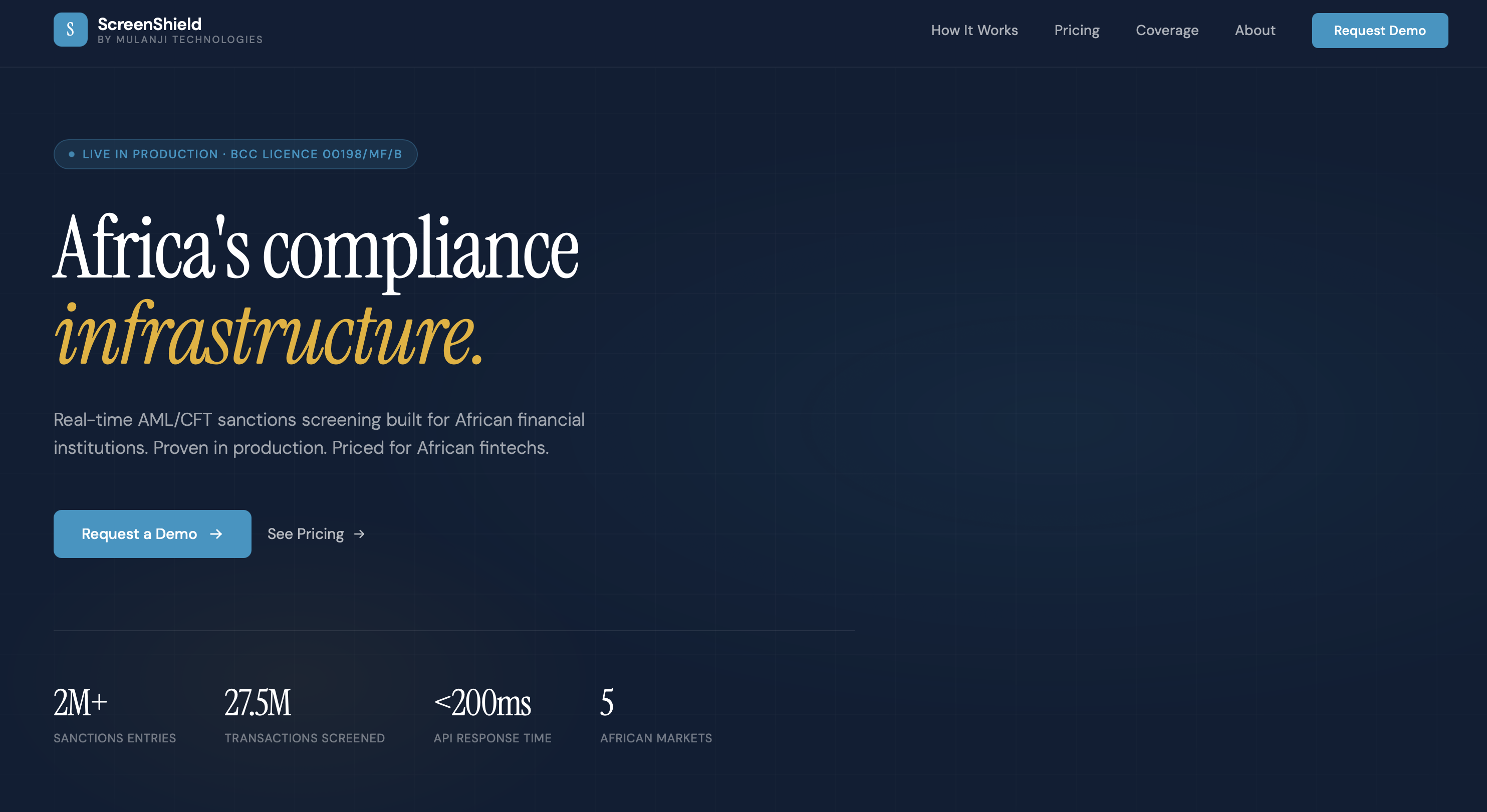
ScreenShield is an AML/CFT sanctions screening and compliance
platform built for African financial institutions — fintechs,
microfinance banks, PSPs, and payment operators.
Every transaction is screened in real time against 2M+ entries
across OFAC SDN, OFAC Consolidated, UN Security Council, EU
Financial Sanctions, NFIU Nigeria (NIGSAC), and PEP datasets
— returning a PROCEED, HOLD, or BLOCK decision in under 200ms.
Key capabilities:
- Real-time sanctions + PEP screening via REST API
- goAML 5.0.1 STR/CTR XML filing — one click, uploads
directly to goaml.nfiu.gov.ng
- False positive management — CLEAR/ESCALATE dashboard
- NFIU Nigeria list included from Growth tier
- Built for NG, CD, GH, CM, SN corridors
- Integrate in 2 days
From $249/month. 14-day free trial.

FCS API is a comprehensive financial market data platform providing real-time and historical data for Forex, Cryptocurrency, Stocks, Indices, and Commodities. Trusted by thousands of developers and fintech companies worldwide, FCS API offers both REST API and WebSocket solutions for building trading platforms, financial applications, and market analysis tools.
Key features include:
- Forex data: 2,000+ currency pairs from 170+ countries
- Crypto data: 10,000+ coins from 20+ exchanges
- Stock data: 125,000+ stocks from 50+ global exchanges
- Technical indicators, pivot points, and economic calendar
- WebSocket for real-time streaming data
- Client libraries for JavaScript, Python, PHP, Java, C#, and more
- Fast support with screenshare assistance when needed

RemSupp is a remote support software, which enables helping your customer via remote session.
Solutions:
- On-demand support
The fastest way to help someone! Invite others to join a remote support session. They just need to click connect button. Resolve issues faster.
- Permanent access
Configure permanent (always-on) access to remote devices. Group and sort them by location or department. Start remote sessions at any time.
- Co-browsing
Get realtime screenshare of your app or website. No installation required. Guide new users or help in realtime. No more: "I don't see a button".