Best Graph Database Solutions

Shalaka Joshi
SJ
Researched and written by Shalaka Joshi

Graph databases use topographical data models to store data. These databases connect specific data points (nodes) and create relationships (edges) in the form of graphs that can then be pulled by the user with queries. Nodes can represent customers, companies, or any data a company chooses to record. Edges are formed by the database so that relationships between nodes are easily understood by the user. Businesses can utilize graph databases when they are pulling data and do not want to spend time organizing it into distinct relationships. Large enterprises may use complex queries to pull precise and in-depth information regarding their customer and user information or product tracking data, among other uses. Database administrators can scale high data values and still create usable models. Some businesses may choose to run an RDF database, a type of graph database that focuses on retrieving triples, or information organized in a subject-predicate-object relationship. Similar types of databases include document database tools, key-value store tools, object-orientated database tools and more. Developers who are looking for an affordable solution can look to free database software.

To qualify for inclusion in the Graph Database category, a product must:

Provide data storage
Record and represent data in a topographical schema
Allow users to retrieve the data using query language
Show More
Show Less

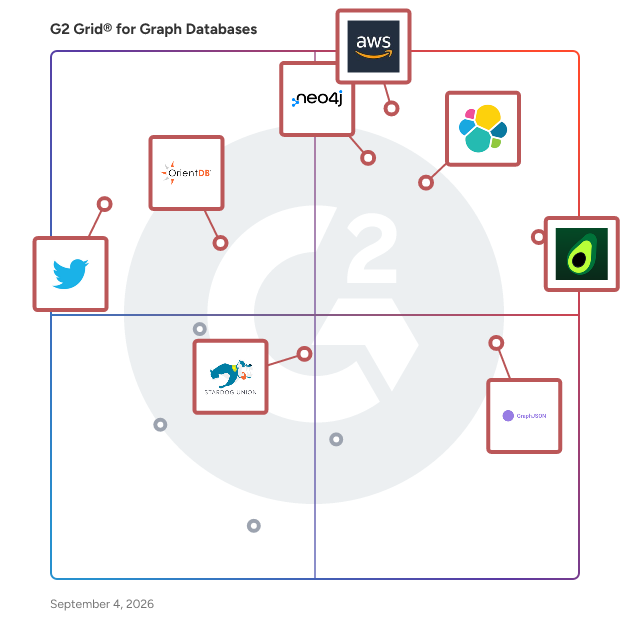
Best Graph Databases At A Glance

Leader:
Highest Performer:
Easiest to Use:
Top Trending:
Best Free Software:
Show LessShow More
Easiest to Use:
Top Trending:
Best Free Software:

G2 takes pride in showing unbiased reviews on user satisfaction in our ratings and reports. We do not allow paid placements in any of our ratings, rankings, or reports. Learn about our scoring methodologies.

No filters applied
68 Listings in Graph Databases Available
(115)4.6 out of 5
3rd Easiest To Use in Graph Databases software
Entry Level Price:Free
G2 Advertising
Sponsored
G2 Advertising
Get 2x conversion than Google Ads with G2 Advertising!
G2 Advertising places your product in premium positions on high-traffic pages and on targeted competitor pages to reach buyers at key comparison moments.
Entry Level Price:Free
(60)3.9 out of 5
4th Easiest To Use in Graph Databases software
View top Consulting Services for OrientDB
Entry Level Price:FREE

Learn More About Graph Databases

What are Graph Databases?

Graph databases are designed for depicting relationships (edges) between data points (nodes). Less structurally rigid than relational databases, graph databases allow nodes to have a multitude of edges; that is, there’s no limit on the number of relationships a node can have. (An example of this is in the following section.) Additionally, each edge can have multiple characteristics which define it. There is no formal limit—nor standardization—on how many edges each node can have, nor how many characteristics an edge can have. Graph databases can also contain many different pieces of information that would not necessarily be normally related.

Each node is defined by pieces of information called properties. Properties could be names, dates, identification numbers, basic descriptors, or other information—anything that would describe the node itself. Nodes are connected by edges, which can be directed or undirected. Like in mathematical graph theory, an undirected edge is bidirectional; that is, a relationship can be carried from node A to node B, and from node B to node A. A directed edge, however, only carries meaning in one direction, say from node B to node A.

Key Benefits of Graph Databases

  • Organize a variety of data without rigid structures
  • Offer flexible scaling and adjustment inherently
  • Describe numerous data relationship characteristics simultaneously

Why Use Graph Databases?

Graph databases are ideal for storing and retrieving information that is independent but related in multiple ways. For example, say a user wanted to map a group of friends. Each friend would be a node, with edges between each friend with a characteristic “friends." But, say two of those friends are coworkers; then, their edge would also have a characteristic “coworkers." Edges can get further definition by adding common interests, personal experiences, and so on.

Because graph databases are, by design, most conducive to organizing broad sets of data through which there are not uniform relationships or kinds of data, they can be invaluable tools for social mapping, master data management, knowledge graphing/ontology, infrastructure mapping, recommendation engines, and more. A business could set each node to be one of their products, and let edges draw recommendation relationships based on what product a consumer might buy. It could also map relationships between contacts, departments, and more.

Graph databases are flexible and scalable by design, so a business user would not need to know an exact or complete use case for a graph database before creating it. Expanding a graph database is a matter of adding new nodes and any potential edges which might be associated with them.

Who Uses Graph Databases?

Like other databases, graph databases are primarily maintained by a database administrator or team. That said, because of their wide range of coverage, graph databases are often accessed by several organizations within a company. Development, IT, billing, and more would all have valid reasons for needing access to graph databases, pending their assigned uses within the company.

Graph Databases Features

Graph database solutions will typically have the following features.

Database creation and maintenance — Graph databases allow users to easily build and maintain a database(s).

CRUD operations — An acronym for create, read, update, and delete, CRUD operations delineate basic operations of many databases. Graph databases should be able to perform these operations and usually can with similar capability to the most notable CRUD-oriented database type, relational.

Scalability and flexibility — Graph databases can grow and expand with business requirements. Unlike some other database solutions, they can scale more quickly with less worry about strict data organization, relying instead on developing relationships between new and existing nodes.

Simplified querying — Graph databases can skip some larger query complexities, bypassing things like foreign keys, nested queries, and join statements in favor of direct or transitive relationships.

OS compatibility — Graph databases do not require any one specific operating system to run, making them a flexible choice for any operating system.

Potential Issues with Graph Databases

Security and privacy — As alluded to above, graph databases can struggle with security and privacy situations. They require more strict implementations of security and access measures. Since graph databases are more oriented toward mapping relationships, that structure can also be utilized in ways that could raise privacy concerns, such as revealing a more laid-bare view of a client or customer—and every other potential client or customer to which they are related. Businesses implementing graph databases should take extra care to secure both how these databases are accessed, and the databases themselves.

Data integrity implications — Graph databases simplify the ways in which information relates to other information. In doing so, by shortening or condensing the relationship (as compared to, say, traversing numerous tables in a relational database), it’s particularly vital that all data in a graph database is accurate. One improperly aligned relationship can directly lead to incorrect data, unlike in a relational database where improper data might hit a snag during a nested query, throw an error, and out the issue. So, in using graph databases, data integrity is of particularly high importance.