Best Data Labeling Software

Last updated: November 14, 2026

How Many Data Labeling Software Products Does G2 Track?

Total Products under this Category: 146

Category Stats (Nov 2026)

  • Average Rating: 4.5/5 (↓0.01 vs Oct 2026) The average rating of products in this category, based on all submitted ratings
  • Top Trending Product: Snorkel AI (+0.51%) - Among all products in this category, Snorkel AI recorded the largest rating increase compared to last month

Last updated: November 01, 2026

How Does G2 Rank Data Labeling Software Products?

Why You Can Trust G2's Software Rankings:

  • 30 Analysts and Data Experts
  • 1,900+ Authentic Reviews
  • 146+ Products
  • Unbiased Rankings

G2's software rankings are built on verified user reviews, rigorous moderation, and a consistent research methodology maintained by a team of analysts and data experts. Each product is measured using the same transparent criteria, with no paid placement or vendor influence. While reviews reflect real user experiences, which can be subjective, they offer valuable insight into how software performs in the hands of professionals. Together, these inputs power the G2 Score, a standardized way to compare tools within every category.

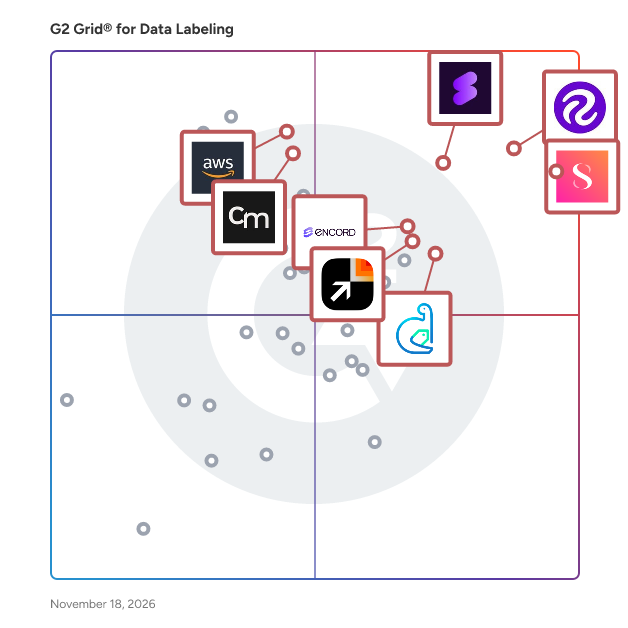
G2 Grid® for Data Labeling Software

G2 Grid® for Data Labeling Software plotting products by satisfaction and market presence

Highlighted products: SuperAnnotate, Roboflow, Surge AI, Encord, Datasaur, CVAT, Amazon Sagemaker Ground Truth, and Chemin.

Underlying data: [Grid® JSON](https://www.g2.com/categories/data-labeling/grids.json?focus%5B%5D=superannotate&focus%5B%5D=roboflow&focus%5B%5D=surge-ai&focus%5B%5D=encord&focus%5B%5D=datasaur&focus%5B%5D=cvat&focus%5B%5D=amazon-sagemaker-ground-truth&focus%5B%5D=chemin)

SuperAnnotate

SuperAnnotate bridges the gap between cutting-edge AI innovation and the high-quality human data that powers it - helping advanced AI teams build more intelligent models. With a global network of thousands of rigorously vetted experts, ethical and scalable managed operations, precise talent matching, and purpose‑built technology, SuperAnnotate delivers full project visibility and unmatched data quality. SuperAnnotate powers complex annotation, evaluation, and reinforcement learning workflows to build, evaluate and align frontier AI. Trusted by innovators like Databricks, IBM and ServiceNow - and backed by NVIDIA, Dell Technologies Capital, Databricks Ventures, Cox Enterprises, and Lionel Messi’s Play Time VC - SuperAnnotate enables the world’s top AI teams to build responsible and state‑of‑the‑art models with human data.

Average Rating: 4.8/5.0

Total Reviews: 352

How Do G2 Users Rate SuperAnnotate?

  • Labeler Quality: 9.6/10 (Category avg: 8.9/10)
  • Object Detection: 9.4/10 (Category avg: 8.9/10)
  • Data Types: 9.5/10 (Category avg: 8.8/10)
  • Ease of Use: 9.5/10 (Category avg: 8.8/10)

Who Is the Company Behind SuperAnnotate?

Who Uses This Product?

  • Who Uses This: Student, Data Annotator
  • Top Industries: Information Technology and Services, Computer Software
  • Company Size: 57% Small, 23% Medium

What Do G2 Reviewers Say About SuperAnnotate?

AI-generated summary from verified user reviews

Pros
  • Users appreciate the simple and user-friendly interface of SuperAnnotate, making complex annotation tasks manageable.
  • Users value the simple and user-friendly interface of SuperAnnotate, enhancing productivity and task management.
  • Users commend the annotation efficiency of SuperAnnotate, highlighting its intuitive interface and advanced tools for seamless collaboration.
  • Users value the efficiency of SuperAnnotate, as it simplifies complex tasks and enhances productivity through streamlined workflows.
  • Users highlight the high quality and reliability of SuperAnnotate, emphasizing its structured workflow and clear review processes.
Cons
  • Users experience performance issues with loading times on larger projects, affecting productivity and overall user satisfaction.
  • Users often face slow performance with SuperAnnotate, especially when dealing with large files and complex tasks.
  • Users find the difficult learning curve challenging due to the abundance of advanced features on SuperAnnotate.
  • Users face complexity in instructions for advanced tools, impacting ease of use and performance with large datasets.
  • Users highlight a lack of guidance for new engineers, seeking clearer onboarding and advanced feature walkthroughs.

What Are Recent G2 Reviews of SuperAnnotate?

What Are G2 Users Discussing About SuperAnnotate?

Roboflow

Roboflow has everything you need to build and deploy computer vision applications. Over 1,000,000 users from businesses of every size — from startups to public companies — use the company's end-to-end platform for image and video collection, organization, annotation, preprocessing, model training, and deployment. Roboflow provides tools for each step in the computer vision deployment lifecycle and integrates with your existing solutions so you can tailor your pipeline to meet your needs.

Average Rating: 4.7/5.0

Total Reviews: 161

How Do G2 Users Rate Roboflow?

  • Labeler Quality: 9.0/10 (Category avg: 8.9/10)
  • Object Detection: 9.1/10 (Category avg: 8.9/10)
  • Data Types: 8.7/10 (Category avg: 8.8/10)
  • Ease of Use: 9.3/10 (Category avg: 8.8/10)

Who Is the Company Behind Roboflow?

  • Seller: Roboflow
  • Year Founded: 2019
  • HQ Location: Remote, US
  • LinkedIn® Page: www.linkedin.com
    144 employees on LinkedIn®

Who Uses This Product?

  • Who Uses This: Founder, Researcher
  • Top Industries: Computer Software, Research
  • Company Size: 77% Small, 15% Medium

What Do G2 Reviewers Say About Roboflow?

AI-generated summary from verified user reviews

Pros
  • Users value the ease of use in Roboflow, enabling efficient annotation and project organization for streamlined workflows.
  • Users commend Roboflow for its high efficiency in annotating large datasets quickly and effectively.
  • Users value the annotation efficiency of Roboflow, completing large datasets significantly faster than alternative methods.
  • Users appreciate the data labeling efficiency of Roboflow, streamlining computer vision workflows for faster results.
  • Users appreciate the effortless dataset management and version control of Roboflow, enhancing efficiency in computer vision workflows.
Cons
  • Users find Roboflow to be expensive, particularly with advanced features and large datasets that complicate affordability.
  • Users find a lack of features in Roboflow's basic tier, limiting complex labeling and advanced workflows.
  • Users find the limited functionality in the basic tier restricts their labeling capabilities and workflow flexibility.
  • Users find annotation issues in Roboflow, particularly with support for multi-attribute annotations and uneven feature availability.
  • Users find inefficient labeling due to limited multi-attribute support and cumbersome data management processes.

What Are Recent G2 Reviews of Roboflow?

Surge AI

We offer an Enterprise plan for teams that need high volume, fully managed data labeling services with guaranteed SLAs — we’ll help you create guidelines, build you custom labeling teams, and manage quality controls end to end.

Average Rating: 4.3/5.0

Total Reviews: 80

How Do G2 Users Rate Surge AI?

  • Labeler Quality: 8.3/10 (Category avg: 8.9/10)
  • Object Detection: 9.3/10 (Category avg: 8.9/10)
  • Data Types: 9.3/10 (Category avg: 8.8/10)
  • Ease of Use: 8.7/10 (Category avg: 8.8/10)

Who Is the Company Behind Surge AI?

  • Seller: Surge AI
  • Year Founded: 2020
  • HQ Location: San Francisco, California, United States
  • LinkedIn® Page: www.linkedin.com
    459 employees on LinkedIn®

Who Uses This Product?

  • Top Industries: Computer Software, Accounting
  • Company Size: 59% Small, 29% Medium

What Do G2 Reviewers Say About Surge AI?

AI-generated summary from verified user reviews

Pros
  • Users appreciate the responsive customer support of Surge AI, enhancing their experience with efficient problem-solving and guidance.
  • Users value the flexible data labeling workflows of Surge AI, enhancing efficiency in achieving high-quality annotations.
  • Users value the ease of use of Surge AI, facilitating quick setup and efficient data labeling workflows.
  • Users appreciate the efficient and user-friendly workflows of Surge AI, facilitating quick setup and high-quality annotations.
  • Users appreciate the ease of use and responsive support of Surge AI, enhancing their data labeling processes.
Cons
  • Users find the pricing somewhat high, making it challenging for smaller projects and startups with limited budgets.
  • Users find the lack of advanced features and analytics limits Surge AI's potential for more effective usage.
  • Users find the limited tools in Surge AI challenging, especially for those needing deeper analytics and accessibility.

What Are Recent G2 Reviews of Surge AI?

AI can help you find the answers. G2 helps you trust them.

Connect G2 to Claude or ChatGPT for answers grounded in G2's trusted reviews, comparisons, and pricing from real user insights.

How it works

Encord

Encord is the universal data layer for AI. The platform helps AI teams train and run their models with the right data - managing, curating, annotating, and aligning data across the full AI lifecycle. Encord works with over 300 leading AI teams, including Woven by Toyota, Zipline, AXA, and Flock Safety. Confidentially build production AI with rich multimodal data. Encord is SOC 2, AICPA SOC, HIPAA, and GDPR compliant.

Average Rating: 4.8/5.0

Total Reviews: 65

How Do G2 Users Rate Encord?

  • Labeler Quality: 9.4/10 (Category avg: 8.9/10)
  • Object Detection: 9.3/10 (Category avg: 8.9/10)
  • Data Types: 9.7/10 (Category avg: 8.8/10)
  • Ease of Use: 9.5/10 (Category avg: 8.8/10)

Who Is the Company Behind Encord?

  • Seller: Encord
  • Year Founded: 2020
  • HQ Location: San Francisco, US
  • LinkedIn® Page: www.linkedin.com
    220 employees on LinkedIn®

Who Uses This Product?

  • Top Industries: Computer Software, Hospital & Health Care
  • Company Size: 51% Small, 40% Medium

What Do G2 Reviewers Say About Encord?

AI-generated summary from verified user reviews

Pros
  • Users commend Encord's responsive customer support, as they actively listen and adapt to feedback and needs.
  • Users highlight Encord's annotation efficiency, appreciating its intuitive interface and seamless integration with existing workflows.
  • Users praise the intuitive annotation tools of Encord, enhancing efficiency and integration for training data curation.
  • Users emphasize Encord's efficiency in data curation, enabling smooth workflows and rapid integration with existing systems.
  • Users praise Encord for its intuitive interface and seamless integration, enhancing their data curation and annotation processes.
Cons
  • Users find complex automation challenging, but appreciate the support provided by the team during the process.
  • Users find it difficult to stay updated due to frequent complexity in new features, despite assistance from customer success.
  • Users find the lack of guidance challenging due to frequent feature updates, though support is available.

What Are Recent G2 Reviews of Encord?

FAQs About Data Labeling Software

Generated using AI

Which Data Labeling platforms support computer vision models using bounding boxes and point cloud annotation

Based on G2 reviews, these products are the clearest fits for image and point cloud annotation needs.

  • Taskmonk — LiDAR projects with quality checks.
  • SuperAnnotate — bounding boxes, segmentation, review workflows.
  • Segments.ai — multi-sensor and point cloud labeling.
  • Roboflow — computer vision datasets and annotations.

Data Labeling platforms that maintain annotation quality while handling high-volume image processing without slowdowns

According to verified users, teams evaluating data labeling software often look for a balance between speed, consistency, and review controls. Recent G2 reviews highlight strengths such as built-in quality checks, version control, structured review steps, and collaboration features that help maintain labeling quality at scale. Reviewers also repeatedly call out limits to watch for, including lag with very large datasets, slower uploads or exports, and occasional responsiveness issues on heavy image workloads. In this category, buyers tend to compare how well platforms support organized dataset management, annotation review, and reliable throughput when image volume rises, rather than looking for raw processing speed alone.

Which Data Labeling tools avoid performance issues and instability when processing large image batches

Based on G2 reviews, these products are commonly mentioned for managing larger image workloads with structured workflows.

  • SuperAnnotate — large datasets with quality controls.
  • Roboflow — image annotation and dataset versioning.
  • Taskmonk — scalable labeling with built-in QC.
  • Encord — video and data pipeline workflows.

What are the most important features in data labeling software

According to verified users, the most important features in data labeling software are annotation tools that match the data type, clear review and quality control workflows, dataset organization, and collaboration support. Recent G2 reviews also point to versioning, preprocessing or augmentation support, export flexibility, and AI-assisted labeling as recurring decision factors. For computer vision use cases, buyers often mention support for bounding boxes, polygons, segmentation, and video or point cloud workflows. Reviewers also care about how easily teams can move from labeling into model training or downstream pipelines. In practice, the best-fit platforms reduce manual effort while still helping teams maintain consistency, traceability, and clean handoffs.

How do teams use Data Labeling for quality control

According to verified users, teams use data labeling for quality control by building review steps directly into annotation workflows. Recent G2 reviews describe practices such as peer review, verify-before-submit checkpoints, role-based task assignment, change tracking, and version control to catch mistakes early and improve consistency across annotators. Buyers also look for tools that centralize labeling, feedback, and project management so fewer issues slip through handoffs. In image-heavy workflows, users value features that help compare annotations, review edge cases, and maintain standards across large batches. The common theme is that quality control works best when it is embedded in the labeling process rather than handled as a separate cleanup step later.

Datasaur

Datasaur offers the most intuitive interface for all your Natural Language Processing related tasks.

Average Rating: 4.4/5.0

Total Reviews: 87

How Do G2 Users Rate Datasaur?

  • Labeler Quality: 9.2/10 (Category avg: 8.9/10)
  • Object Detection: 8.4/10 (Category avg: 8.9/10)
  • Data Types: 8.3/10 (Category avg: 8.8/10)
  • Ease of Use: 9.3/10 (Category avg: 8.8/10)

Who Is the Company Behind Datasaur?

  • Seller: Datasaur
  • Year Founded: 2019
  • HQ Location: San Francisco Bay Area, California
  • LinkedIn® Page: www.linkedin.com
    69 employees on LinkedIn®

Who Uses This Product?

  • Top Industries: Information Technology and Services, Computer Software
  • Company Size: 38% Medium, 35% Small

What Are Recent G2 Reviews of Datasaur?

What Are G2 Users Discussing About Datasaur?

CVAT

Company Overview: CVAT.ai is a global provider of data annotation tools and services, known for developing one of the most popular open-source annotation tools, CVAT. In addition to the open-source platform, we offer professional data labeling services, an Enterprise version of CVAT, as well as consulting and customization services to meet specific client needs. Our team supports businesses and AI researchers worldwide in efficiently managing data annotation for computer vision projects. Key Features: - Popular Open-Source Tool: CVAT is trusted by thousands of developers and organizations globally. - Data Labeling Services: We provide expert data labeling services to handle projects from start to finish. - Enterprise Version of CVAT: The Enterprise version offers advanced features, support, and scalability for larger organizations. - Consulting and Customization: We offer consulting services and can customize CVAT to match your project needs. Learn more about our approach to consulting and feature requests here. - AI-Assisted Automation: Our platform uses AI to enhance labeling efficiency and accuracy. - Team Collaboration: Teams can collaborate seamlessly on large-scale projects. - Customizable and Scalable: CVAT can be adapted to your project size and needs. - Secure: We meet global data privacy and security standards. What We Solve: CVAT.ai helps users reduce manual efforts by making data annotation faster, more accurate, and easy to manage. Through our open-source platform, professional labeling services, consulting, and the Enterprise version, we offer a flexible, comprehensive solution for any computer vision project.

Average Rating: 4.5/5.0

Total Reviews: 65

How Do G2 Users Rate CVAT?

  • Labeler Quality: 9.6/10 (Category avg: 8.9/10)
  • Object Detection: 9.3/10 (Category avg: 8.9/10)
  • Data Types: 8.6/10 (Category avg: 8.8/10)
  • Ease of Use: 8.6/10 (Category avg: 8.8/10)

Who Is the Company Behind CVAT?

  • Seller: CVAT.ai
  • Company Website:
  • Year Founded: 2022
  • HQ Location: 2810 N Church St Suite 88367 Wilmington, DE 19802
  • LinkedIn® Page: www.linkedin.com
    116 employees on LinkedIn®

Who Uses This Product?

  • Top Industries: Research, Computer Software
  • Company Size: 79% Small, 12% Medium

What Do G2 Reviewers Say About CVAT?

AI-generated summary from verified user reviews

Pros
  • Users praise the annotation efficiency of CVAT, highlighting its speed and quality in complex image segmentation tasks.
  • Users highlight the ease of use of CVAT, praising its intuitive interface and seamless integration for efficient workflows.
  • Users highlight the efficiency of CVAT, noting its intuitive tools and streamlined processes for managing large datasets.
  • Users commend the high quality of CVAT’s annotation, noting impressive speed and effective support throughout the process.
  • Users commend the exceptional customer support from CVAT, especially for resolving technical challenges efficiently.
Cons
  • Users find CVAT difficult to learn, especially beginners struggling with initial setup and navigation.
  • Users find the complexity of CVAT overwhelming, particularly for beginners, though detailed files help mitigate this issue.
  • Users experience labeling inconsistencies in complex cases but appreciate the prompt corrections from the team.
  • Users are frustrated by the lack of support for large 16-bit images, limiting their functionality in CVAT.
  • Users report slow performance with CVAT when managing large video files and numerous images.

What Are Recent G2 Reviews of CVAT?

Amazon Sagemaker Ground Truth

Amazon SageMaker Ground Truth helps you build highly accurate training datasets for machine learning quickly. SageMaker Ground Truth offers easy access to public and private human labelers and provides them with built-in workflows and interfaces for common labeling tasks.

Average Rating: 4.1/5.0

Total Reviews: 19

How Do G2 Users Rate Amazon Sagemaker Ground Truth?

  • Labeler Quality: 10.0/10 (Category avg: 8.9/10)
  • Object Detection: 10.0/10 (Category avg: 8.9/10)
  • Data Types: 10.0/10 (Category avg: 8.8/10)
  • Ease of Use: 8.3/10 (Category avg: 8.8/10)

Who Is the Company Behind Amazon Sagemaker Ground Truth?

Who Uses This Product?

  • Top Industries: Information Technology and Services
  • Company Size: 37% Small, 37% Large

What Are Recent G2 Reviews of Amazon Sagemaker Ground Truth?

What Are G2 Users Discussing About Amazon Sagemaker Ground Truth?

Chemin

Building the Data Layer for AI. From data collection and evaluation to teleoperation, Chemin helps teams train and deploy robotics, autonomous vehicles, and AI models. Chemin helps robotics and autonomous-systems teams improve AI with verified physical world data. From teleoperation and egocentric video to synchronized camera, LiDAR, radar and tactile data. We capture diverse conditions and edge cases, and support human feedback, benchmarking and model evaluation, including emerging RLHF and RLVR workflows. With 25 years of experience in enterprise data management, 30,000 data specialists, and 100M+ data points across 18 countries, Chemin helps AI teams close data gaps, strengthen model evaluation, and refine reinforcement learning workflows. Combining a global network of domain experts and data specialists with scalable operations, we help organizations identify performance gaps, validate model capabilities, and turn evaluation findings into actionable improvements as their AI systems evolve.

Average Rating: 4.9/5.0

Total Reviews: 11

How Do G2 Users Rate Chemin?

  • Labeler Quality: 8.8/10 (Category avg: 8.9/10)
  • Object Detection: 9.7/10 (Category avg: 8.9/10)
  • Data Types: 9.2/10 (Category avg: 8.8/10)
  • Ease of Use: 9.3/10 (Category avg: 8.8/10)

Who Is the Company Behind Chemin?

  • Seller: TDCX
  • Company Website:
  • Year Founded: 1995
  • HQ Location: Singapore, SG
  • LinkedIn® Page: www.linkedin.com
    16,518 employees on LinkedIn®
  • Ownership: NYSE: TDCX

Who Uses This Product?

  • Company Size: 45% Medium, 45% Small

What Are Recent G2 Reviews of Chemin?

V7 Darwin

V7 Darwin is a specialized AI platform for creating high-quality training data and managing annotation workflows. It is engineered for teams building sophisticated computer vision models and solving complex, domain-specific challenges with AI. V7 Darwin provides a comprehensive suite of tools for data labeling, video annotation, and medical imaging annotation. - Create pixel-perfect image and video annotations with Auto-Annotate and SAM for semantic masks, instance segmentation, keypoints, and polygons. - Develop medical AI with tools for DICOM, NIfTI, and WSI annotation, featuring an interface with MPR, 3D rendering, precise crosshairs, windowing, and oblique views. - Accelerate video annotation by up to 10x with AI-assisted auto-tracking for objects across frames. - Manage long videos, multi-camera views, and nested annotation classes. - Design multi-stage review workflows with conditional logic, consensus, and task assignment for your data labeling pipeline. - Organize, filter, and manage large datasets with custom views and tags, enabling real-time team collaboration for annotators, reviewers, and ML engineers. - Scale your annotation projects with professional data labeling services, including certified annotators and experts in various domains (medical, video, LLMs, scientific). You can seamlessly integrate V7 Darwin with your existing tech stack and import/export annotations with ease. Get complete control over your models, tasks, and datasets through the open API, Darwin-py SDK, and CLI.

Average Rating: 4.7/5.0

Total Reviews: 55

How Do G2 Users Rate V7 Darwin?

  • Labeler Quality: 9.4/10 (Category avg: 8.9/10)
  • Object Detection: 9.4/10 (Category avg: 8.9/10)
  • Data Types: 9.2/10 (Category avg: 8.8/10)
  • Ease of Use: 9.5/10 (Category avg: 8.8/10)

Who Is the Company Behind V7 Darwin?

  • Seller: V7
  • Year Founded: 2018
  • HQ Location: London, England
  • LinkedIn® Page: www.linkedin.com
    105 employees on LinkedIn®

Who Uses This Product?

  • Top Industries: Information Technology and Services, Computer Software
  • Company Size: 55% Small, 35% Medium

What Do G2 Reviewers Say About V7 Darwin?

AI-generated summary from verified user reviews

Pros
  • Users appreciate the ease of use of V7 Darwin, finding navigation intuitive and workflows easily manageable.
  • Users appreciate the annotation efficiency of V7 Darwin, with quick, accurate tools that streamline the labeling process.
  • Users value the automatic annotation tools in V7 Darwin, enhancing speed and accuracy in their projects.
  • Users value the seamless management of the entire employee lifecycle, praising Darwinbox for its comprehensive HR capabilities.
  • Users highlight the efficiency of V7 Darwin, streamlining workflows and enhancing productivity across various HR tasks.
Cons
  • Users find the lack of essential features in V7 Darwin limits their workflow and flexibility, causing frustration.
  • Users find the missing features of V7 Darwin, like polygon splitting and file manipulation, quite limiting.
  • Users express frustration over limited features in V7 Darwin, seeking functionality enhancements and additional export options.
  • Users are frustrated by the annotation issues such as inability to retract submissions and missing approval shortcuts.
  • Users find the difficult navigation of V7 Darwin challenging, making it hard to efficiently use its features.

What Are Recent G2 Reviews of V7 Darwin?

What Are G2 Users Discussing About V7 Darwin?

Labelbox

Labelbox is the leading data-centric AI platform for building intelligent applications. Teams looking to capitalize on the latest advances in generative AI and LLMs use the Labelbox platform to inject these systems with the right degree of human supervision and automation. Whether they are building AI products with custom or foundation models, or using AI to automate data tasks or find business insights, Labelbox enables teams to do so effectively and quickly. The platform is used by Fortune 500 enterprises such as Walmart, P&G, Genentech, and Adobe, and hundreds of leading AI teams. Labelbox is backed by leading investors including SoftBank, Andreessen Horowitz, B Capital, Gradient Ventures (Google's AI-focused fund), and Databricks Ventures.

Average Rating: 4.5/5.0

Total Reviews: 48

How Do G2 Users Rate Labelbox?

  • Labeler Quality: 9.1/10 (Category avg: 8.9/10)
  • Object Detection: 8.6/10 (Category avg: 8.9/10)
  • Data Types: 8.8/10 (Category avg: 8.8/10)
  • Ease of Use: 9.0/10 (Category avg: 8.8/10)

Who Is the Company Behind Labelbox?

  • Seller: Labelbox
  • Year Founded: 2018
  • HQ Location: San Francisco, California
  • LinkedIn® Page: www.linkedin.com
    482 employees on LinkedIn®

Who Uses This Product?

  • Top Industries: Computer Software, Information Technology and Services
  • Company Size: 46% Small, 38% Medium

What Do G2 Reviewers Say About Labelbox?

AI-generated summary from verified user reviews

Pros
  • Users find Labelbox's ease of use enhances productivity, providing a seamless experience from setup to project completion.
  • Users value the easy and fast data labeling process with Labelbox, enhancing efficiency and output quality.
  • Users find Labelbox to enhance efficiency, streamlining project management and making tasks easy to handle.
  • Users appreciate the advanced AI capabilities of Labelbox, making data labeling and management for AI/ML efficient and accurate.
  • Users value the easy integrations of Labelbox, enabling efficient handling of diverse data types and enhanced organization.
Cons
  • Users find the lack of features like limited task claims and customization options hampers their overall experience with Labelbox.
  • Users experience slow performance with Labelbox, especially when handling large datasets and visualizations.
  • Users find Labelbox to have difficult learning due to its complexity and slow processing with large datasets.
  • Users find the high cost of Labelbox concerning, especially for small-scale users and beginners.
  • Users experience slow processing times with Labelbox, leading to frustration and delays in project initiation.

What Are Recent G2 Reviews of Labelbox?

What Are G2 Users Discussing About Labelbox?

Outlier AI

Outlier AI is a platform that connects human expertise with artificial intelligence to enhance the accuracy, speed, and reliability of AI models. By engaging a global network of over 100,000 experts across more than 50 countries, Outlier AI has facilitated the development of more knowledgeable and impactful AI systems, distributing over $500 million to its contributors. Key Features and Functionality: - Expert-Driven AI Training: Outlier AI leverages the specialized skills of its global expert community to train and refine AI models, ensuring high-quality data annotation and model development. - Flexible Remote Work Opportunities: The platform offers individuals meaningful and accessible job opportunities, allowing experts to contribute remotely and on their own schedules. - Integration with Scale AI: Powered by Scale AI, Outlier AI combines top-tier data infrastructure with advanced anomaly detection capabilities, enhancing the scalability and accuracy of AI solutions. Primary Value and Problem Solved: Outlier AI addresses the challenge of developing reliable and effective AI models by integrating human expertise into the AI training process. This approach not only improves the quality of AI outputs but also provides flexible employment opportunities to a diverse global workforce. By bridging the gap between human intelligence and artificial intelligence, Outlier AI ensures that AI systems are more accurate, efficient, and aligned with real-world applications.

Average Rating: 4.0/5.0

Total Reviews: 14

How Do G2 Users Rate Outlier AI?

  • Labeler Quality: 9.6/10 (Category avg: 8.9/10)
  • Object Detection: 9.2/10 (Category avg: 8.9/10)
  • Data Types: 10.0/10 (Category avg: 8.8/10)
  • Ease of Use: 8.1/10 (Category avg: 8.8/10)

Who Is the Company Behind Outlier AI?

  • Seller: Outlier AI
  • Year Founded: 2023
  • HQ Location: San Francisco, US
  • LinkedIn® Page: www.linkedin.com
    29,937 employees on LinkedIn®

Who Uses This Product?

  • Top Industries: Information Technology and Services
  • Company Size: 100% Small

What Do G2 Reviewers Say About Outlier AI?

AI-generated summary from verified user reviews

Pros
  • Users praise the excellent customer support of Outlier AI, appreciating its helpfulness and responsiveness.
  • Users praise Outlier AI for its superior data accuracy, setting a higher standard compared to other platforms.
  • Users value the flexibility and remote work opportunities provided by Outlier AI for various projects.
  • Users appreciate the transparent and fast payment system of Outlier AI, enhancing their overall experience significantly.
  • Users appreciate the fast response speed of Outlier AI, enhancing their overall experience and satisfaction.
Cons
  • Users express concern over work interruptions, citing inconsistent project availability and unannounced fluctuations that cause frustration.
  • Users face buggy performance issues that disrupt workflow and result in unexpected project removals and poor communication from management.
  • Users find the low compensation frustrating, often struggling with inconsistent project availability and unreliable income.
  • Users note the performance issues of Outlier AI, indicating it could benefit from better optimization for speed and smoothness.
  • Users report poor customer support characterized by communication issues and sudden project removals affecting their experience.

What Are Recent G2 Reviews of Outlier AI?

Sama

Sama is a globally recognized leader in data annotation solutions for enterprise computer vision and generative AI models that require the highest accuracy. As an industry pioneer with 15 years of experience, Sama’s expertise and solutions are trusted by leading companies such as GM, Ford, Continental, Google, and many more. Sama specializes in data annotation services for generative AI, and 2D and 3D image and video (including LiDAR and sensor fusion). We also validate complex machine learning algorithms. As a leader in ethical AI and a Certified B-Corp, we’ve pioneered an impact model that harnesses the power of markets for social good. We have meaningfully improved employment and income outcomes for those with the greatest barriers to formal work (validated by an independent MIT study). So far, we've helped more than 60,000 people lift themselves out of poverty. For more information, visit www.sama.com

Average Rating: 4.6/5.0

Total Reviews: 11

How Do G2 Users Rate Sama?

  • Labeler Quality: 9.0/10 (Category avg: 8.9/10)
  • Object Detection: 9.6/10 (Category avg: 8.9/10)
  • Data Types: 9.6/10 (Category avg: 8.8/10)
  • Ease of Use: 9.2/10 (Category avg: 8.8/10)

Who Is the Company Behind Sama?

  • Seller: Sama
  • Year Founded: 2008
  • HQ Location: San Francisco, US
  • LinkedIn® Page: www.linkedin.com
    4,349 employees on LinkedIn®

Who Uses This Product?

  • Company Size: 55% Small, 36% Large

What Do G2 Reviewers Say About Sama?

AI-generated summary from verified user reviews

Pros
  • Users appreciate the amazing data preparation and analytics features of Sama, enhancing insights and user experience.
  • Users appreciate the 24/7 customer support of Sama, ensuring assistance whenever needed for smooth operations.
  • Users appreciate the amazing data processing and enrichment features of Sama, enhancing their analytics experience significantly.
  • Users value the robust data preparation features of Sama, enhancing efficiency and insights in analytics tasks.
  • Users value the powerful data preparation and enrichment features of Sama, enhancing their analytics experience significantly.
Cons
  • Users find the product's complexity necessitates extensive training or skilled personnel for effective operation.
  • Users find the complex setup of Sama necessitates extensive training or skilled personnel, complicating operations significantly.
  • Users criticize the lack of training needed for Sama, finding it complex and difficult to operate effectively.
  • Users find that extensive training is necessary for effective use of Sama due to its complexity.

What Are Recent G2 Reviews of Sama?

Snorkel AI

Snorkel AI offers a data-centric AI platform designed to accelerate the development of machine learning models by automating the data labeling process. By leveraging programmatic labeling techniques, Snorkel AI enables organizations to create high-quality, specialized datasets efficiently, reducing the time and effort traditionally required for manual data annotation. This approach facilitates rapid iteration and adaptation of AI models, ensuring they remain effective as data and business needs evolve. Key Features and Functionality: - Programmatic Data Labeling: Automates the data annotation process, allowing users to generate labeled datasets quickly and accurately. - Expert Data-as-a-Service: Provides curated, high-quality training and evaluation datasets tailored to specific customer requirements. - Integrated Model Development: Offers tools for training, evaluating, and fine-tuning machine learning models within the platform. - Collaborative Platform: Facilitates seamless collaboration between data scientists and domain experts through user-friendly interfaces and workflows. - Flexible Deployment: Supports various deployment options, including private cloud, public cloud, and on-premises, ensuring compatibility with existing infrastructure. Primary Value and Problem Solved: Snorkel AI addresses the significant bottleneck in AI development caused by the time-consuming and labor-intensive process of manual data labeling. By automating this process through programmatic labeling, the platform enables organizations to develop and deploy AI applications 10 to 100 times faster than traditional methods. This efficiency allows businesses to harness the power of AI more effectively, adapting quickly to changing data and market conditions while maintaining high model accuracy and performance.

Average Rating: 4.3/5.0

Total Reviews: 10

How Do G2 Users Rate Snorkel AI?

  • Labeler Quality: 9.3/10 (Category avg: 8.9/10)
  • Object Detection: 9.6/10 (Category avg: 8.9/10)
  • Data Types: 8.3/10 (Category avg: 8.8/10)
  • Ease of Use: 9.0/10 (Category avg: 8.8/10)

Who Is the Company Behind Snorkel AI?

  • Seller: Snorkel
  • Year Founded: 2019
  • HQ Location: Redwood City, US
  • LinkedIn® Page: www.linkedin.com
    1,314 employees on LinkedIn®

Who Uses This Product?

  • Company Size: 40% Small, 30% Large

What Are Recent G2 Reviews of Snorkel AI?

Taskmonk

Taskmonk is the enterprise AI training data platform for teams that need annotation to work at production scale, not pilot scale. It's one of the few platforms that handles six data modalities: text, image, audio, video, LiDAR, and DICOM in a single environment, so teams aren't stitching together separate tools once a project moves past standard computer vision. Built for annotation teams, project managers, and AI leads alike, Taskmonk pairs a no-code workflow builder with AI-assisted labeling and QA that holds up at scale: • No-code/low-code workflows that adapt per project without engineering time • AI-assisted labeling and model-assisted pre-labeling that cut annotation hours and lift throughput • Multi-stage QA like gold sets, consensus, adjudication, plus affinity-based task routing by annotator performance, not just role • SOC 2 Type II and ISO 27001 compliance, with HIPAA and data residency available for regulated industries Taskmonk has processed 480M+ annotation tasks and 6M+ labeling hours for 10+ Fortune 500 clients, including Flipkart, Myntra, and LG, saving clients $10M+ to date. Teams can also plug in a vetted, SLA-backed annotation workforce on the same platform, so there's one contract and one escalation path instead of sourcing labeling talent separately

Average Rating: 4.6/5.0

Total Reviews: 17

How Do G2 Users Rate Taskmonk?

  • Labeler Quality: 9.3/10 (Category avg: 8.9/10)
  • Object Detection: 9.2/10 (Category avg: 8.9/10)
  • Data Types: 9.7/10 (Category avg: 8.8/10)
  • Ease of Use: 9.2/10 (Category avg: 8.8/10)

Who Is the Company Behind Taskmonk?

  • Seller: Taskmonk
  • Year Founded: 2018
  • HQ Location: Bengaluru, Karnataka, India
  • LinkedIn® Page: www.linkedin.com
    28 employees on LinkedIn®

Who Uses This Product?

  • Top Industries: Information Technology and Services
  • Company Size: 72% Small, 22% Large

What Do G2 Reviewers Say About Taskmonk?

AI-generated summary from verified user reviews

Pros
  • Users commend the ease of use of Taskmonk, appreciating its intuitive interface and quick onboarding process.
  • Users value the exceptional customer support of Taskmonk, highlighting its responsiveness and proactive assistance.
  • Users appreciate the efficiency of Taskmonk, enabling quick management of labeling projects and workflows.
  • Users highlight the intuitive interface and quick onboarding, making project management efficient and productive with Taskmonk.
  • Users appreciate the setup ease of Taskmonk, enabling quick onboarding and effortless management of annotation workflows.
Cons
  • Users highlight the lack of features, noting a need for advanced reporting and improved usability for beginners.
  • Users find the difficult learning curve of Taskmonk challenging for beginners, despite available support and documentation.
  • Users find the UI complexity overwhelming initially, which complicates the overall experience for new users.
  • Users experience occasional technical difficulties but appreciate the prompt resolution from the Taskmonk team.
  • Users face upload issues including slow bulk uploads and restrictions on local uploads for LiDAR projects.

What Are Recent G2 Reviews of Taskmonk?

Keymakr

We are a data labeling company that focuses on providing high quality annotation services and excellent customer support. We are the best choice for: Image Annotation Video Annotation Data validation Document Annotation Data Creation Data Collection Our company creates best-in-class computer vision training data. We offer an in-house team paired with advanced proprietary annotation tools. Scalable and secure one-stop shop for your AI

Average Rating: 4.8/5.0

Total Reviews: 45

How Do G2 Users Rate Keymakr?

  • Labeler Quality: 9.4/10 (Category avg: 8.9/10)
  • Object Detection: 9.7/10 (Category avg: 8.9/10)
  • Data Types: 9.7/10 (Category avg: 8.8/10)
  • Ease of Use: 9.2/10 (Category avg: 8.8/10)

Who Is the Company Behind Keymakr?

  • Seller: Keymakr
  • Year Founded: 2015
  • HQ Location: New York, NY
  • LinkedIn® Page: www.linkedin.com
    64 employees on LinkedIn®

Who Uses This Product?

  • Top Industries: Computer Software
  • Company Size: 52% Small, 22% Medium

What Do G2 Reviewers Say About Keymakr?

AI-generated summary from verified user reviews

Pros
  • Users commend the high-quality customer support from Keymakr, highlighting their fast responses and proactive service.
  • Users commend Keymakr for its high-quality annotations, delivering precision and reliability at an impressive speed.
  • Users commend the high efficiency of Keymakr, appreciating their fast responses and simplified workflows in projects.
  • Users value the efficient annotation process of Keymakr, enhancing productivity and simplifying workflows significantly.
  • Users commend Keymakr for their exceptional customer service, ensuring fast, accurate responses and proactive solutions.
Cons
  • Users experience annotation issues such as recurring mistakes and difficulties exporting COCO format labels, though improvements are noted.
  • Users find the difficult setup frustrating, particularly with UI navigation and connecting to S3 initially.
  • Users find some UI navigation and initial setup complex, which can hinder their overall experience with Keymakr.
  • Users find the limited customization in Keymakr frustrating, particularly the inability to change passwords independently.

What Are Recent G2 Reviews of Keymakr?

Bijou Barry
BB
Researched and written by Bijou Barry

Learn More About Data Labeling Software

What is Data Labeling Software?

Data labeling software labels or annotates data for training machine learning models. Machine learning algorithms rely on large amounts of labeled data to learn patterns and make predictions. Data labeling solutions help humans identify and label the relevant features and characteristics of the data that will be used to train the machine learning model.

Many types of data labeling solutions are available, ranging from simple tools that allow users to label data manually to more advanced tools that use machine learning algorithms to automate the labeling process. Some data labeling software also includes features such as image annotation tools, which allow users to label and annotate images and other visual data, and many data labeling platforms now extend that same tooling to computer vision tasks like bounding boxes and point cloud annotation for 3D and LiDAR data.

Data labeling software is used in various applications, including natural language processing, image and video classification, and object detection. It is an important tool in the development and training of machine learning models and plays a critical role in their accuracy and effectiveness.

What types of data labeling software exist?

Selecting a data labeling software requires a prior evaluation and understanding of data-driven workflows in your business. Below are the types of software you can consider.

  • Manual labeling software: These data labeling platforms segment, label, and classify data with the help of a "human in the loop" service. Human annotators label the training data based on businesses' geographic locations. The data annotation service is extended to the ML model development workflow, and labeling data becomes more effective.
  • Automated labeling software: The automated data labeling software preprocesses raw datasets consisting of text, images, liDAR data, DICOM, PDF, or audio using an unsupervised learning approach. The algorithm assigns labels and categories to data without referring to external annotators.
  • Active learning labeling software: Also known as active learning tools, these are semi-supervised tools that follow a "query-based" approach to labeling data. Based on the uncertainty score, they query data using manual or annotator labeling. For more challenging labels, they prompt the human annotator with queries.
  • Crowdsource labeling software: These data labeling platforms crowd data labeling services to a crowd of developers to train high-quality data pipelines. Custom data labeling can be ideal for large or enterprise-sized teams.
  • Integrated labeling and model training software: These tools provide combined services for data labeling and predictive modeling. Using advanced data analysis, users can label, train, and build machine learning models to optimize their production cycles.

What are the Common Features of Data Labeling Software?

Based on G2 reviews, data scientists and machine learning engineers evaluate data labeling software by comparing annotation tool variety, model-assisted labeling speed, and collaboration features. There are several features that are often included in data labeling software, including:

  • Label assignment: Data labeling software allows users to assign labels or tags to specific data points, such as text, images, or videos.
  • Annotation tools: Some data labeling software includes tools for annotating data, such as bounding boxes, polygon drawing tools, cloud points, keymakers, and point annotation tools. These tools can be used to highlight specific features or characteristics of the data.
  • Machine learning algorithms: Some data labeling software uses machine learning algorithms to automate the labeling process or generate initial labels for data, which humans can then review and correct as needed.
  • Data management and organization: Data labeling software often includes features for organizing and managing large datasets, such as the ability to filter and search for specific data points, track progress and completion, and generate reports.
  • Collaboration tools: Some data labeling software includes collaboration tools, such as the ability to assign tasks to multiple users, track changes and revisions, and review and discuss data labeling decisions.
  • Integration with data science and machine learning platforms: Some data labeling software is designed to integrate with popular data science and machine learning platforms, such as TensorFlow or PyTorch, making it easier to use the labeled data to train machine learning models.
  • Image, text, audio, or video annotation: These tools comply with multiple unstructured data formats to train and validate models designed to generate output in images, text, video, audio, PDF, and so on.

Benefits of Data Labeling Software

Choosing a data labeling platform empowers businesses to either pre-train existing machine learning models to save time or build new models to upgrade their workflows and train teams. 

While data labeling platforms can help do both, it also has some significant benefits listed as under:

  • Improved accuracy and quality of labeled data: Data labeling software can help ensure that data is accurately and consistently labeled, which is critical for the accuracy and effectiveness of machine learning models.
  • Increased efficiency and productivity: Data labeling software can help streamline the data labeling process, allowing users to label more data in less time. This can be particularly useful for large datasets or repetitive or routine tasks.
  • Enhanced collaboration and team communication: Some data labeling software includes collaboration tools, such as the ability to assign tasks to multiple users and track changes and revisions. These tools can help improve communication and coordination within teams working on data labeling projects.
  • Reduced cost: Using data labeling software can help reduce the cost of data labeling projects by automating routine tasks and reducing the need for manual labor.
  • Increased flexibility and scalability: Data labeling software can be used to label a wide variety of data types and can be easily scaled up or down as needed to meet project demands.
  • Respite for data operations, ML, and data science teams: These solutions offer agile service marketplaces with high-quality labelers and annotators that solve the problems of data cleaning, preprocessing, and classification for these teams.
  • Superpixel segmentation and brushes: These tools are also widely used for image recognition, natural language processing (NLP), and computer vision algorithms. It creates region pools using brushing and superpixel segmentation to classify images.

Who Uses Data Labeling Software?

The data labeling tools are a must-have for businesses that want to foray into AI automation and build robust and efficient product applications and SDK with pre-installed machine learning capabilities.

Below are the individuals and organizations that use data labeling platforms:

  • Data scientists and machine learning engineers: Data scientists and machine learning engineers use data labeling software to label and annotate data that will be used to train machine learning models. This helps the models learn to recognize patterns and make predictions based on the labeled data.
  • Business analysts and data analysts: Business analysts and data analysts may use data labeling software to label and annotate data to create reports and visualizations or for use in machine learning models.
  • Quality assurance professionals: Quality assurance professionals may use data labeling software to label and annotate data to test and debug machine learning models or other software applications.
  • Researchers: Researchers in various fields, such as computer science, linguistics, and biology, may use data labeling software to label and annotate data to conduct research or develop machine learning models.

Alternatives to data labeling software

Some alternatives to data labeling software provide annotation and labeling services along with other machine learning features.

  • Natural language processing (NLP) software: The NLP software derives semantic relationships between words of an input sentence and generates relevant and personalized content. These tools replicate the functioning of a human brain to register prompt intent and derive coherent content blocks.
  • Machine learning operationalization (MLOps software): The MLOPs software facilitates the entire machine learning model journey, from data preprocessing to ML integration and delivery. It applies various DevOps automation concepts and runs ML-based workflows without human supervision.
  • Image recognition software: Image recognition software detects, categorizes, and localizes digital images or photographs. It is based on specialized deep-learning models that group data into grids and identify relevant categories of all objects.

Challenges with Data Labeling Software

Even though data labeling software reduces costs, provides security and privacy to data, and moderates data quality control, some evident challenges can occur at any stage of working with this platform.

Below are some of the challenges of data labeling software

  • Data quality and consistency: It is not certain that data labeling tools would predict accurate labels for ML models. Sometimes, the platform can incorrectly categorize text as video or process incorrect calculations, which can lower the data quality.
  • Scalability: As a business receives large influxes of data, repurposing raw data to train models, make model versions, calculate risks, and be consistent with quality control becomes a challenge and results in scalability problems for different teams across the company.
  • Cost: Though data labeling platforms tend to be cheaper than other expensive human annotation services, submitting a large cluster of datasets for categorization can become costly. It would exhaust your credits and leave you with no alternative but to upgrade to a more expensive plan.
  • Complexity of tasks: Not all data labeling tasks are simple. Some require deep domain exercises and more specialized algorithm training, such as reinforcement learning, query sampling, or entropy, to build ML models accurately without investing in external annotation services.
  • Data privacy and security: These platforms are open source or paid. However, they retrieve and store data on hybrid or public cloud storage platforms, which can infect your dataset and give hackers and fishers leeway to infect the data. 

What companies should buy data labeling software?

Companies that want to optimize the quality of their datasets and build powerful algorithms should consider data labeling software. Not just because it helps label data but because it can build accurate predictions and forecasts. Here are some companies that can benefit from these tools:

  • Machine learning startups or research labs: These companies conduct the majority of machine learning experiments and constantly work with data tools. Investing in a data labeling tool can benefit their AI research and ML model development processes.
  • Data companies: Companies that provide data management services like search engines, e-commerce platforms, or social media management tools also need data labeling software to generate effective algorithms that generate accurate responses and deal with large data volumes.
  • Market research companies: Companies that conduct market research or gather customer insights and trends can also benefit from data labeling platforms. These platforms allow them to gather real-time market trends and track consumer behaviors.
  • Healthcare organizations: These companies utilize data labeling platforms for early detection of diseases, medical imaging, patient recordkeeping, consultation, and treatments. With this software, they accurately study patient data and forecast treatment cycles.

How to Buy Data Labeling Software

Investing in data labeling software is a step-by-step process that requires the input of all related teams and stakeholders. Below are the steps buyers need to follow chronologically to purchase the best data labeling platform for their business. 

Requirements Gathering (RFI/RFP) for Data Labeling Software

Before purchasing, buyers should consider their needs and determine what they hope to achieve with this software. Evaluate the type of database system, products, AI maturity, and budget data from revenue teams. Also, make a list of the data-related and language services you expect from the product. Enlist all these points in the form of a structured request for proposal (RFP) and get the approval of your teams and stakeholders who are involved in the decision-making process.

Compare Data Labeling Software Products

Evaluate the shortlisted products' features, security and privacy guidelines, pros and cons, pricing, and AI functionalities. Compare the features and benefits with the requirements your team has listed in the request for proposal. Analyze the budget, contract metrics, and return on investment for each software feature and compare them with those of other contenders in the market. 

At this stage, buyers can also request demos or free trials to see how the software works and ensure it meets their needs. While shortlisting vendors, it is also crucial to consider their credibility. Look for vendors with a strong track record and a good reputation.

Selection of Data Labeling Software

Discuss all shortlisted software's technical and configuration workflows with your IT and software development teams. Sit with them to analyze current software consumption, active subscription plans, system of records, and IT audit reports, and then check where this software fits in your tech stack. Discuss the compatibility of the software with related account executives and sales teams to ensure that the software doesn't cause more overheads and storage expenses for your teams.

Negotiation

After finalizing the software, get your legal teams to draft a legitimate contract outlining RFP terms, renewal policies, data retention and privacy policies, and the vendor's non-compete and discuss it with the vendor. At this stage, it is also feasible to negotiate for a better subscription rate, more features, or add-ons that buyers are interested in at the vendor's discretion. 

Final decision

The final decision to purchase data labeling software lies with the buyer's decision-making teams. These could be the chief information officer (CIO), head of the data science team, or procurement team. While making this decision, it is also important to consider budget constraints, team queries, or business objectives. It will be helpful to consult with stakeholders and experts, like data scientists and ML engineers, to get their input on the best data labeling solution for the institution.

What does data labeling software cost?

The cost of data labeling software can vary widely depending on its specific features and capabilities, as well as the size and scope of the deployment. Some software is free or open-source, while others are commercial products sold on a subscription or per-use basis.

Data labeling software designed for enterprise-level use with a wide range of advanced features will be more expensive than straightforward solutions. Prices can range from a few hundred dollars per year for an introductory subscription to several thousand dollars for a more comprehensive solution.

It is essential to evaluate subscription, license, pay-per-seat, and pay-per-token usage costs to check whether the product is suitable for your business and has scope for a decent return on investment (ROI). While you are engaged in the monetary calculations, factor in software upgrade cost, business size, version, software maintenance, and upsell costs to indicate the budget clearly. These tools can help improve productivity and efficiency, contributing to ROI calculation.

To calculate the ROI of data labeling software, the following formula can be used:

ROI = (Benefits - Costs) / Costs

"Benefits" is the value of the time saved and increased productivity resulting from using the software, and "Costs" is the total cost of the software license and any additional costs associated with implementation and use.

Implementation of data labeling software

When considering purchasing data labeling software, companies should have a rough vision of how to implement it for data science and machine learning teams.

Other factors, such as alignment with notebook editors, statistical tools, data analysis limitations, training, and testing ML cycles, will be altered and modified per the implementation timeline of data labeling software. Below are some tips to ensure a smooth implementation.

  • Integration with existing data and ML workflows: Consult your software development teams on setting up user permissions and integrating this platform with your existing code development platform, such as R or Python editors. The first step is to ensure it is compatible with various data formats, data types, data analysis tools, and other collaborative ML tools.
  • Customization and flexibility in labeling tasks: These platforms must be agile and compatible with datasets of multiple formats and languages. It should provide customization for various tasks such as image recognition, computer vision, audio generation, video generation, and speech recognition. Labeling unstructured data should be open to anyone who authenticates their identity through multi-factor authentication and is an authorized user.
  • Collaboration and workforce management features: The data labeling platform needs to be activated for model prototype and version control. It should have features like role-based access control, data privacy and security guidelines, user authentication, model collaboration, and ML code supervision. The platform should be accessible to respective team members so they can double-check the labeled tasks and stop the model from hallucinating at any stage of the training data pipeline.
  • Quality assurance and review mechanisms: When a model's output accuracy depends on the quality of training data, it is evident that data labeling platforms need to be set of modulation accuracy, quality control, and labeling review mechanisms. Given the models might inaccurately label datasets or predict wrong values, the labels need to be further supervised by a human in the loop service or external human oracle.
  • Scalability, automation, and cost efficiency: As labeling needs grow, ML engineers and developers need to invest in a scalable and cost-efficient data labeling solution that doesn't obstruct their network infrastructure and database architecture. The final implementation step is to ensure that the controls are set, the license is active, and the platform is retrieving and labeling data typically.

Data Labeling FAQs

Small Business FAQs

What is the most affordable data labeling software for SMBs?

Within the small business segment of Data Labeling, the platforms that come up most often are the ones with a genuine free tier rather than just a limited trial.

  • Roboflow: Offers a free entry tier, which fits its large base of solo founders and researchers using it for computer vision projects.
  • CVAT.ai: A team running a small operation can move straight to verifying and correcting pre-annotated data rather than paying for labeling from scratch.
  • SuperAnnotate: Reasonable task rates and convenient payment methods come up in reviews as reasons it works for teams watching costs closely.

What is the best data labeling software for startups?

Startups evaluating small business data labeling tools tend to prioritize a platform a lean team can run without a dedicated annotation specialist.

  • Roboflow: A large share of its reviewers are founders and researchers, and its friendly, frequently updated interface fits a small team without a dedicated ML infrastructure person.
  • SuperAnnotate: Handles every data type in one place, which cuts down on stitching together separate tools as a startup's dataset needs grow.
  • Taskmonk: A smaller sample so far, but its no-code Task Builder lets a startup manage labeling projects at scale without writing custom tooling.

Which data labeling platform is the most user-friendly for startups?

Ease of use matters most at this stage, since the person labeling data is often the same person building and training the model.

  • SuperAnnotate: Its clean, intuitive interface is the most consistently praised feature across reviews from smaller teams.
  • Roboflow: Easy to understand with a friendly UI, which shortens the ramp-up for a small team's first project.
  • Datature: A newer name in this data set, though it's described as extremely user-friendly for both annotation and model training.

Which data labeling tool is easiest to set up for small teams?

Setup speed is one of the more differentiated ratings in this category, and small teams generally do best with a platform that's usable the same day.

  • Labelbox: Setup is described as super simple with no issues, with everything accessible right after signing in.
  • Segments.ai: A smaller sample so far, but its all-in-one workflow lets a team label and review data in the same place without stitching tools together.
  • Roboflow: Frequent updates and a friendly interface keep the path from signup to a first labeled dataset short.

Which data labeling tool is best for solo researchers and independent ML practitioners?

A meaningful share of this category's reviewers work alone or on very small teams, and the platforms that fit best tend to double as a full workspace rather than just a labeling tool.

  • Roboflow: Its user base skews heavily toward founders and researchers working solo, with a free entry tier that matches that reality.
  • FiftyOne: Works as a central orchestration layer for an entire computer vision pipeline, useful when one person is running evaluation, visualization, and labeling together.
  • CVAT.ai: Built for exactly this scenario — a small operation running model-assisted pre-annotation so one person can focus on verifying rather than labeling from scratch.

Enterprise FAQs

What is best-rated data labeling software for large enterprises?

Within the Enterprise segment of Data Labeling, a smaller set of platforms have the review volume from large organizations to back up a strong rating.

  • SuperAnnotate: Holds up well at the enterprise level, with the same broad data-type support and project organization that smaller teams rely on scaling cleanly.
  • Roboflow: The same frequent updates and friendly interface that made it popular with smaller teams carry over at enterprise scale.
  • Taskmonk: A smaller footprint at this scale so far, but its custom workflows and pre-built quality checks are built to optimize labeling budgets as volume grows.

What is the most reliable data labeling tool for enterprises?

Reliability at this scale tends to come down to support responsiveness, since large teams need fast answers when an annotation pipeline stalls.

  • Roboflow: Consistent support ratings back up its reputation for frequent updates and a stable, well-maintained platform.
  • SuperAnnotate: Support quality holds up even as reviewers' organizations get larger and more projects get added.
  • Encord: A smaller sample so far, but its customer success team is described as coming to every meeting prepared and actively building features based on customer feedback.

What is best-reviewed data labeling software for enterprise-scale annotation consistency?

Enterprise deployments need annotation quality to hold steady across many projects and contributors, not just within a single dataset.

  • SuperAnnotate: Its project organization tools are what let large teams keep annotation standards consistent across many datasets at once.
  • Roboflow: Consistent dataset export and import keeps annotation formats stable as a large organization scales up its computer vision work.
  • Kili: A smaller footprint at enterprise scale so far, but its cloud storage integrations and scalability are what growing organizations lean on most.

Which data labeling platform offers the strongest quality assurance and model-assisted annotation for enterprise teams?

At enterprise volume, quality assurance needs to be built into the workflow itself rather than handled through manual spot-checks after the fact.

  • CVAT.ai: Its model-assisted annotation loop runs pre-annotation directly through the platform, turning most enterprise labeling work into verification rather than labeling from scratch.
  • Taskmonk: Pre-built quality checks and custom workflows are designed specifically to enhance data quality at the volume large teams operate at.
  • SuperAnnotate: Its ability to organize projects and split data across large teams supports the kind of structured QA process enterprise labeling needs.

Which data labeling platform is best for large-scale crowdsourced annotation workforces?

Some enterprise labeling needs go beyond software alone and require an actual workforce of annotators, which changes what "best" means for this question.

  • Appen: A robust data collection and crowdsourcing platform built specifically for AI, language, and similar large-scale annotation work.
  • Outlier AI: Offers a flexible range of real AI project work, from writing prompts to reviewing responses, which enterprise teams tap into for large annotation volumes.
  • Keymakr: A smaller sample so far, but its team is described as fast, responsive, and proactive about finding solutions when annotation issues come up.

Researched and written by Matthew Miller