Best Natural Language Understanding (NLU) Software

How Many Natural Language Understanding (NLU) Software Products Does G2 Track?

Total Products under this Category: 83

Category Stats (Sep 2026)

  • Average Rating: 4.4/5 (↓0.02 vs Aug 2026) The average rating of products in this category, based on all submitted ratings
  • Top Trending Product: Microsoft Copilot (+2.64%) - Among all products in this category, Microsoft Copilot recorded the largest rating increase compared to last month

Last updated: September 01, 2026

How Does G2 Rank Natural Language Understanding (NLU) Software Products?

Why You Can Trust G2's Software Rankings:

  • 30 Analysts and Data Experts
  • 3,000+ Authentic Reviews
  • 83+ Products
  • Unbiased Rankings

G2's software rankings are built on verified user reviews, rigorous moderation, and a consistent research methodology maintained by a team of analysts and data experts. Each product is measured using the same transparent criteria, with no paid placement or vendor influence. While reviews reflect real user experiences, which can be subjective, they offer valuable insight into how software performs in the hands of professionals. Together, these inputs power the G2 Score, a standardized way to compare tools within every category.

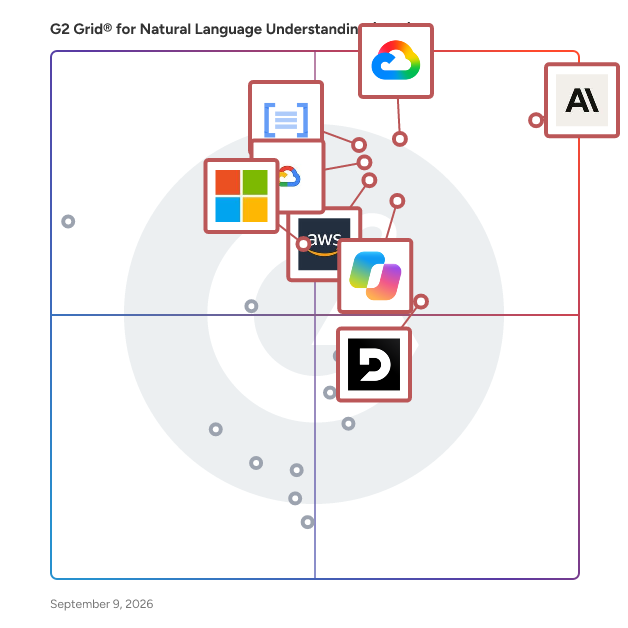
G2 Grid® for Natural Language Understanding (NLU) Software

G2 Grid® for Natural Language Understanding (NLU) Software plotting products by satisfaction and market presence

Highlighted products: Claude, Google Cloud Translation API, Google Cloud Natural Language API, Google Cloud AutoML Natural Language, Microsoft Copilot, Amazon Comprehend, Deepgram, and Azure AI Language.

Underlying data: [Grid® JSON](https://www.g2.com/categories/natural-language-understanding-nlu/grids.json?focus%5B%5D=claude-2025-12-11&focus%5B%5D=google-cloud-translation-api&focus%5B%5D=google-cloud-natural-language-api&focus%5B%5D=google-cloud-automl-natural-language&focus%5B%5D=microsoft-copilot-2026-08-27&focus%5B%5D=amazon-comprehend&focus%5B%5D=deepgram&focus%5B%5D=azure-ai-language)

Claude

Claude is a state-of-the-art large language model (LLM) developed by Anthropic, designed to serve as a helpful, honest, and harmless AI assistant. With its advanced reasoning capabilities and conversational tone, Claude excels in tasks ranging from complex coding to in-depth financial analysis, making it a versatile tool for developers, enterprises, and financial professionals. Key Features and Functionality: - Advanced Coding Capabilities: Claude Opus 4 leads in coding performance, achieving top scores on benchmarks like SWE-bench and Terminal-bench. It supports sustained, long-running tasks, enabling continuous work for several hours, which is ideal for complex software development projects. - Financial Analysis Tools: Claude integrates seamlessly with financial data platforms such as Databricks and Snowflake, providing a unified interface for market analysis, research, and investment decision-making. It offers direct hyperlinks to source materials for instant verification, enhancing the efficiency of financial workflows. - Extended Context Windows: With an enhanced 500k context window available in Claude Sonnet 4, users can upload extensive documents, including hundreds of sales transcripts or large codebases, facilitating comprehensive analysis and collaboration. - Tool Use and Integration: Claude's extended thinking capabilities allow it to utilize tools like web search during reasoning processes, improving response accuracy. It also supports background tasks via GitHub Actions and integrates natively with development environments like VS Code and JetBrains for seamless pair programming. - Enterprise-Grade Security: The Claude Enterprise plan offers advanced security features, including Single Sign-On (SSO), Just-in-Time Provisioning (JIT), role-based permissions, audit logs, and custom data retention controls, ensuring data safety and compliance for organizations. Primary Value and User Solutions: Claude addresses the need for a reliable and intelligent AI assistant capable of handling complex tasks across various domains. For developers, it enhances productivity through advanced coding support and integration with development tools. Financial professionals benefit from its ability to unify and analyze diverse data sources, streamlining research and decision-making processes. Enterprises gain from its scalable solutions and robust security features, enabling efficient and secure deployment of AI capabilities within their operations. Overall, Claude empowers users to achieve higher efficiency, accuracy, and innovation in their respective fields.

Average Rating: 4.6/5.0

Total Reviews: 453

How Do G2 Users Rate Claude?

  • Summarization: 9.9/10 (Category avg: 9.0/10)
  • Language Detection: 9.5/10 (Category avg: 8.8/10)
  • Part of Speech Tagging: 9.2/10 (Category avg: 8.7/10)
  • Quality of Support: 8.2/10 (Category avg: 8.6/10)

Who Is the Company Behind Claude?

  • Seller: Anthropic
  • HQ Location: San Francisco, California
  • Twitter: @AnthropicAI
    1,440,248 Twitter followers
  • LinkedIn® Page: www.linkedin.com
    5,886 employees on LinkedIn®

Who Uses This Product?

  • Who Uses This: Software Engineer, Data Analyst
  • Top Industries: Computer Software, Information Technology and Services
  • Company Size: 53% Small, 33% Medium

What Do G2 Reviewers Say About Claude?

AI-generated summary from verified user reviews

Pros
  • Users value Claude's ease of use, allowing for clear, structured, and organized content creation effortlessly.
  • Users value Claude for its deep discussion capabilities and effective context management for intellectual pursuits.
  • Users find Claude to be exceptionally helpful for deep discussions, aiding in intellectual work and creative projects.
  • Users commend the accuracy of Claude, noting its well-articulated and thoroughly researched answers.
  • Users value Claude's clarity and structured communication, which greatly enhances health education and patient interactions.
Cons
  • Users face usage limitations with Claude, including access restrictions, performance inconsistency, and file handling issues.
  • Users note significant limitations with Claude, including focus on text, lack of visual support, and slow responsiveness.
  • Users find Claude's limited functionality restricts visual content creation and rapid research, impacting efficiency and usability.
  • Users find that Claude can be overly cautious and long-winded, hindering quick and effective responses.
  • Users find the resource limitations frustrating, impacting productivity and increasing costs for their workload management.

What Are Recent G2 Reviews of Claude?

Google Cloud Translation API

Make your content and apps multilingual with fast, dynamic machine translation available in thousands of language pairs.

Average Rating: 4.4/5.0

Total Reviews: 402

How Do G2 Users Rate Google Cloud Translation API?

  • Summarization: 8.7/10 (Category avg: 9.0/10)
  • Language Detection: 8.9/10 (Category avg: 8.8/10)
  • Part of Speech Tagging: 8.9/10 (Category avg: 8.7/10)
  • Quality of Support: 8.5/10 (Category avg: 8.6/10)

Who Is the Company Behind Google Cloud Translation API?

  • Seller: Google
  • Year Founded: 1998
  • HQ Location: Mountain View, CA
  • Twitter: @google
    31,899,995 Twitter followers
  • LinkedIn® Page: www.linkedin.com
    301,144 employees on LinkedIn®
  • Ownership: NASDAQ:GOOG

Who Uses This Product?

  • Who Uses This: Software Engineer, Data Engineer
  • Top Industries: Computer Software, Information Technology and Services
  • Company Size: 53% Small, 24% Medium

What Do G2 Reviewers Say About Google Cloud Translation API?

AI-generated summary from verified user reviews

Pros
  • Users commend the ease of integration and efficiency of Google Cloud Translation API for multi-language translations.
  • Users value the ease of use of Google Cloud Translation API, appreciating its simple integration with applications.
  • Users appreciate the impressive accuracy of Google Cloud Translation API, ensuring effective communication across multiple languages.
  • Users love the multilingual support of Google Cloud Translation API, enabling effective communication across diverse languages worldwide.
  • Users appreciate the extensive language support of Google Cloud Translation API, enabling seamless global communication for projects.
Cons
  • Users often face issues with translation accuracy, leading to errors and the need for extensive proofreading.
  • Users find the cost too expensive for large-scale translation needs, impacting overall satisfaction with the service.
  • Users note accuracy issues with translations, especially for certain languages, requiring additional proofreading efforts.
  • Users find the subscription costs can add up quickly for heavy usage, limiting affordability and flexibility.
  • Users face translation issues, with accuracy and completeness fluctuating across different languages causing additional costs.

What Are Recent G2 Reviews of Google Cloud Translation API?

What Are G2 Users Discussing About Google Cloud Translation API?

Google Cloud Natural Language API

Derive insights from unstructured text using Google machine learning.

Average Rating: 4.3/5.0

Total Reviews: 117

How Do G2 Users Rate Google Cloud Natural Language API?

  • Summarization: 8.6/10 (Category avg: 9.0/10)
  • Language Detection: 8.9/10 (Category avg: 8.8/10)
  • Part of Speech Tagging: 8.7/10 (Category avg: 8.7/10)
  • Quality of Support: 8.6/10 (Category avg: 8.6/10)

Who Is the Company Behind Google Cloud Natural Language API?

  • Seller: Google
  • Year Founded: 1998
  • HQ Location: Mountain View, CA
  • Twitter: @google
    31,899,995 Twitter followers
  • LinkedIn® Page: www.linkedin.com
    301,144 employees on LinkedIn®
  • Ownership: NASDAQ:GOOG

Who Uses This Product?

  • Who Uses This: Software Engineer
  • Top Industries: Information Technology and Services, Computer Software
  • Company Size: 50% Small, 26% Large

What Do G2 Reviewers Say About Google Cloud Natural Language API?

AI-generated summary from verified user reviews

Pros
  • Users highlight the file upload capability of Google Cloud Natural Language API, enhancing decision-making for large databases.
  • Users appreciate the ability to upload databases and large files with Google Cloud Natural Language API for informed decision-making.
  • Users find the database upload capability of Google Cloud Natural Language API invaluable for making informed decisions in healthcare.
Cons
  • Users find the Google Cloud Natural Language API not user-friendly, as it can be difficult to understand and navigate.

What Are Recent G2 Reviews of Google Cloud Natural Language API?

Google Cloud AutoML Natural Language

The powerful pre-trained models of the Natural Language API let developers work with natural language understanding features including sentiment analysis, entity analysis, entity sentiment analysis, content classification, and syntax analysis.

Average Rating: 4.5/5.0

Total Reviews: 35

How Do G2 Users Rate Google Cloud AutoML Natural Language?

  • Summarization: 9.5/10 (Category avg: 9.0/10)
  • Language Detection: 9.2/10 (Category avg: 8.8/10)
  • Part of Speech Tagging: 8.0/10 (Category avg: 8.7/10)
  • Quality of Support: 8.7/10 (Category avg: 8.6/10)

Who Is the Company Behind Google Cloud AutoML Natural Language?

  • Seller: Google
  • Year Founded: 1998
  • HQ Location: Mountain View, CA
  • Twitter: @google
    31,899,995 Twitter followers
  • LinkedIn® Page: www.linkedin.com
    301,144 employees on LinkedIn®
  • Ownership: NASDAQ:GOOG

Who Uses This Product?

  • Top Industries: Information Technology and Services
  • Company Size: 63% Small, 20% Medium

What Are Recent G2 Reviews of Google Cloud AutoML Natural Language?

What Are G2 Users Discussing About Google Cloud AutoML Natural Language?

Microsoft Copilot

Microsoft Copilot is a generative AI assistant for work that’s built into the Microsoft 365 apps people use every day—like Word, Excel, PowerPoint, Outlook, and Teams. It helps you stay in the flow of work by turning your ideas, content, and data into action. Powered by Work IQ, Copilot connects the dots across your work—bringing together your emails, files, meetings, and conversations to deliver more relevant, contextual, and personalized assistance. It understands how work gets done in your organization and adapts to your role, priorities, and patterns over time. Copilot works alongside you to help draft content, analyze data, summarize meetings, and automate tasks—so you can move faster and focus on what matters most. Because it’s built directly into the apps you already use, there’s no need to switch tools or start from scratch. Copilot also inherits Microsoft 365 security, privacy, and compliance controls, so it only surfaces information users are authorized to access while keeping your data protected. By combining AI with the tools and data organizations already rely on, Copilot helps people work smarter, move faster, and get more done. Apps like Word, Excel, PowerPoint, Outlook, Teams, and Loop work with Copilot to support users in the context of their work. For example, Copilot in Word helps users create, understand, and edit documents. By using Copilot Chat, you can draft content, review what you missed, and get answers to questions by using open-ended prompts. This information is securely grounded in your work data. Copilot Search is an AI-powered universal search experience across all your Microsoft 365 applications and connected non-Microsoft data sources. It's integrated with Microsoft 365 Copilot, so users can find the results they need by using search, then seamlessly transition to chat for deeper exploration or follow-up task completion. Out of the box agents like Facilitator, Interpreter, or Channels help support meeting logistics, communication, and collaboration in Microsoft Teams.

Average Rating: 4.4/5.0

Total Reviews: 360

How Do G2 Users Rate Microsoft Copilot?

  • Summarization: 8.3/10 (Category avg: 9.0/10)
  • Quality of Support: 8.5/10 (Category avg: 8.6/10)

Who Is the Company Behind Microsoft Copilot?

  • Seller: Microsoft
  • Company Website:
  • Year Founded: 1975
  • HQ Location: Redmond, Washington
  • Twitter: @microsoft
    13,091,739 Twitter followers
  • LinkedIn® Page: www.linkedin.com
    232,750 employees on LinkedIn®

Who Uses This Product?

  • Who Uses This: Software Engineer, Project Manager
  • Top Industries: Information Technology and Services, Computer Software
  • Company Size: 35% Small, 34% Large

What Are Recent G2 Reviews of Microsoft Copilot?

Amazon Comprehend

Amazon Comprehend is a natural language processing (NLP) service that uses machine learning to find insights and relationships in text. Amazon Comprehend identifies the language of the text; extracts key phrases, places, people, brands, or events; understands how positive or negative the text is; and automatically organizes a collection of text files by topic.

Average Rating: 4.3/5.0

Total Reviews: 83

How Do G2 Users Rate Amazon Comprehend?

  • Summarization: 8.6/10 (Category avg: 9.0/10)
  • Language Detection: 8.3/10 (Category avg: 8.8/10)
  • Part of Speech Tagging: 8.8/10 (Category avg: 8.7/10)
  • Quality of Support: 8.5/10 (Category avg: 8.6/10)

Who Is the Company Behind Amazon Comprehend?

  • Seller: Amazon Web Services (AWS)
  • Year Founded: 2006
  • HQ Location: Seattle, WA
  • Twitter: @awscloud
    2,232,483 Twitter followers
  • LinkedIn® Page: www.linkedin.com
    147,094 employees on LinkedIn®
  • Ownership: NASDAQ: AMZN

Who Uses This Product?

  • Top Industries: Information Technology and Services, Accounting
  • Company Size: 40% Medium, 39% Small

What Do G2 Reviewers Say About Amazon Comprehend?

AI-generated summary from verified user reviews

Pros
  • Users value the data insight capabilities of Amazon Comprehend, simplifying the extraction of key phrases without ML expertise.
  • Users value the valuable insights and ease of use provided by Amazon Comprehend in content creation.
  • Users appreciate the ease of use of Amazon Comprehend, enabling insights without requiring machine learning experience.
  • Users appreciate the valuable insights provided by Amazon Comprehend, enhancing their understanding of various text sources.
  • Users value the insightful text analysis of Amazon Comprehend, facilitating easy extraction and robust data protection.
Cons
  • Users note that accuracy issues arise without sufficient training data, leading to higher costs for analysis.
  • Users note that the product can be expensive, particularly with high data volume requirements for accurate insights.
  • Users face challenges with insufficient training, leading to low accuracy and increased costs for data analysis.

What Are Recent G2 Reviews of Amazon Comprehend?

Deepgram

Enterprise Voice AI platform designed for developers building voice-first products using speech-to-text, text-to-speech, or speech-to-speech APIs. Over 200,000 developers build with Deepgram's voice-native foundational models, accessed via APIs or self-managed software. Start building with $200 in free credits! Beyond that, developers can: 🔊 Process live-streaming or pre-recorded audio with superior accuracy 🗣️ Convert text into natural-sounding AI voices for enterprise use cases with text-to-speech ⚡️ Easily build voice agents with our unified Voice Agent API 🌎 Accurately transcribe audio in over 36+ languages ⚙️ Train custom models for unique use cases 🔑 Access deep NLU with a unified API 💻 Build in any programming language with our SDKs ✅ Deploy on-prem or on DG’s managed cloud 📈 Get scalable GPU infra for training and inference

Average Rating: 4.6/5.0

Total Reviews: 477

How Do G2 Users Rate Deepgram?

  • Summarization: 10.0/10 (Category avg: 9.0/10)
  • Language Detection: 10.0/10 (Category avg: 8.8/10)
  • Part of Speech Tagging: 10.0/10 (Category avg: 8.7/10)
  • Quality of Support: 8.8/10 (Category avg: 8.6/10)

Who Is the Company Behind Deepgram?

  • Seller: Deepgram
  • Company Website:
  • Year Founded: 2015
  • HQ Location: San Francisco, California
  • Twitter: @DeepgramAI
    10,837 Twitter followers
  • LinkedIn® Page: www.linkedin.com
    371 employees on LinkedIn®

Who Uses This Product?

  • Who Uses This: Software Engineer, CEO
  • Top Industries: Computer Software, Information Technology and Services
  • Company Size: 80% Small, 19% Medium

What Do G2 Reviewers Say About Deepgram?

AI-generated summary from verified user reviews

Pros
  • Users praise the high accuracy of Deepgram, benefiting from fast and reliable speech-to-text transcriptions.
  • Users praise Deepgram for its fast and reliable transcriptions, making transcription tasks significantly easier and quicker.
  • Users appreciate the ease of use of Deepgram, thanks to its simple API and efficient transcription services.
  • Users commend Deepgram for its excellent transcription accuracy and user-friendly integration, enhancing their audio processing experience.
  • Users commend Deepgram for its fast and accurate real-time transcription, enhancing analysis and live applications effortlessly.
Cons
  • Users are frustrated by the limited language support which hinders the platform's versatility and usability.
  • Users find the pricing issues concerning, especially for large projects and tight budgets, making it less accessible.
  • Users find the pricing high, making it challenging for startups and students with limited budgets.
  • Users experience inaccuracy issues with Deepgram, including missed words and limited language support that hinder transcription quality.
  • Users note the limited language support of Deepgram, though enhancements are in progress to address this issue.

What Are Recent G2 Reviews of Deepgram?

What Are G2 Users Discussing About Deepgram?

Azure AI Language

Azure AI Language is a managed service for developing natural language processing applications. Identify key terms and phrases, analyze sentiment, summarize text, and build conversational interfaces. Use Language to annotate, train, evaluate, and deploy customizable AI models with minimal machine-learning expertise.

Average Rating: 4.3/5.0

Total Reviews: 79

How Do G2 Users Rate Azure AI Language?

  • Summarization: 8.3/10 (Category avg: 9.0/10)
  • Language Detection: 8.6/10 (Category avg: 8.8/10)
  • Part of Speech Tagging: 8.1/10 (Category avg: 8.7/10)
  • Quality of Support: 8.4/10 (Category avg: 8.6/10)

Who Is the Company Behind Azure AI Language?

  • Seller: Microsoft
  • Year Founded: 1975
  • HQ Location: Redmond, Washington
  • Twitter: @microsoft
    13,091,739 Twitter followers
  • LinkedIn® Page: www.linkedin.com
    232,750 employees on LinkedIn®
  • Ownership: MSFT

Who Uses This Product?

  • Top Industries: Computer Software, Information Technology and Services
  • Company Size: 42% Small, 32% Large

What Are Recent G2 Reviews of Azure AI Language?

What Are G2 Users Discussing About Azure AI Language?

Google NotebookLM

The ultimate tool for understanding the information that matters most to you, built with Gemini 2.0

Average Rating: 4.6/5.0

Total Reviews: 19

How Do G2 Users Rate Google NotebookLM?

  • Summarization: 9.9/10 (Category avg: 9.0/10)
  • Language Detection: 8.1/10 (Category avg: 8.8/10)
  • Part of Speech Tagging: 7.9/10 (Category avg: 8.7/10)
  • Quality of Support: 8.9/10 (Category avg: 8.6/10)

Who Is the Company Behind Google NotebookLM?

Who Uses This Product?

  • Company Size: 47% Small, 32% Medium

What Do G2 Reviewers Say About Google NotebookLM?

AI-generated summary from verified user reviews

Pros
  • Users enjoy the effective content creation features of Google NotebookLM, enhancing understanding through visuals like videos and flashcards.
  • Users value the efficiency of Google NotebookLM for enhancing collaboration and streamlining note tracking and access.
  • Users appreciate the AI-driven insights of Google NotebookLM, enhancing collaboration and decision-making efficiency in their workflow.
  • Users appreciate the enhanced understanding provided by Google NotebookLM through visual aids like videos and flashcards.
  • Users appreciate the intuitive user interface of Google NotebookLM, enhancing their research experience effortlessly.
Cons
  • Users often face inefficient file management with lost chat history, wishing for better automatic saving options.
  • Users express frustration over language limitations, including lack of regional accents and missing subtitles for videos.
  • Users find limited language support frustrating, as it lacks subtitles and regional accents for better understanding.
  • Users note poor response quality from the male voice, finding it repetitive and lacking in depth during analyses.

What Are Recent G2 Reviews of Google NotebookLM?

Stanford CoreNLP

Stanford CoreNLP provides a set of natural language analysis tools that can give the base forms of words, their parts of speech, whether they are names of companies, people, etc., normalize dates, times, and numeric quantities, and mark up the structure of sentences in terms of phrases and word dependencies, indicate which noun phrases refer to the same entities, indicate sentiment, extract open-class relations between mentions, etc.

Average Rating: 4.3/5.0

Total Reviews: 10

How Do G2 Users Rate Stanford CoreNLP?

  • Quality of Support: 6.7/10 (Category avg: 8.6/10)

Who Is the Company Behind Stanford CoreNLP?

Who Uses This Product?

  • Company Size: 60% Small, 20% Large

What Are Recent G2 Reviews of Stanford CoreNLP?

scite.ai

scite is an award-winning research tool that helps users better discover, understand, and evaluate research through Smart Citations. Smart Citations display the context of the citation and describe whether the article provides supporting or contrasting evidence.

Average Rating: 4.7/5.0

Total Reviews: 27

How Do G2 Users Rate scite.ai?

  • Summarization: 8.5/10 (Category avg: 9.0/10)
  • Language Detection: 8.5/10 (Category avg: 8.8/10)
  • Part of Speech Tagging: 6.9/10 (Category avg: 8.7/10)
  • Quality of Support: 8.8/10 (Category avg: 8.6/10)

Who Is the Company Behind scite.ai?

  • Seller: scite.ai
  • Year Founded: 2018
  • HQ Location: New York, US
  • LinkedIn® Page: www.linkedin.com
    6 employees on LinkedIn®

Who Uses This Product?

  • Top Industries: Research, Higher Education
  • Company Size: 52% Small, 11% Medium

What Do G2 Reviewers Say About scite.ai?

AI-generated summary from verified user reviews

Pros
  • Users find scite.ai's powerful literature review tools invaluable, enhancing efficiency and simplifying citation management in research.
  • Users find scite.ai to be incredibly easy to use, making literature reviews and finding references seamless and efficient.
  • Users highlight the impeccable accuracy of scite.ai, ensuring confidence in citation cross-checking and research integrity.
  • Users find scite.ai's efficiency transformative, significantly speeding up literature reviews and enhancing their writing process.
  • Users find scite.ai's helpfulness as a research assistant, enhancing their study quality and literature review efficiency.
Cons
  • Users find that scite.ai has a slow performance that can interrupt workflow and affect user experience.
  • Users find the interface slow and limited in capabilities, affecting their overall experience with scite.ai.
  • Users find context understanding lacking in scite.ai, leading to irrelevant responses and a need for greater accuracy in literature reviews.
  • Users experience poor response quality with scite.ai, often receiving generic answers and irrelevant information that disrupts workflow.
  • Users often face repetitive content issues with scite.ai, leading to frustration and inefficiency during research tasks.

What Are Recent G2 Reviews of scite.ai?

InMoment Experience Improvement (XI) Platform

InMoment, the leader in improving experiences and the highest recommended CX platform and services company in the world is renowned for helping clients collect and integrate customer experience data to uncover the insights that enable the smartest actions. As the pace setters in applying award-winning AI, its global clients activate every byte of their experience data—from structured surveys and social reviews to unstructured conversations from call logs, emails, support tickets, and chat transcripts to breakdown data silos. This unique technology combined with in-house industry experts empower brands to gain ROI from their CX programs in half the time as its competitors. Unlock the true potential of every piece of customer data with InMoment. To learn more, visit inmoment.com

Average Rating: 4.7/5.0

Total Reviews: 314

How Do G2 Users Rate InMoment Experience Improvement (XI) Platform?

  • Quality of Support: 9.0/10 (Category avg: 8.6/10)

Who Is the Company Behind InMoment Experience Improvement (XI) Platform?

Who Uses This Product?

  • Who Uses This: Product Manager, Customer Success Manager
  • Top Industries: Computer Software, Information Technology and Services
  • Company Size: 47% Small, 39% Medium

What Are Recent G2 Reviews of InMoment Experience Improvement (XI) Platform?

What Are G2 Users Discussing About InMoment Experience Improvement (XI) Platform?

MITIE: MIT Information Extraction

MITIE: MIT Information Extraction is a tool that include performing named entity extraction and binary relation detection for training custom extractors and relation detectors.

Average Rating: 4.2/5.0

Total Reviews: 12

How Do G2 Users Rate MITIE: MIT Information Extraction?

  • Summarization: 8.3/10 (Category avg: 9.0/10)
  • Language Detection: 8.3/10 (Category avg: 8.8/10)
  • Part of Speech Tagging: 8.9/10 (Category avg: 8.7/10)
  • Quality of Support: 9.4/10 (Category avg: 8.6/10)

Who Is the Company Behind MITIE: MIT Information Extraction?

  • Seller: MITIE
  • Year Founded: 1987
  • HQ Location: London, UK
  • LinkedIn® Page: www.linkedin.com
    19,498 employees on LinkedIn®
  • Ownership: LON: MTO

Who Uses This Product?

  • Company Size: 42% Large, 33% Small

What Are Recent G2 Reviews of MITIE: MIT Information Extraction?

What Are G2 Users Discussing About MITIE: MIT Information Extraction?

Level AI

Level AI is the intelligence and orchestration layer for customer experience. We analyze 100% of customer interactions across voice, chat, email, and messaging to turn unstructured conversations into measurable insights and automation. From Voice of Customer and journey insights to automated quality, real-time coaching, and AI agents, Level AI helps teams improve customer outcomes, operational performance, and profitable growth.

Average Rating: 4.6/5.0

Total Reviews: 212

How Do G2 Users Rate Level AI?

  • Summarization: 9.7/10 (Category avg: 9.0/10)
  • Language Detection: 8.9/10 (Category avg: 8.8/10)
  • Part of Speech Tagging: 9.2/10 (Category avg: 8.7/10)
  • Quality of Support: 9.0/10 (Category avg: 8.6/10)

Who Is the Company Behind Level AI?

  • Seller: Level AI
  • Company Website:
  • Year Founded: 2018
  • HQ Location: Mountain View, US
  • Twitter: @TheLevelAI
    204 Twitter followers
  • LinkedIn® Page: www.linkedin.com
    221 employees on LinkedIn®

Who Uses This Product?

  • Who Uses This: Quality Analyst, Supervisor
  • Top Industries: Consumer Services, Food & Beverages
  • Company Size: 56% Medium, 33% Large

What Do G2 Reviewers Say About Level AI?

AI-generated summary from verified user reviews

Pros
  • Users appreciate the ease of use of Level AI, facilitating quick access to transcripts and customization options.
  • Users find Level AI's smooth assistance and layout extremely helpful for enhancing customer interactions and QA processes.
  • Users highlight the enhanced efficiency in accessing and analyzing customer interactions, significantly improving support processes.
  • Users appreciate the clean and intuitive interface of Level AI, enhancing efficiency and user experience.
  • Users commend the accurate and context-aware responses of Level AI, significantly enhancing customer interactions and satisfaction.
Cons
  • Users find the inaccuracy in AI QA scores frustrating, as it hampers effective monitoring and evaluation processes.
  • Users express frustration with the slow performance of Level AI, impacting real-time updates and monitoring efficiency.
  • Users express frustration with accuracy issues in AI QA scores, impacting overall evaluation efficiency and clarity.
  • Users experience occasional translation accuracy issues, especially with accents, affecting the quality of insights derived.
  • Users experience AI inaccuracy issues, leading to trust problems with transcripts and delayed call monitoring.

What Are Recent G2 Reviews of Level AI?

What Are G2 Users Discussing About Level AI?

Gensim

Gensim is a Python library that analyze plain-text documents for semantic structure and retrieve semantically similar document.

Average Rating: 4.4/5.0

Total Reviews: 15

How Do G2 Users Rate Gensim?

  • Summarization: 7.6/10 (Category avg: 9.0/10)
  • Language Detection: 7.6/10 (Category avg: 8.8/10)
  • Part of Speech Tagging: 8.0/10 (Category avg: 8.7/10)
  • Quality of Support: 9.1/10 (Category avg: 8.6/10)

Who Is the Company Behind Gensim?

Who Uses This Product?

  • Company Size: 53% Small, 27% Large

What Are Recent G2 Reviews of Gensim?

What Are G2 Users Discussing About Gensim?

Bijou Barry
BB
Researched and written by Bijou Barry
Updated April 9, 2026

Learn More About Natural Language Understanding (NLU) Software

What is Natural Language Understanding Software?

Natural language understanding, a subset of natural language processing (NLP), makes predictions or decisions based on text data. These learning algorithms can be embedded within applications to provide automated artificial intelligence (AI) features. A connection to a data source is necessary for the algorithm to learn and adapt over time. 

Pulling out actionable insights from numerical data housed in ERP systems, CRM software, or accounting software is one thing, but gaining insights from unstructured data sources is invaluable. Without dedicated software for this task, businesses must spend significant time and resources building natural language understanding models or haphazardly investigating the data.

These algorithms may be developed with supervised learning or unsupervised learning. Supervised learning involves training an algorithm to determine a pattern of inference by feeding it consistent data to produce a repeated, general output. Human training is necessary for this type of learning. Unsupervised algorithms independently reach an output and are a feature of deep learning algorithms. Reinforcement learning is the final form of machine learning, which consists of algorithms that understand how to react based on their situation or environment.

End users of intelligent applications may not be aware that an everyday software tool utilizes a machine learning algorithm to provide automation of some kind. Additionally, machine learning solutions for businesses may come in a machine learning as a service (MLaaS) model.

What Does NLU Stand For?

NLU stands for Natural Language Understanding, which is a subset of natural language processing (NLP).

What Types of Natural Language Understanding Software Exist?

Natural language understanding, at its core, allows machines to understand human language in spoken or written form. There are two key methods this can be accomplished.

Machine learning-based systems

Machine learning algorithms use statistical methods. They learn to perform tasks based on training data they are fed and adjust their methods as more data is processed. Using a combination of machine learning, deep learning, and neural networks, natural language processing algorithms hone their own rules through repeated processing and learning.

Rules-based systems

This system uses carefully designed linguistic rules. This approach was used early in the development of natural language processing and is still used.

What are the Common Features of Natural Language Understanding Software?

The following are some core features within natural language understanding software that can help users better understand text data:

Part-of-speech (POS) tagging: With POS tagging, users can parse text by parts of speech. This can help break down sentences into component parts to understand them.

Named entity recognition (NER): Sentences are comprised of various entities, from street names to surnames, places, and more. With NER, one can extract these entities. These extracted entities can then be fed into other systems automatically.

Sentiment analysis: Language can be positive, negative, or neutral. Using sentiment analysis techniques, one can input text and be given the sentiment (positive or negative) of that text.

Emotion detection: Similar to sentiment analysis, emotion detection can detect the emotion of human language, whether written or spoken. Despite the research supporting it, this method has come under scrutiny, and its veracity has been challenged.

What are the Benefits of Natural Language Understanding Software?

Natural language understanding is useful in many different contexts and industries.

Application development: NLU drives the development of AI applications that streamline processes, identify risks, and improve effectiveness.

Efficiency: NLU-powered applications are constantly improving because of the recognition of their value and the need to stay competitive in the industries in which they are used. They also increase the efficiency of repeatable tasks. A prime example of this can be seen in eDiscovery, where machine learning has created massive leaps in the efficiency with which legal documents are looked through, and relevant ones are identified.

Scalability: Humans are great at analysis, but their analysis skills can break down when the amount of data is vast and when they need to produce results in record time. NLU-powered technology does not get stressed, pressured, or tired. It can analyze a (relatively) small amount of data or a large text corpus with ease, speed, and accuracy. This can be scaled across a business’ text datasets and various use cases.

Discovering trends: NLU can do a great job at finding trends and patterns in text data. Through word clouds, graphs and charts, and more, NLU can provide users with deep insight into what is happening beneath the surface.

Empowering non-technical users: Much NLU technology in the market is no-code or low-code, which allows non-technical users to benefit from the technology. Gone are the days when one needed to go to a data scientist or IT professional to understand language data.

Who Uses Natural Language Understanding Software?

NLU has applications across nearly every industry. Some industries that benefit from NLU applications include financial services, cybersecurity, recruiting, customer service, energy, and regulation.

Marketing: NLU-powered marketing applications help marketers identify content trends, shape content strategy, and personalize marketing content. 

Finance: Financial services institutions are increasing their use of NLU-powered applications to stay competitive with others in the industry who are doing the same. Some examples may include trawling through thousands of insurance claims and identifying ones with a high potential to be fraudulent. The process is similar, and the machine learning algorithm can digest the data to achieve the desired outcome quicker.

Human resources: Resumes are long and filled with words. As such, natural language understanding technology can help recruiters comb through large amounts of resumes and other text data to better understand candidates.

What are the Alternatives to Natural Language Understanding Software?

Alternatives to natural language understanding software can replace this type of software, either partially or completely:

Machine learning software: Natural language understanding (NLU) software is specifically connected to and used for text data. If one is looking for more general-use machine learning algorithms, machine learning software would be a good category to pursue.

Text analysis software: NLU software is geared toward incorporating NLU capabilities into other applications or systems. Text analysis software, however, is an all-purpose solution built to analyze any text data. Businesses looking to focus on analyzing their text data, such as from surveys, review sites, social media, and customer service tools, can leverage text analysis software to achieve this goal. This software enables businesses to consolidate and analyze their text data within a single platform. 

Software Related to Natural Language Understanding Software

Related solutions that can be used together with natural language understanding software include:

Chatbots software: Businesses looking for an off-the-shelf conservational AI solution can leverage chatbots. Tools specifically geared toward chatbot creation helps companies use chatbots off the shelf, with little to no development or coding experience necessary.

Bot platforms software: Companies looking to build their own chatbot can benefit from bot platforms, which are tools used to build and deploy interactive chatbots. These platforms provide development tools such as frameworks and API toolsets for customizable bot creation.

Intelligent virtual assistants (IVAs): Businesses that want conversational AI with strong natural language understanding capabilities should consider IVAs. IVAs understand a range of different intents from a singular utterance and can even understand responses they are not explicitly programmed to using natural language processing (NLP). With the use of machine learning and deep learning, IVAs can grow intelligently and understand a wider vocabulary and colloquial language, as well as provide more precise and correct responses to requests.

Challenges with Natural Language Understanding Software

Software solutions can come with their own set of challenges. 

Data preparation: A potential concern is preparing the data to be ingested by the NLU tool. The data needs to be stored properly, whether that is in a database or data warehouse. Users may require IT or a dedicated admin to ensure the text analytics tool can consume the data.

Automation pushback: One of the biggest potential issues with machine learning-powered applications, such as NLU, lies in removing humans from processes. This is particularly problematic when looking at emerging technologies like self-driving cars. By completely removing humans from the product development lifecycle, machines are given the power to decide in life-or-death situations.

Data security: Companies must consider security options to ensure the correct users see the correct data. They must also have security options that allow administrators to assign verified users different levels of access to the platform.

Which Companies Should Buy Natural Language Understanding Software?

Pattern recognition can help businesses across industries. Effective and efficient predictions can help these businesses make data-informed decisions, such as dynamic pricing based upon a range of data points.

Retail: An e-commerce site can leverage an NLU application programming interface (API) to create rich, personalized experiences for every user.

Entertainment: Media organizations can leverage NLU to comb through their scripts and other content to catalog and categorize their material.

Finance: Financial institutions can analyze contracts and conduct sentiment analysis and named entity recognition to better understand these documents and to scale operations.

How to Buy Natural Language Understanding Software

Requirements Gathering (RFI/RFP) for Natural Language Understanding Software

If a company is just starting out and looking to purchase their first NLU software, wherever they are in the buying process, g2.com can help select the best machine learning software for them.

Taking a holistic overview of the business and identifying pain points can help the team create a checklist of criteria. The checklist serves as a detailed guide that includes both necessary and nice-to-have features, including budget, features, number of users, integrations, security requirements, cloud or on-premises solutions, and more. Depending on the scope of the deployment, it might be helpful to produce an RFI, a one-page list with a few bullet points describing what is needed from a machine learning platform.

Compare Natural Language Understanding Software Products

Create a long list

From meeting the business functionality needs to implementation, vendor evaluations are an essential part of the software buying process. For ease of comparison, after the demos are complete, it helps to prepare a consistent list of questions regarding specific needs and concerns to ask each vendor.

Create a short list

From the long list of vendors, it is advisable to narrow down the list of vendors and come up with a shorter list of contenders, preferably no more than three to five. With this list in hand, businesses can produce a matrix to compare the features and pricing of the various solutions.

Conduct demos

To ensure the comparison is thoroughgoing, the user should demo each solution on the shortlist with the same use case and datasets. This will allow the business to evaluate like for like and see how each vendor stacks up against the competition.

Selection of Natural Language Understanding Software

Choose a selection team

Before getting started, it's crucial to create a winning team that will work together throughout the entire process, from identifying pain points to implementation. The software selection team should consist of members of the organization who have the right interest, skills, and time to participate in this process. A good starting point is to aim for three to five people who fill roles such as the main decision maker, project manager, process owner, system owner, or staffing subject matter expert, as well as a technical lead, IT administrator, or security administrator. In smaller companies, the vendor selection team may be smaller, with fewer participants multitasking and taking on more responsibilities.

Negotiation

Prices on a company's pricing page are not always fixed (although some companies will not budge). It is imperative to open up a conversation regarding pricing and licensing. For example, the vendor may be willing to give a discount for multi-year contracts or for recommending the product to others.

Final decision

After this stage, and before going all in, it is recommended to roll out a test run or pilot program to test adoption with a small sample size of users. If the tool is well used and well received, the buyer can be confident that the selection was correct. If not, it might be time to go back to the drawing board.

What Does Natural Language Understanding Software Cost?

NLU software is generally available in different tiers, with the more entry-level solutions costing less than the enterprise-scale ones. The former will usually lack features and may have caps on usage. Vendors may have tiered pricing, in which the price is tailored to the users’ company size, the number of users, or both. This pricing strategy may come with some degree of support, either unlimited or capped at a certain number of hours per billing cycle.

Once set up, they do not often require significant maintenance costs, especially if deployed in the cloud. As these platforms often come with many additional features, businesses looking to maximize the value of their software can contract third-party consultants to help them derive insights from their data and get the most out of the software.

Return on Investment (ROI)

Businesses decide to deploy machine learning software with the goal of deriving some degree of ROI. As they are looking to recoup the losses that they spent on the software, it is critical to understand the costs associated with it. As mentioned above, these platforms typically are billed per user, which is sometimes tiered depending on the company size. 

More users will naturally translate into more licenses, which means more money. Users must consider how much is spent and compare that to what is gained, both in terms of efficiency as well as revenue. Therefore, businesses can compare processes between pre- and post-deployment of the software to better understand how processes have been improved and how much time has been saved. They can even produce a case study (either for internal or external purposes) to demonstrate the gains they have seen from their use of the platform.