Best DDoS Protection Solutions

How Many DDoS Protection Solutions Products Does G2 Track?

Total Products under this Category: 92

Category Stats (Sep 2026)

  • Average Rating: 4.42/5 The average rating of products in this category, based on all submitted ratings
  • Top Trending Product: Azion (+0.36%) - Among all products in this category, Azion recorded the largest rating increase compared to last month

Last updated: September 30, 2026

How Does G2 Rank DDoS Protection Solutions Products?

Why You Can Trust G2's Software Rankings:

  • 30 Analysts and Data Experts
  • 2,900+ Authentic Reviews
  • 92+ Products
  • Unbiased Rankings

G2's software rankings are built on verified user reviews, rigorous moderation, and a consistent research methodology maintained by a team of analysts and data experts. Each product is measured using the same transparent criteria, with no paid placement or vendor influence. While reviews reflect real user experiences, which can be subjective, they offer valuable insight into how software performs in the hands of professionals. Together, these inputs power the G2 Score, a standardized way to compare tools within every category.

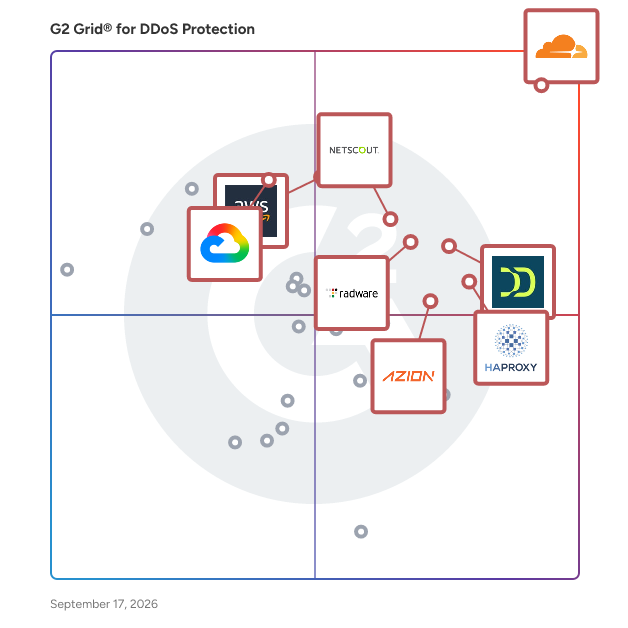
G2 Grid® for DDoS Protection Solutions

G2 Grid® for DDoS Protection Solutions plotting products by satisfaction and market presence

Highlighted products: Cloudflare Application Security and Performance, DataDome, HAProxy, Radware Cloud DDoS Protection Service, Arbor Threat Mitigation System, AWS Shield, Azion, and Google Cloud Armor.

Underlying data: [Grid® JSON](https://www.g2.com/categories/ddos-protection/grids.json?focus%5B%5D=cloudflare-application-security-and-performance&focus%5B%5D=datadome&focus%5B%5D=haproxy&focus%5B%5D=radware-cloud-ddos-protection-service&focus%5B%5D=arbor-threat-mitigation-system&focus%5B%5D=aws-shield&focus%5B%5D=azion&focus%5B%5D=google-cloud-armor)

Cloudflare Application Security and Performance

Cloudflare is the connectivity cloud for the "everywhere world," on a mission to help build a better Internet. We provide a unified platform of networking, security, and developer services delivered from a single, intelligent global network that spans hundreds of cities in over 125 countries. This empowers organizations of all sizes, from small businesses to the world's largest enterprises, to make their employees, applications, and networks faster and more secure everywhere, while significantly reducing complexity and cost. Our comprehensive platform includes: - Advanced Security: Protect your online presence with industry-leading DDoS protection, a robust Web Application Firewall (WAF), Bot mitigation, and API security. Implement Zero Trust security to secure remote access, data, and applications for your entire workforce. - Superior Performance: Accelerate website and application loading times globally with our Content Delivery Network (CDN), intelligent DNS, and smart routing capabilities. Optimize images and deliver dynamic content with unparalleled speed. - Powerful Developer Tools: Empower your developers to build and deploy full-stack applications at the edge using Cloudflare Workers (serverless functions), R2 Storage (object storage without egress fees), and D1 (serverless SQL database). Cloudflare helps connect and protect millions of customers globally, offering the control, visibility, and reliability businesses need to work, develop, and accelerate their operations in today's hyperconnected landscape. Our global network continuously learns and adapts, ensuring your digital assets are always protected and performing at their best.

Average Rating: 4.5/5.0

Total Reviews: 752

How Do G2 Users Rate Cloudflare Application Security and Performance?

  • Logging: 8.7/10 (Category avg: 8.4/10)
  • IT Alerting: 8.8/10 (Category avg: 8.5/10)
  • Website Protection: 9.5/10 (Category avg: 8.9/10)
  • Ease of Setup: 8.8/10 (Category avg: 8.7/10)

Who Is the Company Behind Cloudflare Application Security and Performance?

  • Seller: Cloudflare, Inc.
  • Company Website:
  • Year Founded: 2009
  • HQ Location: San Francisco, California
  • Twitter: @Cloudflare
    286,254 Twitter followers
  • LinkedIn® Page: www.linkedin.com
    8,094 employees on LinkedIn®

Who Uses This Product?

  • Who Uses This: Web Developer, Software Engineer
  • Top Industries: Information Technology and Services, Computer Software
  • Company Size: 62% Small, 27% Medium

What Do G2 Reviewers Say About Cloudflare Application Security and Performance?

AI-generated summary from verified user reviews

Pros
  • Users value the robust security features of Cloudflare, appreciating its effective protection against attacks and fast page loads.
  • Users appreciate the user-friendly interface of Cloudflare, making management of security and performance settings effortless.
  • Users appreciate the user-friendly interface of Cloudflare, making security and performance management easy and efficient.
  • Users appreciate the enhanced site performance provided by Cloudflare, leading to faster page load times and improved security.
  • Users value Cloudflare's DDoS protection, as it effectively secures websites and significantly improves page load times.
Cons
  • Users find the complex user interface of Cloudflare challenging, often leading to confusion and a steep learning curve.
  • Users find the high pricing for advanced features to be a significant drawback, restricting access to essential tools.
  • Users find the complex setup challenging, particularly with advanced configurations that require extra time and support.
  • Users find the complexity of advanced configurations challenging, impacting user-friendliness for those new to security platforms.
  • Users experience a steep learning curve for advanced features in Cloudflare Application Security and Performance, complicating user experience.

What Are Recent G2 Reviews of Cloudflare Application Security and Performance?

What Are G2 Users Discussing About Cloudflare Application Security and Performance?

DataDome

DataDome delivers real-time bot and agent trust management, providing complete visibility and control over all traffic—whether human, bot, or AI. Named a Leader in The Forrester Wave™ for Bot And Agent Trust Management Q2 2026, DataDome is trusted by enterprises like Etsy, PayPal, and Soundcloud. Acting as a traffic-control plane, DataDome's multi-layered AI engine leverages thousands of models and 5 trillion signals daily to analyze intent and stop fraud in under 2 milliseconds, allowing legitimate users to pass through seamlessly across websites, apps, APIs, and MCPs. A recognized Leader on G2 across several categories, DataDome stops 20K+ attacks every second, delivering protection that outperforms.

Average Rating: 4.7/5.0

Total Reviews: 243

How Do G2 Users Rate DataDome?

  • Logging: 8.8/10 (Category avg: 8.4/10)
  • IT Alerting: 8.8/10 (Category avg: 8.5/10)
  • Website Protection: 9.5/10 (Category avg: 8.9/10)
  • Ease of Setup: 8.7/10 (Category avg: 8.7/10)

Who Is the Company Behind DataDome?

  • Seller: DataDome
  • Company Website:
  • Year Founded: 2015
  • HQ Location: New York, NY / Paris, France / Singapore
  • Twitter: @data_dome
    1,760 Twitter followers
  • LinkedIn® Page: www.linkedin.com
    221 employees on LinkedIn®

Who Uses This Product?

  • Who Uses This: CTO, Software Engineer
  • Top Industries: Retail, Information Technology and Services
  • Company Size: 54% Medium, 30% Large

What Do G2 Reviewers Say About DataDome?

AI-generated summary from verified user reviews

Pros
  • Users commend DataDome for its effective bot prevention and intuitive interface, facilitating effortless traffic management and analysis.
  • Users commend the exceptional customer support of DataDome, appreciating the knowledgeable and dedicated team available 24/7.
  • Users value the efficiency of DataDome, benefiting from quick integration and real-time threat visualization.
  • Users appreciate the intuitive dashboard of DataDome, enhancing their visibility and simplifying security insights management.
  • Users value the effective bot protection of DataDome, enjoying peace of mind and easy implementation for their operations.
Cons
  • Users find DataDome to be expensive, especially as traffic scales and cost management becomes challenging.
  • Users experience complex setup issues with DataDome, particularly regarding mobile SDKs and installation at the Load Balancer level.
  • Users experience a high frequency of false alarms, which can disrupt interactions for legitimate users.
  • Users face access limitations with DataDome, particularly in tenant management and data extraction, hindering efficiency.
  • Users face captcha issues that can lead to a poor experience due to aggressive settings and performance concerns.

What Are Recent G2 Reviews of DataDome?

What Are G2 Users Discussing About DataDome?

HAProxy

HAProxy is an open-source software load balancer and reverse proxy for TCP, QUIC, and HTTP-based applications. It provides high availability, load balancing, and best-in-class SSL processing. HAProxy One is an application delivery and security platform that combines the HAProxy core with enterprise-grade security layers, management and orchestration, cloud-native integration, and more. Platform components: HAProxy Enterprise: a flexible data plane layer for TCP, UDP, QUIC, and HTTP-based applications that provides high-performance load balancing, high availability, an API/AI gateway, container networking, SSL processing, DDoS protection, bot detection and mitigation, global rate limiting, and a web application firewall (WAF). HAProxy Fusion: a scalable control plane that provides full-lifecycle management, observability, and automation of multi-cluster, multi-cloud, and multi-team HAProxy Enterprise deployments, with infrastructure integration for AWS, Kubernetes, Consul, and Prometheus. HAProxy Edge: a globally distributed application delivery network that provides fully managed application delivery and security services, a secure partition between external traffic and origin networks, and threat intelligence enhanced by machine learning that powers the security layers in HAProxy Fusion and HAProxy Enterprise. Learn more at HAProxy.com

Average Rating: 4.7/5.0

Total Reviews: 907

How Do G2 Users Rate HAProxy?

  • Logging: 8.4/10 (Category avg: 8.4/10)
  • IT Alerting: 8.8/10 (Category avg: 8.5/10)
  • Website Protection: 9.2/10 (Category avg: 8.9/10)
  • Ease of Setup: 8.6/10 (Category avg: 8.7/10)

Who Is the Company Behind HAProxy?

  • Seller: HAProxy
  • Company Website:
  • Year Founded: 2013
  • HQ Location: Newton, MA
  • Twitter: @HAProxy
    21,218 Twitter followers
  • LinkedIn® Page: www.linkedin.com
    125 employees on LinkedIn®

Who Uses This Product?

  • Who Uses This: DevOps Engineer, Software Engineer
  • Top Industries: Information Technology and Services, Computer Software
  • Company Size: 42% Medium, 35% Large

What Do G2 Reviewers Say About HAProxy?

AI-generated summary from verified user reviews

Pros
  • Users appreciate the easy implementation and effective workload balancing capabilities of HAProxy for traffic management.
  • Users find HAProxy to be exceptionally reliable and fast, enhancing their data security and operational efficiency.
  • Users appreciate the ease of use of HAProxy, finding its intuitive setup and stats page very helpful.
  • Users highlight HAProxy's high performance, appreciating its robust data transmission and seamless operations for reliable web management.
  • Users appreciate HAProxy for its high performance and low latency, making it a reliable choice for load balancing.
Cons
  • Users face difficult configuration challenges with HAProxy, struggling with complex syntax and readability of files.
  • Users find HAProxy's steep learning curve challenging, particularly for beginners in load balancing or networking.
  • Users find the complex setup of HAProxy challenging, requiring time and effort to overcome initial difficulties.
  • Users find the complex configuration of HAProxy to be challenging, particularly for newcomers to load balancing.
  • Users find HAProxy's complexity daunting, especially regarding configuration and debugging in advanced environments.

What Are Recent G2 Reviews of HAProxy?

What Are G2 Users Discussing About HAProxy?

AI can help you find the answers. G2 helps you trust them.

Connect G2 to Claude or ChatGPT for answers grounded in G2's trusted reviews, comparisons, and pricing from real user insights.

How it works

Arbor Threat Mitigation System

The Arbor Threat Mitigation System (TMS) is a sophisticated DDoS mitigation solution designed to ensure service availability and performance for organizations facing the growing threat of distributed denial-of-service (DDoS) attacks. By integrating network-wide intelligence and advanced anomaly detection, Arbor TMS provides a robust framework for identifying and neutralizing various types of DDoS attacks, including volumetric, TCP state exhaustion, and application-layer threats. Targeted primarily at enterprises and service providers, Arbor TMS is essential for organizations that rely on consistent online service delivery. The system is particularly beneficial for businesses in sectors such as finance, e-commerce, and telecommunications, where downtime can result in significant financial losses and reputational damage. With the increasing sophistication of cyber threats, having a reliable DDoS mitigation strategy is critical for maintaining operational integrity and customer trust. Arbor TMS offers a range of mitigation platforms and capacities to meet diverse organizational needs. The solution is available in 2U appliances with mitigation capabilities ranging from 500 Mbps to 400 Gbps, as well as 6U chassis options that provide 10 to 100 Gbps of mitigation. Additionally, the system supports virtual environments with KVM and VMware hypervisors, allowing for flexible deployment options with mitigation capacities from 1 to 40 Gbps. This versatility ensures that organizations can select a solution that aligns with their specific infrastructure and threat landscape. Key features of Arbor TMS include real-time threat intelligence, automated attack detection, and comprehensive reporting capabilities. The system’s ability to analyze traffic patterns and identify anomalies in real-time allows for rapid response to potential threats, minimizing the impact of attacks. Furthermore, Arbor TMS provides detailed reporting and analytics, enabling organizations to understand attack vectors and improve their overall security posture. By leveraging these features, users can enhance their resilience against DDoS attacks and ensure uninterrupted service delivery.  Overall, the Arbor Threat Mitigation System stands out in the DDoS mitigation landscape by combining advanced threat management capabilities with flexible deployment options. Its focus on both cloud and edge protection ensures that organizations can safeguard their assets across various environments, making it a critical tool for maintaining service availability in an increasingly hostile cyber environment. Internet service providers (ISPs), cloud providers, and enterprises alike can benefit from the Arbor Threat Mitigation System’s ability to automatically detect and mitigate DDoS threats and surgically remove DDoS attack traffic from networks without disrupting key services.

Average Rating: 4.6/5.0

Total Reviews: 44

How Do G2 Users Rate Arbor Threat Mitigation System?

  • Logging: 8.7/10 (Category avg: 8.4/10)
  • IT Alerting: 8.2/10 (Category avg: 8.5/10)
  • Website Protection: 8.2/10 (Category avg: 8.9/10)
  • Ease of Setup: 8.1/10 (Category avg: 8.7/10)

Who Is the Company Behind Arbor Threat Mitigation System?

  • Seller: NETSCOUT
  • Company Website:
  • Year Founded: 1984
  • HQ Location: Westford, Mass.
  • Twitter: @NETSCOUT
    13,759 Twitter followers
  • LinkedIn® Page: www.linkedin.com
    2,710 employees on LinkedIn®

Who Uses This Product?

  • Top Industries: Telecommunications, Computer & Network Security
  • Company Size: 60% Large, 30% Medium

What Do G2 Reviewers Say About Arbor Threat Mitigation System?

AI-generated summary from verified user reviews

Pros
  • Users appreciate the timely alerts from Arbor Threat Mitigation System, empowering them to respond swiftly to threats.
  • Users value the security features of Arbor Threat Mitigation System, enabling rapid response to advanced threats and DDoS attacks.
  • Users value the effective threat detection of Arbor Threat Mitigation System, enhancing their ability to respond to attacks swiftly.
Cons
  • Users find pricing issues significant, feeling the fees are excessive despite the product's contributions.

What Are Recent G2 Reviews of Arbor Threat Mitigation System?

What Are G2 Users Discussing About Arbor Threat Mitigation System?

Radware Cloud DDoS Protection Service

Radware Cloud DDoS Protection Service is a cloud-based solution that protects networks, applications, APIs, and digital services fromfrom sophisticated DDoS attacks. It usesIt AI-powered behavioral analysis, real-time threat intelligence, and automated mitigation to detect and stop known, unknown, and zero-day attacks before they disruptdisrupt business operations. The service helps ensure business continuity by distinguishing legitimate users from malicious traffic, keeping services available during large-scale, multi-vector attacks. Protection covers volumetric, network, application-layer, encrypted, bot-driven, and emerging threats. With a globally distributed mitigation network, high-capacity scrubbing infrastructure, and always-on prevention, organizations can reduce risk, minimize downtime, and maintain a seamless user experience. The service also provides real-time visibility, analytics, reporting, and flexible deployment options.

Average Rating: 4.8/5.0

Total Reviews: 23

How Do G2 Users Rate Radware Cloud DDoS Protection Service?

  • Logging: 9.1/10 (Category avg: 8.4/10)
  • IT Alerting: 9.0/10 (Category avg: 8.5/10)
  • Website Protection: 9.2/10 (Category avg: 8.9/10)
  • Ease of Setup: 9.3/10 (Category avg: 8.7/10)

Who Is the Company Behind Radware Cloud DDoS Protection Service?

  • Seller: Radware
  • Company Website:
  • Year Founded: 1997
  • HQ Location: Tel Aviv, Tel Aviv
  • Twitter: @radware
    12,488 Twitter followers
  • LinkedIn® Page: www.linkedin.com
    1,609 employees on LinkedIn®

Who Uses This Product?

  • Top Industries: Information Technology and Services, Banking
  • Company Size: 56% Large, 24% Medium

What Are Recent G2 Reviews of Radware Cloud DDoS Protection Service?

AWS Shield

AWS Shield is a managed Distributed Denial of Service (DDoS) protection service that safeguards web applications running on AWS. AWS Shield provides always-on detection and automatic inline mitigations that minimize application downtime and latency.

Average Rating: 4.0/5.0

Total Reviews: 15

How Do G2 Users Rate AWS Shield?

  • Logging: 10.0/10 (Category avg: 8.4/10)
  • IT Alerting: 10.0/10 (Category avg: 8.5/10)
  • Website Protection: 10.0/10 (Category avg: 8.9/10)
  • Ease of Setup: 8.3/10 (Category avg: 8.7/10)

Who Is the Company Behind AWS Shield?

  • Seller: Amazon Web Services (AWS)
  • Year Founded: 2006
  • HQ Location: Seattle, WA
  • Twitter: @awscloud
    2,232,483 Twitter followers
  • LinkedIn® Page: www.linkedin.com
    147,094 employees on LinkedIn®
  • Ownership: NASDAQ: AMZN

Who Uses This Product?

  • Company Size: 40% Small, 33% Large

What Are Recent G2 Reviews of AWS Shield?

Azion

Azion is the web platform that enables businesses to build, secure, and scale modern applications on a fully managed global infrastructure, with a robust suite of solutions for Application Development, cybersecurity, and AI. Azion allows developers to deploy applications closer to users, ensuring ultra-low latency and high availability. With Functions, you can run distributed serverless code, enhancing performance and reducing costs. For enhanced security, Azion’s Web Application Firewall (WAF) protects against cyber threats. Azion also provides SQL Storage, Object Storage and KV Storage, enabling fast, distributed data storage and retrieval. With Real-Time Metrics and Real-Time Events, businesses gain actionable insights into their applications and infrastructure, ensuring optimal performance and security. Global leaders like Prime Video, Neon, Global Fashion Group, and Radware trust Azion to deliver high-performance, secure digital experiences worldwide. Whether you're building AI-driven applications, securing your digital assets, or scaling globally, Azion provides the fastest path to modern applications. Discover how Azion can transform your digital experiences and empower your business to thrive in the digital age. Visit www.azion.com to learn more about our innovative solutions.

Average Rating: 4.7/5.0

Total Reviews: 33

How Do G2 Users Rate Azion?

  • Logging: 9.5/10 (Category avg: 8.4/10)
  • IT Alerting: 8.5/10 (Category avg: 8.5/10)
  • Website Protection: 9.7/10 (Category avg: 8.9/10)
  • Ease of Setup: 8.8/10 (Category avg: 8.7/10)

Who Is the Company Behind Azion?

  • Seller: Azion
  • Year Founded: 2011
  • HQ Location: Palo Alto, California, United States
  • LinkedIn® Page: www.linkedin.com
    192 employees on LinkedIn®

Who Uses This Product?

  • Top Industries: Retail
  • Company Size: 35% Large, 29% Medium

What Do G2 Reviewers Say About Azion?

AI-generated summary from verified user reviews

Pros
  • Users highly value Azion's responsive and knowledgeable customer support, ensuring smooth and efficient business operations.
  • Users value the ease of use of Azion, praising its quick implementation and seamless integration into daily operations.
  • Users value the easy integrations with Azion, praising its simple setup and seamless functionality for daily operations.
  • Users highlight Azion's consistent reliability and performance, making it a trusted partner for critical operations.
  • Users praise Azion for its excellent performance, significantly improving latency and enhancing user experience.
Cons
  • Users are concerned about the missing features in Azion for Web3 and related service integrations.
  • Users find the complexity of the administration console challenging, requiring significant time to learn and navigate.
  • Users find the difficult learning curve in Azion's administration console frustrating and time-consuming to navigate.
  • Users find the difficult learning curve of Azion's administration console frustrating and time-consuming to navigate.
  • Users desire more flexible pricing and product offerings, as the current costs feel too high for many.

What Are Recent G2 Reviews of Azion?

Google Cloud Armor

Google Cloud Armor is a comprehensive security solution designed to protect applications and websites from a variety of threats, including distributed denial-of-service (DDoS) attacks and common web vulnerabilities. Leveraging Google's global infrastructure, Cloud Armor offers robust defenses to ensure the availability and security of online services. Key Features and Functionality: - Built-in DDoS Defense: Provides automatic protection against Layer 3 and Layer 4 DDoS attacks, benefiting from Google's extensive experience in safeguarding major internet properties. - Adaptive Protection: Utilizes machine learning to detect and mitigate high-volume Layer 7 DDoS attacks, analyzing traffic patterns in real-time to identify and respond to threats. - Pre-configured WAF Rules: Offers out-of-the-box web application firewall rules based on industry standards to defend against common vulnerabilities, such as cross-site scripting (XSS) and SQL injection (SQLi) attacks. - Bot Management: Integrates with reCAPTCHA Enterprise to provide automated protection against malicious bots, helping to prevent fraud and abuse at the edge of the network. - Rate Limiting: Implements rate-based rules to control the volume of incoming requests, protecting applications from being overwhelmed by excessive traffic and ensuring access for legitimate users. Primary Value and User Solutions: Google Cloud Armor delivers enterprise-grade protection by combining DDoS defense and web application firewall capabilities at a predictable monthly price. It addresses critical security challenges by mitigating the OWASP Top 10 risks and providing adaptive, machine learning-based defenses against sophisticated attacks. By integrating seamlessly with Google's global load balancing infrastructure, Cloud Armor ensures that applications remain secure and available, regardless of deployment environment—be it on-premises, in the cloud, or in a hybrid setup.

Average Rating: 4.0/5.0

Total Reviews: 23

How Do G2 Users Rate Google Cloud Armor?

  • Logging: 9.2/10 (Category avg: 8.4/10)
  • IT Alerting: 10.0/10 (Category avg: 8.5/10)
  • Website Protection: 9.2/10 (Category avg: 8.9/10)
  • Ease of Setup: 8.0/10 (Category avg: 8.7/10)

Who Is the Company Behind Google Cloud Armor?

  • Seller: Google
  • Year Founded: 1998
  • HQ Location: Mountain View, CA
  • Twitter: @google
    31,899,995 Twitter followers
  • LinkedIn® Page: www.linkedin.com
    301,144 employees on LinkedIn®
  • Ownership: NASDAQ:GOOG

Who Uses This Product?

  • Top Industries: Computer & Network Security
  • Company Size: 52% Small, 39% Large

What Do G2 Reviewers Say About Google Cloud Armor?

AI-generated summary from verified user reviews

Pros
  • Users appreciate the flexible pricing of Google Cloud Armor, benefiting from substantial long-term savings.
  • Users appreciate the scalability of Google Cloud Armor, allowing for easy adjustment of resources as needed.
  • Users value the advanced security and built-in compliance features of Google Cloud Armor for robust protection.
Cons
  • Users find the complexity of pricing and support plans a barrier to fully utilizing Google Cloud Armor.
  • Users find the cost issues of Google Cloud Armor complex, with pricey support plans and limited enterprise tools.
  • Users find the limited availability of Google Cloud Armor frustrating compared to alternatives like AWS.
  • Users note the limited features of Google Cloud Armor, particularly in enterprise tools compared to competitors.
  • Users find the time-consumption of learning Google Cloud Armor to be a significant challenge in their experience.

What Are Recent G2 Reviews of Google Cloud Armor?

What Are G2 Users Discussing About Google Cloud Armor?

Link11

Link11 is a specialized European IT security provider headquartered in Germany, offering a comprehensive suite of cloud-native IT security services designed to help organizations prevent business disruptions and enhance their cyber resilience. With a global presence that spans Europe, North America, and Asia, Link11 focuses on safeguarding networks and critical applications against a wide array of evolving cyber threats. Targeted primarily at businesses that require robust security measures to protect their digital assets, Link11's services are particularly beneficial for sectors that are vulnerable to cyberattacks, including : - Finance - Healthcare - E-commerce. The company’s integrated security solutions cater to various use cases, from defending against Distributed Denial of Service (DDoS) attacks to ensuring the integrity of web applications and APIs. By addressing the specific needs of its clients, Link11 empowers organizations to maintain operational continuity and secure sensitive information. The key features of Link11's offerings include advanced Network Security, which utilizes machine learning to provide rapid DDoS protection. This capability enables: - Zero-time-to-mitigate defense against known attack vectors - Mitigation of new threats in under 10 seconds Additionally, the Web Application & API Protection (WAAP) platform combines essential security tools, including: - Web Application Firewall (WAF) - Web DDoS Protection - Bot Management - API Security This all-in-one solution is designed to defend against the OWASP Top 10 vulnerabilities and complex Layer 7 attacks, ensuring comprehensive protection for web applications. Moreover, Link11 enhances application performance through its Secure CDN and Secure DNS solutions, which leverage a global Anycast network to deliver maximum availability and speed. This focus on performance ensures that security measures do not compromise user experience, allowing businesses to operate efficiently while maintaining high levels of protection. Link11 is recognized as a BSI-qualified provider for DDoS protection of critical infrastructure (KRITIS) and adheres to stringent data security and compliance standards. The company holds certifications such as: - PCI-DSS - C5 - ISO 27001 The company’s high-performance, multi-terabit global network is continuously monitored by the Link11 Security Operations Center (SOC), providing immediate response capabilities and ongoing protection for a diverse range of industries worldwide. This commitment to security and operational excellence positions Link11 as a reliable partner for organizations seeking to enhance their cybersecurity posture.

Average Rating: 4.7/5.0

Total Reviews: 39

How Do G2 Users Rate Link11?

  • Logging: 9.4/10 (Category avg: 8.4/10)
  • IT Alerting: 9.3/10 (Category avg: 8.5/10)
  • Website Protection: 9.9/10 (Category avg: 8.9/10)
  • Ease of Setup: 8.8/10 (Category avg: 8.7/10)

Who Is the Company Behind Link11?

  • Seller: Link11
  • Company Website:
  • HQ Location: Frankfurt, DE
  • Twitter: @Link11GmbH
    1,031 Twitter followers
  • LinkedIn® Page: www.linkedin.com
    109 employees on LinkedIn®

Who Uses This Product?

  • Top Industries: Computer Software, Information Technology and Services
  • Company Size: 43% Medium, 28% Small

What Do G2 Reviewers Say About Link11?

AI-generated summary from verified user reviews

Pros
  • Users praise Link11 for its exceptional customer support, highlighting responsiveness and technical expertise from their support team.
  • Users value the superior API protection and exceptional support from Link11, enhancing their overall security experience.
  • Users value Link11 for its exceptionally effective DDoS protection, ensuring seamless service and security against attacks.
  • Users appreciate the ease of use of Link11, enabling quick analysis and swift responses to issues.
  • Users value the premium support service from Reblaze, enhancing security and connectivity for web applications effectively.
Cons
  • Users find complex rule management challenging for non-trained or junior employees, leading to potential difficulties in customization.
  • Users find the difficult learning curve for creating custom rules challenging, especially for non-trained staff.
  • Users find that creating custom rules can be difficult for non-trained or junior employees, complicating usage.

What Are Recent G2 Reviews of Link11?

What Are G2 Users Discussing About Link11?

Webroot DNS Protection

What if you could stop up to 88% of known malware BEFORE it hit endpoints and networks? Well, you can. Webroot® DNS Protection works at the DNS layer to prevent malicious traffic and block malware before it infiltrates your networks, endpoints, and end users. Plus, it’s the first DNS filtering product on the market to combine privacy and security by handling DNS over HTTPS (DoH) requests. Here’s a real-world testimonial from a Webroot partner case study: “We blocked 135,470 risky DNS lookups in the first 30 days.” – Bobby Sowder, Director of Client Success, Greystone Technology With over 5000 endpoints under management, Greystone Technology has seen first-hand how a layered approach to cybersecurity makes their business and customers more resilient against cyber threats. _____________________________________________________________________________________ Powered by the proprietary Webroot® Platform, our proprietary threat intelligence architecture that is trusted by industry-leading network and security providers worldwide, DNS Protection is a lightweight, easy-to-implement domain filtering service designed to improve security with more granular control over internet access. Get the visibility and control you need to successfully stop cyberattacks at the DNS layer — before they hit your business or clients.

Average Rating: 4.4/5.0

Total Reviews: 68

How Do G2 Users Rate Webroot DNS Protection?

  • Logging: 8.6/10 (Category avg: 8.4/10)
  • IT Alerting: 9.3/10 (Category avg: 8.5/10)
  • Ease of Setup: 8.8/10 (Category avg: 8.7/10)

Who Is the Company Behind Webroot DNS Protection?

  • Seller: OpenText
  • Year Founded: 1991
  • HQ Location: Waterloo, ON
  • Twitter: @OpenText
    21,565 Twitter followers
  • LinkedIn® Page: www.linkedin.com
    22,835 employees on LinkedIn®
  • Ownership: NASDAQ:OTEX

Who Uses This Product?

  • Top Industries: Information Technology and Services, Computer & Network Security
  • Company Size: 71% Small, 23% Medium

What Are Recent G2 Reviews of Webroot DNS Protection?

What Are G2 Users Discussing About Webroot DNS Protection?

Imperva Web Application Firewall (WAF)

As organizations increasingly rely on web applications to drive business, ensuring those applications are protected from cyber threats is essential. Imperva Web Application Firewall (WAF) delivers robust, enterprise-class protection for applications and APIs across cloud, on-premises, and hybrid environments. With near-zero false positives and managed rules created and tested by Imperva Threat Research, more than 90% of customers deploy in blocking mode from day one. Imperva WAF effectively stops OWASP Top 10 threats such as SQL injections and XSS, defends against malicious file uploads, and safeguards sensitive data to support compliance with standards including GDPR and PCI DSS. Automated policy creation, daily rule updates, and real-time protection ensure defenses stay ahead of emerging threats without adding operational burden. Machine learning-driven Attack Analytics correlates thousands of alerts into clear incident narratives, reducing alert fatigue and accelerating response. With automated deployment and configuration, flexible deployment environments, and centralized management, Imperva WAF streamlines security operations while delivering consistent protection wherever your applications run.

Average Rating: 4.7/5.0

Total Reviews: 39

How Do G2 Users Rate Imperva Web Application Firewall (WAF)?

  • Ease of Setup: 9.1/10 (Category avg: 8.7/10)

Who Is the Company Behind Imperva Web Application Firewall (WAF)?

  • Seller: Thales Group
  • Company Website:
  • HQ Location: Austin, Texas
  • Twitter: @ThalesCloudSec
    6,935 Twitter followers
  • LinkedIn® Page: www.linkedin.com
    46 employees on LinkedIn®
  • Ownership: EPA:HO

Who Uses This Product?

  • Top Industries: Information Technology and Services, Banking
  • Company Size: 41% Large, 39% Small

What Do G2 Reviewers Say About Imperva Web Application Firewall (WAF)?

AI-generated summary from verified user reviews

Pros
  • Users value the ability of Imperva WAF to stop external attacks and ensure a safe online experience.
  • Users appreciate the robust cybersecurity of Imperva WAF, effectively blocking external attacks and protecting website resources.
  • Users commend the robust security provided by Imperva WAF, effectively shielding applications from various threats.
  • Users praise the robust security of Imperva WAF, effectively protecting against various web application threats and attacks.
  • Users benefit from real-time monitoring that enhances security and proactively protects against various online threats.
Cons
  • Users find the complex configuration challenging, needing technical expertise for effective setup and ongoing maintenance.
  • Users face challenges with ineffective blocking, including false positives and a complex setup process that hinders performance.
  • Users find the user interface lacking, suggesting improvements for better usability and ease of management.
  • Users find the setup process complex, often needing technical expertise and ongoing maintenance for effective WAF performance.
  • Users find the licensing costs of Imperva WAF to be harsh, increasing with multiple environments and URLs.

What Are Recent G2 Reviews of Imperva Web Application Firewall (WAF)?

What Are G2 Users Discussing About Imperva Web Application Firewall (WAF)?

TR7 ASP

An application security platform (ASP) designed by IT users angry and frustrated with the time-to-manage complex legacy application delivery and WAF products. TR7's friendly design, dynamic flow-panel, and rich reporting makes it very easy for IT Teams to increase application performance, improve resilience, and prevent cyber attacks faster. The core components of the platform are: ⚖️ Load Balancer 🚪 Access Policy Manager 🌐 Global Traffic Manager 🛡️ WebApp Firewall (WAF) Effective user access controls make it simple to provide the right access and visibility to the right people, enabling IT Network, Application, and Security teams to work more effectively together, and on their respective priorities. Deploy as physical or virtual appliance, or both, depending on your scope and requirements. Friendly cluster options and attractive economies of scale are designed for you to architect resilience and best practice affordably.

Average Rating: 4.9/5.0

Total Reviews: 27

How Do G2 Users Rate TR7 ASP?

  • Logging: 10.0/10 (Category avg: 8.4/10)
  • IT Alerting: 9.8/10 (Category avg: 8.5/10)
  • Website Protection: 10.0/10 (Category avg: 8.9/10)
  • Ease of Setup: 9.5/10 (Category avg: 8.7/10)

Who Is the Company Behind TR7 ASP?

  • Seller: TR7
  • Year Founded: 2023
  • HQ Location: Cheltenham, UK
  • LinkedIn® Page: www.linkedin.com
    39 employees on LinkedIn®

Who Uses This Product?

  • Company Size: 59% Large, 33% Medium

What Do G2 Reviewers Say About TR7 ASP?

AI-generated summary from verified user reviews

Pros
  • Users praise the exceptional customer support of TR7 ASP, highlighting its responsiveness and proactive assistance.
  • Users commend TR7 ASP for its efficient load balancing, ensuring reliable traffic management and seamless application performance.
  • Users find TR7 ASP remarkably easy to use, appreciating its user-friendliness and responsive customer support.
  • Users commend the reliability of TR7 ASP, effectively resolving traffic routing and security issues in their applications.
  • Users highlight the remarkable ease of configuration with TR7 ASP, making implementation a breeze for teams.
Cons
  • Users find the complex operation of TR7 ASP makes software updates more challenging compared to similar products.
  • Users find the complex setup of TR7 ASP to be a barrier, making software updates more challenging.
  • Users find the difficult setup due to the absence of an in-place upgrade for updates.
  • Users find the limited customization of the TR7 ASP's monitoring screens restricts their ability to tailor the experience.
  • Users desire improved features like API Security, indicating a need for increased functionality in TR7 ASP.

What Are Recent G2 Reviews of TR7 ASP?

Radware DefensePro

DefensePro, part of Radware’s attack mitigation solution, provides automated DDoS protection from fast-moving, high-volume, encrypted or very short-duration threats. It defends against IoT-based, Burst, DNS and TLS/SSL attacks to secure organizations against emerging network multi-vector attacks, ransom DDoS campaigns, IoT botnets, phantom floods, and other types of cyberattacks.

Average Rating: 4.6/5.0

Total Reviews: 32

How Do G2 Users Rate Radware DefensePro?

  • Logging: 8.9/10 (Category avg: 8.4/10)
  • IT Alerting: 8.6/10 (Category avg: 8.5/10)
  • Website Protection: 9.0/10 (Category avg: 8.9/10)
  • Ease of Setup: 9.3/10 (Category avg: 8.7/10)

Who Is the Company Behind Radware DefensePro?

  • Seller: Radware
  • Year Founded: 1997
  • HQ Location: Tel Aviv, Tel Aviv
  • Twitter: @radware
    12,488 Twitter followers
  • LinkedIn® Page: www.linkedin.com
    1,609 employees on LinkedIn®

Who Uses This Product?

  • Top Industries: Computer & Network Security, Information Technology and Services
  • Company Size: 43% Large, 41% Medium

What Are Recent G2 Reviews of Radware DefensePro?

What Are G2 Users Discussing About Radware DefensePro?

Quantum DDoS Protector

Check Point DDoS Protector uses a hybrid of dedicated on-premises and cloud-based resources to defend against volumetric, application, reflective and resource-exhaustive DDoS attacks.

Average Rating: 4.2/5.0

Total Reviews: 23

How Do G2 Users Rate Quantum DDoS Protector?

  • Logging: 8.5/10 (Category avg: 8.4/10)
  • IT Alerting: 8.7/10 (Category avg: 8.5/10)
  • Website Protection: 8.3/10 (Category avg: 8.9/10)
  • Ease of Setup: 7.7/10 (Category avg: 8.7/10)

Who Is the Company Behind Quantum DDoS Protector?

Who Uses This Product?

  • Top Industries: Information Technology and Services
  • Company Size: 56% Medium, 44% Large

What Are Recent G2 Reviews of Quantum DDoS Protector?

What Are G2 Users Discussing About Quantum DDoS Protector?

Kaspersky DDoS Protection

Kaspersky DDoS Protection delivers complete integrated DDoS attack mitigation to ensure the continuity of your critical online resources and infrastructure. From the continuous analysis of online traffic, through to alerting you of possible attacks, receiving your redirected traffic, cleaning it and returning your ‘clean’ traffic to you, Kaspersky DDoS Protection provides everything your organization needs to defend against – and mitigate the effects of – all forms of DDoS attack. Complete DDoS protection that ensures continuity of critical online resources.Kaspersky DDoS Protection fights attacks on two fronts: via DDoS intelligence and through Kaspersky Lab’s special defense infrastructure. Our Security Intelligence Teams use sophisticated methods to monitor the DDoS threat landscape and stay ahead of the criminals – so we can detect DDoS attacks even earlier. And we use a combination of on-site & off-site technologies to protect your business: • 24х7х365 Traffic analysis Unique sensor technology for real-time traffic inspection • Always-On and On-Demand work modes Permanent or on-demand traffic redirection to scrubbing centers • Highly scalable EU based cleaning centers Highly scalable and failover cleaning centers in Amsterdam and Frankfurt • Emergency Response Team 24/7 The dedicated emergency response team of Kaspersky Lab experts is available 24/7 to monitor anomalies, mitigate attacks and support clients

Average Rating: 4.3/5.0

Total Reviews: 28

How Do G2 Users Rate Kaspersky DDoS Protection?

  • Logging: 8.1/10 (Category avg: 8.4/10)
  • IT Alerting: 8.6/10 (Category avg: 8.5/10)
  • Website Protection: 8.1/10 (Category avg: 8.9/10)
  • Ease of Setup: 8.8/10 (Category avg: 8.7/10)

Who Is the Company Behind Kaspersky DDoS Protection?

  • Seller: Kaspersky
  • Year Founded: 1997
  • HQ Location: Moscow
  • Twitter: @kasperskylabind
    1,291 Twitter followers
  • LinkedIn® Page: www.linkedin.com
    4,616 employees on LinkedIn®
  • Phone: 1-866-328-5700

Who Uses This Product?

  • Top Industries: Information Technology and Services
  • Company Size: 50% Small, 38% Medium

What Are Recent G2 Reviews of Kaspersky DDoS Protection?

What Are G2 Users Discussing About Kaspersky DDoS Protection?

Lauren Worth
LW
Researched and written by Lauren Worth
Updated November 12, 2024

Learn More About DDoS Protection Solutions

What is a DDoS attack?

A distributed denial of service (DDoS) attack is a cyberattack where multiple compromised computers or devices flood a target server, network, or website with an overwhelming volume of traffic. The aim is to disrupt the normal functioning of the target, making it slow, unresponsive, or entirely inaccessible to legitimate users.

In a DDoS attack, hackers often use a network of infected devices, known as a botnet, to generate massive amounts of traffic, such as connection requests, data packets, or queries, to overwhelm the target. The goal is typically to cause downtime, damage reputation, or financial loss for the targeted organization.

DDoS protection solutions help prevent and mitigate DDoS attacks before and as they happen, ensuring no service interruptions. 

How do DDoS protection and mitigation solutions work?

DDoS protection and mitigation solutions work by identifying and filtering out malicious traffic before it overwhelms the target server, network, or application. 

These solutions continuously monitor incoming traffic, comparing it against normal patterns and historical baselines. When abnormal spikes are detected, they activate automated measures like rate limiting, traffic filtering, and rerouting to maintain service availability. They often use machine learning (ML)  algorithms to improve detection accuracy, quickly distinguishing between legitimate traffic and potential threats.

These measures are orchestrated to ensure consistent availability of online services, even in the face of volumetric, application-layer, or protocol-based DDoS attacks.

Because of the scale and sophistication of modern DDoS attacks, many organizations use a comprehensive DDoS service that includes appliance-based and cloud-based components. These services are often backed by a 24/7 response team that helps mitigate an attack as it happens.

What are the common DDoS protection techniques?

The following are the common techniques employed by DDoS protection solutions to prevent and mitigate DDoS attacks:

  • Traffic analysis and anomaly detection: DDoS software analyzes incoming traffic in real time, identifying unusual patterns that indicate potential DDoS attacks. 
  • Rate limiting: This technique limits the number of requests sent to a server within a given timeframe, preventing overwhelming traffic volumes.
  • Traffic scrubbing centers: Suspicious traffic is redirected to scrubbing centers, where it is filtered and cleaned before being forwarded to the intended destination.
  • Geo-blocking: This method Blocks or restricts traffic from specific geographic locations known for launching frequent DDoS attacks.
  • Blackholing: Blackholing redirects all incoming traffic, both legitimate and malicious, to a “black hole” during severe attacks to prevent damage.
  • Load balancing: This DDoS defense method distributes incoming traffic across multiple servers within the network, preventing any single server from being overwhelmed.
  • Clean pipe method: This technique routes all incoming traffic through a decontamination pipeline that identifies and separates malicious traffic from legitimate traffic. It blocks malicious requests while allowing legitimate users to access the website or service.
  • Content delivery network (CDN): CDNs use distributed networks of servers to deliver content from locations closest to users. Their large bandwidth and global presence make them effective at absorbing DDoS attacks at the network (L3) and transport (L4) layers, diverting traffic away from the origin server.
  • TCP/UDP proxy protection: TCP/UDP proxy protection functions similarly to CDNs but is designed for services using transmission control protocol (TCP) or user datagram protocol (UDP), such as email and gaming platforms. It intercepts and filters malicious TCP/UDP traffic, protecting protocol-specific services from disruption.

Features to look for in a DDoS mitigation software

For IT managers and security teams, selecting the right DDoS mitigation software is critical to maintaining network performance and protecting digital assets. Below are the essential features to consider:

  • Real-time traffic monitoring and filtering: The software should continuously analyze traffic patterns to identify anomalies. It should effectively distinguish between legitimate users and malicious requests, ensuring uninterrupted service.
  • Automatic and adaptive mitigation: Effective DDoS solutions should instantly deploy predefined responses during an attack. AI-driven adaptive mitigation adjusts defenses in real-time as attack patterns evolve, providing round-the-clock protection without manual intervention.
  • Incident reporting and analysis: Detailed reporting provides insights into attack types, system responses, and mitigation effectiveness. This helps refine defense strategies and meet compliance requirements.
  • Application layer protection: Attackers often mimic legitimate user behavior at Layer 7 of the Open Systems Interconnection (OSI) model. The software should accurately differentiate these threats from genuine traffic, ensuring seamless application performance.
  • SIEM integration: Integration with Security Information and Event Management (SIEM) systems offers a holistic view of security. Correlating logs and alerts from various sources enables faster, more informed responses to potential threats.
  • SSL/TLS decryption and inspection: Attackers often use encrypted traffic to evade detection. SSL/TLS inspection decrypts incoming traffic, checks for malicious content, and re-encrypts it before sending it to the target. This capability ensures that encrypted DDoS attacks are identified and blocked, providing more accurate protection.
  • Global threat intelligence: Proactive defense is enhanced by leveraging real-time threat intelligence. This feature keeps the software updated on new attack vectors and known malicious IPs, helping adapt to emerging threats.
  • Scalability and cloud compatibility: Look for solutions that can dynamically scale to handle high-volume attacks on demand, ensuring consistent protection across both on-premises and cloud environments.

Benefits of DDoS protection solutions

DDoS security solutions protect financial assets, maintain brand reputation, enable attack reporting for future analysis, and ensure compliance with regulatory standards. Here are more benefits of the software. 

  • Guaranteed uptime and availability: DDoS protection services ensure that your network, website, or online service remains accessible to legitimate users at all times, even during an attack. This builds and maintains business operations and customer trust.
  • Early threat detection: Many modern DDoS protection service providers use ML and behavior analytics to adapt to new traffic patterns and evolving threats. Businesses can now detect previously unknown attack vectors, providing protection against zero-day attacks. 
  • Prevent data breaches: While DDoS attacks typically aim to overwhelm a service with traffic, they can also serve as a smokescreen for other malicious activities, such as data breaches. DDoS protection services can prevent secondary attacks.
  • Reduced operational costs: By preventing costly downtime, reducing manual intervention, and maintaining service availability, DDoS protection solutions help minimize the financial impact of attacks, translating to significant cost savings over time.
  • Regulatory compliance: Various industries are subject to regulations that mandate a certain level of cybersecurity measures, which can include DDoS protection. Complying with these regulations prevents legal consequences and fines.
  • Better network performance: By managing the flow of traffic and filtering out malicious packets, DDoS protection tools reduce overall network latency and improve users' performance. They also create conditions for continuous network traffic monitoring.
  • Logging and reporting: The best DDoS protection solutions usually come with comprehensive logging and reporting tools, which you need for analysis of attack patterns, network forensics, post-mortem reviews, and proactive security planning.

Types of DDoS protection solutions

DDoS protection solutions vary based on deployment—on-premises, cloud, or hybrid—each tailored to different infrastructure needs. Choosing the right type ensures effective detection, mitigation, and management of DDoS attacks.

  1. On-premises DDoS protection: These solutions involve hardware devices or appliances installed within the organization’s network infrastructure. They provide local traffic monitoring and attack mitigation but may struggle with large-scale attacks that exceed local bandwidth capacity.
  2. Cloud-based DDoS protection: Cloud providers manage traffic routing and scrubbing at the cloud level, allowing scalable protection against large-scale attacks. This approach is ideal for organizations with cloud infrastructure or those seeking to protect multiple locations. 
  3. Hybrid DDoS protection: Combines on-premises and cloud-based solutions, providing comprehensive protection by handling smaller attacks locally and redirecting larger attacks to the cloud for mitigation. This dual-layer approach offers a more reliable defense against complex, multi-vector attacks.

Who uses DDoS protection services?

A broad range of entities use DDoS protection software. Here's a breakdown of some of the most common users.

  • Online businesses: E-commerce platforms, SaaS providers, and other online businesses count on their internet presence for revenue.
  • Government agencies: To protect critical infrastructure and ensure the continuity of public services, government agencies need to defend against DDoS attacks, which may target national security, public safety, and other essential government functions.
  • Gaming industry: Esports are frequent targets of DDoS attacks.
  • Financial institutions: Banks, investment firms, and insurance companies use DDoS protection to secure transactions, protect sensitive customer data, and comply with industry regulations.
  • Healthcare providers: Healthcare portals, hospitals, and clinics that handle sensitive patient information need safeguards to protect patient data.
  • Educational institutions: Schools, colleges, and universities use DDoS protection to maintain access to educational platforms, safeguard research data, and secure online learning environments.
  • Media and entertainment: Streaming services, news channels, and content delivery networks rely on DDoS protection services for uninterrupted service and content delivery to end-users.
  • IT security teams: Tech companies and their IT teams, especially those providing cloud and web services, use DDoS defense services to keep the uptime and reliability of their services consistent.
  • Internet service providers (ISPs): To maintain network stability and service quality, ISPs implement DDoS protections to lessen the blow of attacks before it spreads to subscribers.

Cost of DDoS solutions

DDoS service providers typically offer tiered plans, ranging from free or low-cost options for small websites to enterprise DDoS defense solutions costing thousands per month based on several factors.

Key factors influencing DDoS solution pricing include:

  • Traffic volume: Pricing may depend on the volume of clean traffic handled, measured in Mbps or Gbps or the number of DNS requests.
  • Protection capacity: Costs rise with the maximum attack size that can be mitigated, Gbps or Mpps.
  • Deployment type: On-premises solutions require higher upfront hardware costs, while cloud-based services use subscription models.
  • Additional services: Managed services, dedicated support, extra security features and customizations add to the cost.
  • Licensing: The number of protected domains, IPs, or applications affects license-based pricing.
  • Contract length: Longer-term contracts often offer discounts compared to monthly or pay-as-you-go plans.

For accurate pricing, request quotes tailored to your needs from multiple providers.

Challenges with DDoS protection and mitigation services

There are several challenges associated with increasingly savvy DDoS attacks. The general challenges with DDoS protection services are detailed here. 

  • Large-scale attacks may hurt the software: DDoS attacks come in different sizes. Whether you’re dealing with massive volumetric attacks that flood networks or low-volume attacks, your DDoS software must be able to handle the attack without burdening your organization. Large-scale attacks can damage the software if it isn’t equipped to handle the scale.
  • False positives: DDoS protection systems occasionally generate false positivesor false negatives. Keeping this in mind and fine-tuning detection algorithms by regularly updating the software are necessary to minimize these errors.
  • Evolving vector attacks: Hackers may launch multi-vector attacks – combining different types of DDoS attacks simultaneously – to overwhelm defenses. DDoS protection services need to be equipped with multi-layered defense mechanisms that counter vector attacks. Protection services must stay abreast of emerging attack vectors and employ adaptive mitigation strategies.
  • Attack sophistication and automation: Attackers often utilize advanced automation tools and botnets to orchestrate DDoS attacks, making them challenging to detect. Protection services must employ intelligent detection mechanisms, including behavioral analysis, to differentiate between legitimate traffic and automated attack patterns.

Which companies should buy DDoS protection services?

Nearly any company with an online presence could benefit from anti-DDoS software, especially as attacks continue to grow in frequency and sophistication. Some companies, like those listed here, may find it particularly critical to invest in these services. 

  • Online retailers: These companies rely on website availability for sales and customer interactions. Downtime directly affects revenue and customer trust.
  • Cloud service providers: SaaS, PaaS, IaaS, or any cloud-based service company must ensure constant availability and performance for their users, especially if they support vital business operations.
  • Online news and media websites: Streaming services, online gaming, and digital media companies require constant uptime to bring content to users and maintain their competitive gains.
  • Government agencies: To provide public services and information, as well as to protect sensitive data, government websites need to be resilient against DDoS attacks. Government organizations that distribute public services need to secure their online portals, communication platforms, and essential services.
  • Educational institutions: With the rise of online learning, educational institutions, and e-learning providers need to ensure their platforms are always accessible to students and educators. 

How to choose the best DDoS protection solutions

Choosing the best DDoS protection service ensures your online services' uninterrupted availability and security. 

Assess your attack risk and scope 

Understand your industry, website traffic, and potential vulnerabilities to determine the scale and type of DDoS attacks you might face. Certain industries, like e-commerce, finance, and gaming, are more prone to frequent and complex attacks, which may require advanced, multi-layered defenses.

Define your requirements based on the criticality of online services, traffic volume, and compliance regulations. Look for a solution that can scale with your business, offering global coverage to protect against region-specific threats.

Evaluate DDoS Protection Capabilities

Create a shortlist of solutions of the best DDoS protection tools that match your criteria. Consider potential attack size (measured in Gbps/Mpps), the types of DDoS attacks you aim to manage, and deployment options—whether on-premises, cloud, or hybrid—based on your infrastructure.

In evaluating vendors, consider:

  • Capacity and deployment: Select solutions that handle your required attack size, offering on-premises control or cloud-based scalability.
  • Key features and mitigation stages: Opt for solutions with real-time monitoring, adaptive mitigation, and comprehensive traffic filtering. 
  • Network capacity, processing, and latency: Look for multi-terabit capacity and high forwarding rates. Choose vendors with Points of Presence (PoPs) near your data centers to minimize latency.
  • Integration with security infrastructure: Ensure compatibility with SIEM, firewalls, and other security tools for comprehensive threat management.
  • Reporting, analytics, and support: Prioritize solutions that offer detailed reporting, quick response times, and 24/7 support through a Security Operations Center (SOC).
  • Pricing, SLA, and value: Review pricing models—whether pay-as-you-go, volume-based, or flat fee—and ensure the service level agreements (SLA) cover attack types, response times, and uptime guarantees (aim for 99.999% uptime for critical services).

Review vendor vision, roadmap, viability, and support

Once you have a shortlist, research the reputation and track record of potential DDoS protection vendors. Consider customer reviews, industry recognition, and the vendor’s history in cybersecurity. Evaluate the vendor's commitment to innovation, regular updates, and ability to handle new cyber threats.

Ask critical questions like:

  • How long has the vendor been providing DDoS protection?
  • What types of attacks have they mitigated?
  • What is their response or mitigation time?
  • What level of bandwidth and attack size can they handle?
  • Are there additional fees for higher attack volumes?

Test and validate the solution

Utilize trial periods to evaluate the DDoS solution’s performance in your environment. Seek feedback from peers and industry experts to gauge how well it aligns with your business’s needs, both current and future.

By aligning these factors with your organization’s requirements, you can choose the best DDoS protection solution tailored to your business size and needs.

How to implement DDoS protection solutions

Follow these steps to implement DDoS protection solutions. 

Map vulnerable assets 

A company is susceptible to cyber attacks if it doesn’t protect its vulnerable assets with the help of DDoS mitigation software. Begin by listing all external-facing assets, both virtual and physical. These may include servers, IP addresses, applications, data centers, and domains and subdomains. Knowing which assets to protect and which ones are most vulnerable helps you create a plan to safeguard what’s important.

Assess risk involved  

After identifying the list of vulnerable assets, evaluate the risk involved with each of them. Examine the vulnerabilities individually since the damage depends on the severity and type of attack. An attack on an e-commerce site is different from an attack on a financial company. Prioritize the assets and implement protection accordingly.  

The potential damages from a DDoS attack are direct loss of revenue, productivity, and customers, SLA obligations, and hits to brand and reputation. Customers may choose to stop working with a company after learning about a cyberattack. 

Allocate responsibility

It’s important to assign appropriate responsibility for establishing a DDoS mitigation. Knowing who needs to take up the responsibility depends on which assets the company is trying to protect. For example, a business manager would be responsible if the organization wants to protect revenue, the application owner would be responsible in case of protecting application availability, and so forth. 

Set up detection methods  

The next step in the implementation process is setting up detection techniques that send out alerts when there’s any sign of an attack or vulnerability. Detection methods can be deployed at different stages – either application level or network level. They can help send required alerts. 

Deploy DDoS protection solutions

The final step in the implementation process is to deploy the DDoS defense services. After assessing the vulnerable assets and risk involved, assigning responsibilities, and setting up detection methods, you understand your organization’s requirements and have the means to set up the best DDoS protection solution.