Introducing G2.ai, the future of software buying.Try now

Platform as a Service

by Sagar Joshi
Platform as a service (PaaS) offers a cloud platform where companies can run and manage their applications without complexity. Learn more about its types.

What is a Platform as a Service (PaaS)?

Platform as a service (PaaS) offers a cloud platform where clients run and manage their applications without the complexity and inflexibility of on-premise platforms. The PaaS provider handles the fundamental infrastructure, scaling, and maintenance, leaving the user to concentrate solely on application development and deployment. 

Developers frequently use PaaS software to create apps and integrate business applications. It gives companies a quick and affordable option to build and deploy their apps without the costs of complex on-premise infrastructure.

Types of PaaS

Each type of PaaS has unique features that organizations might need for operations. Some of the most common types of platforms as a service are as follows:

  • Public PaaS is available to everyone and is managed by a third-party supplier.
  • Private PaaS is installed on-site or in a virtual private cloud environment and controlled by an organization's IT staff.
  • Hybrid PaaS is a mix of public and private PaaS that allows businesses to create and launch apps across both settings.
  • Communication PaaS is a cloud-based platform that lets users add real-time communication capabilities into the application without requiring back-end infrastructure and application programming interfaces (APIs).
  • Mobile PaaS is a platform that caters to creating and delivering mobile applications.
  • Open-source PaaS allows users to customize their platforms. Open-source is constructed using open-source technology.

Platform as a Service benefits

Companies turn to PaaS so they can concentrate on their core skills while delivering applications quickly and effectively. PaaS provides a scalable, adaptable platform that enables organizations to innovate rapidly and respond seamlessly to changing customer demands. PaaS also;

  • Reduces coding time. With pre-coded application components such as workflow, directory services, security features, and search, PaaS development tools reduce the time to create new apps.
  • Increases development capacity. PaaS provides development teams with new capabilities without hiring additional staff members with specific skills. 
  • Simplifies developing for different platforms. Some PaaS vendors offer development options for various platforms, including PCs, mobile devices, and browsers.
  • Assists geographically distributed teams. Development teams can collaborate on projects even when members are spread out across different places. They can access the development environment over the Internet.
  • Manages the application lifecycle. PaaS offers relevant tools to support the entire app’s lifetime.

PaaS use cases

PaaS facilitate or advance several IT projects by offering an integrated and ready-to-use platform. It allows businesses to delegate infrastructure administration to the cloud provider and concentrate on developing, deploying, and managing applications. Below are some notable ways companies are using PaaS.

  • API development and management: PaaS makes it easy to create, operate, maintain, and secure APIs for exchanging data and functionality between apps. 
  • Internet of Things (IoT): PaaS supports many programming languages, tools, and application environments required for IoT application development. It processes real-time data produced by IoT devices.
  • Agile development and DevOps: PaaS offers fully configured environments for automating the lifecycle of a software application, including integration, delivery, security, testing, and deployment. 
  • Cloud migration and cloud-native development: Users can easily move existing applications to the cloud with PaaS, especially when doing so via re-platforming or refactoring.
  • Hybrid cloud strategy: Hybrid cloud combines on-premises infrastructure, along with private public cloud services to offer orchestration, management, and application mobility across all three. Organizations can execute and expand their conventional or cloud-native workloads using the most suitable computing model in a unified and flexible distributed computing environment. Building, deploying, and managing a hybrid cloud environment are easy using PaaS. 

Components of PaaS

Discussed below, PaaS components say a lot about how these cloud computing models work. 

  • Cloud infrastructure: PaaS relies on a network of servers and storage devices in data centers worldwide. These servers are interconnected via the Internet, so PaaS can be accessed from anywhere.
  • Subscription model: Most PaaS providers operate on a subscription-based model. Customers pay for the services they use, usually monthly or yearly. Some providers may also offer pay-as-you-go models, whereby customers only pay for the resources they need.
  • Platform provisioning: When users subscribe to PaaS, they rent a platform to manage applications. It includes an operating system, a programming language execution environment, a database, and a web server.
  • Scalability: PaaS vendors offer scalable solutions so if an application's demand increases, the platform allocates additional resources to handle the load. Similarly, it decreases resources during lower demand. Flexibility is one of the main benefits of using PaaS.
  • Development tools: PaaS offers development tools to build, test, and deploy their applications. These include text editors, version control systems, and testing environments.
  • Middleware services: PaaS includes middleware services like application servers, content management, and database management systems. These allow developers to focus on the business logic of their applications rather than the underlying infrastructure.
  • Security and maintenance: PaaS is responsible for the security and maintenance of the underlying infrastructure, like applying patches, performing upgrades, and looking out for security threats.
  • Integration and APIs: PaaS providers offer APIs that allow developers to integrate their applications with other services, both within and outside the service.
  • Multi-tenancy. PaaS is typically multi-tenant, meaning multiple users can use the same underlying resources concurrently. Each tenant's data and applications remain isolated from others, ensuring privacy and security.

PaaS vs. IaaS

It's common to confuse PaaS with IaaS, but the two are different.
PaaS vs IaaS

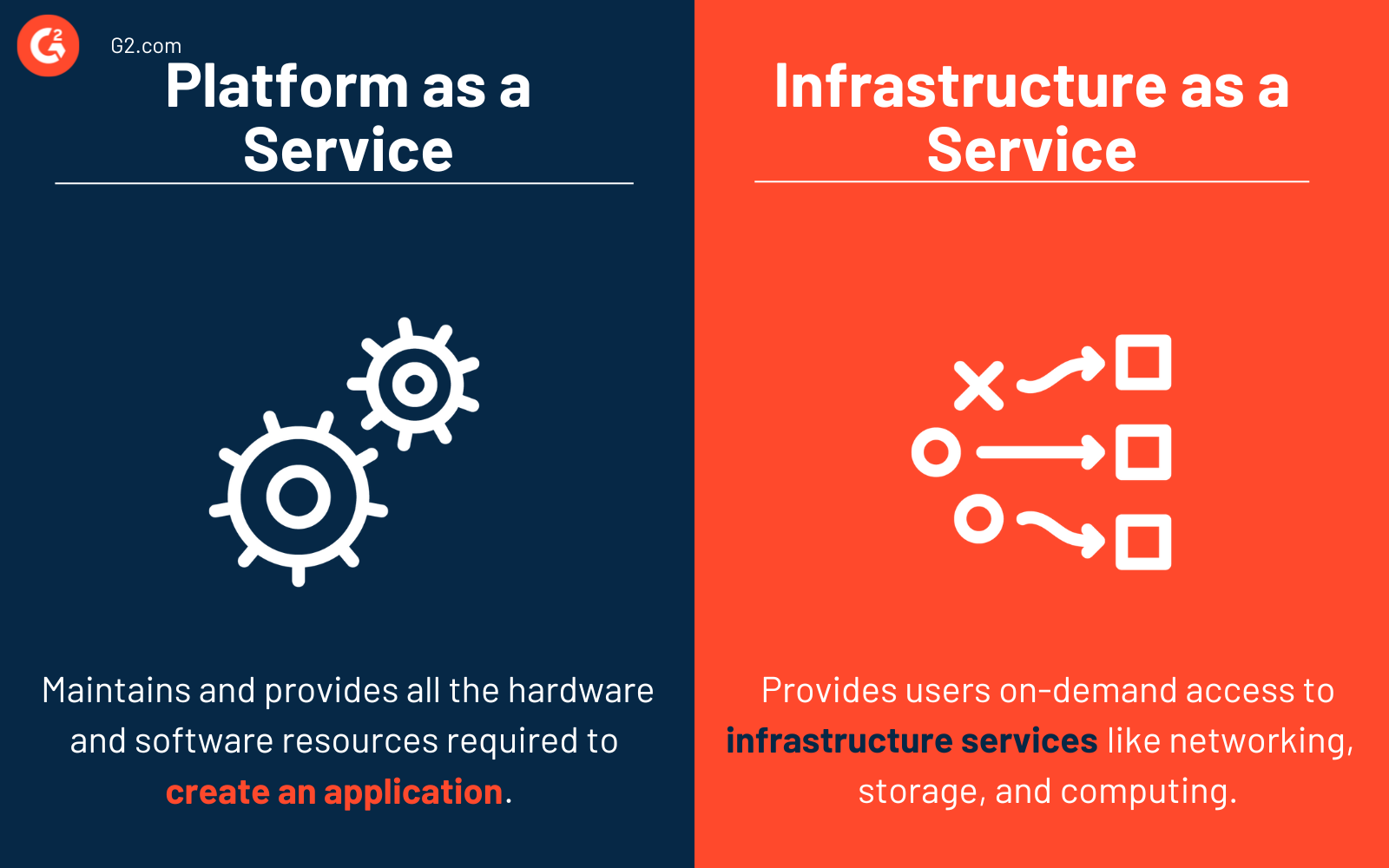
Platform as a service maintains and provides all the hardware and software resources required to create an application. The software development platform is not the user's responsibility to manage. Users are responsible for writing the code and handling all the apps and data. PaaS controls additional resources to lift the operational burden from IT operations teams and developers.

Infrastructure as a service (IaaS) provides users on-demand access to infrastructure services like virtualization, networking, storage, and computing. Consumers are responsible for managing virtual machines, operating systems, middleware, apps, and their own data. However, they don’t have to maintain or update the architecture of their data center. 

Learn more about IaaS and discover a smarter way to manage IT infrastructure.

Sagar Joshi
SJ

Sagar Joshi

Sagar Joshi is a former content marketing specialist at G2 in India. He is an engineer with a keen interest in data analytics and cybersecurity. He writes about topics related to them. You can find him reading books, learning a new language, or playing pool in his free time.

Platform as a Service Software

This list shows the top software that mention platform as a service most on G2.

Google App Engine offers users the ability to build and host web applications on Google's infrastructure. Supercharge your app with services such as Task Queue, XMPP, and Cloud SQL. Manage your app with a simple, web-based dashboard allowing you to customize app performance.

Azure Analysis Services integrates with many Azure services enabling you to build sophisticated analytics solutions.Its integration with Azure Active Directory provides secure, role-based access to your critical data.

SAP Integration Suite powers applications that deliver real-time insights to drive more effective and timely decision making. Dramatically accelerate analytics, business processes, sentiment data processing, and predictive capabilities to run your business in real-time.

Pantheon + Google Cloud Platform Ensure stability for your mission-critical sites with an industry-leading partnership.

Azure Web Apps, a component of Microsoft's Azure App Service, is a fully managed platform-as-a-service (PaaS) offering that enables developers to build, deploy, and scale web applications and APIs efficiently. Supporting a wide range of programming languages—including .NET, Java, Node.js, PHP, and Python—Azure Web Apps allows for the creation of applications on both Windows and Linux environments. This service abstracts the complexities of infrastructure management, such as server maintenance, load balancing, and security patching, allowing developers to focus on delivering high-quality applications. Key Features and Functionality: - Multi-Language Support: Develop applications using various languages and frameworks, including .NET, Java, Node.js, PHP, and Python, catering to diverse development needs. - Flexible Deployment Options: Deploy applications through multiple methods, such as Git, Azure DevOps, GitHub Actions, and FTP, accommodating various development workflows. - Automatic Scaling and Load Balancing: Utilize built-in autoscaling and load balancing to adjust resources dynamically based on traffic demands, ensuring optimal performance and cost efficiency. - Continuous Integration and Deployment (CI/CD): Integrate seamlessly with CI/CD pipelines, enabling automated testing and deployment processes for faster release cycles. - Security and Compliance: Benefit from enterprise-grade security features, including ISO, SOC, and PCI compliance, as well as integration with Microsoft Defender for Cloud for enhanced threat protection. - Global Availability: Deploy applications across Microsoft's global datacenter infrastructure, ensuring high availability and reduced latency for users worldwide. Primary Value and User Solutions: Azure Web Apps simplifies the development and deployment of web applications by providing a fully managed environment that handles infrastructure concerns, such as server provisioning, maintenance, and scaling. This allows developers to concentrate on writing code and delivering features without the overhead of managing the underlying hardware. The platform's support for multiple programming languages and frameworks ensures flexibility, while its integration with various deployment methods and CI/CD tools streamlines the development process. Additionally, Azure Web Apps' robust security measures and global reach make it an ideal choice for businesses aiming to deliver secure, scalable, and high-performing web applications to a worldwide audience.

Cloud Foundry: Industry's Open Platform As A Service. Deploy and scale applications in seconds, without locking yourself into a single cloud.

Platform as a Service (PaaS) eliminates the expense and complexity of evaluating, buying, configuring, and managing all the hardware and software needed for custom-built applications.

AWS Elastic Beanstalk is a fully managed service that simplifies the deployment and scaling of web applications and services. It supports applications developed in various languages, including Java, .NET, PHP, Node.js, Python, Ruby, Go, and Docker. By uploading your code, Elastic Beanstalk automatically handles the provisioning of resources, load balancing, auto-scaling, and monitoring, allowing developers to focus on writing code without managing the underlying infrastructure. Key Features and Functionality: - Simplified Deployment: Deploy applications by uploading code without the need to provision resources or manage configurations. - Automated Management: Handles platform updates, security patches, and health monitoring automatically. - Scalability and Availability: Provides built-in high availability, automatic scaling, and integrated security controls to ensure applications are secure and can handle varying loads. - Cost Efficiency: Operates as a managed service with no additional cost; users pay only for the AWS resources consumed. Primary Value and Problem Solved: AWS Elastic Beanstalk addresses the complexity of deploying and managing web applications by automating infrastructure tasks. This enables developers to concentrate on business logic and application development, reducing operational overhead and accelerating time-to-market. It is particularly beneficial for organizations migrating traditional applications to the cloud or those seeking a straightforward solution for deploying containerized applications without delving into complex container orchestration.

Deliver excellent customer service with a 360-degree view of your customers, an enterprise grade knowledge base, agent productivity tools, service contracts & entitlements, and analytics for complete visibility all on the Salesforce Platform.

Red Hat OpenShift is a platform for creating and deploying any application, quickly and easily, on virtually any infrastructure.

A next-generation iPaaS, reimagined for new hybrid data management challenges with a microservices architecture.

Azure SQL Database is a fully managed, intelligent relational database service built on the Microsoft SQL Server engine, designed to support modern cloud applications. It offers scalability, high availability, and robust security features, enabling developers to build and maintain applications without the complexities of infrastructure management. Key Features and Functionality: - Hyperscale Storage: Rapidly scale storage resources to meet demand, supporting large databases with up to 100 TB capacity. - Serverless Compute: Automatically adjust compute resources based on workload needs, optimizing performance and cost. - Built-in Intelligence: Utilize AI-driven features for performance tuning, threat detection, and advanced security measures. - High Availability: Ensure business continuity with automatic backups, geo-replication, and a 99.99% uptime SLA. - Advanced Security: Protect data with multi-layered security, including encryption, access controls, and compliance with over 100 certifications. Primary Value and Solutions Provided: Azure SQL Database simplifies database management by automating routine tasks such as patching, backups, and monitoring, allowing developers to focus on application development. Its scalability and performance capabilities support applications of varying sizes, from small web apps to large enterprise solutions. The integration with Azure services and support for AI and machine learning workloads enable the creation of intelligent applications. Additionally, its comprehensive security and compliance features ensure data protection and regulatory adherence, making it a reliable choice for businesses seeking a robust cloud-based database solution.

Azure Cloud Services is a comprehensive cloud computing platform developed by Microsoft, offering a wide array of services designed to help organizations build, deploy, and manage applications efficiently. With over 200 products and services, Azure provides solutions for computing, storage, networking, databases, analytics, artificial intelligence, and more, enabling businesses to address current challenges and innovate for the future. Key Features and Functionality: - Compute Services: Azure offers virtual machines for both Windows and Linux, enabling users to run applications in the cloud with scalability and flexibility. - Storage Solutions: Secure and scalable storage options are available, including Blob Storage for unstructured data and Azure Files for managed file shares. - Networking: Azure provides virtual networks, load balancers, and a content delivery network (CDN) to ensure reliable and fast connectivity. - Databases: Managed database services such as Azure SQL Database and Cosmos DB support various data models and ensure high availability. - AI and Machine Learning: Azure AI services and Azure Machine Learning enable the development of intelligent applications with capabilities like natural language processing and computer vision. - Security and Compliance: Azure offers built-in security controls, threat intelligence, and compliance certifications to protect data and applications. Primary Value and Solutions: Azure Cloud Services empowers organizations to accelerate digital transformation by providing a flexible and scalable platform that supports a wide range of workloads. It addresses challenges such as infrastructure management, data storage, and application development, allowing businesses to focus on innovation and delivering value to their customers. With its global presence and commitment to security, Azure ensures that applications are reliable, performant, and compliant with industry standards.

Azure Kubernetes Service (AKS) is a fully managed Kubernetes service that simplifies the deployment, management, and scaling of containerized applications. By handling critical tasks such as health monitoring, maintenance, and scaling, AKS reduces the operational overhead associated with Kubernetes management. This allows developers to focus on building and deploying applications without the complexities of infrastructure management. Key Features and Functionality: - Managed Kubernetes Control Plane: Azure automatically creates and configures the Kubernetes control plane, handling tasks like monitoring, patching, and scaling, thereby reducing the need for in-depth Kubernetes expertise. - Scalability: AKS supports horizontal pod autoscaling and cluster autoscaling, enabling applications to scale seamlessly in response to demand fluctuations. - Integration with Azure Services: AKS integrates with Azure Active Directory for identity management, Azure Monitor for health and performance monitoring, and Azure DevOps for continuous integration and deployment pipelines. - Security and Compliance: Features such as role-based access control (RBAC), private clusters, and Azure Policy enforcement help ensure secure and compliant application deployments. - Support for Windows and Linux Containers: AKS allows the deployment of both Windows and Linux containers within the same cluster, facilitating the modernization of diverse applications. Primary Value and Problem Solved: AKS addresses the challenges of managing Kubernetes infrastructure by providing a fully managed service that automates complex tasks like cluster provisioning, scaling, and maintenance. This enables organizations to accelerate the development and deployment of cloud-native applications, integrate AI capabilities, and ensure high availability and performance without the need for extensive Kubernetes expertise. By offloading the operational complexities to Azure, AKS allows teams to focus on innovation and delivering value to their users.

The Acquia Platform helps businesses transform to meet the ever changing needs of the digital world. Unify your business and technical teams together around one platform that helps you build amazing digital experiences faster.

IBM's platform-as-a-service (IBM SmartCloud Application Services) delivers a secure, collaborative cloud-based environment that supports a full lifecycle of accelerated application development, deployment and delivery.

Azure Application Gateway is a web traffic load balancer that enables you to manage traffic to your web applications. Unlike traditional load balancers that operate at the transport layer (Layer 4), Application Gateway operates at the application layer (Layer 7), allowing it to make routing decisions based on attributes such as URL paths and host headers. This capability provides more control over how traffic is distributed to your applications, enhancing both performance and security. Key Features and Functionality: - Layer 7 Load Balancing: Routes traffic based on HTTP request attributes, enabling more precise control over traffic distribution. - Web Application Firewall (WAF): Protects applications from common web vulnerabilities like SQL injection and cross-site scripting by monitoring and filtering HTTP requests. - SSL/TLS Termination: Offloads SSL/TLS processing to the gateway, reducing the encryption and decryption overhead on backend servers. - Autoscaling: Automatically adjusts the number of gateway instances based on traffic load, ensuring optimal performance and cost efficiency. - Zone Redundancy: Distributes instances across multiple availability zones, enhancing resilience and availability. - URL Path-Based Routing: Directs requests to backend pools based on URL paths, allowing for efficient resource utilization. - Host Header-Based Routing: Routes traffic to different backend pools based on the host header, facilitating multi-site hosting. - Integration with Azure Services: Seamlessly integrates with Azure Traffic Manager for global load balancing and Azure Monitor for centralized monitoring and alerting. Primary Value and User Solutions: Azure Application Gateway provides a scalable and highly available solution for managing web application traffic. By operating at the application layer, it offers intelligent routing capabilities that enhance application performance and reliability. The integrated Web Application Firewall ensures robust security against common web threats, while features like SSL/TLS termination and autoscaling optimize resource utilization and reduce operational overhead. This comprehensive set of features addresses the needs of organizations seeking to build secure, scalable, and efficient web front ends in Azure.