Learn More About Data Governance Tools
Data governance software buying insights at a glance
Data governance tools help organizations define, manage, and control how data is accessed and used across systems. These platforms provide capabilities such as metadata management, lineage tracking, policy enforcement, and access governance, enabling teams to trust the data powering analytics, AI initiatives, and business decisions.
As companies generate and store more data across cloud warehouses, applications, and operational systems, data governance software has become critical for maintaining data reliability, compliance, and responsible data usage.
Organizations typically adopt these tools to address fragmented data environments, unclear data ownership, and inconsistent definitions across departments. Review feedback frequently highlights benefits such as improved visibility into enterprise data, stronger control over sensitive information, and better collaboration between technical and business teams. Many companies also use data governance platforms to document lineage, enforce governance policies, and standardize data quality across analytics pipelines.
When evaluating the best data governance software, buyers often focus on usability, governance automation, metadata discovery, and integrations with modern data infrastructure.
Pricing for these solutions varies based on deployment scale, number of connected data sources, and governance capabilities required. Most enterprise vendors offer custom pricing models, with costs influenced by data volume, governance modules, and user access. Advanced features such as automated lineage discovery, AI-driven governance insights, and cross-system policy enforcement may also impact pricing.
Top 5 FAQs from software buyers
- How do data governance tools help organizations track data lineage and ownership?
-
Which data governance platforms integrate best with modern data warehouses and data lakes?
- What capabilities should teams look for when evaluating the best data governance software?
- How difficult is it to implement data governance software across multiple business systems?
- What security and compliance features do leading data governance solutions provide?
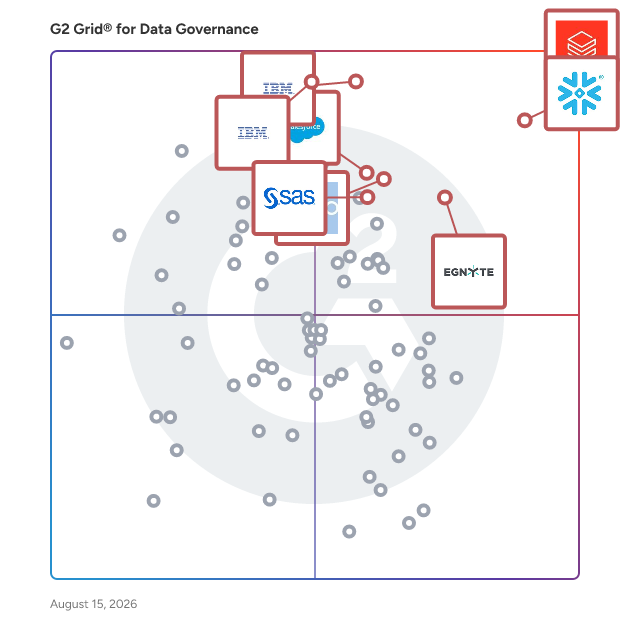
G2’s top-rated data governance software, based on verified reviews, includes Databricks, Domo, Egnyte, SAP Master Data Governance (MDG), and IBM watsonx.data.
What I Often See in Data Governance Tools
Feedback Pros: What Users Consistently Appreciate
• Centralized metadata catalog improves enterprise-wide data discovery and visibility
“I use IBM watsonx.data primarily for training my AI models, and it significantly aids me in my learning purposes. The standout feature for me is its reliability, which provides governed, high-performance, and consistent access to data across hybrid environments. The platform's ability to use open formats along with robust metadata management is a huge advantage. I appreciate that I can access data from anywhere in a very hassle-free manner, which solves a common problem for me because, in my experience, similar models tend to require a lot of information, making them ultimately unusable. These aspects make IBM watsonx.data an excellent tool for my requirements.”
- IBM watsonx.data review, Aman K.
• Granular access controls strengthen governance over sensitive enterprise datasets
“Egnyte is a powerful and versatile platform for secure file storage, sharing, and collaboration. Its hybrid cloud capabilities make it especially valuable for organizations with both on-premise and remote work needs, allowing seamless access to files without sacrificing speed or security. The interface is clean and intuitive, making it easy for end users to navigate, while IT teams benefit from granular permission controls, robust auditing, and strong compliance features (HIPAA, GDPR, etc.).
Performance is strong for both local and remote access, and integration with Microsoft 365, Google Workspace, and other third-party apps is smooth. Mobile access is also reliable, enabling productivity on the go.”
- Egnyte review, Kevin H.
• Automated lineage tracking improves transparency across complex data pipelines
“This is an end-to-end platform that begins with flexible onboarding of data from multiple sources, followed by processing through a medallion architecture. The Unity Catalog is used for governance, cataloging, and tracking data lineage. Databricks SQL serves as the endpoint for use cases such as business intelligence, as well as downstream integration through API endpoints.”
- Databricks review, Awadhesh P.
Cons: Where Many Platforms Fall Short
• Initial implementation requires coordination across multiple technical teams
“The initial setup and learning curve could be improved. There are a lot of concepts that teams need to understand upfront, and the onboarding is configuration-heavy. Setting up workflows, defining roles, and mapping the stages need some effort and research. It's not a plug-and-play kind of system.”
- IBM watsonx.governance review Vineet B.
• User interface complexity when navigating advanced governance features
“While SAP MDG is powerful, its initial configuration and customization can be complex and time-consuming, especially for organizations with unique data models or non-standard processes. The user interface, although improving, can still feel less intuitive compared to modern low-code tools, which sometimes slows down adoption for business users. That said, once the framework is set up, the benefits in data quality and governance outweigh the learning curve.”
- SAP Master Data Governance (MDG) review, Guillaume H.
• Customization limitations when adapting governance frameworks to unique workflows
“The one aspect of Domo that I find could use improvement is the out-of-the-box visualizations. While they are good, they tend to be a bit basic in terms of their default configurations. Unlike Power BI, which offers highly customizable visualizations, Domo's default options don't always allow for fine-tuning to the extent I desire. Although creating custom visualizations is possible, it often requires coding, which demands time and effort I'm reluctant to spend. Additionally, I wish there were more robust security around app pages in Domo. This feature is relatively new in Domo, and while I expect it to improve over time, currently it lacks some security measures I'd prefer.”
- Domo review, Zac P.
Data Governance Software FAQs
What are the top-rated data governance platforms for regulated industries?
Regulated industries such as financial services, healthcare, and government require data governance platforms that support policy enforcement, audit trails, and compliance reporting.
Top-rated data governance platforms used in regulated environments include:
-
Collibra: Helps organizations enforce governance policies, track lineage, and maintain audit-ready data documentation across enterprise systems.
-
Informatica Cloud Data Governance and Catalog: Provides automated metadata discovery, data quality monitoring, and governance controls for regulated data environments.
-
IBM watsonx.governance: Supports governance for both data and AI models, helping organizations manage compliance and monitor data usage.
These platforms are commonly chosen for their ability to support compliance frameworks, maintain data lineage, and centralize governance policies.
Which data governance tool has the best observability?
Data governance observability refers to visibility into data lineage, ownership, and how data flows across systems and pipelines.
Tools often used for governance observability include:
-
DataGalaxy: Provides visual data lineage and knowledge graphs to help organizations understand relationships between datasets.
-
Collibra: Offers impact analysis and lineage tracking, helping teams monitor how data moves through enterprise systems.
-
IBM watsonx.governance: Enables organizations to monitor governance policies across data and AI models.
These platforms help teams track data flows, monitor governance policies, and detect governance gaps.
Which data governance platform is easiest to implement?
Ease of implementation usually depends on how quickly a platform connects to existing data systems and how intuitive governance workflows are.
Platforms commonly recognized for faster adoption include:
-
DataGalaxy: Known for collaborative governance and visual data mapping, allowing teams to document data assets quickly.
-
Alation: Supports automated metadata ingestion and guided catalog setup, helping teams launch governance programs faster.
-
Egnyte: Combines data governance and content governance, making it easier to enforce access policies across file systems.
Organizations often see faster adoption when governance tools integrate directly with data warehouses, BI platforms, and analytics pipelines.
What are the best platforms for centralized data governance policies?
Centralized governance platforms allow organizations to define policies once and enforce them across multiple data systems.
Leading platforms for centralized governance include:
-
Collibra: Provides centralized governance frameworks, stewardship workflows, and policy management.
-
Informatica Cloud Data Governance & Catalog: Enables organizations to manage governance policies, data ownership, and compliance controls from a central platform.
-
IBM watsonx.governance: Supports centralized governance for data and AI policies across enterprise analytics environments.
These tools help organizations standardize governance rules and maintain consistent policies across business systems.
Which platform offers AI-driven data governance recommendations?
AI-driven governance platforms analyze metadata and usage patterns to automatically classify data, detect risks, and recommend governance policies.
Examples include:
These capabilities help organizations scale governance programs while reducing manual policy management.
Sources
Researched By: Shalaka Joshi
Last updated on: March 12, 2026