Clearbox AI
Who Is the Company Behind Clearbox AI?
- Seller: Clearbox AI
- HQ Location: Turin, IT
-
LinkedIn® Page: www.linkedin.com
11 employees on LinkedIn®
Total Products under this Category: 116
Last updated: September 08, 2026
Why You Can Trust G2's Software Rankings:
G2's software rankings are built on verified user reviews, rigorous moderation, and a consistent research methodology maintained by a team of analysts and data experts. Each product is measured using the same transparent criteria, with no paid placement or vendor influence. While reviews reflect real user experiences, which can be subjective, they offer valuable insight into how software performs in the hands of professionals. Together, these inputs power the G2 Score, a standardized way to compare tools within every category.
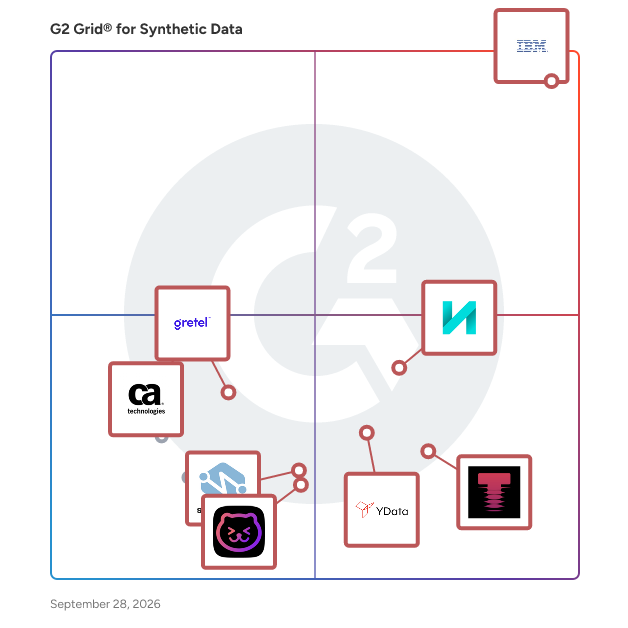
Highlighted products: IBM watsonx.ai, Tonic.ai, Tumult Analytics, YData, CA Test Data Manager, Gretel.ai, Syntheticus.ai | Synthetic Data Generator, and KopiKat.
Underlying data: [Grid® JSON](https://www.g2.com/categories/synthetic-data/grids.json?focus%5B%5D=ibm-watsonx-ai&focus%5B%5D=tonic-ai&focus%5B%5D=tumult-analytics&focus%5B%5D=ydata&focus%5B%5D=ca-test-data-manager&focus%5B%5D=gretel-ai&focus%5B%5D=syntheticus-ai-synthetic-data-generator&focus%5B%5D=kopikat)
DataMaker is a flexible test data generation tool by the team at Automators AI, built for QA engineers, testers, and developers. It provides both a free, lightweight generator for quickly creating synthetic data (names, emails, addresses, CSV/JSON export, no login required), as well as an enterprise edition with advanced features like data masking, integrations with QA tools (SAP, Jira, Tosca, Xray, Playwright, Cypress), and support for large-scale test environments. Whether you just need a few rows of fake data for automation tests or a complete enterprise-ready test data solution, DataMaker helps make QA workflows faster and easier.
DataSpan.ai is a generative AI platform designed to revolutionize automated visual inspection processes by addressing the challenges of data scarcity and defect detection accuracy. By leveraging advanced generative AI techniques, DataSpan.ai enables businesses to generate high-quality synthetic defect data, enhancing the performance of computer vision models and facilitating fully automated visual inspections. This approach leads to significant reductions in error rates, shorter data acquisition times, and substantial cost savings associated with recalls, machine downtime, and manual inspections. Key Features and Functionality: - Generative Defect Modeling: Automatically produces realistic synthetic defect data to augment existing datasets, improving model accuracy even with limited real-world defect samples. - Self-Serve Platform: Empowers users, including non-AI experts, to generate and utilize GenAI data without the need for extensive technical expertise or costly professional services. - Interactive Feedback Mechanism: Incorporates a 'human in the loop' system, allowing subject matter experts to refine and validate synthetic data through an intuitive, interactive interface. - Data-Efficient Training: Enables the training of visual inspection models with significantly less data, reducing the time and resources required for data collection and labeling. - Seamless Integration: Offers 'plug and play' data connectors to securely integrate with existing visual inspection datasets, whether on-premises or in the cloud. Primary Value and Problem Solved: DataSpan.ai addresses the critical challenge of data scarcity in automated visual inspection by generating high-quality synthetic defect data that closely resembles real-world scenarios. This capability allows businesses to: - Enhance Defect Detection Accuracy: Achieve up to a 90% reduction in error rates compared to traditional deep-learning methods, leading to more reliable inspection outcomes. - Accelerate Data Acquisition: Dramatically shorten data acquisition times from years to days, facilitating faster model deployment and iteration. - Reduce Operational Costs: Realize significant savings by minimizing recalls, reducing machine downtime, and decreasing the reliance on manual inspections. By bridging the data gap with generative AI, DataSpan.ai enables companies to fully automate their visual inspection processes, resulting in improved product quality, operational efficiency, and overall cost-effectiveness.
DataSynth is an advanced data synthesis platform designed to generate high-quality, realistic synthetic data for various applications, including machine learning model training, software testing, and data analysis. By creating data that mirrors real-world scenarios without exposing sensitive information, DataSynth enables organizations to enhance their data-driven processes while maintaining privacy and compliance. Key Features and Functionality: - Realistic Data Generation: Produces synthetic datasets that accurately reflect the statistical properties and patterns of real data, ensuring relevance and utility. - Privacy Preservation: Safeguards sensitive information by generating data that maintains the utility of the original dataset without revealing personal or confidential details. - Customizable Data Models: Allows users to define specific parameters and structures, tailoring the synthetic data to meet unique project requirements. - Scalability: Capable of generating large volumes of data efficiently, supporting extensive testing and analysis needs. - Integration Capabilities: Seamlessly integrates with existing data pipelines and tools, facilitating smooth adoption and workflow continuity. Primary Value and Solutions Provided: DataSynth addresses the critical need for high-quality data in scenarios where real data is scarce, sensitive, or restricted. By providing realistic synthetic data, it enables organizations to: - Enhance Machine Learning Models: Train and validate models with diverse datasets, improving accuracy and robustness. - Accelerate Software Development: Test applications under various conditions without the risk of exposing real user data. - Ensure Compliance: Adhere to data protection regulations by utilizing synthetic data that eliminates privacy concerns. - Facilitate Data Sharing: Share data across teams or with external partners without compromising confidentiality. By leveraging DataSynth, organizations can overcome data limitations, drive innovation, and maintain strict privacy standards in their data-driven initiatives.
Generate privacy-safe synthetic data across text, tabular, and image data with differential privacy, without exposing original customer records. CUBIG DTS helps regulated teams augment scarce data, correct class imbalance, replace missing values, and improve AI training
Curiosity redefines enterprise test data management. We empower enterprises to thrive when delivering superior software, overcoming the test data challenges holding them back – complexity, legacy, and scale. Building on decades of experience in unblocking enterprise data delivery, our pioneering approach transforms how enterprises manage data. We focus on key productivity blockers: test data discovery, delivery, compliance, and quality. Our Enterprise Test Data® platform empowers your teams by simplifying your complex application landscape, and providing you with confidence and clarity at every step of your data journey.
Expression Editor AI's Photo Anonymization feature offers advanced AI-driven technology to automatically anonymize faces in photos, ensuring complete privacy protection while preserving image quality and professional appearance. This tool is designed to meet privacy regulations such as GDPR and HIPAA, making it ideal for organizations handling sensitive visual data. Key Features: - Automated Photo Anonymization: Utilizes intelligent algorithms to detect and anonymize faces in images without manual intervention. - Multiple Anonymization Techniques: Offers various methods including blur effects (heavy blur, motion blur, pixelation), artistic transformations (Disney, anime, comic book styles), face coverings (masks, sunglasses), and demographic modifications (age, gender, ethnicity changes). - Batch Processing: Capable of processing multiple photos simultaneously, enhancing efficiency for large datasets. - Quality Preservation: Maintains overall image quality and composition, ensuring anonymized photos remain professional and usable. - Privacy Compliance: Designed to comply with privacy regulations like GDPR and HIPAA, aiding organizations in adhering to data protection laws. Primary Value: The AI Photo Anonymization feature addresses the critical need for privacy protection in visual data by providing an efficient, automated solution for anonymizing faces in photos. It eliminates the time-consuming manual editing process, ensuring compliance with privacy regulations while maintaining high-quality, professional images. This is particularly beneficial for sectors such as research, journalism, healthcare, and education, where safeguarding individual privacy is paramount.
FinCrime Dynamics specializes in enhancing financial institutions' defenses against financial crime and fraud through the use of synthetic data and simulation testing. By creating customized threat testing programs, they help organizations identify and address vulnerabilities in their systems before they can be exploited by real criminals. Their services are tailored to various sectors, including banks, payment companies, neo banks, crypto firms, foreign exchanges, and consultancies. Key Features and Functionality: - Financial Crime and Fraud Control Testing: Develops bespoke testing programs by understanding clients' business operations, systems, and potential threat exposures. - Simulation and Synthetic Data Solutions: Utilizes synthetic data and simulation techniques to safely uncover gaps and errors in controls. - Service and Product Offerings: Provides a range of services and products designed to effectively improve anti-financial crime and fraud controls, tailored to specific problems. - Industry Engagement: Collaborates with financial institutions, government agencies, and law enforcement to promote intelligence sharing and collective efforts against financial crime and fraud. Primary Value and Solutions Provided: FinCrime Dynamics empowers financial institutions to proactively combat financial crime and fraud by offering independent, expert-driven testing and optimization of their control systems. By leveraging synthetic data and simulations, they enable organizations to: - Simulate Financial Crime and Fraud: Test anti-financial crime and fraud controls in a safe environment using simulations of known and customized threat scenarios. - Secure Data Privacy: Mitigate data privacy concerns by using synthetic data that retains analytical qualities without tracing back to original sources. - Enhance Data Quality: Improve data quality by cleansing and reducing bias, with customized labeling for more effective testing. - Scale Data Generation: Quickly generate large amounts of data from small source datasets, avoiding the need for continual access to and cleansing of real data. Through these solutions, FinCrime Dynamics helps clients strengthen their defenses, reduce potential losses, and confidently grow their businesses while ensuring compliance with anti-financial crime regulations.
Gan AI is an advanced artificial intelligence platform designed to generate realistic and high-quality synthetic media content. Leveraging Generative Adversarial Networks (GANs), it enables users to create images, videos, and audio that closely mimic real-world data. This technology is particularly beneficial for industries requiring large datasets for training machine learning models, content creation, and simulation purposes. Key Features and Functionality: - Synthetic Data Generation: Produces lifelike images, videos, and audio, facilitating the creation of diverse datasets without the need for real-world data collection. - Customizable Outputs: Allows users to tailor the generated content to specific requirements, ensuring relevance and applicability across various applications. - Scalability: Capable of generating large volumes of data efficiently, supporting extensive machine learning training and testing needs. - User-Friendly Interface: Provides an intuitive platform for users to easily generate and manage synthetic media content. Primary Value and User Solutions: Gan AI addresses the challenge of obtaining large, diverse, and high-quality datasets necessary for training robust machine learning models. By generating synthetic data, it reduces the dependency on real-world data collection, which can be time-consuming, expensive, and subject to privacy concerns. This solution accelerates the development and deployment of AI applications across various sectors, including healthcare, automotive, entertainment, and more.
GoMask.ai is an AI-powered test data management platform designed to streamline the creation of compliant and realistic test datasets. By integrating advanced data masking and synthetic data generation directly into development pipelines, GoMask.ai enables engineering teams to produce production-like test data in minutes, significantly reducing the time and risk associated with traditional test data provisioning. Key Features and Functionality: - Data Masking: Automatically identifies and replaces sensitive information in production data with realistic, fictitious values, preserving data format, structure, and referential integrity across tables. - Synthetic Data Generation: Creates entirely new datasets based on defined schemas and rules, producing statistically similar data to production while handling complex table relationships and custom business logic. - AI-Powered Data Discovery: Utilizes advanced AI to detect and classify sensitive data across databases, including personal identifiers, financial data, and healthcare information, ensuring comprehensive data protection. - Compliance Automation: Built-in frameworks ensure adherence to regulations such as GDPR, HIPAA, and PCI-DSS, with features like audit trail generation, policy enforcement, and regulatory reporting. - Integration and Scalability: Supports over 200 databases and integrates seamlessly with CI/CD pipelines, offering enterprise-grade security, performance monitoring, and scalability to handle large datasets efficiently. Primary Value and User Solutions: GoMask.ai addresses the critical challenge of test data bottlenecks that impede development velocity and pose compliance risks. By providing instant access to compliant, realistic test data, it eliminates the delays associated with manual data provisioning and the dangers of using production data in testing environments. This empowers development, QA, and DevOps teams to accelerate software delivery, ensure data privacy, and maintain regulatory compliance without compromising on data quality or security.
Grably is a decentralized data ownership network (DeDON) that revolutionizes AI training by providing high-quality, user-consented datasets. By sourcing data directly from individuals, Grably ensures authenticity, diversity, and compliance with global privacy regulations, empowering AI developers with the precise data needed to build more accurate and efficient models. Key Features and Functionality: - Off-the-Shelf Datasets: Access a vast collection of pre-curated datasets across various domains, including multi-race facial recognition, before-and-after weight loss images, damaged car photos, X-rays, human body parts, indoor object segmentation, person home activity, and dashcam traffic scenes. - Custom Data Collection: Leverage Grably's platform to gather high-quality, user-consented data tailored to specific AI model requirements. - Data Curation and Annotation: Enhance datasets with curation services to ensure relevance and accuracy, and utilize expert annotation services to label data precisely, improving AI model training and performance. - Compliance and Security: All datasets adhere to global privacy regulations, including GDPR and CCPA, ensuring ethical sourcing and full transparency in data collection. Primary Value and Solutions Provided: Grably addresses the critical need for high-quality, diverse, and ethically sourced data in AI development. Traditional datasets often suffer from being outdated, biased, or collected without proper consent. Grably solves these issues by offering: - Authentic Data: Sourced directly from users with full consent, ensuring real-world applicability and reducing bias. - Enhanced Model Performance: Provides precise, industry-specific datasets that lead to faster, smarter, and more efficient AI models. - Ethical Data Practices: Ensures compliance with privacy regulations and offers transparency in data collection, fostering trust and integrity in AI development. By connecting AI developers with user-owned data, Grably empowers the creation of more accurate and responsible AI technologies.
