Best Operating Systems - Page 3

How Many Operating Systems Products Does G2 Track?

Total Products under this Category: 146

Category Stats (Sep 2026)

  • Average Rating: 4.31/5 The average rating of products in this category, based on all submitted ratings
  • Top Trending Product: SUSE Multi-Linux Support (+3.13%) - Among all products in this category, SUSE Multi-Linux Support recorded the largest rating increase compared to last month

Last updated: September 01, 2026

How Does G2 Rank Operating Systems Products?

Why You Can Trust G2's Software Rankings:

  • 30 Analysts and Data Experts
  • 18,800+ Authentic Reviews
  • 146+ Products
  • Unbiased Rankings

G2's software rankings are built on verified user reviews, rigorous moderation, and a consistent research methodology maintained by a team of analysts and data experts. Each product is measured using the same transparent criteria, with no paid placement or vendor influence. While reviews reflect real user experiences, which can be subjective, they offer valuable insight into how software performs in the hands of professionals. Together, these inputs power the G2 Score, a standardized way to compare tools within every category.

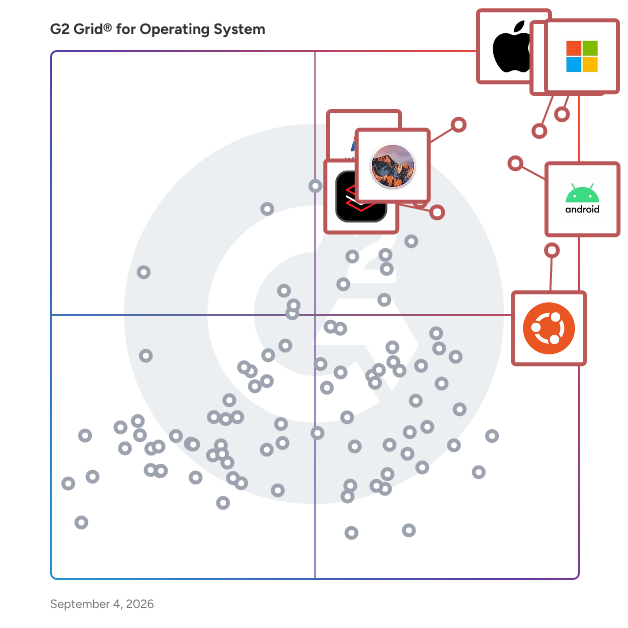
G2 Grid® for Operating Systems

G2 Grid® for Operating Systems plotting products by satisfaction and market presence

Highlighted products: Apple iOS, Windows 11, Chrome OS, Android, macOS Sierra, Ubuntu, Red Hat Enterprise Linux, and Windows 7.

Underlying data: [Grid® JSON](https://www.g2.com/categories/operating-system/grids.json?focus%5B%5D=apple-ios&focus%5B%5D=windows-11&focus%5B%5D=chrome-os&focus%5B%5D=android&focus%5B%5D=apple-macos-sierra&focus%5B%5D=ubuntu&focus%5B%5D=red-hat-enterprise-linux&focus%5B%5D=windows-7)

Amazon Linux 2

Amazon Linux 2 is a Linux operating system developed by Amazon Web Services (AWS) to provide a secure, stable, and high-performance environment for cloud and enterprise applications. It is designed to integrate seamlessly with AWS services, offering a robust platform for developers and IT administrators. Amazon Linux 2 is available at no additional charge and includes long-term support with ongoing security and maintenance updates. Key Features and Functionality: - AWS Integration: Pre-installed packages and configurations facilitate tight integration with AWS services, simplifying the deployment and management of applications. - Long-Term Support: Provides five years of support, ensuring stability and predictability for enterprise applications. - Extras Repository: Offers access to the latest software packages through the Amazon Linux Extras repository, allowing users to install newer versions of popular software without compromising system stability. - On-Premises Use: Available as virtual machine images for VMware, Oracle VM VirtualBox, and Microsoft Hyper-V, enabling on-premises development and testing. - Systemd Support: Includes the systemd init system for efficient process management and service control. - Optimized Kernel and Toolchain: Features an LTS Kernel tuned for enhanced performance on Amazon EC2, along with updated compiler and build toolchain components. - Security Features: Implements default security measures such as limiting remote access, disabling remote root login, and reducing non-critical packages to minimize exposure to vulnerabilities. - Kernel Live Patching: Supports live patching of the Linux kernel, allowing critical and important security updates to be applied without rebooting or downtime. Primary Value and User Solutions: Amazon Linux 2 addresses the need for a secure, reliable, and high-performance operating system tailored for cloud environments. Its deep integration with AWS services streamlines application deployment and management, enhancing developer productivity. The long-term support and regular security updates provide peace of mind for enterprises, ensuring system stability and compliance. Additionally, the availability of virtual machine images for on-premises use allows for consistent development and testing environments, bridging the gap between local and cloud-based operations.

Average Rating: 4.5/5.0

Total Reviews: 62

How Do G2 Users Rate Amazon Linux 2?

  • Has the product been a good partner in doing business?: 9.2/10 (Category avg: 8.5/10)
  • Ease of Use: 9.2/10 (Category avg: 8.5/10)
  • Quality of Support: 8.8/10 (Category avg: 8.2/10)
  • Ease of Admin: 9.4/10 (Category avg: 8.5/10)

Who Is the Company Behind Amazon Linux 2?

Who Uses This Product?

  • Top Industries: Information Technology and Services, Computer Software
  • Company Size: 39% Medium, 31% Small

What Do G2 Reviewers Say About Amazon Linux 2?

AI-generated summary from verified user reviews

Pros
  • Users appreciate the tight integration with AWS services, enjoying a stable and optimized environment for cloud workloads.
  • Users value the long-term support of Amazon Linux 2, ensuring stability and reliability in production environments.
  • Users appreciate the stability of Amazon Linux 2, benefiting from its long-term support and reliable performance in production.
  • Users value the timely updates of Amazon Linux 2, ensuring enhanced security and long-term support.
  • Users value the stable and secure environment of Amazon Linux 2, ensuring optimal performance for cloud workloads.
Cons
  • Users find the limited apps/store on Amazon Linux 2 frustrating, requiring manual installations for newer tools.
  • Users face limited software options, making certain features and third-party support challenging in Amazon Linux 2.
  • Users experience lack of support for third-party software and difficulty finding applicable resources compared to other distros.
  • Users find the limited customization of Amazon Linux 2 restricts access to newer tools and flexibility.
  • Users face OS incompatibility issues with Amazon Linux 2 due to incorrect swap partition mounting methods affecting booting.

What Are Recent G2 Reviews of Amazon Linux 2?

Arista EOS

Arista Extensible Operating System (EOS) is the core of Arista cloud networking solutions for next-generation data centers and cloud networks. Cloud architectures built with Arista EOS scale to hundreds of thousands of compute and storage nodes with management and provisioning capabilities that work at scale. Through its programmability, EOS enables a set of software applications that deliver workflow automation, high availability, unprecedented network visibility and analytics and rapid integration with a wide range of third-party applications for virtualization, management, automation and orchestration services

Average Rating: 4.5/5.0

Total Reviews: 10

How Do G2 Users Rate Arista EOS?

  • Has the product been a good partner in doing business?: 8.3/10 (Category avg: 8.5/10)
  • Ease of Use: 9.7/10 (Category avg: 8.5/10)
  • Quality of Support: 8.7/10 (Category avg: 8.2/10)
  • Ease of Admin: 8.3/10 (Category avg: 8.5/10)

Who Is the Company Behind Arista EOS?

  • Seller: Arista Networks
  • Year Founded: 2004
  • HQ Location: Santa Clara, US
  • Twitter: @arista_channels
    2,437 Twitter followers
  • LinkedIn® Page: www.linkedin.com
    5,642 employees on LinkedIn®
  • Ownership: NYSE:ANET

Who Uses This Product?

  • Company Size: 40% Large, 30% Medium

What Do G2 Reviewers Say About Arista EOS?

AI-generated summary from verified user reviews

Pros
  • Users appreciate the efficient scalability of Arista EOS, enabling support for extensive networks in cloud environments.
  • Users value the flexibility and compatibility of Arista EOS, enjoying seamless integration with various tools and environments.
  • Users appreciate the ease of use of Arista EOS, finding its commands simple and efficient for network management.
  • Users highlight the efficient scalability of Arista EOS, making it ideal for extensive cloud and enterprise networks.
  • Users value the high reliability of Arista EOS, noting its efficiency and support for automation in configurations.
Cons
  • Users note the steep learning curve with Arista EOS, especially for those new to operating systems.
  • Users struggle with a lack of support, finding it challenging to grasp advanced features and documentation effectively.

What Are Recent G2 Reviews of Arista EOS?

What Are G2 Users Discussing About Arista EOS?

Amazon Linux 2

Amazon Linux 2 is a Linux operating system developed by Amazon Web Services (AWS) to provide a secure, stable, and high-performance environment for cloud and enterprise applications. It is designed to integrate seamlessly with AWS services, offering a robust platform for developers and IT administrators. Amazon Linux 2 is available at no additional charge and includes long-term support with ongoing security and maintenance updates. Key Features and Functionality: - AWS Integration: Pre-installed packages and configurations facilitate tight integration with AWS services, simplifying the deployment and management of applications. - Long-Term Support: Provides five years of support, ensuring stability and predictability for enterprise applications. - Extras Repository: Offers access to the latest software packages through the Amazon Linux Extras repository, allowing users to install newer versions of popular software without compromising system stability. - On-Premises Use: Available as virtual machine images for VMware, Oracle VM VirtualBox, and Microsoft Hyper-V, enabling on-premises development and testing. - Systemd Support: Includes the systemd init system for efficient process management and service control. - Optimized Kernel and Toolchain: Features an LTS Kernel tuned for enhanced performance on Amazon EC2, along with updated compiler and build toolchain components. - Security Features: Implements default security measures such as limiting remote access, disabling remote root login, and reducing non-critical packages to minimize exposure to vulnerabilities. - Kernel Live Patching: Supports live patching of the Linux kernel, allowing critical and important security updates to be applied without rebooting or downtime. Primary Value and User Solutions: Amazon Linux 2 addresses the need for a secure, reliable, and high-performance operating system tailored for cloud environments. Its deep integration with AWS services streamlines application deployment and management, enhancing developer productivity. The long-term support and regular security updates provide peace of mind for enterprises, ensuring system stability and compliance. Additionally, the availability of virtual machine images for on-premises use allows for consistent development and testing environments, bridging the gap between local and cloud-based operations.

Average Rating: 4.5/5.0

Total Reviews: 70

How Do G2 Users Rate Amazon Linux 2?

  • Has the product been a good partner in doing business?: 9.0/10 (Category avg: 8.5/10)
  • Ease of Use: 9.1/10 (Category avg: 8.5/10)
  • Quality of Support: 9.2/10 (Category avg: 8.2/10)
  • Ease of Admin: 9.2/10 (Category avg: 8.5/10)

Who Is the Company Behind Amazon Linux 2?

Who Uses This Product?

  • Who Uses This: DevOps Engineer
  • Top Industries: Information Technology and Services, Computer Software
  • Company Size: 44% Small, 29% Medium

What Do G2 Reviewers Say About Amazon Linux 2?

AI-generated summary from verified user reviews

Pros
  • Users value the long-term support of Amazon Linux 2, ensuring consistent security updates and reliable performance.
  • Users value the regular updates of Amazon Linux 2, ensuring security and performance in production environments.
  • Users value the lightweight and high-performance nature of Amazon Linux 2 for seamless AWS integrations and efficient cloud workloads.
  • Users love the lightweight size of Amazon Linux 2, which ensures high performance and efficient resource usage.
  • Users find Amazon Linux 2 to be exceptionally easy to use, providing confidence and smooth performance for various tasks.
Cons
  • Users experience limited software availability with Amazon Linux 2, causing challenges in accessing newer libraries and packages.
  • Users find the limited app availability of Amazon Linux 2 frustrating, affecting access to modern libraries and tools.
  • Users find the tight integration with AWS limits Amazon Linux 2's portability and flexibility in other environments.
  • Users experience a lack of support for newer packages, often needing to navigate complex configurations and insufficient documentation.
  • Users face challenges with outdated technology in Amazon Linux 2, requiring more effort for configuration and software compilation.

What Are Recent G2 Reviews of Amazon Linux 2?

Fedora 34 Cloud Base Images (arm64) HVM

Fedora creates an innovative, free, and open source platform for hardware, clouds, and containers that enables software developers and community members to build tailored solutions for their users.

Average Rating: 4.5/5.0

Total Reviews: 32

How Do G2 Users Rate Fedora 34 Cloud Base Images (arm64) HVM?

  • Has the product been a good partner in doing business?: 8.7/10 (Category avg: 8.5/10)
  • Ease of Use: 8.9/10 (Category avg: 8.5/10)
  • Quality of Support: 8.2/10 (Category avg: 8.2/10)
  • Ease of Admin: 9.0/10 (Category avg: 8.5/10)

Who Is the Company Behind Fedora 34 Cloud Base Images (arm64) HVM?

  • Seller: Amazon Web Services (AWS)
  • Year Founded: 2006
  • HQ Location: Seattle, WA
  • Twitter: @awscloud
    2,232,483 Twitter followers
  • LinkedIn® Page: www.linkedin.com
    147,094 employees on LinkedIn®
  • Ownership: NASDAQ: AMZN

Who Uses This Product?

  • Top Industries: Computer Software
  • Company Size: 47% Medium, 31% Small

What Do G2 Reviewers Say About Fedora 34 Cloud Base Images (arm64) HVM?

AI-generated summary from verified user reviews

Pros
  • Users appreciate the ease of use of Fedora 34 Cloud Base Images, benefiting from its minimal and lightweight design.
  • Users value the lightweight size of Fedora 34 Cloud Base Images, making it ideal for efficient cloud deployments.
  • Users appreciate the lightweight and secure cloud environment provided by Fedora 34 Cloud Base Images, enhancing their experience.
  • Users value the supportive community surrounding Fedora 34 Cloud Base Images, enhancing their overall experience and security.
  • Users appreciate the supportive community around Fedora 34 Cloud Base Images, enhancing their overall experience and security.
Cons
  • Users find the frequent update requirement for Fedora 34 Cloud Base Images cumbersome due to its shorter support lifecycle.
  • Users find the frequent upgrade difficulties challenging due to its shorter long-term support period compared to other options.

What Are Recent G2 Reviews of Fedora 34 Cloud Base Images (arm64) HVM?

What Are G2 Users Discussing About Fedora 34 Cloud Base Images (arm64) HVM?

PureOS

PureOS is a privacy-focused, open-source operating system developed by Purism, designed to provide users with a secure and user-friendly computing environment. Built upon the Debian GNU/Linux distribution, PureOS emphasizes user freedom, security, and privacy by including only free and open-source software. It is endorsed by the Free Software Foundation and is suitable for both desktop and mobile devices, offering a convergent experience across platforms. Key Features and Functionality: - Privacy and Security: PureOS is designed to protect user data and privacy, incorporating tools for encrypting communications and safeguarding sensitive information. - Free and Open-Source Software: The operating system includes a curated selection of free and open-source applications, allowing users to inspect, modify, and distribute the software. - Convergence: PureOS offers a seamless experience across devices, enabling the same operating system and applications to run on both desktops and smartphones, adapted for different screen sizes. - User-Friendly Interface: With desktop environments like GNOME and KDE Plasma, PureOS provides an intuitive and modern user interface suitable for a wide range of users. - Regular Updates: The system receives regular software updates to ensure stability, security, and access to the latest features. Primary Value and User Solutions: PureOS addresses the growing concerns over digital privacy and security by offering an operating system that respects user freedom and autonomy. By excluding proprietary software and potential surveillance mechanisms, it empowers users to have full control over their digital lives. Its convergent design ensures a consistent and secure experience across various devices, making it an ideal choice for individuals and organizations seeking a trustworthy and transparent computing platform.

Average Rating: 4.4/5.0

Total Reviews: 21

How Do G2 Users Rate PureOS?

  • Has the product been a good partner in doing business?: 9.0/10 (Category avg: 8.5/10)
  • Ease of Use: 8.3/10 (Category avg: 8.5/10)
  • Quality of Support: 7.8/10 (Category avg: 8.2/10)
  • Ease of Admin: 9.7/10 (Category avg: 8.5/10)

Who Is the Company Behind PureOS?

Who Uses This Product?

  • Company Size: 68% Small, 23% Medium

What Do G2 Reviewers Say About PureOS?

AI-generated summary from verified user reviews

Pros
  • Users value PureOS for its commitment to software freedom and security, ensuring a safe and private online experience.
  • Users value the strong focus on privacy and software freedom provided by PureOS, enhancing their online security experience.
  • Users value PureOS for its strong privacy focus, ensuring a secure and transparent computing environment.
  • Users value the strong security and privacy measures in PureOS, making it a reliable choice for personal safety.
  • Users value the ease of use in PureOS, finding it straightforward and efficient for their needs.
Cons
  • Users find that performance issues hinder their experience with PureOS, citing optimization and multimedia lag as concerns.
  • Users struggle with compatibility issues, as PureOS lacks support for proprietary drivers needed for various hardware components.
  • Users struggle with driver issues in PureOS, facing compatibility problems with hardware like NVIDIA GPUs and modern peripherals.
  • Users report a lack of support for PureOS, possibly due to its limited user base and community engagement.
  • Users experience limited customization with PureOS, making it challenging to tailor the system to their needs.

What Are Recent G2 Reviews of PureOS?

What Are G2 Users Discussing About PureOS?

Sabayon

Sabayon Linux provides a flexible and extendible Gentoo based operating system, designed for ease of use with access to advanced features, Sabayon aims to provide a bleeding edge OOTB desktop experience using the KISS approach.

Average Rating: 4.1/5.0

Total Reviews: 12

How Do G2 Users Rate Sabayon?

  • Has the product been a good partner in doing business?: 9.0/10 (Category avg: 8.5/10)
  • Ease of Use: 8.5/10 (Category avg: 8.5/10)
  • Quality of Support: 8.8/10 (Category avg: 8.2/10)
  • Ease of Admin: 8.0/10 (Category avg: 8.5/10)

Who Is the Company Behind Sabayon?

  • Seller: Sabayon
  • HQ Location: , IT
  • Twitter: @OfficialSabayon
    226 Twitter followers
  • LinkedIn® Page: www.linkedin.com
    2 employees on LinkedIn®

Who Uses This Product?

  • Top Industries: Computer Software
  • Company Size: 64% Small, 29% Medium

What Do G2 Reviewers Say About Sabayon?

AI-generated summary from verified user reviews

Pros
  • Users appreciate the well-developed app ecosystem of Sabayon, enjoying numerous pre-installed applications that enhance usability.
  • Users appreciate the ease of use of Sabayon, finding it beginner-friendly and efficient with pre-installed applications.
  • Users find Sabayon user-friendly, making it easy for beginners to enjoy a smooth and efficient experience.
  • Users highlight excellent hardware support in Sabayon, ensuring smooth performance across various systems and devices.
  • Users appreciate the reliability of Sabayon, enjoying a smooth experience across various hardware setups.
Cons
  • Users find the slow updates in Sabayon frustrating, impacting their experience compared to other distributions.
  • Users find Sabayon's slow update frequency disappointing compared to other distributions, affecting software availability and security.
  • Users find the usage difficulty of Sabayon challenging due to its complex package management and update delays.

What Are Recent G2 Reviews of Sabayon?

What Are G2 Users Discussing About Sabayon?

Raspbian

Raspbian is a free, Debian-based operating system optimized for the Raspberry Pi hardware. Designed to leverage the full potential of Raspberry Pi devices, Raspbian offers a user-friendly environment suitable for both beginners and experienced users. It comes pre-installed with a comprehensive suite of software, including programming tools, educational applications, and general-purpose utilities, making it an ideal platform for learning, development, and various projects. Key Features and Functionality: - Optimized Performance: Tailored specifically for Raspberry Pi hardware to ensure efficient operation and responsiveness. - Comprehensive Software Suite: Includes a wide range of pre-installed applications such as LibreOffice, Python, Scratch, and more, catering to diverse user needs. - Educational Tools: Provides resources and applications aimed at facilitating learning and teaching in programming and computing. - Regular Updates: Maintained by a dedicated community, ensuring continuous improvements, security patches, and access to the latest software versions. - User-Friendly Interface: Features a graphical user interface (GUI) that is intuitive and easy to navigate, suitable for users of all skill levels. Primary Value and User Solutions: Raspbian serves as a robust and versatile operating system that transforms Raspberry Pi devices into powerful tools for education, development, and experimentation. By offering an accessible platform with a rich set of pre-installed applications, it lowers the barrier to entry for individuals interested in computing and programming. Whether for educational purposes, hobbyist projects, or professional development, Raspbian provides a stable and supportive environment that empowers users to explore and innovate.

Average Rating: 4.7/5.0

Total Reviews: 85

How Do G2 Users Rate Raspbian?

  • Has the product been a good partner in doing business?: 8.8/10 (Category avg: 8.5/10)
  • Ease of Use: 9.0/10 (Category avg: 8.5/10)
  • Quality of Support: 8.7/10 (Category avg: 8.2/10)
  • Ease of Admin: 9.2/10 (Category avg: 8.5/10)

Who Is the Company Behind Raspbian?

  • Seller: Raspbian
  • Year Founded: 2018
  • HQ Location: New Delhi, India
  • LinkedIn® Page: www.linkedin.com
    2 employees on LinkedIn®

Who Uses This Product?

  • Who Uses This: Software Engineer
  • Top Industries: Information Technology and Services, Computer Software
  • Company Size: 61% Small, 24% Medium

What Do G2 Reviewers Say About Raspbian?

AI-generated summary from verified user reviews

Pros
  • Users praise the user-friendly interface of Raspbian, making it easy to set up and navigate for projects.
  • Users appreciate the user-friendly interface of Raspbian, making it easy to set up and navigate projects.
  • Users value the optimized hardware support of Raspbian, enhancing project development and user-friendly experience with ease.
  • Users love the lightweight size of Raspbian, ensuring smooth performance even on older Raspberry Pi models.
  • Users benefit from the strong community support of Raspbian, with extensive tutorials and forums readily available for assistance.
Cons
  • Users find the command line reliance challenging, particularly impacting new users' overall experience with Raspbian.
  • Users note the limited availability of apps on Raspbian, restricting functionality for advanced tasks and power users.
  • Users experience performance issues with Raspbian, especially when running multiple heavy programs or using microSD cards.
  • Users face compatibility issues with resource-heavy applications, particularly on older Raspberry Pi models.
  • Users note the lack of official customer support for Raspbian, often relying on community forums for help.

What Are Recent G2 Reviews of Raspbian?

What Are G2 Users Discussing About Raspbian?

CentOS

CentOS is a community-driven, free software project that provides a robust and reliable Linux distribution, serving as a foundational platform for open-source communities, cloud providers, hosting services, and scientific data processing. Derived from Fedora Linux, CentOS Stream offers a continuously delivered distribution that tracks just ahead of Red Hat Enterprise Linux (RHEL), with major releases every three years and each maintained for five years. This structure allows CentOS Stream to function as a production operating system, a development environment, or a preview of upcoming RHEL releases. Key Features and Functionality: - Continuous Delivery: CentOS Stream provides a rolling-release model, delivering updates that precede RHEL's official releases, ensuring users have access to the latest features and improvements. - Community Collaboration: The project fosters a collaborative environment where Special Interest Groups (SIGs) develop and package software tailored to specific needs, such as cloud infrastructure, storage solutions, and virtualization technologies. - Enterprise Compatibility: By closely tracking RHEL, CentOS Stream ensures compatibility and stability, making it suitable for enterprise deployments and development environments. Primary Value and User Solutions: CentOS Stream addresses the need for a stable yet forward-looking Linux distribution that bridges the gap between development and production environments. It offers a reliable platform for developers to test and deploy applications that will be compatible with future RHEL releases, thereby reducing the time and effort required for migration and ensuring smoother transitions. Additionally, the active community and SIGs provide specialized solutions and support, enhancing the overall ecosystem and catering to diverse user requirements.

Average Rating: 4.4/5.0

Total Reviews: 409

How Do G2 Users Rate CentOS?

  • Has the product been a good partner in doing business?: 8.6/10 (Category avg: 8.5/10)
  • Ease of Use: 8.5/10 (Category avg: 8.5/10)
  • Quality of Support: 8.1/10 (Category avg: 8.2/10)
  • Ease of Admin: 8.5/10 (Category avg: 8.5/10)

Who Is the Company Behind CentOS?

  • Seller: CentOS
  • HQ Location: North Carolina, United States
  • Twitter: @CentOSProject
    82 Twitter followers
  • LinkedIn® Page: www.linkedin.com
    16 employees on LinkedIn®

Who Uses This Product?

  • Who Uses This: Software Engineer, Senior Software Engineer
  • Top Industries: Information Technology and Services, Computer Software
  • Company Size: 39% Medium, 32% Small

What Do G2 Reviewers Say About CentOS?

AI-generated summary from verified user reviews

Pros
  • Users value the enterprise-grade reliability of CentOS, ensuring stability for long-term server environments without high costs.
  • Users value CentOS for its long-term stability, ensuring reliable operation for production environments and critical services.
  • Users value the ease of use of CentOS, appreciating its straightforward setup and reliable management for servers.
  • Users value CentOS for its RHEL compatibility, ensuring a stable and reliable environment for critical production systems.
  • Users value the strong community support of CentOS, enhancing their experience with reliable assistance and resources.
Cons
  • Users find CentOS suffers from outdated technology, with slow updates and lack of support affecting usability.
  • Users struggle with a lack of support, facing slow updates and limited documentation that complicate the user experience.
  • Users note that slow updates hinder software access and complicate planning, impacting long-term stability and support.
  • Users find the lack of features in CentOS frustrating, as updates and newer software are delayed compared to other distributions.
  • Users express concerns about limited availability of updates and newer software, making it less suitable for current needs.

What Are Recent G2 Reviews of CentOS?

Manjaro

Manjaro is a free and open-source Linux distribution based on Arch Linux, designed to provide a user-friendly and accessible operating system without compromising performance or flexibility. It employs a rolling release model, ensuring users have access to the latest software updates and features without the need for complete system reinstallation. Manjaro is developed primarily in Austria, France, and Germany, and is tailored to cater to both newcomers and experienced Linux users. Key Features and Functionality: - User-Centric Design: Manjaro offers a straightforward installation process with both command-line and graphical installers, making it accessible for users of varying technical backgrounds. - Multiple Desktop Environments: Official editions include Xfce, KDE Plasma, and GNOME, each featuring Manjaro's custom themes. Community editions provide additional environments like Cinnamon, i3, and Sway, allowing users to choose an interface that best suits their preferences. - Rolling Release Model: This approach ensures continuous updates, providing users with the latest software and security patches without the need for periodic system overhauls. - Package Management: Manjaro utilizes Pacman for command-line package management and Pamac for graphical management, facilitating easy software installation and updates. - Hardware Detection and Support: The Manjaro Hardware Detection (MHWD) tool automatically identifies and configures hardware components, including proprietary and open-source drivers, enhancing system compatibility and performance. - Arch User Repository (AUR) Access: Users can access a vast array of software through the AUR, expanding the availability of applications beyond the official repositories. Primary Value and User Solutions: Manjaro bridges the gap between the complexity of Arch Linux and the need for a more accessible system. It offers a stable, rolling-release platform that combines the latest software innovations with an intuitive user experience. By providing multiple desktop environments, robust hardware support, and a comprehensive package management system, Manjaro empowers users to explore and utilize Linux effectively, regardless of their technical expertise. Its commitment to user-friendliness and continuous updates ensures a reliable and up-to-date computing environment.

Average Rating: 4.5/5.0

Total Reviews: 58

How Do G2 Users Rate Manjaro?

  • Has the product been a good partner in doing business?: 8.9/10 (Category avg: 8.5/10)
  • Ease of Use: 9.0/10 (Category avg: 8.5/10)
  • Quality of Support: 8.3/10 (Category avg: 8.2/10)
  • Ease of Admin: 8.8/10 (Category avg: 8.5/10)

Who Is the Company Behind Manjaro?

  • Seller: Manjaro
  • Year Founded: 2011
  • HQ Location: Berlin, DE
  • Twitter: @ManjaroLinux
    72,693 Twitter followers
  • LinkedIn® Page: www.linkedin.com
    11 employees on LinkedIn®

Who Uses This Product?

  • Top Industries: Computer Software, Information Technology and Services
  • Company Size: 62% Small, 33% Medium

What Do G2 Reviewers Say About Manjaro?

AI-generated summary from verified user reviews

Pros
  • Users praise the easy installation of Manjaro, allowing for quick setup and immediate productivity.
  • Users appreciate the regular updates of Manjaro, enjoying a seamless experience with the latest software versions.
  • Users value the robust community support in Manjaro, making it easier to find help and guidance.
  • Users value the customization and personalization options of Manjaro, enhancing workflow and user experience significantly.
  • Users appreciate the ease of use and setup of Manjaro, enjoying a smooth installation and effortless updates.
Cons
  • Users find the command line interface challenging, as minor errors lead to significant issues and frustration.
  • Users often face compatibility issues with other distros due to Manjaro's bleeding edge package approach.
  • Users often face installation difficulties due to dependency errors with AUR packages, complicating software setup on Manjaro.
  • Users face installation issues with AUR packages, particularly due to frequent dependency errors hindering software installations.
  • Users face limited customization issues post-upgrade in Manjaro, especially with GNOME extensions affecting usability.

What Are Recent G2 Reviews of Manjaro?

What Are G2 Users Discussing About Manjaro?

Kubuntu

Kubuntu is a community-driven Linux distribution that combines the robust foundation of Ubuntu with the elegant and powerful KDE Plasma desktop environment. Launched in October 2004, Kubuntu has grown into a highly respected operating system, serving millions of users worldwide. It offers a stable, secure, and user-friendly experience, making it suitable for both newcomers and seasoned Linux enthusiasts. Key Features and Functionality: - KDE Plasma Desktop: Provides a sleek, customizable, and intuitive user interface with thoughtfully chosen defaults for a smooth experience. - Comprehensive Suite of Applications: Includes a wide range of pre-installed KDE applications for productivity, multimedia, and system management. - Regular Updates: Follows a six-month release cycle, ensuring users have access to the latest features and security patches. - Free and Open Source: Kubuntu is free to download, use, distribute, and modify, adhering to the principles of open-source software. - Community Support: Backed by a vibrant community, offering extensive documentation and support channels for users. Primary Value and User Solutions: Kubuntu addresses the need for a reliable and user-friendly Linux distribution that leverages the strengths of both Ubuntu and KDE Plasma. It provides a seamless computing experience with a focus on ease of use, customization, and performance. By offering a comprehensive suite of applications and regular updates, Kubuntu ensures users have the tools they need for work, creativity, and entertainment, all within a secure and open-source environment.

Average Rating: 4.3/5.0

Total Reviews: 91

How Do G2 Users Rate Kubuntu?

  • Has the product been a good partner in doing business?: 8.8/10 (Category avg: 8.5/10)
  • Ease of Use: 8.5/10 (Category avg: 8.5/10)
  • Quality of Support: 7.7/10 (Category avg: 8.2/10)
  • Ease of Admin: 8.6/10 (Category avg: 8.5/10)

Who Is the Company Behind Kubuntu?

  • Seller: Kubuntu devs
  • Year Founded: 2004
  • HQ Location: N/A
  • Twitter: @kubuntu
    20,911 Twitter followers
  • LinkedIn® Page: www.linkedin.com
    5 employees on LinkedIn®

Who Uses This Product?

  • Who Uses This: Software Engineer
  • Top Industries: Information Technology and Services, Computer Software
  • Company Size: 63% Small, 27% Medium

What Do G2 Reviewers Say About Kubuntu?

AI-generated summary from verified user reviews

Pros
  • Users value the up-to-date kernel and KDE customization that enhance their Linux experience with Kubuntu.
  • Users enjoy the customization options of Kubuntu, benefiting from a stable and adaptable KDE environment.
  • Users appreciate the user-friendly interface of Kubuntu, enhancing their personalized Linux experience with ease and flexibility.
  • Users value the ease of use of Kubuntu, enjoying its stability and seamless integration with various devices.
  • Users praise the stability of Kubuntu, enjoying its smooth performance even on older hardware for daily tasks.
Cons
  • Users often face driver issues with Kubuntu, requiring manual setup and leading to slow performance and hang-ups.
  • Users experience performance issues with Kubuntu, including slow operation and difficulties with hardware and software installations.
  • Users find the hardware limitations of Kubuntu challenging, as it can be resource heavy and cluttered.
  • Users find that Kubuntu has higher system requirements compared to Ubuntu, necessitating more powerful hardware.
  • Users experience interface issues with window snapping and global bar functionality, impacting the overall usability of Kubuntu.

What Are Recent G2 Reviews of Kubuntu?

What Are G2 Users Discussing About Kubuntu?

Junos OS

Junos OS is a secure, open, and programmable network operating system that serves as the foundation for Juniper Networks' routing, switching, and security devices. Designed to automate network operations with precision, Junos OS enhances operational efficiency and frees up valuable resources, enabling organizations to focus on growth and innovation. Its modular architecture ensures high availability, reliability, and scalability, making it suitable for a wide range of network environments. Key Features and Functionality: - Automation Frameworks: Supports integration with open-source automation tools like Puppet, Chef, Ansible, and Salt, facilitating seamless network management and reducing manual tasks. - Programmability: Offers the Juniper Extension Toolkit (JET) API, providing open access to control, management, and data plane services, enabling customized network solutions. - Telemetry: Incorporates the Junos Telemetry Interface (JTI), a scalable engine that streams real-time network data, enhancing visibility and proactive issue resolution. - Open Data Models: Utilizes standardized YANG models and OpenConfig, promoting interoperability and simplifying network configuration and management. - High Availability: Features like Junos Continuity allow for non-disruptive hardware upgrades, ensuring uninterrupted service during maintenance. Primary Value and Solutions Provided: Junos OS addresses the complexities of modern network management by automating repetitive tasks, thereby reducing operational costs and minimizing human errors. Its open and programmable nature empowers organizations to rapidly deploy and customize network services, enhancing agility and responsiveness to changing business needs. The system's modular design and high availability features ensure reliable and scalable network performance, supporting the demands of cloud-native applications, IoT, and 5G technologies. By providing a consistent operating system across various devices, Junos OS simplifies training and operations, leading to a lower total cost of ownership and a more efficient network infrastructure.

Average Rating: 4.6/5.0

Total Reviews: 27

How Do G2 Users Rate Junos OS?

  • Has the product been a good partner in doing business?: 9.1/10 (Category avg: 8.5/10)
  • Ease of Use: 8.6/10 (Category avg: 8.5/10)
  • Quality of Support: 9.2/10 (Category avg: 8.2/10)
  • Ease of Admin: 7.9/10 (Category avg: 8.5/10)

Who Is the Company Behind Junos OS?

Who Uses This Product?

  • Who Uses This: Network Engineer
  • Top Industries: Information Technology and Services, Computer Networking
  • Company Size: 46% Large, 34% Medium

What Do G2 Reviewers Say About Junos OS?

AI-generated summary from verified user reviews

Pros
  • Users value the separation of control and forwarding in Junos OS, enhancing virtualization and cloud integration capabilities.
  • Users value the consistent CLI and rock-solid stability of Junos OS, enhancing automation-friendly configuration management.
  • Users value the advanced virtualization and cloud integration in Junos OS, enhancing operational efficiency and flexibility.
  • Users value the reliability of Junos OS, noting its consistent performance and ease of operation for network management.
  • Users value the rock-solid stability of Junos OS, ensuring reliable performance for critical network operations.
Cons
  • Users find a steep learning curve in Junos OS, compounded by complex licensing that hinders accessibility to features.
  • Users find the high cost of Junos OS prohibitive due to complex licensing and a steep learning curve.
  • Users find the steep learning curve of Junos OS challenging, with complex licensing creating accessibility barriers.

What Are Recent G2 Reviews of Junos OS?

What Are G2 Users Discussing About Junos OS?

Fedora

Fedora IoT is a specialized edition of the Fedora Linux operating system, designed to provide a robust and flexible foundation for Internet of Things (IoT) and edge computing environments. It leverages the latest open-source technologies to deliver a container-based host system that runs efficiently on a variety of hardware platforms, including x86_64 and ARM architectures. This makes it particularly suitable for deploying workloads outside traditional data centers, such as on edge devices. Key Features and Functionality: - Leading Technology: Built on the latest advancements in open-source software, ensuring users have access to cutting-edge features and improvements. - Container-Based Architecture: Utilizes a container-based host system, facilitating efficient deployment and management of applications on edge devices. - Open-Source Ecosystem: Fully supported by the Fedora Project's free and open-source ecosystem, promoting transparency and community collaboration. - Flexibility: Offers a wide range of supported installation methods, accommodating diverse hardware configurations and user requirements. - Edge Support: Optimized for workloads computed outside traditional data centers, making it ideal for edge computing scenarios. - Hardware Compatibility: Developed in collaboration with hardware vendors to ensure excellent support across a broad spectrum of devices. Primary Value and User Solutions: Fedora IoT addresses the growing need for a secure, scalable, and adaptable operating system tailored for IoT and edge computing applications. By providing a container-based platform, it simplifies the deployment and management of applications on edge devices, enhancing operational efficiency. Its commitment to open-source principles ensures users benefit from a transparent and community-driven ecosystem, fostering innovation and continuous improvement. Additionally, Fedora IoT's flexibility and extensive hardware support enable organizations to deploy it across various devices and environments, effectively meeting the diverse challenges of modern IoT deployments.

Average Rating: 4.4/5.0

Total Reviews: 210

How Do G2 Users Rate Fedora?

  • Has the product been a good partner in doing business?: 8.3/10 (Category avg: 8.5/10)
  • Ease of Use: 8.4/10 (Category avg: 8.5/10)
  • Quality of Support: 7.9/10 (Category avg: 8.2/10)
  • Ease of Admin: 8.7/10 (Category avg: 8.5/10)

Who Is the Company Behind Fedora?

  • Seller: Fedora
  • Year Founded: 2003
  • HQ Location: Minnesota, United States
  • Twitter: @fedora
    181,360 Twitter followers
  • LinkedIn® Page: www.linkedin.com
    280 employees on LinkedIn®

Who Uses This Product?

  • Who Uses This: Software Engineer, DevOps Engineer
  • Top Industries: Information Technology and Services, Computer Software
  • Company Size: 52% Small, 27% Medium

What Do G2 Reviewers Say About Fedora?

AI-generated summary from verified user reviews

Pros
  • Users appreciate the strong security features of Fedora, with robust defaults and SELinux enhancing safety right out of the box.
  • Users value the fast and stable performance of Fedora, ideal for programming and general-purpose use.
  • Users value the strong community support of Fedora, enhancing their development experience with reliable resources and assistance.
  • Users value the lightweight size of Fedora, ensuring fast performance on diverse hardware systems.
  • Users appreciate the fast and stable performance of Fedora, making it ideal for programming and general use.
Cons
  • Users note a steep learning curve with Fedora, requiring prior Linux knowledge and experience for effective use.
  • Users feel the frequent update cycle of Fedora creates pressure and may not suit those seeking stability.
  • Users face driver issues with Fedora, especially after new releases, impacting support and functionality for some users.
  • Users experience a lack of support from the community, making problem-solving difficult and frustrating.
  • Users find usage difficulty in Fedora due to its less user-friendly interface and limited available tutorials.

What Are Recent G2 Reviews of Fedora?

What Are G2 Users Discussing About Fedora?

Zorin

Zorin OS is a user-friendly Linux distribution based on Ubuntu, designed to provide a familiar computing experience for users transitioning from Windows or macOS. It offers a sleek and intuitive interface that closely resembles traditional operating systems, making it accessible for newcomers to Linux. Zorin OS is available in multiple editions, including Core, Pro, and Lite, catering to a wide range of user needs and hardware capabilities. Key Features and Functionality: - Customizable Desktop Environments: Zorin OS provides a variety of desktop layouts that mimic the look and feel of Windows, macOS, and other operating systems, allowing users to choose an interface that suits their preferences. - Pre-installed Applications: The operating system comes with essential software such as the Brave web browser, LibreOffice suite, and Rhythmbox music player, enabling users to be productive immediately after installation. - Windows Compatibility Layer: With built-in support for Wine and PlayOnLinux, Zorin OS allows users to run many Windows applications seamlessly, facilitating a smoother transition for those accustomed to Windows software. - Zorin Connect: This feature enables integration between the user's computer and Android devices, allowing for file sharing, remote control, and notification syncing. - Enhanced Performance: Zorin OS is optimized for speed and efficiency, providing a responsive experience even on older hardware. Primary Value and User Solutions: Zorin OS addresses the challenges faced by users seeking an alternative to traditional operating systems by offering a familiar and customizable environment that reduces the learning curve associated with switching to Linux. Its compatibility with Windows applications ensures that users can continue using essential software without disruption. Additionally, Zorin OS's performance optimizations make it an ideal choice for revitalizing older computers, extending their usability and reducing electronic waste. By combining ease of use, versatility, and robust performance, Zorin OS empowers users to take control of their computing experience without compromising on functionality or familiarity.

Average Rating: 4.5/5.0

Total Reviews: 46

How Do G2 Users Rate Zorin?

  • Has the product been a good partner in doing business?: 9.3/10 (Category avg: 8.5/10)
  • Ease of Use: 9.5/10 (Category avg: 8.5/10)
  • Quality of Support: 8.3/10 (Category avg: 8.2/10)
  • Ease of Admin: 9.4/10 (Category avg: 8.5/10)

Who Is the Company Behind Zorin?

  • Seller: Zorin
  • Year Founded: 2008
  • HQ Location: Dublin, Ireland
  • Twitter: @ZorinOS
    34,212 Twitter followers
  • LinkedIn® Page: www.linkedin.com
    8 employees on LinkedIn®

Who Uses This Product?

  • Top Industries: Information Technology and Services, Computer Software
  • Company Size: 70% Small, 28% Medium

What Do G2 Reviewers Say About Zorin?

AI-generated summary from verified user reviews

Pros
  • Users value the lightweight size of Zorin, enabling smooth performance even on minimal configurations.
  • Users love Zorin's user-friendly interface, as it provides a familiar experience for Windows users.
  • Users enjoy Zorin's robust App Ecosystem, offering many familiar apps that enhance the Windows-like experience.
  • Users appreciate the compatibility with Windows, making Zorin OS an easy transition for new users.
  • Users appreciate the ease of use of Zorin, finding it friendly and similar to Windows.
Cons
  • Users find Zorin's limited customization options restrictive, particularly compared to its Pro version and other Linux distributions.
  • Users struggle with installation difficulties on Zorin, finding it challenging and limited in customization options.
  • Users feel the lack of support in Zorin is noticeable due to its smaller community compared to other distributions.
  • Users express concern over the limited apps available in Zorin, wishing for broader software support and customization options.
  • Users often experience update issues with Zorin, encountering errors and bugs during the update process.

What Are Recent G2 Reviews of Zorin?

What Are G2 Users Discussing About Zorin?

Amazon Linux 2

Amazon Linux 2 is a Linux operating system developed by Amazon Web Services (AWS) to provide a secure, stable, and high-performance environment for cloud and enterprise applications. It is designed to integrate seamlessly with AWS services, offering a robust platform for developers and IT administrators. Amazon Linux 2 is available at no additional charge and includes long-term support with ongoing security and maintenance updates. Key Features and Functionality: - AWS Integration: Pre-installed packages and configurations facilitate tight integration with AWS services, simplifying the deployment and management of applications. - Long-Term Support: Provides five years of support, ensuring stability and predictability for enterprise applications. - Extras Repository: Offers access to the latest software packages through the Amazon Linux Extras repository, allowing users to install newer versions of popular software without compromising system stability. - On-Premises Use: Available as virtual machine images for VMware, Oracle VM VirtualBox, and Microsoft Hyper-V, enabling on-premises development and testing. - Systemd Support: Includes the systemd init system for efficient process management and service control. - Optimized Kernel and Toolchain: Features an LTS Kernel tuned for enhanced performance on Amazon EC2, along with updated compiler and build toolchain components. - Security Features: Implements default security measures such as limiting remote access, disabling remote root login, and reducing non-critical packages to minimize exposure to vulnerabilities. - Kernel Live Patching: Supports live patching of the Linux kernel, allowing critical and important security updates to be applied without rebooting or downtime. Primary Value and User Solutions: Amazon Linux 2 addresses the need for a secure, reliable, and high-performance operating system tailored for cloud environments. Its deep integration with AWS services streamlines application deployment and management, enhancing developer productivity. The long-term support and regular security updates provide peace of mind for enterprises, ensuring system stability and compliance. Additionally, the availability of virtual machine images for on-premises use allows for consistent development and testing environments, bridging the gap between local and cloud-based operations.

Average Rating: 4.5/5.0

Total Reviews: 87

How Do G2 Users Rate Amazon Linux 2?

  • Has the product been a good partner in doing business?: 8.7/10 (Category avg: 8.5/10)
  • Ease of Use: 9.2/10 (Category avg: 8.5/10)
  • Quality of Support: 8.5/10 (Category avg: 8.2/10)
  • Ease of Admin: 8.9/10 (Category avg: 8.5/10)

Who Is the Company Behind Amazon Linux 2?

Who Uses This Product?

  • Who Uses This: Software Engineer, DevOps Engineer
  • Top Industries: Information Technology and Services, Computer Software
  • Company Size: 38% Medium, 33% Small

What Do G2 Reviewers Say About Amazon Linux 2?

AI-generated summary from verified user reviews

Pros
  • Users value the long-term support of Amazon Linux 2, boosting confidence for production workloads with regular updates.
  • Users value the regular updates of Amazon Linux 2, ensuring stability and security for their production workloads.
  • Users appreciate the high performance and seamless integration of Amazon Linux 2, enhancing their AWS cloud experience.
  • Users appreciate the user-friendly experience of Amazon Linux 2, allowing for seamless application management and setup.
  • Users appreciate the seamless integration with AWS services in Amazon Linux 2, enhancing their cloud deployments significantly.
Cons
  • Users note the limitations in package availability of Amazon Linux 2, impacting software installation and flexibility.
  • Users face limited app availability with Amazon Linux 2, making software installation and flexibility more challenging.
  • Users note that Amazon Linux 2 can have outdated technology, leading to delays in accessing newer packages and software versions.
  • Users find the slow updates of Amazon Linux 2 hinder access to the latest features and packages.

What Are Recent G2 Reviews of Amazon Linux 2?

openSUSE Tumbleweed

openSUSE Tumbleweed is a cutting-edge, rolling-release Linux distribution that provides users with the latest stable versions of software packages. Designed for those who desire up-to-date applications without the need for periodic system upgrades, Tumbleweed ensures a continuously updated and reliable operating system suitable for both desktop and server environments. Key Features and Functionality: - Continuously Updated: Tumbleweed offers a rolling-release model, delivering frequent updates that include the latest features, security patches, and software versions. This approach eliminates the need for major system upgrades, providing a seamless and up-to-date user experience. - Leading-Edge Software: Users benefit from access to the most recent kernels, drivers, and desktop environments, ensuring compatibility with new hardware and the latest software developments. - Stability and Reliability: Despite its rolling-release nature, Tumbleweed maintains high stability through rigorous testing processes. Each update undergoes thorough quality assurance to ensure system consistency and reliability. - User-Friendly Management: With tools like the YaST control panel and the snapper utility, users can easily manage system settings, perform updates, and create system snapshots for quick rollbacks if needed. - Hardware Compatibility: Tumbleweed's up-to-date kernel and driver support ensure excellent compatibility with a wide range of hardware, making it suitable for workstations, laptops, and servers. Primary Value and User Solutions: openSUSE Tumbleweed addresses the needs of users who require a modern, stable, and continuously updated operating system without the disruptions of traditional upgrade cycles. It is particularly beneficial for developers, system administrators, and power users who need the latest software stacks and tools. By combining cutting-edge software with robust stability and user-friendly management tools, Tumbleweed offers a powerful platform that adapts to evolving technological demands while ensuring system reliability and security.

Average Rating: 4.2/5.0

Total Reviews: 30

How Do G2 Users Rate openSUSE Tumbleweed?

  • Has the product been a good partner in doing business?: 8.5/10 (Category avg: 8.5/10)
  • Ease of Use: 9.0/10 (Category avg: 8.5/10)
  • Quality of Support: 8.5/10 (Category avg: 8.2/10)
  • Ease of Admin: 9.0/10 (Category avg: 8.5/10)

Who Is the Company Behind openSUSE Tumbleweed?

  • Seller: SUSE
  • Year Founded: 1992
  • HQ Location: Nürnberg, DE
  • Twitter: @SUSE
    64,779 Twitter followers
  • LinkedIn® Page: www.linkedin.com
    2,729 employees on LinkedIn®

Who Uses This Product?

  • Top Industries: Information Technology and Services
  • Company Size: 53% Small, 31% Medium

What Do G2 Reviewers Say About openSUSE Tumbleweed?

AI-generated summary from verified user reviews

Pros
  • Users love the regular updates of openSUSE Tumbleweed, ensuring stable access to the latest software and features.
  • Users appreciate the excellent compatibility of openSUSE Tumbleweed with various hardware, enhancing their overall experience.
  • Users value the customizability and personalization of openSUSE Tumbleweed, enhancing their overall workflow and experience.
  • Users admire the visually pleasing design of openSUSE Tumbleweed, enhancing their overall user experience and workflow.
  • Users find the easy setup of openSUSE Tumbleweed quick and problem-free, enhancing their overall experience.
Cons
  • Users find the daily updates disruptive and challenging, especially for those who are not experienced with Linux.
  • Users find that upgrading can be time-consuming if the system hasn't been updated in a while, causing potential issues.
  • Users find the daily updates disruptive, making it challenging for beginners to maintain a stable environment.

What Are Recent G2 Reviews of openSUSE Tumbleweed?

What Are G2 Users Discussing About openSUSE Tumbleweed?

Shalaka Joshi
SJ
Researched and written by Shalaka Joshi
Updated March 5, 2025