# Best Enterprise Architecture Tools - Page 3

*By [Tian Lin](https://research.g2.com/insights/author/tian-lin)*


Traditionally, enterprise architecture is viewed as an approach, but a number of technology solutions have emerged to facilitate the analysis, design, and implementation of business technologies or strategies. Administrators are given tools to organize a business’ operations, processes, and standards to visualize and understand the company’s structure. They support high-level project portfolio management to plan the business structure, process, and asset utilization. They also assist in technology portfolio, risk, requirements, project, and business process management.

There is a strong relationship between enterprise architecture tools and [application portfolio management software](https://www.g2.com/categories/application-portfolio-management). They differ in the idea that application portfolio management is only one component of the entire enterprise architecture. While enterprise architecture tools are designed more for project planning and managing technological execution, policies, and organization, application portfolio management tools are geared solely toward aligning technologies in place.

To qualify for inclusion in the Enterprise Architecture Tools category, a product must:

- Facilitate business modeling, management, and structural analysis
- Assist in managing processes, requirements, and risks
- Provide project management features for business strategy planning


## How Many Enterprise Architecture Tools Products Does G2 Track?
**Total Products under this Category:** 53

### Category Stats (Jul 2026)
- **Average Rating**: 4.33/5 The average rating of products in this category, based on all submitted ratings
- **Top Trending Product**: Boldo (+0.17%) - Among all products in this category, Boldo recorded the largest rating increase compared to last month
*Last updated: July 05, 2026*


## How Does G2 Rank Enterprise Architecture Tools Products?

**Why You Can Trust G2's Software Rankings:**

- 30 Analysts and Data Experts
- 700+ Authentic Reviews
- 53+ Products
- Unbiased Rankings

G2's software rankings are built on verified user reviews, rigorous moderation, and a consistent research methodology maintained by a team of analysts and data experts. Each product is measured using the same transparent criteria, with no paid placement or vendor influence. While reviews reflect real user experiences, which can be subjective, they offer valuable insight into how software performs in the hands of professionals. Together, these inputs power the G2 Score, a standardized way to compare tools within every category.


## Which Enterprise Architecture Tools Is Best for Your Use Case?

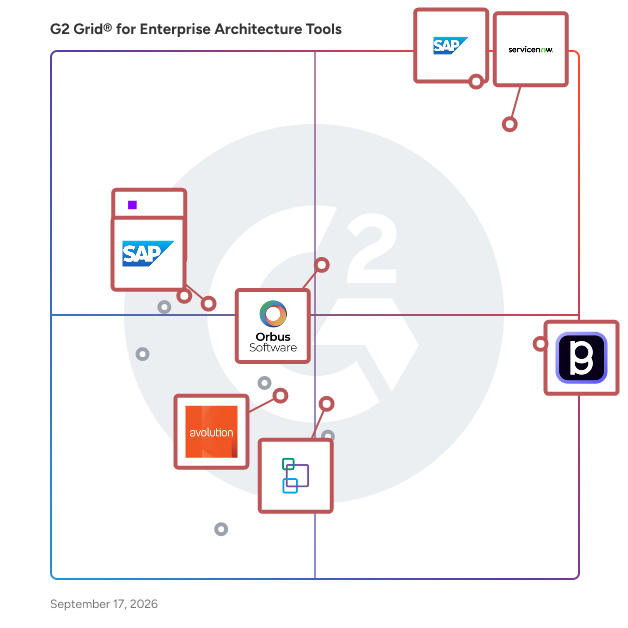
- **Leader:** [SAP LeanIX](https://www.g2.com/products/sap-leanix/reviews)
- **Highest Performer:** [Boldo](https://www.g2.com/products/boldo/reviews)
- **Easiest to Use:** [BIC Platform](https://www.g2.com/products/gbtec-software-bic-platform/reviews)
- **Top Trending:** [ServiceNow Enterprise Architecture](https://www.g2.com/products/servicenow-enterprise-architecture/reviews)
- **Best Free Software:** [Faddom](https://www.g2.com/products/faddom/reviews)


---

**Sponsored**

### CAST Highlight

Portfolio-level insights for app modernization, AI readiness, tech debt, OSS risks CAST Highlight is a SaaS software intelligence technology that delivers rapid, fact-based insights across your entire application portfolio. By automatically analyzing the source code of hundreds or thousands of applications, CAST Highlight helps organizations assess cloud maturity, AI &amp; Agentic readiness, software health, open source risk, resiliency, technical debt, and sustainability from a single lightweight scan. CAST Highlight is designed for CIOs, CTOs, enterprise architects, cloud leaders, application owners, security teams, and modernization teams that need a fact-based way to prioritize modernization, cloud, and AI adoption decisions at scale. It helps teams identify which applications are ready to move quickly, which require remediation, and where hidden software risks may affect transformation cost, timelines, security, resilience, or business outcomes. Unlike traditional manual or survey-based assessments, CAST Highlight analyzes application source code directly to rapidly segment portfolios, prioritize modernization paths, and uncover risks before they impact transformation programs. Organizations use CAST Highlight to: - Accelerate cloud migration and modernization planning - Segment applications by cloud maturity and transformation path - Identify high-value AI adoption opportunities - Assess Agentic Readiness across application portfolios - Prioritize technical debt, resiliency, and maintainability improvements - Assess open source vulnerabilities and IP / license exposure - Evaluate software sustainability with Green Impact insights - Reduce complexity, cost, and risk across transformation programs Businesses move faster using CAST to understand, improve, and transform their software. Through semantic analysis of source code, CAST generates dashboards and 3D maps for executives, technologists, and AI to navigate inside individual applications and across entire portfolios. This intelligence enables companies to steer, speed, and report on initiatives such as technical debt, modernization, and cloud. As the pioneer of the software intelligence field, CAST is trusted by the world’s leading companies and governments, their consultancies and cloud providers. See it all at castsoftware.com.


[Visit website](https://www.g2.com/external_clickthroughs/record?secure%5Bad_program%5D=ppc&amp;secure%5Bad_slot%5D=category_product_list&amp;secure%5Bcategory_id%5D=1204&amp;secure%5Bchosen_at%5D=2026-07-06T01%3A42%3A12Z&amp;secure%5Bdisplayable_resource_id%5D=1203&amp;secure%5Bdisplayable_resource_type%5D=Category&amp;secure%5Bmedium%5D=sponsored&amp;secure%5Bplacement_reason%5D=neighbor_category&amp;secure%5Bplacement_resource_ids%5D%5B%5D=1203&amp;secure%5Bprioritized%5D=false&amp;secure%5Bproduct_id%5D=58553&amp;secure%5Bresource_id%5D=1204&amp;secure%5Bresource_type%5D=Category&amp;secure%5Bsource_type%5D=category_page&amp;secure%5Bsource_url%5D=https%3A%2F%2Fwww.g2.com%2Fcategories%2Fenterprise-architecture-tools%3Fpage%3D3&amp;secure%5Btoken%5D=313a71ac3c84c817f073ac02b761130995d991f4089f8580baccd4e52a49be33&amp;secure%5Burl%5D=https%3A%2F%2Fwww.castsoftware.com%2Ftryhighlight%3Futm_campaign%3Dg2_clicks_ads%26utm_source%3Dcast_highlight%26utm_medium%3Dtrial_request&amp;secure%5Burl_type%5D=free_trial)

---

## What Are the Top-Rated Enterprise Architecture Tools Products in 2026?
### 1. [Smarchy](https://www.g2.com/products/smarchy/reviews)
Not sure how to kickstart your Enterprise Architecture practice? Or tired of updating deprecated documentation manually? Smarchy, a free Enterprise Architecture tool can do the tedious task of building and maintaining your ArchiMate model for you!


**Who Is the Company Behind Smarchy?**

- **Seller:** [Smarchy](https://www.g2.com/sellers/smarchy)
- **HQ Location:** N/A
- **LinkedIn® Page:** https://www.linkedin.com/company/18230651 (2 employees on LinkedIn®)


### 2. [TechBrain](https://www.g2.com/products/techbrain/reviews)
TechBrain is an enterprise-grade, AI-assisted technical architecture design platform that provides a structured, governed workspace for translating validated solution requirements into executable, build-ready technical designs. It instantiates each initiative as a controlled design project where scope, objectives, process flows, and system context are consolidated into a clear technical baseline. From this foundation, TechBrain generates enterprise-aligned architecture blueprints and structured execution workflows, enables collaborative refinement across technical and cross-functional stakeholders, and uses AI-assisted guidance to surface gaps in integrations, data dependencies, security, system compatibility, and deployment assumptions during iteration. Once designs are finalized, it produces comprehensive, version-controlled, and fully traceable technical artifacts , including architecture documentation, functional specifications, epics, BRDs, user stories, schema definitions, information architecture, and integration specifications , ensuring alignment from requirements through engineering handoff.


**Who Is the Company Behind TechBrain?**

- **Seller:** [Abhinav Jain](https://www.g2.com/sellers/abhinav-jain)
- **HQ Location:** N/A
- **LinkedIn® Page:** https://www.linkedin.com/company/No-Linkedin-Presence-Added-Intentionally-By-DataOps (1 employees on LinkedIn®)


### 3. [Turbo EA](https://www.g2.com/products/turbo-ea/reviews)
Turbo EA is an Open Source self-hosted Enterprise Architecture Management platform with embedded BPM. Map applications, capabilities, technologies, and their relationships with a fully admin-configurable metamodel, AI-assisted metadata, and multilingual support.


**Who Is the Company Behind Turbo EA?**

- **Seller:** [Turbo EA](https://www.g2.com/sellers/turbo-ea)
- **HQ Location:** N/A
- **LinkedIn® Page:** https://www.linkedin.com/company/No-Linkedin-Presence-Added-Intentionally-By-DataOps (1 employees on LinkedIn®)


## What Is Enterprise Architecture Tools?

[IT Management Software](https://www.g2.com/categories/it-management)

## What Software Categories Are Similar to Enterprise Architecture Tools?

- [Application Portfolio Management Software](https://www.g2.com/categories/application-portfolio-management)


---

## How Do You Choose the Right Enterprise Architecture Tools?

### What You Should Know About Enterprise Architecture Tools

### What are Enterprise Architecture Tools?

Enterprise architecture (EA) is the process of designing, mapping, implementing, and executing large-scale business strategies. Enterprise architecture tools are software applications designed to help businesses achieve their goals and improve visibility and productivity across the company. These tools empower individuals to collaborate and organize resources and strategies across disparate or siloed departments. IT systems, business resources, staff, and other components of internal organizations are mapped out to identify unnecessary efforts or spending. From there, users will strategize a plan to streamline operations and improve overall efficiency.

Some businesses will have designated enterprise architects, but others will simply rely on administrators or project managers to take ownership of enterprise architecture. Enterprise architects would be specialized individuals with experience mapping out departments, resources, and large-scale business strategies. Regardless of whether enterprise architects are the ones using EA solutions, the tools will continue to assist in improving business operations while modernizing a business’ internal enterprise architecture framework.

The scope of a business is a large factor in whether enterprise architecture solutions are necessary. Enterprise companies and businesses with individually operating departments are more likely to need enterprise architecture solutions. Smaller businesses are less likely to need a large-scale solution to map isolated departments, resources, or manpower.

Companies that are large enough to require these solutions will map out their business structures, information sources, applications, IT assets, and IT infrastructure. This information will be used to build an architecture description that details the current state and the target state. From there, the user will outline the work and time necessary to help the business achieve its goals.

Key Benefits of Enterprise Architecture Tools

- Improved organizational design and visibility
- Standardized organizational processes
- Simplified project and portfolio management
- Fewer unnecessary costs and improved IT value

### Why Use Enterprise Architecture Tools?

Companies hoping to modernize and streamline their existing enterprise business should look to EA solutions. These tools make it significantly easier to enact large-scale changes because every impact is mapped out prior to implementation. It can also help keep businesses on track and set deadlines for specific tasks. In all, these tools enable companies to identify flaws in their business, determine the steps necessary to facilitate change, and ensure that transformative projects remain on schedule.

**Business Architecture —** Companies are always in possession of data related to their business structures, objectives, and capabilities. But many businesses fail to utilize that information to identify potential flaws or inconsistencies within their operations. These tools can help explain to both administrators and users where contributions are made, where roadblocks exist, and where improvements can be implemented.

**Increased Visibility —** Enterprise architecture solutions are helpful for continually displaying each worker’s or department&#39;s contribution to the company’s collective goals. Employees can also speak up if they identify pain points within the company’s business processes to further improve operations.

**Business Transformation —** Enterprise architecture tools are especially useful for companies hoping to adapt their business to the modern day. This could mean abandoning legacy systems, restructuring their IT operations, or simplifying complex IT systems. Enterprise architecture toos are also helpful in developing entirely new systems and demonstrating to users what impacts will arise as a result of new technology adoption.

### What are the Common Features of Enterprise Architecture Tools?

**Timelines —** Timelines help users with long-term planning for projects, strategies, and tasks. These features also help users identify various phases and track progress at different stages.

**Roadmaps —** Roadmapping features allow users to visually display strategies along with the various relevant resources, departments, and assets. They can also assist with progress tracking and standards monitoring throughout project implementation.

**Analytics —** Analytics features will provide users with tools to analyze productivity, resource usage, and standards enforcement. This information can be useful in future planning and help teams better strategize for related tasks and projects.

**Collaboration —** The ability for teams to collaborate on projects and other tasks within the platform.

**Asset Management —** Tools to organize and manage all resources and assets within an organization.

**Budget Hierarchies —** Define budget structure elements and how they are linked hierarchically.

**Reporting —** Administrators can define and manage the reporting structure and access rights to each report.

**Standards —** Design and develop standards for modelling business systems.

### Software and Services Related to Enterprise Architecture Tools

[**Strategy and Innovation Roadmapping Tools**](https://www.g2.com/categories/strategy-and-innovation-roadmapping-tools) **—** Enterprise architecture tools are used for strategic innovation and road mapping but cover a lot more ground. Road mapping tools may be useful in further outlining implementation strategies but typically do not provide the same cross-department collaboration, modeling, and analytics capabilities.

[**IT Portfolio Analysis Software**](https://www.g2.com/categories/it-portfolio-analysis) **—** IT portfolio analysis software is similar to EA tools, in that it helps map out resources and identify areas of improvement. But IT portfolio analysis solutions only cover a portion of EA’s overall business modeling capabilities. IT is important and typically included in EA, but it is not the entire focus of these solutions.

[**Project and Portfolio Management Software**](https://www.g2.com/categories/project-and-portfolio-management) **(PPM) —** PPM software is useful in tracking projects and road mapping changes to businesses. They are a nice complement to EA solutions for maintaining project timelines but typically do not provide the same capabilities for managing an entire business’s resources and processes.


