Best Electronic Data Interchange (EDI) Software

How Many Electronic Data Interchange (EDI) Software Products Does G2 Track?

Total Products under this Category: 124

Category Stats (Sep 2026)

  • Average Rating: 4.48/5 The average rating of products in this category, based on all submitted ratings
  • Top Trending Product: 1 EDI Source, an Epicor solution (+0.47%) - Among all products in this category, 1 EDI Source, an Epicor solution recorded the largest rating increase compared to last month

Last updated: September 01, 2026

How Does G2 Rank Electronic Data Interchange (EDI) Software Products?

Why You Can Trust G2's Software Rankings:

  • 30 Analysts and Data Experts
  • 6,900+ Authentic Reviews
  • 124+ Products
  • Unbiased Rankings

G2's software rankings are built on verified user reviews, rigorous moderation, and a consistent research methodology maintained by a team of analysts and data experts. Each product is measured using the same transparent criteria, with no paid placement or vendor influence. While reviews reflect real user experiences, which can be subjective, they offer valuable insight into how software performs in the hands of professionals. Together, these inputs power the G2 Score, a standardized way to compare tools within every category.

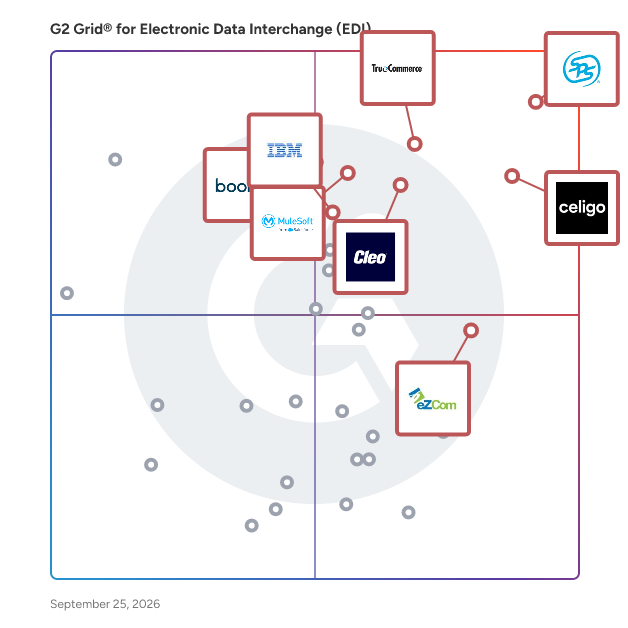
G2 Grid® for Electronic Data Interchange (EDI) Software

G2 Grid® for Electronic Data Interchange (EDI) Software plotting products by satisfaction and market presence

Highlighted products: SPS Commerce Fulfillment EDI, Celigo, TrueCommerce EDI, Cleo Integration Cloud, MuleSoft Anypoint Platform, Boomi, eZCom Software EDI, and IBM webMethods B2B.

Underlying data: [Grid® JSON](https://www.g2.com/categories/electronic-data-interchange-edi/grids.json?focus%5B%5D=sps-commerce-fulfillment-edi&focus%5B%5D=celigo&focus%5B%5D=truecommerce-edi&focus%5B%5D=cleo-integration-cloud&focus%5B%5D=mulesoft-anypoint-platform&focus%5B%5D=boomi&focus%5B%5D=ezcom-software-edi&focus%5B%5D=ibm-webmethods-b2b)

SPS Commerce Fulfillment EDI

SPS Commerce Fulfillment EDI is your gateway to retail growth. With access to the world’s largest network of pre-mapped connections via the only EDI solution on the market with full-service support, you’ll remove the heavy lift associated with manual supply chain management. Enjoy a fully compliant solution proactively monitored 24/7 by our team of experts that tackles all your EDI needs, including system integration and document automation. Ready to see how your EDI solution can work for you? Discover SPS Commerce Fulfillment EDI.

Average Rating: 4.3/5.0

Total Reviews: 702

How Do G2 Users Rate SPS Commerce Fulfillment EDI?

  • EDI Testing: 8.5/10 (Category avg: 9.0/10)
  • Data Exchange: 9.2/10 (Category avg: 9.3/10)
  • Has the product been a good partner in doing business?: 8.5/10 (Category avg: 9.0/10)
  • Data Mapping: 8.6/10 (Category avg: 9.0/10)

Who Is the Company Behind SPS Commerce Fulfillment EDI?

  • Seller: SPS Commerce
  • Company Website:
  • Year Founded: 1987
  • HQ Location: Minneapolis, MN
  • LinkedIn® Page: www.linkedin.com
    3,271 employees on LinkedIn®
  • Ownership: NASDAQ:SPSC

Who Uses This Product?

  • Who Uses This: Operations Manager, Owner
  • Top Industries: Consumer Goods, Wholesale
  • Company Size: 67% Small, 29% Medium

What Do G2 Reviewers Say About SPS Commerce Fulfillment EDI?

AI-generated summary from verified user reviews

Pros
  • Users appreciate the ease of use of SPS Commerce Fulfillment EDI, streamlining order processing and enhancing efficiency.
  • Users value the incredible customer support from SPS Commerce, enhancing the overall experience and platform utilization.
  • Users value the ease of order processing with SPS Commerce Fulfillment EDI, enhancing efficiency and reducing costs.
  • Users value the efficiency of SPS Commerce Fulfillment EDI, which streamlines data integration and enhances operational productivity.
  • Users commend the implementation ease of SPS Commerce Fulfillment EDI, facilitating quick onboarding and user-friendly experiences.
Cons
  • Users criticize the poor customer support, highlighting slow response times and lack of monitoring for issues.
  • Users report integration issues with SPS Commerce Fulfillment EDI, causing delays and decreased visibility in order management.
  • Users report frustrating technical issues with SPS Commerce Fulfillment EDI, leading to delays in resolution and integration challenges.
  • Users report a difficult setup with SPS Commerce Fulfillment EDI, facing long onboarding and complicated processes.
  • Users report an inefficient process with SPS Commerce, marked by slow support and a lengthy onboarding experience.

What Are Recent G2 Reviews of SPS Commerce Fulfillment EDI?

What Are G2 Users Discussing About SPS Commerce Fulfillment EDI?

Celigo

Celigo puts intelligent automation in the hands of every team, unifying workflows from the predictable to the fully agentic in a single platform through a first-of-its-kind natural language interface. The platform is recognized by G2 as #1 in iPaaS and a Leader in API Management, API Marketplace, and EDI and is the only vendor named a 2025 Gartner® Peer Insights™ Customers’ Choice for iPaaS. Learn more at: celigo.com.

Average Rating: 4.6/5.0

Total Reviews: 1,068

How Do G2 Users Rate Celigo?

  • EDI Testing: 9.2/10 (Category avg: 9.0/10)
  • Data Exchange: 9.6/10 (Category avg: 9.3/10)
  • Has the product been a good partner in doing business?: 9.2/10 (Category avg: 9.0/10)
  • Data Mapping: 9.7/10 (Category avg: 9.0/10)

Who Is the Company Behind Celigo?

  • Seller: Celigo
  • Company Website:
  • Year Founded: 2011
  • HQ Location: Redwood City, California
  • Twitter: @celigoinc
    1,418 Twitter followers
  • LinkedIn® Page: www.linkedin.com
    786 employees on LinkedIn®

Who Uses This Product?

  • Who Uses This: IT Manager, NetSuite Administrator
  • Top Industries: Retail, Consumer Goods
  • Company Size: 58% Medium, 37% Small

What Do G2 Reviewers Say About Celigo?

AI-generated summary from verified user reviews

Pros
  • Users value the ease of use in Celigo, appreciating its intuitive interface and effective connectivity options.
  • Users value the comprehensive integrations offered by Celigo, enabling seamless connections with various business systems effortlessly.
  • Users appreciate the comprehensive integration capabilities of Celigo, facilitating connections with various partners seamlessly.
  • Users praise the easy integrations offered by Celigo, especially with NetSuite, appreciating the prebuilt connectors and solid support.
  • Users praise the responsive and helpful customer support from Celigo, making issue resolution seamless.
Cons
  • Users find that error handling is unclear, making it challenging to resolve issues and track discrepancies efficiently.
  • Users note that Celigo can be expensive, especially for small businesses needing multiple managed modules.
  • Users face a notable learning curve with Celigo, making initial navigation and understanding of flows challenging.
  • Users report that Celigo’s complexity can lead to frustration, especially when debugging and understanding data flows.
  • Users find pricing issues with Celigo, noting that costs increase with additional features and managed modules.

What Are Recent G2 Reviews of Celigo?

What Are G2 Users Discussing About Celigo?

TrueCommerce EDI

Across industries, TrueCommerce is viewed as one of the best names in global supply chain integration and automation. Leveraging our TrueCommerce Trading Partner Platform, we offer seamless integration options, including EDI integration with your business or ERP system, an automated connection to hundreds of leading online marketplaces like Amazon and Walmart, and integration with leading eCommerce platforms including Shopify, Magento and WooCommerce.

Average Rating: 4.4/5.0

Total Reviews: 436

How Do G2 Users Rate TrueCommerce EDI?

  • EDI Testing: 8.6/10 (Category avg: 9.0/10)
  • Data Exchange: 9.1/10 (Category avg: 9.3/10)
  • Has the product been a good partner in doing business?: 9.0/10 (Category avg: 9.0/10)
  • Data Mapping: 8.7/10 (Category avg: 9.0/10)

Who Is the Company Behind TrueCommerce EDI?

  • Seller: TrueCommerce
  • Company Website:
  • Year Founded: 1995
  • HQ Location: Cranberry Township, PA
  • Twitter: @TrueCommerce
    1,288 Twitter followers
  • LinkedIn® Page: www.linkedin.com
    1,018 employees on LinkedIn®

Who Uses This Product?

  • Who Uses This: IT Manager, Office Manager
  • Top Industries: Wholesale, Consumer Goods
  • Company Size: 62% Small, 34% Medium

What Do G2 Reviewers Say About TrueCommerce EDI?

AI-generated summary from verified user reviews

Pros
  • Users find TrueCommerce EDI easy to use, enhancing their experience and simplifying management of EDI processes.
  • Users value the outstanding customer support of TrueCommerce EDI, providing quick, effective solutions and reliable guidance.
  • Users value the outstanding support team of TrueCommerce EDI, ensuring reliable and smooth EDI transactions and implementations.
  • Users value the efficiency of TrueCommerce EDI, which simplifies transaction management and saves valuable time.
  • Users value the all-in-one EDI solution of TrueCommerce EDI, enjoying seamless support and usability.
Cons
  • Users criticize the poor customer support with delays, communication issues, and unknowledgeable techs impacting project efficiency.
  • Users find TrueCommerce EDI lacking features, noting its complexity and difficulties in integration with native platforms like QuickBooks.
  • Users experience slow performance with TrueCommerce EDI, including lagging and screen freezing during operations.
  • Users experience slow processing, with lagging, freezing screens, and ongoing issues despite customer support efforts.
  • Users find the setup of TrueCommerce EDI to be difficult, requiring manual effort and posing challenges for new users.

What Are Recent G2 Reviews of TrueCommerce EDI?

What Are G2 Users Discussing About TrueCommerce EDI?

Cleo Integration Cloud

Cleo Integration Cloud is a B2B integration and EDI platform built for companies that need to automate trading partner transactions, connect ERP and supply chain systems, and manage exceptions across high-volume order to-cash and procure-to-pay workflows. Cleo helps teams automate common EDI document flows including purchase orders, acknowledgments, ASNs, invoices, shipment status updates, and other X12/EDIFACT transactions across retail, manufacturing, logistics, wholesale distribution, food and beverage, and healthcare ecosystems. The platform supports EDI, API, AS2, SFTP, MFT, and other B2B connectivity patterns so businesses can exchange data securely with customers, suppliers, carriers, marketplaces, 3PLs, and internal applications. Cleo Integration Cloud is designed for teams that need more than basic EDI compliance. It provides trading partner onboarding, EDI mapping and transformation, real-time transaction visibility, exception monitoring, AI assisted issue resolution, and flexible service models for self-service, managed service, or blended integration teams. Companies use Cleo to replace legacy EDI tools, reduce manual partner work, improve document traceability, connect ERP/TMS/WMS/eCommerce systems, and scale B2B automation as transaction volume and partner complexity grow.

Average Rating: 4.4/5.0

Total Reviews: 584

How Do G2 Users Rate Cleo Integration Cloud?

  • EDI Testing: 9.1/10 (Category avg: 9.0/10)
  • Data Exchange: 9.4/10 (Category avg: 9.3/10)
  • Has the product been a good partner in doing business?: 8.9/10 (Category avg: 9.0/10)
  • Data Mapping: 9.2/10 (Category avg: 9.0/10)

Who Is the Company Behind Cleo Integration Cloud?

  • Seller: Cleo
  • Company Website:
  • Year Founded: 1976
  • HQ Location: Rockford, IL
  • Twitter: @CleoNeverStops
    958 Twitter followers
  • LinkedIn® Page: www.linkedin.com
    581 employees on LinkedIn®

Who Uses This Product?

  • Who Uses This: EDI Analyst, IT Manager
  • Top Industries: Transportation/Trucking/Railroad, Logistics and Supply Chain
  • Company Size: 51% Medium, 30% Large

What Do G2 Reviewers Say About Cleo Integration Cloud?

AI-generated summary from verified user reviews

Pros
  • Users value the responsive customer support of Cleo Integration Cloud, enhancing their overall experience and learning process.
  • Users appreciate the seamless connectivity of Cleo Integration Cloud, enabling diverse and efficient integrations across platforms.
  • Users value the integration capabilities of Cleo Integration Cloud, enabling seamless connections to diverse software with ease.
  • Users value the easy integrations of Cleo Integration Cloud, simplifying complex setups and enhancing overall efficiency.
  • Users value the easy setup of Cleo Integration Cloud, enabling seamless EDI connections for efficient operations.
Cons
  • Users find the difficult learning curve of Cleo Integration Cloud frustrating due to complex tools and minimal support.
  • Users find the pricing to be high, raising concerns about the overall feasibility of Cleo Integration Cloud.
  • Users experience slow processing with Cleo Integration Cloud, citing delayed support and ineffective integration updates.
  • Users find the complexity of integration and training within Cleo Integration Cloud to be challenging and time-consuming.
  • Users often face a steep learning curve with Cleo Integration Cloud, complicating advanced configurations and customizations.

What Are Recent G2 Reviews of Cleo Integration Cloud?

What Are G2 Users Discussing About Cleo Integration Cloud?

MuleSoft Anypoint Platform

MuleSoft Anypoint Platform is the industry-leading integration and governance solution designed to connect any application, API, and AI agent across hybrid and multi-cloud environments. For nearly two decades, we have served as the integration backbone for the world’s most complex enterprises. Today, we are extending to the AI era. We allow organizations to move beyond AI sprawl into a unified architecture where legacy systems, modern APIs, and autonomous agents interact securely on a single, trusted foundation. Key capabilities and components include: Hybrid integration and connectivity, utilizing a library of hundreds of pre-built connectors and support for new AI protocols like MCP and A2A to provide AI agents with the tools they need to access and act within legacy ERPs, CRMs, and on-premise databases. MuleSoft Agent Fabric: Unified API and agent governance, applying the same rigorous security policies, cost controls, and traffic enforcement to AI models and agents that organizations already trust for their global API ecosystems through a single, federated control plane. Fabric also includes agent visibility and registry, offering a single source of truth to discover and observe any cross-ecosystem agent, ensuring complete transparency and the elimination of shadow AI. MuleSoft Vibes: Natural language design and management, providing a revamped experience where teams can use native natural language prompts to scaffold integrations, manage lifecycles, and stay ahead of technical sprawl using the AI tools they already prefer. Trusted runtime and compliance, delivering a fully managed, hybrid, or on-prem foundation that has been proven at scale for years, ensuring that every interaction is backed by enterprise-grade monitoring and human-in-the-loop security. Overall, MuleSoft Anypoint Platform is the enterprise platform for organizations seeking to bring visibility, trust, and orchestration to their APIs and AI agents.

Average Rating: 4.4/5.0

Total Reviews: 763

How Do G2 Users Rate MuleSoft Anypoint Platform?

  • EDI Testing: 8.3/10 (Category avg: 9.0/10)
  • Data Exchange: 9.4/10 (Category avg: 9.3/10)
  • Has the product been a good partner in doing business?: 8.8/10 (Category avg: 9.0/10)
  • Data Mapping: 9.1/10 (Category avg: 9.0/10)

Who Is the Company Behind MuleSoft Anypoint Platform?

  • Seller: Salesforce
  • Company Website:
  • Year Founded: 1999
  • HQ Location: San Francisco, CA
  • Twitter: @salesforce
    579,511 Twitter followers
  • LinkedIn® Page: www.linkedin.com
    89,711 employees on LinkedIn®

Who Uses This Product?

  • Who Uses This: Software Engineer, Senior Software Engineer
  • Top Industries: Information Technology and Services, Computer Software
  • Company Size: 54% Large, 31% Medium

What Do G2 Reviewers Say About MuleSoft Anypoint Platform?

AI-generated summary from verified user reviews

Pros
  • Users appreciate the ease of use of MuleSoft Anypoint Platform, finding it ideal for their data loading needs.
  • Users value the integration capabilities of MuleSoft Anypoint Platform, enabling seamless connections across various systems and APIs.
  • Users value the ease of integration with MuleSoft Anypoint Platform, benefiting from its comprehensive API management features.
  • Users appreciate the clean UI and comprehensive features of MuleSoft Anypoint Platform for efficient API management.
  • Users value the easy integrations of MuleSoft Anypoint Platform, simplifying the connection of various systems seamlessly.
Cons
  • Users express concern over the high cost of MuleSoft Anypoint Platform, making it less accessible for smaller projects.
  • Users express concern over the high pricing issues of MuleSoft Anypoint Platform, making it less accessible for smaller organizations.
  • Users find the learning curve steep for MuleSoft Anypoint Platform, especially for those transitioning from other tools.
  • Users find learning difficulty with MuleSoft Anypoint Platform, requiring advanced skills and complicating transitions from familiar tools.
  • Users experience a steep learning curve with MuleSoft Anypoint, often requiring extensive training and adjustment time.

What Are Recent G2 Reviews of MuleSoft Anypoint Platform?

What Are G2 Users Discussing About MuleSoft Anypoint Platform?

Boomi

Boomi, the data activation company for AI, powers the agentic enterprise by bringing data to life across the business. The Boomi Enterprise Platform is the active data foundation that delivers essential agentic infrastructure to drive agentic transformation. By unifying agent design and governance, API and MCP management, integration and automation, and data management into a single platform, Boomi enables organizations to harness the power of AI with secure, scalable connectivity. Trusted by over 30,000 customers and supported by a network of 800+ partners, Boomi helps organizations of all sizes achieve agility, efficiency, and innovation at scale.

Average Rating: 4.4/5.0

Total Reviews: 454

How Do G2 Users Rate Boomi?

  • EDI Testing: 8.7/10 (Category avg: 9.0/10)
  • Data Exchange: 8.9/10 (Category avg: 9.3/10)
  • Has the product been a good partner in doing business?: 8.8/10 (Category avg: 9.0/10)
  • Data Mapping: 8.9/10 (Category avg: 9.0/10)

Who Is the Company Behind Boomi?

  • Seller: Boomi
  • Company Website:
  • Year Founded: 2000
  • HQ Location: Conshohocken, PA
  • Twitter: @boomi
    101,014 Twitter followers
  • LinkedIn® Page: www.linkedin.com
    3,071 employees on LinkedIn®

Who Uses This Product?

  • Who Uses This: Software Engineer, Senior Software Engineer
  • Top Industries: Information Technology and Services, Computer Software
  • Company Size: 45% Large, 39% Medium

What Do G2 Reviewers Say About Boomi?

AI-generated summary from verified user reviews

Pros
  • Users value the powerful integrations Boomi provides, enabling seamless connectivity with multiple cloud providers and tools.
  • Users appreciate the ease of use of Boomi, making integrations quick and straightforward with strong support.
  • Users value the easy integrations Boomi offers, simplifying connections with multiple systems and enhancing overall functionality.
  • Users value Boomi's seamless integration features, enhanced documentation, and robust support for deployment and monitoring.
  • Users value the robust integration capabilities of Boomi, facilitating seamless connections with multiple systems and tools.
Cons
  • Users find that complexity in implementation leads to increased effort and performance issues with Boomi's integrations.
  • Users report that Boomi can be difficult to learn initially, especially with complex scenarios and intricacies.
  • Users find the initial learning curve of Boomi challenging, particularly with complex scenarios before implementation.
  • Users face integration issues with Boomi, highlighting the need for more connectors and improved user interface simplicity.
  • Users face complex coding challenges with Boomi, requiring significant effort for integrating intricate business logic.

What Are Recent G2 Reviews of Boomi?

What Are G2 Users Discussing About Boomi?

eZCom Software EDI

eZCom’s Lingo is a comprehensive, web-based Electronic Data Interchange (EDI) solution designed to assist suppliers and brands in efficiently processing retail orders across various fulfillment channels while adhering to retailer compliance requirements. This platform is tailored for businesses seeking to streamline their operations and enhance their order fulfillment processes, making it an essential tool for suppliers aiming to thrive in a competitive marketplace. The primary audience for Lingo includes suppliers, manufacturers, and brands that require a robust EDI solution to effectively manage their retail orders. The platform offers flexible usage options, functioning either as a standalone web application or integrating seamlessly with existing back-end systems such as ERP, accounting, warehouse management systems (WMS), and inventory management tools. This adaptability allows businesses to select the setup that best aligns with their operational needs, ensuring a smooth workflow without disrupting current processes. One of the key features of Lingo is its automation capabilities, particularly in generating labels and packing slips for direct-to-consumer orders. This functionality significantly reduces the time and effort associated with manual data entry. Additionally, Lingo establishes direct connections with major shipping providers and Amazon, streamlining the shipping process and eliminating the need for suppliers to navigate multiple portals. This integration is especially advantageous for Fulfilled by Merchant (FBM) suppliers, as it enhances efficiency through bulk automation of label creation for single-item orders. Lingo also emphasizes security and efficiency by enabling secure sharing of essential shipping details with third-party logistics (3PL) partners while protecting confidential financial information. The platform's document processing capabilities include file downloads for 850/PO and 810/Invoice, as well as uploads for 856/Advance Ship Notice and 810/Invoice generated externally. With features such as purchase order and invoice item reporting, batch processing of documents, and automatic invoice creation upon receiving the 856/ASN, Lingo provides users with a comprehensive suite of tools for effective data management and analysis. Furthermore, Lingo incorporates multi-level rules validation for outgoing documents, ensuring that all essential data required by trading partners is included before sending. This feature minimizes the risk of errors and enhances compliance with retailer requirements. With 15-pack methods available for creating the 856/ASN, Lingo offers flexibility and precision in shipment documentation, making it a valuable asset for suppliers looking to optimize their EDI processes and improve overall operational efficiency.

Average Rating: 4.7/5.0

Total Reviews: 276

How Do G2 Users Rate eZCom Software EDI?

  • EDI Testing: 9.4/10 (Category avg: 9.0/10)
  • Data Exchange: 9.5/10 (Category avg: 9.3/10)
  • Has the product been a good partner in doing business?: 9.7/10 (Category avg: 9.0/10)
  • Data Mapping: 9.4/10 (Category avg: 9.0/10)

Who Is the Company Behind eZCom Software EDI?

  • Seller: eZCom Software Inc.
  • Company Website:
  • Year Founded: 2000
  • HQ Location: Englewood, New Jersey
  • Twitter: @eZComSoftware
    130 Twitter followers
  • LinkedIn® Page: www.linkedin.com
    38 employees on LinkedIn®

Who Uses This Product?

  • Who Uses This: President, Operations Manager
  • Top Industries: Wholesale, Consumer Goods
  • Company Size: 79% Small, 15% Medium

What Do G2 Reviewers Say About eZCom Software EDI?

AI-generated summary from verified user reviews

Pros
  • Users value the exceptional customer support from eZCom Software EDI, ensuring swift resolutions and smooth onboarding experiences.
  • Users value the ease of use of eZCom Software EDI, making training and order processing simple and efficient.
  • Users value the knowledgeable support from eZCom Software EDI, ensuring quick resolutions and smooth onboarding experiences.
  • Users praise the user-friendly EDI integration of eZCom Software, which simplifies order management and enhances support experience.
  • Users value the quick response time of eZCom Software EDI, appreciating prompt assistance from a dedicated support team.
Cons
  • Users note the poor interface design, suggesting it feels outdated and could use modern visual updates.
  • Users find eZCom Software EDI to be not user-friendly, often requiring assistance due to its complicated features.
  • Users note that the learning curve for eZCom Software EDI can be steep without prior EDI experience or support.
  • Users experience poor customer support, often facing long hold times and unhelpful responses from staff.
  • Users frequently face technical issues with eZCom, causing confusion and requiring tech support for assistance.

What Are Recent G2 Reviews of eZCom Software EDI?

IBM webMethods B2B

Simplify the complexity of how you B2B with IBM webMethods B2B. The B2B integration allows you to share documents—purchase orders, invoices, shipping notices, contracts and more—in the cloud and keep everything in sync with APIs.

Average Rating: 4.5/5.0

Total Reviews: 56

How Do G2 Users Rate IBM webMethods B2B?

  • Has the product been a good partner in doing business?: 8.4/10 (Category avg: 9.0/10)

Who Is the Company Behind IBM webMethods B2B?

  • Seller: IBM
  • Year Founded: 1911
  • HQ Location: Armonk, New York, United States
  • Twitter: @IBMSecurity
    74,660 Twitter followers
  • LinkedIn® Page: www.linkedin.com
    344,328 employees on LinkedIn®
  • Ownership: SWX:IBM

Who Uses This Product?

  • Top Industries: Staffing and Recruiting, Computer Software
  • Company Size: 42% Medium, 35% Large

What Do G2 Reviewers Say About IBM webMethods B2B?

AI-generated summary from verified user reviews

Pros
  • Users praise the ease of use of IBM webMethods B2B, appreciating its simplicity and user-friendly design.
  • Users appreciate the scalable and user-friendly features of IBM webMethods B2B for seamless data exchange and automation.
  • Users praise the strong security features of IBM webMethods B2B, ensuring data protection and secure transactions.
  • Users value the end-to-end automation provided by IBM webMethods B2B, enhancing efficiency in data exchange with partners.
  • Users commend the integration capabilities of IBM webMethods B2B, enabling seamless communication and data sharing across enterprises.
Cons
  • Users find the complexity of IBM webMethods B2B challenging, especially for those without prior experience or expertise.
  • Users highlight that the product can be expensive, leading to concerns about budget management and overall value.
  • Users find difficult learning curves due to a lack of familiarity with B2B integration concepts on IBM webMethods.
  • Users express concerns about pricing transparency, with a desire for clearer cost breakdowns for better budgeting.
  • Users experience a learning curve with webMethods B2B, requiring time to adapt and understand its features.

What Are Recent G2 Reviews of IBM webMethods B2B?

1 EDI Source, an Epicor solution

1 EDI Source, an Epicor solution, is your ultimate partner in achieving seamless global business-to-business (B2B) communication and integration across supply chains and trading partner networks. Imagine having a solution that offers a comprehensive range of services tailored to meet your unique business needs, whether you require a standalone solution or integration into your existing ERP system. With 1 EDI Source, you get the flexibility of hosted, cloud-based, do-it-yourself approaches and fully managed offerings. This means you can choose the option that best fits your specific requirements, ensuring your business operates at peak efficiency. What sets 1 EDI Source apart is its ability to integrate smoothly with your existing ERP systems, enhancing operational efficiency without the need for extensive modifications. This solution supports global B2B communication, enabling you to connect with trading partners worldwide and streamline your supply chain processes. By automating and streamlining B2B communication, 1 EDI Source helps reduce manual processes, minimize errors, and improve overall operational efficiency. Plus, it provides real-time visibility into supply chain activities, allowing you to monitor and manage your operations more effectively, leading to significant cost savings. As an Epicor solution, 1 EDI Source is backed by a reputable provider known for delivering reliable and robust business solutions. Its scalability makes it suitable for businesses of all sizes, from small enterprises to large corporations. The comprehensive support services ensure that you have the assistance you need to maximize the value of your EDI solution. With its range of offerings, seamless integration capabilities, and adaptability, 1 EDI Source is a versatile and reliable tool for enhancing B2B communication and integration. It's a valuable asset for businesses looking to streamline their supply chain operations and improve overall efficiency. The solution's flexibility, reliability, and support make it an excellent choice for businesses aiming to enhance their digital presence and customer engagement.

Average Rating: 4.3/5.0

Total Reviews: 35

How Do G2 Users Rate 1 EDI Source, an Epicor solution?

  • EDI Testing: 9.2/10 (Category avg: 9.0/10)
  • Data Exchange: 9.7/10 (Category avg: 9.3/10)
  • Has the product been a good partner in doing business?: 9.6/10 (Category avg: 9.0/10)
  • Data Mapping: 9.4/10 (Category avg: 9.0/10)

Who Is the Company Behind 1 EDI Source, an Epicor solution?

  • Seller: Epicor
  • Company Website:
  • Year Founded: 1972
  • HQ Location: Austin, TX
  • Twitter: @Epicor
    9,286 Twitter followers
  • LinkedIn® Page: www.linkedin.com
    6,154 employees on LinkedIn®

Who Uses This Product?

  • Company Size: 56% Medium, 28% Small

What Do G2 Reviewers Say About 1 EDI Source, an Epicor solution?

AI-generated summary from verified user reviews

Pros
  • Users appreciate the exceptional customer support from 1 EDI Source, emphasizing responsiveness and a helpful attitude.
  • Users value the local US support and expert assistance from 1 EDI Source, enhancing their overall EDI experience.
  • Users praise the ease of use of 1 EDI Source, appreciating its seamless navigation and excellent customer support.
  • Users praise the automation capabilities of 1 EDI Source, which streamline electronic transactions and enhance efficiency.
  • Users value the flexibility of 1 EDI Source, enabling tailored processes to meet diverse business needs.
Cons
  • Users express concern over limited customization, particularly with reporting and UI features affecting ease of use.
  • Users find the user interface not user-friendly, highlighting navigation complexities and lack of customization options.
  • Users criticize the poor interface design of 1 EDI Source, citing complexity and lack of intuitive navigation.
  • Users face resource limitations requiring workarounds, as project hour management lacks proactive communication.
  • Users find the complex setup of 1 EDI Source's mapping tool challenging and not user-friendly, impacting efficiency.

What Are Recent G2 Reviews of 1 EDI Source, an Epicor solution?

Axway B2B Integration

Axway B2B Integration is the lifeblood behind the global B2B ecosystem. We simplify complex partner networks by automating with APIs and AI, unifying API and EDI partner flows, removing EDI complexity, and connecting to iPaaS and other backend systems — so your most critical transactions keep flowing, no matter the volume or integration pattern. Connect and grow without limits with Axway B2B Integration: - Any need, anytime, B2B integration: Customer-proven solutions support most integration patterns and use cases such as EDI, API, e-invoicing, and VAN with a consistent, scalable B2B platform. - B2B integration that adapts to your strategy: Deploy as software, private SaaS or managed service in the Axway cloud, or hybrid. Choose classic installation or container deployment. Reversible if preferences change. - Tailored B2B integration experience: UI and API-first tools boost efficiency with REST APIs for configuration, partner onboarding, operations, and API governance. Key features and functionalities of Axway B2B Integration include: - Partner management: Self-service onboarding and enrollment, partner SLA tracking and testing - Mapping and orchestration: Quickly and easily onboard new trading partners using powerful map designer and wizards - Real-time visibility: Meet SLAs and optimize thanks to real-time EDI visibility - EDI + API: Leverage all major EDI and API protocols and standards - Managed services: Taking full care of your B2B operations and eliminating risks - Connectors: Rely on connectors with cloud ERPs, Amazon S3, MS SharePoint, Splunk, and other systems - Value-added services: In addition to the core B2B offering, you can take advantage of Axway Business Network (VAN), B2B API Service, WebEDI Supplier Portal, eInvoicing, Track & Trace, and CSOS options

Average Rating: 4.4/5.0

Total Reviews: 109

How Do G2 Users Rate Axway B2B Integration?

  • EDI Testing: 8.9/10 (Category avg: 9.0/10)
  • Data Exchange: 9.2/10 (Category avg: 9.3/10)
  • Has the product been a good partner in doing business?: 8.9/10 (Category avg: 9.0/10)
  • Data Mapping: 8.4/10 (Category avg: 9.0/10)

Who Is the Company Behind Axway B2B Integration?

  • Seller: Axway
  • Company Website:
  • Year Founded: 2001
  • HQ Location: Scottsdale, AZ
  • LinkedIn® Page: www.linkedin.com
    1,665 employees on LinkedIn®
  • Ownership: 74SW.PA

Who Uses This Product?

  • Who Uses This: Software Engineer
  • Top Industries: Pharmaceuticals, Hospital & Health Care
  • Company Size: 58% Large, 21% Medium

What Do G2 Reviewers Say About Axway B2B Integration?

AI-generated summary from verified user reviews

Pros
  • Users value the ease of use of Axway B2B Integration, which streamlines complex processes and enhances operational efficiency.
  • Users value the excellent visibility and tracking features of Axway B2B Integration for monitoring transactions effectively.
  • Users value the strong support for multiple protocols in Axway B2B Integration, simplifying partner onboarding and ensuring reliability.
  • Users benefit from the high efficiency of Axway B2B Integration, streamlining workflows and enhancing operational productivity.
  • Users highly value the automation capabilities of Axway B2B Integration, which enhance workflow efficiency and reduce manual efforts.
Cons
  • Users find the steep learning curve of Axway B2B Integration challenging, especially during initial setup and configuration.
  • Users find the complexity of Axway B2B Integration challenging, particularly due to its outdated interface and steep learning curve.
  • Users find the poor interface design of Axway B2B Integration confusing, complicating setup and overall user experience.
  • Users find the interface not intuitive, leading to a frustrating learning curve and complex troubleshooting processes.
  • Users find Axway B2B Integration to have a not user-friendly interface, complicating setup and error reporting significantly.

What Are Recent G2 Reviews of Axway B2B Integration?

OpenText Business Network Cloud EDI

The global nature of business is pressuring organizations to automate supply chain operations and improve collaboration with customers and partners. Mid-sized companies are now investing in digitization at a higher rate than their enterprise counterparts. Yet, many require external EDI support to supplement their internal resources and assist with the overwhelming complexity of their digital B2B networks. ​ Business Network Cloud EDI integration solutions by OpenText allows businesses to quickly and easily modernize internal and external integrations to enable collaboration with partners while controlling cost and complexity of their growing B2B networks. OpenText EDI solutions can help businesses meet specific partner EDI requirements for smooth integration, while turnkey ERP adapters and trading partner kits speed the flow of transaction data for boosted customer satisfaction. Even non-technical staff can easily manage tasks with OpenText’s self-service tools, easing bottlenecks and time-consuming manual effort. ​ OpenText acts as a strategic partner for organizations seeking to upgrade their EDI/B2B environments. Companies can leverage market-leading technologies and services that scale and customize to fit any business’ current and future needs. Organizations can tap into decades of EDI/B2B experience to augment their internal IT resources’ expertise to accelerate their digitalization projects without increasing costs and disruption to customers. ​

Average Rating: 4.1/5.0

Total Reviews: 39

How Do G2 Users Rate OpenText Business Network Cloud EDI?

  • EDI Testing: 8.6/10 (Category avg: 9.0/10)
  • Data Exchange: 8.9/10 (Category avg: 9.3/10)
  • Has the product been a good partner in doing business?: 8.2/10 (Category avg: 9.0/10)
  • Data Mapping: 9.1/10 (Category avg: 9.0/10)

Who Is the Company Behind OpenText Business Network Cloud EDI?

  • Seller: OpenText
  • Year Founded: 1991
  • HQ Location: Waterloo, ON
  • Twitter: @OpenText
    21,565 Twitter followers
  • LinkedIn® Page: www.linkedin.com
    22,835 employees on LinkedIn®
  • Ownership: NASDAQ:OTEX

Who Uses This Product?

  • Company Size: 44% Medium, 37% Large

What Are Recent G2 Reviews of OpenText Business Network Cloud EDI?

What Are G2 Users Discussing About OpenText Business Network Cloud EDI?

IBM Sterling B2B Integration SaaS

IBM Sterling B2B Integration SaaS is a trusted and scalable business-to-business network that augments the power of EDI integration with API capabilities. It helps automate and orchestrate your supply chain processes and partner collaboration on a single cloud-based platform. Support peak volumes of any transaction type with global availability and AI-powered data insights to help you detect anomalies and take corrective action to avoid disruptions. Unify supply chain data, insights and actions across your customers, partners and suppliers on a single business network. Simplify business collaboration with access to more than 800,000 pre-connected trading partners exchanging billions of EDI documents globally. As your business grows or requirements change, get the flexibility to onboard new partners quickly. IBM can help simplify B2B integration, reduce supply chain risk and accelerate innovation for your business, partners and people. Key Highlights:  - Anomaly detection, alerts and natural language search - Multi-party, security-rich shared ledger of digital transactions - Real-time visibility; trend analysis and dashboards - Any-to-any connectivity - Premium managed services - Expanding self-service capabilities  - IBM data security best practices - Seamless PEPPOL support for B2G and B2B trade - e-Invoicing signature, validation and archiving - Automation of small partner interactions - Catalog management for product ordering

Average Rating: 4.5/5.0

Total Reviews: 51

How Do G2 Users Rate IBM Sterling B2B Integration SaaS?

  • EDI Testing: 8.3/10 (Category avg: 9.0/10)
  • Data Exchange: 8.6/10 (Category avg: 9.3/10)
  • Has the product been a good partner in doing business?: 9.1/10 (Category avg: 9.0/10)
  • Data Mapping: 8.4/10 (Category avg: 9.0/10)

Who Is the Company Behind IBM Sterling B2B Integration SaaS?

  • Seller: IBM
  • Year Founded: 1911
  • HQ Location: Armonk, New York, United States
  • Twitter: @IBMSecurity
    74,660 Twitter followers
  • LinkedIn® Page: www.linkedin.com
    344,328 employees on LinkedIn®
  • Ownership: SWX:IBM

Who Uses This Product?

  • Top Industries: Logistics and Supply Chain
  • Company Size: 40% Small, 37% Large

What Do G2 Reviewers Say About IBM Sterling B2B Integration SaaS?

AI-generated summary from verified user reviews

Pros
  • Users value the ease of use of IBM Sterling B2B Integration, facilitating seamless data exchange and transformation.
  • Users value the easy integrations of IBM Sterling B2B Integration SaaS, facilitating seamless data exchange and process management.
  • Users value the seamless EDI integration of IBM Sterling B2B Integration, ensuring stable and secure data exchange.
  • Users praise the versatile capabilities of IBM Sterling B2B Integration SaaS, allowing multiple data processing tasks in one application.
  • Users value the versatile API management of IBM Sterling B2B Integration, enhancing connectivity and functionality across applications.
Cons
  • Users dislike the multiple interfaces of IBM Sterling B2B Integration SaaS, finding them cumbersome and confusing to navigate.

What Are Recent G2 Reviews of IBM Sterling B2B Integration SaaS?

What Are G2 Users Discussing About IBM Sterling B2B Integration SaaS?

SAP Integration Suite

SAP Integration Suite (formerly SAP Cloud Platform Integration Suite) is an integration platform as a service (iPaaS) that allows the user to integrate on-premise and cloud-based applications and processes with tools and prebuilt content managed by SAP. With SAP Integration Suite, you can become future ready and scale up your integration capabilities to connect and contextualize experiences for customers, partners, and employees across the enterprise and extended ecosystems.

Average Rating: 4.3/5.0

Total Reviews: 261

How Do G2 Users Rate SAP Integration Suite?

  • Has the product been a good partner in doing business?: 8.3/10 (Category avg: 9.0/10)

Who Is the Company Behind SAP Integration Suite?

  • Seller: SAP
  • Company Website:
  • Year Founded: 1972
  • HQ Location: Walldorf
  • Twitter: @SAP
    297,052 Twitter followers
  • LinkedIn® Page: www.linkedin.com
    149,349 employees on LinkedIn®

Who Uses This Product?

  • Who Uses This: Consultant, Senior Consultant
  • Top Industries: Information Technology and Services, Computer Software
  • Company Size: 51% Large, 25% Medium

What Do G2 Reviewers Say About SAP Integration Suite?

AI-generated summary from verified user reviews

Pros
  • Users appreciate the ease of use of SAP Integration Suite, enabling quick setup and seamless integrations effortlessly.
  • Users value the seamless integration capabilities of SAP Integration Suite, enhancing efficiency through centralized API and process management.
  • Users commend the easy integrations of SAP Integration Suite, enabling seamless connections across various applications and systems.
  • Users laud the integration capabilities of SAP Integration Suite, which streamline processes and enhance B2B management significantly.
  • Users love the ease of API integration with SAP Integration Suite, simplifying system connectivity across different platforms.
Cons
  • Users find the complexity of SAP Integration Suite overwhelming, making it difficult for new users to adapt quickly.
  • Users find the licensing costs of SAP Integration Suite to be high, especially for smaller organizations or projects.
  • Users find the steep learning curve of SAP Integration Suite challenging, especially for those new to SAP integration tools.
  • Users find the learning curve challenging, often feeling overwhelmed and requiring significant time to master the SAP Integration Suite.
  • Users face difficult debugging issues in SAP Integration Suite, leading to inefficiencies and frustrating troubleshooting experiences.

What Are Recent G2 Reviews of SAP Integration Suite?

What Are G2 Users Discussing About SAP Integration Suite?

Jitterbit

For organizations ready to modernize and innovate, Jitterbit provides a unified AI-infused low-code platform for integration, orchestration, automation, and app development that accelerates business transformation, boosts productivity, and unlocks value. The Jitterbit Harmony platform, including iPaaS, API Manager, App Builder, and EDI, future-proofs operations, simplifies complexity, and drives innovation for organizations globally.

Average Rating: 4.5/5.0

Total Reviews: 604

How Do G2 Users Rate Jitterbit?

  • EDI Testing: 8.5/10 (Category avg: 9.0/10)
  • Data Exchange: 8.9/10 (Category avg: 9.3/10)
  • Has the product been a good partner in doing business?: 9.2/10 (Category avg: 9.0/10)
  • Data Mapping: 8.8/10 (Category avg: 9.0/10)

Who Is the Company Behind Jitterbit?

  • Seller: Jitterbit
  • Company Website:
  • Year Founded: 2003
  • HQ Location: Alameda, CA
  • Twitter: @jitterbit
    3,659 Twitter followers
  • LinkedIn® Page: www.linkedin.com
    464 employees on LinkedIn®

Who Uses This Product?

  • Who Uses This: IT Manager, CEO
  • Top Industries: Information Technology and Services, Computer Software
  • Company Size: 52% Medium, 25% Large

What Do G2 Reviewers Say About Jitterbit?

AI-generated summary from verified user reviews

Pros
  • Users praise Jitterbit for its ease of use, appreciating straightforward setup and effective support for integrations.
  • Users value the outstanding customer support from Jitterbit, appreciating their dedication and quick, effective problem-solving.
  • Users praise Jitterbit for its easy integrations, enabling efficient data management across various systems seamlessly.
  • Users value the easy integrations of Jitterbit, enabling seamless data connection between various sources efficiently.
  • Users find Jitterbit's ease of integration invaluable, allowing seamless data connections across various platforms efficiently.
Cons
  • Users find the lack of key features in Jitterbit, like a comprehensive dashboard, limits effective monitoring.
  • Users find a steep learning curve with Jitterbit, making it hard for non-technical people to build effective systems.
  • Users struggle with integration issues in Jitterbit, facing complexities that complicate workflows and hinder data accuracy.
  • Users find the complexity of the UI in Jitterbit challenging, affecting data accuracy and workflow efficiency.
  • Users report slow performance in Jitterbit, affecting efficiency and making complex workflows challenging to manage.

What Are Recent G2 Reviews of Jitterbit?

What Are G2 Users Discussing About Jitterbit?

Comarch EDI and e-Invoicing

Comarch EDI and e-Invoicing is a comprehensive, cloud-based B2B/B2G integration platform that enables seamless and efficient exchange of electronic invoices and business documents between organizations, their trading partners, and governmental e-Invoicing/e-Reporting platforms. The company‘s offering comprises a B2B and B2G network guaranteeing secure and reliable data transmission with over 180,000 entities worldwide. Comarch e-Invoicing allows legally compliance exchange of invoices according to the mandates in 60+ countries worldwide. Comarch EDI supports the entire trade lifecycle—from order placement and shipment tracking to invoice processing and payment—it automates and digitizes critical processes, ensuring accuracy, compliance, and efficiency. Combining those two elements guarantees proper addressing of the customers’ needs regarding exchange of the electronic documents. Comarch is a global IT challenger with a presence in 60+ countries and 90 local offices. Specializing in comprehensive IT solutions for diverse industries including retail, telecommunications, finance, and healthcare, Comarch collaborates with renowned businesses like MAN Bus&Truck, Danone, Metro Digital, Nestle, Carrefour, Leroy Merlin, BP, BIC, Unilever, Valeant, Valeo, Fazer, Technicolor, and many others. Comarch’s solutions are legally compliant across 60+ countries, offering integration with government platforms such as France (Chorus Pro, AIFE), Italy (SDI), Finland (Tieto, Tieke), Germany (OZG, ZRE), Hungary (NAV), Romania (ANAF), Spain (Face), among others. The key features of Comarch EDI/e-Invoicing Platform are: • Seamless integration with the governmental e-Invoicing and e-Reporting platforms worldwide; • Constant adjustment to the changing legal regulations; • Any-to-any formats mapping, standards conversion, and integration; • Automation of the document processes and flow by automated routing and enrichment of the documents; • Enhancement of automatic exchange of documents by the manual features (manual enrichment and routing) • Support of numerous communication channels (e.g. AS2, AS4, SFTP, Web, API); • Legal and business data control adjusted to individual requirements; • Support for various communication channels; • Data monitoring and tracking to facilitate a prompt reaction to any problem; • Configurable reporting on data exchanged via the platform; • Scalable and flexible architecture; • Electronic archiving facilitating fast access to archived documents from any place with access to the Internet; • Set of web application allowing monitoring, processing, archiving and performing other tasks on documents. Comarch’s global e-Invoicing functionalities automate accounts payable (AP) and accounts receivable (AR) processes, offering features like invoice validation, legal e-archiving, electronic signatures, format conversion, and multichannel distribution. Fully compliant with the latest international regulations and government mandates, the platform facilitates real-time reporting and invoicing, ensuring businesses stay ahead of regulatory requirements. With nearly 30 years of experience in delivering complex B2B and B2G projects, Comarch leverages its deep expertise to support businesses across industries. By integrating these advanced solutions into their digital strategy, organizations can enhance operational capabilities, achieve global compliance, and strengthen relationships with their partners. In an interconnected and competitive business environment, Comarch EDI/ e-Invoicing Platform equips companies to drive growth, improve efficiency, and thrive in the digital age. Comarch's solutions are endorsed by industry leaders including Forrester, Gartner, Billentis or IDC. Comarch’s leadership is recognized in the IDC MarketScape 2024: European Compliant e-Invoicing Vendor Assessment, where it was named a Leader. The report highlights Comarch’s e-Invoicing hub, which integrates multiple systems into one service. With its proprietary B2B network and automation capabilities, the platform ensures secure data transmission, validation, and archiving while complying with regulations in over 60 countries.

Average Rating: 4.4/5.0

Total Reviews: 17

How Do G2 Users Rate Comarch EDI and e-Invoicing?

  • EDI Testing: 9.2/10 (Category avg: 9.0/10)
  • Data Exchange: 9.1/10 (Category avg: 9.3/10)
  • Has the product been a good partner in doing business?: 8.8/10 (Category avg: 9.0/10)
  • Data Mapping: 9.3/10 (Category avg: 9.0/10)

Who Is the Company Behind Comarch EDI and e-Invoicing?

  • Seller: Comarch
  • Year Founded: 1993
  • HQ Location: Kraków, PL
  • Twitter: @ComarchGroup
    1,190 Twitter followers
  • LinkedIn® Page: www.linkedin.com
    4,980 employees on LinkedIn®
  • Ownership: WSE: CMR

Who Uses This Product?

  • Company Size: 41% Large, 35% Small

What Do G2 Reviewers Say About Comarch EDI and e-Invoicing?

AI-generated summary from verified user reviews

Pros
  • Users value the automation capabilities of Comarch EDI, enhancing efficiency through seamless integration and ease of use.
  • Users value the excellent customer support provided by Comarch EDI and e-Invoicing, enhancing their overall experience.
  • Users commend the ease of use of Comarch EDI and e-Invoicing for its user-friendly interface and seamless integration.
  • Users appreciate the seamless ERP integration of Comarch EDI, enhancing compliance and streamlining invoicing processes efficiently.
  • Users appreciate the comprehensive global compliance and support for multiple document types in Comarch EDI and e-Invoicing.
Cons
  • Users highlight pricing issues with Comarch EDI and e-Invoicing, especially for smaller businesses with low document volumes.
  • Users find the pricing structure challenging, particularly for small businesses with low document exchange needs.
  • Users find the initial setup complex, especially those in smaller teams lacking EDI experience.
  • Users find the difficult navigation in Comarch EDI and e-Invoicing can hinder their overall experience.
  • Users find the difficult setup challenging, especially for smaller teams lacking prior EDI experience.

What Are Recent G2 Reviews of Comarch EDI and e-Invoicing?

Shalaka Joshi
SJ
Researched and written by Shalaka Joshi
Updated September 11, 2026

Learn More About Electronic Data Interchange (EDI) Software

What is Electronic Data Interchange (EDI) Software?

Electronic data interchange (EDI) software was created to lessen the procedural demand around industry trading processes such as shipping and mass product purchasing, purchase order (PO) generation, etc. Initially, invoices, POs, supply chain shipping information, and the like were manually generated and was time consuming to share between trading partners. 

EDI software is a simple and secure solution that significantly shortens the time taken in the purchasing process, as well as reduce the costs associated with manual entry using automation. It facilitates the exchange of such business documents in an electronic real-time format between trading partners and across a variety of platforms and programs. It allows automation for generating electronic documents like POs, invoices, advance ship notices (ASN), and inventory levels. 

Presently, EDI has expanded beyond trade. Documents and data exchanged using EDI can still be trade transactions, but now they also can involve health care data (e.g., patient electronic health records), transportation information (e.g., mass shipping data), construction workflows, and more.

When selecting EDI software, it is critical to understand the format of the information that is being sent, and the format the target receiver can accept. For example, UN/EDIFACT is an international standard format and predominantly used within the U.K., but transmissions in the U.S. typically follow the ANSI ASC X12 standard. If the sender and receptor data EDI formats do not match, the information will not be received.

EDI software also integrates well with other software solutions. Many EDI buyers are looking to integrate with a warehouse management system (WMS), an enterprise resource planning (ERP) system, SAP services, or other data processing systems. 

What Does EDI Stand For?

EDI stands for electronic data interchange. However, electronic file transfer is only one of many things that this software can do. It also offers features that can help businesses by lowering costs and improving speed, accuracy, and business efficiency. 

EDI is used to electronically transfer business documents such as POs, supply chain invoices, shipping bills, and communicate with one another. A specified format which is known as EDI standards is set by both parties to facilitate the transmission of information. Traders use EDI to exchange financial information in electronic form. 

What Types of Electronic Data Interchange (EDI) Software Exist?

On-premises vs. cloud-based EDI software

A cloud-based solution will make important data readily available to any permitted users with an internet connection, enabling remote business partners to access data regardless of their location. Conversely, an on-premises solution will be accessible from one location or server but tends to allow more overall control and security. Some EDIs offer both cloud and on-premises options, allowing the buyer to choose their deployment preference. However, some EDIs only exist as either a cloud-based or on-premises system. An important determining factor would be to verify whether existing software easily integrates with an on-premise or cloud-based solution.

Additionally, it is helpful to consider the preferences of business partners and clients. How do they prefer to access files and media? Some corporations prefer data that can be accessed through real-time, web-based services. This question also requires an organization to consider their security preferences. Although cloud solutions do have defensive security features, some companies might prefer controlled access to files, which on-premises solutions readily offer.

Integration capabilities 

EDI software is able to integrate quickly with other tools, such as those that help manage back-end processes. After integration, processes that were once manual become automated tasks, allowing companies to shift their focus toward other important efforts. Potential buyers should consider their integration requirements and ensure the product they choose will work well with the processes they already have in place.

What are the Common Features of Electronic Data Interchange (EDI) Software?

To maximize the strategic value and return on investment (ROI) of an EDI software investment, buyers should opt for solutions that enable robust business document transfer automation, minimize manual intervention, and can smoothly and seamlessly scale as the needs grow. The following are some core features within EDI software:

  1. Data exchange: Data exchange capabilities of EDI software enable electronic document transfer between businesses and trading partners.
  2. Data mapping: EDI software can translate the data back and forth, converting internal data format into the EDI standard format. 
  3. Workflow management: The workflow scheduler feature enables end-to-end automation of key EDI processes without any user intervention.
  4. Exception handling: EDI solutions detect the errors and instantly notifies and alerts the transmission issue.
  5. Communication protocols: The software supports encrypted file transfer protocols like VAN, AS2, FTP/sFTP, and HTTPS.
  6. Real-time reporting: Real-time reporting features within an EDI software provides a real-time customizable dashboard that allows users to track, monitor, and manage transactions.
  7. EDI standards: This software provides built-in support for agreed-upon EDI standards to send and receive business documents.
  8. Transfer methods: This software allows the company to exchange data directly, through a value-added network (VAN), or sometimes both. VAN is a hosted data-sharing service.
  9. Secure exchange: EDI software facilitates the safe exchange of data between endpoints since EDI transmission data should stay secure in the sharing network.
  10. Integration: The software easily integrates with different systems or software to create a smoother workflow experience.
  11. Data tracking: Data tracking feature aggregates and generates details surrounding data transmissions. Solutions will typically offer dashboards or reporting features to evaluate transactions. EDI software allows users to use this data to plan projects, map documents, and optimize transfers.
  12. EDI testing: The software creates a test environment for EDI transactions to verify them and ensure they adhere to industry compliance requirements.

What are the Benefits of Electronic Data Interchange (EDI) Software?

EDI solutions are highly efficient in business process automation, is entirely paperless, and require little to no human intervention. Deploying an EDI system not only saves time and money, but it also enables close collaboration between trading partners and helps build customer satisfaction and loyalty.

  • Time savings: EDI changes transmission time from days to minutes so users can get more done, quicker. Additionally, improved accuracy of EDIs let teams spend less time making corrections to invoices and other pieces of data.
  • Cost savings: Order processing can be costly. By cutting the costs associated with sending physical documentation, EDI software reduces the spending related to generating and distributing data.
  • Efficiency and accuracy: EDI software improves the accuracy of data transmissions. Between slimmed-down processes and increased accuracy, teams will have more time for other tasks. In addition, EDI increases transparency in B2B interactions, offering greater insight into entire transactions for auditing purposes.
  • Improved timelines: EDI solutions reduce the time taken in manually sending and receiving documents in real time. It also reduces the time taken to manually create invoices and process POs.

Who Uses Electronic Data Interchange (EDI) Software?

Any team that deals with B2B data interactions daily would potentially benefit from an EDI software. Since EDI solutions improve business data transmissions with efficiency, cost, and time savings, any teams or companies doing regular B2B data transmission would also benefit. Health care is a prime example as critical patient data can be transmitted accurately in minutes instead of hours or days. 

Purchase and invoice teams: EDI software also automates transactions that occur between organizations on a frequent basis, such as exchanging POs, invoices, and supply chain shipping notices. Purchase and invoice generation teams utilize EDI to automate supply chain processes and exchange business documents. 

EDI helps many organizations that produce, ship, purchase, and sell goods or provide care, from retailers and manufacturers to logistics firms, airlines, healthcare providers, insurers, and more.

Supply chain companies (retail, manufacturing, and automotive industries): EDI streamlines the process of transferring business documents and is hence an essential part of manufacturing processes. Automating data exchange across supply chains ensures time-critical data delivery and real-time tracking. EDI software allows shorter order processing and delivery times which in turn helps in reducing inventory.

Companies in the financial sector: These businesses manage a lot of confidential data and complicated transactions. EDI helps financial firms reduce manual paper processes in payables and receivables. It also prevents errors by process automation in document transfers and generations.

Retail industry: EDI in the retail industry allows companies to cut costs without compromising on customer service. It helps reduce the time taken in manual transactions and increases efficiency through the supply chain. 

Healthcare organizations: EDI software enables exchanging patient health information and processing health insurance documents.

What’s the best EDI software for small businesses?

For small businesses aiming to streamline order processing, ensure compliance, and integrate with trading partners efficiently, leading SMB EDI software options include:

  • SPS Commerce Fulfillment EDI offers a comprehensive solution with full-service support, providing access to a vast network of pre-mapped connections. It's designed to help vendors meet retailer requirements, including EDI compliance and batch processing, making it a strong choice for small businesses seeking scalability and ease of use.
  • TrueCommerce EDI provides seamless integration across the supply chain, simplifying the process of transmitting invoices, orders, and other documents. Its user-friendly interface and robust customer support suit small businesses looking to automate their EDI processes.
  • eZCom Software EDI is recognized for its user-friendly interface and robust customer support. It streamlines order processing and ensures compliance with trading partners. Its intuitive design makes it accessible for businesses seeking efficient EDI solutions.

What’s the best value EDI software for manufacturing?

For manufacturing companies seeking cost-effective EDI solutions that streamline supply chain operations and integrate seamlessly with existing systems, leading options include:

  • TrueCommerce EDI offers comprehensive integration across the supply chain, facilitating seamless connections with ERP systems and leading eCommerce platforms like Shopify and Magento. Its user-friendly interface and robust customer support suit manufacturers aiming to automate their EDI processes.
  • Cleo Integration Cloud provides a cloud-based platform that unifies EDI and API integrations, offering end-to-end visibility across B2B transactions. Its customizable interface simplifies partner onboarding and enhances exception management, catering to the complex needs of manufacturing operations.
  • MuleSoft Anypoint Platform enables manufacturers to integrate EDI with other applications and data sources through robust API-led connectivity. Its real-time reporting features and scalability support complex manufacturing ecosystems requiring agile data exchange.

Software Related to Electronic Data Interchange (EDI) Software

Related solutions that can be used together with EDI software include:

Blockchain software: As blockchain software becomes more prevalent, there’s significant discussion about how blockchain might augment EDI or even make EDI obsolete. Blockchain’s natural transparency can improve accountability and accuracy in EDI transmissions, and its reliability can further improve EDI accuracy and dependability.

Challenges with Electronic data interchange (EDI) Software

On-premises EDI solutions are becoming a challenge for companies. Here are some of the most common issues enterprises face from their EDI technologies deployed on premises.

Increased costs: EDI is an expensive investment, but maintaining outdated and legacy EDI solutions can further magnify costs. When an enterprise owns EDI software and hardware, it also needs to invest in manpower to manage and maintain the on-premises software. Additionally, when something crashes, the hours and costs for maintenance also add up quickly.

Scaling: Homegrown on-premises EDI software is not capable of scaling up to support data needs as the business grows. This becomes challenging for businesses in the long run as they plan to grow operations. EDI standards also vary from industry to industry, supporting each of the standardized data format to enable EDI transactions is difficult with on-premises EDI systems.

Lack of automation: EDI based on the cloud can integrate with other business systems and applications to automate processes. Traditional EDI solutions are quite rigid and can only perform specific EDI tasks because they cannot integrate with an ERP or CRM for end-to-end processing. Using on-premises EDI solutions become time consuming, inefficient, and unscalable.

How to Buy Electronic Data Interchange (EDI) Software

Requirements Gathering (RFI/RFP) for Electronic Data Interchange (EDI) Software

If a company is just starting out and looking to purchase the first EDI software, or maybe an organization needs to update a legacy system--wherever a business is in its buying process, g2.com can help select the best EDI software for the business.

The particular business pain points might be related to all of the manual processes involved in ordering and distribution and business document exchange in large volumes on day to day basis between trading partners. 

If the company has a lot of data transfers daily, the need is to look for a solution that can grow with the organization. Users should think about the pain points and jot them down; these should be used to help create a checklist of criteria. Additionally, the buyer must determine the number of employees who will need to use this software, as this drives the number of licenses they are likely to buy.

Taking a holistic overview of the business and identifying pain points can help the team springboard into creating a checklist of criteria. Buyers should identify the features they want in an EDI solution and have an idea of what the organization needs in terms of deployment, industry, and cybersecurity. Buyers must create a checklist of requirements that can be easily referred to when evaluating different EDI solutions.

Compare Electronic Data Interchange (EDI) Software Products

Create a long list

From meeting the business functionality needs to implementation, vendor evaluations are an essential part of the software buying process. For ease of comparison after all demos are complete, it helps to prepare a consistent list of questions regarding specific needs and concerns to ask each vendor.

Create a short list

From the long list of vendors, it is helpful to narrow down the list of vendors and come up with a shorter list of contenders, preferably no more than three to five. With this list in hand, businesses can produce a matrix to compare the features and pricing of the various solutions.

Conduct demos

To ensure the comparison is thorough, the user should demo each solution on the short list with the same use case and datasets. This will allow the business to evaluate like for like and see how each vendor stacks up against the competition.

Selection of Electronic Data Interchange (EDI) Software

Choose a selection team

Before getting started, it's crucial to create a winning team that will work together throughout the entire process, from identifying pain points to implementation. The software selection team should consist of members of the organization who have the right interest, skills, and time to participate in this process.

Negotiation

Many companies are willing to negotiate pricing that is listed on their website. It is imperative to open up a conversation regarding pricing and licensing. For example, the vendor may be willing to give a discount for multi-year contracts or for recommending the product to others.

Final decision

After this stage, and before going all in, it is recommended to roll out a test run or pilot program to test adoption with a small sample size of users. If the tool is well used and well received, the buyer can be confident that the selection was correct. If not, it might be time to go back to the drawing board.  

What Does Electronic Data Interchange (EDI) Software Cost?

An EDI solution can be deployed by organizations in one of two ways: on premises or in the cloud.

In addition to transaction volume, costs are always a consideration. As cloud-based EDI is a subscription model, the company only pays for what it uses. As the volume increasesthe cost does too. In contrast, on-premises EDI requires an upfront expenditure for hardware. It is a good practice to map the current and future requirements and it’s impact on the budget. Organizations that require control over their data opt for an on-premises EDI solution. EDI software may be a big investment, but in terms of improved efficiencies, increased productivity, and accelerated growth potential, the return on investment (ROI) is worth it.

Some of the key factors to measure the ROI of an EDI software include determining the cost of and time taken in manual data entry in POs and invoices, error detection percentage in manual data entry, and the number of data transmission requests per day.

Implementation of Electronic Data Interchange (EDI) Software

How is Electronic Data Interchange (EDI) Software Implemented?

Deployment options include on-premises or on the cloud. In an on-premises deployment, the software is loaded on servers at a company’s location. One advantage to on-premises deployment of EDI is the ability for in-house management. However, this option does require a skilled IT team with the bandwidth to manage updates and monitoring.

In contrast, a cloud EDI deployment is hosted and managed at an off-site third-party location. The company has access to their EDI data through their office computers.

Who is Responsible for Electronic Data Interchange (EDI) Software Implementation?

Some key people involved in the implementation of an EDI software includes: 

EDI coordinator: These are IT professionals with extensive experience in delivering EDI solutions. The coordinator can be an in-house team member or an external consultant, depending on the EDI requirements and experience of the organizations. 

Executive committee: This committee consists of a group of department heads of the business units which are going to be affected by the EDI deployment. This committee is typically led by the EDI coordinator.

Dedicated EDI team: This is a team formed to primarily focus on the actual implementation of the EDI system.

What Does the Implementation Process Look Like for Electronic Data Interchange (EDI) Software?

EDI implementation can be complicated at both technical and organizational levels, so following a systematic and structured approach to the implementation process can be helpful. Some of the processes in EDI implementation are listed as follows:

Requirements analysis: The implementation process starts with addressing key questions such as what business processes (orders, invoices) should the software support, data or information that needs to be exchanged, whether data exchange should be a one-way or a two-way process, etc.

Building organization structure: For EDI implementation, it is important to make strategic decisions with regard to equipping the project team with the necessary resources and expertise required in driving the implementation within the organization.

Selection of the ideal EDI solution (in-house or EDI service provider): To ensure automated data processing, companies need special EDI software that supports the message standards and interface requirements. Businesses must conduct research around the solutions available in the market and weigh the pros and cons of an EDI outsourcing solution. 

Information compilation: A variety of information is required for implementation and rollout such as EDI translation, EDI formats or EDI standards, transliteration (EBCDIC, ASCII, UTF), EDI data file transfer, or managed communication, etc.

System and data integration: The necessary infrastructure must be set up (in-house model) or the communication connection to the EDI provider (outsourcing model) needs to be established according to the company’s operational model. Then, the interfaces to the internal ERP system must be supplied or adapted. 

EDI testing: Once the EDI system has been implemented or all of the requirements have been fulfilled by the EDI provider, pilot project testing is conducted with the buyer.