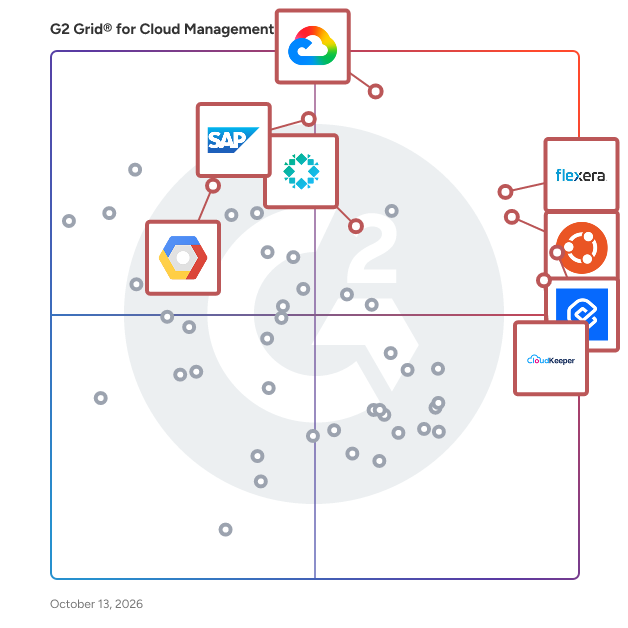
  # Best Enterprise Cloud Management Platforms - Page 2

  *By [Rachana Hasyagar](https://research.g2.com/insights/author/rachana-hasyagar)*


   Products classified in the overall Cloud Management Platforms category are similar in many regards and help companies of all sizes solve their business problems. However, enterprise business features, pricing, setup, and installation differ from businesses of other sizes, which is why we match buyers to the right Enterprise Business Cloud Management Platforms to fit their needs. Compare product ratings based on reviews from enterprise users or connect with one of G2&#39;s buying advisors to find the right solutions within the Enterprise Business Cloud Management Platforms category.

In addition to qualifying for inclusion in the Cloud Management Platforms category, to qualify for inclusion in the Enterprise Business Cloud Management Platforms category, a product must have at least 10 reviews left by a reviewer from an enterprise business.


## Top Cloud Management Platforms at a Glance
| # | Product | Rating | Best For | What Users Say |
|---|---------|--------|----------|----------------|
| 1 | [Google Compute Engine](https://www.g2.com/products/google-compute-engine/reviews) | 4.5/5.0 (875 reviews) | GCP-native VM provisioning and autoscaling workflows | "[Streamlined AI Training with Google Compute Engine, But Needs Longer Sessions](https://www.g2.com/survey_responses/google-compute-engine-review-12611767)" |
| 2 | [Ubuntu](https://www.g2.com/products/ubuntu/reviews) | 4.5/5.0 (2,340 reviews) | Zero-cost Linux infrastructure for cloud-native DevOps | "[Fast, Clean, and Efficient—Ubuntu Powers My Daily Workflow](https://www.g2.com/survey_responses/ubuntu-review-12843345)" |
| 3 | [Cast AI](https://www.g2.com/products/cast-ai/reviews) | 4.6/5.0 (191 reviews) | Autonomous Kubernetes cost optimization and rightsizing | "[Lock and Bolt Infrastructure: Fire-and-Forget Cloud Savings for K8s](https://www.g2.com/survey_responses/cast-ai-review-12457236)" |
| 4 | [SAP Business Data Cloud](https://www.g2.com/products/sap-business-data-cloud/reviews) | 4.2/5.0 (74 reviews) | SAP-native unified semantic data governance | "[Unify SAP and non-SAP data](https://www.g2.com/survey_responses/sap-business-data-cloud-review-12851557)" |
| 5 | [Flexera One](https://www.g2.com/products/flexera-one/reviews) | 4.3/5.0 (115 reviews) | Hybrid IT license compliance and FinOps visibility | "[A must have tool for inventory management for every organisation](https://www.g2.com/survey_responses/flexera-one-review-11647810)" |
| 6 | [CloudKeeper](https://www.g2.com/products/cloudkeeper/reviews) | 4.7/5.0 (288 reviews) | AWS cost visibility with guaranteed commitment-free discounts | "[Great Cloud Cost Dashboard with strong Granularity](https://www.g2.com/survey_responses/cloudkeeper-review-12298543)" |
| 7 | [AWS Compute Optimizer](https://www.g2.com/products/aws-compute-optimizer/reviews) | 4.4/5.0 (17 reviews) | ML-driven EC2 right-sizing recommendations | "[AWS through my eyes](https://www.g2.com/survey_responses/aws-compute-optimizer-review-10520148)" |
| 8 | [Rubrik](https://www.g2.com/products/rubrik/reviews) | 4.5/5.0 (267 reviews) | Immutable backup and ransomware-aware cloud recovery | "[Organised, Informative, and a Strong Shift Toward Cyber Resilience](https://www.g2.com/survey_responses/rubrik-review-12940696)" |
| 9 | [Cloudshot](https://www.g2.com/products/cloudshot/reviews) | 4.9/5.0 (60 reviews) | Multi-cloud visibility with diagram-to-deployment automation | "[Easy to Use, Multi-Cloud Visualizations and  operational features.](https://www.g2.com/survey_responses/cloudshot-review-10695935)" |
| 10 | [IBM Turbonomic](https://www.g2.com/products/ibm-turbonomic/reviews) | 4.4/5.0 (288 reviews) | AI-driven rightsizing across hybrid multicloud workloads | "[Advanced Infrastructure Optimizer with challenging configuration requirements.](https://www.g2.com/survey_responses/ibm-turbonomic-review-12821189)" |

    ---
## What Are the Most Common Questions About Cloud Management Platforms?
*AI-generated · Last updated: May 26, 2026*
  ### What top platforms for ensuring multi-cloud compliance?
  Based on G2 reviews, buyers looking at cloud management platforms for multi-cloud compliance consistently mention visibility, policy enforcement, and centralized oversight. Reviewers for Hyperglance describe strong compliance monitoring with visual cloud mapping and rule-based alerts across AWS, Azure, and Google Cloud environments. According to verified users, Flexera One is often used to improve license compliance and governance across cloud, SaaS, and on-prem assets from a single platform. G2 reviewers also mention Cloudshot for governance rules, IAM drift detection, and unified multi-cloud visibility, which can help teams monitor configurations across providers. Common tradeoffs mentioned in reviews include learning curves, setup effort, and occasional UI complexity.

**Here are some of the top-rated products on G2:**

- [Hyperglance](https://www.g2.com/products/hyperglance/reviews) – visualizes multi-cloud resources and flags compliance and security issues across environments
- [Flexera One](https://www.g2.com/products/flexera-one/reviews) – helps teams track compliance, governance, and spend across software, SaaS, and cloud assets
- [Cloudshot](https://www.g2.com/products/cloudshot/reviews) – supports governance monitoring with multi-cloud visibility and IAM drift detection


  ### What top-rated cloud management platforms for large enterprises?
  Based on G2 reviews, large enterprises often prioritize centralized visibility, automation, and governance across broad infrastructure estates. Flexera One is frequently discussed by reviewers managing large organizations because it combines software, SaaS, and cloud visibility in one platform and supports compliance and cost control. According to verified users, IBM Cloudability is valued for multi-cloud cost transparency, forecasting, and chargeback-style reporting across complex environments. G2 reviewers mention CloudKeeper for teams that want hands-on support alongside cost visibility and optimization, especially in AWS-heavy environments. Across reviews, enterprise buyers repeatedly call out reporting depth, hybrid or multi-cloud visibility, and the ability to reduce manual effort, though onboarding and configuration complexity are common concerns.

**Here are some of the top-rated products on G2:**

- [Flexera One](https://www.g2.com/products/flexera-one/reviews) – centralizes cloud, SaaS, and on-prem asset visibility for compliance and cost optimization
- [IBM Cloudability](https://www.g2.com/products/ibm-cloudability/reviews) – provides multi-cloud cost reporting, forecasting, and spend visibility for large teams
- [CloudKeeper](https://www.g2.com/products/cloudkeeper/reviews) – combines cloud cost analysis with technical support and optimization guidance


  ### Which cloud management tool offers the most automation?
  Based on G2 reviews, Cast AI stands out most often for automation-focused use cases in this category. According to verified users, it automates Kubernetes rightsizing, node scaling, rebalancing, and spot instance management with far less manual intervention than traditional tooling. G2 reviewers mention that it continuously adjusts resources, reduces infrastructure babysitting, and helps teams spend more time on product work instead of manual tuning. Reviews also highlight strong visibility into cost and cluster behavior, though some users note that advanced tuning, documentation clarity, and trust in autonomous actions can take time. For buyers prioritizing hands-off optimization, the review language around Cast AI is more automation-centric than most alternatives in this dataset.


  ### What best platforms for integrating cloud governance and cost control?
  Based on G2 reviews, the most commonly cited platforms for combining governance and cost control are Flexera One, IBM Cloudability, and Hyperglance. Reviewers describe Flexera One as useful for bringing compliance, asset visibility, and cloud cost management into one place. According to verified users, IBM Cloudability helps teams centralize spend visibility, budgeting, and optimization across cloud providers, which supports stronger financial governance. G2 reviewers mention Hyperglance for combining cost intelligence with architecture views, security monitoring, and compliance checks inside one platform. Across these products, buyers often value centralized dashboards and actionable recommendations, while also noting that setup, tagging strategy, and customization may require extra effort to get the most value.

**Here are some of the top-rated products on G2:**

- [Flexera One](https://www.g2.com/products/flexera-one/reviews) – combines compliance tracking, asset governance, and cloud cost optimization in one platform
- [IBM Cloudability](https://www.g2.com/products/ibm-cloudability/reviews) – supports cost governance with forecasting, reporting, and optimization across cloud providers
- [Hyperglance](https://www.g2.com/products/hyperglance/reviews) – unifies cloud visibility, cost insights, and compliance monitoring through visual infrastructure mapping


  ### What best tools for provisioning and scaling cloud resources?
  Based on G2 reviews, Cast AI, CloudBolt Software, and IBM Turbonomic are the strongest matches for provisioning and scaling cloud resources. Reviewers describe Cast AI as highly effective for automated Kubernetes scaling, rightsizing, and node management. According to verified users, CloudBolt Software helps teams accelerate provisioning with self-service blueprints, workflow automation, and a single point of entry for deployments. G2 reviewers mention IBM Turbonomic for automatically adjusting resource allocations, scaling workloads, and reducing over-provisioning across hybrid and cloud environments. Buyers often highlight time savings and reduced manual effort with these tools, while also noting that policy tuning, onboarding, or advanced customization can take time before full value is realized.

**Here are some of the top-rated products on G2:**

- [Cast AI](https://www.g2.com/products/cast-ai/reviews) – automates Kubernetes scaling, rightsizing, and node provisioning for dynamic workloads
- [CloudBolt Software](https://www.g2.com/products/cloudbolt-cloudbolt-software/reviews) – supports self-service provisioning with blueprints and workflow automation
- [IBM Turbonomic](https://www.g2.com/products/ibm-turbonomic/reviews) – optimizes and scales resources automatically based on workload demand


  ### What best software for real-time cloud resource monitoring?
  Based on G2 reviews, cloud teams looking for real-time monitoring often point to Hyperglance, Cloudshot, and CloudKeeper. Reviewers for Hyperglance repeatedly mention real-time visibility, topology mapping, and the ability to understand dependencies and issues across cloud resources. According to verified users, Cloudshot is valued for real-time monitoring, topology maps, and alerts that help teams detect changes and manage multi-cloud environments more efficiently. G2 reviewers also mention CloudKeeper for dashboard visibility, cost tracking, and support that helps teams investigate cloud usage and anomalies. Common themes across reviews include better visibility and faster troubleshooting, while drawbacks usually center on learning curves, interface complexity, or occasional lag in large environments.

**Here are some of the top-rated products on G2:**

- [Hyperglance](https://www.g2.com/products/hyperglance/reviews) – provides real-time infrastructure views, dependency mapping, and cloud monitoring insights
- [Cloudshot](https://www.g2.com/products/cloudshot/reviews) – offers real-time monitoring, topology maps, and alerts across multi-cloud environments
- [CloudKeeper](https://www.g2.com/products/cloudkeeper/reviews) – helps teams monitor cloud resources, usage trends, and cost-related changes through dashboards and support


  ### What top tools for managing multi-cloud deployments?
  Based on G2 reviews, buyers managing multi-cloud deployments most often mention Hyperglance, Cloudshot, and IBM Cloudability. Hyperglance reviewers emphasize unified visibility across AWS, Azure, Google Cloud, and Kubernetes, along with diagrams that make distributed infrastructure easier to understand. According to verified users, Cloudshot simplifies multi-cloud oversight with a single dashboard, topology mapping, and budget or governance-oriented monitoring. G2 reviewers mention IBM Cloudability for consolidating cloud spending data and improving control across providers, which is especially useful when financial management is part of deployment oversight. Across these reviews, the strongest themes are centralized visibility, easier troubleshooting, and cost transparency, balanced against setup effort and some dashboard complexity in larger environments.

**Here are some of the top-rated products on G2:**

- [Hyperglance](https://www.g2.com/products/hyperglance/reviews) – visualizes multi-cloud resources and dependencies in one centralized platform
- [Cloudshot](https://www.g2.com/products/cloudshot/reviews) – brings AWS, Azure, and GCP into a single dashboard for easier multi-cloud management
- [IBM Cloudability](https://www.g2.com/products/ibm-cloudability/reviews) – centralizes multi-cloud spend and reporting to improve deployment oversight and financial control


  ### Which is the best cloud management platform for hybrid environments?
  Based on G2 reviews, IBM Turbonomic is the strongest fit for hybrid environments in this dataset. According to verified users, it is frequently used across cloud and on-prem infrastructure to automate resource optimization, improve application performance, and reduce over-provisioning. G2 reviewers mention visibility across hybrid estates, workload-aware scaling, and policy-based automation that helps teams avoid constant manual tuning. Reviews also note benefits for Kubernetes, VMware, and broader hybrid cloud operations, especially when balancing cost and performance. The main cautions mentioned by reviewers are setup complexity, learning curve, and the need to tune policies carefully, but the hybrid environment use case appears consistently throughout the review set.


  ### Which cloud management solution is easiest to deploy?
  Based on G2 reviews, Cast AI appears to be the easiest to deploy among products with enough review volume in this dataset. According to verified users, onboarding is often described as fast and straightforward, with cluster connection happening quickly and initial value visible soon after setup. G2 reviewers mention simple installation, easy initial setup, and smooth onboarding for Kubernetes cost optimization and scaling use cases. Other products in the category are often praised for capabilities, but many reviews also call out steeper setup or configuration effort. Cast AI still has some reported learning curve around advanced controls and documentation, yet its reviews most consistently frame deployment as quick and low-friction.


  ### Which platform offers AI-powered workload optimization?
  Based on G2 reviews, Cast AI is the clearest match for AI-powered workload optimization. Reviewers consistently describe automated rightsizing, workload autoscaling, bin-packing, and cost-aware infrastructure decisions that reduce the need for manual tuning. According to verified users, the platform analyzes workload behavior and automatically recommends or executes optimization actions across Kubernetes environments. G2 reviewers mention that this helps cut waste, improve efficiency, and simplify scaling decisions, especially for teams managing multiple clusters or variable demand. Some reviews note that visibility into decision logic could be better and that teams may need time to build trust in automation, but the workload optimization theme is repeatedly associated with Cast AI.


## How Many Cloud Management Platforms Products Does G2 Track?
**Total Products under this Category:** 186

### Category Stats (Jun 2026)
- **Average Rating**: 4.55/5 (↑0.01 vs May 2026) The average rating of products in this category, based on all submitted ratings
- **New Reviews This Quarter**: 93
- **Buyer Segments**: Small-Business 40% │ Mid-Market 34% │ Enterprise 26% Represents the distribution of reviewers across all products in this category.
- **Top Trending Product**: Cloudbolt Software (+6.25%) - Among all products in this category, Cloudbolt Software recorded the largest rating increase compared to last month
*Last updated: June 09, 2026*

  
## How Does G2 Rank Cloud Management Platforms Products?

**Why You Can Trust G2's Software Rankings:**

- 30 Analysts and Data Experts
- 6,600+ Authentic Reviews
- 186+ Products
- Unbiased Rankings

G2's software rankings are built on verified user reviews, rigorous moderation, and a consistent research methodology maintained by a team of analysts and data experts. Each product is measured using the same transparent criteria, with no paid placement or vendor influence. While reviews reflect real user experiences, which can be subjective, they offer valuable insight into how software performs in the hands of professionals. Together, these inputs power the G2 Score, a standardized way to compare tools within every category.


---

**Sponsored**

### Hostman

Hostman is a cloud platform designed for developers, startups, and tech teams to deploy and manage websites, applications, e-commerce stores, games, and more. With Hostman, you have the freedom to choose services, reserve as many resources as you need, and manage them through a user-friendly interface. 🚀 Cloud Servers — High-performance servers in the USA, Poland, and the Netherlands (soon expanding to Singapore, Egypt, and Nigeria) with 25+ pre-configured setups for analytics, gaming, e-commerce, and streaming, and websites of any complexity. ☁️ Database Management — Instant setup for MySQL, PostgreSQL, MongoDB, Redis, Apache Kafka, and OpenSearch, ensuring secure and scalable data management. 🛠 App Deployment — Seamless integration with GitHub, GitLab, and Bitbucket for automated testing and deployment of web applications built with React, Angular, Vue, Next.js, Ember, and more. 🔒 S3 Storage — Experience unmatched performance and security with free bandwidth, SSL certificates, private and public buckets, and custom domains. 🧩 Kubernetes — Reliable clusters powered by 3.3 GHz processors and NVMe disks, providing unlimited traffic through high-speed 200 Mbit channels and guaranteeing a 100% CPU share. Hostman makes it simple to launch and scale cloud solutions efficiently while maintaining flexibility and control, whether you have one virtual machine or ten thousand.


[Visit website](https://www.g2.com/external_clickthroughs/record?secure%5Bad_program%5D=ppc&amp;secure%5Bad_slot%5D=category_product_list&amp;secure%5Bcategory_id%5D=2036&amp;secure%5Bdisplayable_resource_id%5D=80&amp;secure%5Bdisplayable_resource_type%5D=Category&amp;secure%5Bmedium%5D=sponsored&amp;secure%5Bplacement_reason%5D=neighbor_category&amp;secure%5Bplacement_resource_ids%5D%5B%5D=80&amp;secure%5Bprioritized%5D=false&amp;secure%5Bproduct_id%5D=142270&amp;secure%5Bresource_id%5D=2036&amp;secure%5Bresource_type%5D=Category&amp;secure%5Bsource_type%5D=category_page&amp;secure%5Bsource_url%5D=https%3A%2F%2Fwww.g2.com%2Fcategories%2Fcloud-management-platforms%2Fenterprise%3Fpage%3D2&amp;secure%5Btoken%5D=9bd177377d7924bfe3ce988ba7f6190271508c5486cdb4bd6c41b689c28d4aa6&amp;secure%5Burl%5D=https%3A%2F%2Fhostman.com%2F&amp;secure%5Burl_type%5D=company_website)

---

  
    ## What Is Cloud Management Platforms?
  [IT Management Software](https://www.g2.com/categories/it-management)
  ## What Software Categories Are Similar to Cloud Management Platforms?
    - [Infrastructure as a Service (IaaS) Software](https://www.g2.com/categories/infrastructure-as-a-service-iaas)
    - [Cloud Cost Management Tools](https://www.g2.com/categories/cloud-cost-management)
    - [Cloud Compliance Software](https://www.g2.com/categories/cloud-compliance)

  
---

## How Do You Choose the Right Cloud Management Platforms?

### What You Should Know About Cloud Management Platforms

### What are Cloud Management Platforms?

A cloud management platform (CMP) is a set of unified software tools which help companies monitor and control cloud computing resources. While these tools can be deployed by an enterprise exclusively for a public or private cloud arrangement, CMPs commonly focus on the management of hybrid and multi-cloud models to help optimize control of various cloud-based infrastructures. CMPs also include open-source software modules that provide a framework to create and manage both public and private cloud infrastructure. This aids cost management, backup and disaster recovery, and enhancement of performance and security.

Cloud management platforms offer the administrative visibility and capability of [cloud cost management software](https://www.g2.com/categories/cloud-cost-management), [cloud infrastructure monitoring software](https://www.g2.com/categories/cloud-infrastructure-monitoring), [cloud infrastructure automation software](https://www.g2.com/categories/cloud-infrastructure-automation), and more. CMPs are designed to integrate with a variety of [infrastructure as a service (IaaS)](https://www.g2.com/categories/infrastructure-as-a-service-iaas) tools as well.

#### What Types of Cloud Management Platforms Exist?

**Focused platforms**

Platforms that offer only one type of cloud problem solving, say, cloud security to protect data, applications, and infrastructure from threats, and automation of tasks to reduce manual intervention, or cost optimization to increase business efficiency. These products will generally focus on a specific task.

**Multi-cloud platforms**

In multi-cloud infrastructure, cloud assets, software, and applications are distributed across several cloud environments. With a typical multi-cloud architecture involving two or more public and private clouds, a multi-cloud environment aims to eradicate the dependency on any single provider or instance. Multicloud management is the set of tools and procedures that allows a business to monitor and secure applications and workloads across multiple public or private clouds or a combination of both. By offering simplified, centralized management, a multi-cloud management solution allows IT teams to more effectively manage applications and workloads across multiple clouds.

**Hybrid cloud and hyper-converged infrastructure (HCI)&amp;nbsp;**

Platforms that support hybrid clouds as well as on-premise infrastructure fit into this category. Hyper-converged infrastructure (HCI) is a software-defined, unified system that combines all the elements of a traditional data center—storage, computing, networking, and management. Hybrid cloud solutions combine a private cloud with one or more public cloud services, with proprietary software enabling communication between each distinct service. Hybrid cloud computing is powerful because it gives businesses greater control over their private data. An organization can store sensitive data on a private cloud or local data center and simultaneously leverage the robust computational resources of a managed public cloud. Due to complexities such as migration of services, compatibility issues between different cloud service providers, etc., in the management of such an infrastructure, these tools rely heavily on custom implementation.&amp;nbsp;

### What are the Common Features of Cloud Management Platforms?

The following are a few essential features that a cloud management platform should have to help organizations gain visibility into their cloud deployments and take necessary actions.

**Cost control:** A good cloud management tool should provide insights to the user to help them visualize the utilization and cost of current infrastructure and track cost consumption across all cloud resources. Insights will help the user to reduce overall costs. A cloud management platform is a software solution whose main attribute is a vast and extensive set of APIs that allow it to extract data from every area of the IT infrastructure. The tools should be able to provide cost savings by giving one the capability to hibernate their unutilized resources and provide insights into each service with estimated savings.&amp;nbsp;

**Logs monitoring:** What makes a cloud management tool unique is its ability to integrate monitoring processes by providing logs from all the major resources. CMPs are purpose-built to draw humongous volumes of data from the user’s application stack in the form of automatically generated computer logs. Log files contain information about every event that occurs in the user’s cloud environment. Analyzing those files can yield information about errors, vulnerabilities, compliance, security, and more.&amp;nbsp;

**Compliance:** Cloud compliance is the principle that cloud-delivered systems must be in accordance with the standards their customers require. It ensures that cloud computing services meet the compliance requirements of enterprise customers. Maintaining compliance takes effort on the part of both the cloud service provider and the enterprise; without that effort, the organization&#39;s data could be at risk of not adhering to mandatory rules and regulations.

**Optimizing the overall workload:** CPM implementation in the IT market makes workflow better, optimizing the best practice and managing the resources to get better outcomes without losing out on either money or time. Features of the cloud management tools are connected internally and work together. This means that the tool can automatically control the infrastructure and make adjustments when necessary. The platform also helps in decision making. It can also play a role in managing and creating policy frameworks.

**Billing and metering:** This is another crucial feature provided by a cloud management platform. CPM accounts for an organization’s unique cloud architecture and finds ways to manage billing and chargebacks effectively. Metering refers to the methods and tools used to track the usage of infrastructure and software delivered via the cloud. IaaS, PaaS, and SaaS vendors have a variety of options for metering the usage of the solutions they provide to clients, including per-user metering, per-account metering, and per-transaction metering.

### What are the Benefits of Cloud Management Platforms?

**Self-service management:** Most CMP solutions support self-service cloud resource management. Enterprises can provision resources for their cloud environment themselves rather than having a set amount of resources delivered. A CMP can help enterprises determine if they are using the optimal amount of resources for their business needs. That can help in determining the correct amount of resources to request from the cloud provider in the future.

**Cloud cost management:** Enterprises want to manage their resource usage to reduce costs. Resources that aren&#39;t being used will just be a drain on the company’s finances. By managing operations to ensure that every resource is being used, cloud cost optimization can reduce the wastage of resources.&amp;nbsp;

**Automated management policies:** CMPs deliver automated cloud management policies and tasks to help utilize resources using automatic orchestration. For example, it automates the process of finding spare resources on the network whenever one needs them. Rather than waiting until the IT team discovers wasted resources, the CMP automatically fixes resource usage problems.

**Cloud compliance and governance:** Usage of cloud services requires the integration of traditional IT governance best practices, such as compliance and chargebacks. Therefore, to govern the cloud for operational excellence, it is important to implement cloud management tools for compliance, incident, and transparent financial management. By doing this, the IT team will run responsible, compliant operations—with tight fiscal controls and transparency. As a result, an organization can benefit from economies of scale, lower individual usage costs, and centralize infrastructure costs while extending or improving current governance capabilities.

### Who Uses Cloud Management Platforms?

**IT industry:** CMPs help IT teams secure and optimize cloud infrastructure, including the applications and data residing on it. Administrators can manage compliance, set up real-time monitoring, and prevent cyberattacks and data breaches. Today organizations have dozens of diverse applications running in the cloud. Cloud management gives visibility and control over this otherwise uncoordinated ecosystem, integrating operating systems, applications, storage frameworks, provisioning, cloud security, and anything else hosted on the enterprise’s cloud. Administrators gain access and control over the enterprise cloud through a web-based interface that they can access remotely.&amp;nbsp;

**Finance industry:** Cloud services enable the digital transformation of the finance industry while cloud management platforms offer a dramatically improved experience for this industry using the platform. Due to the increase in mobile consumerization and mass digitization, financial services institutions are transforming data and automating core processes and workflows. The banking sector now provides customized solutions to meet the needs of their diverse customer base with the help of enterprise cloud managed services that support a multitude of enterprise applications. Since cloud offerings and adoption of cloud services are growing, a CMP solution aids in streamlining operations, enabling managed service providers (MSPs) to deliver financial governance, security and compliance governance, and identity and access governance across multiple public clouds. By implementing a CMP solution, the BFSI sector can lower infrastructure costs and increase asset utilization, thereby improving agility and operational efficiency.

**Media and entertainment industry:** A global consumer base with a growing demand for “bingeable” content is pushing the M&amp;E industry to provide content that is not only available in a variety of formats, but also tailored for diverse audiences in disparate geographies. Implementation of a cloud management platform helps media enterprises streamline access to media from any location. It enables the management of huge quantities of digital content in a faster, dynamic, and cost-effective manner.&amp;nbsp;

**E-commerce industry:** The scalability of the cloud complements the needs of the retail sector. Provisioning more servers on its own or obtaining funds to build a bigger IT infrastructure will slow down an enterprise&#39;s growth. Cloud management solutions provide a business the ability to view and search for non-compliant servers across environments. CMP provides superior stability for online retail and ensures cost efficiency. Cloud management provides advanced data security which has been a rising concern for e-commerce platforms.

**Automotive industry:** The automotive industry needs to be up-to-date with its supply chain as this allows them to interact effectively with customers and cater to their needs. Cloud management platforms help this industry as they can have a common environment for both automotive suppliers and manufacturers to share data to ensure that both sides have supply chain visibility. Cloud management platforms are useful for moving, storing, securing, and indexing massive volumes of data generated from connected vehicles.&amp;nbsp;

**Healthcare industry:** Cloud healthcare solutions help doctors to easily stay connected to their patients which improves collaboration with each other. Cloud solutions for the healthcare sector enhance patient engagement, empower health team collaboration, and improve clinical and operational data insights to improve decision making and operational efficiencies. Implementing a cloud management platform by the healthcare industry makes it faster and easier to provide more efficient services to patients and helps ensure the end-to-end security, compliance, and interoperability of health data.

#### Software Related to Cloud Management Platforms

[Cloud cost management software](https://www.g2.com/categories/cloud-cost-management) **:** Cloud cost management software allows an enterprise to understand and manage the costs and needs associated with its cloud technology. In particular, this means finding cost-effective ways to maximize cloud usage and efficiency. These tools are typically paired with an [infrastructure as a service (IaaS) provider](https://www.g2.com/categories/infrastructure-as-a-service-iaas) offering to minimize the costs of their pay-as-you-go model. Cloud cost management software helps companies reduce waste by alerting users of low demand or automatically scaling usage to optimal rates. Companies also use these tools to increase the efficiency of their cloud service usage—these solutions often provide reporting features to outline waste and redundancies. Cloud cost management software has some overlap with [SaaS spend management software](https://www.g2.com/categories/saas-spend-management), but the latter is used to monitor and manage spending on cloud applications rather than infrastructure.

[Cloud infrastructure monitoring software](https://www.g2.com/categories/cloud-infrastructure-monitoring) **:** Cloud infrastructure monitoring software allows companies to visualize and track the performance of their applications or services. These tools aggregate data in real time to display information related to a company’s cloud-based resources. These tools can track application performance, network availability, and resource allocation, among other factors. Cloud infrastructure monitoring is a process that makes sure an application both remains available and responds to user requests within an acceptable amount of time. It can also involve goals such as optimizing code or reducing infrastructure costs. Cloud infrastructure monitoring tools may have overlapping features with either [cloud workload protection platforms](https://www.g2.com/categories/cloud-workload-protection-platforms) or [cloud cost management software](https://www.g2.com/categories/cloud-cost-management). Those tools, however, perform more individualized and specific management capabilities and may not provide adequate or necessary monitoring capabilities.

[Cloud infrastructure automation software](https://www.g2.com/categories/cloud-infrastructure-automation) **:** Cloud infrastructure automation technology is used to provision servers and computer data centers through metadata files, as opposed to physical configuration. The concept in practice can also be referred to as implementing &quot;infrastructure as code&quot; or performing continuous configuration automation. Developers will create templated infrastructure to run their application code, review, and integrate it. These templates can then be reused and generated automatically, minimizing a developer’s need to reconfigure infrastructure. Companies use cloud infrastructure automation technology in DevOps practices to reuse pre-configured infrastructure and ensure configuration visibility at all times. These tools can save developers time in configuring infrastructure as well as reduce downtime. These tools have a strong tie to the continuous delivery process. Many DevOps-focused [configuration management software](https://www.g2.com/categories/configuration-management) tools will have the ability to automate cloud infrastructure, but that capability is not inherent in all configuration management tools.

Other Software Related to Cloud Management Platforms: [AWS management](https://www.g2.com/categories/cloud-management-platforms/f/aws-management), [Azure management](https://www.g2.com/categories/cloud-management-platforms/f/azure-management), [Google Cloud Platform (GCP) management](https://www.g2.com/categories/cloud-management-platforms/f/google-cloud-platform-gcp-management), [Others](https://www.g2.com/categories/cloud-management-platforms/f/others),

### Challenges with Cloud Management Platforms

**Security and privacy:** Keeping confidential data safe and secure is among the topmost priorities for organizations. Earlier, most companies used corporate firewalls to safeguard their sensitive data. Now with migration to the cloud becoming increasingly common, the challenge of keeping the data secure makes businesses extremely cautious. Where the cloud provider provides the first layer of security, the customer must provide the second. The challenge here is that customers must know what is required by each cloud service provider so that they can properly secure data across their various providers.

**Interoperability:** Another common challenge that businesses face while using cloud infrastructure is how to avoid the prospect of being locked into a service. Cloud environments are typically built around an organization’s requirements, which means that switching can be hard. Every business should expect the freedom of portability that allows them to move in and out of the cloud, and between clouds without any hassles. When that is not possible due to lock-in periods and other similar problems, the benefits can be lessened.&amp;nbsp;

**Cloud costs:** Costing is a significant challenge in the adoption, operation, and migration of cloud computing services, especially for small and mid-sized businesses.&amp;nbsp;

**Cloud migration:** Cloud migration refers to the process of moving all the applications and data from on-premises storage to the cloud. Moving business operations to a cloud service provider can be very challenging and may impact the functioning of connected systems. Among the other challenges involved with migration are security configurations, other software investments, time-consuming preparatory work, slow data migrations, extensive troubleshooting, and application downtime.

**Limitations on cloud reporting structure:** Rather than using a single cloud, organizations today are using multiple public and private clouds. Enterprises tend to receive reporting metrics from different cloud service providers. This can be challenging when not only trying to correlate between reports from each of these providers but with the organizational reporting structure itself. This imposes limitations on one’s cloud reporting structure.

### How to Buy Cloud Management Platforms

#### Requirements Gathering (RFI/RFP) for Cloud Management Platforms

If a company is just starting and looking to purchase its first CMP, or maybe an organization needs to update a legacy system--wherever a business is in its buying process, [g2.com](https://www.g2.com/) can help select the best cloud management platform for the business.

Finding the right cloud management platform for a business can be difficult due to numerous potential vendors and seemingly similar offerings. Without digging deeper to uncover the details, enterprises run the risk of selecting a solution that can result in unexpected costs, vendor lock-in, difficult-to-agree service level agreements (SLAs), or simply a lack of fit to requirements.&amp;nbsp;

The functional or technical requirements are a core part of the purchase process. Functional requirements usually vary from one organization to the next. Organizations must determine the end goal of purchasing a CMP, whether it is for optimizing costs, requirements around data retention, security, performance, or specific functional requirements. Depending on the scope of the deployment, it might be helpful to produce an RFI, a one-page list with a few bullet points describing what is needed from the platform.

#### Compare Cloud Management Platform Products&amp;nbsp;

**Create a long list**

As more and more organizations build internal private clouds or enter the service provider market with public clouds, choosing the right vendor and platform for managing today’s hybrid and multi-cloud environments boils down to more than just technical capabilities.

Long lists are created by eliminating the options that do not align with the organization’s cloud strategy. Vendor evaluation is an essential part of the CMP buying process, it helps to prepare a consistent list of questions regarding specific needs and concerns to ask each vendor.

Whether embarking on a proof-of-concept/pilot or a full enterprise-level deployment of the CMP, the following considerations should enable the establishment of realistic and achievable goals:

**Business requirements:** It is important to take into consideration which departments and clients will benefit from the platform deployment and the extent of disruption during the implementation. A business must also take into account the period within which implementation of the CMP will start generating ROI.

**Product requirements**** :** The enterprise willing to adopt a CMP should determine the consistency of the platform with its existing cloud strategy. The tool helps in the management of the various cloud platforms and cloud services. Achieving the full value of this investment also requires integration with other tools in the infrastructure that support functions such as service management, DevOps, configuration management, and financial management. A CMP should allow for seamless integration with the organization’s existing services to generate customized and actionable insights.

Depending on whether a SaaS or on-premises deployment solution is selected, there may be an impact on the existing connectivity and service level commitments. It is crucial to understand the management functions covered by the CMP in terms of resources, spend, and security and how fast it can detect usage of resources and determine their necessity.&amp;nbsp;

**Support requirements:** The enterprise should be aware of the extent to which it will be dependent on the vendor after the full implementation of the platform. Additionally, vendor patch releases are an important consideration when evaluating cloud management vendors. The user must find out about the release cycles and frequency of the releases in their development cycles. Vendors should provide regular fixes and functional enhancements. If an organization is using a CMP with a SaaS model, it can usually minimize the impact of software releases. The process is usually more seamless than an on-premises deployment.

**Create a short list**

From the long list of vendors, it is pragmatic to narrow down the list of contenders. Enterprises must select solutions that are aligned with the enterprise’s goals. With this list, businesses can compare the features offered by different vendors and the pricing structure of various solutions.

**Conduct demos**

Demos provide an opportunity to buyers to see how a cloud management platform works. While pre-recorded demonstrations and slide decks are available online, it is lucrative to request the vendor for a live demo of the CMP platform using the system to dive deep into their technical capabilities.&amp;nbsp;

Additionally, mapping out a draft deployment plan or proof of concept (POC) is highly recommended before making a selection as it provides a roadmap for subsequent activities and defines the resources that are required in each phase. A PoC should prove (or disprove) whether the technology matches the organization’s requirements.&amp;nbsp;

#### Selection of a Cloud Management Platform

**Choose a selection team**

It is important to recognize that project success is based on a team’s effort including the vendor that will support the CMP deployment with their training and professional services staff as well as the tenant and end-user community. Forming the team and establishing a common vision is imperative. The partnerships for deployment must extend into the enterprise itself.&amp;nbsp;

**Final decision**

Cloud services and CMPs are still evolving, it is unlikely that any one platform can serve as a “one size fits all” solution. However, selecting a vendor that has a strategy aligned with the enterprise’s directions and objectives will accelerate growth as the product matures. Rapid developments have pushed providers to innovate and develop mature solutions that work with top public cloud providers as well as on-premises virtual stacks.&amp;nbsp;

Here are few factors to consider while making the final decision:

**Total cost of ownership and cost associated with day-to-day data transfers:** One way to evaluate a cloud management vendor is to establish the total cost of ownership (TCO) of its CMP. This involves calculating the cost of acquisition and the recurring operational costs for the service. If there are any additional integrations required, it’s best to include the anticipated costs into the TCO estimate. Some cloud providers offer a low base price but charge extra fees to transfer data. This could lock the user into their product by making it a costly affair to transfer to another provider, hampering the user’s ability to use their data in a way that best suits their requirements. Many cloud service providers encourage customers to move data into their respective clouds by not charging for data ingress. However, data transfer fees do exist for data egress—or moving data out of a cloud data center—not just from the cloud to on-premises, but also between data centers within the same provider, or another cloud provider. The data transfer fees can add up over time. It is crucial to keep data transfer fees in mind when choosing a cloud management solution.&amp;nbsp;

**Product licensing or service subscription model:** A CMP is either a vendor SaaS offering, open-source or a licensed on-premises product. Acquisition and recurring costs will vary widely based on the model an enterprise opts for. It is imperative to scrutinize the terms and conditions of the product support and licensing agreements or SaaS SLAs to achieve enterprise goals within the defined OPEX (operating expense) and CAPEX (capital expenditure) budgets.&amp;nbsp;

**Identifying risks and opportunities early:** Whether a commitment to a given CMP product has been made, or early evaluation is underway, it is important to capture and monitor deployment and operations risks, and improvement opportunities early so that it is possible to leverage the lessons learned, contain cost overruns, and modify plans when needed. Whenever a new technology is leveraged, it is good to devise back-out plans or alternatives when assumptions and outcomes change. It must be ensured that the solution chosen will be adaptable to the organization’s future requirements.

### Cloud Management Platforms Trends

**Multi and hybrid cloud environments will continue to grow**

Enterprises recognize that cloud management isn’t about having one specific platform or infrastructure, it’s about choosing the solution that’s fit for the job at hand. The emerging trend is that enterprises are becoming less worried about sticking with one vendor and embracing a multi-cloud or hybrid-cloud offering to get the best out of each solution.

**Solution-focused partners**

As businesses continue to move their infrastructure using SaaS, PaaS, and IaaS, there will be a continuous requirement for third-party vendors who specialize in meeting specific use cases and problem-solving. While one’s cloud service provider will be responsible for infrastructure needs such as storage, outsources will be taking care of computing and networking, specific needs such as data, visibility, AI and ML technology, or IoT.

**Continuous shift to tech on demand**

As cloud costs are controlled, businesses will have more revenue at their disposal to take advantage of solutions that beat their specific industry challenges. In turn, providers will look to push out innovation that is easily accessible to a wide audience, has a low learning curve, low-code interface, and is more democratized overall, so that anyone can reap the rewards.


