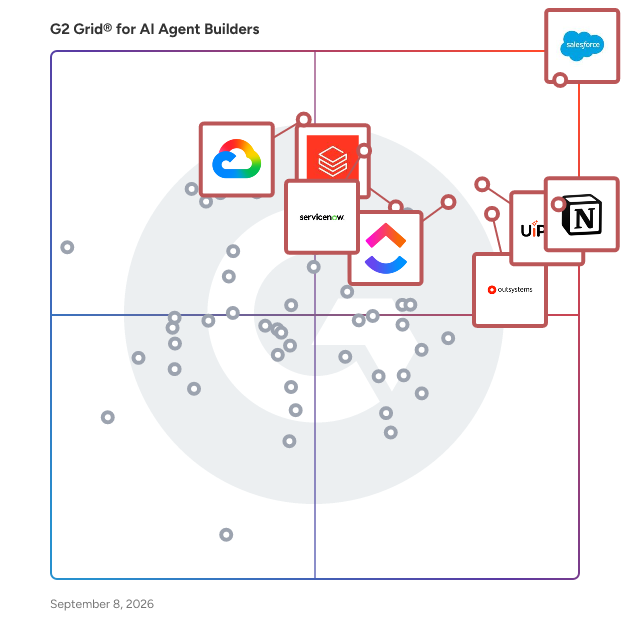
AI agent builders are platforms designed to build, deploy, and manage autonomous AI agents deeply integrated with a company’s data ecosystem, business processes, and customer relationship management (CRM) systems.
Automation is a fundamental component of these platforms, which is facilitated by connections to the enterprise’s core systems. As a result, these platforms offer a level of specificity and integration that sets them apart from broader bot platforms.
AI agent builders provide extensive integrations that create a lock-in effect that enhances the agents' capabilities. Unlike standard chatbots software, which may provide basic conversational abilities, AI agent builders enable highly customizable agents of different varieties that can be embedded directly into business workflows and data structures.
AI agent builders can provide a more refined conversational experience than traditional chatbots due to their focus on specialized roles and targeted business functions. They act autonomously to support a variety of agentic use cases, such as customer support, sales development, human resources (HR), and IT operations.
These builders allow for a high degree of customization. They enable businesses to design agents tailored to their exact needs, leveraging natural language processing (NLP) and machine learning (ML) to understand user interactions and provide contextually aware, personalized responses. Furthermore, AI agent builders differ from AI agents as they support proactive and reactive interactions, allowing agents to autonomously initiate or respond to user queries, perform actions based on triggers, and seamlessly escalate complex issues to human agents when necessary.
To qualify for inclusion in the AI Agent Builders category, a product must:
G2's software rankings are built on verified user reviews, rigorous moderation, and a consistent research methodology maintained by a team of analysts and data experts. Each product is measured using the same transparent criteria, with no paid placement or vendor influence. While reviews reflect real user experiences, which can be subjective, they offer valuable insight into how software performs in the hands of professionals. Together, these inputs power the G2 Score, a standardized way to compare tools within every category.
Buyer's Guide: AI Agent Builders
What does an AI agent builder do?
I describe AI agent builders as platforms that allow teams to design automated agents capable of performing tasks, handling conversations, and integrating with internal systems. These tools provide a controlled environment to outline an agent’s logic, define triggers, and connect data sources, enabling it to operate reliably. Instead of writing every action from scratch, I can structure workflows, permissions, and knowledge inputs in a single, centralized location.
Why do businesses use AI agent builders?
I’ve seen most teams seek ways to automate repetitive tasks without compromising quality. AI agent builders support that by managing predictable interactions and routing more complex requests to humans when needed. They help offload work while maintaining consistent responses.
Based on the G2 review data I’ve analyzed, a few themes appear frequently:
These shared points show how AI agent builders help teams improve efficiency and maintain predictable outcomes.
Who usually uses AI agent builders?
Based on G2 review insights, the groups that rely heavily on AI agent builders include:
Each group uses agents differently, but the goal remains the same: to streamline tasks while maintaining a consistent experience.
What types of AI agent builders should I consider?
G2 reviewers often distinguish agent builders by their complexity and intended users. The types I see most frequently include:
The best fit depends on your team’s technical comfort and the sophistication of the tasks you want the agent to handle.
What are the core features to look for in AI agent builders?
When I sort through G2 feedback in this category, a handful of features consistently show up as make-or-break for successful deployment.
These capabilities shape how dependable and scalable an agent ultimately becomes.
What trends are shaping AI agent builders right now?
As the market evolves, I’m seeing new features and design philosophies that make AI agent builders far more adaptable than they used to be. Some of the notable trends include:
How should I choose an AI agent builder?
For me, the best agent builder is the one that matches team skill level, integrates cleanly with existing systems, and provides enough control to handle complex workflows safely. When those pieces align, the platform becomes a reliable part of how teams automate tasks and deliver consistent, scalable interactions.
This description is provided by the seller.
Vivgrid is an AI agent platform designed to help teams build, test, and operate production-ready AI agents with confidence. Instead of stitching together scattered tools for orchestration, evaluation, monitoring, and deployment, Vivgrid provides a unified environment that brings the entire agent lifecycle into one place. Teams get full observability into every prompt, tool call, and decision, along with automated safety evaluation and guardrails that ensure agents behave reliably before and after launch. With built-in multi-agent orchestration and a globally distributed GPU inference network, Vivgrid enables developers, startups, and enterprises to deploy agents with low latency anywhere in the world. Supporting frontier models like GPT-5.1, Gemini 2.5 Pro, and DeepSeek-V3, Vivgrid is built for real-world applications—from rapid prototypes to mission-critical enterprise systems. Our mission is to make AI agents trustworthy, scalable, and operationally simple, empowering organizations to bring intelligent automation into everyday workflows.
This description is provided by the seller.
Workforce is Agile Defense Labs’ Generative AI hub that fields reusable “AI Teammates” and orchestrated multi-agent Teams to augment analysts, planners, and operators. Workforce isn't just another chatbot -- it's the platform for building truly autonomous AI workflows.
This description is provided by the seller.
Workgrid is an AI Assistant designed to simplify the workday for employees. It provides employees with a single conversational interface to find information and perform tasks across various systems, documents, and knowledge sources. Workgrid's conversational AI platform delivers over 50 prebuilt agent templates and a low-code builder to create bespoke agents, offering companies an efficient and scalable way to deploy AI agents for any use cases across their organization.
Pros and Cons are compiled from review feedback and grouped into themes to provide an easy-to-understand summary of user reviews.
Users value the ease of use of Workgrid, benefiting from a personalized dashboard and efficient task management features.
Users appreciate the easy integrations of Workgrid, enabling streamlined communication and improved productivity across teams.
Users value the efficiency of Workgrid, enjoying streamlined task management and integration that enhances productivity.
Users find the learning curve challenging, which can hinder the effective use of Workgrid's features initially.
Users find the dependency issues of Workgrid challenging, especially due to integration and compatibility with other systems.
Users report integration issues with Workgrid that disrupt workflow continuity and hinder overall efficiency.
This description is provided by the seller.
Pros and Cons are compiled from review feedback and grouped into themes to provide an easy-to-understand summary of user reviews.
Users value the ease of use of Workgrid, benefiting from a personalized dashboard and efficient task management features.
Users appreciate the easy integrations of Workgrid, enabling streamlined communication and improved productivity across teams.
Users value the efficiency of Workgrid, enjoying streamlined task management and integration that enhances productivity.
Users find the learning curve challenging, which can hinder the effective use of Workgrid's features initially.
Users find the dependency issues of Workgrid challenging, especially due to integration and compatibility with other systems.
Users report integration issues with Workgrid that disrupt workflow continuity and hinder overall efficiency.

