Translation Management Software Features
Translation management tools bring together mainstay translation software solutions with automation to streamline the translation and localization process. Below are the core features within translation management software, as well as secondary features that some products may include in their offering.
Computer-assisted translation (CAT) — Translation management software comes with a built-in CAT program. Some translation management solutions provide their own native CAT solution or provide integrations with leading CAT tools in the industry. In either case, translation management software always allows translators to access a CAT tool within the application.
Glossary — Translation management software allows users to store glossaries for multiple languages. Editable glossaries allow translators to record and store frequently-used words, speeding up the translation process so they are able to focus on novel words or technical terms specific to a project.
User permissions — This type of software allows administrators to designate certain permissions on a user-by-user basis. This feature is particularly popular in solutions with client-facing capabilities. This feature enables LSPs to give their clients insight and input into translation projects without giving them all the permissions of their translators.
Comments and mentions — Translation management software allows users to comment or mention others for proofreading purposes. Comments and mentions are the main forms of communication between translators working on a project. They allow translators to ask questions and provide feedback without tampering with the project itself.
Additional Translation Management Software Features
Billing and invoicing — The software allows users to bill and invoice clients from within the application. Some translation management tools are integrated with external billing and invoicing tools instead of providing one themselves, but are still made available in the application for the convenience of the user.
Client portal — Translation management software offers a client-facing portal that allows clients to provide feedback and review information within the application. Some translation management tools are integrated with external client portal tools instead of providing one themselves, but they are still made available in the application for the benefit of the user.
Client management — Translation management software allows users to manage their client information within the application.
Resource management — This type of software allows users to manage their workforce and resources.
Task delegation — Translation management software allows users to create and delegate tasks surrounding translation within the application. Task delegation features can look very similar to those found in task management software, though these will be more specific to translation and localization projects. Some solutions come with pre-built workflows as well.
Quality assurance — The software comes with built-in quality assurance testing features.
Translation Management FAQs
Most Popular FAQs
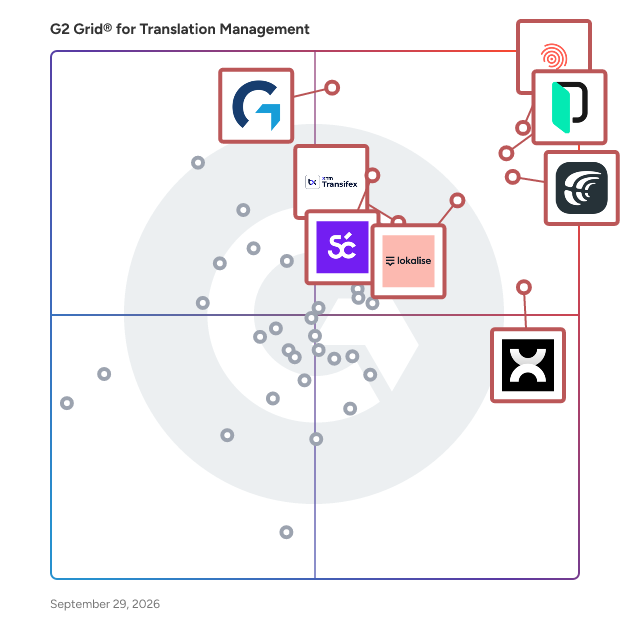
Which translation management software has the best reviews?
Shortlist the products that feel consistently strong on usability, support, and day-to-day workflow quality:
-
Weglot - A strong fit for teams that want fast multilingual website deployment with minimal setup overhead.
-
Lokalise - Best for teams that need structured localization workflows, automation, and cross-functional collaboration.
-
Smartling - A good choice for organizations that want polished workflow controls, QA, and managed translation operations.
-
Crowdin - Well-suited to software and product teams that want collaborative translation tied closely to development workflows.
Why consider a translation management system?
Consider a translation management system when multilingual content is starting to outgrow spreadsheets, ad hoc vendor handoffs, or manual copy-paste work. The value is usually in centralizing translation memory, glossaries, approvals, and collaboration, so launches move faster, consistency improves, and fewer errors slip into production.
What is the best solution for managing multi-language content workflows?
Prioritize platforms that make intake, assignment, review, QA, and handoff feel connected rather than fragmented:
-
Phrase Localization Platform - A strong all-in-one option for teams managing recurring localization work with translation memory and streamlined project flow.
-
Smartling - Best for organizations that want governance, workflow clarity, and fewer quality issues at scale.
-
Lokalise - Ideal for teams that want automation and task-based workflows across product, content, and localization.
-
Crowdin - A good match for collaborative, file-based, and developer-linked localization processes.
What platform integrates translation management with CMS systems?
Start with products that repeatedly feel natural in connected publishing environments and reduce manual publishing work:
-
Weglot - Best for website teams that want a fast CMS-friendly path into multilingual publishing.
-
Crowdin - A solid pick for teams that want localization tied to repos, content sources, and developer workflows.
-
Transifex - A good option for companies managing website, product, and digital content localization from one hub.
-
Smartling - Strong for enterprises that want broader integration flexibility with workflow and quality controls.
What is the difference between LLM and NMT?
NMT is a translation-first engine, and an LLM is a broader language model that can also translate. In practice, NMT is usually better when you want predictable, scalable translation with terminology control and repeatability, while LLMs are more useful when you need context handling, rewriting, or tone adaptation around the translation task. The practical tradeoff is that LLMs can feel more flexible, but NMT often remains the safer choice for high-volume production localization and domain-specific consistency.
Small Business FAQs
What is the most affordable translation management software for SMBs?
For smaller teams, focus on tools that look lightweight to adopt before worrying about enterprise depth.
-
Localazy - A smart fit for SMBs that want automation and fast rollout without a heavy admin burden.
-
POEditor - Best for small teams that want a straightforward online localization workflow with less operational complexity.
-
Loco - A practical choice for teams that want a simpler translation workflow without overbuilding their stack.
What is the best translation management software for startups?
For startups, favor products that help a lean team move quickly, launch internationally, and avoid building localization operations from scratch.
-
Gridly - A strong option for startup teams that want flexible content structures and localization workflow control in one place.
-
Phrase Localization Platform - A good fit for startups that need room to grow from simple localization into more mature workflows.
-
Crowdin - Best for product-led startups that want collaboration and developer-friendly localization.
-
Localize - Worth a look for startups that want a focused path to managing website and product localization.
Which translation management software is the most user-friendly for startups?
Ease of use is especially important for startup teams that need software with a short onboarding curve, minimal setup friction, and a workflow that feels intuitive from the first project. These translation management platforms for small business earn strong marks for usability among startup and small-team users:
-
Weglot - Best for startups that want the fastest path from one-language content to multilingual publishing.
-
Localazy - A strong fit for small teams that want automation and easy review cycles without much setup friction.
-
memoQ - A good option when startups want richer translation features but still need the product to stay approachable.
-
POEditor - Useful for teams that want a simple online interface for organizing strings and translations.
Why do SMBs adopt translation management earlier than they expect?
SMBs hit the need for translation management as soon as multilingual content becomes continuous instead of occasional. Once marketing pages, product UI, help content, and release updates all need to stay in sync across languages, a dedicated system starts saving time immediately by reducing rework and keeping terminology consistent.
How quickly can a small business see value from translation management?
A small business can see value quickly when the tool removes manual coordination, speeds up publishing, and gives the team one place to manage translations and reviews. The fastest wins usually come from easier setup, cleaner handoffs, and fewer repetitive edits across languages.
Enterprise FAQs
What is the best-rated translation management software for tech enterprises?
For larger organizations, look for products that balance governance, integrations, and workflow discipline.
-
Lokalise - A strong fit for tech enterprises that need automation, task management, and collaboration across product teams.
-
Phrase Localization Platform - Best for enterprises that want an all-in-one localization operating layer with room for scale.
-
Smartling - A dependable choice for enterprises that value QA, workflow consistency, and managed localization rigor.
-
GlobalLink - Worth considering when enterprise-grade control and centralized global translation operations matter most.
What is the most reliable translation management tool for enterprises?
For enterprise buyers, reliability usually means stable workflows, strong support, repeatable quality, and fewer surprises during high-volume localization.
-
GlobalLink - A good fit for enterprises that prioritize consistency, operational control, and broad global translation coverage.
-
XTM Cloud - Best for organizations that need structured multilingual workflow management across larger programs.
-
Smartling - A reliable option for enterprises that want a mature workflow and strong service layer.
-
Crowdin - A solid enterprise choice when collaboration and developer-connected localization are central.
What is the best-reviewed translation management software for enterprise app integration?
For enterprise integration needs, prioritize products that fit naturally into product, repository, and content workflows rather than forcing localization into a separate silo.
-
Transifex - A strong choice for enterprises managing ongoing app, website, and digital content localization.
-
Lokalise - Best for product organizations that want localization embedded into engineering and release workflows.
-
memoQ - A good fit for enterprises that need API-connected workflows and centralized language assets.
-
Phrase Localization Platform - Useful for teams that want flexible integration paths plus broader localization management.
How do enterprises keep terminology and approval workflows consistent across regions?
Treat this as a governance problem first and a translation problem second. The best enterprise setups centralize translation memory, term bases, style rules, reviewer roles, and approval stages so regional teams can move quickly without rewriting brand language every time content changes.
When should an enterprise prioritize translation management over standalone AI translation?
Prioritize a translation management platform when the organization needs auditability, approvals, glossary control, handoffs between teams, and integrations with product or content systems. Standalone AI translation can help with speed, but enterprises usually need workflow control and consistency more than raw translation output alone.
Last updated on April 23, 2026