Best Large Language Models (LLMs) Software

How Many Large Language Models (LLMs) Software Products Does G2 Track?

Total Products under this Category: 24

Category Stats (Aug 2026)

  • Average Rating: 4.38/5 (↓0.01 vs Jul 2026) The average rating of products in this category, based on all submitted ratings
  • Top Trending Product: Grok (+1.35%) - Among all products in this category, Grok recorded the largest rating increase compared to last month

Last updated: August 05, 2026

How Does G2 Rank Large Language Models (LLMs) Software Products?

Why You Can Trust G2's Software Rankings:

  • 30 Analysts and Data Experts
  • 4,000+ Authentic Reviews
  • 24+ Products
  • Unbiased Rankings

G2's software rankings are built on verified user reviews, rigorous moderation, and a consistent research methodology maintained by a team of analysts and data experts. Each product is measured using the same transparent criteria, with no paid placement or vendor influence. While reviews reflect real user experiences, which can be subjective, they offer valuable insight into how software performs in the hands of professionals. Together, these inputs power the G2 Score, a standardized way to compare tools within every category.

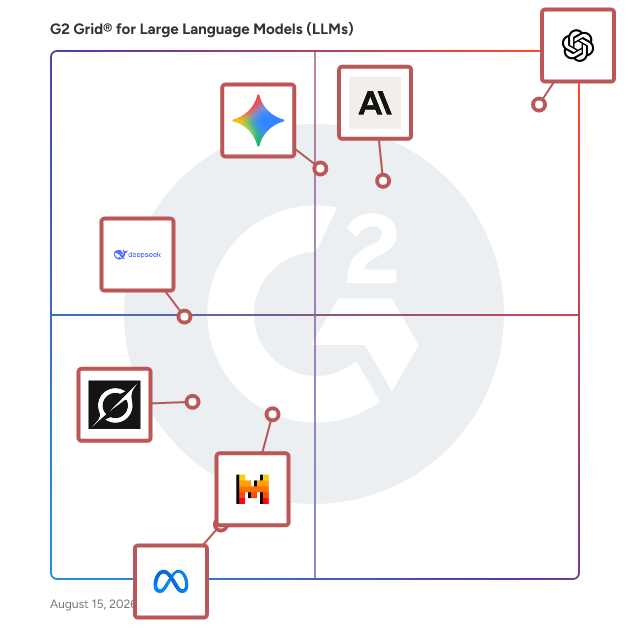
G2 Grid® for Large Language Models (LLMs) Software

G2 Grid® for Large Language Models (LLMs) Software plotting products by satisfaction and market presence

Highlighted products: ChatGPT, Claude, Gemini, Deepseek, Mistral AI, Grok, and Llama.

Underlying data: [Grid® JSON](https://www.g2.com/categories/large-language-models-llms/grids.json?focus%5B%5D=chatgpt&focus%5B%5D=claude-2025-12-11&focus%5B%5D=google-gemini&focus%5B%5D=deepseek&focus%5B%5D=mistral-ai&focus%5B%5D=xai-grok&focus%5B%5D=llama)

Sponsored

Gemini Enterprise Agent Platform

Google Cloud's comprehensive platform for developers to build, scale, govern and optimize agents and models. It's a single destination for technical teams to build agents that can transform enterprise applications and workflows into powerful agentic systems.

Visit website

ChatGPT

ChatGPT est un modèle de langage IA avancé développé par OpenAI, conçu pour aider les utilisateurs à générer du texte ressemblant à celui d'un humain en fonction des entrées qu'il reçoit. Il sert d'outil polyvalent pour une large gamme d'applications, y compris la rédaction d'e-mails, l'écriture de code, la création de contenu et la fourniture d'explications détaillées sur divers sujets. ChatGPT évolue continuellement pour améliorer l'expérience utilisateur et répondre à des besoins diversifiés. Caractéristiques clés et fonctionnalités : - Compréhension du langage naturel : ChatGPT peut comprendre et générer du texte qui ressemble de près à une conversation humaine, rendant les interactions intuitives et engageantes. - Applications polyvalentes : Il prend en charge des tâches telles que la création de contenu, l'assistance au codage, l'apprentissage de nouveaux concepts, et plus encore, répondant à des cas d'utilisation personnels et professionnels. - Amélioration continue : OpenAI met régulièrement à jour ChatGPT pour améliorer ses performances, sa précision et sa sécurité, garantissant qu'il reste un outil fiable pour les utilisateurs. Valeur principale et solutions pour les utilisateurs : ChatGPT répond au besoin d'une assistance efficace et accessible dans divers domaines. En tirant parti de ses capacités avancées de traitement du langage, il aide les utilisateurs à gagner du temps, à améliorer leur productivité et à accéder à l'information de manière transparente. Que ce soit pour rédiger des documents, apprendre de nouveaux sujets ou automatiser des tâches routinières, ChatGPT fournit une ressource précieuse qui s'adapte aux exigences individuelles, en faisant un outil indispensable dans le paysage numérique d'aujourd'hui.

Average Rating: 4.6/5.0

Total Reviews: 2,739

How Do G2 Users Rate ChatGPT?

  • Qualité du support: 8.4/10 (Category avg: 7.8/10)
  • Modération de contenu: 8.4/10 (Category avg: 8.4/10)
  • Compréhension contextuelle: 8.6/10 (Category avg: 8.7/10)
  • Atténuation des biais: 7.7/10 (Category avg: 8.0/10)

Who Is the Company Behind ChatGPT?

  • Vendeur: OpenAI
  • Année de fondation: 2015
  • Emplacement du siège social: San Francisco, CA
  • Twitter: @OpenAI
    4,941,980 abonnés Twitter
  • Page LinkedIn®: www.linkedin.com
    8,807 employés sur LinkedIn®

Who Uses This Product?

  • Who Uses This: Étudiant, Ingénieur logiciel
  • Top Industries: Technologie de l'information et services, Logiciels informatiques
  • Company Size: 54% Small, 27% Medium

What Do G2 Reviewers Say About ChatGPT?

AI-generated summary from verified user reviews

Pros
  • Les utilisateurs trouvent la facilité d'utilisation de ChatGPT rafraîchissante, simplifiant les tâches complexes et améliorant la productivité quotidienne sans effort.
  • Les utilisateurs adorent les réponses rapides et conversationnelles de ChatGPT, rendant l'accès à l'information fluide et efficace.
  • Les utilisateurs trouvent que ChatGPT est un assistant créatif utile, améliorant la productivité avec des idées nouvelles et des solutions efficaces.
  • Les utilisateurs apprécient les capacités d'économie de temps de ChatGPT, améliorant la productivité et rationalisant les flux de travail à travers diverses tâches.
  • Les utilisateurs constatent que les capacités d'économie de temps de ChatGPT rationalisent leurs flux de travail, améliorant la créativité et la productivité dans les tâches de conception.
Cons
  • Les utilisateurs notent les limitations en matière de précision et de référence des sources de ChatGPT, nécessitant une vérification occasionnelle avec des outils externes.
  • Les utilisateurs trouvent que la compréhension du contexte de ChatGPT est insuffisante, ce qui entraîne de la confusion et des répétitions lors des conversations.
  • Les utilisateurs sont frustrés par la fenêtre de contexte limitée dans ChatGPT, ce qui entrave sa capacité à traiter efficacement des entrées étendues.
  • Les utilisateurs constatent une inexactitude dans ChatGPT, notant des réponses répétitives et une compréhension parfois médiocre de sujets complexes.
  • Les utilisateurs sont confrontés à des réponses inexactes de ChatGPT, nécessitant souvent une reformulation pour un meilleur contexte et une plus grande clarté dans les réponses.

What Are Recent G2 Reviews of ChatGPT?

What Are G2 Users Discussing About ChatGPT?

Claude

Claude est un modèle de langage de grande envergure (LLM) à la pointe de la technologie, développé par Anthropic, conçu pour servir de manière utile, honnête et inoffensive en tant qu'assistant IA. Avec ses capacités de raisonnement avancées et son ton conversationnel, Claude excelle dans des tâches allant de la programmation complexe à l'analyse financière approfondie, en faisant un outil polyvalent pour les développeurs, les entreprises et les professionnels de la finance. Caractéristiques clés et fonctionnalités : - Capacités de programmation avancées : Claude Opus 4 est leader en performance de codage, obtenant des scores élevés sur des benchmarks comme SWE-bench et Terminal-bench. Il prend en charge des tâches soutenues et de longue durée, permettant un travail continu pendant plusieurs heures, ce qui est idéal pour des projets de développement logiciel complexes. - Outils d'analyse financière : Claude s'intègre parfaitement avec des plateformes de données financières telles que Databricks et Snowflake, fournissant une interface unifiée pour l'analyse de marché, la recherche et la prise de décision en matière d'investissement. Il offre des hyperliens directs vers les matériaux sources pour une vérification instantanée, améliorant l'efficacité des flux de travail financiers. - Fenêtres de contexte étendues : Avec une fenêtre de contexte améliorée de 500k disponible dans Claude Sonnet 4, les utilisateurs peuvent télécharger des documents volumineux, y compris des centaines de transcriptions de ventes ou de grandes bases de code, facilitant une analyse et une collaboration complètes. - Utilisation et intégration d'outils : Les capacités de réflexion étendues de Claude lui permettent d'utiliser des outils comme la recherche sur le web pendant les processus de raisonnement, améliorant la précision des réponses. Il prend également en charge les tâches en arrière-plan via GitHub Actions et s'intègre nativement avec des environnements de développement comme VS Code et JetBrains pour une programmation en binôme sans faille. - Sécurité de niveau entreprise : Le plan Claude Enterprise offre des fonctionnalités de sécurité avancées, y compris l'authentification unique (SSO), le provisionnement juste-à-temps (JIT), des permissions basées sur les rôles, des journaux d'audit et des contrôles de rétention de données personnalisés, garantissant la sécurité des données et la conformité pour les organisations. Valeur principale et solutions pour les utilisateurs : Claude répond au besoin d'un assistant IA fiable et intelligent capable de gérer des tâches complexes dans divers domaines. Pour les développeurs, il améliore la productivité grâce à un support de codage avancé et à l'intégration avec des outils de développement. Les professionnels de la finance bénéficient de sa capacité à unifier et analyser des sources de données diverses, rationalisant les processus de recherche et de prise de décision. Les entreprises profitent de ses solutions évolutives et de ses fonctionnalités de sécurité robustes, permettant un déploiement efficace et sécurisé des capacités d'IA au sein de leurs opérations. Dans l'ensemble, Claude permet aux utilisateurs d'atteindre une plus grande efficacité, précision et innovation dans leurs domaines respectifs.

Average Rating: 4.6/5.0

Total Reviews: 418

How Do G2 Users Rate Claude?

  • Qualité du support: 8.1/10 (Category avg: 7.8/10)
  • Modération de contenu: 6.9/10 (Category avg: 8.4/10)
  • Compréhension contextuelle: 8.7/10 (Category avg: 8.7/10)
  • Atténuation des biais: 7.3/10 (Category avg: 8.0/10)

Who Is the Company Behind Claude?

  • Vendeur: Anthropic
  • Emplacement du siège social: San Francisco, California
  • Twitter: @AnthropicAI
    1,440,248 abonnés Twitter
  • Page LinkedIn®: www.linkedin.com
    5,178 employés sur LinkedIn®

Who Uses This Product?

  • Who Uses This: Ingénieur logiciel, Analyste de données
  • Top Industries: Logiciels informatiques, Technologie de l'information et services
  • Company Size: 52% Small, 33% Medium

What Do G2 Reviewers Say About Claude?

AI-generated summary from verified user reviews

Pros
  • Les utilisateurs apprécient la facilité d'utilisation de Claude, leur permettant de créer facilement un contenu éducatif clair et structuré.
  • Les utilisateurs louent Claude pour sa capacité à maintenir des discussions longues et profondes, enrichissant ainsi leurs projets intellectuels et créatifs.
  • Les utilisateurs trouvent Claude exceptionnellement utile pour des discussions approfondies et pour gérer efficacement diverses tâches intellectuelles.
  • Les utilisateurs apprécient les résultats précis fournis par Claude, améliorant ainsi leur efficacité et leur expérience avec l'outil.
  • Les utilisateurs apprécient la communication claire et structurée de Claude, ce qui améliore leur capacité à éduquer et informer efficacement.
Cons
  • Les utilisateurs trouvent les limitations d'utilisation frustrantes, surtout avec les restrictions d'accès et les performances incohérentes qui impactent leur expérience.
  • Les utilisateurs trouvent que Claude a des limitations significatives dans le support de contenu visuel, l'intégration et la réactivité, ce qui affecte l'efficacité et la créativité.
  • Les utilisateurs trouvent que la fonctionnalité limitée de Claude est restrictive, en particulier en ce qui concerne le support de contenu visuel et la vitesse de recherche.
  • Les utilisateurs trouvent que Claude est trop prudent et lent à répondre, ce qui peut entraver une communication rapide et efficace.
  • Les utilisateurs expriment leur inquiétude concernant les limitations de ressources telles que l'utilisation de jetons et les plafonds de recherche, affectant significativement la productivité.

What Are Recent G2 Reviews of Claude?

Gemini

Gemini est une famille de modèles d'IA générative multimodale. Ces modèles ont été développés par Google DeepMind et Google Research. Ils sont conçus pour comprendre, opérer à travers et combiner différents types d'informations. Cela inclut le texte, les images, l'audio, la vidéo et le code. Gemini sert d'assistant IA polyvalent au quotidien et alimente un chatbot conversationnel. Caractéristiques et Capacités Clés du Produit Compréhension Multimodale : Gemini comprend et combine le texte, les images, l'audio, la vidéo et le code. Il peut analyser des documents complexes, des dépôts de code et de longues vidéos. IA Conversationnelle : Gemini permet des conversations naturelles. Il fonctionne comme un assistant intelligent capable de réfléchir, planifier et discuter de sujets. Recherche et Analyse Approfondies : Gemini peut analyser des sites web et des fichiers utilisateurs pour générer des rapports. Il peut également créer des résumés audio des informations. Capacités Agentiques : Les utilisateurs peuvent créer des "Gems" personnalisés (experts IA spécialisés). Les modèles peuvent agir comme des agents pour effectuer des actions dans des outils comme Chrome. Productivité Intégrée : Gemini est intégré dans Gmail, Google Docs, Drive et Meet. Cela aide à résumer, écrire, éditer et organiser l'information. Outils Créatifs : Les fonctionnalités incluent la génération d'images et la création de vidéos, permettant la génération de vidéos de 8 secondes avec du son. Fenêtre de Contexte Longue : Les modèles haut de gamme disposent d'une fenêtre de contexte allant jusqu'à 1 million de tokens. Cela permet d'analyser de grandes quantités de données.

Average Rating: 4.4/5.0

Total Reviews: 369

How Do G2 Users Rate Gemini?

  • Qualité du support: 8.6/10 (Category avg: 7.8/10)
  • Modération de contenu: 8.3/10 (Category avg: 8.4/10)
  • Compréhension contextuelle: 8.3/10 (Category avg: 8.7/10)
  • Atténuation des biais: 7.9/10 (Category avg: 8.0/10)

Who Is the Company Behind Gemini?

  • Vendeur: Google
  • Année de fondation: 1998
  • Emplacement du siège social: Mountain View, CA
  • Twitter: @google
    31,899,995 abonnés Twitter
  • Page LinkedIn®: www.linkedin.com
    341,888 employés sur LinkedIn®
  • Propriété: NASDAQ:GOOG

Who Uses This Product?

  • Who Uses This: Ingénieur logiciel, Analyste de recherche
  • Top Industries: Technologie de l'information et services, Logiciels informatiques
  • Company Size: 49% Small, 29% Medium

What Do G2 Reviewers Say About Gemini?

AI-generated summary from verified user reviews

Pros
  • Les utilisateurs louent Gemini pour sa facilité d'utilisation, permettant des opérations fluides et une documentation et une résolution de problèmes efficaces.
  • Les utilisateurs trouvent l'utilité de Gemini pour le brainstorming et la synthèse des notes exceptionnelle, en faisant un incontournable pour des réponses rapides.
  • Les utilisateurs adorent Gemini pour son utilité dans la création d'e-mails, le brainstorming et la simplification des tâches d'analyse de données.
  • Les utilisateurs apprécient les capacités de création de contenu sans faille de Gemini, permettant des résultats visuels diversifiés et impressionnants.
  • Les utilisateurs adorent la vitesse de Gemini, offrant des suggestions et des solutions créatives en quelques secondes seulement.
Cons
  • Les utilisateurs trouvent les limitations de précision et de réactivité de Gemini frustrantes, préférant souvent des alternatives pour des réponses concises.
  • Les utilisateurs trouvent que l'inexactitude dans la génération d'images et les données est problématique, affectant de manière significative la confiance et l'utilisabilité.
  • Les utilisateurs trouvent des limitations d'utilisation dans Gemini, notamment en termes de conscience contextuelle et de capacités d'intégration.
  • Les utilisateurs sont frustrés par les problèmes techniques de Gemini, y compris des réponses inexactes et une génération de code peu fiable, affectant l'utilisabilité.
  • Les utilisateurs constatent que Gemini a une capacité limitée à comprendre le contexte, ce qui entraîne des réponses génériques et des nuances manquées.

What Are Recent G2 Reviews of Gemini?

Deepseek

DeepSeek LLM is a series of high-performance, open-source large language models from China-based DeepSeek AI.

Average Rating: 4.5/5.0

Total Reviews: 20

How Do G2 Users Rate Deepseek?

  • Quality of Support: 7.3/10 (Category avg: 7.8/10)
  • Content Moderation: 8.8/10 (Category avg: 8.4/10)
  • Contextual Understanding: 8.5/10 (Category avg: 8.7/10)
  • Bias Mitigation: 7.9/10 (Category avg: 8.0/10)

Who Is the Company Behind Deepseek?

  • Seller: DeepSeek
  • Year Founded: 2023
  • HQ Location: Hangzhou
  • LinkedIn® Page: www.linkedin.com
    200 employees on LinkedIn®

Who Uses This Product?

  • Top Industries: Computer Software
  • Company Size: 70% Small, 20% Medium

What Do G2 Reviewers Say About Deepseek?

AI-generated summary from verified user reviews

Pros
  • Users appreciate the fast and accessible performance improvements of DeepSeek, enhancing their daily tasks with accurate results.
  • Users find Deepseek to be exceptionally easy to use, with a simple interface and fast responses for various tasks.
  • Users find Deepseek's accuracy impressive, delivering precise answers and effective solutions for a variety of tasks.
  • Users value Deepseek for its effective content creation capabilities, enabling efficient generation of ideas and summaries for social media.
  • Users value the creativity enhancement of DeepSeek, appreciating its ability to generate fresh and diverse content ideas.
Cons
  • Users often experience context understanding issues with Deepseek, affecting the accuracy and relevance of its responses.
  • Users often express concerns about low accuracy in Deepseek's outputs, impacting the reliability of generated information.
  • Users report technical issues, particularly with real-time data and missing image/video generation features, impacting satisfaction.
  • Users are concerned about bias and censorship in Deepseek, questioning its reliability for unbiased information generation.
  • Users express significant concerns about data security and privacy risks due to data storage practices in China.

What Are Recent G2 Reviews of Deepseek?

FAQs About Large Language Models (LLMs) Software

Generated using AI

Last updated: June 3, 2026

Best Large Language Models avoiding vendor lock-in concerns about data portability and long-term independence

Based on G2 reviews, these products are commonly mentioned for flexible workflows and broad day-to-day adoption.

  • ChatGPT — broad drafting, coding, and research workflows.
  • Gemini — document analysis and workspace-based productivity.
  • Claude — long documents, coding, and structured writing.
  • Deepseek — lower-cost reasoning and coding support.

Large Language Models with flexible pricing that doesn't explode as token usage increases over time unexpectedly

According to verified users, pricing concerns usually show up as usage caps, paid-plan limits, or pressure to upgrade during heavier workloads. In recent G2 reviews, buyers most often describe value in terms of time saved on drafting, research, coding, summarization, and documentation rather than raw token economics. Reviewers mention that lower-cost or free-access options can be useful for everyday tasks, but they also note tradeoffs like weaker integrations, inconsistent depth, or the need to verify outputs. For teams expecting sustained usage, the most grounded takeaway from G2 reviews is to compare plan limits, workflow fit, and how often users hit caps during normal work rather than assuming one pricing model will stay efficient at scale.

What are the best Large Language Models for small marketing teams automating customer messaging workflows

Based on G2 reviews, these products appear often in messaging, content, and workflow-related use cases.

  • ChatGPT — email drafting, messaging, and content ideas.
  • Claude — polished writing and customer communication support.
  • Gemini — Gmail-connected drafting and daily communication tasks.
  • Deepseek — email drafting and content curation.

What features matter most in llm software

According to verified users, the most valued features in llm software are fast response times, clear explanations, strong context handling, easy setup, and versatility across writing, research, coding, summarization, and analysis. Recent G2 reviews also point to workflow features such as file handling, chat history, memory, document summarization, image support, and the ability to refine outputs through follow-up questions. For workplace use, buyers repeatedly mention integrations with tools like email, documents, spreadsheets, project tools, and internal workflows as important. At the same time, reviewers consistently flag limits around accuracy, outdated information, context drift in long conversations, and plan or usage caps, so reliability and usability matter as much as feature breadth.

How do teams use Large Language Models for documentation

G2 reviewers mention that teams use Large Language Models to speed up documentation work across reports, SOPs, technical documents, summaries, presentations, emails, and customer-facing materials. In recent reviews, users describe turning rough notes into structured drafts, summarizing long files, refining tone, and preparing repeatable documentation faster than manual workflows. Technical teams also mention using these tools for code explanations, report preparation, ticket refinement, and knowledge-base style outputs. The buyer takeaway is that documentation value comes from reducing first-draft time and organizing complex information quickly, but reviewers still recommend human review for specialized, business-critical, or rapidly changing content because answers can sometimes be too generic, inaccurate, or inconsistent.

Mistral AI

A Mistral AI é uma empresa francesa de inteligência artificial especializada no desenvolvimento de modelos de linguagem de grande escala (LLMs) e soluções de IA de código aberto, adaptadas para diversas aplicações. Fundada em 2023, a Mistral AI foca na criação de modelos eficientes e de alto desempenho que capacitam desenvolvedores e empresas a construir aplicações inteligentes em vários domínios. Características e Funcionalidades Principais: - Ofertas Diversificadas de Modelos: A Mistral AI oferece uma gama de modelos, incluindo: - Mistral Large 2: Um modelo de raciocínio de alto nível projetado para tarefas complexas, suportando múltiplos idiomas e uma janela de contexto grande de 128K tokens. - Codestral: Um modelo especializado otimizado para tarefas de codificação, treinado em mais de 80 linguagens de programação e com uma janela de contexto de 32K tokens. - Pixtral Large: Um modelo multimodal capaz de analisar e entender tanto texto quanto imagens. - Plataforma para Desenvolvedores (La Plateforme): Oferece APIs para acessar e personalizar os modelos da Mistral, permitindo a implantação em vários ambientes, como on-premises ou na nuvem. - Le Chat: Um assistente de IA multilíngue disponível em plataformas móveis, conhecido por sua velocidade e funcionalidades como busca na web, compreensão de documentos e assistência em código. Valor e Soluções Primárias: A Mistral AI atende à crescente demanda por modelos de IA personalizáveis e eficientes, fornecendo soluções de código aberto que oferecem maior flexibilidade e controle aos usuários. Seus modelos são projetados para serem implantados em várias plataformas, garantindo privacidade e adaptabilidade às necessidades específicas das empresas. Ao focar em modelos de IA abertos e eficientes, a Mistral AI capacita desenvolvedores e empresas a integrar capacidades avançadas de IA em suas aplicações, aumentando a produtividade e a inovação.

Average Rating: 4.3/5.0

Total Reviews: 32

How Do G2 Users Rate Mistral AI?

  • Qualidade do Suporte: 8.2/10 (Category avg: 7.8/10)
  • Moderação de Conteúdo: 9.2/10 (Category avg: 8.4/10)
  • Compreensão contextual: 9.3/10 (Category avg: 8.7/10)
  • Mitigação de vieses: 7.9/10 (Category avg: 8.0/10)

Who Is the Company Behind Mistral AI?

  • Vendedor: Mistral
  • Ano de Fundação: 2023
  • Localização da Sede: Paris, Île-de-France, France
  • Twitter: @MistralAI
    195,825 seguidores no Twitter
  • Página do LinkedIn®: www.linkedin.com
    1,114 funcionários no LinkedIn®

Who Uses This Product?

  • Top Industries: Tecnologia da Informação e Serviços
  • Company Size: 61% Small, 33% Medium

What Do G2 Reviewers Say About Mistral AI?

AI-generated summary from verified user reviews

Pros
  • Os usuários valorizam o acesso gratuito à API da Mistral AI, que facilita o teste e a comparação com outros modelos.
  • Os usuários valorizam o acesso ao conhecimento da Mistral AI, apreciando seus recursos informativos e eficientes com a API gratuita.
Cons
  • Os usuários encontram uma falta de criatividade no Mistral AI, levando-os a buscar modelos de IA alternativos para tarefas específicas.
  • Os usuários acham as capacidades limitadas da Mistral AI inadequadas para tarefas específicas, muitas vezes recorrendo a outros modelos para obter melhores resultados.

What Are Recent G2 Reviews of Mistral AI?

Grok

Grok é seu companheiro de IA em busca da verdade para respostas sem filtros, com capacidades avançadas em raciocínio, codificação e processamento visual.

Average Rating: 4.2/5.0

Total Reviews: 31

How Do G2 Users Rate Grok?

  • Qualidade do Suporte: 7.7/10 (Category avg: 7.8/10)
  • Moderação de Conteúdo: 7.8/10 (Category avg: 8.4/10)
  • Compreensão contextual: 8.3/10 (Category avg: 8.7/10)
  • Mitigação de vieses: 7.8/10 (Category avg: 8.0/10)

Who Is the Company Behind Grok?

  • Vendedor: xAI
  • Ano de Fundação: 2022
  • Localização da Sede: Asnières-sur-Seine, FR
  • Página do LinkedIn®: www.linkedin.com
    3 funcionários no LinkedIn®

Who Uses This Product?

  • Top Industries: Software de Computador
  • Company Size: 69% Small, 25% Medium

What Do G2 Reviewers Say About Grok?

AI-generated summary from verified user reviews

Pros
  • Os usuários apreciam a facilidade de uso do Grok, permitindo acesso rápido aos recursos com treinamento mínimo necessário.
  • Os usuários valorizam as capacidades de pesquisa rápida do Grok, permitindo uma compreensão ágil de tópicos complexos de saúde e nutrição.
  • Os usuários valorizam o Grok por suas capacidades de pesquisa rápidas e poderosas, melhorando seu fluxo de trabalho e clareza em tópicos complexos.
  • Os usuários valorizam o Grok por seu tempo de resposta rápido, tornando a pesquisa e a preparação de conteúdo eficientes e eficazes.
  • Os usuários apreciam a versatilidade do Grok, permitindo a rápida criação de conteúdo e diversas aplicações para suas necessidades profissionais.
Cons
  • Os usuários relatam baixa precisão nas respostas do Grok, levando a frustração e perda de tempo devido à desinformação.
  • Os usuários frequentemente enfrentam problemas técnicos com o Grok, desperdiçando horas em perguntas repetidas e recebendo links quebrados.
  • Os usuários observam a compreensão limitada de contexto do Grok, muitas vezes levando a respostas imprecisas e insuficiente profundidade para análises complexas.
  • Os usuários frequentemente experimentam respostas imprecisas do Grok, levando a confusão e problemas de confiabilidade em várias tarefas.
  • Os usuários relatam experimentar alucinações do Grok, levando à confiança em declarações falsas e informações não confiáveis.

What Are Recent G2 Reviews of Grok?

Llama

Llama 4 Maverick 17B Instruct (128E) is a high-capacity multimodal language model developed by Meta, designed to handle both text and image inputs while generating multilingual text and code outputs across 12 languages. Built on a mixture-of-experts (MoE) architecture with 128 experts, it activates 17 billion parameters per forward pass out of a total of 400 billion, ensuring efficient processing. Optimized for vision-language tasks, Maverick is instruction-tuned to exhibit assistant-like behavior, perform image reasoning, and facilitate general-purpose multimodal interactions. It features early fusion for native multimodality and supports a context window of up to 1 million tokens. Trained on approximately 22 trillion tokens from a curated mix of public, licensed, and Meta-platform data, with a knowledge cutoff in August 2024, Maverick was released on April 5, 2025, under the Llama 4 Community License. It is well-suited for research and commercial applications requiring advanced multimodal understanding and high model throughput. Key Features and Functionality: - Multimodal Input Support: Processes both text and image inputs, enabling comprehensive understanding and generation capabilities. - Multilingual Output: Generates text and code outputs in 12 languages, including Arabic, English, French, German, Hindi, Indonesian, Italian, Portuguese, Spanish, Tagalog, Thai, and Vietnamese. - Mixture-of-Experts Architecture: Utilizes 128 experts with 17 billion active parameters per forward pass, optimizing computational efficiency and performance. - Instruction-Tuned: Fine-tuned for assistant-like behavior, image reasoning, and general-purpose multimodal interactions, enhancing its applicability across various tasks. - Extended Context Window: Supports a context length of up to 1 million tokens, facilitating the processing of extensive and complex inputs. Primary Value and User Solutions: Llama 4 Maverick 17B Instruct addresses the growing demand for advanced AI models capable of understanding and generating content across multiple modalities and languages. Its multimodal and multilingual capabilities make it an invaluable tool for developers and researchers working on applications that require nuanced language understanding, image processing, and code generation. The model's instruction-tuned nature ensures it can perform a wide range of tasks with high accuracy, from serving as an intelligent assistant to executing complex reasoning tasks. Its efficient architecture and extended context window allow for the handling of large-scale data inputs, making it suitable for both research and commercial applications that demand high throughput and advanced multimodal understanding.

Average Rating: 4.3/5.0

Total Reviews: 151

How Do G2 Users Rate Llama?

  • Quality of Support: 7.1/10 (Category avg: 7.8/10)
  • Content Moderation: 7.6/10 (Category avg: 8.4/10)
  • Contextual Understanding: 8.5/10 (Category avg: 8.7/10)
  • Bias Mitigation: 7.8/10 (Category avg: 8.0/10)

Who Is the Company Behind Llama?

Who Uses This Product?

  • Who Uses This: Software Engineer
  • Top Industries: Computer Software, Information Technology and Services
  • Company Size: 58% Small, 24% Medium

What Do G2 Reviewers Say About Llama?

AI-generated summary from verified user reviews

Pros
  • Users praise the high accuracy of Meta LLaMA 3, enhancing interactions with its advanced contextual understanding.
  • Users find Llama 3 to be exceptionally easy to use, streamlining complex tasks with fast, accurate responses.
  • Users commend the speed and accuracy of Meta Llama 3, finding it significantly improves response quality for tasks.
  • Users value the open-source nature of Llama, enabling cost-effective hosting and fostering innovative AI tool development.
  • Users appreciate the helpfulness of Llama, noting its quick responses and advanced contextual understanding for various applications.
Cons
  • Users face limitations in capabilities, particularly in text recognition, table creation, and indexing support for specific use cases.
  • Users find Llama's slow performance frustrating, especially compared to other AI models like OpenAI's offerings.
  • Users report poor response quality from Llama, with issues like repetition and duplicative answers from prompts.
  • Users report inaccuracies in responses from Llama, necessitating careful verification to ensure reliability.
  • Users note a limited understanding in Llama 3, particularly during complex interactions and context retention.

What Are Recent G2 Reviews of Llama?

bloom

The BLOOM model has been proposed with its various versions through the BigScience Workshop. BigScience is inspired by other open science initiatives where researchers have pooled their time and resources to collectively achieve a higher impact. The architecture of BLOOM is essentially similar to GPT3 (auto-regressive model for next token prediction), but has been trained on 46 different languages and 13 programming languages. Several smaller versions of the models have been trained on the same dataset. BLOOM is available in the following versions:

Average Rating: 4.5/5.0

Total Reviews: 3

How Do G2 Users Rate bloom?

  • Quality of Support: 6.7/10 (Category avg: 7.8/10)
  • Content Moderation: 10.0/10 (Category avg: 8.4/10)
  • Contextual Understanding: 10.0/10 (Category avg: 8.7/10)
  • Bias Mitigation: 10.0/10 (Category avg: 8.0/10)

Who Is the Company Behind bloom?

  • Seller: Hugging Face
  • Year Founded: 2016
  • HQ Location: United States
  • Twitter: @huggingface
    708,886 Twitter followers
  • LinkedIn® Page: www.linkedin.com
    984 employees on LinkedIn®

Who Uses This Product?

  • Company Size: 33% Large, 33% Medium

What Are Recent G2 Reviews of bloom?

Phi

Phi-4 is a state-of-the-art language model developed by Microsoft Research, designed to deliver advanced reasoning capabilities within a compact architecture. With 14 billion parameters, this dense decoder-only Transformer model is optimized for text-based inputs, particularly excelling in chat-based prompts. Trained on a diverse dataset comprising 9.8 trillion tokens—including synthetic datasets, filtered public domain content, academic literature, and Q&A datasets—Phi-4 emphasizes high-quality data to enhance its reasoning abilities. The model underwent rigorous enhancement and alignment processes, incorporating both supervised fine-tuning and direct preference optimization to ensure precise instruction adherence and robust safety measures. Released on December 12, 2024, under the MIT license, Phi-4 is tailored for applications requiring efficient performance in memory or compute-constrained environments, latency-sensitive scenarios, and tasks demanding advanced reasoning and logic. Key Features and Functionality: - Advanced Reasoning: Phi-4 is engineered to perform complex reasoning tasks, making it suitable for applications that require logical processing and decision-making. - Efficient Architecture: With 14 billion parameters, the model offers a balance between performance and resource utilization, catering to environments with memory and compute constraints. - Extensive Training Data: The model is trained on a vast dataset of 9.8 trillion tokens, including high-quality synthetic data, filtered public domain content, academic books, and Q&A datasets, ensuring a comprehensive understanding of diverse topics. - Optimized for Chat Prompts: Phi-4 excels in generating coherent and contextually relevant responses to chat-based inputs, enhancing user interaction experiences. - Safety and Alignment: The model incorporates supervised fine-tuning and direct preference optimization to adhere to instructions accurately and maintain robust safety measures. Primary Value and User Solutions: Phi-4 addresses the need for a powerful yet efficient language model capable of advanced reasoning in resource-constrained environments. Its optimized architecture and extensive training enable developers to integrate sophisticated AI capabilities into applications without compromising performance. By focusing on high-quality data and safety measures, Phi-4 ensures reliable and contextually appropriate responses, making it a valuable tool for enhancing user engagement and decision-making processes in various applications.

Average Rating: 4.0/5.0

Total Reviews: 1

How Do G2 Users Rate Phi?

  • Quality of Support: 8.3/10 (Category avg: 7.8/10)
  • Contextual Understanding: 8.3/10 (Category avg: 8.7/10)

Who Is the Company Behind Phi?

  • Seller: Microsoft
  • Year Founded: 1975
  • HQ Location: Redmond, Washington
  • Twitter: @microsoft
    13,091,739 Twitter followers
  • LinkedIn® Page: www.linkedin.com
    231,632 employees on LinkedIn®
  • Ownership: MSFT

Who Uses This Product?

  • Company Size: 100% Large

What Do G2 Reviewers Say About Phi?

AI-generated summary from verified user reviews

Pros
  • Users value the easy integrations with Microsoft Azure, enhancing efficiency and compatibility with various tools.
  • Users find Phi to be highly efficient and cost-effective, outperforming many models of its size.
Cons
  • Users find Phi's performance for complex tasks is limited compared to larger models like GPT-4.

What Are Recent G2 Reviews of Phi?

Aleph Alpha

Aleph Alpha's LLM-powered agent accelerates complex semiconductor documentation retrieval, reducing search time by 90%.

Who Is the Company Behind Aleph Alpha?

Amazon Nova

Amazon Nova é um conjunto de modelos de base avançados desenvolvidos pela Amazon, projetados para oferecer inteligência de ponta e desempenho de preço líder na indústria. Integrados ao Amazon Bedrock, esses modelos suportam uma ampla gama de tarefas em múltiplas modalidades, incluindo processamento de texto, imagem e vídeo. O Amazon Nova tem como objetivo simplificar o desenvolvimento de aplicações de IA generativa, oferecendo soluções versáteis e econômicas para empresas e desenvolvedores.

Who Is the Company Behind Amazon Nova?

  • Vendedor: Amazon Web Services (AWS)
  • Ano de Fundação: 2006
  • Localização da Sede: Seattle, WA
  • Twitter: @awscloud
    2,232,483 seguidores no Twitter
  • Página do LinkedIn®: www.linkedin.com
    147,094 funcionários no LinkedIn®
  • Propriedade: NASDAQ: AMZN

Command

Command A is Cohere's most advanced large language model, specifically engineered to meet the complex demands of enterprise applications. With 111 billion parameters and a context length of 256,000 tokens, it excels in tasks such as tool use, retrieval-augmented generation , agent-based workflows, and multilingual processing across 23 languages. Designed for efficient deployment, Command A operates effectively on just two GPUs, making it a cost-effective solution for businesses seeking high-performance AI capabilities. Key Features and Functionality: - High Performance: Delivers top-tier results in enterprise tasks, including tool integration, RAG, and agentic operations. - Extended Context Length: Supports up to 256,000 tokens, enabling the processing of extensive documents and complex datasets. - Multilingual Support: Proficient in 23 languages, facilitating global business applications. - Efficient Deployment: Operates on minimal hardware—specifically, two A100 or H100 GPUs—reducing infrastructure costs. - Data Security: Designed for on-premise or Virtual Private Cloud deployment, ensuring sensitive data remains within the organization's control. Primary Value and User Solutions: Command A addresses the critical need for enterprises to integrate advanced AI into their operations without compromising on performance, scalability, or data security. By automating complex workflows, enhancing content generation, and supporting multilingual communication, it empowers organizations to boost productivity and maintain a competitive edge in the global market. Its efficient deployment requirements make it accessible to businesses seeking powerful AI solutions without significant hardware investments.

Who Is the Company Behind Command?

  • Seller: Cohere
  • Year Founded: 2019
  • HQ Location: Toronto, Ontario, Canada
  • LinkedIn® Page: www.linkedin.com
    818 employees on LinkedIn®

Deep Cogito

Deep Cogito builds general superintelligence via advanced reasoning and iterative self‑improvement LLMs outperforming peers.

Who Is the Company Behind Deep Cogito?

Falcon

Infraestrutura de ponta impulsionada por IA, adaptada para coletar, analisar e interpretar dados comportamentais. Ao aproveitar o poder da IA e do aprendizado de máquina, transformamos dados comportamentais brutos em inteligência acionável, permitindo que as organizações tomem decisões baseadas em dados com precisão e eficiência sem precedentes.

Who Is the Company Behind Falcon?

  • Vendedor: Synerise
  • Ano de Fundação: 2013
  • Localização da Sede: San Francisco, California
  • Twitter: @Synerise
    4,971 seguidores no Twitter
  • Página do LinkedIn®: www.linkedin.com
    195 funcionários no LinkedIn®

GLM

A Zhipu AI é uma empresa chinesa de inteligência artificial especializada no desenvolvimento de modelos de linguagem e multimodais de grande escala. Estabelecida em 2019 como um desdobramento do Departamento de Ciência da Computação da Universidade de Tsinghua, a Zhipu AI foca em avançar a inteligência cognitiva através de tecnologias inovadoras de IA. Seus produtos principais incluem a série de modelos GLM, como o GLM-4 e o ChatGLM, que são projetados para realizar uma ampla gama de tarefas, incluindo geração de texto, compreensão de imagens e assistência em programação. Esses modelos são acessíveis através de sua plataforma aberta, apoiando diversas aplicações de IA em várias indústrias. A missão da Zhipu AI é ensinar máquinas a pensar como humanos, capacitando assim empresas e indivíduos com soluções de IA de ponta.

Who Is the Company Behind GLM?

  • Vendedor: Zhipu AI
  • Localização da Sede: Beijing, CN
  • Página do LinkedIn®: www.linkedin.com
    79 funcionários no LinkedIn®
Bijou Barry
BB
Researched and written by Bijou Barry
Updated April 9, 2026

Learn More About Large Language Models (LLMs) Software

Large language models (LLMs) are machine learning models developed to understand and interact with human language at scale. These advanced artificial intelligence (AI) systems are trained on vast amounts of text data to predict plausible language and maintain a natural flow.

What are large language models (LLMs)?

LLMs are a type of Generative AI models that use deep learning and large text-based data sets to perform various natural language processing (NLP) tasks.

These models analyze probability distributions over word sequences, allowing them to predict the most likely next word within a sentence based on context. This capability fuels content creation, document summarization, language translation, and code generation. 

The term "large” refers to the number of parameters in the model, which are essentially the weights it learns during training to predict the next token in a sequence, or it can also refer to the size of the dataset used for training.

How do large language models (LLMs) work?

LLMs are designed to understand the probability of a single token or sequence of tokens in a longer sequence. The model learns these probabilities by repeatedly analyzing examples of text and understanding which words and tokens are more likely to follow others. 

The training process for LLMs is multi-stage and involves unsupervised learning, self-supervised learning, and deep learning. A key component of this process is the self-attention mechanism, which helps LLMs understand the relationship between words and concepts. It assigns a weight or score to each token within the data to establish its relationship with other tokens.

Here’s a brief rundown of the whole process:

  • A large amount of language data is fed to the LLM from various sources such as books, websites, code, and other forms of written text.
  • The model comprehends the building blocks of language and identifies how words are used and sequenced through pattern recognition with unsupervised learning.
  • Self-supervised learning is used to understand context and word relationships by predicting the following words.
  • Deep learning with neural networks learns language's overall meaning and structure, going beyond just predicting the next word.
  • The self-attention mechanism refines the understanding by assigning a score to each token to establish its influence on other tokens. During training, scores (or weights) are learned, indicating the relevance of all tokens in the sequence to the current token being processed and giving more attention to relevant tokens during prediction.

What are the common features of large language models (LLMs)?

LLMs are equipped with features such as text generation, summarization, and sentiment analysis to complete a wide range of NLP tasks.

  • Human-like text generation across various genres and formats, from business reports to technical emails to basic scripts tailored to specific instructions. 
  • Multilingual support for translating comments, documentation, and user interfaces into multiple languages, facilitating global applications and seamless cross-lingual communication.
  • Understanding context for accurately comprehending language nuances and providing appropriate responses during conversations and analyses.
  • Content summarization recapitulates complex technical documents, research papers, or API references for easy understanding of key points.
  • Sentiment analysis categorizes opinions expressed in text as positive, negative, or neutral, making them useful for social media monitoring, customer feedback analysis, and market research.  
  • Conversational AI and chatbots powered by LLM simulate human-like dialogue, understand user intent, answer user questions, or provide basic troubleshooting steps.
  • Code completion analyzes an existing code to report typos and suggests completions. Some advanced LLMs can even generate entire functions based on the context. It increases development speed, boosts productivity, and tackles repetitive coding tasks.
  • Error identification looks for grammatical errors or inconsistencies in writing and bugs or anomalies in code to help maintain high code and writing quality and reduce debugging time.
  • Adaptability allows LLMs to be fine-tuned for specific applications and perform better in legal document analysis or technical support tasks.
  • Scalability processes vast amounts of information quickly and accommodates the needs of both small businesses and large enterprises.

Who uses large language models (LLMs)? 

LLMs are becoming increasingly popular across various industries because they can process and generate text in creative ways. Below are some businesses that interact with LLMs more often.

  • Content creation and media companies produce significant content, such as news articles, blogs, and marketing materials, by utilizing LLMs to automate and enhance their content creation processes.
  • Customer service providers with large customer service operations, including call centers, online support, and chat services, power intelligent chatbots, and virtual assistants using LLMs to improve response times and customer satisfaction.
  • E-commerce and retail platforms use LLMs to generate product descriptions and offer personalized shopping experiences and customer service interactions, enhancing the overall shopping experience.
  • Financial services providers like banks, investment firms, and insurance companies benefit from LLMs by automating report generation, providing customer support, and personalizing financial advice, thus improving efficiency and customer engagement.
  • Education and e-learning platforms offering educational content and tutoring services use LLMs to create personalized learning experiences, automate grading, and provide instant feedback to students.
  • Healthcare providers use LLMs for patient support, medical documentation, and research, LLMs can analyze and interpret medical texts, support diagnosis processes, and offer personalized patient advice.
  • Technology and software development companies can use LLMs to generate documentation, provide coding assistance, and automate customer support, especially for troubleshooting and handling technical queries.

Types of large language models (LLMs)

Language models can basically be classified into two main categories — statistical models and language models designed on deep neural networks.

Statistical language models

These probabilistic models use statistical techniques to predict the likelihood of a word or sequence of words appearing in a given context. They analyze large corpora of text to learn the patterns of language. 

N-gram models and hidden Markov models (HMMs) are two examples. 

N-gram models analyze sequences of words (n-grams) to predict the probability of the next word appearing. The probability of a word's occurrence is estimated based on the occurrence of the words preceding it within a fixed window of size 'n.' 

For example, consider the sentence, "The cat sat on the mat." In a trigram (3-gram) model, the probability of the word "mat" occurring after the sequence "sat on the" is calculated based on the frequency of this sequence in the training data.

Neural language models

Neural language models utilize neural networks to understand language patterns and word relationships to generate text. They surpass traditional statistical models in detecting complex relationships and dependencies within text. 

Transformer models like GPT use self-attention mechanisms to assess the significance of each word in a sentence, predicting the following word based on contextual dependencies. For example, if we consider the phrase "The cat sat on the," the transformer model might predict "mat" as the next word based on the context provided. 

Among large language models, there are also two primary types — open-domain models and domain-specific models.

  • Open-domain models are designed to perform various tasks without needing customization, making them useful for brainstorming, idea generation, and writing assistance. Examples of open-domain models include generative pre-trained transformer (GPT) and bidirectional encoder representations from transformers (BERT). 
  • Domain-specific models: Domain-specific models are customized for specific fields, offering precise and accurate outputs. These models are particularly useful in medicine, law, and scientific research, where expertise is crucial. They are trained or fine-tuned on datasets relevant to the domain in question. Examples of domain-specific LLMs include BioBERT (for biomedical texts) and FinBERT (for financial texts).

Benefits of large language models (LLMs)

LLMs come with a suite of benefits that can transform countless aspects of how businesses and individuals work. Listed below are some common advantages.

  • Increased productivity: LLMs simplify workflows and accelerate project completion by automating repetitive tasks.
  • Improved accuracy: Minimizing inaccuracies is crucial in financial analysis, legal document review, and research domains. LLMs enhance work quality by reducing errors in tasks like data entry and analysis.
  • Cost-effectiveness: LLMs reduce resource requirements, leading to substantial cost savings for businesses of all sizes.
  • Accelerated development cycles: The process from code generation and debugging to research and documentation gets faster for software development tasks, leading to quicker product launches.
  • Enhanced customer engagement: LLM-powered chatbots like ChatGPT enable swift responses to customer inquiries, round-the-clock support, and personalized marketing, creating a more immersive brand interaction.
  • Advanced research capabilities: With LLMs capable of summarizing complex data and sourcing relevant information, research processes become simplified.
  • Data-driven insights: Trained to analyze large datasets, LLMs can extract trends and insights that support data-driven decision-making.

Applications of large language models

LLMs are used in various domains to solve complex problems, reduce the amount of manual work, and open up new possibilities for businesses and people.

  • Keyword research: Analyzing vast amounts of search data helps identify trends and recommend keywords to optimize content for search engines.
  • Market research: Processing user feedback, social media conversations, and market reports uncover insights into consumer behavior, sentiment, and emerging market trends.
  • Content creation: Generating written content such as articles, product descriptions, and social media posts, saves time and resources while maintaining a consistent voice.
  • Malware analysis: Identifying potential malware signatures, suggesting preventive measures by analyzing patterns and code, and generating reports help assist cybersecurity professionals.
  • Translation: Enabling more accurate and natural-sounding translations, LLMs provide multilingual context-aware translation services.
  • Code development: Writing and reviewing code, suggesting syntax corrections, auto-completing code blocks, and generating code snippets within a given context.
  • Sentiment analysis: Analyzing text data to understand the emotional tone and sentiment behind words.
  • Customer support: Engaging with users, answering questions, providing recommendations, and automating customer support tasks, enhance the customer experience with quick responses and 24/7 support.

How much does LLM software cost?

The cost of an LLM depends on multiple factors, like type of license, word usage, token usage, and API call consumptions. The top contenders of LLMs are GPT-4, GPT-Turbo, Llama 3.1, Gemini, and Claude, which offer different payment plans like subscription-based billing for small, mid, and enterprise businesses, tiered billing based on features, tokens, and API integrations and pay-per-use based on actual usage and model capacity and enterprise custom pricing for larger organizations. 

Mostly, LLM software is priced according to the number of tokens consumed and words processed by the model. For example, GPT-4 by OpenAI charges $0.03 per 1000 input tokens and $0.06 for output. Llama 3.1 and Gemini are open-source LLMs that charge between $0.05 to $0.10 per 1000 input tokens and an average of 100 API calls. While the pricing portfolio for every LLM software varies depending on your business type, version, and input data quality, it has become evidently more affordable and budget-friendly with no compromise to processing quality.

Limitations of large language model (LLM) software

While LLMs have boundless benefits, inattentive usage can also lead to grave consequences. Below are the limitations of LLMs that teams should steer clear of:

  • Plagiarism: Copying and pasting text from the LLM platform directly on your blog or other marketing media will raise a case of plagiarism. As the data processed by the LLM is mostly internet-scraped, the chances of content duplication and replication become significantly higher. 
  • Content bias: LLM platforms can alter or change the cause of events, narratives, incidents, statistics, and numbers, as well as inflate data that can be highly misleading and dangerous. Because of limited training abilities, these platforms have a strong chance of generating factually incorrect content that offends people.
  • Hallucination: LLMs even hallucinate and don't correctly register the user's input prompt. Though they might have gotten similar prompts before and know how to answer, they reply in a hallucinated state and don't give you access to data. Writing a follow-up prompt can get LLMs out of this stage and functional again. 
  • Cybersecurity and data privacy: LLMs transfer critical, company-sensitive data to public cloud storage systems that make your data more prone to data breaches, vulnerabilities, and zero-day attacks. 
  • Skills gap: Deploying and maintaining LLMs requires specialized knowledge, and there may be a skills gap in current teams that needs to be addressed through hiring or training.

How to choose the best large language model (LLM) for your business?

Selecting the right LLM software can impact the success of your projects. To choose the model that suits your needs best, consider the following criteria:

  • Use case: Each model has strengths, whether generating content, providing coding assistance, creating chatbots for customer support, or analyzing data. Determine the primary task the LLM will perform and look for models that excel in that specific use case.
  • Model size and capacity: Consider the model's size, which often correlates with capacity and processing needs. Larger models can perform various tasks but require more computational resources. Smaller models may be more cost-effective and sufficient for less complex tasks.
  • Accuracy: Evaluate the LLM's accuracy by reviewing benchmarks or conducting tests. Accuracy is critical — an error-prone model could negatively impact user experience and work efficiency.
  • Performance: Assess the model's speed and responsiveness, especially if real-time processing is required.
  • Training data and pre-training: Determine the breadth and diversity of the training data. Models pre-trained on extensive, varied datasets tend to work better across inputs. However, models trained on niche datasets may perform better for specialized applications.
  • Customization: If your application has unique needs, consider whether the LLM allows for customization or fine-tuning with your data to better tailor its outputs.
  • Cost: Factor in the total cost of ownership, including initial licensing fees, computational costs for training and inference, and any ongoing fees for updates or maintenance.
  • Data security: Look for models that offer security features and compliance with data protection laws relevant to your region or industry.
  • Availability and licensing: Some models are open-source, while others may require a commercial license. Licensing terms can dictate the scope of use, such as whether it's available for commercial applications or has any usage limits.

It's worthwhile to test multiple models in a controlled environment to directly compare how they meet your specific criteria before making a final decision.

LLM implementation

The implementation of an LLM is a continuous process. Regular assessments, upgrades, and re-training are necessary to ensure the technology meets its intended objectives. Here's how to approach the implementation process:

  • Define objectives and scope: Clearly define your project goals and success metrics from the outset to specify what you wish to achieve using an LLM. Identify areas where automation or cognitive enhancements can add value.
  • Data privacy and compliance: Choose an LLM with solid security measures that comply with data protection regulations relevant to your industry, such as GDPR. Establish data handling procedures that preserve user privacy.
  • Model selection: Evaluate whether a general-purpose model like GPT-3 better suits your needs or if a domain-specific model would provide more precise functionality. 
  • Integration and infrastructure: Determine whether you will use the LLM as a cloud service or host it on-premises, considering the computational and memory requirements, potential scalability needs, and latency sensitivities. Account for the API endpoints, SDKs, or libraries you'll need.
  • Training and fine-tuning: Allocate resources for training and validation and tune the model through continuous learning from new data.
  • Content moderation and quality control: Implement systems to oversee the LLM-generated content to ensure that the outputs align with your organizational standards and suit your audience.
  • Continuous evaluation and improvement: Build an evaluation framework to regularly assess your LLM's performance against your objectives. Capture user feedback, monitor performance metrics, and be ready to re-train or update your model to adapt to evolving data patterns or business needs.

Alternatives to LLM software

There are several other alternatives to explore in place of a large language model software that can be tailored to specific departmental workflows. 

  • Natural language understanding (NLU) tools facilitate computer comprehension of human language. NLU enables machines to understand, interpret, and derive meaning from human language. It involves text understanding, semantic analysis, entity recognition, sentiment analysis, and more. NLU is crucial for various applications, such as virtual assistants, chatbots, sentiment analysis tools, and information retrieval systems.
  • Natural language generation (NLG) tools convert structured information into coherent human language text. It is used in language translation, summarization, report generation, conversational agents, and content creation.