Learn More About Vulnerability Assessment Services Providers
Vulnerability Assessment Services providers identify security weaknesses across an organization's devices, applications, and networks, then prioritize them by urgency and scope and recommend how to fix them. These service providers run diagnostics and testing across infrastructure, cloud, web, API, and mobile environments, report findings mapped to industry standards, and often support remediation, retesting, and compliance work.
Unlike consulting categories tied to one software vendor's certified partner program, Vulnerability Assessment Services providers span specialist testing firms such as Mithra Consulting and Packetlabs, managed security providers such as Cybriant, and the services arms of security vendors such as Sophos Professional Services and Rapid7 Security Services.
Frequently Asked Questions (FAQs) on Vulnerability Assessment Services Providers
1. What are the best vulnerability assessment service providers?
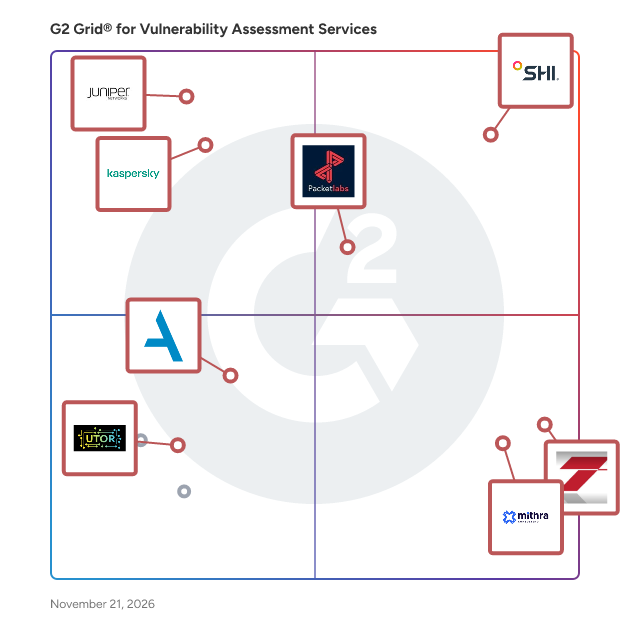
SHI leads with a G2 Score of 89. It is rated 4.7 out of 5 and is best for buyers who want security assessments from a global IT solutions provider and value-added reseller. 7 Layer Solutions, rated 4.8 out of 5, is best for managed IT and cybersecurity support in North America. Mithra Consulting, rated 4.9 out of 5, is best for vulnerability and penetration testing of web, API, and mobile applications. Appsecco, rated 4.8 out of 5, is best for penetration testing as a service for cloud-hosted product teams. Packetlabs, rated 4.9 out of 5, is best for manual, CREST-accredited testing.
3. Which vulnerability assessment service providers also offer penetration testing?
Mithra Consulting, Packetlabs, PlutoSec, and Vumetric Cybersecurity offer penetration testing alongside or in place of vulnerability assessment. Mithra Consulting describes its work as vulnerability and penetration testing, Packetlabs lists security assessments alongside penetration testing and red teaming, PlutoSec focuses on penetration testing across web applications, APIs, cloud infrastructure, networks, and operating systems, and Vumetric Cybersecurity is dedicated entirely to penetration testing.
4. Which vulnerability assessment services providers support compliance frameworks like SOC 2 and ISO 27001?
Mithra Consulting, Packetlabs, Netsurion, and PlutoSec are the providers who support compliance work. Mithra Consulting helps with SOC 2 and ISO 27001 audits and gap assessments; Packetlabs is CREST-accredited and SOC 2 Type II attested; Netsurion offers compliance management support within its managed open XDR, and PlutoSec provides guidance on compliance requirements. Appsecco positions itself for teams whose basic compliance-driven testing falls short.
5. Which vulnerability assessment services providers cover cloud and on-premises environments?
Packetlabs lists infrastructure, cloud, web applications, APIs, mobile and AI/LLM systems; PlutoSec lists web applications, APIs, cloud infrastructure, networks and operating systems; Mithra Consulting lists web, API and mobile applications, and Appsecco is built for cloud-hosted product teams.
6. Which vulnerability assessment services providers reduce false positives?
Packetlabs says 95% of its testing is manual and promises verified findings with no false positives, which is the provider's own claim, and Appsecco says it goes beyond automated scanners that lack context.
7. Which vulnerability assessment services providers offer managed or continuous vulnerability management?
Cybriant lists comprehensive vulnerability management alongside managed SIEM with live monitoring, managed detection and remediation, and XDR with 24/7 threat detection. Netsurion offers managed open XDR with a 24x7 SOC designed to work with an existing security stack, and 7 Layer Solutions manages and secures IT environments for businesses across North America.
8. Which vulnerability assessment services providers work with financial institutions and other regulated industries?
Packetlabs and Cybriant reviewers most often work in financial services, Appsecco targets teams building in regulated industries, and PlutoSec lists healthcare, finance, real estate, and technology and aligns its assessments to the OWASP Top 10, NIST SP 800-115, and MITRE ATT&CK. Their reviewer mix is mostly mid-sized and small, with 48% mid-market for Packetlabs and 47% for Cybriant, so large institutions should ask for references at comparable scale.
9. Which vulnerability assessment services providers suit small businesses and which suit larger organizations?
Mithra Consulting, Kaspersky Cybersecurity Services and Vumetric Cybersecurity have the largest small-business reviewer shares, at 67%, 53% and 50% on their profiles. Rapid7 Security Services, Juniper Services, and PlutoSec show the largest large-company shares, at 33%, 31%, and 17%. Vumetric Cybersecurity lists Fortune 1000, small and mid-sized, and government clients.
10. Should I choose a specialist testing firm or a security vendor's services team?
Mithra Consulting, Packetlabs, Appsecco, and PlutoSec are specialist security testing firms, while Sophos Professional Services, Rapid7 Security Services, Kaspersky Cybersecurity Services, Juniper Services, and Microsoft Defender Experts for XDR are services offered by security or networking vendors. SHI is a reseller partnered with AWS, Cisco, CrowdStrike, Dell, HP, Microsoft, Palo Alto, and others.
11. What are the common pitfalls in a vulnerability assessment engagement, and which providers avoid them?
Packetlabs, Mithra Consulting, and 7 Layer Solutions describe the most structured defence against the pitfalls reviewers raise most: cost, staff turnover, and limited availability. Packetlabs offers report walkthroughs and retesting, Mithra Consulting maps every finding to OWASP and CVSS, and 7 Layer Solutions reviewers praise team consistency over many years. 7 Layer Solutions, Mithra Consulting, and Packetlabs score 98%, 99%, and 98% on Ability to Execute, against 81% for Security testing and a 94% category average. SHI may suit organizations that value its breadth of services and can budget for its pricing, while 7 Layer Solutions may fit teams that can plan around its availability and higher costs.
12. What does vulnerability assessment cost?
Packetlabs publishes penetration testing pricing, stating that a test costs between $5K and $150K, with an average between $40K and $50K, depending on scope, methodology, the mix of automated and manual testing, and time frame. That guide covers penetration testing, which goes beyond a vulnerability scan. Netsurion lists Pay-as-you-Grow pricing for its managed open XDR, and reviewers describe SHI and 7 Layer Solutions as expensive, though many 7 Layer Solutions reviewers say the quality justifies the cost.
G2 Review Data Insights for Vulnerability Assessment Services Providers
Based on 1,000+ G2 reviews across the providers in this category.
-
What are vulnerability assessment service providers? Vulnerability assessment services identify security weaknesses across an organization’s devices, applications, and networks, then recommend improvements based on urgency and scope. G2 lists176 service providers holding an average rating of 4.56 out of 5.
-
Which software do these providers work alongside? G2's category description notes that businesses can deploy vulnerability management software in lieu of or in addition to vulnerability assessment services.
-
Which industries use vulnerability assessment service providers the most? Providers on G2 serve businesses across financial services, manufacturing, telecommunications, software, and other industries.
-
How satisfied are customers with Vulnerability Assessment Services providers? G2's Fall 2026 Grid® Report for Vulnerability Assessment Services reports a category average of 94% for Likelihood to Recommend. Level of Professionalism scores highest at 97%, followed by Ease of Doing Business With, Communication Skills, and Level of Responsiveness at 95%.
Explore Related Categories
Looking for deeper testing or compliance support? Explore penetration testing services for providers that uncover vulnerabilities in systems, networks, and applications, or IT compliance services for providers that help technology infrastructure meet regulatory standards.