  # Best Industrial IoT Software for Small Business

  *By [Nathan Calabrese](https://research.g2.com/insights/author/nathan-calabrese)*

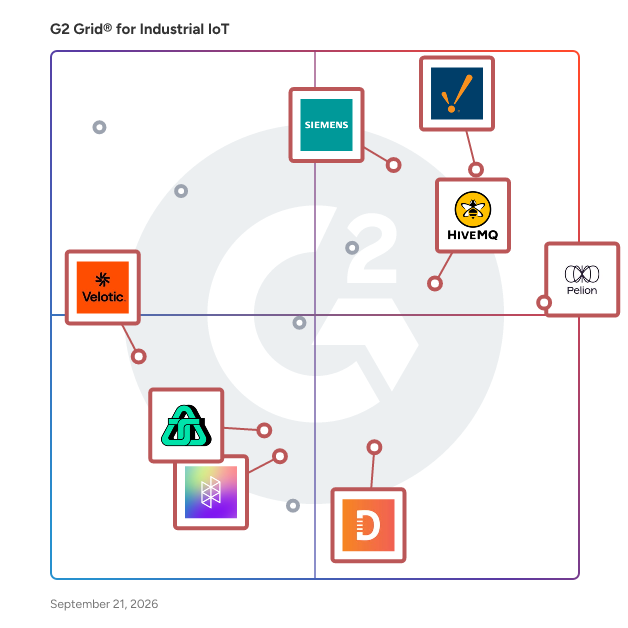
   Products classified in the overall Industrial IoT category are similar in many regards and help companies of all sizes solve their business problems. However, small business features, pricing, setup, and installation differ from businesses of other sizes, which is why we match buyers to the right Small Business Industrial IoT to fit their needs. Compare product ratings based on reviews from enterprise users or connect with one of G2&#39;s buying advisors to find the right solutions within the Small Business Industrial IoT category.

In addition to qualifying for inclusion in the Industrial IoT Software category, to qualify for inclusion in the Small Business Industrial IoT Software category, a product must have at least 10 reviews left by a reviewer from a small business.


## How Many Industrial IoT Software Products Does G2 Track?
**Total Products under this Category:** 125

### Category Stats (May 2026)
- **Average Rating**: 4.47/5
- **New Reviews This Quarter**: 17
- **Buyer Segments**: Mid-Market 51% │ Small-Business 29% │ Enterprise 20%
- **Top Trending Product**: Rayven (+0.039)
*Last updated: May 19, 2026*

  
## How Does G2 Rank Industrial IoT Software Products?

**Why You Can Trust G2's Software Rankings:**

- 30 Analysts and Data Experts
- 1,800+ Authentic Reviews
- 125+ Products
- Unbiased Rankings

G2's software rankings are built on verified user reviews, rigorous moderation, and a consistent research methodology maintained by a team of analysts and data experts. Each product is measured using the same transparent criteria, with no paid placement or vendor influence. While reviews reflect real user experiences, which can be subjective, they offer valuable insight into how software performs in the hands of professionals. Together, these inputs power the G2 Score, a standardized way to compare tools within every category.


  ## What Are the Top-Rated Industrial IoT Software Products in 2026?
### 1. [Pelion IoT Connectivity](https://www.g2.com/products/pelion-iot-connectivity/reviews)
  Pelion: Global IoT Connectivity Made Effortless What is Pelion? Pelion helps customers rapidly deploy, connect, secure and manage IoT Connectivity for operations of any scale or use case. With Pelion’s market leading eSIM eUICC technology you can experience flexible and seamless multi carrier access with one SIM spanning 600+ networks in over 150 countries. Pelion offers you the best network access and the best data rates, across the most reliable mobile networks globally. Providing greater visibility and control of every single eSIM connection across your estate with our scalable and simple-to-use management platform. By combining the best in connectivity, software and services Pelion empowers ambitious businesses in energy, e-mobility, manufacturing, transportation, retail and healthcare to deploy faster, reduce costs, mitigate risk and simplify operations.


  **Average Rating:** 4.3/5.0
  **Total Reviews:** 145

**Who Is the Company Behind Pelion IoT Connectivity?**

- **Seller:** [Pelion](https://www.g2.com/sellers/pelion)
- **Company Website:** https://pelion.com/
- **Year Founded:** 2002
- **HQ Location:** Glasgow, Scotland, United Kingdom
- **Twitter:** @PelionIoT (183 Twitter followers)
- **LinkedIn® Page:** https://www.linkedin.com/company/pelioniot/ (126 employees on LinkedIn®)

**Who Uses This Product?**
  - **Top Industries:** Information Technology and Services, Transportation/Trucking/Railroad
  - **Company Size:** 43% Small-Business, 28% Mid-Market


#### What Are Pelion IoT Connectivity's Pros and Cons?

**Pros:**

- Ease of Use (51 reviews)
- Customer Support (50 reviews)
- Network Connectivity (47 reviews)
- IoT Connectivity (40 reviews)
- Easy Setup (34 reviews)

**Cons:**

- SIM Issues (36 reviews)
- Poor Support (23 reviews)
- Technical Issues (21 reviews)
- SIM Management Issues (20 reviews)
- Technical Difficulties (19 reviews)

### 2. [Hologram](https://www.g2.com/products/hologram/reviews)
  Own your IoT deployment with Hologram&#39;s cellular SIM cards and easy-to-use monitoring dashboard. Our seamless, global coverage, multi-carrier network and support specialists are here to help you connect and manage your IoT devices. Our flexible pricing plans are designed to get you off the ground. Focus on scaling your fleet and managing your devices without any additional carrier negotiations, integrations, or hardware swaps. Test drive Hologram with a pilot IoT SIM and get connected in under a week.


  **Average Rating:** 4.5/5.0
  **Total Reviews:** 62

**Who Is the Company Behind Hologram?**

- **Seller:** [Hologram](https://www.g2.com/sellers/hologram)
- **Company Website:** https://hologram.io
- **Year Founded:** 2013
- **HQ Location:** Chicago, US
- **Twitter:** @Hologram_io (26 Twitter followers)
- **LinkedIn® Page:** https://www.linkedin.com/company/3293837/ (71 employees on LinkedIn®)

**Who Uses This Product?**
  - **Who Uses This:** CEO
  - **Top Industries:** Farming, Transportation/Trucking/Railroad
  - **Company Size:** 70% Small-Business, 29% Mid-Market


#### What Are Hologram's Pros and Cons?

**Pros:**

- API Integration (1 reviews)
- Custom Dashboards (1 reviews)
- Customer Support (1 reviews)
- Documentation Quality (1 reviews)
- Efficient Solutions (1 reviews)

**Cons:**

- Limited Customization (1 reviews)
- Limited Features (1 reviews)

### 3. [Insights Hub](https://www.g2.com/products/siemens-digital-industries-software-insights-hub/reviews)
  Insights Hub is a solution for Data-Driven Manufacturing. It is designed to help users harness the power of data generated from assets and operations within smart manufacturing environments and implement a continuous improvement process. It leverages AI to transform raw data into actionable insights, enabling organizations to continuously enhance their manufacturing processes and make informed decisions that drive operational excellence. Targeted primarily at manufacturers and industrial operators, Insights Hub serves a diverse audience that includes equipment manufacturers, facility managers, and production teams. The solution addresses a variety of use cases, such as asset monitoring, performance optimization, quality improvement, and maintenance streamlining. By utilizing Insights Hub, organizations can gain a comprehensive understanding of their operations, identify inefficiencies, and implement strategies that lead to enhanced productivity and reduced costs. This makes it an essential tool for businesses looking to stay competitive in an increasingly data-driven industry. Insights Hub encompasses several key features that cater to specific operational needs. For instance, Insights Hub Monitor allows users to track asset performance in real-time, providing critical data that can inform maintenance schedules and operational adjustments. This feature is particularly beneficial for organizations aiming to minimize downtime and maximize the availability of their equipment. Insights Hub OEE focuses on overall equipment effectiveness, helping organizations analyze performance metrics to improve efficiency and reduce downtime. Additionally, Insights Hub Quality Prediction enhances quality inspection processes by utilizing predictive analytics to identify potential defects before they occur, thereby minimizing rework and waste. Insights Hub Asset Health and Maintenance is tailored for equipment manufacturers and operators, offering tools to streamline maintenance services and extend asset lifecycles. Insights Hub is also providing dedicated solutions to improve sustainability, leveraging Machine Learning to reduce energy and resource consumption. It also enhances traceability and facilitates containment of issues, avoiding negative impact on customers. By integrating these features, Insights Hub delivers significant value to its users. Insights Hub not only improves operational decision-making through data-driven insights but also fosters a culture of continuous improvement within manufacturing environments. The expanded portfolio, which includes software, IoT-connected hardware, and related services, allows customers and partners within the Siemens Xcelerator ecosystem to develop industry-specific applications tailored to their unique operational challenges. This adaptability ensures that Insights Hub remains relevant and effective in a rapidly evolving industrial landscape, positioning organizations to thrive in the era of smart manufacturing.


  **Average Rating:** 4.6/5.0
  **Total Reviews:** 55

**Who Is the Company Behind Insights Hub?**

- **Seller:** [Siemens Digital Industries Software](https://www.g2.com/sellers/siemens-digital-industries-software)
- **Company Website:** https://www.sw.siemens.com/
- **Year Founded:** 1980
- **HQ Location:** Plano, Texas
- **Twitter:** @siemenssoftware (36,968 Twitter followers)
- **LinkedIn® Page:** https://www.linkedin.com/company/28423178/ (20,658 employees on LinkedIn®)

**Who Uses This Product?**
  - **Top Industries:** Industrial Automation, Food &amp; Beverages
  - **Company Size:** 36% Enterprise, 36% Small-Business


#### What Are Insights Hub's Pros and Cons?

**Pros:**

- Ease of Use (8 reviews)
- Features (7 reviews)
- User-Friendly (7 reviews)
- Easy Integrations (6 reviews)
- Custom Dashboards (5 reviews)

**Cons:**

- Learning Curve (6 reviews)
- Limited Customization (4 reviews)
- Navigation Issues (4 reviews)
- Poor Usability (4 reviews)
- Difficult Navigation (3 reviews)

### 4. [HiveMQ](https://www.g2.com/products/hivemq/reviews)
  HiveMQ is the Industrial Data Platform helping enterprises move from connected devices to intelligent operations. Built on the MQTT standard and a distributed edge-to-cloud architecture, HiveMQ connects and governs industrial data in real time, enabling organizations to act with intelligence. With proven reliability, scalability, and interoperability, HiveMQ provides the foundation industrial companies need to operationalize AI, powering the next generation of intelligent industry. Global leaders including Audi, BMW, Eli Lilly, Liberty Global, Mercedes-Benz, and Siemens trust HiveMQ to run their most mission-critical operations.


  **Average Rating:** 4.5/5.0
  **Total Reviews:** 84

**Who Is the Company Behind HiveMQ?**

- **Seller:** [HiveMQ](https://www.g2.com/sellers/hivemq)
- **Company Website:** https://www.hivemq.com/
- **Year Founded:** 2012
- **HQ Location:** Landshut, Bayern
- **Twitter:** @HiveMQ (2,855 Twitter followers)
- **LinkedIn® Page:** https://www.linkedin.com/company/2949784 (170 employees on LinkedIn®)

**Who Uses This Product?**
  - **Top Industries:** Computer Software, Information Technology and Services
  - **Company Size:** 45% Mid-Market, 39% Small-Business


#### What Are HiveMQ's Pros and Cons?

**Pros:**

- Reliability (20 reviews)
- Features (18 reviews)
- Monitoring (14 reviews)
- Efficiency Improvement (11 reviews)
- Customer Support (10 reviews)

**Cons:**

- Expensive (17 reviews)
- Difficult Learning (9 reviews)
- Usability Issues (9 reviews)
- Technical Issues (7 reviews)
- UX Improvement (4 reviews)

### 5. [Telnyx IoT](https://www.g2.com/products/telnyx-iot/reviews)
  Telnyx IoT provides secure, global connectivity solutions for IoT devices, simplifying the challenge of bringing smart devices online from anywhere. Leveraging the power of a secure virtual private mobile and IP network in the cloud, Telnyx IoT offers flexible data coverage across 180+ countries through a single SIM, catering to a diverse range of IoT applications. Telnyx IoT SIM cards are eUICC enabled and available in various forms including triple-size plastic SIM cards, eSIM chips (embedded MFF2), and over-the-air eSIMs. A single Telnyx SIM connects devices to over 650 networks (4G LTE, 3G, 2G, and LTE-M) worldwide, including all major carriers in the United States. Intelligent network switching allows automatic and seamless failover to the best carrier, ensuring maximum uptime for connected devices.The service offers pay-as-you-go pricing, starting at $0.0125 per MB, and includes options for private LTE networks and public static IP addresses. For managing IoT deployments, Telnyx provides a portal and APIs for easy control and monitoring of SIM fleets, including activation and deactivation, setting data limits, network priorities, and more. For more information, visit https://telnyx.com/products/iot-sim-card .


  **Average Rating:** 4.6/5.0
  **Total Reviews:** 69

**Who Is the Company Behind Telnyx IoT?**

- **Seller:** [Telnyx](https://www.g2.com/sellers/telnyx)
- **Year Founded:** 2009
- **HQ Location:** 600 Congress Avenue 14th Floor Austin, TX 78701
- **Twitter:** @telnyx (4,387 Twitter followers)
- **LinkedIn® Page:** https://www.linkedin.com/company/3349412/ (367 employees on LinkedIn®)

**Who Uses This Product?**
  - **Top Industries:** Information Technology and Services, Telecommunications
  - **Company Size:** 84% Small-Business, 14% Mid-Market


#### What Are Telnyx IoT's Pros and Cons?

**Pros:**

- Customer Support (4 reviews)
- Ease of Use (4 reviews)
- Affordable Pricing (2 reviews)
- Easy Setup (2 reviews)
- IoT Connectivity (2 reviews)

**Cons:**

- SIM Issues (2 reviews)
- SIM Management Issues (2 reviews)
- Expensive (1 reviews)
- High Pricing (1 reviews)
- Learning Curve (1 reviews)

### 6. [DATOMS](https://www.g2.com/products/datoms/reviews)
  DATOMS is a Connected Asset Management Software designed for OEMs, rental companies, and enterprises. It enables the monitoring and management of industrial assets through internet-connected devices and sensors. This software facilitates the tracking of the usage of assets, monitors performance and condition, predicts maintenance needs, and automates work orders. By employing connected asset management, companies can enhance the efficiency and lifespan of their assets, minimize downtime and maintenance expenses, and improve overall operations.


  **Average Rating:** 4.7/5.0
  **Total Reviews:** 69

**Who Is the Company Behind DATOMS?**

- **Seller:** [Phoenix Robotix Pvt. Ltd.](https://www.g2.com/sellers/phoenix-robotix-pvt-ltd)
- **Company Website:** https://datoms.io/
- **Year Founded:** 2015
- **HQ Location:** Bengaluru, Karnataka
- **Twitter:** @datoms_iot (143 Twitter followers)
- **LinkedIn® Page:** https://www.linkedin.com/company/datoms (74 employees on LinkedIn®)

**Who Uses This Product?**
  - **Top Industries:** Manufacturing, Mechanical or Industrial Engineering
  - **Company Size:** 44% Mid-Market, 42% Small-Business


#### What Are DATOMS's Pros and Cons?

**Pros:**

- Customer Support (31 reviews)
- Ease of Use (24 reviews)
- Data Management (19 reviews)
- User Interface (18 reviews)
- User-Friendly (17 reviews)

**Cons:**

- Slow Performance (15 reviews)
- Slow Speed (13 reviews)
- Technical Difficulties (13 reviews)
- Technical Issues (13 reviews)
- Data Management Issues (7 reviews)


    ## What Is Industrial IoT Software?
  [ Manufacturing](https://www.g2.com/categories/manufacturing)
  ## What Software Categories Are Similar to Industrial IoT Software?
    - [IoT Platforms](https://www.g2.com/categories/iot-platforms)
    - [IoT Device Management Platforms](https://www.g2.com/categories/iot-device-management-platforms)
    - [IoT Connectivity Management Software](https://www.g2.com/categories/iot-connectivity-management)

  
---

## How Do You Choose the Right Industrial IoT Software?

### What You Should Know About Industrial IoT Software

### What is Industrial IoT Software?

The Internet of Things (IoT) is transforming industries around the world, and perhaps none more than the manufacturing industry. Smart sensors and well-programmed IoT applications are helping convert factory equipment into functioning IoT devices, allowing them to generate actionable data, communicate with other machines, and optimize production. Industrial IoT software empowers factory operators to harness the power of smart technology with their own IoT projects, connecting production machines, and uncovering the benefits of industrial automation.

The widespread adoption of IoT systems in manufacturing is called the Fourth Industrial Revolution or Industry 4.0. Achieving IoT connectivity and its potential business outcomes requires more than a single software platform. Bringing a factory operation to the industrial internet requires a substantial investment in modern hardware. These initiatives require unique networks and data plans to bring connectivity to industrial IoT devices, and relevant programming. For companies with resources, industrial IoT software can provide digital capabilities for real-time monitoring of connected objects, managing of IoT data, and configuring the applications that make these systems perform in the desired ways. The industrial IoT market is evolving on a daily basis, becoming a top priority for how businesses invest their resources and structure into their critical factory processes. As it becomes more accessible for the average business, the advanced tools in this emerging software category will be an IoT gateway for many of these teams, helping make sense of complex IoT technology and using it to achieve specific needs.

Key Benefits of Industrial IoT Software

- Create real-world applications for smart technology within a manufacturing scenario
- Unify distributed factory equipment and corresponding data on a centralized platform
- Automate processes and trigger device-based events across the supply chain
- Track real-time analytics related to machine performance, allowing predictive maintenance and proactive improvements to business-critical assets

### Why Use Industrial IoT Software?

Industrial IoT, or IIoT, is helping manufacturing businesses perform at a higher level than ever before. As the IIoT market continues to evolve, it becomes more affordable and sensible for businesses to implement IoT applications and hardware on their factory floors, whether incrementally or in complete transformations of their equipment fleet. Used properly and with the necessary resources, intelligent factory systems can maximize efficiency, reduce operational costs, and improve worker safety, among various other benefits.

There are a number of technologies and cloud-based platforms that can assist with monitoring and optimizing factory operations, such as [manufacturing intelligence software](https://www.g2.com/categories/manufacturing-intelligence). Internet connectivity and IoT platforms have expanded these capabilities by enabling machines to “talk&quot; with each other and share timely, actionable insights with factory workers and supervisors. Considering recent innovations such as artificial intelligence and blockchain, as well as the growing popularity of industrial robots, IoT-enabled factory devices are helping manufacturers produce consistently and securely, minimizing equipment downtime and discrepancies in production. This allows workers to focus on the most critical tasks, while making data-driven decisions about machine maintenance, worker distribution, and overall production strategy. An IoT strategy may be an overwhelming or nerve-wrecking concept for established manufacturing operations, but thanks to advanced platforms like those in this category, factory connectivity and automation are within reach for businesses around the globe.

### Who Uses Industrial IoT Software?

The IoT market is rapidly scaling thanks to implementation across industries and regions, with smart technology now commonplace in homes, retail stores, and countless other scenarios. Industrial IoT applications are designed specifically for manufacturing environments, with unique tools for connecting, programming, and tracking factory machinery and other equipment. These platforms are best suited for decision-makers and supervisory experts, along with machine and process engineers who help these teams execute their overarching strategies. Each of these applications offers a unique set of tools, and may be intended for certain aspects of IIoT management.

### Industrial IoT Software Features

Though the platforms in this category can help achieve similar outcomes, they each provide different sets of features, whether for very specific components of industrial IoT or end-to-end execution of smart factory scenarios. The following are some common features of these diverse offerings.

**Real-time monitoring —** Managing a factory floor can involve an outsized number of expensive, complex machines, with a never-ending demand for inspections, upgrades, and repairs. This can be especially troublesome for larger operations, with distributed assets and various products assembled at any given moment. Using live sensor data from embedded machinery, factory supervisors can keep a close eye on machine performance and health, with granular tracking of equipment parts and connected processes. Industrial IoT software may share features of or integrate with [IoT device management software](https://www.g2.com/categories/iot-device-management), providing users with valuable information about any and all assets connected to the IoT network. Using the actionable data from these monitoring tools, factory managers can make proactive decisions about machine upkeep and resource allocation, while ensuring these distributed assets are active and working as needed for the desired outcomes.

**Machine workflow creation —** Automation is a resounding benefit of industrial IoT technology for businesses adopting these solutions. Using similar programming modules as [IoT platforms](https://www.g2.com/categories/iot-platforms) and [IoT development tools](https://www.g2.com/categories/iot-development-tools)—or importing the applications designed with these solutions—industrial IoT systems can help implement automated process and response flows across connected machinery. In addition to optimizing machine processes, these intelligent workflows can instruct machines to adjust their processes based on triggers, observations, or signals from other machines. For example, if a nearby machine encounters a problem, it can communicate the problem and cause a connected machine to pause production. By creating intelligent workflows with various situations and preferred responses, it can alleviate factory workers of certain time-sensitive tasks and keep things running throughout the ups and downs of production. It can also help create a symbiotic relationship between the many and varied systems on a factory floor, unifying production and improving business outcomes across the operation.

**Factory data analytics —** There are boundless data points to be considered in a modern manufacturing operation, from the efficiency of certain machines to the number and types of anomalies encountered on the assembly line. Each new piece of data can help factory managers make informed decisions about how to structure work processes, allocate resources, and train employees. The platforms in this category offer features similar to or integrate with [IoT analytics software](https://www.g2.com/categories/iot-analytics), collecting data from distributed assets and revealing the most actionable insights related to production, work environments, equipment health, and more. These platforms may also offer features which integrate with [digital twin software](https://www.g2.com/categories/digital-twin), allowing users to monitor virtual replicas of machines and machine parts as well as view predictive analytics about maintenance needs or performance outcomes. Factories that take advantage of these advanced analytics can continuously improve their operations in ways that were not possible before the rise of IoT technology.

### Software and Services Related to Industrial IoT Software

The following software and service markets are worth considering, and may help shape companies’ manufacturing strategy and processes in significant ways.

[**Manufacturing intelligence software**](https://www.g2.com/categories/manufacturing-intelligence) **—** Manufacturing intelligence software provides factory supervisors and leadership boards with high-level insights drawn from sources across the operation. For factory operations to succeed and meet the increasing demands of customers and partners, there needs to be a continuous effort to identify issues and improvement opportunities related to cost, production quality, and worker productivity. Manufacturing intelligence platforms help to gather and structure data from company software systems and production equipment, allowing users to quickly and conveniently observe the metrics that matter most so they can determine priorities and adjust strategies. Employees on the factory floor may also utilize this data to inform their ongoing manufacturing tasks and gain a deeper understanding of their operation and output, along with the equipment they use on a daily basis. With or without an IoT strategy in place, these tools can centralize and visualize the most relevant analytics for manufacturing teams, with timely alerts or notifications about production issues and other important findings.

[**PLM software**](https://www.g2.com/categories/plm) **—** Product lifecycle management software, or PLM software, provides manufacturing teams with a centralized information hub related to their product development. These tools help industrial companies track various data points throughout a product’s creation and distribution cycle, including the people and systems involved at every step in the process. PLM software often integrates with [ERP systems](https://www.g2.com/categories/erp-systems), which help manage the many resources involved in a production-based business. As factories continue to adopt IoT technology, these platforms can help store and organize critical production data and ensure that resources are allocated as necessary for the desired business outcomes.

[**Managed IoT services**](https://www.g2.com/categories/managed-iot-services) **—** Deploying a fleet of IoT devices and connected factory assets is only part of the challenge, as these assets demand constant monitoring, analysis, updates, and maintenance to realize their potential and function as intended. In certain situations, manufacturing teams may not be properly equipped to manage these fleets and handle the litany of tasks related to their management and optimization. Managed IoT services providers allow these businesses to outsource one or more of the responsibilities related to an industrial IoT infrastructure, including device monitoring, data analysis, and system diagnostics. Additionally, a business may consider working with an external [IoT developer](https://www.g2.com/categories/internet-of-things-iot-developers) to design and deploy underlying applications that allow machines to communicate, gather data, and automate responses to various events or triggers. Limited internal experience with smart technology and embedded systems should not stand in the way of a business realizing the benefits of industrial IoT. Working with a third-party specialist may allow companies to achieve these goals faster and with fewer risks.


