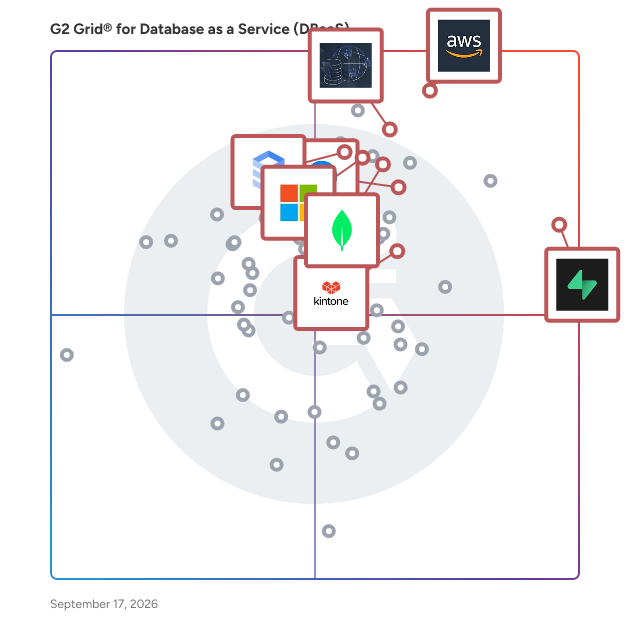
  # Best Database as a Service (DBaaS) Providers - Page 2

  *By [Rachana Hasyagar](https://research.g2.com/insights/author/rachana-hasyagar)*

   Database as a service (DBaaS) is the process of application owners paying an outside provider that launches and maintains a cloud database for storage, as opposed to having the application owners control the database themselves. Payments are per-usage and application owners can access their application data as they please. These databases provide the same functionality as a standard relational or non-relational database. DBaaS is beneficial for companies that are trying to avoid the work of configuring, maintaining, and upgrading their own databases. DBaaS lives in the overall realm of software as a service (SaaS), similar to platform as a service ([PaaS](https://www.g2.com/categories/cloud-platform-as-a-service-paas)) and infrastructure as a service ([IaaS](https://www.g2.com/categories/infrastructure-as-a-service-iaas)), where all products are hosted as a service. Other types of databases include [relational database](https://www.g2.com/categories/relational-databases) tools, [NoSQL database](https://www.g2.com/categories/nosql-databases) tools, [graph database](https://www.g2.com/categories/graph-databases) tools and more. Developers on a budget also have options with [free database software](https://learn.g2.com/free-database-software).

To qualify for inclusion in the Database as a Service category, a product must:

- Be offered by an independent data storage provider
- The outside provider must launch, maintain, administer, and be held responsible for performance of said database
- Application owners must be able to access necessary data on-demand
- These services must be offered via per-usage subscription-based payment plans


## How Many Database as a Service (DBaaS) Providers Products Does G2 Track?
**Total Products under this Category:** 144

### Category Stats (May 2026)
- **Average Rating**: 4.42/5
- **New Reviews This Quarter**: 46
- **Buyer Segments**: Small-Business 42% │ Enterprise 34% │ Mid-Market 24%
- **Top Trending Product**: Amazon MemoryDB (+0.027)
*Last updated: May 18, 2026*

  
## How Does G2 Rank Database as a Service (DBaaS) Providers Products?

**Why You Can Trust G2's Software Rankings:**

- 30 Analysts and Data Experts
- 10,600+ Authentic Reviews
- 144+ Products
- Unbiased Rankings

G2's software rankings are built on verified user reviews, rigorous moderation, and a consistent research methodology maintained by a team of analysts and data experts. Each product is measured using the same transparent criteria, with no paid placement or vendor influence. While reviews reflect real user experiences, which can be subjective, they offer valuable insight into how software performs in the hands of professionals. Together, these inputs power the G2 Score, a standardized way to compare tools within every category.

  
## Which Database as a Service (DBaaS) Providers Is Best for Your Use Case?

- **Leader:** [Amazon Relational Database Service (RDS)](https://www.g2.com/products/amazon-relational-database-service-rds/reviews)
- **Highest Performer:** [Boost.space](https://www.g2.com/products/boost-space/reviews)
- **Easiest to Use:** [DigitalOcean](https://www.g2.com/products/digitalocean/reviews)
- **Top Trending:** [Boost.space](https://www.g2.com/products/boost-space/reviews)
- **Best Free Software:** [Amazon Relational Database Service (RDS)](https://www.g2.com/products/amazon-relational-database-service-rds/reviews)

  
---

**Sponsored**

### Kintone

Kintone is a no-code business application platform designed to empower non-technical users to create robust applications, workflows, and databases tailored to their teams and organizations. By utilizing a user-friendly interface that emphasizes clicks over coding, Kintone enables individuals to develop applications that streamline business processes, enhance collaboration on projects and tasks, and facilitate the reporting of complex data with ease. This platform is particularly beneficial for business users who require immediate solutions without the need for extensive programming knowledge. Kintone offers a wide array of pre-built applications that cater to various use cases, including customer relationship management (CRM), project management, inventory management, and more. These templates allow users to hit the ground running and adapt the applications to their specific needs, significantly reducing the time and effort required to implement new systems. Kintone&#39;s target audience includes small to medium-sized businesses, project managers, team leaders, and any professional looking to optimize their workflow without relying on IT departments or external developers. The no-code approach democratizes app development, allowing users from diverse backgrounds to participate in creating solutions that address their unique challenges. This inclusivity fosters a culture of innovation within organizations, as team members can contribute ideas and improvements based on their firsthand experiences. Key features of Kintone include customizable dashboards, automated workflows, and real-time collaboration tools. Users can design dashboards that provide insights into their projects and data at a glance, while automated workflows help eliminate repetitive tasks, ensuring that team members can focus on higher-value activities. The platform also supports real-time collaboration, enabling teams to work together seamlessly, share updates, and track progress on projects without the need for constant meetings or email exchanges. Kintone stands out in the no-code platform category by offering a flexible and scalable solution that grows with organizations. Its ability to integrate with other tools and services further enhances its functionality, allowing users to create a comprehensive ecosystem that meets their evolving business needs. By providing a powerful yet accessible platform for app development, Kintone empowers users to take control of their workflows and drive efficiency within their teams.


[Visit website](https://www.g2.com/external_clickthroughs/record?secure%5Bad_program%5D=ppc&amp;secure%5Bad_slot%5D=category_product_list&amp;secure%5Bcategory_id%5D=318&amp;secure%5Bdisplayable_resource_id%5D=318&amp;secure%5Bdisplayable_resource_type%5D=Category&amp;secure%5Bmedium%5D=sponsored&amp;secure%5Bplacement_reason%5D=page_category&amp;secure%5Bplacement_resource_ids%5D%5B%5D=318&amp;secure%5Bprioritized%5D=false&amp;secure%5Bproduct_id%5D=16406&amp;secure%5Bresource_id%5D=318&amp;secure%5Bresource_type%5D=Category&amp;secure%5Bsource_type%5D=category_page&amp;secure%5Bsource_url%5D=https%3A%2F%2Fwww.g2.com%2Fcategories%2Fdatabase-as-a-service-dbaas%2Fsmall-business&amp;secure%5Btoken%5D=3ebf89641528453180d59061720a93353db99f8d8caf9195f6f8f0563c075365&amp;secure%5Burl%5D=https%3A%2F%2Fwww.kintone.com%2Fdatabase-management-software%2F%3Futm_campaign%3DG2%2520Database%26utm_source%3DG2%26utm_medium%3DCPC%26utm_content%3DDatabase_CTA&amp;secure%5Burl_type%5D=custom_url)

---

  ## What Are the Top-Rated Database as a Service (DBaaS) Providers Products in 2026?
### 1. [E2E Cloud](https://www.g2.com/products/e2e-cloud/reviews)
  E2E Cloud, Meity Empanelled and NSE-Listed AI-First Hyperscaler [NSE:E2E] is a cloud service provider that helps users deploy, manage, and scale high-performance computing resources, particularly for AI/ML applications and data-intensive workloads. It is designed to serve startups, developers, data scientists, enterprises, and public sector organisations with cost-effective and scalable cloud solutions.


  **Average Rating:** 4.8/5.0
  **Total Reviews:** 130
**How Do G2 Users Rate E2E Cloud?**

- **Application Performance:** 9.3/10 (Category avg: 8.9/10)
- **Ease of Use:** 9.2/10 (Category avg: 8.8/10)
- **Scalability:** 9.5/10 (Category avg: 8.9/10)
- **Provisioning:** 9.0/10 (Category avg: 8.7/10)

**Who Is the Company Behind E2E Cloud?**

- **Seller:** [E2E Networks](https://www.g2.com/sellers/e2e-networks)
- **Year Founded:** 2009
- **HQ Location:** New Delhi, IN
- **Twitter:** @e2enetworks (3,406 Twitter followers)
- **LinkedIn® Page:** https://www.linkedin.com/company/e2enetworks/ (256 employees on LinkedIn®)
- **Ownership:** E2E (NSE)

**Who Uses This Product?**
  - **Who Uses This:** Founder, Director
  - **Top Industries:** Computer Software, Information Technology and Services
  - **Company Size:** 73% Small-Business, 26% Mid-Market


#### What Are E2E Cloud's Pros and Cons?

**Pros:**

- Cost-Effective (31 reviews)
- Customer Support (31 reviews)
- Affordable (27 reviews)
- Ease of Use (21 reviews)
- Services (21 reviews)

**Cons:**

- Poor Customer Support (7 reviews)
- Interface Issues (6 reviews)
- Resource Limitations (6 reviews)
- Poor Interface Design (5 reviews)
- Poor UI (5 reviews)

### 2. [Supabase](https://www.g2.com/products/supabase-supabase/reviews)
  Supabase is an open-source backend-as-a-service (BaaS) platform that enables developers to build and scale applications efficiently without managing server infrastructure. Launched in 2020 as an alternative to Firebase, Supabase offers a suite of tools including a PostgreSQL database, authentication, real-time subscriptions, and storage capabilities. By leveraging the robustness of PostgreSQL, Supabase provides a scalable and secure foundation for modern web and mobile applications. Key Features and Functionality: - PostgreSQL Database: Each Supabase project includes a dedicated PostgreSQL database, offering full SQL support and advanced features such as JSON handling, full-text search, and vector support. - Instant APIs: Supabase automatically generates RESTful and GraphQL APIs based on your database schema, eliminating the need for manual coding and accelerating development. - Authentication and Authorization: The platform provides built-in user authentication with support for various sign-in methods, including email/password, magic links, and social logins. It also integrates seamlessly with PostgreSQL&#39;s Row Level Security for fine-grained access control. - Real-time Capabilities: Supabase enables real-time data synchronization via WebSockets, allowing applications to respond instantly to database changes. - Edge Functions: Developers can deploy serverless functions close to users for low-latency execution, facilitating scalable and efficient backend logic. - File Storage: Supabase offers scalable storage solutions for managing and serving files, complete with configurable access policies to ensure data security. Primary Value and User Solutions: Supabase addresses the challenges developers face in building and scaling applications by providing a comprehensive, open-source backend platform. It eliminates the complexities of managing server infrastructure, allowing developers to focus on creating feature-rich applications. With its real-time capabilities, robust authentication, and seamless integration with PostgreSQL, Supabase empowers developers to build secure, scalable, and responsive applications efficiently.


  **Average Rating:** 4.7/5.0
  **Total Reviews:** 47
**How Do G2 Users Rate Supabase?**

- **Application Performance:** 9.6/10 (Category avg: 8.9/10)
- **Ease of Use:** 9.0/10 (Category avg: 8.8/10)
- **Scalability:** 9.6/10 (Category avg: 8.9/10)
- **Provisioning:** 9.8/10 (Category avg: 8.7/10)

**Who Is the Company Behind Supabase?**

- **Seller:** [Supabase](https://www.g2.com/sellers/supabase)
- **Year Founded:** 2020
- **HQ Location:** Global, US
- **LinkedIn® Page:** https://www.linkedin.com/company/supabase/ (270 employees on LinkedIn®)

**Who Uses This Product?**
  - **Top Industries:** Information Technology and Services, Computer Software
  - **Company Size:** 79% Small-Business, 15% Mid-Market


#### What Are Supabase's Pros and Cons?

**Pros:**

- Ease of Use (9 reviews)
- Features (7 reviews)
- Easy Integrations (5 reviews)
- Setup Ease (5 reviews)
- User-Friendly (5 reviews)

**Cons:**

- Beginner Unfriendliness (2 reviews)
- Expensive (2 reviews)
- High Complexity (2 reviews)
- Insufficient Guidance (2 reviews)
- Learning Difficulty (2 reviews)

### 3. [Google Cloud Memorystore](https://www.g2.com/products/google-cloud-memorystore/reviews)
  Cloud Memorystore for Redis provides a fully managed in-memory data store service built on scalable, secure, and highly available infrastructure managed by Google. Use Cloud Memorystore to build application caches that provides sub-millisecond data access. Cloud Memorystore is compatible with the Redis protocol, allowing easy migration with zero code changes.


  **Average Rating:** 4.3/5.0
  **Total Reviews:** 45
**How Do G2 Users Rate Google Cloud Memorystore?**

- **Application Performance:** 8.9/10 (Category avg: 8.9/10)
- **Ease of Use:** 8.7/10 (Category avg: 8.8/10)
- **Scalability:** 9.0/10 (Category avg: 8.9/10)
- **Provisioning:** 8.6/10 (Category avg: 8.7/10)

**Who Is the Company Behind Google Cloud Memorystore?**

- **Seller:** [Google](https://www.g2.com/sellers/google)
- **Year Founded:** 1998
- **HQ Location:** Mountain View, CA
- **Twitter:** @google (31,915,529 Twitter followers)
- **LinkedIn® Page:** https://www.linkedin.com/company/1441/ (336,169 employees on LinkedIn®)
- **Ownership:** NASDAQ:GOOG

**Who Uses This Product?**
  - **Top Industries:** Computer Software, Information Technology and Services
  - **Company Size:** 38% Small-Business, 35% Mid-Market


### 4. [Amazon Timestream](https://www.g2.com/products/amazon-timestream/reviews)
  Amazon Timestream is a fast, scalable, fully managed time series database service for IoT and operational applications that makes it easy to store and analyze trillions of events per day at 1/10th the cost of relational databases. Driven by the rise of IoT devices, IT systems, and smart industrial machines, time-series data, data that measures how things change over time, is one of the fastest growing data types.


  **Average Rating:** 3.7/5.0
  **Total Reviews:** 20
**How Do G2 Users Rate Amazon Timestream?**

- **Ease of Use:** 8.2/10 (Category avg: 8.8/10)

**Who Is the Company Behind Amazon Timestream?**

- **Seller:** [Amazon Web Services (AWS)](https://www.g2.com/sellers/amazon-web-services-aws-3e93cc28-2e9b-4961-b258-c6ce0feec7dd)
- **Year Founded:** 2006
- **HQ Location:** Seattle, WA
- **Twitter:** @awscloud (2,228,514 Twitter followers)
- **LinkedIn® Page:** https://www.linkedin.com/company/amazon-web-services/ (156,424 employees on LinkedIn®)
- **Ownership:** NASDAQ: AMZN

**Who Uses This Product?**
  - **Top Industries:** Computer Software
  - **Company Size:** 45% Mid-Market, 32% Small-Business


#### What Are Amazon Timestream's Pros and Cons?

**Pros:**

- Reliability (1 reviews)


### 5. [Amazon ElastiCache](https://www.g2.com/products/amazon-elasticache/reviews)
  Amazon ElastiCache is a fully managed service that makes it easy to deploy, operate, and scale an in-memory data store and cache in the cloud. Often working in conjunction with other AWS database and storage services, ElastiCache ensures modern applications meet real-time requirements for high data throughput and sub-milli second response times, while serving millions of simultaneous requests. Amazon ElastiCache supports two open-source in-memory engines: o Redis - a fast, open source, in-memory data store and cache. Amazon ElastiCache for Redis is a Redis-compatible in-memory service that delivers the ease-of-use and power of Redis along with the availability, reliability and performance suitable for the most demanding applications. ElastiCache for Redis is fully managed, scalable, and secure - making it an ideal candidate to power high-performance use cases such as Web, Mobile Apps, Gaming, Ad-Tech, and IoT. o Memcached - a widely adopted memory object caching system. Amazon ElastiCache for Memcached is protocol compliant with Memcached, so popular tools that you use today with existing Memcached environments will work seamlessly with the service. ElastiCache for Memcached is suitable for caching use cases where performance and concurrency is important.


  **Average Rating:** 4.5/5.0
  **Total Reviews:** 83
**How Do G2 Users Rate Amazon ElastiCache?**

- **Application Performance:** 8.8/10 (Category avg: 8.9/10)
- **Ease of Use:** 8.9/10 (Category avg: 8.8/10)
- **Scalability:** 8.6/10 (Category avg: 8.9/10)
- **Provisioning:** 8.8/10 (Category avg: 8.7/10)

**Who Is the Company Behind Amazon ElastiCache?**

- **Seller:** [Amazon Web Services (AWS)](https://www.g2.com/sellers/amazon-web-services-aws-3e93cc28-2e9b-4961-b258-c6ce0feec7dd)
- **Year Founded:** 2006
- **HQ Location:** Seattle, WA
- **Twitter:** @awscloud (2,228,514 Twitter followers)
- **LinkedIn® Page:** https://www.linkedin.com/company/amazon-web-services/ (156,424 employees on LinkedIn®)
- **Ownership:** NASDAQ: AMZN

**Who Uses This Product?**
  - **Who Uses This:** Software Engineer, DevOps Engineer
  - **Top Industries:** Computer Software, Information Technology and Services
  - **Company Size:** 36% Small-Business, 33% Mid-Market


#### What Are Amazon ElastiCache's Pros and Cons?

**Pros:**

- Cost Efficiency (1 reviews)
- Customer Support (1 reviews)
- Low Latency (1 reviews)
- Performance (1 reviews)
- Performance Efficiency (1 reviews)

**Cons:**

- Cost Issues (1 reviews)
- Downtime Issues (1 reviews)
- Expensive (1 reviews)
- Poor Customer Support (1 reviews)
- Scaling Issues (1 reviews)

### 6. [Azure Redis Cache](https://www.g2.com/products/azure-redis-cache/reviews)
  Azure Redis Cache is a secure data cache and messaging broker that provides high throughput and low-latency access to data for applications.


  **Average Rating:** 3.7/5.0
  **Total Reviews:** 19
**How Do G2 Users Rate Azure Redis Cache?**

- **Ease of Use:** 8.1/10 (Category avg: 8.8/10)

**Who Is the Company Behind Azure Redis Cache?**

- **Seller:** [Microsoft](https://www.g2.com/sellers/microsoft)
- **Year Founded:** 1975
- **HQ Location:** Redmond, Washington
- **Twitter:** @microsoft (13,101,622 Twitter followers)
- **LinkedIn® Page:** https://www.linkedin.com/company/microsoft/ (227,697 employees on LinkedIn®)
- **Ownership:** MSFT

**Who Uses This Product?**
  - **Top Industries:** Computer Software
  - **Company Size:** 36% Enterprise, 36% Mid-Market


### 7. [Amazon Lightsail](https://www.g2.com/products/amazon-lightsail/reviews)
  Amazon Lightsail is the easiest way to get started with AWS for developers, small businesses, students, and other users who need a simple virtual private server (VPS) solution. Lightsail provides developers compute, storage, and networking capacity and capabilities to deploy and manage websites and web applications in the cloud. Lightsail includes everything you need to launch your project quickly – a virtual machine, SSD-based storage, data transfer, DNS management, and a static IP – for a low, predictable monthly price.


  **Average Rating:** 4.3/5.0
  **Total Reviews:** 54
**How Do G2 Users Rate Amazon Lightsail?**

- **Application Performance:** 8.3/10 (Category avg: 8.9/10)
- **Ease of Use:** 8.6/10 (Category avg: 8.8/10)
- **Scalability:** 9.8/10 (Category avg: 8.9/10)
- **Provisioning:** 9.2/10 (Category avg: 8.7/10)

**Who Is the Company Behind Amazon Lightsail?**

- **Seller:** [Amazon Web Services (AWS)](https://www.g2.com/sellers/amazon-web-services-aws-3e93cc28-2e9b-4961-b258-c6ce0feec7dd)
- **Year Founded:** 2006
- **HQ Location:** Seattle, WA
- **Twitter:** @awscloud (2,228,514 Twitter followers)
- **LinkedIn® Page:** https://www.linkedin.com/company/amazon-web-services/ (156,424 employees on LinkedIn®)
- **Ownership:** NASDAQ: AMZN

**Who Uses This Product?**
  - **Top Industries:** Information Technology and Services, Computer Software
  - **Company Size:** 56% Small-Business, 25% Mid-Market


#### What Are Amazon Lightsail's Pros and Cons?

**Pros:**

- Ease of Use (3 reviews)
- Configuration Ease (2 reviews)
- Efficiency (2 reviews)
- Management Ease (2 reviews)
- Cloud Services (1 reviews)

**Cons:**

- Complex Configuration (1 reviews)
- Complexity (1 reviews)
- Complex Usability (1 reviews)
- Learning Difficulty (1 reviews)
- Limited Compatibility (1 reviews)

### 8. [Vultr](https://www.g2.com/products/vultr/reviews)
  Vultr is on a mission to make high-performance cloud computing easy to use, affordable, and locally accessible for businesses and developers around the world. A favorite with developers, Vultr has served over 1.5 million customers across 185 countries with flexible, scalable, global cloud computing, cloud GPU, bare metal, and cloud storage solutions. Founded by David Aninowsky, and completely bootstrapped, Vultr has become one of the largest cloud computing platforms in the world, without ever raising equity financing. Learn more at www.vultr.com.


  **Average Rating:** 4.3/5.0
  **Total Reviews:** 282
**How Do G2 Users Rate Vultr?**

- **Application Performance:** 6.1/10 (Category avg: 8.9/10)
- **Ease of Use:** 9.1/10 (Category avg: 8.8/10)
- **Scalability:** 8.7/10 (Category avg: 8.9/10)
- **Provisioning:** 8.3/10 (Category avg: 8.7/10)

**Who Is the Company Behind Vultr?**

- **Seller:** [Vultr Holdings LLC](https://www.g2.com/sellers/vultr-holdings-llc)
- **Company Website:** https://www.vultr.com/
- **Year Founded:** 2014
- **HQ Location:** West Palm Beach, FL
- **Twitter:** @Vultr (123,251 Twitter followers)
- **LinkedIn® Page:** https://www.linkedin.com/company/15209570/ (329 employees on LinkedIn®)

**Who Uses This Product?**
  - **Who Uses This:** CEO, CTO
  - **Top Industries:** Computer Software, Information Technology and Services
  - **Company Size:** 80% Small-Business, 10% Mid-Market


#### What Are Vultr's Pros and Cons?

**Pros:**

- Ease of Use (11 reviews)
- Affordable (8 reviews)
- Cost-Effective (8 reviews)
- Deployment (6 reviews)
- Easy Setup (5 reviews)

**Cons:**

- Poor Customer Support (5 reviews)
- Payment Issues (3 reviews)
- Billing Issues (2 reviews)
- Latency Issues (2 reviews)
- Limited Features (2 reviews)

### 9. [Google Cloud Spanner](https://www.g2.com/products/google-cloud-spanner/reviews)
  The first horizontally scalable, strongly consistent, relational database service


  **Average Rating:** 4.2/5.0
  **Total Reviews:** 31
**How Do G2 Users Rate Google Cloud Spanner?**

- **Application Performance:** 8.2/10 (Category avg: 8.9/10)
- **Ease of Use:** 7.8/10 (Category avg: 8.8/10)
- **Scalability:** 8.8/10 (Category avg: 8.9/10)
- **Provisioning:** 8.2/10 (Category avg: 8.7/10)

**Who Is the Company Behind Google Cloud Spanner?**

- **Seller:** [Google](https://www.g2.com/sellers/google)
- **Year Founded:** 1998
- **HQ Location:** Mountain View, CA
- **Twitter:** @google (31,915,529 Twitter followers)
- **LinkedIn® Page:** https://www.linkedin.com/company/1441/ (336,169 employees on LinkedIn®)
- **Ownership:** NASDAQ:GOOG

**Who Uses This Product?**
  - **Top Industries:** Computer Software, Information Technology and Services
  - **Company Size:** 47% Enterprise, 31% Small-Business


### 10. [EDB Postgres Advanced Server](https://www.g2.com/products/edb-postgres-advanced-server/reviews)
  EDB Postgres Advanced Server (EPAS) is based on open source PostgreSQL, the world&#39;s most advanced open-source database management system. EPAS gives you the best of both worlds - all the advantages of PostgreSQL, enhanced with mission-critical features that help you maintain greater consistency across your PostgreSQL deployments. EDB Postgres Advanced Server extends PostgreSQL with the security and performance features that enterprises need. It is also Oracle compatible.


  **Average Rating:** 4.5/5.0
  **Total Reviews:** 34
**How Do G2 Users Rate EDB Postgres Advanced Server?**

- **Application Performance:** 8.8/10 (Category avg: 8.9/10)
- **Ease of Use:** 8.9/10 (Category avg: 8.8/10)
- **Scalability:** 9.2/10 (Category avg: 8.9/10)
- **Provisioning:** 9.3/10 (Category avg: 8.7/10)

**Who Is the Company Behind EDB Postgres Advanced Server?**

- **Seller:** [EnterpriseDB (EDB)](https://www.g2.com/sellers/enterprisedb-edb)
- **Year Founded:** 2004
- **HQ Location:** Bedford, US
- **Twitter:** @EDBPostgres (8,637 Twitter followers)
- **LinkedIn® Page:** https://www.linkedin.com/company/edbpostgres/ (1,502 employees on LinkedIn®)
- **Ownership:** Private

**Who Uses This Product?**
  - **Top Industries:** Financial Services, Telecommunications
  - **Company Size:** 62% Enterprise, 27% Mid-Market


#### What Are EDB Postgres Advanced Server's Pros and Cons?

**Pros:**

- Features (7 reviews)
- Customer Support (4 reviews)
- Data Analytics (3 reviews)
- Reliability (3 reviews)
- Compatibility (2 reviews)

**Cons:**

- Limited Features (2 reviews)
- Connection Issues (1 reviews)
- Cost Issues (1 reviews)
- Expensive (1 reviews)
- Feature Limitations (1 reviews)

### 11. [Amazon Quantum Ledger Database (QLDB)](https://www.g2.com/products/amazon-quantum-ledger-database-qldb/reviews)
  Amazon QLDB is a fully managed ledger database that provides a transparent, immutable, and cryptographically verifiable transaction log, owned by a central trusted authority. Amazon QLDB tracks each and every application data change and maintains a complete and verifiable history of changes over time.


  **Average Rating:** 4.0/5.0
  **Total Reviews:** 12
**How Do G2 Users Rate Amazon Quantum Ledger Database (QLDB)?**

- **Ease of Use:** 9.5/10 (Category avg: 8.8/10)

**Who Is the Company Behind Amazon Quantum Ledger Database (QLDB)?**

- **Seller:** [Amazon Web Services (AWS)](https://www.g2.com/sellers/amazon-web-services-aws-3e93cc28-2e9b-4961-b258-c6ce0feec7dd)
- **Year Founded:** 2006
- **HQ Location:** Seattle, WA
- **Twitter:** @awscloud (2,228,514 Twitter followers)
- **LinkedIn® Page:** https://www.linkedin.com/company/amazon-web-services/ (156,424 employees on LinkedIn®)
- **Ownership:** NASDAQ: AMZN

**Who Uses This Product?**
  - **Company Size:** 62% Mid-Market, 38% Small-Business


### 12. [Ninox](https://www.g2.com/products/ninox/reviews)
  Ninox is an AI-native low-code platform that helps teams build the software they actually need. From CRM and ERP to project management and HR. AI is built in from the ground up, allowing systems to adapt and scale with your business. With low-code flexibility, real-time collaboration, and document management in one place, Ninox creates a single source of truth for modern teams. Trusted by 250,000+ users across 6,000+ companies worldwide. GDPR-compliant and ISO 27001-certified.


  **Average Rating:** 4.7/5.0
  **Total Reviews:** 332
**How Do G2 Users Rate Ninox?**

- **Application Performance:** 8.3/10 (Category avg: 8.9/10)
- **Ease of Use:** 8.7/10 (Category avg: 8.8/10)
- **Scalability:** 8.3/10 (Category avg: 8.9/10)
- **Provisioning:** 8.0/10 (Category avg: 8.7/10)

**Who Is the Company Behind Ninox?**

- **Seller:** [Ninox Software GmbH](https://www.g2.com/sellers/ninox-software-gmbh)
- **Company Website:** https://ninox.com
- **Year Founded:** 2013
- **HQ Location:** Monbijoustraße 3A, 10117, Berlin, Germany
- **LinkedIn® Page:** https://www.linkedin.com/company/10468570/ (92 employees on LinkedIn®)

**Who Uses This Product?**
  - **Who Uses This:** CEO, Director
  - **Top Industries:** Education Management, Construction
  - **Company Size:** 86% Small-Business, 10% Mid-Market


#### What Are Ninox's Pros and Cons?

**Pros:**

- Ease of Use (6 reviews)
- Flexibility (4 reviews)
- Low Code (4 reviews)
- Low Coding (4 reviews)
- Customer Management (3 reviews)

**Cons:**

- Expensive (2 reviews)
- Pricing Issues (2 reviews)
- Access Restrictions (1 reviews)
- Backup Issues (1 reviews)
- Complexity (1 reviews)

### 13. [Oracle MySQL Cloud Service](https://www.g2.com/products/oracle-mysql-cloud-service/reviews)
  MySQL Database Service is a fully managed database service that enables organizations to deploy cloud-native applications using the world&#39;s most popular open source database. It is 100% developed, managed and supported by the MySQL Team.


  **Average Rating:** 4.2/5.0
  **Total Reviews:** 37
**How Do G2 Users Rate Oracle MySQL Cloud Service?**

- **Application Performance:** 9.1/10 (Category avg: 8.9/10)
- **Ease of Use:** 8.8/10 (Category avg: 8.8/10)
- **Scalability:** 9.1/10 (Category avg: 8.9/10)
- **Provisioning:** 8.9/10 (Category avg: 8.7/10)

**Who Is the Company Behind Oracle MySQL Cloud Service?**

- **Seller:** [Oracle](https://www.g2.com/sellers/oracle)
- **Year Founded:** 1977
- **HQ Location:** Austin, TX
- **Twitter:** @Oracle (828,755 Twitter followers)
- **LinkedIn® Page:** https://www.linkedin.com/company/1028/ (199,301 employees on LinkedIn®)
- **Ownership:** NYSE:ORCL

**Who Uses This Product?**
  - **Top Industries:** Information Technology and Services, Computer Software
  - **Company Size:** 45% Mid-Market, 33% Small-Business


#### What Are Oracle MySQL Cloud Service's Pros and Cons?

**Pros:**

- Speed (1 reviews)


### 14. [IBM Cloud Databases for MySQL](https://www.g2.com/products/ibm-cloud-databases-for-mysql/reviews)
  IBM Cloud Databases for MySQL is a fast, easy-to-use, and flexible RDBMS. As the central component of the LAMP model, it sports a number of connectors, including Python, PHP and C++ for development needs. MySQL is a popular choice because of its flexibility and vast supported ecosystem.


  **Average Rating:** 4.7/5.0
  **Total Reviews:** 13
**How Do G2 Users Rate IBM Cloud Databases for MySQL?**

- **Application Performance:** 8.9/10 (Category avg: 8.9/10)
- **Ease of Use:** 9.2/10 (Category avg: 8.8/10)
- **Scalability:** 8.9/10 (Category avg: 8.9/10)
- **Provisioning:** 8.9/10 (Category avg: 8.7/10)

**Who Is the Company Behind IBM Cloud Databases for MySQL?**

- **Seller:** [IBM](https://www.g2.com/sellers/ibm)
- **Year Founded:** 1911
- **HQ Location:** Armonk, New York, United States
- **Twitter:** @IBMSecurity (74,796 Twitter followers)
- **LinkedIn® Page:** https://www.linkedin.com/company/1009/ (324,553 employees on LinkedIn®)
- **Ownership:** SWX:IBM

**Who Uses This Product?**
  - **Top Industries:** Computer Software
  - **Company Size:** 57% Enterprise, 29% Mid-Market


### 15. [SAP HEC (HANA Enterprise Cloud)](https://www.g2.com/products/sap-hec-hana-enterprise-cloud/reviews)
  SAP HANA Enterprise Cloud is the only end-to-end solution of its kind, delivering comprehensive cloud infrastructure and managed services for our in-memory applications, database, and platform.


  **Average Rating:** 4.5/5.0
  **Total Reviews:** 88
**How Do G2 Users Rate SAP HEC (HANA Enterprise Cloud)?**

- **Application Performance:** 9.1/10 (Category avg: 8.9/10)
- **Ease of Use:** 9.1/10 (Category avg: 8.8/10)
- **Scalability:** 9.4/10 (Category avg: 8.9/10)
- **Provisioning:** 9.2/10 (Category avg: 8.7/10)

**Who Is the Company Behind SAP HEC (HANA Enterprise Cloud)?**

- **Seller:** [SAP](https://www.g2.com/sellers/sap)
- **Year Founded:** 1972
- **HQ Location:** Walldorf
- **Twitter:** @SAP (297,206 Twitter followers)
- **LinkedIn® Page:** https://www.linkedin.com/company/sap/ (141,341 employees on LinkedIn®)
- **Ownership:** NYSE:SAP

**Who Uses This Product?**
  - **Who Uses This:** SAP Consultant
  - **Top Industries:** Information Technology and Services, Logistics and Supply Chain
  - **Company Size:** 42% Enterprise, 30% Mid-Market


### 16. [Oracle Database Cloud Service](https://www.g2.com/products/oracle-database-cloud-service/reviews)
  Deploy Oracle databases quickly and easily in a highly-available cloud environment, and benefit from the performance of dedicated hardware, proven RAC reliability, data security, and granular controls


  **Average Rating:** 4.3/5.0
  **Total Reviews:** 40
**How Do G2 Users Rate Oracle Database Cloud Service?**

- **Application Performance:** 9.1/10 (Category avg: 8.9/10)
- **Ease of Use:** 8.5/10 (Category avg: 8.8/10)
- **Scalability:** 9.0/10 (Category avg: 8.9/10)
- **Provisioning:** 9.3/10 (Category avg: 8.7/10)

**Who Is the Company Behind Oracle Database Cloud Service?**

- **Seller:** [Oracle](https://www.g2.com/sellers/oracle)
- **Year Founded:** 1977
- **HQ Location:** Austin, TX
- **Twitter:** @Oracle (828,755 Twitter followers)
- **LinkedIn® Page:** https://www.linkedin.com/company/1028/ (199,301 employees on LinkedIn®)
- **Ownership:** NYSE:ORCL

**Who Uses This Product?**
  - **Company Size:** 54% Enterprise, 37% Mid-Market


#### What Are Oracle Database Cloud Service's Pros and Cons?

**Pros:**

- Ease of Use (3 reviews)
- Performance Speed (3 reviews)
- Cloud Storage (2 reviews)
- Security (2 reviews)
- Simple (2 reviews)

**Cons:**

- Complexity (2 reviews)
- Time-Consumption (2 reviews)
- Complex Pricing (1 reviews)
- Poor Documentation (1 reviews)
- Poor Interface Design (1 reviews)

### 17. [Azure Database for PostgreSQL](https://www.g2.com/products/azure-database-for-postgresql/reviews)
  Azure Database for PostgreSQL is a Managed PostgreSQL database service for app developers that integrates the PostgreSQL community edition with Azure for scalability, high-availability, and your choice of languages and frameworks.


  **Average Rating:** 3.9/5.0
  **Total Reviews:** 17
**How Do G2 Users Rate Azure Database for PostgreSQL?**

- **Application Performance:** 8.5/10 (Category avg: 8.9/10)
- **Ease of Use:** 8.5/10 (Category avg: 8.8/10)
- **Scalability:** 9.3/10 (Category avg: 8.9/10)
- **Provisioning:** 7.6/10 (Category avg: 8.7/10)

**Who Is the Company Behind Azure Database for PostgreSQL?**

- **Seller:** [Microsoft](https://www.g2.com/sellers/microsoft)
- **Year Founded:** 1975
- **HQ Location:** Redmond, Washington
- **Twitter:** @microsoft (13,101,622 Twitter followers)
- **LinkedIn® Page:** https://www.linkedin.com/company/microsoft/ (227,697 employees on LinkedIn®)
- **Ownership:** MSFT

**Who Uses This Product?**
  - **Top Industries:** Computer Software
  - **Company Size:** 39% Small-Business, 39% Mid-Market


### 18. [Tanzu](https://www.g2.com/products/tanzu/reviews)
  VMware Tanzu Advanced simplifies and secures the container lifecycle to speed the delivery of modern apps at scale. With its modular, full-stack capabilities, you can embrace DevSecOps and stand up a platform for modern apps that works for your organization. Automatically build a stream of compliant containers. Secure your software supply chain end to end. And operationalize containers and clusters across clouds.


  **Average Rating:** 4.2/5.0
  **Total Reviews:** 28
**How Do G2 Users Rate Tanzu?**

- **Application Performance:** 9.3/10 (Category avg: 8.9/10)
- **Ease of Use:** 8.5/10 (Category avg: 8.8/10)
- **Scalability:** 9.2/10 (Category avg: 8.9/10)
- **Provisioning:** 9.1/10 (Category avg: 8.7/10)

**Who Is the Company Behind Tanzu?**

- **Seller:** [Broadcom](https://www.g2.com/sellers/broadcom-ab3091cd-4724-46a8-ac89-219d6bc8e166)
- **Year Founded:** 1991
- **HQ Location:** San Jose, CA
- **Twitter:** @broadcom (63,483 Twitter followers)
- **LinkedIn® Page:** https://www.linkedin.com/company/broadcom/ (55,707 employees on LinkedIn®)
- **Ownership:** NASDAQ: CA

**Who Uses This Product?**
  - **Top Industries:** Information Technology and Services, Computer Software
  - **Company Size:** 43% Mid-Market, 39% Enterprise


### 19. [Couchbase](https://www.g2.com/products/couchbase/reviews)
  Couchbase’s operational data platform for AI is a scalable foundation for enterprise operational, analytical, mobile and AI workloads that replaces legacy infrastructure and data services.


  **Average Rating:** 4.3/5.0
  **Total Reviews:** 142
**How Do G2 Users Rate Couchbase?**

- **Application Performance:** 8.3/10 (Category avg: 8.9/10)
- **Ease of Use:** 8.4/10 (Category avg: 8.8/10)
- **Scalability:** 8.3/10 (Category avg: 8.9/10)
- **Provisioning:** 8.3/10 (Category avg: 8.7/10)

**Who Is the Company Behind Couchbase?**

- **Seller:** [Couchbase](https://www.g2.com/sellers/couchbase)
- **Company Website:** https://www.couchbase.com/
- **Year Founded:** 2009
- **HQ Location:** San Jose, CA
- **Twitter:** @couchbase (136,277 Twitter followers)
- **LinkedIn® Page:** https://www.linkedin.com/company/1866670/ (859 employees on LinkedIn®)

**Who Uses This Product?**
  - **Who Uses This:** Senior Software Engineer, Software Engineer
  - **Top Industries:** Computer Software, Information Technology and Services
  - **Company Size:** 39% Small-Business, 34% Enterprise


#### What Are Couchbase's Pros and Cons?

**Pros:**

- Ease of Use (5 reviews)
- Ease of Setup (3 reviews)
- Scalability (2 reviews)
- Search Efficiency (2 reviews)
- Speed (2 reviews)

**Cons:**

- Complexity (2 reviews)
- Difficult Learning (2 reviews)
- Complex Configuration (1 reviews)
- Data Management (1 reviews)
- High Memory Usage (1 reviews)

### 20. [IBM Cloudant](https://www.g2.com/products/ibm-cloudant/reviews)
  Fully Managed — IBM Cloud service provides a fully managed, distributed JSON document database. Instantly deploy an instance, create databases, and independently scale throughput capacity and data storage to meet your application requirements. IBM expertise takes away the pain of hardware and software provisioning, patching and upgrades, while offering a 99.95 percent SLA. Secure — Cloudant is ISO27001, SOC 2 Type 2 compliant and HIPAA ready. All data is encrypted over the wire and at rest with optional user-defined key management through IBM Key Protect. Cloudant also offers an EU-managed service, that ensures all data and operations are handled solely by EU citizens. Global Availability — Available in all IBM Cloud regions and 55+ data centers across the world, Cloudant can easily be set up for disaster recovery between continents or scaling an app for a global release through a horizontal scaling architecture that can handle millions of users and terabytes of data to grow seamlessly alongside your business. All Cloudant instances are deployed on clusters that span availability zones in regions that support them, for added durability at no extra cost. Data flexibility — Leverage a flexible JSON schema and powerful API that is compatible with Apache CouchDB™, enabling you to access an abundance of language libraries and tools to rapidly build new applications and features. Durable replication — Move application data closer to all the places it needs to be — for uninterrupted data access, offline or on. Cloudant helps teams build Progressive Web Apps, develop with an offline-first architecture or manipulate data on edge devices. Powerful serverless API — Enhance your applications with built-in key-value, MapReduce, full-text search and geospatial querying that go beyond simple bounding boxes. Stream the changes feed for seamless integration with event-driven applications and IBM Cloud functions.


  **Average Rating:** 3.8/5.0
  **Total Reviews:** 39
**How Do G2 Users Rate IBM Cloudant?**

- **Application Performance:** 8.2/10 (Category avg: 8.9/10)
- **Ease of Use:** 8.6/10 (Category avg: 8.8/10)
- **Scalability:** 8.9/10 (Category avg: 8.9/10)
- **Provisioning:** 8.9/10 (Category avg: 8.7/10)

**Who Is the Company Behind IBM Cloudant?**

- **Seller:** [IBM](https://www.g2.com/sellers/ibm)
- **Year Founded:** 1911
- **HQ Location:** Armonk, New York, United States
- **Twitter:** @IBMSecurity (74,796 Twitter followers)
- **LinkedIn® Page:** https://www.linkedin.com/company/1009/ (324,553 employees on LinkedIn®)
- **Ownership:** SWX:IBM

**Who Uses This Product?**
  - **Top Industries:** Computer Software, Information Technology and Services
  - **Company Size:** 48% Small-Business, 31% Enterprise


### 21. [Google Cloud BigTable](https://www.g2.com/products/google-cloud-bigtable/reviews)
  Cloud Bigtable is Google&#39;s NoSQL Big Data database service. It&#39;s the same database that powers many core Google services, including Search, Analytics, Maps, and Gmail. Bigtable is designed to handle massive workloads at consistent low latency and high throughput, so it&#39;s a great choice for both operational and analytical applications, including IoT, user analytics, and financial data analysis.


  **Average Rating:** 4.4/5.0
  **Total Reviews:** 37
**How Do G2 Users Rate Google Cloud BigTable?**

- **Application Performance:** 8.2/10 (Category avg: 8.9/10)
- **Ease of Use:** 8.4/10 (Category avg: 8.8/10)
- **Scalability:** 8.6/10 (Category avg: 8.9/10)
- **Provisioning:** 7.8/10 (Category avg: 8.7/10)

**Who Is the Company Behind Google Cloud BigTable?**

- **Seller:** [Google](https://www.g2.com/sellers/google)
- **Year Founded:** 1998
- **HQ Location:** Mountain View, CA
- **Twitter:** @google (31,915,529 Twitter followers)
- **LinkedIn® Page:** https://www.linkedin.com/company/1441/ (336,169 employees on LinkedIn®)
- **Ownership:** NASDAQ:GOOG

**Who Uses This Product?**
  - **Company Size:** 41% Mid-Market, 32% Enterprise


#### What Are Google Cloud BigTable's Pros and Cons?

**Pros:**

- Cloud Storage (8 reviews)
- Ease of Use (4 reviews)
- Integrations (4 reviews)
- Application Development (3 reviews)
- Data Analytics (3 reviews)

**Cons:**

- Cost Issues (5 reviews)
- Expensive (4 reviews)
- Billing Issues (2 reviews)
- Complexity (2 reviews)
- Learning Difficulty (2 reviews)

### 22. [Tembo](https://www.g2.com/products/tembo/reviews)
  Tembo is a multi-workload Postgres managed service that enables organizations to harness the full power of Postgres for transactional, analytical, and AI workloads. With robust SaaS and self hosted deployment options, Tembo enables everyone – from the smallest startups to the Fortune 500 – to go “all in” on Postgres, achieving unprecedented stability and efficiency across a variety of applications and use cases. With Tembo, customers get all the stability, reliability, and extensibility of Postgres open source with enhanced observability, compliance, and developer experience.


  **Average Rating:** 4.7/5.0
  **Total Reviews:** 26
**How Do G2 Users Rate Tembo?**

- **Application Performance:** 9.3/10 (Category avg: 8.9/10)
- **Ease of Use:** 9.4/10 (Category avg: 8.8/10)
- **Scalability:** 9.5/10 (Category avg: 8.9/10)
- **Provisioning:** 9.2/10 (Category avg: 8.7/10)

**Who Is the Company Behind Tembo?**

- **Seller:** [Tembo](https://www.g2.com/sellers/tembo)
- **Year Founded:** 2022
- **HQ Location:** Cincinnati, US
- **Twitter:** @tembo_io (3 Twitter followers)
- **LinkedIn® Page:** https://www.linkedin.com/company/tembo-inc/ (31 employees on LinkedIn®)

**Who Uses This Product?**
  - **Top Industries:** Computer Software
  - **Company Size:** 85% Small-Business, 15% Mid-Market


#### What Are Tembo's Pros and Cons?

**Pros:**

- Ease of Use (16 reviews)
- Features (12 reviews)
- Integrations (10 reviews)
- Ease of Setup (8 reviews)
- Easy Integrations (8 reviews)

**Cons:**

- Limited Flexibility (5 reviews)
- AWS Dependency (4 reviews)
- Cloud Limitations (4 reviews)
- Expensive (4 reviews)
- Limited Customization (4 reviews)

### 23. [Zoho Creator](https://www.g2.com/products/zoho-creator/reviews)
  Zoho Creator is an AI-powered low-code platform that helps companies build powerful mobile and web applications tailored to their unique needs. From startups to large enterprises, businesses use Zoho Creator to automate processes, modernize legacy systems, and accelerate digital transformation, all without extensive coding. With Zoho Creator, you can create forms, collect data, automate workflows, generate reports, and build dashboards. The platform integrates AI, business intelligence, and advanced analytics to provide meaningful insights. Its unified data model and auto-scaling infrastructure ensure reliable performance as your business grows. With this multiplatform builder, you can design applications that run natively across web, mobile, and tablet devices, all from a single build. You can also seamlessly integrate your apps with existing systems like ERPs, accounting software, inventory platforms, IoT devices, and other cloud tools to create a connected ecosystem. Create apps that work the way you work. Try Zoho Creator for free!


  **Average Rating:** 4.3/5.0
  **Total Reviews:** 154
**How Do G2 Users Rate Zoho Creator?**

- **Application Performance:** 8.9/10 (Category avg: 8.9/10)
- **Ease of Use:** 8.5/10 (Category avg: 8.8/10)
- **Scalability:** 8.8/10 (Category avg: 8.9/10)
- **Provisioning:** 8.7/10 (Category avg: 8.7/10)

**Who Is the Company Behind Zoho Creator?**

- **Seller:** [Zoho](https://www.g2.com/sellers/zoho-b00ca9d5-bca8-41b5-a8ad-275480841704)
- **Year Founded:** 1996
- **HQ Location:** Austin, TX
- **Twitter:** @Zoho (137,495 Twitter followers)
- **LinkedIn® Page:** https://www.linkedin.com/company/38373/ (30,531 employees on LinkedIn®)
- **Phone:** +1 (888) 900-9646 

**Who Uses This Product?**
  - **Top Industries:** Information Technology and Services, Computer Software
  - **Company Size:** 48% Small-Business, 42% Mid-Market


#### What Are Zoho Creator's Pros and Cons?

**Pros:**

- Integrations (7 reviews)
- Ease of Use (5 reviews)
- Easy Integrations (4 reviews)
- Collaboration (3 reviews)
- Features (3 reviews)

**Cons:**

- Complexity (3 reviews)
- Learning Curve (3 reviews)
- Limited Customization (3 reviews)
- Poor Customer Support (3 reviews)
- Customization Difficulty (2 reviews)

### 24. [Dragonfly](https://www.g2.com/products/dragonflydb-dragonfly/reviews)
  Dragonfly is a drop-in Redis replacement, designed to meet the performance and efficiency requirements of modern cloud-based applications. Organizations that switch to Dragonfly require less hardware and achieve dramatically improved data performance.


  **Average Rating:** 4.9/5.0
  **Total Reviews:** 15
**How Do G2 Users Rate Dragonfly?**

- **Application Performance:** 8.7/10 (Category avg: 8.9/10)
- **Ease of Use:** 9.8/10 (Category avg: 8.8/10)
- **Scalability:** 8.7/10 (Category avg: 8.9/10)
- **Provisioning:** 9.4/10 (Category avg: 8.7/10)

**Who Is the Company Behind Dragonfly?**

- **Seller:** [DragonflyDB](https://www.g2.com/sellers/dragonflydb)
- **Company Website:** https://www.dragonflydb.io
- **Year Founded:** 2022
- **HQ Location:** Dragonfly 2345 Yale Street First Floor 94306-1449 Palo Alto, USA
- **Twitter:** @dragonflydbio (3,102 Twitter followers)
- **LinkedIn® Page:** https://www.linkedin.com/company/dragonflydb/ (35 employees on LinkedIn®)

**Who Uses This Product?**
  - **Top Industries:** Computer Software
  - **Company Size:** 67% Small-Business, 20% Mid-Market


#### What Are Dragonfly's Pros and Cons?

**Pros:**

- Ease of Use (4 reviews)
- Performance (4 reviews)
- Cost-Effective (3 reviews)
- Easy Setup (3 reviews)
- Scalability (3 reviews)

**Cons:**

- Limited Features (2 reviews)
- Limited Functionality (1 reviews)
- System Stability (1 reviews)

### 25. [Neo4j Graph Database](https://www.g2.com/products/neo4j-graph-database/reviews)
  The fastest path to graph. Centered around the leading native graph database, today&#39;s Neo4j Graph Data Platform is a suite of applications and tools helping the world make sense of data. The Platform includes the Neo4j Graph Data Science Library – the leading enterprise-ready analytics workspace for graph data available as both open source and through a commercial license for enterprises – the graph visualization and exploration tool Bloom, the Cypher query language - very easy to learn and can operate across Neo4j, Apache Spark and Gremlin-based products using open source toolkits: &quot;Cypher on Apache Spark (CApS) and Cypher for Gremlin.), Neo4j ETL and Kettle for data integration, and numerous additional tools, integrations and connectors to help developers and data scientists build graph-based solutions with ease. And the world&#39;s largest community to help enable any graph journey. Neo4j is the leading scalable, ACID-compliant graph database designed with a high-performance distributed cluster architecture, available in self-hosted and cloud offerings


  **Average Rating:** 4.5/5.0
  **Total Reviews:** 131
**How Do G2 Users Rate Neo4j Graph Database?**

- **Application Performance:** 8.9/10 (Category avg: 8.9/10)
- **Ease of Use:** 8.2/10 (Category avg: 8.8/10)
- **Scalability:** 9.4/10 (Category avg: 8.9/10)
- **Provisioning:** 7.5/10 (Category avg: 8.7/10)

**Who Is the Company Behind Neo4j Graph Database?**

- **Seller:** [Neo4j](https://www.g2.com/sellers/neo4j)
- **Year Founded:** 2007
- **HQ Location:** San Mateo, CA
- **Twitter:** @neo4j (47,053 Twitter followers)
- **LinkedIn® Page:** https://www.linkedin.com/company/neo4j/ (996 employees on LinkedIn®)

**Who Uses This Product?**
  - **Who Uses This:** Software Engineer
  - **Top Industries:** Computer Software, Information Technology and Services
  - **Company Size:** 44% Small-Business, 30% Mid-Market


#### What Are Neo4j Graph Database's Pros and Cons?

**Pros:**

- Ease of Use (2 reviews)
- Features (2 reviews)
- Database Management (1 reviews)
- Design Flexibility (1 reviews)
- Flexibility (1 reviews)

**Cons:**

- Learning Curve (2 reviews)
- Backup Issues (1 reviews)
- Data Management Issues (1 reviews)
- Difficult Learning (1 reviews)
- Import Issues (1 reviews)


    ## What Is Database as a Service (DBaaS) Providers?
  [Database Software](https://www.g2.com/categories/database-software)
  ## What Software Categories Are Similar to Database as a Service (DBaaS) Providers?
    - [Cloud Platform as a Service (PaaS) Software](https://www.g2.com/categories/cloud-platform-as-a-service-paas)
    - [Infrastructure as a Service (IaaS) Software](https://www.g2.com/categories/infrastructure-as-a-service-iaas)
    - [VPS Hosting Platforms](https://www.g2.com/categories/vps-hosting-platforms)
    - [Relational Databases](https://www.g2.com/categories/relational-databases)
    - [Database Management Systems (DBMS)](https://www.g2.com/categories/database-management-systems-dbms)
    - [Document Databases](https://www.g2.com/categories/document-databases)
    - [Key Value Databases](https://www.g2.com/categories/key-value-databases)

  
---

## How Do You Choose the Right Database as a Service (DBaaS) Providers?

### What You Should Know About Database as a Service (DBaaS)

### What is Database as a Service (DBaaS)?&amp;nbsp;

Database as a Service (DBaaS) is the software used to set up, operate, and scale databases in the cloud. Users can access a cloud database system without having to purchase hardware, install additional software, or even manage the database themselves. All these activities are done by the DBaaS provider, including upgrades, new software additions, availability of the database at all times, and downtime minimization. A few minutes of deployment time could replace weeks of time for development and installation work. DBaaS has been growing in popularity since it allows customers to focus on business operations and decisions.&amp;nbsp;

The DBaaS software will manage runtime environment, OS, middleware, servers, storage, networking capabilities, and virtualization, whereas the customer needs to manage applications and data. In an on-premise environment, a customer needs to handle all the components mentioned above.

**Evolution of DBaaS**

Companies spent their finances to get servers, storage, database management systems, and any other hardware that would be installed and located within their own data center. Along with infrastructure costs, training for IT staff on this hardware was required. Additional costs such as maintenance and licensing all led to a very high total cost of ownership (TCO) for the vendor. Companies were so busy focusing on developing their data centers that several ended up forgetting the reasons they were installed in the first place—to streamline business processes and make data-driven decisions. IT administrators would take a long time to troubleshoot and fix errors, and these would often cause downtimes and delays affecting the entire business. Considering these exorbitant costs, SME or SMBs would find it extremely difficult to invest in such requirements.

As these issues grew along with the time and cost, companies realized a need for a more efficient process in place. The focus was now on automating tasks—virtualization, containerization, and several other technologies grew significantly. Finally, with the advent of cloud computing databases being offered as a service not only by some of the largest cloud providers (such as Amazon Relational Database Service, IBM Db2, Azure SQL Database, and Google Cloud Firestore) but also on-premises database management system providers, people realized the importance of cloud.

**What Does DBaaS Stand For?**

DBaaS stands for Database as a Service. DBaaS is also known as managed database service. Usage of a DBaaS software means that there is no need for a user to deploy a database management system (DBMS) on premises since it is a managed service. It uses all the benefits of cloud computing to ensure that the user has low to zero initial infrastructure costs.

### What are the Common Features of Database as a Service (DBaaS)?

The following are some core features within the DBaaS that can help users in several ways:

**Automation:** Database administration, access control, monitoring, and several other tasks are completely automated. The customers do not need to concern themselves with these tasks, since they are designed in a manner that the machine itself will automatically execute all tasks without any human intervention.

**Self-service capabilities:** Since the DBaaS software is fully automated, admin tasks can be automated as well. These tasks can be scheduled to support different database activities. DBaaS providers will support numerous automated tasks such as OS and kernel updates, back-up scheduling and restoration, software patching, and built-in replication among others.

**On-demand usage:** Users can opt for the DBaaS as per requirement, and it only takes a couple of minutes to set up. There are overall IT savings since the customer will only pay as per usage.

**Dynamic:** The DBaaS software is a flexible platform and will use the resources available as required. It will tailor itself to match the user&#39;s environment needs.

**True high availability (HA) and resilience:** DBaaS systems need to show true HA so that the system is dependable enough to continuously work without any errors. For a DBaaS system, HA means that users can run several critical applications and workloads without having to worry about a database failing or becoming unavailable due to any failure.

### What are the Benefits of Database as a Service (DBaaS)?

Some of the key benefits of DBaaS software is provided below:&amp;nbsp;

**Low initial costs:** Since the customer does not need to invest in any hardware, there are no upfront costs associated with database technologies. In addition, the customer does not need to purchase additional database management systems if the need for scaling arrives. The customer only needs to pay a subscription fee for using the DBaaS software which is determined by the resources being consumed. In case a customer needs to purchase additional capacity in the future, they can just opt to subscribe for the same or add additional features to their subscription pricing plan.

**Scalability:** Since the customer would not own the hardware itself, the DBaaS software vendor will provide the customer with a flexible and scalable infrastructure to scale up or down based on their database needs. A customer can scale down the number of resources being used during off-peak times, and increase its resources during high-peak requirements. This benefit is also very useful when we consider very large datasets or big data applications.

**Reduced risk complexities:** When creating a DBaaS service level agreement (SLA), the cloud computing provider needs to ensure that the customer will be provided a certain amount of uptime. In case this fails, the customer can be compensated for the same.

**Supports configurability:** Most of the DBaaS providers provide numerous options for customers to configure their DBaaS as per their database. Since there are several different types of databases, this configurability feature is a must to ensure the quality of the DBMS process.

**Lower admin costs:** Since there is no hardware owned by the customer, there is no requirement for a database management team to handle it. Most of the operations are handled by the DBaaS provider and customers can choose what they prefer to control. IT staff can refocus their time on working on other applications, software, and workloads.

**Improved time to market:** When using an on-premises database, development teams usually raise a ticket to their IT teams to provide some information which could take days. But with DBaaS software, developers can also be allowed to access the DBaaS capabilities, and download their required data or information in a matter of minutes.

**Security:** Since cloud providers have their own strong and secure encryption and security methods to ensure that customer data is safe on the cloud, these security features are extended to a DBaaS customer as well. DBaaS software providers will also take care of any government compliance data regulations such as HIPAA.

### Who Uses Database as a Service (DBaaS)?

Some of the key personas that use DBaaS are listed below:

**DBaaS administrator:** This persona will be primarily responsible for maintaining and managing the DBaaS software. A DBaaS administrator can use the software to create, delete, and restore database deployments, can monitor service usage in the cloud, and send requests to scale or patch up as required.

**Cloud account administrator:** A cloud account administrator manages the cloud accounts for an organization. They can create users and provide them access to the DBaaS solutions. The administrator will be responsible for deleting and adding user personas as well.

**Identity domain administrator:** This persona will be in charge of creating cloud service administrators and creating accounts for the DBaaS administrator within a particular identity domain.

**Nonuser or administrator:** This persona will work with the cloud service. This user will be assigned application roles, service roles, workload-related tasks, and others. Users will be able to access several database instances within a particular identity domain.

**Application owner** : Within the organization, the application owner will use the DBaaS software to access or call any database required for running the application. There is no need to wait for days to raise any request to get access to a database.

**Developers:** Developers can use several cloud-hosted APIs to build new applications and access and manipulate the data for various programs. Because of this feature, DBaaS shares several similarities with other SaaS or PaaS cloud-based offerings.

### Challenges with Database as a Service (DBaaS)&amp;nbsp;

DBaaS solutions can come with their own set of challenges.&amp;nbsp;

**Lack of control:** This is considered to be the biggest challenge that customers face with DBaaS. Customers do not have direct access to servers that are running the database. The customer cannot be involved in the physical security of the servers or even cybersecurity that protects the data. If for any reason the server stops working, the customer is affected until the cloud provider fixes it.

**Security concerns:** Although DBaaS providers provide top-notch security from their cloud computing capabilities, organizations might find using DBaaS a challenge. The fact that the customer would not have control over how the data is stored, accessed, transmitted, or backed up could cause severe security concerns. There have been numerous data breaches being reported daily across the globe and several organizations are becoming wary of using DBaaS software.

**Dependency on the cloud provider for additional enhancements:** There is a lack of physical control when a customer opts for a DBaaS solution. In case a customer wants to upgrade their service with enhanced security products, for example, the customer will not have any control over the same. They can raise a ticket request with the cloud provider. There is no method in place for a customer to implement any additional services that they want which are not offered by the cloud provider. So in the example above, the customer would need to wait until that particular security enhancement is supported by the cloud provider or opt for the one that the cloud provider is offering.

**Vendor lock-in challenges:** Several DBaaS solution offerings will provide numerous features today to move more customer databases to the cloud. However, no one can predict the future so what is a good decision today may not be one tomorrow. As an example, data privacy and compliance regulations in the future could pressurize EU customers to store their data in a particular location, but due to vendor lock-in issues, the customer could run into several problems since several DBaaS cloud providers such as Amazon, Google, and Oracle are based out of US headquarters.

### How to Buy Database as a Service (DBaaS)&amp;nbsp;

Under this section, a customer can gather and prioritize key requirements and RFI distribution, specifically for DBaaS software:

#### Requirements Gathering (RFI/RFP) for Database as a Service (DBaaS)

For customers looking for a wide array of DBaaS options, having a neutral opinion will be key to choosing one. Customers can use reviews here at G2.com as a guide to move forward with the DBaaS option.

When choosing a DBaaS option, it’s very important to ask the following questions:

- Does the cloud provider support the type of database that is required?
- Can the provider support scaling requirements in the future?
- Are there standards for data protection and regulations?
- Does the provider have support teams present in case of any query?
- Is it a high availability (HA) software? Is it able to withstand any nodal failures?
- Does it have a robust backup? Does it support built-in replication?

By answering these questions, the customer will have an understanding of what kind of DBaaS service provider would be the best fit for their organization. Understanding the customer’s database type or technology and making sure that the cloud provider can support this database is key.

#### Compare Database as a Service (DBaaS) Products

**Create a long list**

In this step, buyers should keep their options open to consider the full range of products. Buyers have the freedom to explore numerous offerings that the DBaaS market has. In addition, this is the main step to evaluate the answers to the above questions. The long list can be made much more concise and smaller by addressing the goals.

**Create a short list**

Buyers can make much more granular comparisons on this step. In addition to this, buyers can use the G2 reviews to further narrow this list down.

**Conduct demos**

Once the list has been reduced to a couple of vendors, buyers may begin to request a demo. During a DBaaS demo, buyers should seek out information that is related to their non-negotiable terms. This is a good stage where the buyer can delve more deeply into understanding how secure their database will be, what the features are—latency in loading databases, after-service support, staff training, and other additional features that can be provided.&amp;nbsp;

#### Selection of Database as a Service (DBaaS)

**Choose a selection team**

Choosing the right team to work together to decide the right DBaaS software is a critical part of the process. This team will be in charge of overseeing the entire database migration to cloud. The team should include a mix of different personas who have the required skills, the interest, and the time. Some roles include DBaaS admins, cloud engineers, and IT admins. The buyer administrator is one of the key personnel required for this selection team since this admin will control the buying process. For smaller firms that want to move to DBaaS, they might not have several employees to be a part of this team, and therefore they might need to overlap roles to make the best assessment.

**Negotiation**

A buyer can choose to negotiate to trim costs. The buyer needs to note that if in the future there is a requirement for scaling, there would be additional costs or an increase to the subscription pricing. Keeping such factors in mind will help the buyer to put forward better negotiation tactics for the specific functions that matter.

**Final decision**

Once all the steps are complete, the final decision is made weighing all factors and scenarios. Having a trial run of the DBaaS software is a good place to start. A small group of developers or admins can use the DBaaS software to see if there are viable benefits and pass on their views to the team making the final decision.


