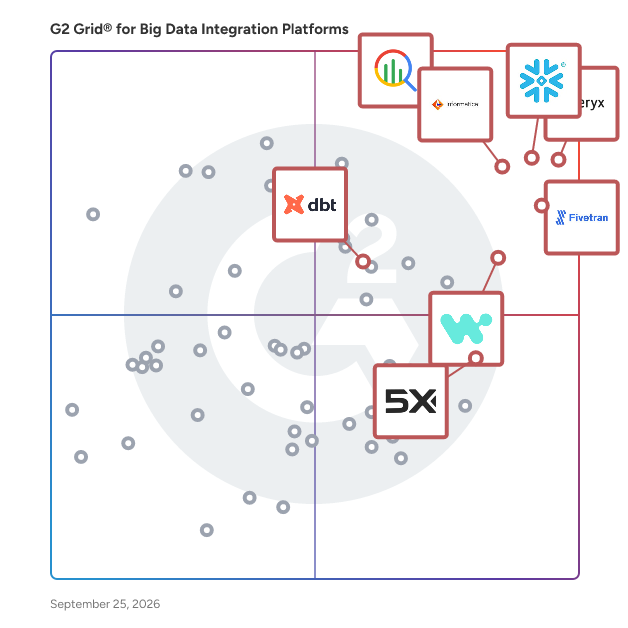
# Best Big Data Integration Platforms for Small Business - Page 2

*By [Shalaka Joshi](https://research.g2.com/insights/author/shalaka-joshi)*


Products classified in the overall Big Data Integration Platforms category are similar in many regards and help companies of all sizes solve their business problems. However, small business features, pricing, setup, and installation differ from businesses of other sizes, which is why we match buyers to the right Small Business Big Data Integration Platforms to fit their needs. Compare product ratings based on reviews from enterprise users or connect with one of G2&#39;s buying advisors to find the right solutions within the Small Business Big Data Integration Platforms category.

In addition to qualifying for inclusion in the Big Data Integration Platforms category, to qualify for inclusion in the Small Business Big Data Integration Platforms category, a product must have at least 10 reviews left by a reviewer from a small business.


## Top Big Data Integration Platforms at a Glance
| # | Product | Rating | Best For | What Users Say |
|---|---------|--------|----------|----------------|
| 1 | [Google Cloud BigQuery](https://www.g2.com/products/google-cloud-bigquery/reviews) | 4.5/5.0 (1,145 reviews) | Serverless SQL analytics across Google-native data pipelines | "[Easy-to-Use Cloud Tool with Shareable, Saved Queries](https://www.g2.com/survey_responses/google-cloud-bigquery-review-12958418)" |
| 2 | [Alteryx](https://www.g2.com/products/alteryx/reviews) | 4.6/5.0 (830 reviews) | No-code ETL and multi-source data blending | "[Alteryx Streamlines Data Prep with an Intuitive Drag-and-Drop Workflow Builder](https://www.g2.com/survey_responses/alteryx-review-13000974)" |
| 3 | [Snowflake](https://www.g2.com/products/snowflake/reviews) | 4.5/5.0 (708 reviews) | Multi-workload analytics with compute-storage separation | "[Easy, Efficient Data Extraction with Clear Database Insights](https://www.g2.com/survey_responses/snowflake-review-12884116)" |
| 4 | [Workato](https://www.g2.com/products/workato/reviews) | 4.7/5.0 (748 reviews) | Cross-application data orchestration with low-code recipes | "[Workato helps us building complex integrations at lightning speed.](https://www.g2.com/survey_responses/workato-review-10305521)" |
| 5 | [Azure Data Factory](https://www.g2.com/products/azure-data-factory/reviews) | 4.6/5.0 (95 reviews) | Azure-native ETL orchestration across hybrid data sources | "[Intuitive, Scalable Data Integration with Azure Data Factory](https://www.g2.com/survey_responses/azure-data-factory-review-12454264)" |
| 6 | [Amazon Redshift](https://www.g2.com/products/amazon-redshift/reviews) | 4.3/5.0 (369 reviews) | AWS-native analytical data warehousing at petabyte scale | "[Powerful Analytics Tool with Some Flexibility Limitations](https://www.g2.com/survey_responses/amazon-redshift-review-12781722)" |
| 7 | [SnapLogic Intelligent Integration Platform (IIP)](https://www.g2.com/products/snaplogic-intelligent-integration-platform-iip/reviews) | 4.4/5.0 (371 reviews) | Low-code ETL pipeline building across hybrid environments | "[SnapLogic Snaps Make No-Code Data Integration Simple and Powerful](https://www.g2.com/survey_responses/snaplogic-intelligent-integration-platform-iip-review-13058311)" |
| 8 | [5X](https://www.g2.com/products/5x/reviews) | 4.9/5.0 (81 reviews) | End-to-end data stack consolidation with managed dbt orchestration | "[A reliable and scalable data partner](https://www.g2.com/survey_responses/5x-review-11889175)" |
| 9 | [Maia](https://www.g2.com/products/matillion-maia/reviews) | 4.5/5.0 (119 reviews) | — | "[Maia Scaled 800+ Pipeline Migrations Without Added Overhead](https://www.g2.com/survey_responses/maia-review-12920298)" |
| 10 | [IBM webMethods B2B](https://www.g2.com/products/ibm-webmethods-b2b/reviews) | 4.5/5.0 (56 reviews) | EDI-native trading partner data integration | "[Strongly recommend to use](https://www.g2.com/survey_responses/ibm-webmethods-b2b-review-10173432)" |


## How Many Big Data Integration Platforms Products Does G2 Track?
**Total Products under this Category:** 128

### Category Stats (Jul 2026)
- **Average Rating**: 4.52/5 (↑0.01 vs Jun 2026) The average rating of products in this category, based on all submitted ratings
- **Top Trending Product**: Orchestra (+0.43%) - Among all products in this category, Orchestra recorded the largest rating increase compared to last month
*Last updated: July 08, 2026*


## How Does G2 Rank Big Data Integration Platforms Products?

**Why You Can Trust G2's Software Rankings:**

- 30 Analysts and Data Experts
- 9,400+ Authentic Reviews
- 128+ Products
- Unbiased Rankings

G2's software rankings are built on verified user reviews, rigorous moderation, and a consistent research methodology maintained by a team of analysts and data experts. Each product is measured using the same transparent criteria, with no paid placement or vendor influence. While reviews reflect real user experiences, which can be subjective, they offer valuable insight into how software performs in the hands of professionals. Together, these inputs power the G2 Score, a standardized way to compare tools within every category.


---

**Sponsored**

### Cloudera

Cloudera is the only hybrid data and AI platform company that large organizations trust to bring AI to their data anywhere it lives. Unlike other providers, Cloudera delivers a consistent cloud experience that converges public clouds, on-prem data centers, and the edge, leveraging a proven open-source foundation. As the pioneer in big data, Cloudera empowers businesses to apply AI and assert control over 100% of their data, in all forms, improving security, governance, and real-time and predictive insights. The world’s largest brands across all industries rely on Cloudera to transform decision-making and ultimately boost bottom lines, safeguard against threats, and save lives. The Cloudera data and AI platform includes: Cloudera AI: Deploy and scale any AI model, anywhere. Cloudera brings compute to governed data where it lives for Private AI anywhere by design. Complete control, security, and governance of mission-critical data, models, agents, and inference ensure faster sovereign AI deployments. Cloudera Data-in-Motion: Make fast decisions from real-time data anywhere. Move data with any structure from any source to any destination seamlessly across hybrid environments, enabling in-the-moment business-critical decisions by processing and analyzing real-time data anywhere, from the edge to AI, as business happens. Cloudera Open Data Lakehouse: Process any data, anywhere, for actionable insights. Make smart decisions with an open data lakehouse powered by Apache Iceberg that delivers trusted, reliable, and unified data to fuel agents, AI applications, and analytics, improving collaboration, breaking silos, and simplifying sharing. Cloudera Unified Data Fabric: Unify security and governance across the entire data estate. Move beyond fragmented data management: Break down silos and connect disparate data sources intelligently and securely to provide a unified view of all organizational data and centralized end-to-end control across complex hybrid data environments.


[Visit website](https://www.g2.com/external_clickthroughs/record?secure%5Bad_program%5D=ppc&amp;secure%5Bad_slot%5D=category_product_list&amp;secure%5Bcategory_id%5D=1186&amp;secure%5Bchosen_at%5D=2026-07-08T13%3A25%3A47Z&amp;secure%5Bdisplayable_resource_id%5D=1186&amp;secure%5Bdisplayable_resource_type%5D=Category&amp;secure%5Bmedium%5D=sponsored&amp;secure%5Bplacement_reason%5D=page_category&amp;secure%5Bplacement_resource_ids%5D%5B%5D=1186&amp;secure%5Bprioritized%5D=false&amp;secure%5Bproduct_id%5D=1886&amp;secure%5Bresource_id%5D=1186&amp;secure%5Bresource_type%5D=Category&amp;secure%5Bsource_type%5D=category_page&amp;secure%5Bsource_url%5D=https%3A%2F%2Fwww.g2.com%2Fcategories%2Fbig-data-integration-platforms%2Fsmall-business%3Fpage%3D2&amp;secure%5Btoken%5D=39ffd580273ad642096cadfd622331dda59a184b069499bc4833533a980e806c&amp;secure%5Burl%5D=https%3A%2F%2Fwww.cloudera.com%2Fproducts%2Fcloudera-data-platform%2Fcdp-demos.html%3Finternal_link%3Dp18%23get-started&amp;secure%5Burl_type%5D=custom_url)

---

## What Are the Top-Rated Big Data Integration Platforms Products in 2026?
### 1. [ClicData](https://www.g2.com/products/clicdata/reviews)
ClicData is a cloud-based data platform that spans multiple product categories: Business Intelligence, ETL, Data Warehousing and Data Lakehouse, Data Visualization, Embedded Analytics, and AI-assisted Analytics. It is built to support the full data lifecycle, from ingestion and storage to transformation, visualization, and distribution, within a single environment. Mid-market companies use ClicData to consolidate data workflows that would otherwise require separate tools for each stage. The platform is used across industries including retail, healthcare, media, manufacturing, and public services, by both centralized data teams and operational groups managing their own reporting needs. Our core capabilities include: - Connecting to databases, cloud applications, APIs, and flat files through a library of pre-built connectors - Storing and organizing data in an integrated data warehouse and data lake structure - Cleaning and transforming data using no-code ETL interfaces or SQL - Building dashboards and reports using a drag-and-drop editor or an AI dashboard builder that generates interactive, fully functional dashboards from plain-language prompts - Scheduling data refreshes, automating alerts, and delivering reports on defined triggers - Embedding dashboards into third-party platforms or client-facing applications - Extending analysis with Python scripts for statistical modeling or machine learning workflows For Leadership and Business Leaders ClicData provides a governed environment where data from multiple sources can be consolidated and made available across teams. It reduces dependency on ad hoc data requests by giving your team leads and operational teams direct access to up-to-date dashboards and reports. AI-assisted features support anomaly detection and automated alerting, so leadership can be notified of significant changes in key metrics without relying on manual monitoring. Scheduling and alerting features support proactive monitoring without manual intervention. For Data Practitioners Data engineers and analysts can manage the full pipeline: ingestion, transformation, modeling, and delivery without switching between tools. ClicData supports both no-code and SQL or Python-based transformation, version-controlled data flows or predictive model development. AI capabilities are accessible at the pipeline level, allowing practitioners to integrate predictive models or automated data quality checks directly into existing data flows. For Operational and Business Users Teams outside of IT can access curated dashboards, apply filters, and work with data that has already been validated upstream. AI-assisted features surface trends, forecasts, and anomalies directly within dashboards, making it possible for non-technical users to act on predictive insights without requiring analytical expertise. Embedded analytics capabilities allow organizations to surface data, including AI-generated insights, directly within the products or portals their end users already work in, without requiring those users to log into a separate BI tool. ClicData addresses the common challenge of fragmented data stacks by covering data engineering, storage, and analytics in one platform. It is suited for growing organizations looking to standardize how data is collected, managed, and consumed across different teams and functions.


**Average Rating:** 4.4/5.0
**Total Reviews:** 36
**How Do G2 Users Rate ClicData?**

- **Has the product been a good partner in doing business?:** 8.8/10 (Category avg: 8.9/10)
- **Quality of Support:** 8.9/10 (Category avg: 8.9/10)
- **Ease of Use:** 8.2/10 (Category avg: 8.8/10)
- **Ease of Admin:** 8.8/10 (Category avg: 8.5/10)

**Who Is the Company Behind ClicData?**

- **Seller:** [ClicData](https://www.g2.com/sellers/clicdata)
- **Company Website:** https://www.clicdata.com/
- **Year Founded:** 2008
- **HQ Location:** Lille, France
- **Twitter:** @ClicData (806 Twitter followers)
- **LinkedIn® Page:** https://www.linkedin.com/company/278851/ (46 employees on LinkedIn®)

**Who Uses This Product?**
- **Top Industries:** Information Technology and Services, Computer Software
- **Company Size:** 51% Small-Business, 32% Mid-Market


#### What Are Recent G2 Reviews of ClicData?

**"[Quick and simple solution to implement with a responsive and efficient helpdesk team](https://www.g2.com/survey_responses/clicdata-review-11445571)"**

**Rating:** 4.5/5.0 stars
*— Verified User in Restaurants*

[Read full review](https://www.g2.com/survey_responses/clicdata-review-11445571)

---

**"[Outstanding Customer Service and Communication from the ClicData Team](https://www.g2.com/survey_responses/clicdata-review-12848126)"**

**Rating:** 4.0/5.0 stars
*— Verified User in Primary/Secondary Education*

[Read full review](https://www.g2.com/survey_responses/clicdata-review-12848126)

---


#### What Are G2 Users Discussing About ClicData?

- [What are the benefits of business intelligence?](https://www.g2.com/discussions/clicdata-what-are-the-benefits-of-business-intelligence)
- [How do I create a dashboard in ClicData?](https://www.g2.com/discussions/how-do-i-create-a-dashboard-in-clicdata) - 1 comment, 1 upvote
- [Is ClicData free?](https://www.g2.com/discussions/is-clicdata-free) - 1 comment
- [What is CLIC software?](https://www.g2.com/discussions/what-is-clic-software) - 1 comment

### 2. [Qlik Replicate](https://www.g2.com/products/qlik-replicate/reviews)
Qlik Replicate (formerly Attunity Replicate) empowers organizations to accelerate data replication, ingestion and streaming across a wide variety of heterogeneous databases, data warehouses, and big data platforms. Used by hundreds of enterprises worldwide, Qlik Replicate moves your data easily, securely, and efficiently with minimal operational impact. Qlik Replicate provides automated, real-time, and universal data integration across all major source endpoints such as databases, systems like SAP, mainframes and Salesforce and delivers data to streaming systems, data warehouses, and data lakes. On-premises and in the cloud. Qlik Replicate is different and Enterprise-Ready. It moves data at high speed from source to target, simply and easily, and offers a single pane of glass monitoring of your data pipelines across the enterprise, all managed through a graphical interface that completely automates end-to-end replication. With our streamlined and agentless configuration, your administrators and data architects can quickly set up, control, and monitor bulk loads and real-time updates with automated change data capture (CDC) at scale.


**Average Rating:** 4.3/5.0
**Total Reviews:** 95
**How Do G2 Users Rate Qlik Replicate?**

- **Has the product been a good partner in doing business?:** 8.3/10 (Category avg: 8.9/10)
- **Quality of Support:** 8.0/10 (Category avg: 8.9/10)
- **Ease of Use:** 8.4/10 (Category avg: 8.8/10)
- **Ease of Admin:** 8.0/10 (Category avg: 8.5/10)

**Who Is the Company Behind Qlik Replicate?**

- **Seller:** [Qlik](https://www.g2.com/sellers/qlik)
- **Year Founded:** 1993
- **HQ Location:** Radnor, PA
- **Twitter:** @qlik (64,130 Twitter followers)
- **LinkedIn® Page:** https://www.linkedin.com/company/10162/ (4,551 employees on LinkedIn®)
- **Phone:** 1 (888) 994-9854

**Who Uses This Product?**
- **Top Industries:** Information Technology and Services, Banking
- **Company Size:** 42% Enterprise, 35% Mid-Market


#### What Are Qlik Replicate's Pros and Cons?

**Pros:**

- Features (3 reviews)
- Database Management (2 reviews)
- Easy Integrations (2 reviews)
- Scalability (2 reviews)
- Automation (1 reviews)

**Cons:**

- Complex Setup (2 reviews)
- Learning Difficulty (2 reviews)
- Difficult Setup (1 reviews)
- Expensive (1 reviews)
- Inadequate Security (1 reviews)


### What Do G2 Reviewers Say About Qlik Replicate?
*AI-generated summary from verified user reviews*

**Pros:**

- Users appreciate the **robust functionality** of Qlik Replicate, benefiting from efficient change tracking and user-friendly interface.
- Users value the **extensive database support** in Qlik Replicate, enabling seamless and efficient data importing and validation.
- Users value the **easy integrations** of Qlik Replicate, facilitating seamless connectivity across numerous platforms and systems.
- Users praise the **scalability** of Qlik Replicate, allowing efficient replication of millions of data seamlessly.
- Users praise the **automation and scalability** of Qlik Replicate, making it the top choice in the data space.

**Cons:**

- Users find the **complex setup** of Qlik Replicate time-consuming due to numerous system requirements and configuration challenges.
- Users find the **learning difficulty** of Qlik Replicate steep, requiring significant time and effort to master.
- Users find the **difficult setup** of Qlik Replicate time-consuming due to extensive system and environment requirements.
- Users find Qlik Replicate to be **expensive** , requiring significant investment in both time and money for setup and learning.
- Users note that the **data security** of Qlik Replicate lacks advancement and needs improvements for better protection.

#### What Are Recent G2 Reviews of Qlik Replicate?

**"[Qlik Replicate: Intelligent Data Replication for Modern Enterprises – Seamless Sync, Move Faster](https://www.g2.com/survey_responses/qlik-replicate-review-11427532)"**

**Rating:** 4.0/5.0 stars
*— Soumava S.*

[Read full review](https://www.g2.com/survey_responses/qlik-replicate-review-11427532)

---

**"[Bestest for Data](https://www.g2.com/survey_responses/qlik-replicate-review-8237655)"**

**Rating:** 4.5/5.0 stars
*— Kaustubh Y.*

[Read full review](https://www.g2.com/survey_responses/qlik-replicate-review-8237655)

---


#### What Are G2 Users Discussing About Qlik Replicate?

- [What are the benefits and drawbacks of using Qlik Replicate for data replication?](https://www.g2.com/discussions/what-are-the-benefits-and-drawbacks-of-using-qlik-replicate-for-data-replication)
- [What is Qlik Replicate used for?](https://www.g2.com/discussions/what-is-qlik-replicate-used-for)
- [How Qlik Replicate works?](https://www.g2.com/discussions/how-qlik-replicate-works)
- [How much does Attunity Replicate cost?](https://www.g2.com/discussions/how-much-does-attunity-replicate-cost) - 1 comment
- [What is Attunity Replicate?](https://www.g2.com/discussions/what-is-attunity-replicate)

### 3. [Qubole](https://www.g2.com/products/qubole/reviews)
Qubole is the open data lake company that provides a simple and secure data lake platform for machine learning, streaming, and ad-hoc analytics. No other platform provides the openness and data workload flexibility of Qubole while radically accelerating data lake adoption, reducing time to value, and lowering cloud data lake costs by 50 percent. Qubole’s Platform provides end-to-end data lake services such as cloud infrastructure management, data management, continuous data engineering, analytics, and machine learning with near-zero administration. Qubole is trusted by leading brands such as Expedia, Disney, Oracle, Gannett and Adobe to spur innovation and to transform their businesses for the era of big data. For more information, visit us at www.qubole.com.


**Average Rating:** 4.0/5.0
**Total Reviews:** 237
**How Do G2 Users Rate Qubole?**

- **Has the product been a good partner in doing business?:** 8.1/10 (Category avg: 8.9/10)
- **Quality of Support:** 7.9/10 (Category avg: 8.9/10)
- **Ease of Use:** 7.8/10 (Category avg: 8.8/10)
- **Ease of Admin:** 7.6/10 (Category avg: 8.5/10)

**Who Is the Company Behind Qubole?**

- **Seller:** [Qubole](https://www.g2.com/sellers/qubole)
- **Year Founded:** 2011
- **HQ Location:** Santa Clara, CA
- **Twitter:** @qubole (9,425 Twitter followers)
- **LinkedIn® Page:** https://www.linkedin.com/company/2531735/ (24 employees on LinkedIn®)

**Who Uses This Product?**
- **Who Uses This:** Software Engineer, Data Scientist
- **Top Industries:** Computer Software, Information Technology and Services
- **Company Size:** 51% Enterprise, 44% Mid-Market


#### What Are Recent G2 Reviews of Qubole?

**"[Qubole is an amazing data lake platform for analytics](https://www.g2.com/survey_responses/qubole-review-5474365)"**

**Rating:** 5.0/5.0 stars
*— Parth C.*

[Read full review](https://www.g2.com/survey_responses/qubole-review-5474365)

---

**"[&quot;Great and easy to implement tool to manage big data&quot;](https://www.g2.com/survey_responses/qubole-review-7111868)"**

**Rating:** 5.0/5.0 stars
*— Muhammad D.*

[Read full review](https://www.g2.com/survey_responses/qubole-review-7111868)

---


#### What Are G2 Users Discussing About Qubole?

- [What is Qubole used for?](https://www.g2.com/discussions/what-is-qubole-used-for)

### 4. [Riva](https://www.g2.com/products/riva/reviews)
Empowering Trusted Relationships in Financial Services Riva is the trusted partner for organizations seeking to build stronger client relationships while streamlining operations. Our innovative solutions empower advisors to deliver personalized, compliant experiences at scale. With seamless CRM integration, real-time client insights, and advanced data governance, Riva ensures every interaction counts. Serving financial services and other data-sensitive industries for over 15 years, we help businesses safeguard their clients, nurture lifelong relationships, and reclaim valuable time. Join the 650+ enterprises worldwide who trust Riva to transform how they engage with their customers. https://rivaengine.com/


**Average Rating:** 4.1/5.0
**Total Reviews:** 106
**How Do G2 Users Rate Riva?**

- **Has the product been a good partner in doing business?:** 8.6/10 (Category avg: 8.9/10)
- **Quality of Support:** 8.8/10 (Category avg: 8.9/10)
- **Ease of Use:** 8.4/10 (Category avg: 8.8/10)
- **Ease of Admin:** 8.0/10 (Category avg: 8.5/10)

**Who Is the Company Behind Riva?**

- **Seller:** [Omni Technology Solutions](https://www.g2.com/sellers/omni-technology-solutions)
- **Company Website:** https://www.rivacrmintegration.com
- **Year Founded:** 2008
- **HQ Location:** Edmonton, Alberta
- **Twitter:** @crm_integration (6 Twitter followers)
- **LinkedIn® Page:** https://www.linkedin.com/company/278719/ (125 employees on LinkedIn®)

**Who Uses This Product?**
- **Top Industries:** Financial Services, Banking
- **Company Size:** 41% Mid-Market, 31% Small-Business


#### What Are Riva's Pros and Cons?

**Pros:**

- Accuracy (3 reviews)
- Time-saving (3 reviews)
- Automation (2 reviews)
- CRM Integration (2 reviews)
- Customer Support (2 reviews)

**Cons:**

- AI Integration (1 reviews)
- AI Limitations (1 reviews)
- Automation Difficulty (1 reviews)
- Automation Issues (1 reviews)
- Complexity (1 reviews)


### What Do G2 Reviewers Say About Riva?
*AI-generated summary from verified user reviews*

**Pros:**

- Users highlight the **accuracy** of Riva&#39;s data processing, ensuring reliable and error-free evaluations for enhanced workflows.
- Users highlight the **time-saving automation** of Riva, enhancing productivity and making workflows seamless and efficient.
- Users find that Riva&#39;s **automation** greatly enhances productivity by simplifying workflows and ensuring accurate data synchronization.
- Users appreciate the **seamless CRM integration** of Riva, significantly enhancing productivity and data synchronization.
- Users commend Riva for its **expert customer support** , highlighting the team&#39;s responsiveness and effective problem-solving skills.

**Cons:**

- Users dislike the **automatic nature** of Riva, finding it difficult to perform tasks manually when necessary.
- Users dislike the **automatic nature** of Riva, finding it difficult to perform manual tasks when necessary.
- Users find the **automation difficulty** of Riva restrictive, making manual adjustments challenging when necessary.
- Users find the **automation issues** of Riva limiting, as it restricts necessary manual adjustments when required.
- Users find the **installation complexity** of Riva challenging, requiring significant support to complete the process.

#### What Are Recent G2 Reviews of Riva?

**"[Excellent for Business Growth and Team Success](https://www.g2.com/survey_responses/riva-review-11972631)"**

**Rating:** 5.0/5.0 stars
*— aqib j.*

[Read full review](https://www.g2.com/survey_responses/riva-review-11972631)

---

**"[Riva Platform User Experience Review](https://www.g2.com/survey_responses/riva-review-11051978)"**

**Rating:** 5.0/5.0 stars
*— Danny H.*

[Read full review](https://www.g2.com/survey_responses/riva-review-11051978)

---


#### What Are G2 Users Discussing About Riva?

- [How has Riva impacted your CRM synchronization, and what advice would you give to new users?](https://www.g2.com/discussions/how-has-riva-impacted-your-crm-synchronization-and-what-advice-would-you-give-to-new-users)
- [What is Riva used for?](https://www.g2.com/discussions/what-is-riva-used-for)

### 5. [Peregrine Connect](https://www.g2.com/products/peregrine-connect/reviews)
Peregrine Connect is one of the leading integration platforms that enables businesses to simplify the design, deployment, hosting, management of applications, APIs, and workflows. The platform secures the most critical integrations and business processes with actionable visibility, pinpoint diagnostics, alerting and unified control across your entire organization. Peregrine Connect enables your Microsoft .NET Core resources to be reused and extended to further simplify the integration of applications and the automation of critical business functions. The Peregrine Connect product portfolio encompasses Neuron ESB, FlightPath Data Mapper Management Suite, Design Studio, and NetSuite PSA Add-In for Microsoft Project. Peregrine Connect offers an innovative set of connectors for popular enterprise applications. It provides robust data integration features and a simple yet flexible UI to design &amp; execute integrations for organizations of all sizes. Customers benefit from a superior development experience, better performance, reduced complexity, and immediate time-to-value. Peregrine Connect customers deploy projects in a matter of weeks rather than months with clients around the globe in a variety of industries. To learn more, visit http://www.peregrineconnect.com


**Average Rating:** 4.4/5.0
**Total Reviews:** 91
**How Do G2 Users Rate Peregrine Connect?**

- **Has the product been a good partner in doing business?:** 9.1/10 (Category avg: 8.9/10)
- **Quality of Support:** 8.4/10 (Category avg: 8.9/10)
- **Ease of Use:** 8.5/10 (Category avg: 8.8/10)
- **Ease of Admin:** 8.4/10 (Category avg: 8.5/10)

**Who Is the Company Behind Peregrine Connect?**

- **Seller:** [Peregrine](https://www.g2.com/sellers/peregrine)
- **HQ Location:** Irvine, California
- **LinkedIn® Page:** https://www.linkedin.com/company/peregrineconnect/ (5 employees on LinkedIn®)

**Who Uses This Product?**
- **Top Industries:** Information Technology and Services, Computer Software
- **Company Size:** 44% Enterprise, 35% Mid-Market


#### What Are Recent G2 Reviews of Peregrine Connect?

**"[Unmatched Integration Capabilities with Peregrine Connect](https://www.g2.com/survey_responses/peregrine-connect-review-8350071)"**

**Rating:** 5.0/5.0 stars
*— Verified User in Oil &amp; Energy*

[Read full review](https://www.g2.com/survey_responses/peregrine-connect-review-8350071)

---

**"[Easiest Integration Platform to Use](https://www.g2.com/survey_responses/peregrine-connect-review-8338207)"**

**Rating:** 5.0/5.0 stars
*— Lina F.*

[Read full review](https://www.g2.com/survey_responses/peregrine-connect-review-8338207)

---


#### What Are G2 Users Discussing About Peregrine Connect?

- [What do you like most about Peregrine Connect for application integration, and what could be improved?](https://www.g2.com/discussions/what-do-you-like-most-about-peregrine-connect-for-application-integration-and-what-could-be-improved)
- [What is Peregrine Connect used for?](https://www.g2.com/discussions/what-is-peregrine-connect-used-for)


## What Is Big Data Integration Platforms?

[Cloud Data Integration Software](https://www.g2.com/categories/cloud-data-integration)

## What Software Categories Are Similar to Big Data Integration Platforms?

- [ETL Tools](https://www.g2.com/categories/etl-tools)
- [iPaaS Software](https://www.g2.com/categories/ipaas)
- [Data Extraction Tools](https://www.g2.com/categories/data-extraction-tools)


---

## How Do You Choose the Right Big Data Integration Platforms?

### What You Should Know About Big Data Integration Platforms

### What are Big Data Integration Platforms?

Big data integration is defined as a process within the data lifecycle that involves extracting data from heterogeneous sources and combining it to obtain insightful unified information which can aid in better decision making.&amp;nbsp;

Big data integration platforms are the tools that allow data to be extracted from various data sources and then sort and process it. There is a huge volume of data generated from various sources daily. Organizations are trying to capture value out of this data. Most of the data comes in an unstructured format. Required data is often distributed across various sources like IoT endpoints, applications, communications, or provided by third parties.&amp;nbsp;

#### What Types of Big Data Integration Platforms Exist?

The end goal of a big data integration platform is to transfer and unify data from disparate sources. Data managers can get a better understanding of various methods of achieving this goal by understanding the different types of data integration software. They can decide which type of platform suits them the most:&amp;nbsp;

**Middleware data integration**

Middleware is a software that acts as a binding material for two different systems. It connects various applications and transfers data from application to database. Middleware is widely in use for application integration and data management. When an organization is integrating legacy systems with modern ones, middleware is used.&amp;nbsp;

**Data consolidation**

This term is interchangeably used with data integration. Data consolidation means combining data from all disparate sources. It also removes any errors before storing it in a data warehouse or data lake. Data consolidation improves data quality.

**Extract, transform and load (ETL)**

ETL forms the core of data integration tools even today. ETL is the process of consolidation of data in a data warehouse. It involves extracting the data from source systems, transforming it into the required format, and loading it to the target system.

**Enterprise data integration**

While big data integration is a broader term, enterprise data integration refers to the centralization of data across multiple organizations. This is usually done when the organizations go through mergers and acquisitions.&amp;nbsp;

### What are the Common Features of Big Data Integration Platforms?

Big data integration software is one way for any organization to make informed decisions. Below are key features of big data integration platforms:

**Big data connectors:** Many applications use more than one database nowadays. Data connectors make it possible to move data from one database to another. Organizations use big data connectors to filter and transform data in a proper structure for querying and analyzing purposes. Organizations can benefit from the scalability and real-time data transmissions unlike that of traditional batches. With cloud-based and data-driven businesses gaining popularity, advanced data integration in any big data integration platform helps with more agile integrations, without constant schema changes. IPaaS provides pre-built big data connectors, business rules, and maps, which help organize integration flows.&amp;nbsp;

**Data transformation:** Data transformation is the process of changing data from one format structure into another. Organizations use this tool to organize the data better by making it compatible with other data, joining data, and so on. The processes such as data integration, data migration, data warehousing/data storage, and data wrangling all may involve data transformation.

**Leverage data from unconventional sources of big data:** This is one of the key features of any efficient big data integration platform. Common file formats like PDFs are usually supported by data integration tools. The advanced feature of leveraging data from unconventional sources supports file formats like COBOL, email sources, and XML/JSON files. Organizations use this feature to obtain streamlined data analysis.

**Data virtualization:** Organizations benefit from this feature by getting access to a unified view of various disparate systems. There is no physical movement of data to and from databases. The feature gives organizations real-time access to their data without exposing the technical details of the source systems.

**Data quality:** This feature is central to all the big data integration platforms. When data is of excellent quality, it is easier to process and analyze, ultimately helping organizations to make better decisions.

**Database integration:** Database technology aids in data storage and has evolved over the years. Relational, NoSQL, hierarchical, and many more are types of databases. NoSQL database is also known as a non-relational database. Database integration is usually done in cases of mergers and acquisitions. Two individual databases are integrated for a better understanding of new business.

**Big data management:** It is the organization, administration, and governance of large volumes of structured and unstructured data. Data governance is a major part of data management. A big data governance strategy plays a key role in determining how the business will benefit from available resources. Organizations leverage this feature to ensure a high level of data quality.&amp;nbsp;

**Data processing:** The feature manipulates data by collecting and combining it to obtain usable information. With big data migrating to the cloud, the benefits of cloud data processing can be reaped by small and large organizations alike.

**Application programming interface (API):** This feature connects one system to another via APIs,&amp;nbsp;allowing the data exchange between those two systems. It facilitates seamless connectivity between devices and programs.

**Data warehouse:** This is a part of the data integration process which deals with cleansing, formatting, and data storage. One of the important implementations of big data integration is building a data warehouse. It is done by merging systems to unify the data from disparate sources. Technically data warehouses perform queries and analysis.

### What are the Benefits of Big Data Integration Platforms?

Businesses today are data-driven. Hence, it is important to clean, process, and organize this data for better decision-making. Following are the benefits of implementing big data integration platforms at organizations:&amp;nbsp;

**Reducing the complexity of big data:** In any organization, the more the number of applications, the more are the number of interfaces. Big data can be difficult to manage at times. However, big data integration software helps in managing complexity, making easier delivery of data to any system, and streamlining the connections. It begins with defining business-critical data; data related to customers, products, sites, and suppliers. The overall process might involve updating, collating, and refining data to form a uniform understanding of the same.&amp;nbsp;

**Scalability:** Big data is primarily unstructured and requires real-time analysis. Advanced big data tools in association with cloud computing aid in connecting the data with real-time events and automate resource allocation based on integration activities. When organizations have scalable data platforms, they are also prepared for potential growth in their data needs.

**Better decision making:** Organizations often deal with a variety of data from disparate sources. Data integration helps managers understand the dynamics of their business and anticipate shifts in the market. Data entered manually can often have flaws and thus poor insights going further. Integration platforms help in obtaining up-to-date data, thus facilitating faster and higher quality decision making. When data is unified, it is available for everyone in the organization to access. This boosts transparency, collaboration, and ultimately maximizes data value.&amp;nbsp;

**Cost optimization:** Integration platforms create a centralized software architecture that connects to system and software and allows transporting data seamlessly. This focuses on eliminating inefficiencies caused due to using multiple software within an organization. This brings down the cost required for storing, processing, and analyzing large amounts of data.

**Data governance:** This system helps in understanding the executives in charge of data assets in an organization.&amp;nbsp;

### Who Uses Big Data Integration Platforms?

**Data analysts and data scientists:** These employees are generally the main users of big data integration tools. They use the software to gather a deeper understanding of business-critical data. These teams may be tasked with data preparation, cleansing, and data processing for further analysis.

**Marketing teams:** Marketing teams often run different types of campaigns, including email marketing, digital advertising, or even traditional advertising campaigns. The data that is error free and insightful helps the marketing team to execute successful campaigns and strategies. Big data integration helps the marketing teams promote the company or its product to the target audience.

**Finance teams:** Finance teams leverage data integration platforms to gain insight and understanding into the factors that impact an organization&#39;s business. Finance teams require real-time data for obtaining actionable insights which is possible using advanced data integration software. By integrating financial data with other operations data, accounting and finance teams pull actionable insights that might not have been uncovered through the use of traditional tools.

#### Software Related to Big Data Integration Platforms

Related solutions that can be used together with data integration include:

**Metadata-driven data integration software:** Big data integration software can handle a variety of data. However, when used with powerful metadata, it can streamline the creation and management of BI reporting. Metadata repository provides a view and analyses the movement of data around the organization.

[Data management platforms](https://www.g2.com/categories/data-management-platforms) **:** This category of software is used to gather, analyze, and store big data. Data management platforms help organizations leverage big data from various sources in real time leading to effective customer engagement.

[Data replication software](https://www.g2.com/categories/data-replication) **:** Data replication can be one-time or an ongoing process. This software aims at keeping all the members of the organization on the same page. Data replication involves copying data from one server to a database on another server.

[Big data analytics software](https://www.g2.com/categories/big-data-analytics) **:** Data Analytics platforms are a great aid to any organization with the need for timely data visualization of high-level analytics. Many industries target their customers using data analytics which helps the companies provide a customized experience and meet customer expectations.

**Application integration software:** Application integration, like data integration, works in batches; this leaves gaps in taking quick actions. Organizations can benefit from moving data in real time with application integration to easy access and quicker actions.

### Challenges with Big Data Integration Platforms

**Managing large data volume:** The exponential growth of data from various sources is one of the biggest challenges of big data integration. This further creates issues with the retention of this data. Sometimes data runs on multiple platforms—a combination of on-premises and cloud hosting. This gives rise to complexity and managing can become difficult.

**Manual data integration tasks:** In many organizations, data scientists are the employees finding and preparing the data, which leaves an equivalent to only a week’s time for actual data science tasks and analytical work. This has made enterprises look for tools to automate ingestion and integration.

**Growth of heterogeneous data:** Heterogeneous data is a group of data with non-similar data types. Data is collected in different formats—structured, unstructured, and semi-structured. Integrating all these disparate data types is a tedious process and would need a proper ETL tool. Data is mostly handled by various data handling systems and it may not be in the same format.

**Issues with data quality:** Incompatible or invalid data may be present in the data obtained from disparate sources. Businesses might not be aware of this, and the analytics might show insights with this incompatible data which could have severe repercussions. The insights provided by data analytics could potentially be misleading. The quality of gathered data is kept in check by appointing an executive for data management. This manual job can be time consuming for huge volumes of data.

### Which Companies Should Buy Big Data Integration Platforms?

**Retail:** This industry is the most common one to use big data software. They want to attract more customers to their business. For that, they need to correctly anticipate what the customers want. Accurate insights can help companies to identify their target customers as well as build on their competitive advantage.

**Logistics:** Data Integration brings different systems together by combining data and functions. Data in the transportation and logistics industry is stored in on-premises ERP and cloud-based CRM systems. Big data integration solutions help organizations overcome challenges like traffic congestion and mismanagement of capacity using automated fleet management and cloud-based analytics. Business processes are optimized and transcription errors are also reduced.

**Education:** Data privacy and security are of utmost importance in the education industry. Big data tools are changing the educational scenario altogether. Cutting-edge technology can help make better educational assessments.&amp;nbsp;

**Banking and finance:** Data integration helps banks in providing better customer experience, cross-selling, customer retention, and overall profitability. Big data integration helps in fraud detection and compliance.

**Construction:** Large infrastructure projects are huge in volume. While construction is one of the least digitized industries, organizations are now realizing the importance of the data that is generated and that it should be leveraged for obtaining better results. Using big data integration platforms, companies can combine design and construction data so that every department remains on the same page. This leads to better tracking of project design data being used at the construction site.

**Healthcare:** Big data platforms are critical to the healthcare industry. The data in healthcare is unstructured and data integration can prove useful in obtaining valuable insights. The ultimate goal of data integration solutions in this industry is to improve the quality and cost of healthcare for patients and researchers.

### How to Buy Big Data Integration Platforms?

#### Requirements Gathering (RFI/RFP) for Big Data Integration Platforms

If a company is just starting out and looking to purchase the first big data integration platform, or maybe an organization needs to update a legacy system--wherever a business is in its buying process, g2.com can help select the best big data integration software for the business.

The particular business pain points might be related to all of the manual work that must be completed. If the company has amassed a lot of data, the need is to look for a solution that can grow with the organization. Users should think about the pain points and jot them down; these should be used to help create a checklist of criteria. Additionally, the buyer must determine the number of employees who will need to use the big data integration tool, as this drives the number of licenses they are likely to buy.

Taking a holistic overview of the business and identifying pain points can help the team springboard into creating a checklist of criteria. The checklist serves as a detailed guide that includes both necessary and nice-to-have features including budget features, number of users, integrations, security requirements, cloud or on-premises solutions, and more.

Depending on the scope of the deployment, it might be helpful to produce an RFI, a one-page list with a few bullet points describing what is needed from a big data integration platform.

#### Compare Big Data Integration Platforms Products

**Create a long list**

From meeting the business functionality needs to implementation, vendor evaluations are an essential part of the software buying process. For ease of comparison after all demos are complete, it helps to prepare a consistent list of questions regarding specific needs and concerns to ask each vendor.

**Create a short list**

From the long list of vendors, it is helpful to narrow down the list of vendors and come up with a shorter list of contenders, preferably no more than three to five. With this list in hand, businesses can produce a matrix to compare the features and pricing of the various big data integration solutions.

**Conduct demos**

To ensure the comparison is thorough, the user should demo each solution on the shortlist with the same use case and datasets. This will allow the business to evaluate like for like and see how each vendor stacks up against the competition.

#### Selection of Big Data Integration Platforms

**Choose a selection team**

Before getting started, it&#39;s crucial to create a team that will work together throughout the entire process, from identifying pain points to implementation. The software selection team should consist of members of the organization who have the right interest, skills, and time to participate in this process. A team of three to five people with roles such as the main decision maker, project manager, process owner, system owner, or staffing subject matter expert, as well as a technical lead, IT administrator would suffice. In smaller companies, the vendor selection team may be smaller, with fewer participants multitasking and taking on more responsibilities.

**Negotiation**

As data integration platforms are all about the data, the user must make sure that the selection process is data driven as well. The selection team should compare important data like pricing metrics of a particular vendor, the stage that buyer organization is in, and also terms and conditions of the organization.

**Final decision**

It is imperative to open up a conversation regarding pricing and licensing. For example, the vendor may be willing to give a discount for multi-year contracts or for recommending the product to others.

### What Do Big Data Integration Platforms Cost?

Data Integration software is available both on-premises and on cloud. The cost per type changes given there are certain factors for each type to consider. The organizations that consider deploying on-premises software are liable for costs associated with server hardware, power consumption, and space. Whereas software using the cloud can be charged for the resources it uses and prices go up or down depending on how much of the software is consumed.&amp;nbsp;

#### Return on Investment (ROI)

Organizations buy big data integration platforms with an expectation of a certain ROI. Although there are ways to directly calculate ROIs, it could be a little daunting to use those here. It entirely depends on the intricacy of the project and ultimately the software itself. ROI can be further looked at from an IT perspective and a business perspective. The ROI on IT infrastructure, staffing, expertise-building, and services cost is calculated. Whereas, for business, time investments, outside investments (the cost related to external partners involved in the project), and opportunity costs are treated as important.

### Implementation of Big Data Integration Platforms

**How are Big Data Integration Platforms Implemented?**

It is necessary to define the goals to be achieved using a big data integration platform. This will help measure the success of target projects for which big data integration software will be used. Large organizations have data in large volumes from heterogeneous data sources, hence it is better to hire an external party for implementing the software.&amp;nbsp;Connectivity between systems is ensured during the process. With a rich experience throughout the years, the specialists from these consultancy firms can guide the businesses in connecting and consolidating their data effectively by helping the company to identify the best vendors in the space that would suit their business needs and goals.

**Who is Responsible for Big Data Integration Platforms Implementation?**

Data integration implementation can be a tedious process. In such times, it is advisable to have vendor support throughout the implementation. The team size could range from moderate to large depending on the complexity of the software being implemented. With cross-functional teams, it is possible to streamline the implementation process. Before actual use, it is always a good practice to test sample data.

**What Does the Implementation Process Look Like for Big Data Integration Platforms?**

The overall implementation process can be done in the following steps:

- Identifying and defining the project is a step when organizations can figure out the format in which the consolidated data has to be in so that it can prove of maximum usefulness to the organization.
- Reviewing the systems becomes crucial at this point. Depending on the connectivity, the consultancy specialists may advise on data connectors and/or SFTP ports to facilitate data interchange.
- Defining data integration framework.
- Defining how data will be processed.

**When Should You Implement Big Data Integration Platforms?**

Big data integration software is usually required when the organization deals with loads of data coming from disparate sources.

### Big Data Integration Platforms Trends

**Hybrid integration platforms**

These platforms help business users to handle highly complex data. Hybrid integration platforms integrate on-premises and cloud-based data. These platforms help in reducing costs and risks.

**Integration using artificial intelligence and machine learning**

The disruptive nature of today’s digital transformation has paved the way for many new developments in integration platforms. With artificial intelligence, it is possible to obtain accurate insights about customer data and thus meet up to their expectations. Machine learning helps in providing the transparency to make better decisions.

**Adoption of software as a service (SaaS) and cloud**

SaaS is helping traditional on-premises software to migrate to the cloud. The ease of use of cloud and SaaS enables the organizations to use data from any place, at any time, and pay for how much is used. It also eliminates the use of hardware making the infrastructure flexible.&amp;nbsp;

**Blockchain for data and analytics**

Blockchain technology can help in more than one way:&amp;nbsp;

- Enhances security
- Provides transparency
- Streamlines the integration process
- Simplifies communications
- Eliminates the need for middlemen thus reducing the cost.


