Sponsored
ENDVR
Digital platform for driving retail sales in the physical world
Total Products under this Category: 42
Last updated: August 12, 2026
Why You Can Trust G2's Software Rankings:
G2's software rankings are built on verified user reviews, rigorous moderation, and a consistent research methodology maintained by a team of analysts and data experts. Each product is measured using the same transparent criteria, with no paid placement or vendor influence. While reviews reflect real user experiences, which can be subjective, they offer valuable insight into how software performs in the hands of professionals. Together, these inputs power the G2 Score, a standardized way to compare tools within every category.

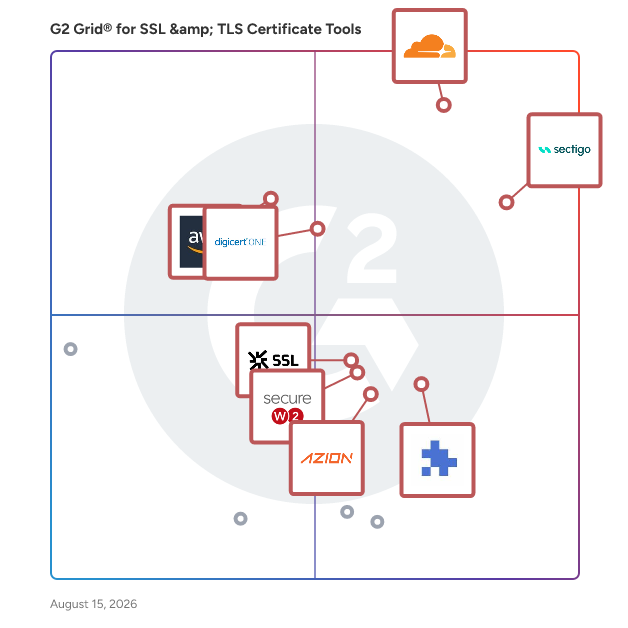
Highlighted products: Cloudflare Application Security and Performance, Sectigo Certificate Manager, DigiCert ONE, AWS Certificate Manager, ZeroSSL, SSL.com, SecureW2 JoinNow, and Azion.
Underlying data: [Grid® JSON](https://www.g2.com/categories/ssl-tls-certificate-tools/grids.json?focus%5B%5D=cloudflare-application-security-and-performance&focus%5B%5D=sectigo-certificate-manager&focus%5B%5D=digicert-one&focus%5B%5D=aws-certificate-manager&focus%5B%5D=zerossl&focus%5B%5D=ssl-com&focus%5B%5D=securew2-joinnow&focus%5B%5D=azion)
Sponsored
Digital platform for driving retail sales in the physical world
Cloudflare is the connectivity cloud for the "everywhere world," on a mission to help build a better Internet. We provide a unified platform of networking, security, and developer services delivered from a single, intelligent global network that spans hundreds of cities in over 125 countries. This empowers organizations of all sizes, from small businesses to the world's largest enterprises, to make their employees, applications, and networks faster and more secure everywhere, while significantly reducing complexity and cost. Our comprehensive platform includes: - Advanced Security: Protect your online presence with industry-leading DDoS protection, a robust Web Application Firewall (WAF), Bot mitigation, and API security. Implement Zero Trust security to secure remote access, data, and applications for your entire workforce. - Superior Performance: Accelerate website and application loading times globally with our Content Delivery Network (CDN), intelligent DNS, and smart routing capabilities. Optimize images and deliver dynamic content with unparalleled speed. - Powerful Developer Tools: Empower your developers to build and deploy full-stack applications at the edge using Cloudflare Workers (serverless functions), R2 Storage (object storage without egress fees), and D1 (serverless SQL database). Cloudflare helps connect and protect millions of customers globally, offering the control, visibility, and reliability businesses need to work, develop, and accelerate their operations in today's hyperconnected landscape. Our global network continuously learns and adapts, ensuring your digital assets are always protected and performing at their best.
Average Rating: 4.5/5.0
Total Reviews: 662
AI-generated summary from verified user reviews
"Set It and Forget It: A real world Cloudflare review"
Rating: 5.0/5.0 stars
— Soumalya S.
"Reliable security and performance in one platform"
Rating: 4.5/5.0 stars
— bruno m.
Sectigo Certificate Manager (SCM) helps organizations eliminate certificate chaos and reduce hidden risk with a cloud-native certificate lifecycle management (CLM) platform built for simplicity at scale. SCM discovers, issues, automates, and governs certificates across your entire identity environment through a single, centralized dashboard so nothing goes unmanaged.As a fully CA-agnostic solution, SCM works with both public and private certificate authorities and supports modern enrollment protocols including ACME, SCEP, and EST. With more than 50 turnkey integrations across cloud, DevOps, networking, and security tools, SCM fits seamlessly into existing environments without adding operational complexity. Designed for a world of shorter TLS certificate lifespans and increasing operational risk, SCM helps prevent outages, accelerates time to value, and builds the automation foundation needed for post-quantum cryptography readiness. Backed by one of the largest, longest-standing, and most reputable CAs, SCM is a fast, scalable way to secure and manage digital trust.
Average Rating: 4.5/5.0
Total Reviews: 195
"Very best experience with Sectigo Certificate Manager"
Rating: 5.0/5.0 stars
— Jean-Baptiste F.
"Affordable, Easy-to-Use Certificate Automation with a Centralized DevOps Dashboard"
Rating: 4.5/5.0 stars
— Khalid B.
DigiCert ONE is a cloud-native digital trust platform that helps organizations automate, manage, and secure certificates, identities, software, devices, DNS infrastructure, documents, and email communications from a single platform. Designed to simplify complex trust environments, DigiCert ONE provides centralized visibility, policy-based governance, and automation to reduce operational risk, improve compliance, and accelerate digital transformation initiatives. The platform includes: - Trust Lifecycle Manager for CA-agnostic certificate lifecycle management, certificate discovery, automation, and public and private PKI. - Software Trust Manager for secure code signing, software supply chain protection, and automated signing workflows. - Device Trust Manager for establishing and managing trusted device identities throughout the IoT and device lifecycle. - Content Trust Manager for digital signatures, electronic seals, timestamping, and document trust services. - UltraDNS for highly available, secure DNS infrastructure, intelligent traffic management, and application resiliency. - Messaging Trust for email authentication, domain protection, phishing prevention, and improved email deliverability. DigiCert ONE also integrates with CertCentral®, enabling organizations to streamline the issuance, management, and automation of publicly trusted TLS/SSL certificates alongside their broader digital trust operations. Built on a scalable, container-based architecture, DigiCert ONE supports cloud, on-premises, hybrid, and air-gapped deployments, enabling organizations to meet security, operational, and regulatory requirements while maintaining agility. Organizations use DigiCert ONE to eliminate manual trust management processes, prevent certificate-related outages, secure software and connected devices, protect critical infrastructure, and build trusted digital experiences at scale.
Average Rating: 4.3/5.0
Total Reviews: 71
"Centralized Certificate Lifecycle Management in One Intuitive Dashboard"
Rating: 4.5/5.0 stars
— Saurabh J.
"Intuitive UI, But Manual DNS Validation for SANs Slows Renewals"
Rating: 4.5/5.0 stars
— Saurabh J.
AWS Certificate Manager is a service that lets you easily provision, manage, and deploy Secure Sockets Layer/Transport Layer Security (SSL/TLS) certificates for use with AWS services to secure network communications and establish the identity of websites.
Average Rating: 4.5/5.0
Total Reviews: 55
"Simple place to Manage all SSL Certificates"
Rating: 4.5/5.0 stars
— preethi S.
"Effortless SSL/TLS Automation and Renewal with AWS Certificate Manager"
Rating: 4.0/5.0 stars
— Atharva P.
ZeroSSL is a comprehensive solution for SSL certificate creation and management, designed to enhance website security through the issuance of SSL certificates. This platform caters to a variety of users, from individual website owners to large organizations, providing them with the tools necessary to secure their online presence. With a focus on user-friendliness, ZeroSSL offers multiple methods for certificate creation, including a straightforward user interface, ACME integrations, and a robust SSL REST API. The target audience for ZeroSSL includes web developers, IT professionals, and businesses seeking to implement secure connections on their websites. This solution is particularly beneficial for those managing multiple domains or requiring various types of certificates, such as single-domain, multi-domain, and wildcard certificates. The flexibility of choosing between 90-day and 1-year certificate validity periods allows users to tailor their security needs based on their specific requirements and operational timelines. Key features of ZeroSSL include its intuitive user interface, which simplifies the process of generating and managing SSL certificates. Users can easily navigate through the steps required to obtain a certificate, making it accessible even for those with limited technical expertise. Additionally, the ACME integrations streamline the process for developers, allowing for automated certificate issuance and renewal, which is essential for maintaining uninterrupted website security. The SSL REST API further enhances the platform's capabilities, enabling advanced users to integrate SSL management into their existing systems seamlessly. ZeroSSL stands out in the SSL certificate market by providing a combination of ease of use and flexibility. The ability to manage various types of certificates from a single platform reduces the complexity often associated with SSL management. Furthermore, the option to select different validity periods allows users to optimize their security strategy based on their operational needs. This adaptability, coupled with the platform's commitment to user experience, positions ZeroSSL as a valuable tool for anyone looking to enhance their website's security posture effectively.
Average Rating: 4.3/5.0
Total Reviews: 68
"Cert renewal I no longer have to think about"
Rating: 4.0/5.0 stars
— Prajwal G.
"Easy SSL Management with Reliable Automation"
Rating: 4.5/5.0 stars
— Rohan G.
SSL.com is an integral component of an organization’s layered cybersecurity defense strategy. As a Digital Identity and Trust Services Provider, SSL.com provides publicly trusted digital certificates, cloud code and document signing services, and enterprise PKI solutions. Businesses and governments in over 180 countries utilize SSL.com solutions to protect their internal networks, customer communications, eCommerce platforms, and web services.
Average Rating: 4.3/5.0
Total Reviews: 39
AI-generated summary from verified user reviews
"Stellar Customer Service That Resolved My Issue in Few Hours"
Rating: 5.0/5.0 stars
— Joonas M.
"Smooth, High-Quality Service That’s Easy to Buy, Install, and Use"
Rating: 5.0/5.0 stars
— Karen C.
SecureW2 is a cloud-native authentication solution designed to enhance security by eliminating credential compromise through its innovative JoinNow Platform. This platform combines Dynamic Public Key Infrastructure (PKI) and Cloud RADIUS to facilitate real-time trust validation and continuous authentication for users accessing networks and applications. Each access request initiates an identity-based risk assessment, which determines the issuance of certificates and the corresponding access privileges. Once access is granted, the system continuously validates the compliance of devices, ensuring that only verified entities maintain their authorization. The JoinNow Platform caters to a diverse range of users, including K-12 and higher education institutions, mid-market businesses, and global enterprises. By providing scalable and resilient authentication solutions, SecureW2 addresses the unique security needs of various sectors without placing an additional burden on IT teams. The platform's ability to seamlessly integrate with existing identity providers, such as Entra ID (formerly Azure AD), Okta, and Google Workspace, allows organizations to implement adaptive, passwordless authentication without the need for complex upgrades or disruptions. SecureW2 effectively tackles several prevalent security challenges. Credential compromise remains a significant concern, as traditional passwords and multi-factor authentication (MFA) can be vulnerable. By utilizing certificate-based authentication, SecureW2 eliminates these risks entirely. Additionally, the platform addresses high operational overhead associated with managing legacy security systems by automating certificate issuance, revocation, and lifecycle management. This automation not only saves IT resources but also enhances visibility and control, providing real-time insights into authentication processes. Key features of SecureW2 include its agentless architecture, which eliminates software bloat while ensuring secure and frictionless authentication. The extensive policy engine allows organizations to create customized policies that are automatically enforced both before and after authentication. Continuous authentication adapts in real time, validating access dynamically based on evolving security conditions. Furthermore, the platform’s interoperability ensures compatibility with any identity provider, mobile device management (MDM) system, and security stack, making it a versatile choice for organizations looking to enhance their security posture. In summary, SecureW2 redefines authentication for modern businesses by ensuring that every access request is trust-validated. Its scalable, lightweight design enables rapid deployment and effortless scaling, allowing organizations to maintain robust security without the complexities and costs typically associated with traditional authentication solutions.
Average Rating: 4.7/5.0
Total Reviews: 96
AI-generated summary from verified user reviews
"Effortless WiFi Authentication with Outstanding Support"
Rating: 5.0/5.0 stars
— Evan B.
"Seamless, Touchless Network Onboarding with SecureW2 JoinNow"
Rating: 4.5/5.0 stars
— Verified User in Higher Education
Azion is the web platform that enables businesses to build, secure, and scale modern applications on a fully managed global infrastructure, with a robust suite of solutions for Application Development, cybersecurity, and AI. Azion allows developers to deploy applications closer to users, ensuring ultra-low latency and high availability. With Functions, you can run distributed serverless code, enhancing performance and reducing costs. For enhanced security, Azion’s Web Application Firewall (WAF) protects against cyber threats. Azion also provides SQL Storage, Object Storage and KV Storage, enabling fast, distributed data storage and retrieval. With Real-Time Metrics and Real-Time Events, businesses gain actionable insights into their applications and infrastructure, ensuring optimal performance and security. Global leaders like Prime Video, Neon, Global Fashion Group, and Radware trust Azion to deliver high-performance, secure digital experiences worldwide. Whether you're building AI-driven applications, securing your digital assets, or scaling globally, Azion provides the fastest path to modern applications. Discover how Azion can transform your digital experiences and empower your business to thrive in the digital age. Visit www.azion.com to learn more about our innovative solutions.
Average Rating: 4.7/5.0
Total Reviews: 31
AI-generated summary from verified user reviews
"Azion Services: Elevated Security and Impeccable Support"
Rating: 5.0/5.0 stars
— Luciano G.
"Azion as one of the main strategic partners in cybersecurity."
Rating: 5.0/5.0 stars
— Luciano K.
All-in-one: SSL, firewall and malware protection. Comprehensive protection and security for your site.
Average Rating: 4.1/5.0
Total Reviews: 18
"Best SSL Certificates for website or store"
Rating: 5.0/5.0 stars
— Rahul P.
"GoDaddy is the best for domain registration, With their GoDaddy SSL Certificates"
Rating: 4.0/5.0 stars
— Amit K.
Lets Encrypt is a free, automated, and open certificate authority brought to you by the non-profit Internet Security Research Group (ISRG).
Average Rating: 4.8/5.0
Total Reviews: 21
"Let’s Encrypt: Free, Open-Source Certificate Authority for Digital Certificates"
Rating: 4.5/5.0 stars
— Verified User in Information Technology and Services
"Easy, Free to use and auto renew"
Rating: 5.0/5.0 stars
— Rahul K.
An application security platform (ASP) designed by IT users angry and frustrated with the time-to-manage complex legacy application delivery and WAF products. TR7's friendly design, dynamic flow-panel, and rich reporting makes it very easy for IT Teams to increase application performance, improve resilience, and prevent cyber attacks faster. The core components of the platform are: ⚖️ Load Balancer 🚪 Access Policy Manager 🌐 Global Traffic Manager 🛡️ WebApp Firewall (WAF) Effective user access controls make it simple to provide the right access and visibility to the right people, enabling IT Network, Application, and Security teams to work more effectively together, and on their respective priorities. Deploy as physical or virtual appliance, or both, depending on your scope and requirements. Friendly cluster options and attractive economies of scale are designed for you to architect resilience and best practice affordably.
Average Rating: 4.9/5.0
Total Reviews: 25
AI-generated summary from verified user reviews
"Easy to Use, Great Support, Performance, and Pricing"
Rating: 5.0/5.0 stars
— Ufuk .
"TR7’s Single-Panel UI and Strong Real-Time Performance at a Lower Price"
Rating: 4.5/5.0 stars
— Halil İbrahim K.
EZCA is a managed Cloud PKI and Certificate Authority for hybrid and cloud workloads, built by ex-Microsoft PKI engineers and the first of its kind on the market. EZCA replaces complex on-premises AD CS deployments and per-user cloud PKI services with a managed cloud CA priced at a flat $200 per certificate authority per month, with no surprise charges as you scale. SOC 2 Type II, ISO 27001, and FIPS 140-2 Inside, out of the box. EZCA delivers deep native integrations with Microsoft Entra ID, Intune, Azure Key Vault, and Azure IoT Hub, so Microsoft-centric teams get certificates issued, rotated, and consumed by Azure workloads following Microsoft best practices, without the expired certs, outages, and manual NDES connectors that haunt legacy PKI. Built-in support for ACME, SCEP, OCSP, and smartcards covers every certificate workflow a modern enterprise runsm, including scenarios Microsoft Cloud PKI does not: SCEP for Intune, Jamf, and other MDM platforms, smartcard issuance, Azure IoT Hub authentication, and one-click Azure Key Vault certificate rotation. For platform and security teams, EZCA's integration with public PKI providers automates the certificate lifecycle end-to-end: critical now that Apple and Google have set a course toward 47-day TLS certificates. What used to require a handful of renewals a year will soon require dozens per certificate; EZCA's automation, monitoring, and alerting handle the volume so teams don't have to. Common deployments include: - Replacing AD CS without standing up a new CA hierarchy or NDES servers - Issuing device certificates at scale via Intune, Jamf, and other MDM platforms (Windows, macOS, iOS, and Android) - Securing Wi-Fi and VPN with certificate-based authentication via EZRADIUS - Authenticating IoT and healthcare devices with X.509 in Azure IoT Hub - Workload identity and encrypted communications for internal APIs, microservices, and containers - Auto-rotating TLS certificates stored in Azure Key Vault Unlike traditional PKI vendors that require complex CA hierarchies, hardware provisioning, and per-user pricing that punishes growth, EZCA is delivered as a fully managed service. HSM-backed roots, high availability, disaster recovery, and 24/7 support are included by default. There are no agents to install on servers and no on-prem connectors to maintain. EZCA is available in the Azure Marketplace, Microsoft Security Store, and Jamf Marketplace, and is trusted by enterprises in healthcare, finance, manufacturing, and critical infrastructure to secure identity, encrypt communications, and govern certificate lifecycles across hybrid, cloud, and IoT environments.
Average Rating: 4.8/5.0
Total Reviews: 20
"Game-Changing Azure-Native CA for Easy PKI and PIV on Entra ID"
Rating: 5.0/5.0 stars
— Zachary C.
"Automated 802.1X Certificates with Intune SCEP using EZCA"
Rating: 4.5/5.0 stars
— Gayan K.
OpenSSL is an open source project that provides a robust, commercial-grade, and full-featured toolkit for the Transport Layer Security (TLS) and Secure Sockets Layer (SSL) protocols.
Average Rating: 4.5/5.0
Total Reviews: 27
Rating: 5.0/5.0 stars
— Renato M.
"Powerful OpenSSL CLI for Managing SSL/TLS Certificates"
Rating: 4.0/5.0 stars
— Verified User in Information Technology and Services
IONOS 1&1 offers a comprehensive suite of domain registration and web hosting services tailored to meet the needs of individuals, small businesses, and enterprises. With over 30 years of experience, IONOS provides reliable and innovative solutions, including domain registration, web hosting, email services, and cloud infrastructure, all hosted in their own regional data centers in the US and Europe. Their offerings are designed to help users establish and maintain a robust online presence with ease and efficiency. Key Features and Functionality: - Domain Registration: Secure your unique online address with a wide selection of domain extensions, ensuring your brand stands out. - Web Hosting: Choose from various hosting plans that include features like redundant storage, multiple databases, and unmetered bandwidth to accommodate websites of all sizes. - Email Services: Create professional email addresses matching your domain, enhancing your brand's credibility and communication. - Security Measures: Benefit from Wildcard SSL certificates included in hosting plans, ensuring encrypted and secure data transfers for your website visitors. - User-Friendly Management: Utilize intuitive control panels and management tools to easily oversee your domains, hosting, and email services. Primary Value and Solutions Provided: IONOS 1&1 simplifies the process of establishing and managing an online presence by offering integrated services that cater to various digital needs. By combining domain registration, hosting, and email services under one provider, users experience streamlined operations, enhanced security, and dedicated customer support. This holistic approach allows businesses and individuals to focus on growth and engagement without the complexities of managing multiple service providers.
Average Rating: 3.5/5.0
Total Reviews: 150
AI-generated summary from verified user reviews
"Affordable pricing for small businesses"
Rating: 4.0/5.0 stars
— Diane E.
"Easy-to-use dashboard makes life simple"
Rating: 4.5/5.0 stars
— Robert C.
GlobalSign's cloud-based certificate management platform offers unique features and functionality that give you complete control of your certificate needs from one centralized account.
Average Rating: 3.6/5.0
Total Reviews: 11
"GlobalSign the Best in the Email security and Digital Signature"
Rating: 4.5/5.0 stars
— Deepak Kumar I.
Rating: 5.0/5.0 stars
— Verified User in Computer & Network Security
Secure sockets layer (SSL) and transport layer security (TLS) are standard methods of initiating encrypted connections between servers and clients. SSL and TLS connections are established based on SSL and TLS digital certificates. These digital certificates authenticate a website’s identity and then utilize public key infrastructure (PKI) to create links between web servers and clients. These encryption keys secure website visitor information, building digital trust by preventing cyber criminals from reading data they may attempt to steal as it's transferred from the server to the client.
Unlike general encryption software, which allows users to encrypt and transmit data between two parties, SSL and TLS technologies establish connections between servers and clients by creating a TLS/SSL certificate with a unique digital signature. These certificates authenticate the domain requesting the data. If the server accepts the certificate, the data is encrypted using this client’s public key, transferred to the client, and decrypted using the client’s private key. This process is called an SSL or TLS “handshake.”
There are several different types of SSL and TLS certificates which all allow for a website to utilize HTTPS encryption. Different types of certificates are suited for different purposes and require varying degrees of validation processes, which yields correspondingly secure encryption capabilities. The most secure and rigorously obtained SSL and TLS certificates are often used by large, global organizations that handle incredibly sensitive information, including healthcare organizations, financial institutions, and insurance companies.
What Do SSL and TLS Stand For?
SSL and TLS software, respectively, stand for secure sockets layer and transport layer security software. SSL is the predecessor to TLS, though the two terms are closely related and sometimes used interchangeably.
Single-domain SSL certificates: These authenticate precisely one domain and will not authenticate any other, including subdomains associated with the one domain it has been issued to authenticate.
Wildcard SSL certificates: These authenticate a domain and all of its subdomains.
Multi-domain SSL certificates: These authenticate multiple domains and their subdomains on the same certificate.
In addition to the different types of certificates, there are three distinct levels of certificate validation, as mentioned below:
Domain validation (DV) certificates: These are the least stringent to acquire and simply prove an organization controls a particular domain and are not recommended for commercial use.
Organization validation (OV) certificates: The issuing CA authenticates these against a government-hosted business registry database to authenticate an organization.
Extended validation (EV) certificates: The most expensive and most-vetted SSL and TLS certificate level to obtain. Leading businesses and organizations often use EV certificates to ensure digital trust in their domains.
The following are some core features within SSL and TLS certificate products that can help users in multiple ways:
Provide SSL and TLS certificates: A core feature of SSL and TLS certificate software is their ability for domains to present servers with certificates that authenticate their identities. SSL and TLS certificates rely on public-key cryptography, which means one or both parties knows precisely whom they are interacting with. Once the sensitive data has been transferred from the server to the client, the client’s private key is used for decryption.
Implementing SSL and TLS certificates allows data requested from servers to be encrypted using HTTPS. Website visitors can ensure the page is encrypted by checking the padlock icon in the web domain bar.
Delegate certificates across an entire domain: For organizations that use multiple servers, detecting when private keys have been compromised can be challenging. To mitigate this, SSL and TLS certificate software can delegate certificates across an entire domain. This means private keys are stored in a secure, more easily monitored location.
Securing the certificate’s key in this manner also means there’s no need for certificate revocation if the delegated certificate used in the handshake is stolen. This is because delegated digital certificates are short lived, typically expiring after a few hours or days. This capability also means organizations do not need to expose their private keys to servers. Instead, they merely supply the delegated certificate, which the server uses to authenticate the client through code signing.
Utilize trusted certificate authorities: Certificate authorities are the organizations responsible for issuing SSL and TLS certificates. They are trusted organizations that issue different types of SSL and TLS certificates based on which type the domain has requested for its particular needs. The SSL and TLS certificates that the certificate authorities issue certifies that the named domain or subject on that certificate is the owner of the associated public key. This authentication builds digital trust between servers and clients, as sensitive information and transactions are known to go to the proper parties through a secure encryption and decryption process using HTTPS.
A few crucial benefits of SSL and TLS certificates software are mentioned below:
Improves website security: SSL and TLS certificates improve domain security through encryption, which enables secure connections. Transferring data from servers to clients creates vulnerabilities that attackers exploit through malware and denial-of-service attacks. Without the certificate’s private key, however, even if attackers capture data during its transfer, they cannot read it.
Organizations use SSL and TLS certificates to encrypt their proprietary information, including trade secrets and financial details. Other commonly encrypted information through SSL and TLS certificate implementations include employee, customer, and transaction information.
Enables compliance: Though not legally required, since 2017, web browsers have strongly urged domains to acquire an SSL or TLS certificate. Through self regulation, browsers now often label websites as having an unsecured connection if they don’t have an SSL or TLS certificate and ask for the user’s consent to continue to the domain. In addition, search engines favor results from websites with SSL and TLS certificates, and domains with secure connections more frequently populate SEO-driven searches.
Hospitals, medical systems, and healthcare offices: Healthcare services that record patient information are subject to various regulations regarding patient privacy, including the Healthcare Insurance Portability and Accountability Act (HIPAA). To remain compliant with these regulations, patient information must be kept secure through encryption when healthcare data, including diagnoses, prescription details, and test results, is transferred from servers to clients.
Financial institutions: Bank and credit union members depend on security to keep their financial information out of the hands of bad actors, which necessitates the use of encryption during online banking transactions. SSL and TLS certificates bolster this security through encryption.
Online retailers: Payment processing information must be kept private for e-commerce shoppers to keep information like credit card numbers private. SSL and TLS-facilitated encryption methods protect this information through encryption and guarantee that the money website visitors spend is being sent to the proper business through the certificate’s primary function of domain authentication. Payment card industry (PCI) standards recommend online retailers remain up-to-date with their digital certificates to keep payment information secure.
Blogs and content-driven websites: Since 2017, web browsers have preferred to populate SEO-powered searches with domains secured with HTTPS encryption, which SSL and TLS certificates enable. Website owners whose business models depend on ad sales and, therefore, organic web traffic will be able to generate more revenue with a secure site that appears higher in search engine queries. Also, even though blogs and content-driven websites don’t necessarily collect payments or particularly sensitive data, it is beneficial for site visitors if their activity is kept private.
Certificate expirations: SSL and TLS certificates don’t last forever, meaning security teams need to be aware of pending expiration dates for their certificates. Some SSL and TLS certificate products have built-in features to track expiration dates, though not all do. In the latter case, certificate lifecycle management (CLM) software can help organizations take a centralized approach to monitoring their certificates. By streamlining and automating the lifecycle management process, organizations can secure new SSL and TLS certificates before the expiration of their current certificate.
Vulnerabilities: Older SSL and TLS certificates have known vulnerabilities that can compromise the integrity of their encryptions, so it is imperative to use the most up-to-date SSL and TLS certificate software. Weak ciphers can make it easy for attacks to decrypt sensitive data. Additionally, if an attacker acquires the private key that the SSL or TLS encryption uses, they can decrypt past transactions even long after they’ve happened.
When choosing an SSL or TLS certificate software, buyers should consider several factors to ensure their needs are being met to secure private browsing for users on their websites. Buyers should keep the following considerations in mind:
Type: Buyers should understand the type of SSL or TLS certificate they need to secure to best safeguard sensitive information against bad actors. Requesting information from potential SSL and TLS certificate software vendors about the types of certificates they can secure and assessing which certificates adequately address the buyer’s needs is a good starting point.
Level: The level of the certificate the buyer’s organization needs to validate their identity and control of a domain is critically important. Levels of organization validation that are less stringent to obtain are typically not as complexly encrypted as levels that require manual validation against government-hosted databases. Buyers should ensure the SSL or TLS certificate software they choose can secure the proper level of validation for their needs.
Certificate management: Some organizations already implement CLM software to keep certificate management centralized, so managing SSL and TLS certificates can be included in these pre-existing infrastructures. However, companies that do not already employ CLM software will either have to manually track expiration dates or consider getting it to automate the process. Some SSL and TLS certificate software now come with built-in lifecycle management, making it easier for enterprises to manage them and employ certificate renewals.
Create a long list
There is a multitude of SSL and TLS certificate software available, making it difficult for buyers to narrow down which among them best suits their needs. It’s best to begin the selection process by determining which products offer the certificates the buyer needs for their industry, their organization’s size, which products best integrate with existing workflows, and the sensitivity of the information they’re protecting with HTTPS encryption.
Built-in features that may best suit the operations of the purchasing organization should also be considered when creating a long list. Does the buyer already have a system for tracking certificate lifecycles? Does the buyer want an SSL or TLS certificate software that can track the expiration dates of its own certificates?
Create a short list
To further narrow the pool of potential products, buyers should leverage user reviews from g2.com. User reviews speak to the ease of implementation, potential costs, intuitive interfaces, and overall functionality of the certificate software. Most certificates also come with a warranty, but buyers must be sure to inquire with vendors about the warranty’s details when choosing to secure certificates through them. Beyond reading the reviews, buyers are also empowered to leverage the G2 Grid® to see how competing SSL and TLS certificate software stack up against each other.
Conduct demos
Buyers can contact many vendors directly on g2.com to request demos by selecting the “Get a quote” button. At each demo, buyers must ask the same questions to best evaluate each product. Buyers should ask vendors about the types of certificates they can secure and the average time to secure them.
Choose a selection team
The team responsible for selecting the SSL or TLS certificate software should include the organization's ultimate decision maker, IT department members, software engineers, and the parties responsible for the certificate and digital key management. Including a representative from the organization’s DevOps team may also be beneficial.
Negotiation
Typically, longer-length contracts can improve the chances of securing better pricing when negotiating a contract. Furthermore, the total number of certificates and their types and level of validation may give buyers flexibility when negotiating a rate with vendors.
Final decision
The final decision will come down to whether or not the product offers the appropriate certificates the buyer needs for their industry, organization size, and the sensitivity of the data they transfer between servers and clients. A final decision should also be made only once the person responsible for managing the certificate’s lifecycle unless the buyer has chosen an SSL and TLS certificate product with built-in lifecycle management.