Sponsored
Google Cloud Logging
Cloud Logging is a fully managed service that allows you to store, search, analyze, monitor, and alert on logging data and events from Google Cloud and Amazon Web Services.
Total Products under this Category: 97
Last updated: August 05, 2026
Why You Can Trust G2's Software Rankings:
G2's software rankings are built on verified user reviews, rigorous moderation, and a consistent research methodology maintained by a team of analysts and data experts. Each product is measured using the same transparent criteria, with no paid placement or vendor influence. While reviews reflect real user experiences, which can be subjective, they offer valuable insight into how software performs in the hands of professionals. Together, these inputs power the G2 Score, a standardized way to compare tools within every category.
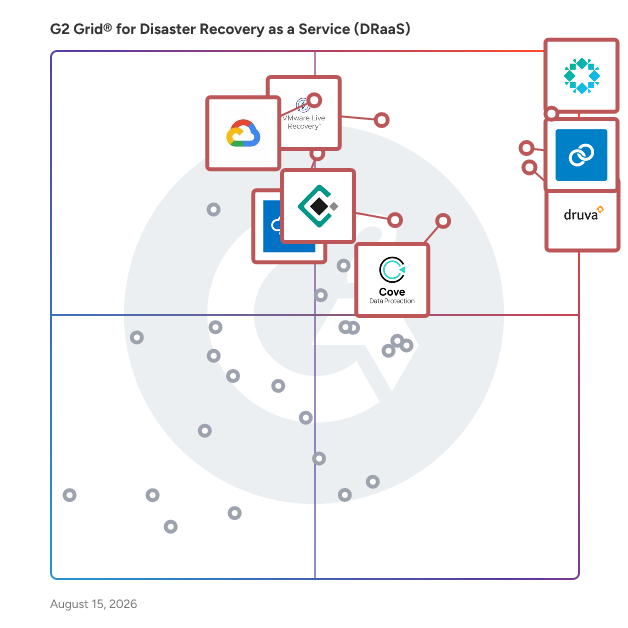
Highlighted products: Rubrik, Druva Data Security Cloud, Datto SIRIS, VMware Live Recovery (VLR), Cove Data Protection, Google Backup and DR service, Commvault Cloud Rewind, and Azure Site Recovery.
Underlying data: [Grid® JSON](https://www.g2.com/categories/disaster-recovery-as-a-service-draas/grids.json?focus%5B%5D=rubrik&focus%5B%5D=druva-data-security-cloud&focus%5B%5D=kaseya-datto-siris&focus%5B%5D=vmware-live-recovery-vlr&focus%5B%5D=cove-data-protection&focus%5B%5D=google-backup-and-dr-service&focus%5B%5D=commvault-cloud-rewind&focus%5B%5D=azure-site-recovery)
Sponsored
Cloud Logging is a fully managed service that allows you to store, search, analyze, monitor, and alert on logging data and events from Google Cloud and Amazon Web Services.
Rubrik is the leading cyber resilience and data protection company with a mission to secure the world’s data. Rubrik pioneered Zero Trust Data SecurityTM to help organizations achieve business resilience against cyberattacks, malicious insiders, and operational disruptions. Rubrik Security Cloud, built with a Zero Trust design and powered by machine learning, delivers complete cyber resilience in a single platform across enterprise, cloud, and SaaS. Rubrik’s platform automates data policy management and enforcement, safeguards sensitive data, delivers data threat analytics and response, and orchestrates rapid cyber and operational recovery.
Average Rating: 4.6/5.0
Total Reviews: 280
AI-generated summary from verified user reviews
"Evaluating Rubrik for Enterprise Data Protection"
Rating: 4.5/5.0 stars
— Rayanne A.
"Reliable and User-Friendly Backup Solution"
Rating: 4.5/5.0 stars
— Aditi S.
Over the past decade, data risks have diversified, shifting data protection’s role from a passive last line of defense to an active data partner in responding to and recovering from diverse data risks. Traditionally, backup solutions aimed to secure against system risks such as hardware and application failures. However, with cloud making infrastructure redundant and applications becoming more resilient, risks have shifted from infrastructure to the data layer. While security tools play a critical role in creating defensive layers to secure the enterprise perimeter, some threats inevitably breach these defenses. Legacy backup approaches typically resorted to brute force recovery, but modern incident response demands a thorough analysis of the breach's scope, impact, and remediation strategies before recovery can occur. Data security is essential in this process, providing deep data insights that, when combined with perimeter security data, drive comprehensive and effective data-powered incident response. Druva bolsters enterprise data defense with the Data Security Cloud, a 100% SaaS, fully-managed platform that enhances protection, monitoring, and recovery. Druva ensures secure and clean recovery through air-gapped immutable backups, and advanced anomaly detection facilitates early threat identification. The platform's integrated response capabilities allow organizations to assess and address threats promptly, and bounce back to clean data without loss. By combining these features, Druva complements existing perimeter defenses, providing a seamless, comprehensive solution that simplifies the response and recovery process and ensures robust protection against modern threats. About Druva Druva is the leading provider of data security solutions, empowering customers to secure and recover their data from all threats. The Druva Data Security Cloud is a fully managed SaaS solution offering air-gapped and immutable data protection across cloud, on-premises, and edge environments. By centralizing data protection, Druva enhances traditional security measures and enables faster incident response, effective cyber remediation, and robust data governance. Trusted by over 7,500 customers, including 65 of the Fortune 500, Druva safeguards business data in an increasingly interconnected world.
Average Rating: 4.7/5.0
Total Reviews: 728
AI-generated summary from verified user reviews
"Fast, Easy Backup & Restore with Meaningful Time Savings"
Rating: 4.5/5.0 stars
— Verified User in Electrical/Electronic Manufacturing
"Simple, Cloud-Native Backups with Strong Ransomware Protection"
Rating: 5.0/5.0 stars
— James D.
Datto SIRIS is an all-in-one BCDR solution built for MSPs to efficiently prevent data loss and minimize downtime. Utilizing a cloud-first approach, MSPs can offer their clients local backup and recovery with a secure, cloud-based repository and full disaster recovery in the cloud. All of this administered from a multi-tenant cloud portal that allows MSPs to view, manage and recover client data from a single interface. Simplicity is a guiding design principle for SIRIS. From deployment flexibility that spans a software-only implementation to hardened backup appliances, MSPs can implement the solution that fits their client’s requirements. SIRIS cross-platform support enables MSPs to protect their client’s data anywhere it lives, from physical servers to virtual machines running Windows Server or Linux. Innovative features include: • Inverse Chain Technology™ for reliable backup • Patented ransomware scanning • Patented Screenshot Verification for recovery assurance • Intuitive Recovery Launchpad for failproof recovery • Patented Fast Failback™ to primary system after a disaster • Instant virtualization recovery, local or in the cloud SIRIS Explainer: https://www.youtube.com/watch?v=C5We4VpRqOA
Average Rating: 4.6/5.0
Total Reviews: 281
AI-generated summary from verified user reviews
"Reliable Backup & Rapid Recovery with Datto SIRIS"
Rating: 4.0/5.0 stars
— D S.
"Datto SIRIS: Reliable, Stable Backup That Just Works"
Rating: 4.5/5.0 stars
— Brad K.
Protect your data, minimize downtime and reduce costs with optimized disaster recovery (DR) that’s easily accessible on demand and delivered as a SaaS solution. VMware Live Recovery's ransomware recovery feature ensures confident ransomware recovery with a plan that rapidly restores critical apps and supports resiliency. Efficiently identify points of recovery to run rapid recovery point validations.
Average Rating: 4.5/5.0
Total Reviews: 131
AI-generated summary from verified user reviews
"Seamless VMware Disaster Recovery Automation"
Rating: 5.0/5.0 stars
— Ashish G.
"Effortless Disaster Recovery, Seamless Management"
Rating: 5.0/5.0 stars
— Alberto B.
Cove Data Protection, from N-able, is a cloud-first backup and disaster recovery service for servers, workstations, and Microsoft 365™, all managed from a multitenant web-based dashboard. Cove was created and optimized for the cloud, so incremental backups are up to 60 times smaller than with traditional image backup products. This allows you to back up more often, and the SaaS delivery format reduces administrative time, lowering your cost of service delivery. Storage in our private cloud is included, with data centers worldwide.
Average Rating: 4.5/5.0
Total Reviews: 428
AI-generated summary from verified user reviews
"Reliable Backups with Room for UI Improvement"
Rating: 5.0/5.0 stars
— Charles O.
"Cloud Backup Product - Works very well indeed"
Rating: 4.5/5.0 stars
— Peter J.
Google Cloud's Backup and Disaster Recovery (DR) Service is a secure, centrally managed solution designed to protect Google Cloud workloads from malicious or accidental data loss. It offers comprehensive backup and recovery capabilities for Compute Engine virtual machines (VMs), VMware VMs, databases, and file systems, ensuring data integrity and business continuity. Key Features and Functionality: - Immutable Backup Vaults: Store backup data in secure, Google-managed environments that prevent modification or early deletion, providing self-contained, indelible backups. - Centralized Management Interface: Manage a wide range of workloads through a unified dashboard integrated directly into the Google Cloud console, simplifying backup operations. - Comprehensive Monitoring and Alerts: Gain real-time visibility into backup operations with detailed monitoring, customizable alerts, and reporting to ensure compliance and operational insights. - Integration with Automation Tools: Utilize gcloud CLI, APIs, or Terraform to automate backup processes at scale, seamlessly incorporating them into existing infrastructure-as-code workflows. Primary Value and Problem Solved: The Backup and DR Service addresses the critical need for robust data protection by safeguarding against data loss due to cyberattacks, user errors, or system failures. By providing immutable backups and centralized management, it enhances cyber resilience, ensures compliance with data protection regulations, and facilitates rapid recovery to maintain business continuity. This service reduces operational burdens and integrates smoothly with existing workflows, offering a reliable and efficient solution for data backup and disaster recovery needs.
Average Rating: 4.6/5.0
Total Reviews: 22
AI-generated summary from verified user reviews
"Centralized, Immutable Backups with Peace of Mind for Diverse Workloads"
Rating: 5.0/5.0 stars
— ASHISH K.
"Reliable Data Protection, Fast Recovery, and Peace of Mind"
Rating: 4.5/5.0 stars
— Verified User in Commercial Real Estate
Cloud application downtime causes organizations significant costs, risks, and reputation. Applications experience downtime due to ransomware attacks, cloud misconfigurations, zone-level cloud service failures, natural disasters, region failures, or simply human error. Traditional backup & recovery or DR products do not auto-program your cloud services to recover your distributed cloud environments from downtime, costing organizations precious time, labor, revenue, and reputation. With Appranix integrated Backup and DR-as-a-Service, you can backup an entire application environment resources such as VMs, Containers/K8s, Cloud Volumes, Security Groups, Elastic IPs, Elastic File Systems, Network interfaces, VPCs, Routes, Load Balancer, RDS, and their dependencies and configurations using policies. Appranix leverages all the cloud-native data management for rapid copy management - backup, replication, ransomware vaulting, and recovery with much better RPO and RTO. Appranix automatically programs your environment resources and dependencies using native Infrastructure-as-Code for guaranteed recovery. All your data at a particular point in time will be recovered in the same production VPC or across to another isolated recovery environment (IRE). Recover with a single click seven to eight layers of distributed application stacks with no help from your developers, network admins, system, and database administrators at the time of dire need. Book a meeting for a demo - https://calendly.com/appranix-team/30min.
Average Rating: 4.7/5.0
Total Reviews: 18
"Unlocking Unparalleled Application Resilience in the Cloud"
Rating: 4.5/5.0 stars
— Verified User in Mechanical or Industrial Engineering
Rating: 5.0/5.0 stars
— Shai P.
Recovery plans are simple to create through the Azure management portal, where they are stored. The plans can be as simple or as advanced as your business requirements demand, including the execution of custom Windows PowerShell scripts and pauses for manual interventions.
Average Rating: 4.7/5.0
Total Reviews: 34
"Review on Azure Site Recovery"
Rating: 4.5/5.0 stars
— shashank s.
Rating: 4.5/5.0 stars
— Simi J.
Axcient x360Recover is the most reliable, flexible and cost-effective business continuity and disaster recovery (BCDR) solution for MSPs and the SMBs they serve. With x360Recover you can comprehensively protect data from cyberthreats like ransomware or risks like accidental deletion with a solution that is simple to deploy and manage. Delivered as a flexible direct-to-cloud or appliance-based deployment, x360Recover can cover nearly all modern backup and recovery use cases—including appliance, server, and cloud-to-cloud—with a solution built on Axcient's proprietary Chain-Free backup technology and including features like AirGap, AutoVerify, Virtual Office, and PSA/RMM integration. By eliminating the pains and inefficiencies of chain management, Axcient dramatically simplifies management and can include worry-free data storage and retention by default. Innovative features mean backup integrity is automatically verified, and one or more systems can be virtualized almost instantly. x360Recover delivers an RPO of 15 minutes and an RTO of less than 1 hour.
Average Rating: 4.6/5.0
Total Reviews: 129
AI-generated summary from verified user reviews
"Reliable backup that is easy to use!"
Rating: 5.0/5.0 stars
— Verified User in Information Technology and Services
"Flexible Local/Cloud Backups with Easy Recovery and Built-In Auto-Verification"
Rating: 4.5/5.0 stars
— David L.
Unitrends Data Center Backup and Recovery offers a Unified BCDR solution enabling our users to address the challenges of today with a complete, agile solution designed to backup, secure and recover all workloads. The platform encompasses protection for traditional data center infrastructure as well as cloud-based IaaS workloads, SaaS applications and the data being generated on endpoint devices such as laptops and PCs. Purposeful integrations with security tools provide end-to-end protection against cybercrime and human error, while automation and artificial intelligence is injected into the platform to simplify complex systems and provide a unified experience with visibility across a complete backup infrastructure.
Average Rating: 4.2/5.0
Total Reviews: 443
AI-generated summary from verified user reviews
"Reliable Backup and Recovery for Mixed Environments"
Rating: 4.0/5.0 stars
— Jonathan N.
"Unitrends Backup and Recovery"
Rating: 4.0/5.0 stars
— D S.
HYCU is the #1 AI Resilience Company. With one platform covering 100+ workloads across AI systems, SaaS applications, cloud environments, and on-premises infrastructure, HYCU eliminates the complexity and cost of out-of-phase data protection operations. With HYCU R-Cloud, organizations protect any workload, recover data to a location of their choice, and connect that data to streamline compliance and governance. When disruption strikes, they resume operations quickly and securely. Data anywhere, protected everywhere. What HYCU protects SaaS applications: Microsoft 365, iManage Cloud, Jira, Confluence, GitHub, Box, and 100+ additional applications. Identity & Access Management: Microsoft Entra ID, Okta, AWS IAM, and other IAM platforms. Cloud-native workloads: AWS, Google Cloud, and Microsoft Azure, including instances, storage buckets, databases, Amazon VPC, and AWS Route 53. On-premises and hybrid: Native, agentless protection for Nutanix, VMware, Dell, and NetApp with a software-only approach and complete storage flexibility. Core capabilities Backup and recovery · Disaster recovery · File-level and granular recovery · Data migration and mobility · Compliance and governance · SaaS data estate visualization Why HYCU 100% automated data protection, free from third-party risk. Competitive, transparent pricing with no lock-in. Trusted by thousands of enterprises and government agencies in 78 countries. 440+ partners worldwide.
Average Rating: 4.7/5.0
Total Reviews: 148
AI-generated summary from verified user reviews
"A Simple and Reliable Backup Software"
Rating: 4.5/5.0 stars
— Timothée S.
"Robust, Reliable Backups with Exceptional Support and Value"
Rating: 5.0/5.0 stars
— Hossaena W.
CrashPlan delivers enterprise-grade backup, recovery, and archiving to protect the data organizations cannot afford to lose. Our cloud-native platform helps businesses secure Microsoft 365, Google Workspace, endpoint, and server data with scalable protection that reduces risk, supports compliance, and controls storage costs. Built for modern IT environments, CrashPlan enables fast, reliable recovery while supporting long-term retention, legal hold, and broader data governance needs. We help enterprises strengthen resilience and maintain continuity without added complexity.
Average Rating: 4.9/5.0
Total Reviews: 260
AI-generated summary from verified user reviews
"Consistent Endpoint Protection and Data Recovery"
Rating: 5.0/5.0 stars
— Subhojit G.
"Reliable Endpoint and Microsoft 365 Backup Solution"
Rating: 5.0/5.0 stars
— Nikhil P.
LINK Datacenter owns and operates one of the largest data centers in Egypt.
Average Rating: 4.7/5.0
Total Reviews: 10
AI-generated summary from verified user reviews
"Valuable Work Experience in a Friendly Environment"
Rating: 4.0/5.0 stars
— Rana A.
"Outstanding Environment and Exceptional Services"
Rating: 5.0/5.0 stars
— Mahmoud R.
Acronis Cyber Protect delivers robust protection against cyberthreats, unparalleled backup and recovery capabilities and simplified management and visibility through a single pane of glass, for the entire environment. Key features of Acronis Cyber Protect include: · Cyberthreat protection: Using artificial intelligence (AI) and machine learning (ML), proactively secures data, applications and systems, from advanced cyberattacks, including ransomware and other forms of malware. · Rapid Recovery: Reduced dependency on central IT support empowers users to initiate one-click recovery of distributed endpoints, including bare-metal recovery of physical workloads. · Reduced TCO: Broad, multigenerational OS support, enables vendor consolidation while ensuring comprehensive protection. · Simplified management: Centralized management includes local autonomy and seamless integration with existing third-party tools to provide a unified view of backup and recovery operations along with broad, multigenerational OS support. · Data sovereignty: With the use of Acronis’ extensive network of global data centers, users can ensure compliance and master regional data sovereignty laws, offering peace of mind and regulatory compliance. Acronis is majority-owned by EQT.
Average Rating: 4.3/5.0
Total Reviews: 657
AI-generated summary from verified user reviews
"Effortless Backup and Disaster Recovery"
Rating: 4.5/5.0 stars
— VIVEK KUMAR D.
"Comprehensive Protection with Single pane of glass Management"
Rating: 4.5/5.0 stars
— Dave P.
InterVision has been recognized as a top provider of Disaster Recover-as-a-Service (DRaaS) by Gartner, Forrester and IDC analyst firms. Its exclusive program, InterVision Recovery Assurance™ gives clients complete confidence that their disaster recovery solution will be uncompromisingly secure, thoroughly supported and comprehensively tested. With datacenters in the US, InterVision supports a wide range of compliance frameworks and is SOC 2 Type II audited. InterVision is the only AWS Premier Consulting Partner verified by both Gartner and Forrester who can target Disaster Recovery as a Service (DRaaS) to the AWS cloud. InterVision leverages best of breed backup, replication and HA technologies such as Zerto, Veeam and Vision Solutions/DoubleTake. Our proprietary software, Bluelock Portfolio™, pulls data from these tools and key internal sources to provide insights for spending, recovery capability and verification for stakeholders with a single consolidated dashboard. InterVision's dedication to helping organizations mitigate risk and provide continuous availability has resulted in the highest customer satisfaction scores in the industry. Protect sensitive data and seamlessly bridge any interruption with our tailored DRaaS solutions.
Average Rating: 4.9/5.0
Total Reviews: 15
"InterVision Cloud Disaster Recovery"
Rating: 5.0/5.0 stars
— NIMRATA S.
"Excellent Disaster Recovery Partner and Solution"
Rating: 5.0/5.0 stars
— Ben V.
Disaster recovery as a service (DRaaS) solutions enable companies to back up their data along with IT infrastructure in a third-party cloud computing environment. In the event of power outages, cyberattacks, equipment failures, human errors, natural disasters, or any form of disruption, this will allow companies to regain access to the backup data and mirrored IT infrastructure.
Since DRaaS solutions follow the as-a-service model, companies don't have to own all the disaster recovery (DR) resources or handle all the associated processes. Instead, they can rely on the provider. The third-party DRaaS provider reduces the burden of regularly backing up company data and is also helpful for organizations that lack the needed expertise to plan, configure, and test a DR plan.
DRaaS is also sometimes known as business continuity as a service (BCaaS). DRaaS solutions are a form of failover insurance for cloud computing environments and are crucial for business continuity. In the context of disaster recovery, failover is an operational mode that (automatically) shifts to a standby server, network, or database if the primary system fails or is shut down for some reason.
In the managed DRaaS model, third-party service providers are responsible for the failover process and transitioning the users from the primary environment to their hosted services.
Like infrastructure as a service (IaaS) and cloud platform as a service (PaaS), DRaaS solutions were made possible through the widespread adoption of cloud computing. These tools make the disaster recovery process more manageable by bringing all aspects into a SaaS product.
DRaaS tools reduce or eliminate downtime for customer-facing applications and internal networks and are critical for business continuity. They replace traditional backup software and hardware using the cloud and offer data protection and replication, better security, and faster recovery.
There are typically three types of DRaaS—self-service, assisted, and managed. Buyers should note that not all implementations of these solutions can meet all the requirements of an organization. Therefore, it’s essential to evaluate which variation of the software meets their needs fully.
Self-service DRaaS
As the name suggests, the self-service DRaaS model offers businesses tools and essential resources to perform its own disaster recovery planning and backups. Although this model provides greater flexibility, businesses are fully responsible for every aspect of DR strategy, testing, management, and executing the recovery process.
Although self-service DRaaS models are less expensive, the time and resources required to manage them may not make them the most cost effective solution. More precisely, self-service DRaaS is ideal for organizations with internal IT teams that have the required DR expertise.
Assisted DRaaS
In the assisted DRaaS model, the disaster recovery service provider acts as an adviser to the organization. The service provider typically handles the infrastructure and replication and offers advice on implementing, testing, and managing DR solutions.
When disruption occurs, the provider may also offer additional support for failover and failback operations. Generally speaking, assisted DRaaS doesn't provide a recovery service level agreement (SLA). That's because the organization is mainly responsible for executing the recovery procedures.
In the case of disaster recovery operations, SLAs are made up of recovery time objectives (RTOs) and recovery point objectives (RPOs). RTO refers to the time frame within which a business process must be restored after a disaster to prevent unacceptable consequences. RPO refers to the amount of data that can be lost during a disaster without affecting a business process.
Companies can also utilize assisted DRaaS to identify weaknesses in their disaster recovery capabilities and avail the provider's specific services. When compared to the self-service model, this model is typically more expensive.
Managed DRaaS
In this model, the service provider is responsible for all aspects of the DRaaS strategy, including planning, testing, managing, and implementing. A managed DRaaS provider enables organizations and their IT teams to offload all DR concerns, as a third-party service provider is fully responsible for recovery.
When disaster strikes, the managed DRaaS provider will carry out the recovery process. These services offer a recovery SLA unique to a company's requirements. Managed DRaaS providers can also provide a platform-agnostic solution that provides failover for virtual or physical hardware, both within on-premises data centers and across multiple cloud service providers.
In short, managed DRaaS reduces the effort the IT team has to put in during disaster recovery to almost zero. As expected, managed DR solutions are typically the most expensive when compared to self-service or assisted DRaaS models. However, managed models are especially useful for small businesses that may lack the infrastructure and in-house expertise to plan and execute IT disaster recovery plans.
The following are some of the common features of cloud disaster recovery as a service tools.
Orchestration: Automates the recovery process to ensure that the crucial applications, servers, and their dependencies get back online without much IT intervention.
One-click failover: Helps configure the sequence and timing in which mission-critical systems are restored.
Automated discovery: Reduces the number of manual steps required in DR and, therefore, the likelihood of human errors.
Recovery point options: Helps to failback to a specific point in time or recover the most recent replicated data.
Bandwidth optimization: Enhances performance and bandwidth by sending only small amounts of data on an ongoing basis.
DNS redirect: Automates the updating of DNS and redirecting of requests to the new system.
Disaster recovery can help minimize data loss and downtime in the event of a disruption. When compared to traditional disaster recovery approaches, DRaaS offers enhanced reliability and resiliency. The following are some of the notable benefits of DRaaS solutions.
Improved administration: DRaaS software reduces the administrative burden otherwise placed on the IT team and empowers team members to focus on other tasks that offer greater business value.
Minimizes downtime: These solutions come with high availability, which means that businesses can rapidly recover. Immediate recovery means lower downtime, which also means that the organization wouldn't be drastically affected in terms of productivity. More precisely, DRaaS offers a faster and automated recovery process when compared to traditional DR methods.
Scalability: Scaling up the data storage or computational infrastructure might be an inconvenient process for on-premises disaster recovery systems, but not for DRaaS solutions. When using a disaster recovery system, organizations can continually review their needs and scale upwards or outwards when necessary.
The scalability of DRaaS tools makes it notably cost effective. The ability to scale up or down based on requirements ensures organizations don't have to make significant investments in these solutions. Additionally, opting for a managed DRaaS solution means that the service provider is responsible for hardware protection. This means that companies don't have to pay for hardware maintenance, and if a natural disaster makes the office unusable, they'll be able to continue business from another location.
Access to resources: When a disaster strikes, a managed DRaaS provider can help provide resources such as temporary employees, facilities, and communications assistance to get a business back on track and running smoothly.
Ransomware recovery: DRaaS can minimize the effects of ransomware attacks, which are becoming more common. Businesses can restore stolen or corrupted data with ease as the data is stored in a remote location. This will ensure the business operations aren't affected drastically.
IT administrators: IT administrators, or more specifically, internal IT management teams, are the most common users of DRaaS tools. These tools help administrators to perform disaster recovery operations and maintain business continuity.
Alternatives to disaster recovery as a service solution can replace this type of software either partially or wholly include:
Disaster recovery software: These tools empower organizations to quickly and effectively recover data, software, and settings in the event of infrastructure, computer, or server failure. Unlike DRaaS, where a third party is responsible for most aspects of disaster recovery, DR software lets businesses perform their recovery.
Related solutions that can be used together with Disaster recovery as a service (DRaaS) solutions include:
Online backup software: It is a backup technology that secures information created or stored on the web. It's used for various file types and information and helps organizations ensure business continuity in case of hardware failure or if files are deleted accidentally.
Server backup software: It's used to ensure that the information processed or stored in server hardware remains intact in the event of user error or mechanical failure. These tools store the data processed by the server in a remote location, cloud, or on some on-premises hardware.
SaaS backup software: These tools help businesses back up data generated within SaaS solutions like CRM software, email software, and business instant messaging software.
Business continuity management software: This software helps organizations identify potential disruptions in their operations and address them.
DRaaS software can offer better performance than other disaster recovery methods and minimize the effects of disruption. However, they come with their own set of challenges and limitations. The following are some of them.
DRaaS vendor's cloud bandwidth: Most DRaaS service providers are typically capable of handling the occasional DR events of a considerable number of customers. But most providers aren't fitted to perform DR operations of all of their customers simultaneously. This is mainly because they lack the needed cloud bandwidth. Therefore customers should research more about the capabilities of the vendor and see whether they can handle such instances.
Local internet bandwidth: In most cases, organizations don't have a direct connection with DRaaS providers. Instead, they connect to an internet service provider (ISP), who then routes traffic to the provider. If the local internet bandwidth is limited, then the DR operation's speed will be significantly affected. Therefore, along with assessing the cloud bandwidth of DRaaS providers, companies should check with the ISPs regarding internet bandwidth.
No company is immune to a disaster. Regardless of the company size, losing customer data or other critical information can disrupt business operations.
Therefore, businesses of all sizes should opt for a DRaaS solution to minimize the effects of disruption and maintain business continuity. This is specifically valid for small and medium-sized companies that may not have the needed in-house IT infrastructure and staffing.
Before getting into comparing solutions, buyers should perform an internal assessment that would reflect what disaster recovery means to an organization. For instance, disaster recovery may mean minimizing data loss or minimizing downtime. Additionally, it's crucial to understand the types of disasters the business requires the DRaaS solution to protect against.
When searching for DRaaS tools, organizations should also consider parameters such as recovery time objective (RTO) and recovery point objective (RPO). This will allow businesses to estimate their tolerance with downtime and data loss and find the most suitable software solution to minimize revenue loss.
As mentioned earlier, there are mainly three types of DRaaS models. The type of service model companies choose will have a profound impact on the solution's cost. Although the self-service DRaaS model requires the lowest investment, it may not necessarily be the most cost effective solution. For managed DRaaS, the service provider takes care of almost every aspect of disaster recovery, hence freeing the IT team to concentrate on other crucial tasks.
Understanding the services commonly offered by DRaaS providers can also help the buyer set clear expectations. Some of the services provided are simple and selective data recovery from the service provider's data center, virtual machine mounting for temporary application availability, domain name system (DNS) updating, and virtual private network(VPN) rerouting. Along with such services, DRaaS providers may also assist with disaster recovery planning and testing and bring in the needed staff for recovery.
Create a long list
Once the requirements are gathered, buyers should start creating a long list of software products. More than trying to find the right option, buyers should try to get a basic understanding of the kind of DRaaS solutions available. This long list can include any software product that meets the organization's basic requirements.
Create a short list
After creating a long list of DRaaS products, buyers should make a shorter, refined list. This list can include software products that specifically meet the company's requirements or have must-have features. Excluding products that don't have the nice-to-have features also makes sense.
Buyers can look at factors like DR testing frequency, data availability, and replication times. Buyers can also check whether the virtual machines (VM) would run in the DR site as ably as they do when running in the primary data center.
To narrow down the list even further, buyers can inquire about the number of customers the DRaaS provider can support simultaneously. Similarly, having a fair idea of the number of customers the service provider caters to will help buyers comprehend the level of support they will receive if a disaster hits all customers.
Digging deeper to understand the kind of prioritization the service provider abides by, such as first-come first-serve, or what happens when a customer can't be serviced, will help refine the list even further. Buyers can also look at other factors such as pricing, usability, vendor support, and DR features.
Conduct demos
Demos are helpful to effectively and fairly compare the products in the short list. This also means that buyers should demo each DRaaS software with the same use cases. Examining the usability of the software product, checking whether the features work as expected, and asking questions regarding the features the company requires the most are some other things to do during the product demo.
Choose a selection team
A selection team can significantly affect the success of software selection, purchase, and implementation. Such a team typically includes relevant stakeholders, including company leaders and IT administrators. They should be able to use the software product and determine whether it will meet the company's specific requirements.
Negotiation
Once the buyer has discovered a product that fits their needs most appropriately, they should discuss the terms and conditions and negotiate the pricing with the vendor. Even if something is written on the vendor's pricing page, prices aren't fixed in most cases. Vendors may offer free licenses or discounts and may remove certain optional features and lower the price.
Final decision
To make the final software purchase decision, buyers should try to implement the software on a small scale. Doing so will give the buyer the confidence that their choice of the software product is correct. If the DRaaS solution doesn't work to meet the expectations, the software options must be re-evaluated.
A DRaaS provider may not cover all disasters or offer all possible services. To set clear expectations, buyers should thoroughly inspect the service provider's offerings and have a precise understanding of what to expect. Making the mistake of wrongly assuming and finding out that a service provider doesn't offer a specific service during a disaster might be highly unfavorable.
The cost of DRaaS software solutions depends on several factors. This includes the type, assured RTO and RPO, and the kind of services the provider offers. As a rule of thumb, the closer RTO and RPO get to zero, the higher the costs will be.
ROI for DRaaS solutions can be typically determined by the cost of implementing relative to the cost of managing an in-house DR team and infrastructure. As expected, opting for a DRaaS solution is generally cost effective. In most cases, service providers may also offer discounts and additional services.
When calculating the ROI, companies should also consider the time and effort saved by availing the services of DRaaS providers. These tools have unparalleled recovery times, unlike traditional backup systems, which means business productivity isn't disrupted drastically. DRaaS solutions also help companies save the cost of data they would lose if it isn’t backed up.
