Best Emotion AI Software

Last updated: November 25, 2026

How Many Emotion AI Software Products Does G2 Track?

Total Products under this Category: 214

Category Stats (Nov 2026)

  • Average Rating: 4.49/5 The average rating of products in this category, based on all submitted ratings
  • Top Trending Product: FaceReader Online (+3.16%) - Among all products in this category, FaceReader Online recorded the largest rating increase compared to last month

Last updated: November 29, 2026

How Does G2 Rank Emotion AI Software Products?

Why You Can Trust G2's Software Rankings:

  • 30 Analysts and Data Experts
  • 200+ Authentic Reviews
  • 214+ Products
  • Unbiased Rankings

G2's software rankings are built on verified user reviews, rigorous moderation, and a consistent research methodology maintained by a team of analysts and data experts. Each product is measured using the same transparent criteria, with no paid placement or vendor influence. While reviews reflect real user experiences, which can be subjective, they offer valuable insight into how software performs in the hands of professionals. Together, these inputs power the G2 Score, a standardized way to compare tools within every category.

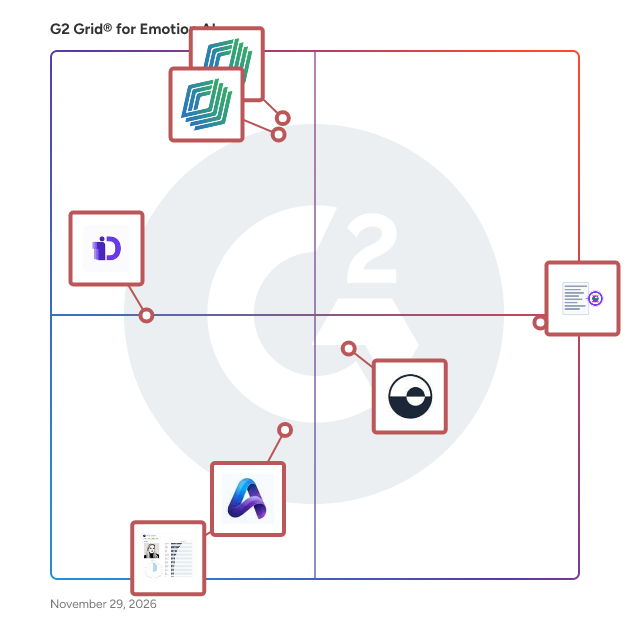
G2 Grid® for Emotion AI Software

G2 Grid® for Emotion AI Software plotting products by satisfaction and market presence

Highlighted products: Lucid, Conversation Insights Agent, Sales Interaction Agent, FaceReader Online, Amotions AI, Decode, and EchoDepth.

Underlying data: [Grid® JSON](https://www.g2.com/categories/emotion-ai/grids.json?focus%5B%5D=ultradeep-technologies-lucid&focus%5B%5D=conversation-insights-agent&focus%5B%5D=sales-interaction-agent&focus%5B%5D=facereader-online&focus%5B%5D=amotions-ai&focus%5B%5D=entropik-decode&focus%5B%5D=echodepth)

Lucid

Lucid detects cognitive biases in AI outputs. It identifies 74 bias types with 98% precision in under 2 minutes. Available as a Chrome extension and API for enterprise integration. Designed for AI governance teams, compliance officers, and developers who need to ensure AI generated content is fair, accurate, and free from systematic distortion.

Average Rating: 4.4/5.0

Total Reviews: 56

Who Is the Company Behind Lucid?

Who Uses This Product?

  • Top Industries: Information Technology and Services
  • Company Size: 46% Small, 45% Medium

What Are Recent G2 Reviews of Lucid?

Conversation Insights Agent

Unlock the power of your enterprise data with conversational analytics built from the ground up to use large language models. Uniphore U-Analyze uses generative AI to uncover trends, intents and insights from customer interactions, helping businesses better understand their customers, fine-tune contact center operations and create smoother, simpler customer experiences.

Average Rating: 4.3/5.0

Total Reviews: 19

Who Is the Company Behind Conversation Insights Agent?

  • Seller: Uniphore
  • Year Founded: 2008
  • HQ Location: Palo Alto , US
  • LinkedIn® Page: www.linkedin.com
    884 employees on LinkedIn®
  • Ownership: Private
  • Phone: (650) 352-5500

Who Uses This Product?

  • Company Size: 53% Small, 26% Large

What Are Recent G2 Reviews of Conversation Insights Agent?

Sales Interaction Agent

Q for Sales gives revenue teams real-time guidance to eliminate guesswork, accelerate workflows, and win more deals. With the help of Q for Sales, you can capture notes, analyze sales conversations, and understand what motivates buyers to boost seller engagement and effectively coach your team from the customer’s perspective. Built with the entire revenue team in mind. From real-time insights to Voice of the Customer and buyer analytics, Q surfaces actionable insights for every member of the revenue team. Validate messaging, surface the moments that matter, share important meeting clips across teams, and enable your reps to meet buyers in the moment—with better understanding across every meeting and deal. Q for Sales Includes: Q Real-Time: AI-Powered Notetaking and Meeting Insights for Zoom, Teams, & WebEx Meeting Insights: Auto-surface key moments and action items. Analyze buyer sentiment and engagement to identify the topics, content, and moments that matter most to your customer. Deal Insights: Understand the sentiment and engagement of all stakeholders, identify what is needed to move deals forward and accelerate sales execution. Analytics: Voice of customer insights based on verbal, tonal, and visual signals to validate messaging and methodology, identify market trends, gauge confidence, and better understand your buyer. Improve: Micro-Coaching and Seller EQ to inform Reps on their performance, surface coachable moments, and improve conversation skills and empathy based on buyer reactions. Team EQ: Realize the value of training and enablement. Identify lapses in empathy, hesitations, and coachable moments across your team. Track improvement and correlate training to real business outcomes. Sharing: Quickly create and share meeting clips and playlists based on your selection or save time with AI-generated key moments. Sales Coaching: Surface coachable moments based on buyer confusion and concern while gaining new metrics around Rep performance. Realize the value of training and enablement. Team Selling: Get the right people involved in every deal and streamline handoffs. Comment and collaborate directly within the context of specific meetings and deals. Access Controls: Complete or controlled access to Meeting Insights, Deal Insights, and Analytics based on your unique permissions.

Average Rating: 4.2/5.0

Total Reviews: 19

Who Is the Company Behind Sales Interaction Agent?

  • Seller: Uniphore
  • Year Founded: 2008
  • HQ Location: Palo Alto , US
  • LinkedIn® Page: www.linkedin.com
    884 employees on LinkedIn®
  • Ownership: Private
  • Phone: (650) 352-5500

Who Uses This Product?

  • Top Industries: Information Technology and Services
  • Company Size: 42% Medium, 37% Small

What Are Recent G2 Reviews of Sales Interaction Agent?

AI can help you find the answers. G2 helps you trust them.

Connect G2 to Claude or ChatGPT for answers grounded in G2's trusted reviews, comparisons, and pricing from real user insights.

How it works

FaceReader Online

FaceReader Online is a web-based facial coding and webcam eye tracking platform. It integrates Responsible AI with Behavior AI, helping advertising experts, academic researchers, and UX professionals to understand real human reactions and boost the effectiveness of their content and designs. The company aims to give data-driven insights, that can improve design, and maximize campaign impact. With a global user base and a commitment to scientific rigor, FaceReader Online is recognized as a leader in the field of affective computing.

Average Rating: 4.2/5.0

Total Reviews: 22

Who Is the Company Behind FaceReader Online?

Who Uses This Product?

  • Top Industries: Computer Software
  • Company Size: 55% Small, 23% Large

What Are Recent G2 Reviews of FaceReader Online?

Amotions AI

Amotions AI is a real-time AI sales coach for teams that want help during live sales calls without inviting a meeting bot. Reps see private, hands-free prompts for discovery questions, objections, and next steps in a desktop or Chrome overlay on supported Zoom, Microsoft Teams, Google Meet, and computer-audio dialer workflows. Before calls, reps can practice with AI buyers. After calls, managers and reps can review scorecards and feedback to decide what to practice next. Teams on eligible plans can use their own talk tracks, buyer scenarios, and scoring criteria. Basic is free with usage limits. See https://amotionsinc.com/pricing for plan details.

Average Rating: 4.4/5.0

Total Reviews: 17

Who Is the Company Behind Amotions AI?

Who Uses This Product?

  • Company Size: 72% Small, 17% Medium

What Are Recent G2 Reviews of Amotions AI?

Decode

Decode is an integrated Human Insights AI Platform that replaces fragmented research stacks with a single, comprehensive solution. By unifying consumer research, user experience testing, predictive creative analytics, and insights management with Emotion AI, Behavior AI and Generative AI, Decode delivers faster, more actionable insights across the entire customer journey. Complete Research Suite: - Consumer Insights: AI-powered surveys, qualitative research, diary studies, shopper behavior analysis, and social media research that decode emotions and predict behaviors. - User Experience Research: Remote user testing, journey mapping, wireframe validation, prototype testing, and live website optimization. - Predictive Creative Analytics: Real-time eye-gaze tracking, attention measurement, and creative optimization powered by advanced Neuro AI. - Insights Intelligence Hub: Centralized AI Copilot that automatically analyzes calls, meetings, documents, and research data to surface connected insights across all touchpoints.

Average Rating: 4.5/5.0

Total Reviews: 51

Who Is the Company Behind Decode?

Who Uses This Product?

  • Top Industries: Information Technology and Services
  • Company Size: 43% Medium, 37% Large

What Do G2 Reviewers Say About Decode?

AI-generated summary from verified user reviews

Pros
  • Users find Decode's intuitive interface effortless, enhancing productivity and making complex tasks easy to navigate.
  • Users appreciate Decode's comprehensive consumer insights, enhancing understanding through advanced behavioral and emotional data tools.
  • Users find Decode's integrative AI capabilities transformative for understanding consumer behavior and optimizing strategies.
  • Users benefit greatly from the advanced data analysis tools in Decode, enhancing strategic planning and consumer insights.
  • Users commend Decode for its exceptional analytics capabilities, enhancing consumer insights and forecasting trends effectively.
Cons
  • Users note the complexity of initial setup, finding the extensive features overwhelming before becoming easier to navigate over time.
  • Users find the learning curve steep, especially for advanced features, but value the powerful insights gained once mastered.
  • Users find the navigation difficult, as the interface can be unintuitive and tools harder to locate initially.
  • Users feel that the interface is not user-friendly, making it challenging to locate tools and reports efficiently.
  • Users face a steep learning curve when starting with Decode, making initial use challenging before mastering its capabilities.

What Are Recent G2 Reviews of Decode?

EchoDepth

EchoDepth is Cavefish core platform for **Emotional Decision Intelligence**. It is designed to measure how people actually feel about something in real time, rather than relying on what they say after the fact. At a practical level, it works by analysing **involuntary human signals** captured through standard video. Instead of asking questions like “what do you think?”, it observes the immediate emotional response that occurs before someone has time to interpret or filter it. The system focuses on two layers: First, **facial Action Units**. These are specific muscle movements in the face, originally defined in the Facial Action Coding System. They occur automatically and reflect genuine emotional reactions in the first few hundred milliseconds after exposure to a stimulus. Second, **emotional state modelling** using three dimensions: * Valence: whether the response is positive or negative * Arousal: the intensity of the response * Dominance: the sense of control or submission By combining these, EchoDepth produces a moment-by-moment map of emotional response. This allows you to distinguish between surface-level approval and genuine desire or resistance, which often look identical in traditional research. The purpose is to solve a structural limitation in research and decision-making: people cannot reliably articulate their true emotional response, especially in real time or in social contexts. EchoDepth bypasses that limitation by measuring the response before it is verbalised. Typical use cases include: * Product and packaging testing * Marketing and creative evaluation * Leadership communication and investor messaging * Employee experience and culture diagnostics * High-stakes decision validation In simple terms, EchoDepth helps organisations understand **how decisions will land emotionally before they are made**, so emotional risk can be assessed alongside financial and operational factors.

Average Rating: 4.5/5.0

Total Reviews: 13

Who Is the Company Behind EchoDepth?

Who Uses This Product?

  • Company Size: 77% Small, 15% Medium

What Are Recent G2 Reviews of EchoDepth?

Opsis Emotion AI

Awarding-winning emotion machine learning algorithm for multimodal facial, speech, text and posture with psychological annotation to manifest an individual or large group with refine classification. The solution is adapted to run natively on SAP platform and can used as service for other apps.

Average Rating: 4.8/5.0

Total Reviews: 2

Who Is the Company Behind Opsis Emotion AI?

Who Uses This Product?

  • Company Size: 100% Large, 50% Small

What Are Recent G2 Reviews of Opsis Emotion AI?

Real-time Guidance Agent

U-Assist is an intelligent agent guidance solution designed to streamline the onboarding process, reduce error rates, and enhance operational efficiencies within customer service environments. By integrating advanced technologies such as Artificial Intelligence (AI) and Robotic Process Automation (RPA), U-Assist automates knowledge-based integration, ensuring that agents have immediate access to essential customer information during interactions. This capability allows agents to provide seamless service without the need to place customers on hold, thereby improving the overall customer experience. The target audience for U-Assist includes organizations that prioritize customer service excellence and seek to optimize their operational workflows. This solution is particularly beneficial for call centers, customer support teams, and businesses that handle a high volume of customer inquiries. By addressing common pain points such as lengthy onboarding processes and high error rates, U-Assist empowers agents to perform more effectively and efficiently, ultimately leading to improved customer satisfaction. Key features of U-Assist include real-time data retrieval, automated knowledge sharing, and performance analytics. These features work together to enhance the agent experience by reducing the time required for onboarding new staff, allowing them to become productive more quickly. Additionally, U-Assist increases upsell and cross-sell opportunities by equipping agents with relevant information that can be leveraged during customer interactions. This not only boosts agent performance but also contributes to the overall revenue potential of the organization. U-Assist minimizes costly errors by providing agents with accurate and up-to-date information, thereby reducing the likelihood of repeat calls and enhancing the quality of service provided. The solution also helps reduce agent handling time, allowing for more efficient call management and enabling agents to deliver consistently exceptional customer service. By integrating U-Assist into their operations, organizations can expect to see a significant improvement in both agent productivity and customer satisfaction, creating a more effective and responsive customer service environment.

Average Rating: 5.0/5.0

Total Reviews: 1

Who Is the Company Behind Real-time Guidance Agent?

  • Seller: Uniphore
  • Year Founded: 2008
  • HQ Location: Palo Alto , US
  • LinkedIn® Page: www.linkedin.com
    884 employees on LinkedIn®
  • Ownership: Private
  • Phone: (650) 352-5500

Who Uses This Product?

  • Company Size: 50% Medium, 50% Small

What Are Recent G2 Reviews of Real-time Guidance Agent?

Viewpoints.ai

Viewpoints.ai is a patented legal technology platform for litigation strategy, jury research, and case evaluation. Developed by Stanford-trained media psychologists and grounded in research on human decision-making, the platform uses venue-specific AI jurors to help trial teams test how different types of jurors may respond to case themes, evidence, witnesses, damages arguments, and other strategic decisions before trial. Unlike general-purpose AI tools that produce a single answer, Viewpoints creates populations of distinct simulated jurors with different backgrounds, life experiences, media exposure, psychological traits, cognitive biases, and decision-making tendencies. Jurors can review pleadings, testimony, exhibits, video, expert opinions, openings, closings, and other case materials, then answer questions, interact with attorneys, and deliberate in panels. Litigators use Viewpoints to test themes and arguments, evaluate witnesses and evidence, explore damages strategies, compare competing narratives, and inform case valuation and settlement decisions. Simulations can be rerun quickly as discovery and trial strategy evolve. The platform is used by more than a dozen Am Law 100 firms and major insurance companies, and its methodology has also been tested against live human jury research.

Average Rating: 4.7/5.0

Total Reviews: 3

Who Is the Company Behind Viewpoints.ai?

Who Uses This Product?

  • Company Size: 67% Small, 33% Medium

What Are Recent G2 Reviews of Viewpoints.ai?

Affectiva

Affectiva is now a Smart Eye company. In June 2021 Smart Eye acquired Affectiva. We are merging the two companies to form a global AI powerhouse.

Who Is the Company Behind Affectiva?

Affiniti AI

Affiniti AI is an innovative conversational AI platform designed to enhance mental health therapy by providing continuous support to clients between sessions. Serving as a virtual co-therapist, it enables clients to practice and internalize coping strategies, reinforcing their commitment to mental health improvement. Therapists benefit from detailed insights into client experiences, facilitating more focused and impactful therapy sessions. Key Features and Functionality: - Client Engagement: Offers AI-based support between therapy sessions, allowing clients to practice coping strategies and maintain progress. - Therapist Support: Provides therapists with in-depth interaction analysis, offering insights into client experiences and obstacles. - Seamless Integration: Easily incorporates into existing therapy practices without disruption, complementing traditional methods. - Security and Privacy: Employs robust security measures to safeguard all client interactions and data. Primary Value and Solutions: Affiniti AI addresses the challenge of maintaining client engagement between therapy sessions by offering continuous, personalized support. This approach empowers clients to actively participate in their mental health journey, leading to improved outcomes and a stronger therapeutic alliance. For therapists, the platform streamlines session planning and enhances the effectiveness of therapy by providing valuable insights into client progress and challenges.

Who Is the Company Behind Affiniti AI?

Agaton

Who Is the Company Behind Agaton?

  • Seller: Agaton
  • Year Founded: 2024
  • HQ Location: Stockholm, SE
  • LinkedIn® Page: www.linkedin.com
    27 employees on LinkedIn®

AI Brain

AIBrain is a technology startup based in Palo Alto, California, specializing in artificial intelligence solutions for education and entertainment. Recognized as a top 5 entertainment AI company in 2023, AIBrain focuses on developing AI technologies that enhance human capabilities through innovative applications. Key Features and Functionality: - AICoRE (Adaptive Interactive Cognitive Reasoning Engine): A foundational AI engine designed to augment human intelligence by integrating neural and cognitive sciences. - Memory Graph: A system that enables AI to remember and learn from interactions, facilitating continuous improvement and personalized experiences. - TYCHE: An AI-powered family companion robot that engages users through interactive and educational activities. - SMILE (Social Mind for Intelligently Learning Emotions): An AI system capable of understanding and responding to human emotions, enhancing social interactions. - Futurable: An AI-driven game that offers dynamic and adaptive gameplay experiences, recognized among the top 30 games by the Google Indie Game Festival in 2016. - SAIVA (Sports AI Virtual Assistant): An AI solution for football (soccer) that analyzes game situations and recommends successful pass potentials, aiming to improve player performance and training. Primary Value and Solutions: AIBrain's suite of AI technologies addresses the need for intelligent systems that can learn, adapt, and interact with humans in meaningful ways. By integrating advanced AI into education and entertainment, AIBrain enhances learning experiences, provides personalized companionship, and offers innovative tools for sports training and performance analysis. Their solutions aim to bridge the gap between artificial intelligence and human interaction, fostering environments where AI acts as a supportive and enhancing presence in daily life.

Who Is the Company Behind AI Brain?

Reviews of Emotion AI products
Tian Lin
TL
Researched and written by Tian Lin

Learn More About Emotion AI Software

Emotion AI buying insights at a glance

Emotion AI software organizes signals from text, speech, video, or facial capture for a researcher to interpret. A recurring integration question is: Which Emotion AI tools integrate with design software and research platforms for seamless workflow adoption? The practical test is whether the stimulus, recording, participant comment, and any inferred label remain connected when a study is reviewed or exported. Recent G2 reviews praise remote capture and time-linked views, while describing lighting problems, uncertain labels, cost, and lost context. An emotion label is a model output, not direct knowledge of a person's internal state.

Emotion ai software spans different methods. Facial-coding feedback is relevant to participant studies; conversation-analysis reviews concern customer or sales calls. Buyers should decide which kind of evidence answers their research question before comparing products in one category ranking. In a pilot, have a researcher inspect the source clip, note disagreement with an interview, and exclude recordings that fail a quality check. If a product offers a Chrome extension for real-time sentiment or bias analysis, compare its result with the same content in the team's normal research workflow. The best emotion ai software should make uncertainty visible and preserve the path back to the original evidence.

Common use cases and how businesses benefit:

  • Remote participant studies: Collect consented recordings outside a lab and review whether capture quality is adequate for the planned analysis.
  • Media testing: Align a reaction with the moment in a video or design stimulus, then compare it with what the participant actually said.
  • Qualitative review: Organize transcripts and clips so researchers can return to context instead of treating a label as a conclusion.
  • Customer conversations: Examine call-level patterns when that method fits the question; do not substitute a sales-call tool for a participant study.

Pricing comparisons need a defined study. Ask vendors what a quote includes for participants, recording time, analysis runs, exports, and access for researchers. Add recruitment, consent, capture checks, and manual interpretation to the team's own cost estimate. The recent reviews do not identify a universally cheapest option, and a low software fee would not resolve unusable recordings or labels that cannot be checked. A small pilot with the intended audience is a better basis for a budget than an assumed cost per study.

Top 5 FAQs from software buyers

Start with the intended signal, the people affected, and the review needed before acting on an inferred result.

  • Which signals can an emotion AI tool assess in the intended workflow?
  • How will the team test results across different people and contexts?
  • What review step is needed before acting on an inferred emotion?
  • Where must consent, privacy, and access controls apply?
  • How should buyers compare setup effort with the value of the insight?

The products below include Lucid, Conversation Insights Agent, Sales Interaction Agent, and FaceReader Online.

What are the top-reviewed Emotion AI on G2?

The G2 category listing shows the products below in the displayed order. Overall star ratings describe product experience; buyers should test the specific workflow they need.

Lucid

  • Number of Reviews: 57
  • G2 Rating: 4.4/5

Conversation Insights Agent

  • Number of Reviews: 19
  • G2 Rating: 4.3/5

Sales Interaction Agent

  • Number of Reviews: 19
  • G2 Rating: 4.2/5

FaceReader Online

  • Number of Reviews: 23
  • G2 Rating: 4.2/5

Amotions AI

  • Number of Reviews: 18
  • G2 Rating: 4.4/5

Learn more about how G2 calculates these scores. (Source 1)

What I Often See in Emotion AI

Feedback Pros: What Users Consistently Appreciate

  • Remote facial coding expands access to research participants

"Participants can take part from home, and the process is quick and doesn’t ask a lot of them."

- FaceReader Online review, Nienke de Vlieger

  • Time-linked recordings help researchers inspect audience responses

"automated, time-resolved analysis"

- FaceReader Online review, Shyama Shah

  • Video and transcript views can organize qualitative findings

"video, accurate transcripts, and smart AI sentiment tracking in a simple, intuitive dashboard."

- Decode review, anonymous reviewer

Cons: Where Many Platforms Fall Short

  • Lighting and camera angles can undermine facial tracking

"bad lighting, weird angles, or someone fidgeting will wreck facial tracking fast."

- FaceReader Online review, Chain Singh Bajiya

  • Emotion labels need context before researchers draw conclusions

"The accuracy can sometimes vary, and the results may not always reflect a person’s true emotions."

- FaceReader Online review, Naveen Kankipati

  • Restricted trials make full capability difficult to assess

"The trial account feels quite limited for proper evaluation"

- FaceReader Online review, Tuli Deb

My Expert Takeaway on Emotion AI

The first choice is the research method, not the category score. I would use emotion ai tools for a consented question whose output can be checked against participant words, source video, or human coding. Reviewers describe value in remote capture and organized, time-linked views; they also surface lighting problems and uncertainty in labels. Those limitations matter most when a team is tempted to treat a model's label as the participant's actual feeling.

For the best emotion ai software, I would require a reviewer to open the source clip, see how the label was assigned, and exclude a poor-quality session. A customer-call analysis product may suit conversation coaching while a facial-coding product suits a user study. Their reviews answer different questions. I would compare emotion ai software only within the intended workflow, then run the same sample across different speakers, recording conditions, and languages where relevant. The purchase case should rest on useful evidence and an auditable interpretation, not a confident-looking score.

Emotion AI FAQs

What is emotion AI used for?

Emotion AI is used to organize signals associated with a response to a design, message, video, or conversation. In a participant study, a researcher may align facial or verbal signals with a source clip and compare them with interview comments. Customer-conversation tools serve a different review workflow. Recent G2 feedback supports time-linked analysis while also warning about capture quality and uncertain labels. Obtain consent, preserve the original evidence, and have a person interpret the result.

What are the best emotion AI platforms for understanding user motivations and cognitive biases in feedback?

No tool can infer motivation or bias from a facial signal alone. I would compare recordings with participant comments using these review-backed candidates:

A researcher should validate every interpretation in an interview.

Which emotion AI tools provide transparent methodology for emotional metrics?

The reviews do not certify any vendor's methodology. Ask these candidates to show inputs, label definitions, uncertainty, and a timestamped source clip:

Compare explanations on the same recording.

Is there a machine that reads emotions?

Software can classify patterns in facial images, speech, or text that correlate with labeled emotion categories. That is not the same as directly reading a person's internal state. Camera conditions, culture, context, and individual differences affect interpretation. Buyers should ask for validation results relevant to their audience and should avoid using a single inferred label to make consequential decisions about a person.

How accurate is AI sentiment analysis?

Accuracy depends on the input, labels, language, context, and validation method, so a single number cannot describe every study. Recent G2 reviewers report useful time-linked analysis but also describe problems when capture conditions or inferred labels do not match participant feedback. Ask a vendor to show validation for the same kind of text, audio, or video your team will use, including uncertain and failed cases. Compare the output with participant interviews and human coding before using it to support a decision.

What is the most affordable emotion AI software for small research teams?

Pricing depends on participants, recordings, and analysis runs; reviews do not establish a cheapest choice. Small business emotion AI options with recent study-related feedback include:

Only FaceReader Online and Decode have recent small-business feedback that matches this research task. Request pricing for the same study size and compare capture, analysis, and export costs.

Which emotion AI tools suit a startup's first user study?

Start with a signal that can be checked against participant feedback. Small-business reviews cover:

The recent reviews of other category products do not establish a comparable first-user-study workflow; test these two against participant interviews before expanding the shortlist.

Which emotion AI platform is easiest for a small team to learn?

Test consent, capture, interpretation, and export in one study. Reviewers describe:

These two have relevant small-team research feedback. Ask each to complete the same capture-to-export exercise instead of equating a general onboarding review with research usability.

What should a small business check before using facial coding?

Ask participants for informed consent and test the camera, lighting, and recording quality. G2 reviewers describe capture failures and uncertain labels. Compare any inferred signal with participant comments and allow a researcher to exclude unusable sessions.

Can a startup use emotion AI without a research specialist?

The software can organize signals, but a person still needs to design the study and interpret context. Begin with a narrow question, inspect individual recordings, and record where the tool disagrees with an interview. Avoid consequential decisions from a single inferred label.

Which emotion AI products have enterprise review evidence?

The enterprise emotion AI category includes three distinct workflows:

Choose by study design.

Which enterprise tools make emotional metrics easier to audit?

Do not infer methodological transparency from a category score. Ask each candidate for a source clip and uncertain-case explanation:

What is the best-reviewed option for enterprise research integration?

The research system must preserve recordings and context through export. Recent enterprise participant-research feedback supports a focused FaceReader Online pilot:

For customer or sales calls, Conversation Insights Agent and Sales Interaction Agent have relevant enterprise reviews, but those reviews do not establish participant-research integration. Test the export and consent workflow directly.

How should an enterprise govern recordings and inferred labels?

Document consent, retention, access, and deletion rules before collecting data. Keep source clips and human notes linked to each label. The review evidence supports workflow evaluation, but it does not establish scientific validity or legal suitability for employment, credit, or other consequential uses.

How can an enterprise evaluate emotion AI across languages and regions?

Use representative participants and compare tool outputs with interviews and human coding by language and recording condition. Track uncertain or failed captures separately. A single aggregate accuracy claim can hide variation that matters for a particular audience.

Sources

1. G2 Research Scoring Methodologies

2. Emotion AI category page

Researched By: Tian Lin

Last updated on: November 23, 2026