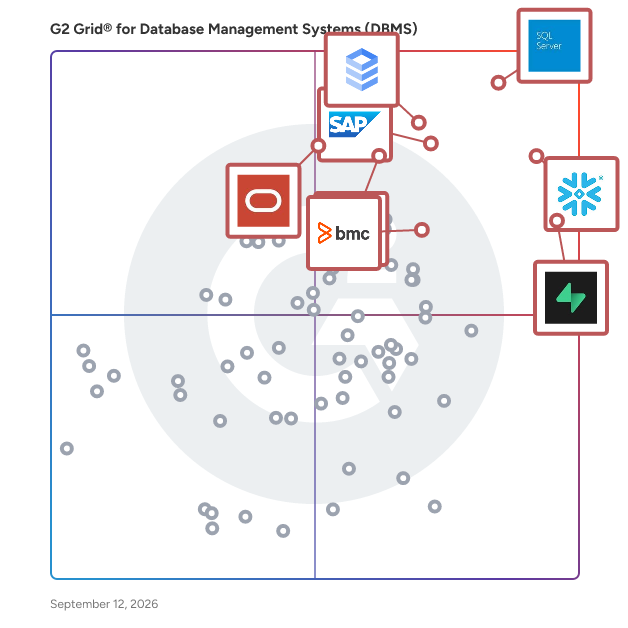
# Best Database Management Systems (DBMS) - Page 7

*By [Shalaka Joshi](https://research.g2.com/insights/author/shalaka-joshi)*


Database management systems (DBMS) are designed to define, store, retrieve, and manage the data within a database. It allows users to create, maintain, and manage databases. DBMS manipulates the database as per the user requirements. Using DBMS ensures that the data of an organization is clean, consistent, secure, relevant, and supports concurrency.

Along with the standard database functionalities (e.g., CRUD operations), DBMS software has much stronger management capabilities. These include functions like stronger metadata visibility and analysis, in-depth and custom reporting, performance monitoring, usage analytics, and compliance checks. Extensive solutions may offer capabilities of [database backup software](https://www.g2.com/categories/database-backup), [data replication software](https://www.g2.com/categories/data-replication), [disaster recovery software](https://www.g2.com/categories/disaster-recovery), or [disaster recovery as a service (DRaaS) software](https://www.g2.com/categories/disaster-recovery-as-a-service-draas), as well.

Typically used by database administrators, DBMS are integral to preserving database quality and integrity. They fall into a larger database-oriented stack, which can include solutions like database security and database monitoring.

DBMS is used as part of both relational and non-relational databases. DBMS software are of different types, in association with the database being managed and organized. Some of the more popular DBMS are as follows:

- Relational: Associated typically with [relational databases](https://www.g2.com/categories/relational-databases), the relational model organizes data tabularly (rows and columns approach) and is currently the most standard database model. DMBS focused on the relational model are referred to as RDBMS.
- Object oriented: [Object-oriented databases](https://www.g2.com/categories/object-oriented-databases) follow a programming-style, object-oriented approach to entering and organizing data. DBMS aligned with this model are referred to as OODMBS.
- Hierarchical: In a hierarchical model, data is organized with a tree-like structure, where associations (“branches&quot;) extend from a point of data. DBMS aligned with this model are sometimes referred to as HDBMS.
- Distributed: Under a distributed database model, data is decentralized and stored across several locations. These locations can be physically local (e.g., different servers in the same data center) or spread apart (perhaps connected via SD-WAN). DMBS aligned with the distributed database model are sometimes referred to as DDBMS.
- Non-relational DBMS or NoSQL DBMS: NoSQL DBMS support both structured and unstructured data. There is no set defined schema as compared to other data models. The key benefit of this DBMS is that users can process queries of various elements and not be limited by the structure.

To qualify for inclusion in the Database Management Systems (DBMS) category, a product must:

- Manage and align with a database model (e.g., relational, object-oriented, hierarchical, distributed, non-relational)
- Can also exist as a standalone tool to manage databases
- Provide database maintenance functionalities
- Provide extensive reporting and activity analytics


## Top Database Management Systems (DBMS) at a Glance
| # | Product | Rating | Best For | What Users Say |
|---|---------|--------|----------|----------------|
| 1 | [Microsoft SQL Server](https://www.g2.com/products/microsoft-sql-server/reviews) | 4.4/5.0 (2,127 reviews) | Microsoft-ecosystem relational data with SSMS administration | "[Powerful Performance Tuning, Strong Security and Environment Flexible](https://www.g2.com/survey_responses/microsoft-sql-server-review-12873238)" |
| 2 | [Snowflake](https://www.g2.com/products/snowflake/reviews) | 4.5/5.0 (707 reviews) | Elastic cloud data warehousing with workload isolation | "[Easy, Efficient Data Extraction with Clear Database Insights](https://www.g2.com/survey_responses/snowflake-review-12884116)" |
| 3 | [SAP HANA Cloud](https://www.g2.com/products/sap-hana-cloud-2025-10-01/reviews) | 4.3/5.0 (522 reviews) | In-memory HTAP analytics inside SAP ecosystems | "[Efficient Transactions, But Time-Intensive Setup](https://www.g2.com/survey_responses/sap-hana-cloud-review-12983922)" |
| 4 | [Google Cloud SQL](https://www.g2.com/products/google-cloud-sql/reviews) | 4.5/5.0 (354 reviews) | Fully-managed relational databases inside GCP ecosystems | "[Secure, Highly Available, and Scalable Cloud SQL for Diverse Workloads](https://www.g2.com/survey_responses/google-cloud-sql-review-12804608)" |
| 5 | [Databricks](https://www.g2.com/products/databricks/reviews) | 4.6/5.0 (1,284 reviews) | Unified lakehouse ETL, analytics, and ML | "[Powerful Lakehouse for Big Data, Collaboration, and Efficient Pipelines](https://www.g2.com/survey_responses/databricks-review-12946286)" |
| 6 | [Amazon Athena](https://www.g2.com/products/amazon-athena/reviews) | 4.4/5.0 (162 reviews) | Serverless ad-hoc querying on S3 data lakes | "[Simple, Scalable and Cost-Effective Analytics with Amazon Athena](https://www.g2.com/survey_responses/amazon-athena-review-12380769)" |
| 7 | [SAS Viya](https://www.g2.com/products/sas-sas-viya/reviews) | 4.3/5.0 (757 reviews) | Unified analytics lifecycle with in-memory processing | "[SAS Viya is a Powerful Analytics](https://www.g2.com/survey_responses/sas-viya-review-11702846)" |
| 8 | [TiDB](https://www.g2.com/products/tidb/reviews) | 4.6/5.0 (67 reviews) | MySQL-compatible HTAP with horizontal scalability | "[Seamless Integration, Reliable and Scalable](https://www.g2.com/survey_responses/tidb-review-12354194)" |
| 9 | [Teradata Autonomous Knowledge Platform](https://www.g2.com/products/teradata-autonomous-knowledge-platform/reviews) | 4.3/5.0 (355 reviews) | Massively parallel enterprise data warehouse analytics | "[Teradata Vantage Excels at Big Data Processing and Advanced Analytics](https://www.g2.com/survey_responses/teradata-autonomous-knowledge-platform-review-12739181)" |
| 10 | [SQL Developer](https://www.g2.com/products/sql-developer/reviews) | 4.3/5.0 (245 reviews) | Oracle-native PL/SQL development and schema administration | "[Audit-Ready Fraud Insights from Large-Scale Transaction Analysis](https://www.g2.com/survey_responses/sql-developer-review-12372052)" |


## How Many Database Management Systems (DBMS) Products Does G2 Track?
**Total Products under this Category:** 252

### Category Stats (Jun 2026)
- **Average Rating**: 4.29/5 The average rating of products in this category, based on all submitted ratings
- **Top Trending Product**: BMC AMI Data (+0.96%) - Among all products in this category, BMC AMI Data recorded the largest rating increase compared to last month
*Last updated: June 18, 2026*


## How Does G2 Rank Database Management Systems (DBMS) Products?

**Why You Can Trust G2's Software Rankings:**

- 30 Analysts and Data Experts
- 11,100+ Authentic Reviews
- 252+ Products
- Unbiased Rankings

G2's software rankings are built on verified user reviews, rigorous moderation, and a consistent research methodology maintained by a team of analysts and data experts. Each product is measured using the same transparent criteria, with no paid placement or vendor influence. While reviews reflect real user experiences, which can be subjective, they offer valuable insight into how software performs in the hands of professionals. Together, these inputs power the G2 Score, a standardized way to compare tools within every category.


## Which Database Management Systems (DBMS) Is Best for Your Use Case?

- **Leader:** [Microsoft SQL Server](https://www.g2.com/products/microsoft-sql-server/reviews)
- **Highest Performer:** [DbVisualizer](https://www.g2.com/products/dbvisualizer/reviews)
- **Easiest to Use:** [Databricks](https://www.g2.com/products/databricks/reviews)
- **Top Trending:** [EDB Postgres AI for CloudNativePG](https://www.g2.com/products/edb-postgres-ai-for-cloudnativepg/reviews)
- **Best Free Software:** [DbVisualizer](https://www.g2.com/products/dbvisualizer/reviews)


---

**Sponsored**

### RaimaDB

RaimaDB: The High-Performance Embedded Database for Edge and IoT Systems RaimaDB is a high-performance, small-footprint database designed for edge computing, IoT, and embedded systems. Built on over three decades of database innovation, RaimaDB provides a powerful, reliable, and resource-efficient solution for developers building applications where data integrity, speed, and local storage are critical. Unlike large-scale enterprise databases, RaimaDB is purpose-built for environments with limited memory and processing power—such as industrial controllers, automotive systems, medical devices, and network appliances. Its lightweight architecture allows for fast transactions, deterministic performance, and minimal overhead, making it ideal for real-time applications. RaimaDB supports both SQL and C/C++ APIs, giving developers flexibility in how they access and manage data. It’s fully ACID-compliant, ensuring data reliability even in harsh or disconnected environments. With advanced features like in-memory performance, high availability, and flexible replication, RaimaDB enables secure local data processing while still integrating seamlessly with cloud or enterprise systems when connectivity is restored. The database can be deployed on a wide range of operating systems, including Linux, embedded Linux, Windows, QNX, and VxWorks, and can run on both ARM and x86 architectures. Its modular design allows for efficient scaling—from compact single-board computers to complex distributed networks. Trusted by global leaders in industries such as automotive, aerospace, energy, and telecommunications, RaimaDB powers mission-critical systems that demand reliability and speed. Developers choose RaimaDB for its ease of integration, low maintenance requirements, and proven performance under demanding conditions. Whether you’re building the next generation of connected devices or optimizing data handling at the edge, RaimaDB provides the robust foundation you need. Experience the efficiency of a database built for embedded and real-time systems—fast, reliable, and ready for the future of intelligent data management.


[Visit website](https://www.g2.com/external_clickthroughs/record?secure%5Bad_program%5D=ppc&amp;secure%5Bad_slot%5D=category_product_list&amp;secure%5Bcategory_id%5D=303&amp;secure%5Bdisplayable_resource_id%5D=303&amp;secure%5Bdisplayable_resource_type%5D=Category&amp;secure%5Bmedium%5D=sponsored&amp;secure%5Bplacement_reason%5D=page_category&amp;secure%5Bplacement_resource_ids%5D%5B%5D=303&amp;secure%5Bprioritized%5D=false&amp;secure%5Bproduct_id%5D=6173&amp;secure%5Bresource_id%5D=303&amp;secure%5Bresource_type%5D=Category&amp;secure%5Bsource_type%5D=category_page&amp;secure%5Bsource_url%5D=https%3A%2F%2Fwww.g2.com%2Fcategories%2Fdatabase-management-systems-dbms%3Fpage%3D7&amp;secure%5Btoken%5D=71503e0e155a58dc3972af058e263dd64ce95d128049032b103a4b938bb83e16&amp;secure%5Burl%5D=https%3A%2F%2Fraima.com%2Fdownload-trial%2F%3Futm_content%3Dproducts-raimadb-reviews%26utm_medium%3Dreferral%26utm_source%3Dg2&amp;secure%5Burl_type%5D=free_trial)

---

## What Are the Top-Rated Database Management Systems (DBMS) Products in 2026?
### 1. [Infinidb](https://www.g2.com/products/infinidb/reviews)
Infinidb enables to deploy massively scalable high-performance analytics applications in Amazon Web Services (AWS) with dynamic provisioning.


**Average Rating:** 1.5/5.0
**Total Reviews:** 1
**How Do G2 Users Rate Infinidb?**

- **Has the product been a good partner in doing business?:** 8.3/10 (Category avg: 8.8/10)

**Who Is the Company Behind Infinidb?**

- **Seller:** [Infinidb](https://www.g2.com/sellers/infinidb)
- **HQ Location:** Frisco, TX
- **Twitter:** @InfiniDB (633 Twitter followers)
- **LinkedIn® Page:** https://www.linkedin.com/company/No-Linkedin-Presence-Added-Intentionally-By-DataOps (1 employees on LinkedIn®)

**Who Uses This Product?**
- **Company Size:** 100% Enterprise


#### What Are G2 Users Discussing About Infinidb?

- [What is Infinidb used for?](https://www.g2.com/discussions/what-is-infinidb-used-for)

### 2. [KubeDB](https://www.g2.com/products/kubedb/reviews)
KubeDB is an open-source, cloud-native, and highly scalable database management solution designed for Kubernetes. With KubeDB, you can deploy and manage popular databases, including MySQL, PostgreSQL, Elasticsearch, MongoDB, and Redis, with ease. KubeDB is built for modern, cloud-native applications that demand high availability, scalability, and performance. It allows you to easily manage the full lifecycle of your databases, from deploying and scaling to backup and recovery. KubeDB also supports automatic failover, point-in-time recovery, and other advanced features that make it easy to run mission-critical databases in a Kubernetes environment. KubeDB is designed to be highly extensible and flexible, allowing you to customize and configure it to meet your specific needs. It supports various deployment models, including standalone, clustered, and sharded databases, and can be easily integrated with other Kubernetes tools and services. Whether you&#39;re a small startup or a large enterprise, KubeDB makes it easy to manage your databases in Kubernetes, providing a scalable, reliable, and highly available solution for all your database needs. Try KubeDB today and experience the power of cloud-native database management.


**Average Rating:** 4.0/5.0
**Total Reviews:** 1
**How Do G2 Users Rate KubeDB?**

- **Has the product been a good partner in doing business?:** 6.7/10 (Category avg: 8.8/10)
- **Data dictionary:** 6.7/10 (Category avg: 8.5/10)
- **Backup and Recovery:** 8.3/10 (Category avg: 8.5/10)
- **Data Migration:** 8.3/10 (Category avg: 8.4/10)

**Who Is the Company Behind KubeDB?**

- **Seller:** [AppsCode](https://www.g2.com/sellers/appscode)
- **Year Founded:** 2016
- **HQ Location:** Las Vegas, US
- **LinkedIn® Page:** http://www.linkedin.com/company/appscode (50 employees on LinkedIn®)

**Who Uses This Product?**
- **Company Size:** 100% Small-Business


#### What Are Recent G2 Reviews of KubeDB?

**"[Big help for managing databases](https://www.g2.com/survey_responses/kubedb-review-8502716)"**

**Rating:** 4.0/5.0 stars
*— Verified User in Computer Software*

[Read full review](https://www.g2.com/survey_responses/kubedb-review-8502716)

---


### 3. [Node14](https://www.g2.com/products/node14/reviews)
Node14 provides businesses with a customizable online database configured specifically to customer’s business needs at much less cost and time than from scratch custom software development. Node14 runs customer’s databases on the preexisting Node14 database engine. This proprietary engine provides customers with powerful features like reporting, searching, dashboards, automation, advanced processing and more from day one. While other database companies expect the customer to build and configure their own database, Node14 does it all. At no point is the customer responsible for writing code, learning design interfaces of setting up servers. All configuration is performed by trained Node14 engineers so the job is done right from the beginning. Do you need a database or business intelligence system for your business? Consider Node14!


**Average Rating:** 4.5/5.0
**Total Reviews:** 1

**Who Is the Company Behind Node14?**

- **Seller:** [Node14](https://www.g2.com/sellers/node14)
- **HQ Location:** N/A
- **LinkedIn® Page:** https://www.linkedin.com/company/No-Linkedin-Presence-Added-Intentionally-By-DataOps (1 employees on LinkedIn®)

**Who Uses This Product?**
- **Company Size:** 100% Small-Business


#### What Are Recent G2 Reviews of Node14?

**"[This is easy and quick online database for your projects](https://www.g2.com/survey_responses/node14-review-8762780)"**

**Rating:** 4.5/5.0 stars
*— Harish P.*

[Read full review](https://www.g2.com/survey_responses/node14-review-8762780)

---


### 4. [Nosqlclient](https://www.g2.com/products/nosqlclient/reviews)
Cross-platform easy to use mongodb management tool


**Average Rating:** 3.0/5.0
**Total Reviews:** 1
**How Do G2 Users Rate Nosqlclient?**

- **Data dictionary:** 6.7/10 (Category avg: 8.5/10)
- **Backup and Recovery:** 6.7/10 (Category avg: 8.5/10)
- **Data Migration:** 6.7/10 (Category avg: 8.4/10)

**Who Is the Company Behind Nosqlclient?**

- **Seller:** [Mongoclient](https://www.g2.com/sellers/mongoclient)
- **HQ Location:** N/A
- **LinkedIn® Page:** https://www.linkedin.com/company/No-Linkedin-Presence-Added-Intentionally-By-DataOps (1 employees on LinkedIn®)

**Who Uses This Product?**
- **Company Size:** 100% Mid-Market


### 5. [OAK!Merge](https://www.g2.com/products/oak-merge/reviews)
Act! Data Import &amp; Export AddOn


**Average Rating:** 5.0/5.0
**Total Reviews:** 1

**Who Is the Company Behind OAK!Merge?**

- **Seller:** [Kannegiesser ETEC](https://www.g2.com/sellers/kannegiesser-etec)
- **Year Founded:** 1948
- **HQ Location:** Minneapolis, US
- **LinkedIn® Page:** https://www.linkedin.com/company/kannegiesser-usa/ (130 employees on LinkedIn®)

**Who Uses This Product?**
- **Company Size:** 100% Small-Business


#### What Are Recent G2 Reviews of OAK!Merge?

**"[OAK!Merge Automatic Data Import for Act!](https://www.g2.com/survey_responses/oak-merge-review-48085)"**

**Rating:** 5.0/5.0 stars
*— Dave W.*

[Read full review](https://www.g2.com/survey_responses/oak-merge-review-48085)

---


#### What Are G2 Users Discussing About OAK!Merge?

- [What is OAK!Merge used for?](https://www.g2.com/discussions/oak-merge-what-is-oak-merge-used-for)
- [What is OAK!Merge used for?](https://www.g2.com/discussions/what-is-oak-merge-used-for)

### 6. [PHP CRUD Generator](https://www.g2.com/products/php-crud-generator/reviews)
PHP CRUD Generator (PHPCG) is a web application to generate professional Bootstrap 4 Admin Dashboards. PHPCG is ideal for any kind of PHP MySQL project, whatever the complexity of the database. In a nutshell: - Upload the package to your server, then start the installation. - The program detects and analyzes your database: tables, fields and relationships. - Open the generator - Choose a table, your preferences and options, then validate to generate your paginated data lists, add/edit forms, etc. - Open your Admin Dashboard in your browser - everything is up and running. The online demo, documentation and numerous tutorials are available at https://www.phpcrudgenerator.com


**Average Rating:** 4.5/5.0
**Total Reviews:** 1
**How Do G2 Users Rate PHP CRUD Generator?**

- **Has the product been a good partner in doing business?:** 10.0/10 (Category avg: 8.8/10)
- **Data dictionary:** 10.0/10 (Category avg: 8.5/10)
- **Backup and Recovery:** 10.0/10 (Category avg: 8.5/10)
- **Data Migration:** 8.3/10 (Category avg: 8.4/10)

**Who Is the Company Behind PHP CRUD Generator?**

- **Seller:** [Miglisoft](https://www.g2.com/sellers/miglisoft)
- **HQ Location:** N/A
- **LinkedIn® Page:** https://www.linkedin.com/company/No-Linkedin-Presence-Added-Intentionally-By-DataOps (1 employees on LinkedIn®)

**Who Uses This Product?**
- **Company Size:** 100% Mid-Market


#### What Are Recent G2 Reviews of PHP CRUD Generator?

**"[A wonderful tool](https://www.g2.com/survey_responses/php-crud-generator-review-9718328)"**

**Rating:** 4.5/5.0 stars
*— Nashit H.*

[Read full review](https://www.g2.com/survey_responses/php-crud-generator-review-9718328)

---


### 7. [PlanetScale Vitess Operator](https://www.g2.com/products/planetscale-vitess-operator/reviews)
The Vitess Operator deploys and manages instances of MySQL with Vitess, a database clustering system for horizontal scaling of MySQL through generalized sharding


**Average Rating:** 2.5/5.0
**Total Reviews:** 1
**How Do G2 Users Rate PlanetScale Vitess Operator?**

- **Has the product been a good partner in doing business?:** 8.3/10 (Category avg: 8.8/10)
- **Data dictionary:** 10.0/10 (Category avg: 8.5/10)
- **Backup and Recovery:** 10.0/10 (Category avg: 8.5/10)
- **Data Migration:** 10.0/10 (Category avg: 8.4/10)

**Who Is the Company Behind PlanetScale Vitess Operator?**

- **Seller:** [PlanetScale](https://www.g2.com/sellers/planetscale)
- **Year Founded:** 2018
- **HQ Location:** San Francisco, US
- **Twitter:** @PlanetScale (39,421 Twitter followers)
- **LinkedIn® Page:** https://www.linkedin.com/company/planetscale (61 employees on LinkedIn®)

**Who Uses This Product?**
- **Company Size:** 100% Mid-Market


### 8. [R:Base](https://www.g2.com/products/r-base/reviews)
R:BASE&#39;s powerful database engine lets users query large amounts of data that other applications cannot. And, users are never limited to menu listings in R:BASE, because ad hoc queries can be executed at the R\&gt; Prompt command interface with lightning quick results.


**Average Rating:** 4.0/5.0
**Total Reviews:** 2

**Who Is the Company Behind R:Base?**

- **Seller:** [R:Base Technologies](https://www.g2.com/sellers/r-base-technologies)
- **HQ Location:** N/A
- **LinkedIn® Page:** https://www.linkedin.com/company/No-Linkedin-Presence-Added-Intentionally-By-DataOps (1 employees on LinkedIn®)

**Who Uses This Product?**
- **Company Size:** 50% Mid-Market, 50% Small-Business


#### What Are Recent G2 Reviews of R:Base?

**"[If you know R syntax, you&#39;ll love this](https://www.g2.com/survey_responses/r-base-review-5185288)"**

**Rating:** 4.5/5.0 stars
*— Verified User in Newspapers*

[Read full review](https://www.g2.com/survey_responses/r-base-review-5185288)

---


#### What Are G2 Users Discussing About R:Base?

- [What is R:Base used for?](https://www.g2.com/discussions/what-is-r-base-used-for)

### 9. [Rocket M204](https://www.g2.com/products/rocket-m204/reviews)
Model 204 handles large volumes of data and high transaction loads. It stores, manages and accesses even exceedingly large databases at high speeds, and includes a rapid application development environment.


**Average Rating:** 3.5/5.0
**Total Reviews:** 1

**Who Is the Company Behind Rocket M204?**

- **Seller:** [Rocket Software](https://www.g2.com/sellers/rocket-software)
- **Year Founded:** 1990
- **HQ Location:** Waltham, MA
- **Twitter:** @Rocket (3,532 Twitter followers)
- **LinkedIn® Page:** https://www.linkedin.com/company/10127/ (4,347 employees on LinkedIn®)

**Who Uses This Product?**
- **Company Size:** 100% Small-Business


### 10. [SQL Doctor](https://www.g2.com/products/sql-doctor/reviews)
SQL Doctor is a must-have time-saving tool that leverages proven industry best practices endorsed by SQL Server MVPs to analyze and provide recommendations for improving SQL Server performance. It targets some of the most common performance problems such as queries, server configuration, security, database objects, memory, wait statistics, query plans, and much more.


**Average Rating:** 4.0/5.0
**Total Reviews:** 1
**How Do G2 Users Rate SQL Doctor?**

- **Data dictionary:** 10.0/10 (Category avg: 8.5/10)
- **Backup and Recovery:** 8.3/10 (Category avg: 8.5/10)
- **Data Migration:** 10.0/10 (Category avg: 8.4/10)

**Who Is the Company Behind SQL Doctor?**

- **Seller:** [Idera, Inc.](https://www.g2.com/sellers/idera-inc-6c9eda01-43cf-4bd5-b70c-70f59610d9a0)
- **Year Founded:** 1999
- **HQ Location:** Houston, TX
- **Twitter:** @MigrationWiz (482 Twitter followers)
- **LinkedIn® Page:** https://www.linkedin.com/company/bittitan (73 employees on LinkedIn®)

**Who Uses This Product?**
- **Company Size:** 100% Small-Business


#### What Are Recent G2 Reviews of SQL Doctor?

**"[Doctor to manage and keep your database healthy](https://www.g2.com/survey_responses/sql-doctor-review-8837729)"**

**Rating:** 4.0/5.0 stars
*— Pratikesh G.*

[Read full review](https://www.g2.com/survey_responses/sql-doctor-review-8837729)

---


### 11. [SQLMachine DBMS](https://www.g2.com/products/sqlmachine-dbms/reviews)
SQLMachine is a freeware, safe, scalable and adequate performance client-server side architectural SQL DBMS. (Database Management System)


**Average Rating:** 5.0/5.0
**Total Reviews:** 1
**How Do G2 Users Rate SQLMachine DBMS?**

- **Data dictionary:** 10.0/10 (Category avg: 8.5/10)
- **Backup and Recovery:** 10.0/10 (Category avg: 8.5/10)
- **Data Migration:** 10.0/10 (Category avg: 8.4/10)

**Who Is the Company Behind SQLMachine DBMS?**

- **Seller:** [Gokhan Korukcu](https://www.g2.com/sellers/gokhan-korukcu)
- **HQ Location:** N/A
- **LinkedIn® Page:** https://www.linkedin.com/company/No-Linkedin-Presence-Added-Intentionally-By-DataOps (1 employees on LinkedIn®)

**Who Uses This Product?**
- **Company Size:** 100% Mid-Market


#### What Are Recent G2 Reviews of SQLMachine DBMS?

**"[SQL Database](https://www.g2.com/survey_responses/sqlmachine-dbms-review-9385132)"**

**Rating:** 5.0/5.0 stars
*— Lokesh A.*

[Read full review](https://www.g2.com/survey_responses/sqlmachine-dbms-review-9385132)

---


### 12. [SQLTreeo SSMS Add-In](https://www.g2.com/products/sqltreeo-ssms-add-in/reviews)
SSMS Addin Effective organization of your SQL databases SQLTreeo SSMS ADDIN for Microsoft SQL Server Management Studio supports SSMS 2005 up to the latest SQL Server version. Dynamic folders shared automatically with other SQLTreeo team members Place your databases, tables, views, jobs etc. into meaningfull categories Compare objects in 1 click Quickly generate INSERT scripts from your data Scripting database objects Table &amp; database properties


**Average Rating:** 5.0/5.0
**Total Reviews:** 1
**How Do G2 Users Rate SQLTreeo SSMS Add-In?**

- **Data dictionary:** 10.0/10 (Category avg: 8.5/10)
- **Data Migration:** 8.3/10 (Category avg: 8.4/10)

**Who Is the Company Behind SQLTreeo SSMS Add-In?**

- **Seller:** [SQLTReeo](https://www.g2.com/sellers/sqltreeo)
- **Year Founded:** 1998
- **HQ Location:** Vleuten, Netherlands
- **Twitter:** @SQLTreeo (24 Twitter followers)
- **LinkedIn® Page:** https://www.linkedin.com/company/10626844/ (1 employees on LinkedIn®)

**Who Uses This Product?**
- **Company Size:** 100% Mid-Market


#### What Are Recent G2 Reviews of SQLTreeo SSMS Add-In?

**"[Add On Review](https://www.g2.com/survey_responses/sqltreeo-ssms-add-in-review-6482121)"**

**Rating:** 5.0/5.0 stars
*— Verified User in Food &amp; Beverages*

[Read full review](https://www.g2.com/survey_responses/sqltreeo-ssms-add-in-review-6482121)

---


#### What Are G2 Users Discussing About SQLTreeo SSMS Add-In?

- [What is SQLTreeo SSMS Add-In used for?](https://www.g2.com/discussions/what-is-sqltreeo-ssms-add-in-used-for)

### 13. [SysTools DBX Converter](https://www.g2.com/products/systools-dbx-converter/reviews)
SysTools DBX Converter Software is a conversion tool designed to transform Outlook Express DBX files to Outlook PST and other formats such as EML, MSG and MBOX.


**Average Rating:** 3.0/5.0
**Total Reviews:** 1

**Who Is the Company Behind SysTools DBX Converter?**

- **Seller:** [SysTools Software](https://www.g2.com/sellers/systools-software)
- **Year Founded:** 2007
- **HQ Location:** Pune, IN
- **Twitter:** @SYSTOOLS (396 Twitter followers)
- **LinkedIn® Page:** https://www.linkedin.com/company/2976252/ (140 employees on LinkedIn®)

**Who Uses This Product?**
- **Company Size:** 100% Small-Business


#### What Are G2 Users Discussing About SysTools DBX Converter?

- [What is SysTools DBX Converter used for?](https://www.g2.com/discussions/what-is-systools-dbx-converter-used-for)

### 14. [Yaacomo](https://www.g2.com/products/yaacomo/reviews)
Yaacomo is a relational, in-memory database management system for real-time analytics and big data solutions.


**Average Rating:** 3.5/5.0
**Total Reviews:** 1
**How Do G2 Users Rate Yaacomo?**

- **Has the product been a good partner in doing business?:** 6.7/10 (Category avg: 8.8/10)
- **Data dictionary:** 6.7/10 (Category avg: 8.5/10)
- **Backup and Recovery:** 3.3/10 (Category avg: 8.5/10)
- **Data Migration:** 5.0/10 (Category avg: 8.4/10)

**Who Is the Company Behind Yaacomo?**

- **Seller:** [Q2Web](https://www.g2.com/sellers/q2web)
- **HQ Location:** N/A
- **LinkedIn® Page:** https://www.linkedin.com/company/No-Linkedin-Presence-Added-Intentionally-By-DataOps (1 employees on LinkedIn®)

**Who Uses This Product?**
- **Company Size:** 100% Mid-Market


### 15. [Alventis Database](https://www.g2.com/products/alventis-database/reviews)
Alventis Database is a management software that allows to take information, store in a database, search and retrieve from the search results.


**Who Is the Company Behind Alventis Database?**

- **Seller:** [Alventis](https://www.g2.com/sellers/alventis)
- **Year Founded:** 2006
- **HQ Location:** Quebec, Canada
- **LinkedIn® Page:** https://www.linkedin.com/company/No-Linkedin-Presence-Added-Intentionally-By-DataOps (1 employees on LinkedIn®)


### 16. [Andi](https://www.g2.com/products/andi/reviews)
We are not just another query tool. Andi is a database productivity tool that empowers users of all skill levels to quickly access and analyze data, without needing to write complex SQL. The innovative design eliminates database contention and makes Andi extremely fast - allowing for millions of rows of data to be retrieved in just seconds. Common issues like freezing and crashing are a thing of the past, and intuitive tools are designed for everyone from Business Operations to IT &amp; Application Development. The end result is higher productivity across the organization, with more valuable insight into your data.


**Who Is the Company Behind Andi?**

- **Seller:** [Andiware](https://www.g2.com/sellers/andiware)
- **HQ Location:** Auburn, US
- **Twitter:** @andi_software (6 Twitter followers)
- **LinkedIn® Page:** http://www.linkedin.com/company/jreflections-llc (2 employees on LinkedIn®)


### 17. [AnyDB](https://www.g2.com/products/anydb/reviews)
AnyDB is a customizable operations platform for storing, managing, and connecting business records across teams, vendors, and field crews. It centralizes jobs, inventory, compliance, and vendor data using flexible structured databases that replace scattered spreadsheets and rigid ERPs. Users work in an Excel-like interface where they can create reusable record templates, link related data across departments, and build live dashboards with real time references to build a real operational system. Built-in portals support external collaboration with unlimited guest access and granular permission access controls. Records can store files, photos, and structured data like text, numbers, and formulas. They track status and due dates and can be shared or turned into forms for data collection. AnyDB includes version history, API access, and import tools to convert spreadsheets into structured records, while encryption and access controls protect sensitive information.


**Who Is the Company Behind AnyDB?**

- **Seller:** [Humanly](https://www.g2.com/sellers/humanly)
- **Year Founded:** 2025
- **HQ Location:** Austin, US
- **LinkedIn® Page:** https://www.linkedin.com/company/anydb/ (9 employees on LinkedIn®)


### 18. [Araelium Querious](https://www.g2.com/products/araelium-querious/reviews)
MySQL database management utility for Mac OS X.


**Who Is the Company Behind Araelium Querious?**

- **Seller:** [Araelium](https://www.g2.com/sellers/araelium)
- **HQ Location:** N/A
- **Twitter:** @AraeliumGroup (515 Twitter followers)
- **LinkedIn® Page:** https://www.linkedin.com/company/No-Linkedin-Presence-Added-Intentionally-By-DataOps (1 employees on LinkedIn®)


### 19. [Aryson MySQL Database Repair Tool](https://www.g2.com/products/aryson-mysql-database-repair-tool/reviews)
Aryson MySQL Database Repair Tool is a reliable and efficient software designed to repair and recover corrupt or inaccessible MySQL database files with ease. It helps restore essential database components such as tables, views, triggers, keys, and data types while maintaining data integrity throughout the process. The tool supports recovery from both InnoDB and MyISAM storage engines, making it suitable for a wide range of MySQL environments. It can handle different levels of database corruption and recover data from files like .frm, .ibdata, .myd, and .myi. With its user-friendly interface, the software is easy to use for both technical and non-technical users. It also provides a preview feature that allows users to view recoverable database objects before saving them, ensuring accuracy and better control over the recovery process. Additionally, the tool enables users to save the repaired database into a new MySQL database or as a SQL script file by entering server credentials. It supports selective recovery, allowing users to restore only the required data, saving both time and effort. Overall, Aryson MySQL Database Repair Tool is a complete solution for repairing damaged MySQL databases and restoring them quickly without data loss.


**Who Is the Company Behind Aryson MySQL Database Repair Tool?**

- **Seller:** [Aryson Technologies](https://www.g2.com/sellers/aryson-technologies)
- **Year Founded:** 2014
- **HQ Location:** Noida, Uttar Pradesh
- **Twitter:** @Arysontec (46 Twitter followers)
- **LinkedIn® Page:** https://www.linkedin.com/company/13397311/ (105 employees on LinkedIn®)


### 20. [AutosyncDB](https://www.g2.com/products/autosyncdb/reviews)
AutosyncDB is a comprehensive solution to compare and synchronize SQL Server database schemas and predefined data of your apps from version to version. AutosyncDB compares two database schemas, CLR, security, permissions, reports to Excel, and generates the sync script to update one structure to another.


**Who Is the Company Behind AutosyncDB?**

- **Seller:** [Shapes](https://www.g2.com/sellers/shapes)
- **Year Founded:** 2022
- **HQ Location:** Tel Aviv, Israel
- **LinkedIn® Page:** https://www.linkedin.com/company/shapesco/ (79 employees on LinkedIn®)


### 21. [Baci](https://www.g2.com/products/baci/reviews)
Online record keeping The revolutionary platform, powered by AWS (Amazon Web Services), that puts the power of cloud database management directly in your hands. Database Management Reimagined Design your screens exactly as you need them with drag &amp; drop functionality. Create unlimited user-defined database tables. 11 field types including images and videos. Advanced filtering and instant search capabilities. No coding skills required - if you can use a computer, you can use Baci. Try Baci for free for one month. Subscriptions start at just £8 per month. A free version is available for tables with a total of up to 1000 records.


**Who Is the Company Behind Baci?**

- **Seller:** [Baci](https://www.g2.com/sellers/baci)
- **HQ Location:** N/A
- **LinkedIn® Page:** https://www.linkedin.com/company/No-Linkedin-Presence-Added-Intentionally-By-DataOps (1 employees on LinkedIn®)


### 22. [BigParser](https://www.g2.com/products/bigparser/reviews)
BigParser allows you to search almost kind of file and share publicly or privately


**Who Is the Company Behind BigParser?**

- **Seller:** [Big Parser](https://www.g2.com/sellers/big-parser)
- **HQ Location:** N/A
- **Twitter:** @BigParser (79,976 Twitter followers)
- **LinkedIn® Page:** https://www.linkedin.com/company/bigparser/ (3 employees on LinkedIn®)


### 23. [Brytlyt](https://www.g2.com/products/brytlyt/reviews)
Brytlyt is an advanced GPU Database &amp; Analytics Platform combining performance with ease of use, scalability and more.


**Who Is the Company Behind Brytlyt?**

- **Seller:** [Brytlyt](https://www.g2.com/sellers/brytlyt)
- **Year Founded:** 2013
- **HQ Location:** London, GB
- **Twitter:** @brytlytdb (7,790 Twitter followers)
- **LinkedIn® Page:** https://www.linkedin.com/company/brytlyt/ (9 employees on LinkedIn®)


### 24. [CA RC/Migrator for DB2 for z/OS](https://www.g2.com/products/ca-rc-migrator-for-db2-for-z-os/reviews)
CA RC/Migrator for DB2 for z/OS to automate administrative tasks to increase database availability and decrease human error. It helps to automate the migration of DB2 objects from one environment to another with features designed to simplify administration tasks, reduce database downtime and increase DBA productivity.


**Who Is the Company Behind CA RC/Migrator for DB2 for z/OS?**

- **Seller:** [Broadcom](https://www.g2.com/sellers/broadcom-ab3091cd-4724-46a8-ac89-219d6bc8e166)
- **Year Founded:** 1991
- **HQ Location:** San Jose, CA
- **Twitter:** @broadcom (63,909 Twitter followers)
- **LinkedIn® Page:** https://www.linkedin.com/company/broadcom/ (55,094 employees on LinkedIn®)
- **Ownership:** NASDAQ: CA


### 25. [CA RC/Query for DB2 for z/OS](https://www.g2.com/products/ca-rc-query-for-db2-for-z-os/reviews)
CA RC/Query for DB2 for z/OS provides catalog management capabilities and alleviates the time-consuming task of manually developing and testing specialized queries. It allows taking immediate action during a reporting section, whether that means executing a command, invoking a utility or moving to another CA Database Management product.


**Who Is the Company Behind CA RC/Query for DB2 for z/OS?**

- **Seller:** [Broadcom](https://www.g2.com/sellers/broadcom-ab3091cd-4724-46a8-ac89-219d6bc8e166)
- **Year Founded:** 1991
- **HQ Location:** San Jose, CA
- **Twitter:** @broadcom (63,909 Twitter followers)
- **LinkedIn® Page:** https://www.linkedin.com/company/broadcom/ (55,094 employees on LinkedIn®)
- **Ownership:** NASDAQ: CA


## What Is Database Management Systems (DBMS)?

[Database Software](https://www.g2.com/categories/database-software)

## What Software Categories Are Similar to Database Management Systems (DBMS)?

- [Relational Databases](https://www.g2.com/categories/relational-databases)
- [Database as a Service (DBaaS) Providers](https://www.g2.com/categories/database-as-a-service-dbaas)
- [Analytics Platforms](https://www.g2.com/categories/analytics-platforms)
- [Data Science and Machine Learning Platforms](https://www.g2.com/categories/data-science-and-machine-learning-platforms)
- [Big Data Processing And Distribution Systems](https://www.g2.com/categories/big-data-processing-and-distribution)
- [Data Governance Tools](https://www.g2.com/categories/data-governance-tools)
- [SQL Integrated Development Environments (IDE) Software](https://www.g2.com/categories/sql-integrated-development-environments-ide)


---

## How Do You Choose the Right Database Management Systems (DBMS)?

### What You Should Know About Database Management Systems (DMBS) Software

### What are Database Management Systems (DBMS)?

A database management system (DBMS) is a software application that is designed to store, retrieve, define, and manage the data within a database. DBMS can be viewed as an interface between the user and the database. The software is used to manage the data, database engine, and database schema. Simply put, DBMS manipulates the database as per the user requirements. Using DBMS ensures that the data of an organization is clean, consistent, secure, relevant, and supports concurrency.

To understand database management systems, it’s important to clearly define a database. A database is a collection of structured data stored within a computer system. The control of this database is done via DBMS. Data is modeled into rows and columns to make it more structured for applications to query information as required by the user. The data can be accessed from the database via Structured Query Language (SQL) or NoSQL databases. Some popular database solutions include Oracle database (Oracle RDBMS offering), Microsoft SQL Server, IBM DB2, Amazon RDS, among others.

In addition, several DBMS products are open source in nature, which means it grants the users complete freedom to customize the data as per requirements. An open-source database has its code freely available for download, modification, and reuse. Open source is the opposite of a proprietary database wherein the code cannot be accessed by anyone. Some examples include MongoDB, MariaDB, PostgreSQL, MySQL, and so on.

**What does a database management system (DBMS) do?**

In addition to all the features shared above, DBMS supports change management, security, backup and recovery, analyzes performance management, concurrency, among several other features. All the data being generated is being logged in the database, and also undergoes continuous audits to ensure that the applications that access them get the correct data.

From a user perspective, DBMS is a unified repository where end users can access any data required. The software ensures that the end user can access the required information limited to the particular persona. The user does not have to be concerned about where the data is located, as long as they can obtain the data for running their applications. The DBMS will handle every request that comes from an end user or any application.

**Components of a DBMS**

To understand more about database management systems, it is a good idea to identify the various components that constitute a DBMS:

**Storage:** This is the database or the place where the company stores its data. DBMS will act as the interface between the computer and the user to provide the data. It acts as an interface between an operating system (OS) (such as Windows or Linux) and a file system to store any data that comes through.

**Access language:** The DBMS needs to have an access language that allows it to communicate with multiple parties. SQL is an example of this.

**Metadata catalog** : This is also known as a data dictionary. It is a storehouse of all the data objects created. This catalog serves as an index page for users to query the information, or verify data requests. This catalog can hold various levels of details such as schemas, programs, usage details, communication details, performance updates, and several others.

**Lock managers:** This component of DBMS ensures that all user access is restricted to what rights have been set for that persona. Only those with access can add, edit, or delete data.

**Changelog:** The changelog component keeps a track of all changes being made to the database application. A record of all changes is known as the log. DBMS uses a log manager to keep track of all the logs created.

**Additional features:** Some database management tools can also include other additional components such as backup, copy, data integrity checks, among several others.

**What Does DBMS Stand For?**

DBMS stands for database management systems. DBMS is involved with incoming data, or more specifically managing and running the data. Data is unprocessed and random in nature. When this data is organized, this is known as information. Database management systems involve processing or managing data, and not information. With the growth of big data, data-intensive applications and data-heavy workloads being used to drive well-informed decisions has become the new norm. Having a strong database management system in place which understands a company&#39;s data needs and manages the data accordingly is key to ensuring that the data is being used justifiably.

#### What Types of Database Management Systems (DBMS) Exist?

DBMS are based on the database models that it works with. Some of the best database management systems are as follows:

**Hierarchical data model**** :** In this data model, data elements have a 1:n (one-to-many) relationship. It is a tree structure of data. It is a good option to store data that involves features, attributes, child-parent relationships, and other types of data.

**Network data model:** In this type of data model, the data is structured as 1:1 or many-to-many. Data can have more than one parent node. A key benefit of this type of database model is that it can build several relationships among different data types, which makes it much more efficient.&amp;nbsp;

**Relational database model:** This is the most commonly used data model by companies. In this, data has a 2D relationship, where the data is organized into rows and columns. The data within the table is related to each other, hence the term relational. Data within one table can also be linked to data in another table by using keys.

**Object-Oriented data model:** In this database model, the data is stored in the form of objects and not within tables or rows. The object would contain all the required data within it, and the user needs to access the address of the object to obtain the data for usage. Object-oriented databases are highly compatible with several programming languages, key ones include Java, C++, Perl, and several others.

**No SQL data model:** NoSQL data models support both structured and unstructured data. There is no set defined schema as compared to other data models. The key benefit of this data model is that users can process queries of various elements and not be limited by the structure.

**Cloud-based data model:** Companies can also choose to store their databases online as a cloud database. Here, the DBaaS model comes into the picture, wherein databases are managed via the cloud provider, the user only needs to pay the subscription fee. There is no need for the user to procure any additional hardware, which allows companies to save a significant amount of money on initial investments.

### What are the Common Features of Database Management Systems (DBMS)?

The following are some core features within database management software that can help users in several ways:

**Data structure:** This is the key feature of DBMS. All the data is stored in a categorized structure so that it becomes easier for the user to call upon the data when it is required. It makes it easier for applications to understand the data structure. DBMS can also ensure continuous updates when the data is in a clear hierarchical structure.

**Minimized duplication and redundancy:** Databases are used across almost all functions within a company. Since there are several users, this could cause issues such as data duplication and redundancy. DBMS ensures that the data present is only in a single instance, thereby reducing redundancy significantly.

**Database maintenance:** Every transaction creates a large amount of unstructured data. Large enterprises will have tons of data that require cleaning, security, and even backup and recovery. DBMS allows enterprises to ensure that the tons of data being generated every minute are being processed and managed correctly.

**Permanent data storage:** DBMS ensures that the data being stored is permanent and that there is no loss to the data. In case a loss occurs due to any unforeseen activity, the DBMS ensures that the data is backed up and can be recovered by the user when needed.

**Data security support:** Data needs to be safe. Ensuring that the data does not fall in the wrong hands is a key concern for companies especially when there are several data breaches causing companies to lose critical information. The DBMS features allow companies to create “personas” who can access all the data or some of the data (for a specific function for example). These key personas create user identities and approve access to ensure that security is maintained to a maximum.

**Multi-user access** : In continuation of the above point, multiple users can be given access once certain limits are set. These limits ensure that the data can be accessed or viewed as per the rights given.

**Metadata support:** Metadata is defined as the data that summarizes the main data; it makes finding the actual data easier. It provides the user what all data is within it, such as related files and objects. It provides more context for the data being stored. DBMS has a key feature of providing metadata libraries, making it easier for applications to call out the required data.

### What are the Benefits of Database Management Systems (DBMS)?

**Improved process efficiency:** One of the key features of DBMS is that it ensures that there are no inconsistencies in the data, caused by duplication. This allows for a clean database and smoother data management which improves the process efficiency across the company. In addition, since data is shared, it does not require much storage space, further streamlining the process.

**Data consistency:** DBMS ensures that the data is the same which is being used across various functions within a company. There is no change to the data, regardless of who is viewing it.&amp;nbsp;

**Customization:** A key benefit of DBMS is that it keeps applications and the database separate. An application can be customized as per user requirements, but the data being called or used will remain the same. In addition, these applications need not use all the data called while using the DBMS, only the required data is used. Ideally, each employee will have different ways to access the database based on the front-end application that they have been given. For example, an employee will not be able to access other employees’ personal information but the HR department will have access to this.

**Data availability:** DBMS needs to ensure that the data is made accessible to different employees at any time and from anywhere. Multiple users can access data remotely 24 hours a day.

### Who Uses Database Management Systems (DBMS)?

Users of DBMS have an important job of ensuring that the valuable data of a company is handled efficiently. These users need to be mindful of who can/cannot access the critical data and ensure the right settings and permissions have been given. Other users are primarily developers and designers who need access to the data while creating a new product/application.

Some of the main users of DBMS have been listed below:

**Database administrator (DBA):** Key persona handling the DBMS. The schema is determined by the DBA. They are also responsible for setting up different user IDs and rights for those who can access the database. This persona also monitors the database, ensures security is maintained, monitors backup and recovery plans, tracks errors or failures, provides database support, and several other requirements.

**Database designers:** Under this persona, the designer uses the DBMS to create data tables, rows, columns, indexes, and other design structures.

**Software developers:** Programmers and software developers would need access to data when developing a software application or making changes to one. This persona will have access to the database to ensure that the software application development process goes smoothly. In addition, as long as the various programs being created use an application programming interface (API) for the database software that has been provided by the DBMS provider, developers need not modify any programs just because changes were made to a database. This API does not bother the developer to keep track of any changes done to the database, it will automatically make the modifications that the developer requires.

**Managers:** Managers can use the database temporarily or whenever they require new information. This persona doesn&#39;t use DBMS daily, as the other personas, only when the requirement arises.&amp;nbsp;

**Other users:** This includes users such as analysts, scientists who do not write a code, but use the DBMS to query some information as and when required. They have interactions with the database as per their data requirements.

### Challenges with Database Management Systems (DBMS)

DBMS software is critical for any organization that manages its data. The software needs to be effective in handling the data accurately and safely. However, DBMS software does come with its own set of challenges.&amp;nbsp;

**Security challenges:** Hacking of the database is the biggest concern companies face. Critical data, master data, financial data, and several other data points of a company could be breached by hackers, who could misuse this information. Having robust, secure, and high-performance DBMS to ensure that the database is fully protected is a necessity. Setting up user rights for the database, which limits to which section of data a user can access, is a must.

**Safety of data:** Data needs to be clean, concise, and without any errors. When data is being processed, no part of it should be lost. DBMS should ensure that the database does not have any duplicate data points, cannot be deleted without the correct user rights, and should have transactional guarantees to ensure that all the data generated by a transaction is pure.

**Increased cost:** As the amount of data increases, there is a need to purchase more memory and higher server processing power to process large amounts of data. Along with the cost of infrastructure, security costs, maintenance costs, staff training costs, and data center construction costs, several other additional costs could end up becoming a huge investment for the firm. Although the introduction of cloud database as a service (DBaaS) does alleviate the issue, not many customers might be keen to move all their critical data to cloud and would prefer it on-premises.

**Data integration:** There are numerous sources of data—from hardware points such as mobile phones, laptops, to social media to IoT and several others. Businesses need to ensure that all this valuable data is being recorded properly. It can be a huge task for the DBMS to ensure that all the data from all these various data points are being recorded properly. Ensuring that the data is clean and has no duplicates or errors is a strenuous task.

**Managing both cloud and on-premises databases:** Companies can choose to opt for a mix of cloud and on-premises databases as per requirements. This could be a major challenge for DBMS since it would need to handle requests of both the databases and treat it as one big database. The user of the database does not need to know where or how the data is located, but only how they can access it. In addition, the vendor will need to choose a DBMS that is scalable when cloud is involved.

### How to Buy Database Management Systems (DBMS)

#### Requirements Gathering (RFI/RFP) for Database Management Systems (DBMS)

When choosing a DBMS, some important criteria need to be considered. Factors such as usability, functionality, and security are key criteria that cannot be compromised on. Having features such as dashboards and visualizations is a great benefit to have, to ensure ease of analyzing the data and keeping track of several queries. Other important features to look out for are support and development—the hours when customer support is available, the willingness to solve user queries, and so on.

As a business grows, scalability is an important criterion to keep in mind. With tons of data being generated, it can get difficult for the customers’ DBMS to scale as per requirement and manage millions of rows and columns of data. Another key feature to ensure that the DBMS has is integration support. There are numerous other software that are a part of a company&#39;s environment such as CRM, ERP, and others. How these integrations are managed and how the company ensures all these software connect with the DBMS is critical for the smooth flow of data.

#### Compare Database Management Systems (DBMS) Products

**Create a long list**

In this step, buyers should keep their options open to consider the full range of products. Buyers have the freedom to explore numerous offerings that the database management software market has. In addition, this is the main step to evaluate the answers to the above questions. The long list can be made much more concise and smaller by addressing the goals.

**Create a short list**

Buyers can make much more granular comparisons on this step. In addition to this, buyers can use the G2 reviews to further narrow this list down.

**Conduct demos**

Once the list has been reduced to a couple of vendors, buyers may begin to request a demo. During the demo, buyers should seek out information that is related to their non-negotiable terms. This is a good stage where the buyer can delve more deeply into understanding how secure their database will be, if they can promise high-performance support, and what the features are—latency in loading databases, after-service support, staff training, and other additional features that can be provided when opting for their DBMS product.&amp;nbsp;

#### Selection of Database Management Systems (DBMS)

**Choose a selection team**

Choosing the right team to work together to decide the right DBMS is a critical part of the process since several personas would need to access the database applications as per requirements. The team should include a mix of different personas who have the required skills, the interest, and the time. Some roles include DBMS admins, CXOs, application developers, and others.

**Negotiation**

A buyer can choose to negotiate to trim costs. The buyer needs to note that if in the future there is a requirement for scaling, there would be additional costs or an increase to the subscription pricing. For example, in case a customer chooses to opt for DBaaS solutions in addition to on-premises DBMS, it would be a good practice to check with the DBMS vendor if they offer any cloud support, training, and other factors. Keeping such factors in mind will help the buyer to put forward better negotiation tactics for the specific functions that matter.

**Final decision**

Once all the steps are complete, the final decision is made weighing all factors and scenarios. Having a trial run of the DBMS using smaller databases is a good place to start. A small group of database admins can pass on their views to the team making the final decision.


---
## What Are the Most Common Questions About Database Management Systems (DBMS)?
*AI-generated · Last updated: June  3, 2026*
### Which DBMS offers the most advanced indexing capabilities
According to verified users, advanced indexing in this category is most often described through fast query optimization, execution plan visibility, and smoother performance tuning on large structured datasets. Recent reviewers repeatedly connect strong indexing with handling high-volume transactions, improving reporting speed, and reducing bottlenecks in ETL and analytics workflows. They also mention that indexing matters most when teams need consistent performance across growing workloads and concurrent usage. In the current review set, buyers most often praise indexing alongside query analyzers, stored procedures, partitioning, and centralized administration rather than as an isolated capability, so evaluation tends to focus on overall tuning experience and operational reliability.


### Which DBMS supports the widest range of data types
According to verified users, support for different data types usually shows up in reviews as the ability to work with structured records plus formats like JSON, semi-structured data, document-style content, graph, spatial, or time-series use cases. Recent reviewers frame this less as a checklist and more as a practical question of whether a platform can unify multiple workloads without forcing teams into separate systems. They also highlight that flexible data type support matters most for integrations, analytics, and evolving application requirements. In this review set, buyers frequently mention structured data first, then call out JSON, semi-structured data, multi-model processing, and vector or relational combinations as useful differentiators for broader database needs.


### Which DBMS offers the lowest total cost of ownership
According to verified users, total cost of ownership in this category depends on more than licensing alone. Recent reviews point to infrastructure overhead, scaling efficiency, administration effort, backup and recovery management, and how many separate tools a team needs around the database. Buyers often describe lower ownership costs when a platform reduces manual tuning, simplifies deployment, automates maintenance, or consolidates analytics, storage, and governance tasks. At the same time, reviewers frequently note that premium editions, complex enterprise pricing, and resource-heavy workloads can raise costs quickly. In practice, G2 reviewers evaluate cost through the balance of performance, reliability, support burden, and operational simplicity rather than through sticker price alone.


### What are the most important features in database management systems
According to verified users, the most important features in database management systems are reliability, performance, security, scalability, and ease of administration. Recent reviews also emphasize backup and recovery, high availability, query optimization, monitoring, and support for reporting or analytics workflows. Integration is another recurring theme, especially with cloud platforms, BI tools, ETL pipelines, and application environments. Buyers repeatedly mention that the best systems make it easier to centralize data, maintain a single source of truth, and keep workloads stable as usage grows. For many teams, the most valuable feature set is the one that combines dependable day-to-day operations with enough flexibility for analytics, automation, and future expansion.


### How do teams use Database Management Systems (DBMS) for reporting
According to verified users, teams use Database Management Systems (DBMS) for reporting by centralizing structured data, running queries across large datasets, and feeding dashboards or business intelligence tools with more consistent information. Recent reviews describe reporting workflows tied closely to ETL pipelines, stored procedures, fact tables, and scheduled data transformations. Buyers also mention using database platforms to improve data accessibility, reduce duplication, and create a single source of truth for operational and strategic decisions. In many cases, reporting use includes downstream integrations with visualization tools, cloud services, and analytics environments. The strongest review themes connect reporting value to faster decision-making, smoother daily operations, and more reliable access to current business data.


