  # Best Enterprise Academic Advising Software

  *By [Emma Stein](https://research.g2.com/insights/author/emma-stein)*

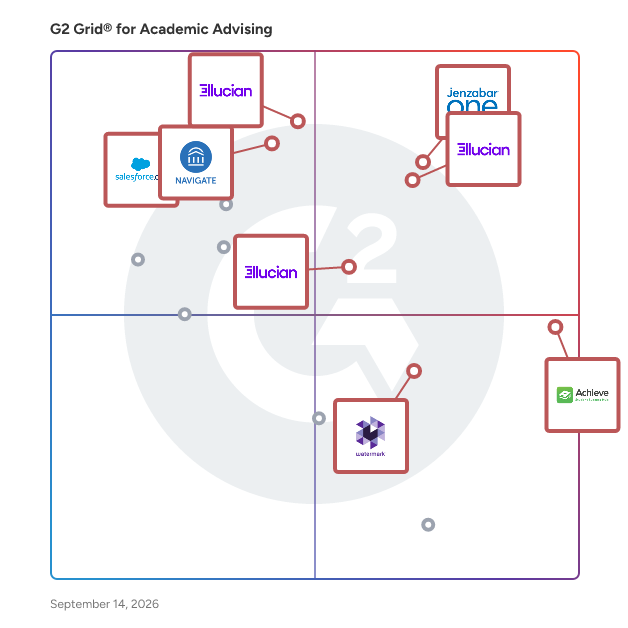
   Products classified in the overall Academic Advising category are similar in many regards and help companies of all sizes solve their business problems. However, enterprise business features, pricing, setup, and installation differ from businesses of other sizes, which is why we match buyers to the right Enterprise Business Academic Advising to fit their needs. Compare product ratings based on reviews from enterprise users or connect with one of G2&#39;s buying advisors to find the right solutions within the Enterprise Business Academic Advising category.

In addition to qualifying for inclusion in the Academic Advising Software category, to qualify for inclusion in the Enterprise Business Academic Advising Software category, a product must have at least 10 reviews left by a reviewer from an enterprise business.


## How Many Academic Advising Software Products Does G2 Track?
**Total Products under this Category:** 50

### Category Stats (Jun 2026)
- **Average Rating**: 4.14/5 The average rating of products in this category, based on all submitted ratings
- **New Reviews This Quarter**: 1
- **Buyer Segments**: Mid-Market 100% Represents the distribution of reviewers across all products in this category.
- **Top Trending Product**: Workday Student (+0.28%) - Among all products in this category, Workday Student recorded the largest rating increase compared to last month
*Last updated: June 04, 2026*

  
## How Does G2 Rank Academic Advising Software Products?

**Why You Can Trust G2's Software Rankings:**

- 30 Analysts and Data Experts
- 700+ Authentic Reviews
- 50+ Products
- Unbiased Rankings

G2's software rankings are built on verified user reviews, rigorous moderation, and a consistent research methodology maintained by a team of analysts and data experts. Each product is measured using the same transparent criteria, with no paid placement or vendor influence. While reviews reflect real user experiences, which can be subjective, they offer valuable insight into how software performs in the hands of professionals. Together, these inputs power the G2 Score, a standardized way to compare tools within every category.


  ## What Are the Top-Rated Academic Advising Software Products in 2026?
### 1. [Ellucian Student](https://www.g2.com/products/ellucian-student/reviews)
  Ellucian is the leading provider of higher education technology with a singular focus on the unique needs of colleges and universities. Their comprehensive, integrated ecosystem includes purpose-built solutions like Student Information Systems (SIS), Enterprise Resource Planning (ERP), and Customer Relationship Management (CRM) tools, all designed to put student success at the center. Ellucian’s AI-powered platform delivers predictive insights that help institutions proactively support students, optimize operations, and align programs with workforce needs. Built to scale and adapt, Ellucian’s solutions provide the flexibility that both small colleges and large universities need to navigate a rapidly changing higher education landscape, empowering them to drive outcomes that matter for students, faculty, and staff.


  **Average Rating:** 3.3/5.0
  **Total Reviews:** 260
**How Do G2 Users Rate Ellucian Student?**

- **Ease of Use:** 6.3/10 (Category avg: 8.2/10)
- **Quality of Support:** 7.0/10 (Category avg: 8.4/10)
- **Ease of Admin:** 7.1/10 (Category avg: 8.3/10)
- **Ease of Setup:** 6.6/10 (Category avg: 7.8/10)

**Who Is the Company Behind Ellucian Student?**

- **Seller:** [Ellucian](https://www.g2.com/sellers/ellucian)
- **Company Website:** https://www.ellucian.com
- **Year Founded:** 1968
- **HQ Location:** Reston, VA
- **Twitter:** @EllucianInc (6,159 Twitter followers)
- **LinkedIn® Page:** https://www.linkedin.com/company/2536305/ (4,302 employees on LinkedIn®)

**Who Uses This Product?**
  - **Top Industries:** Higher Education, Education Management
  - **Company Size:** 48% Mid-Market, 46% Enterprise


#### What Are Ellucian Student's Pros and Cons?

**Pros:**

- Centralized Information (1 reviews)
- Comprehensive Features (1 reviews)
- Customer Support (1 reviews)
- Ease of Access (1 reviews)
- Ease of Use (1 reviews)

**Cons:**

- Technical Issues (2 reviews)
- Access Limitations (1 reviews)
- Learning Difficulty (1 reviews)
- Poor Support (1 reviews)

### 2. [Achieve](https://www.g2.com/products/e2e-advising-achieve/reviews)
  Achieve - Student Success and Retention Platform. An end-to-end student service advising platform for higher education to recruit, retain, and graduate more students on time. Achieve offers a real-time two-way sync feature with Microsoft Outlook and Google Calendar, making scheduling appointments a breeze. Integrated self-check-in virtual or in-person kiosk for queue and case management. Meaningful analytics and insights with data visualizations that drive student success and retention decisions. Directly integrate with SIS systems (Banner, Colleague, or PeopleSoft), Canvas, D2L Brightspace, and Blackboard Learn—optional integration with Salesforce.


  **Average Rating:** 4.8/5.0
  **Total Reviews:** 57
**How Do G2 Users Rate Achieve?**

- **Ease of Use:** 9.6/10 (Category avg: 8.2/10)
- **Quality of Support:** 9.8/10 (Category avg: 8.4/10)
- **Ease of Admin:** 9.2/10 (Category avg: 8.3/10)
- **Ease of Setup:** 9.3/10 (Category avg: 7.8/10)

**Who Is the Company Behind Achieve?**

- **Seller:** [E2E Advising](https://www.g2.com/sellers/e2e-advising)
- **Year Founded:** 2012
- **HQ Location:** Bloomington, Indiana
- **Twitter:** @e2eadvising (27 Twitter followers)
- **LinkedIn® Page:** https://www.linkedin.com/company/e2e-advising-llc/ (1 employees on LinkedIn®)

**Who Uses This Product?**
  - **Top Industries:** Higher Education, Education Management
  - **Company Size:** 52% Mid-Market, 30% Enterprise


### 3. [Workday Student](https://www.g2.com/products/workday-student/reviews)
  Workday Student is an end-to-end student and faculty lifecycle information system that is designed to work seamlessly with Workday Financial Management, Workday Human Capital Management, Workday Payroll, and Workday Grants Management. It unites an entire campus under a single configurable, easy-to-use application that is delivered in the cloud.


  **Average Rating:** 4.0/5.0
  **Total Reviews:** 55
**How Do G2 Users Rate Workday Student?**

- **Ease of Use:** 8.1/10 (Category avg: 8.2/10)
- **Quality of Support:** 8.1/10 (Category avg: 8.4/10)
- **Ease of Admin:** 8.3/10 (Category avg: 8.3/10)
- **Ease of Setup:** 6.7/10 (Category avg: 7.8/10)

**Who Is the Company Behind Workday Student?**

- **Seller:** [Workday](https://www.g2.com/sellers/workday)
- **Year Founded:** 2005
- **HQ Location:** Pleasanton, CA
- **Twitter:** @Workday (52,305 Twitter followers)
- **LinkedIn® Page:** https://www.linkedin.com/company/17719/ (24,145 employees on LinkedIn®)
- **Ownership:** NYSE:WDAY

**Who Uses This Product?**
  - **Top Industries:** Higher Education, Education Management
  - **Company Size:** 47% Enterprise, 43% Mid-Market


### 4. [Anthology Beacon](https://www.g2.com/products/ellucian-anthology-beacon/reviews)
  The Campus Labs platform provides a centralized hub for a holistic view of your campus, so you can collect and connect your data and then explore the right questions.


  **Average Rating:** 3.2/5.0
  **Total Reviews:** 23
**How Do G2 Users Rate Anthology Beacon?**

- **Ease of Use:** 6.8/10 (Category avg: 8.2/10)
- **Quality of Support:** 8.0/10 (Category avg: 8.4/10)
- **Ease of Admin:** 7.7/10 (Category avg: 8.3/10)
- **Ease of Setup:** 5.6/10 (Category avg: 7.8/10)

**Who Is the Company Behind Anthology Beacon?**

- **Seller:** [Ellucian](https://www.g2.com/sellers/ellucian)
- **Year Founded:** 1968
- **HQ Location:** Reston, VA
- **Twitter:** @EllucianInc (6,159 Twitter followers)
- **LinkedIn® Page:** https://www.linkedin.com/company/2536305/ (4,302 employees on LinkedIn®)

**Who Uses This Product?**
  - **Top Industries:** Higher Education, Education Management
  - **Company Size:** 57% Enterprise, 30% Mid-Market


### 5. [PowerSchool Naviance CCLR](https://www.g2.com/products/powerschool-powerschool-naviance-cclr/reviews)
  PowerSchool Naviance is a comprehensive platform for college, career, and life readiness, empowering students to explore and plan for their futures.​


  **Average Rating:** 3.7/5.0
  **Total Reviews:** 36
**How Do G2 Users Rate PowerSchool Naviance CCLR?**

- **Ease of Use:** 7.6/10 (Category avg: 8.2/10)
- **Quality of Support:** 7.3/10 (Category avg: 8.4/10)
- **Ease of Admin:** 7.3/10 (Category avg: 8.3/10)
- **Ease of Setup:** 7.8/10 (Category avg: 7.8/10)

**Who Is the Company Behind PowerSchool Naviance CCLR?**

- **Seller:** [PowerSchool](https://www.g2.com/sellers/powerschool)
- **HQ Location:** Folsom, CA
- **Twitter:** @MyPowerSchool (12,150 Twitter followers)
- **LinkedIn® Page:** https://www.linkedin.com/company/10114126/ (3,365 employees on LinkedIn®)
- **Ownership:** NYSE: PWSC

**Who Uses This Product?**
  - **Top Industries:** Primary/Secondary Education, Education Management
  - **Company Size:** 39% Mid-Market, 37% Enterprise


    ## What Is Academic Advising Software?
  [Education Software](https://www.g2.com/categories/education)

  
---

## How Do You Choose the Right Academic Advising Software?

### What You Should Know About Academic Advising Software

### What is Academic Advising Software?

Academic advisors at any school want to provide the best service to students. However, this can be difficult when the number of students in an advisor’s caseload increases. Academic advising software empowers advisors to provide personalized support to students and allows them to monitor the progress of multiple advisees. Advisors can create comprehensive course plans for students and track their progress. When students fall behind, advisors can receive alerts that let them intervene and provide extra support to help students get back on track.

### Why Use Academic Advising Software?

Advisors at colleges and universities use academic advising software to promote student success and increase retention rates. Course-planning tools embedded in advising software allow advisors to collaborate with students. This encourages students and advisors to design a clear plan so students understand which courses they must complete to graduate on time. Students struggling with academics or finances might need to leave school; identifying those students early on is crucial to ensure they receive prompt support. Many academic advising software have analytics functions and online alerts built in. These functions enable counselors to automate some monitoring responsibilities necessary for their job.

At the high school level, academic advising software helps counselors guide students toward college or career paths that match their interests and strengths. Assessment tools within advising software can generate suggested majors or industries that might interest a student. Matching features provide a list of best-fit colleges for students, based on an individual’s academic record, location preferences, potential college majors, and other data points.

### Who Uses Academic Advising Software?

The primary users of academic advising technology are K-12 schools and higher education institutions.

**Advisors at colleges and universities —** Higher education institutions use academic advising software to offer guidance to students throughout their college careers and assist students who are falling behind.

**Advisors at K-12 schools —** Counseling at the high school level tends to focus on helping students explore their postsecondary options, including attending college or going into the workforce or other alternative training program.

**Students —** Students at all levels use tools in advising software to help them plan for their future goals. A student might use a degree-planning tool to lay out a long-term course sequence or take a quiz that indicates which colleges or careers would be a good fit.

**Faculty —** Some advising tools allow teachers and professors to have direct involvement in the advising process. High school teachers can use software to organize and submit letters of recommendation for students. College professors can leave notes about students they are concerned about or connect with advisors to coordinate support across departments.

### Academic Advising Software Features

Many academic advising software products contain some or all of the following features:

**Appointment scheduling —** Most advising software products contain an online scheduling tool that allows students to book appointments with their advisors. University staff members help set up appointments with students. Some tools sync these appointments to a student or advisor’s [personal calendar](https://www.g2.com/categories/calendar).

**Course planning —** Students can build customized degree plans that align with their goals and schedule, with the assistance of their advisor. Administrators can define university requirements for each program within the software so students know if their plan leaves out any essential courses.

**Schedule simulators —** Students considering changing their major can use what if functions in academic advising tools to visualize the impacts of a potential change before making any final decisions.

**Advisor dashboard —** Academic advising software typically offers dynamic dashboards that show updated information about a student’s progress. Advisors using these online portals can see notes from students, academic progress reports, contacts the student has had with different departments, and other information on a single screen.

**Note-taking —** Collaborative note-taking tools allow advisors, faculty, tutors and other staff members to record notes about interactions with students or log concerns about a student’s progress and view notes that others have left.

**Predictive analytics —** Computer modeling built into some academic advising software can leverage data from different campus departments to identify at-risk students—both individuals and groups—so counselors know which students need additional support. This predictive modeling technology is often custom-built for each college or university, based on factors unique to each campus.

**Automated alerts —** Advisors can configure software tools to automatically notify them about concerning developments for students on their caseload, such as a student repeatedly missing classes or getting poor grades in a given academic term. These alerts can be sent to students directly, letting them know they’re off track and connecting them with resources for extra help.

**Messaging —** Both individual and group messaging functions allow advisors to reach out to students between meetings. Messaging features in mobile apps allow students to easily contact their counselors.

**Assessments —** Some advising tools have integrated tests for students to help them explore which major to pursue, which careers might be right for them, what their strengths are, or which colleges could be a good fit.

**College matching —** Advising tools for high school guidance counselors can combine multiple student data points such as GPA, test scores, college major preferences, and personal interests, to generate a list of schools for a student to consider.

### Trends Related to Academic Advising Software

**Use of analytics —** Businesses have increasingly used predictive modeling and [machine learning software](https://www.g2.com/categories/machine-learning) to achieve strategic goals and gain insights into future outcomes. Those same technologies are making their way to college advising offices, as modern advising software products enable administrators to proactively flag struggling students. That intelligence can give staff a chance to intervene and help at-risk students before they fall behind.

**Customization —** Vendors are giving administrators at colleges and universities greater freedom to configure academic advising tools to meet the needs of their campus. Predictive modeling algorithms can be customized to analyze what factors are most important to each institution’s goals. Advisors can adjust dashboards to track student progress and display different combinations of data. Academic requirements can be adjusted to match changes made by top administrators. Customization allows institutions to make the tool fit their unique needs.

**Mobile device integrations —** Developers have built mobile integrations directly into their software as most college students use smartphones. Students can use phone apps or mobile-friendly websites to take assessments, communicate with advisors, and book appointments.

### Potential Issues with Academic Advising Software

**Student profiling —** While predictive modeling is a powerful tool, it also has the potential to have negative impacts on certain student demographic groups if not implemented carefully. A computer algorithm that takes demographic data into account might consider students from historically underrepresented groups to be more “at risk&quot; than other students. Consequently, this system might discourage, for example, a student of color from pursuing a more challenging college major, or may be more sensitive if they are doing poorly in a class. Advisors must be cognizant of the potential for bias in predictive analytics and should use these tools thoughtfully to avoid unintentionally discouraging students and limiting their potential.

**Data privacy —** Colleges and universities must properly secure the sensitive data that academic advising software relies upon, such as students’ academic records and students’ demographic information. This becomes more important when institutions share this data with third-party software companies. Students should be well-informed about what data their school is collecting and how it is used. Handling student data improperly could put institutions at risk of violating federal student privacy laws.

**Adequate staffing —** Despite the potential of academic advising software to streamline advising operations, these tools are not a substitute for human advisors. Advisors are often responsible for hundreds of students. Educational institutions must prioritize staffing so advisors have the capacity to meet one-on-one with students and the bandwidth to respond promptly to student needs.

### Software and Services Related to Academic Advising Software

Academic advising software often integrates with [student information systems](https://www.g2.com/categories/student-information-systems-sis), allowing advisors to access grade book data and demographic information. These products may also pull data from [financial aid platforms](https://www.g2.com/categories/financial-aid-management) to give advisors a complete picture of a student’s financial situation.


