
Sudipto Paul
Sudipto Paul leads the SEO content team at G2 in India. He focuses on shaping SEO content strategies that drive high-intent traffic and ensure your brand is front-and-center as LLMs change the way buyers discover software. He also tests and evaluates software products, translating first-hand experience into content that guides buyers toward the right solutions. He runs Content Strategy Insider, a newsletter where he regularly breaks down his insights on content and search. Want to connect? Say hi to him on LinkedIn.
What are consumables?
Consumables are non-durable goods intended for immediate or short-term use and require frequent replacement.
Businesses or individuals typically use up or transform these products, which is why consumables need recurring replacements. Some manufacturers also use consumables like chemicals, semiconductor wafers, welding rods, and electrodes as components of end products.
Disposable consumables are those that people only use once. Examples include single-use batteries or hygiene products. Warranty policies don’t cover consumable goods, as insuring them would raise premiums excessively.
Production-focused companies use inventory control software to track stock levels, monitor usage patterns, forecast demand, and automate replenishment. These tools help ensure critical consumables are always available while minimizing waste and optimizing operational efficiency.
TL;DR: Consumables definition, types, and examples
Consumables are short-life, non-durable goods that individuals or businesses use up quickly and need to replace regularly. Examples include food, office supplies, and medical items. They differ from durable goods, which last longer and retain value over time.


What are the different types of consumables?
Consumables are broadly categorized into essential consumer staples (everyday necessities with steady demand) and non-essential consumer discretionary items (spending that fluctuates with economic conditions).
Consumer staples refer to essential goods that consumers use regardless of their financial situation. Common examples include foods and beverages, hygiene products, and household items. Year-round demand exists for these non-cyclical consumables.
The consumer staple sector is heaven for investors looking for equity financing opportunities because people purchase clothes, groceries, and gas regardless of the state of the economy. Consumer staples stocks are less volatile and offer solid dividends.
Consumer discretionary items are non-essential goods and services. Common examples include high-end products, big ticket items, leisure activities, automobiles, expensive apparel, and durable goods. These consumable suppliers are known as consumer discretionaries or consumer cyclicals.
Consumers avoid these discretionary items and spend more on staples during the contractionary phase of an economy.
Financial institutions closely monitor consumer spending patterns to identify potential inflation and economic shifts. High inflation lowers the income that people spend on discretionary items.
What are the key characteristics of consumables?
Consumables are short-lived, non-durable items that are quickly used up and need frequent replacement. They are vital for daily operational needs in various industries, usually inexpensive, disposable, and often regulated by specific quality standards based on their purpose.
| Key characteristics | Description |
| Limited lifespan (short-term use) | Used up quickly or discarded after one or a few uses (e.g., toner, masks, pipette tips) |
| High turnover and frequent replacement | Require continuous replenishment due to regular use (e.g., paper, gloves, syringes) |
| Essential for operations | Support processes or equipment functionality (e.g., welding wire, lab vials) |
| Specific quality requirements | Must meet standards like sterility or precision in certain industries |
| Cost-efficient and disposable | Low-cost per unit and designed for convenience or hygiene |
What are some common examples of consumables?
Consumables vary across industries, from construction and healthcare to retail and hospitality, and include everyday, disposable items used to support operations and services.
- Construction consumables refer to items that construction workers use to execute work. Examples include tape, welding rods, glue, electrodes, utilities, petroleum, oil, and lubricants (POLs).
- Discount grocery consumables offer lower prices to attract customers and beat the competition. For example, grocery supply companies and modern trade stores use discounts to sell more fast-moving consumer goods (FMCGs).
- Medical consumables are disposable items that medical practitioners use while diagnosing diseases and injuries. Examples include gloves, bandages, dental crowns, orthodontic wires, implants, and biomaterials.
- Cleanroom consumables include clothes, wipes, sterile coveralls, facemasks, shoe covers, mops, cleaning products, gloves, maintenance supplies, and swabs. Nanotechnologists, research labs, and pharmaceutical industries use these items to prevent contamination and clean products.
- Hospitality consumables are items that hotels, resorts, and restaurants stock to offer a hassle-free customer experience. Examples include bath foam, conditioner, lotion, hand wash, shampoo, and insect repellent.
How are consumables and durable goods different?
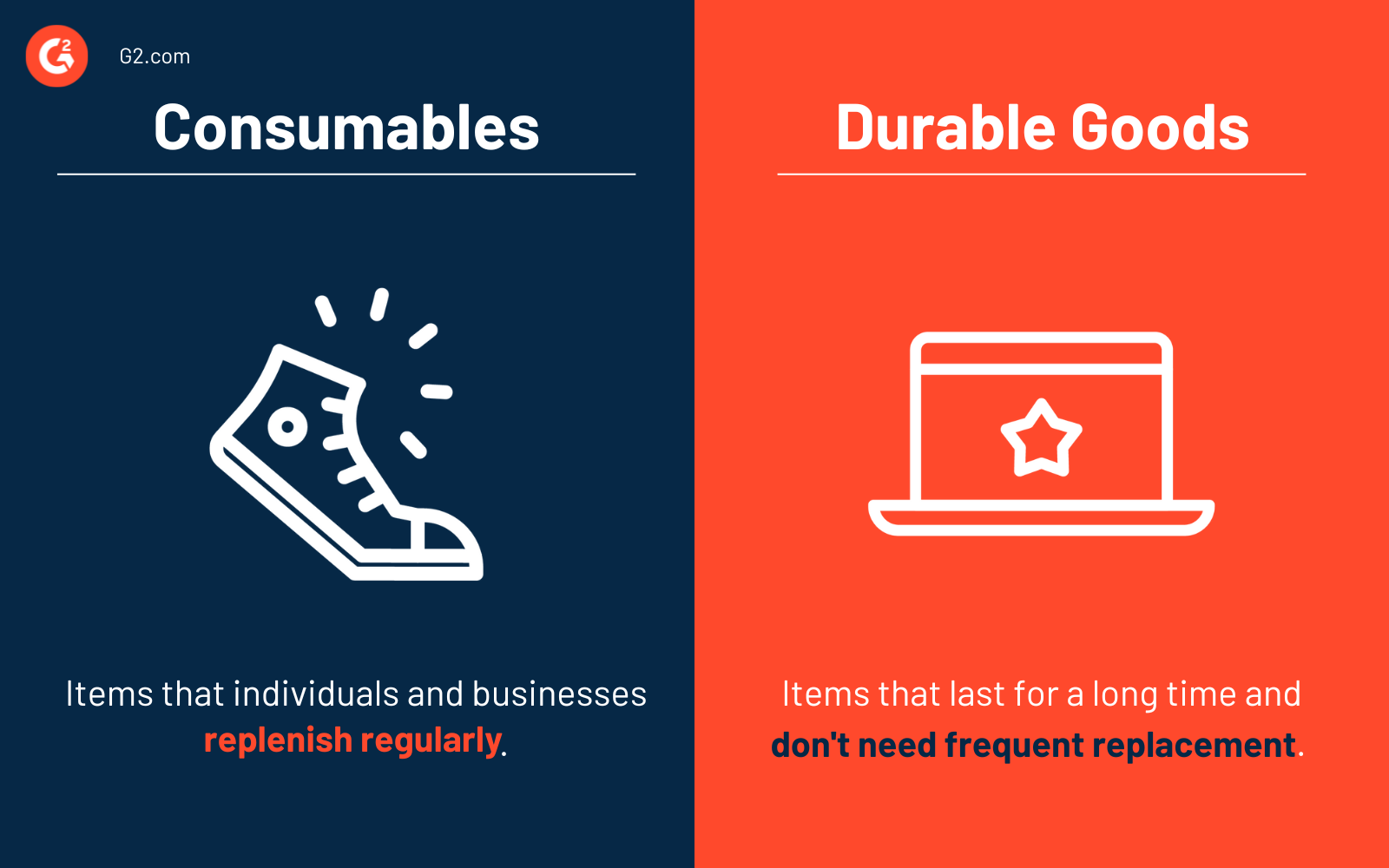
Consumables are goods that are used up quickly and need frequent replacement, whereas durable goods are long-lasting items that can be used repeatedly over time.
| Feature | Consumables | Durable goods |
| Lifespan | Short-term | Long-term |
| Usage | Used up quickly | Used repeatedly |
| Replacement | Frequent | Infrequent |
| Examples | Food, paper, gloves | Appliances, vehicles, tools |
Relevant economics and market theory resources
Frequently asked questions about consumables
Here are the frequently asked questions about consumables.
Q1. Are consumables always disposable?
Not always. While many consumables are single-use (e.g., gloves, batteries), others may last briefly before depletion. However, most are not covered under warranties due to their short lifespan.
Q2. Are consumables considered expenses?
Yes. Once used, consumables are recorded as operating expenses in financial statements.
Q3. What is the difference between consumables and supplies?
Consumables are a type of supply that gets used up quickly. Supplies may include both consumable and non-consumable items.
Q4. Why don’t warranties cover consumables?
Because consumables are expected to be used up quickly, covering them would significantly increase warranty costs.
Q5. Are consumables assets?
Initially, yes (as supplies). After use, they are expensed.
Q6. How are consumables accounted for?
Businesses buying consumable goods use accounting software to record these items as supplies on hand on the balance sheet. Once they count the supplies on hand at the end of a financial year, they use adjusting entries to record used items as expenses in the income statement.
Find the best inventory management software, backed by real user reviews.


