









What is performance benchmarking?
Performance benchmarking is the process of measuring and comparing an organization’s products, services, processes, or operational metrics against competitors or established industry standards to identify performance gaps and improvement opportunities. It enables businesses to evaluate key performance indicators (KPIs), efficiency, quality, and customer outcomes to drive data-informed decision-making and continuous improvement.
Many businesses use corporate performance management (CPM) software to monitor their business activities’ performance. Performance benchmarking allows them to see how their business pans out against competitors or best-in-class industry standards.
TL;DR: performance benchmarking definition explained
Performance benchmarking helps organizations identify gaps, adopt best practices, and improve operational efficiency by comparing internal and external metrics. It includes strategic and competitive benchmarking types, follows a structured 5-step process, and supports smarter decision-making through continuous performance evaluation and optimization.


What are the types of performance benchmarking?
The main types of performance benchmarking include internal and external benchmarking. Organizations use these methods to compare performance metrics, key performance indicators (KPIs), processes, and strategies against competitors, industry standards, or past performance data to drive continuous improvement.
Strategic benchmarking
Strategic benchmarking is the process of comparing an organization’s long-term strategies, business models, and core competencies against top-performing companies to identify opportunities for strategic improvement.
Unlike short-term performance comparisons, it focuses on evaluating high-level approaches such as innovation, market positioning, and product development. Strategic benchmarking helps businesses adopt best practices and strengthen their long-term growth and competitive advantage.
Competitive benchmarking
Competitive benchmarking evaluates a company’s products, services, and operational performance against direct competitors to identify performance gaps and industry standards. By analyzing competitor processes, pricing, features, and service quality, businesses can determine their market position and uncover areas for improvement.
Both strategic and competitive benchmarking are types of external benchmarking processes. Below are a few other external benchmarking examples to help businesses learn and improve.
- Collaborative benchmarking: Partnering with industry associations or peer organizations to share data and conduct comparative performance analysis.
- Process benchmarking: Comparing workflows, operational methods, and procedures to identify best practices and efficiency improvements.
- Product benchmarking: Evaluating product features, functionality, quality, and pricing against competing offerings.
Internal benchmarking
Internal benchmarking enables companies to assess and compare their performance metrics over a period. This helps decide the steps to enhance business performance, effectiveness, and efficiency. Internal benchmarking is relatively easier since a company has access to its own data, allowing a business to enhance and modify its processes.
Because it relies on internal data, it is easier to implement and helps businesses identify performance gaps, optimize workflows, and support continuous improvement. However, it may limit innovation since comparisons are confined to internal standards rather than external best practices.
Businesses perform various types of internal performance benchmarking, including:
- SWOT Analysis. Businesses list their strengths, weaknesses, opportunities, and threats (SWOT) to analyze and gain insight into where and how to improve. Many companies use strategic planning software to perform these analyses.
- Financial benchmarking. Companies compare financial performance against forecasts to take corrective action and further improve their financial operations.
- Performance metrics. Assessing internal KPIs and customer-focused metrics to identify gaps and enhance service quality.
What is the 5-step performance benchmarking process?
The performance benchmarking process follows 5 structured steps that help organizations systematically evaluate and improve their performance. From planning and analysis to implementation and maturity, each stage ensures data-driven decisions and long-term strategic improvement.
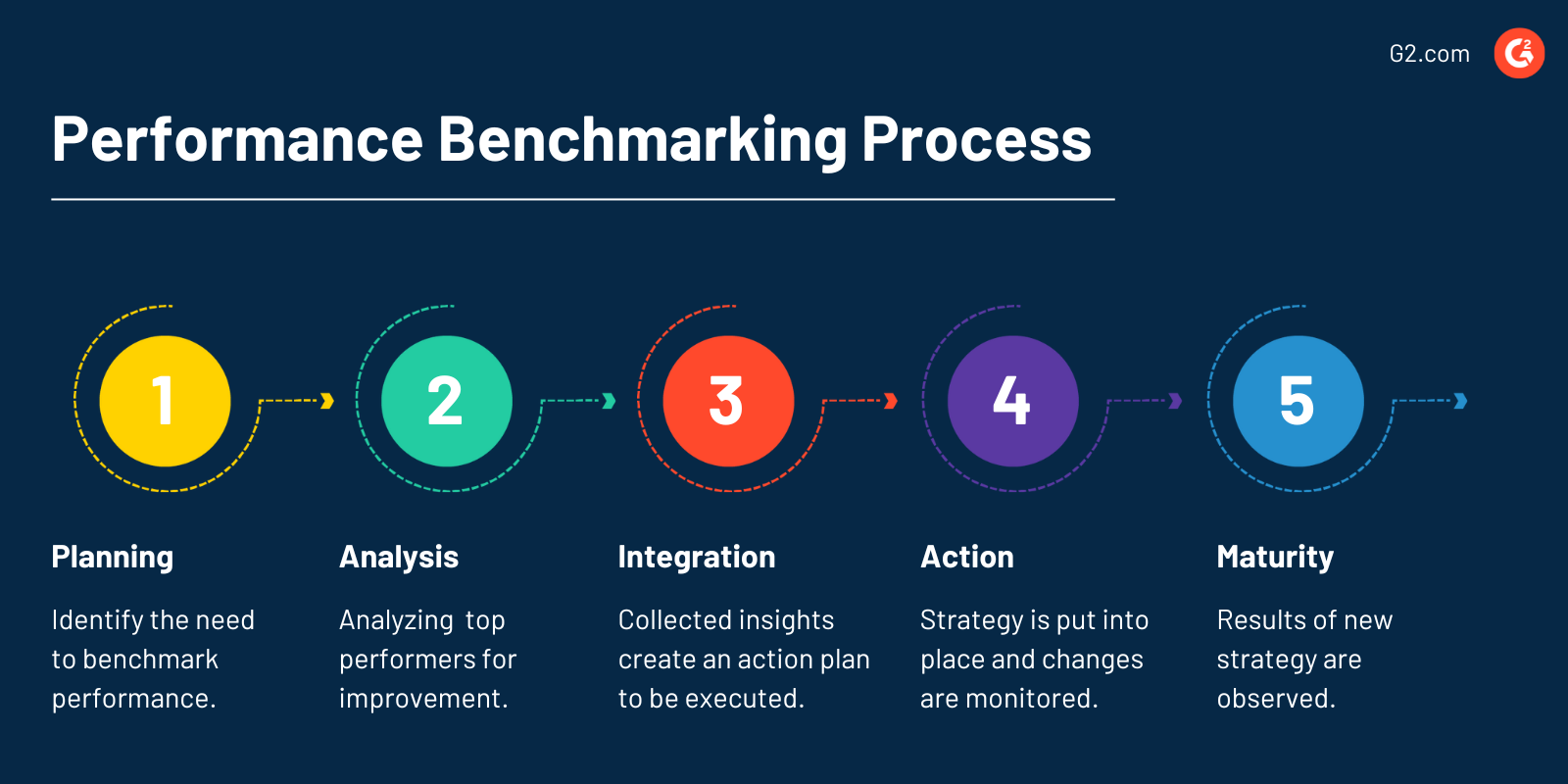
- Planning: Performance managers identify the need to benchmark performance at this stage and list competitors, processes, products, or services to analyze.
- Analysis: Next, they start analyzing their competitors or top-performers to find areas for improvement. It helps them understand their competitors’ strengths and weaknesses and align their strategies accordingly.
- Integration: Analysts report these insights to the senior leadership team with an action plan. The action plan and new strategies are executed once the management approves them.
- Action: Performance managers implement and execute the revamped strategy and monitor performance changes.
- Maturity: They observe new results from the revamped strategy. These results are likely to be better when performance benchmarking is done appropriately.
What are the benefits of performance benchmarking?
Performance benchmarking helps organizations identify performance gaps, adopt best practices, improve operational efficiency, and strengthen competitive advantage.
The key benefits include:
- Technology and process upgrades: Benchmarking highlights areas where new tools, automation, or system improvements can optimize productivity and modernize the tech stack.
- Standardization and scalability: Establishing performance benchmarks helps organizations define standard operating procedures (SOPs), product specifications, and service quality standards that support consistent growth.
- Greater efficiency and accuracy: Refining processes based on benchmark data reduces inefficiencies, minimizes errors, and improves overall operational effectiveness.
- Enhanced customer satisfaction: Evaluating metrics such as customer feedback, retention rates, and Net Promoter Score (NPS) enables businesses to improve service quality, strengthen customer experience, and build long-term loyalty.
What are performance benchmarking best practices?
Effective performance benchmarking requires clear objectives, structured timelines, relevant comparison groups, cross-industry insights, and continuous operational improvement. Following best practices ensures benchmarking efforts produce accurate, actionable insights rather than surface-level comparisons.
Key best practices include:
- Start early and define objectives: Identify performance gaps and improvement areas early by aligning benchmarking goals with business strategy and key performance indicators (KPIs).
- Select a relevant comparison group: Choose competitors or organizations with similar business models, market size, geographic presence, or product categories to ensure meaningful comparisons.
- Look beyond your industry: Analyze best practices from other industries facing similar operational challenges to uncover innovative solutions and efficiency gains.
- Prioritize operational improvement: Use benchmarking insights to refine processes, optimize workflows, enhance service quality, and strengthen overall business performance.
Frequently asked questions for performance benchmarking
Have unanswered questions? Let’s tackle them.
Q1. How do you perform benchmarking?
To perform benchmarking, organizations identify key performance metrics, collect reliable data, compare results against competitors or industry standards, and implement improvements based on identified gaps. The process typically includes defining objectives, selecting benchmarks, ensuring data quality, analyzing performance differences, and applying best practices.
Q2.What are performance metrics?
Performance metrics are measurable indicators used to evaluate the efficiency, effectiveness, and success of a business process, product, or strategy. These metrics may include revenue growth, customer retention rate, Net Promoter Score (NPS), operational efficiency, or system performance. Accurate benchmarking depends on strong data quality, as unreliable data can distort insights and lead to poor decision-making. Some organizations adopt a human-in-the-loop model to review automated analytics outputs and reduce the risk of biased or misleading results.
Q3. What is the difference between a KPI and a benchmark?
A KPI (key performance indicator) measures how well a business achieves a specific objective, while a benchmark is a reference point used to compare performance against industry standards or competitors. In simple terms, KPIs track internal performance, and benchmarks provide external or historical comparison. Organizations often use both together to evaluate progress, improve strategy, and maintain competitive positioning.
Q4. How do you check benchmark performance?
Benchmark performance is checked by comparing actual results against predefined standards, competitor data, or industry averages. This involves analyzing performance metrics, identifying performance gaps, and reviewing trends over time. Many organizations use analytics tools and dashboards, often overseen by a knowledge architect or data specialist, to ensure insights are accurate, unbiased, and aligned with business goals.
Q5. What are some examples of benchmarks?
Examples of benchmarks include industry-average customer retention rates, competitor pricing models, production cost per unit, system uptime percentages, and Net Promoter Score (NPS) standards. In digital environments, benchmarks may also include website load speed, conversion rates, or customer sentiment analysis scores. These reference points help organizations measure success and guide continuous improvement.
Explore top-rated performance management and benchmarking software to track KPIs, compare industry standards, and drive continuous improvement with confidence.

Sagar Joshi
Sagar Joshi is a former content marketing specialist at G2 in India. He is an engineer with a keen interest in data analytics and cybersecurity. He writes about topics related to them. You can find him reading books, learning a new language, or playing pool in his free time.


