Best Distribution ERP Software - Page 11

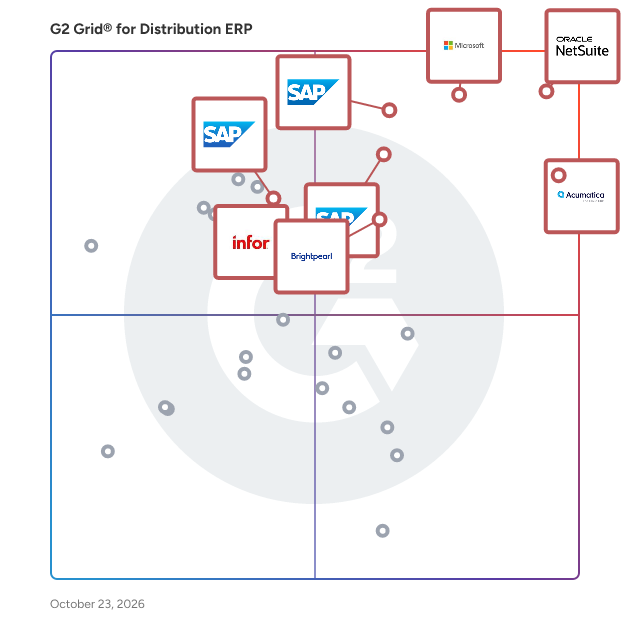
How Many Distribution ERP Software Products Does G2 Track?

Total Products under this Category: 180

Category Stats (Jul 2026)

  • Average Rating: 4.22/5 The average rating of products in this category, based on all submitted ratings
  • Top Trending Product: CBOS Cloud ERP (+5.56%) - Among all products in this category, CBOS Cloud ERP recorded the largest rating increase compared to last month

Last updated: July 01, 2026

How Does G2 Rank Distribution ERP Software Products?

Why You Can Trust G2's Software Rankings:

  • 30 Analysts and Data Experts
  • 11,800+ Authentic Reviews
  • 180+ Products
  • Unbiased Rankings

G2's software rankings are built on verified user reviews, rigorous moderation, and a consistent research methodology maintained by a team of analysts and data experts. Each product is measured using the same transparent criteria, with no paid placement or vendor influence. While reviews reflect real user experiences, which can be subjective, they offer valuable insight into how software performs in the hands of professionals. Together, these inputs power the G2 Score, a standardized way to compare tools within every category.

Product Description

PAX ERP is a cloud-based ERP and CRM platform built specifically for small manufacturing companies. It was developed inside a medical device manufacturing facility by a team that needed a better system for their own operation and couldn't find one at a reasonable price. The result is a modern, full-featured platform designed for manufacturers with 5 to 50 employees who need production planning, inventory management, financial reporting, and customer management in a single system. PAX combines core ERP functionality with an integrated CRM, eliminating the need to run separate systems for manufacturing operations and sales management. On the ERP side, the platform covers production planning with MRP, bill of materials management, lot and expiration tracking, inventory control with automated reorder points, purchasing, GAAP-compliant financial reporting, shipping integration with FedEx and UPS label generation, and e-commerce synchronization. Real-time dashboards provide visibility into shop floor performance, inventory levels, and financial data. The interface is touchscreen-friendly, designed to be used by operators on the production floor (not just office staff). The built-in CRM manages the full customer lifecycle from first contact through repeat orders. Features include prospect and lead management, opportunity tracking with probability-weighted revenue forecasting, quote generation with one-click conversion to sales orders, activity logging for calls and meetings, task management, email templates, and customer segmentation. Because the CRM shares data with the ERP, sales teams have visibility into production status, inventory availability, and order history without switching between platforms. PAX is designed for small manufacturers with simple to moderate bills of materials and straightforward production workflows. It is well suited for industries such as medical devices, consumer packaged goods, electronics assembly, cosmetics, supplements, and light industrial manufacturing. The platform is not intended for large enterprises, highly complex multi-level BOMs, or manufacturers requiring deep industry-specific compliance modules such as AS9100 or IATF 16949. Implementation is measured in days, not months. PAX handles data migration at no additional cost in most cases, and the system does not require consultants or extensive IT resources to deploy. Pricing is transparent and published, with plans starting at $200 per month (significantly below the cost of most comparable manufacturing ERP systems). A free trial is available for teams who want to test run the system. Thanks for reading about PAX ERP + CRM. If you would like to learn more, please visit our website.

Product Description

Peritus Financial & Inventory Management (known as PFIM) provides a complete business management solution

G2 Advertising
Sponsored
G2 Advertising
Get 2x conversion than Google Ads with G2 Advertising!
G2 Advertising places your product in premium positions on high-traffic pages and on targeted competitor pages to reach buyers at key comparison moments.

Product Description

Qdos specialises in cloud software for retailers, wholesalers and franchises. The Qdos cloud suite of products integrates business processes onto one centralised platform delivering:

Product Description

The R4 Enterprise ERP software aligns customer demand with supply. Give your company the ability to deliver to customers on time, all the time. The R4 Enterprise System operates in a truly open environment with mainstream operating systems, such as Windows and Unix’s various flavors (Aix, SCO, HP-UX, Linux, etc. ). The application runs on any popular hardware platform, including IBM, DELL, HP, SUN, etc. Royal 4 Systems has hundreds of installations on 6 continents, including the US, Latin America, Canada, Australia, Europe, and Africa.

Product Description

RouteMagic is a B2B last-mile sales and distribution platform that digitises, controls, and manages every aspect of wholesalers, manufacturers, and distributors doing van sales and/or wholesale delivery. We offer a single product for the entire order-to-cash cycle. It offers features such as real-time insights, fast order fulfillment, effective pricing and promotions, efficient inventory management, excellent route planning and monitoring, enhanced customer experience, complete business control, paperless fulfillment, use of the latest technologies, increased sales, and optimised accounting. Our platform also comes with a mobile app for field staff, that allows them to manage van stock, utilise mobile invoicing, provide real-time customer insights, and much more. Getting started with RouteMagic is fast and easy. Our platform is incredibly user-friendly and can be up and running in under a week. Additionally, our subscription-based model is incredibly affordable – costing less than your daily cup of coffee! To top it all off, RouteMagic is completely customizable, allowing you to tailor it to your specific business needs. With more than 90 customers in 6 countries, RouteMagic helps companies in food service, food-to-go, fresh produce, fresh meat, fruit & vegetables, snacks & confectionery, automotive aftermarket, construction & building materials, FMCG, and pharmaceuticals sectors get better business control and greater operational visibility. To know more, reach us at sales@routemagic.co.uk or visit our website: www.routemagic.co.uk.

Product Description

RSA eBusiness Solutions is a Supply Chain, Service Billing and Financial Management solution available in two flavours, a traditional Server based solution or from the Cloud.

Product Description

Savance Enterprise is an integrated solution that helps wholesale distributors streamline business operations related to accounting, sales, purchasing, inventory and more. It enables users to automatically add customer/vendor contacts in an in-built database and view quoting or purchasing history on a centralized platform. Features of Savance Enterprise include invoicing, returns management, barcode scanning, electronic signature capture, regulatory compliance, payment processing and more. Users can utilize the administrative dashboard to track the performance of sales representatives and export generated reports in PDF, Excel or CSV format. Additionally, it allows organizations to send automated reminders to prospects through alerts/notifications, facilitating follow-up processes. Savance Enterprise offers integration with various third-party applications such as Authorize.net, IDEA, MITS, RingCentral and more. Pricing is available on monthly subscriptions and support is extended via email, phone, live chat and other online measures.

Product Description

Scopevisio is a cloud-based corporate software for forward-thinking businesses. Manage and organize your entire business in Scopevisio! Digitize and automate business processes to save time, costs, and effort! You assemble the software individually to meet your requirements. An expansion is possible at any time because Scopevisio is scalable and grows as your company does. • Organization: contacts, tasks, activities, time recording, travel recording • DMS/ECM: data archiving, versioning, eCollaboration, end-to-end text search • Sales: campaigns, leads, sales projects, quotes, forecast • Human Resources: Wage & Salary, Payroll, Evaluation • Procurement: materials and inventory management, ordering, purchasing, stocktaking • Finance: GoBD-compliant accounting, payment runs, banking, cash registers, BI integration. Easily integrate third-party solutions via the Scopevisio interface (OpenScope). So, you can leverage existing solutions and centrally manage all business data via Scopevisio. Scopevisio links all business disciplines in only one tool, bringing more speed to your processes and boosting your growth.

Product Description

What is SDX? | AI-Powered CPG Sales, Distribution & Logistics Software SDX (Sales, Distribution, and eXecution) is an AI-driven, cloud-based SaaS solution designed to optimize sales automation, distribution management, and logistics for the Consumer-Packaged Goods (CPG) industry. As an end-to-end CPG software, SDX helps companies streamline order management, trade promotions, CRM, inventory control, and B2B e-commerce—all from a single, fully integrated platform. 🚀 Why Choose SDX? ✔ Unified Sales & Distribution Management – Automate pre-sales, direct sales (XVan), order fulfillment, and route planning. ✔ AI-Powered Analytics & Reporting – Gain real-time business intelligence, predictive insights, and performance tracking. ✔ Advanced Inventory & Logistics Optimization – Monitor stock levels, demand forecasting, and warehouse operations. ✔ Trade Promotions & CRM – Manage customer relationships, promotional campaigns, and contract workflows. ✔ B2B E-Commerce & Self-Service – Empower customers with online ordering, digital payments, and account management. ✔ Mobile & Cloud-Based – Access field sales tools, offline functionality, and ERP integrations anytime, anywhere. Who Benefits from SDX? 🔹 CPG Manufacturers & Distributors – Gain real-time visibility and control over supply chain and distribution networks. 🔹 Retailers & Wholesalers – Improve order processing, trade promotions, and customer engagement. 🔹 E-Commerce & B2B Businesses – Enable seamless digital transformation and self-service capabilities. 🔎 Why SDX is the Best CPG Software on G2? 💰 Cost-Effective: Starts at $85/user/year, making it the most affordable CPG SaaS platform. ⚡ Faster Implementation: Deploy 3X faster than traditional ERP-based solutions. 📊 AI-Driven Optimization: Reduces manual workload with automation, machine learning, and route optimization. Discover why leading CPG brands trust SDX to optimize sales, distribution, and logistics. Request a free demo today at https://nordstar.xyz/contact-us

Product Description

Semilla is a business digitization platform that offers industry-specific solutions: ERP for distribution (Semilla Logística), a management system for clinics with medical records, scheduling, and odontograms (Semilla Salud), and e-commerce and website development. Its key differentiator is its support: strategic consulting, customized implementation, ongoing training, and dedicated assistance. More than 50 companies have been digitized since 2019.

Product Description

SeniorERP includes specific modules for managing activities of distribution, manufacturing, services and retail and can be extended with specialized software solutions such as: CRM, Business Intelligence, SFA, WMS, E-commerce and so on.

Product Description

Sigma ERP provides the leading Salesforce solutions, cloud based IT consulting, QA Automation, Desktop Apps, mobile App(IOS/Android) & Web Development..

Product Description

Simplisales is a B2B wholesale commerce platform that enables wholesalers and distributors to manage orders, inventory, customers, and sales operations from a single integrated system. The platform combines a central Dashboard with customer-facing storefronts, field sales tools, and AI-powered order automation to digitize wholesale operations without requiring dedicated IT resources. Simplisales is designed for small and medium-sized wholesalers and distributors, particularly those in food, beverage, and consumer goods sectors with 10-200 employees. The platform addresses a common challenge in wholesale: orders arriving through fragmented channels such as phone calls, WhatsApp messages, emailed spreadsheets, and handwritten lists that require manual entry into disconnected systems. The platform consists of five integrated modules: Dashboard: The central operations hub for inventory management, order processing, customer relationship management, invoicing, and accounting. Supports customer-specific pricing, custom product catalogues, bulk order editing, and multi-warehouse operations. eCommerce Storefronts: White-label native iOS and Android mobile apps plus a responsive website that deploy under your own branding. Customers can browse products, view their specific pricing, check real-time stock availability, and place orders around the clock. Field Sales App: A dedicated mobile application for sales representatives that provides access to customer information, order history, and pricing while in the field. Reps can create orders, apply discounts, process returns, and capture signatures on location. Analytics: Reporting and business intelligence tools that transform operational data into insights on sales trends, customer behavior, inventory turnover, and demand forecasting. Marketing Suite: Customer engagement tools including WhatsApp Business integration and email campaigns, with automation triggers based on order history and customer activity. AI-driven order capture: Simplisales uses machine learning to extract order information from unstructured inputs including WhatsApp messages, emails, uploaded PDFs, images of handwritten orders, and spreadsheets. The system creates draft orders for review, reducing manual data entry. The platform integrates with over 30 ERP and accounting systems including Microsoft Dynamics, SAP, Sage, Oracle NetSuite, Xero, and QuickBooks, enabling real-time synchronization of products, inventory, pricing, and orders. Simplisales can operate as a standalone system or as a commerce layer that extends existing ERP infrastructure. Founded in 2021 and headquartered in London, Simplisales was recognized as an IDC Innovator in 2025 for its approach to B2B wholesale commerce.

Product Description

SITIC ERP is the only enterprise resource planning system built from the ground up for heavy equipment dealers, distributors, and service workshops. Since 1997, SITIC has unified service workshop, parts inventory, unit sales, floor plan financing, manufacturer warranty management, and multi-branch operations in a single platform — purpose-built for this industry, never adapted from a generic solution. Trusted by Kenworth and DAF concessionaires across Mexico and Latin America.

Product Description

Sowaan ERP is a leading organization that specializes in providing ERP services to businesses in Saudi Arabia, UAE, and Oman. With a strong focus on delivering top-quality solutions, Sowaan ERP has helped numerous businesses optimize their operations and streamline their workflows.

Nathan Calabrese
NC
Researched and written by Nathan Calabrese
Updated October 3, 2024

How Do You Choose the Right Distribution ERP Software?

What You Should Know About Distribution ERP Software

What is Distribution ERP Software?

Distribution enterprise resource planning (ERP) software provides distributors and wholesalers with comprehensive solutions for all tasks involved with distributing goods. This management system includes fleet management, warehouse management, inventory control, marketing, shipping, and customer relationship management (CRM). Rather than installing individual software for each step in the distribution supply chain, distribution ERP software provides functionality for all distribution processes by streamlining them using one single platform.

A distribution business (also known as a wholesale distribution) buys finished products from manufacturers and sells them to other companies or individuals. Some distribution companies may also acquire finished goods, which they sell to manufacturers. To help these companies, a distribution ERP software provides a central repository to manage all processes involved with distribution, helps maintain better relationships with customers, and allows users to analyze their operations' financial and operational performance accurately.

What Types of Distribution ERP Software Exist?

There are a few major types of ERP solutions for distribution:

Cloud or on-premises

Cloud ERP is slowly replacing legacy systems delivered on premises, and distribution ERP is no exception to the rule. There are two types of cloud ERP solutions for distribution—traditional on-premises software that have been modernized and moved to the cloud, and cloud-native products that are only available as a subscription model (or software as a service (SaaS)).

Industry agnostic or vertical-focused

The wholesale distribution sector covers multiple industries from manufacturing and retail to construction and minerals. Each of these industries requires special transportation and storage conditioning. For instance, food distribution relies on refrigerated trucks and warehouses, while chemical distribution requires protection from potentially dangerous hazardous materials. A distribution ERP solution for food and beverage companies should provide features to manage expiry dates and sales in bulk or batches (as opposed to pieces and units for discrete products). 

Standalone or part of ERP systems

While some ERP solutions focus exclusively on distribution, ERP for manufacturing software also provides features for logistics. Manufacturers who need advanced logistics features would benefit more from using ERP systems such as discrete ERP, ETO ERP, and mixed mode ERP.

What are the Common Features of Distribution ERP Software?

An ERP system dedicated to distribution is built to serve every business function involved in the distribution process. As such, distribution ERP systems include a wide variety of features and functionalities. From procurement to shipping, the features listed below help any company manage its entire distribution process.

Accounting: Financial management features allow distributors to manage accounts payable, accounts receivable, general ledgers, and other financial aspects involved in the distribution process. Distributors can also set up different modes of payment on their invoices to ensure timely payments from their customers.

Inventory: Distributors need to track the inventory of finished goods stored in their warehouses across multiple locations. Distribution ERP allows inventory managers to monitor inventory movements in real time to ensure that the company can fulfill their customers' orders.

Warehouse management: Warehouse management features allow distributors to manage all aspects of their inventory. This includes inventory control features that track sales orders and match them with inventory availability and business intelligence features that allow distributors to identify stock that is not being purchased.

Purchasing: Distributors create purchase orders to fulfill customer demand. Proactive companies may also acquire goods based on demand forecasting, without having firm orders from customers. Distribution ERP helps the purchasing departments find the optimal balance between the quantities ordered and customer demand.

Sales and marketing: Most distribution ERP systems have customer relationship management (CRM) features that allow users to engage with customers on a more personal level. CRM features provide an entire overview of a customer's profile with contact activity, purchase history, contact information, and related selling opportunities. This helps drive more meaningful and effective customer communication. Also, some distribution ERP systems provide an internet portal for customers, which allows them to place orders and track the estimated arrival time (ETA) on shipping.

Assembly: Distribution companies don't need manufacturing software but may sometimes require functionality for "light" production, sometimes referred to as assembly or kitting. Assembly refers to combining components to create a product (similar to Ikea furniture) while kitting bundles products that can be sold together (like a shirt and a tie). These operations do not require manufacturing software but need to be managed to reduce waste and optimize processes, especially for high-volume assembly and kitting.

Logistics: To be effective, distributors need to track the movement of goods from suppliers to customers accurately. Distribution ERP provides functionality to address this challenge, such as receiving, picking and packing, and shipping. A distribution ERP software is also tailor made for warehousing operations.

Human resources (HR): The HR modules of distribution ERP solutions are usually limited to workforce management and payroll. Functionality for talent management is delivered through integration with human capital management systems.

E-commerce: Some distribution ERP systems allow users to set up digital storefronts from within the software. If the user chooses to set up a digital storefront, the website can be linked to inventory available so that customers can access a complete product catalog. B2B e-commerce features such as order management are often included in the software. 

Analytics: Analytics dashboards allow distributors to evaluate trends and operational data within their business. Users may tailor dashboards to look at inventory performance, shipment times, and sales opportunities to gather more business intelligence.

Other features of distribution ERP software: BOM, Disassembly, Integrations, Payment Batches, and Time & Attendance.

What are the Benefits of Distribution ERP Software?

Distribution ERP software is beneficial in multiple ways, the most common being:

Single source of truth: Distribution ERP software is meant to function as a centralized business management system to manage all front-end and back-office activities for wholesale and distribution companies. From warehouse management to shipping to a customer's front door, distribution ERP software provides features to help wholesale and distribution companies ensure that all their operations and business needs are streamlined.

Supply chain visibility: One of the core reasons to implement a distribution ERP software is for achieving unified visibility into all the distribution processes. The distribution ERP system may be considered a unified software that connects workflows from various business departments. For example, suppose a retail worker makes a sale and records the sold product in the distribution ERP software. In that case, this will automatically alert the warehouse on inventory levels within that particular store. This will let the warehouse know if stock is running low in that specific store and whether they need to send out more shipments. Increased visibility ensures that departments stay connected, allowing businesses to react quickly.

Sales and inventory forecasting: Distribution ERP software makes it easier to plan and forecast demand. Using historical sales and procurement data stored in the software, distributors and suppliers can evaluate which products are in high demand or underperforming. This helps with more accurate sales forecasts and signals the potential financial health of a business.

Increased profitability: Distribution ERP tracks all costs associated with distribution activities, such as product costs, shipping and handling, order processing, and returns. By comparing these costs with sales numbers, the distributor can calculate its level of profitability. 

Improved customer satisfaction: Distribution ERP software makes it easier for distributors to deliver the right products at the right time. With enhanced visibility across the supply chain, customers who place an order on the digital storefront will automatically alert the workers in the warehouse to start packing the order. Once those orders are packed and shipped, the drivers can participate in live communication with fleet managers and customers with updates on when their shipments will arrive. In today's business world, quick shipping times and visibility for customers are crucial to staying competitive.

Who Uses Distribution ERP Software?

Distribution ERP systems are used mainly by departments in charge of purchasing, inventory, warehousing, and logistics. These departments are often found at e-commerce companies, wholesale distributors, and other retail and supply chain businesses. While departments involved with logistics are the primary users for distribution ERP software, the all-encompassing nature of the software allows other departments to benefit from its offerings. This includes sales teams, marketers, and accountants.

Inventory managers: Distribution ERP software provides inventory management and control, generates inventory count documents for cycle counts, tracks sales orders and matches them with inventory availability, and includes features to manage warehouses across multiple locations. These features let warehouses have full visibility over their inventory, allowing them to streamline processes for packing and shipping.

Procurement: Procurement professionals use this software to identify and fulfill the demand for raw materials and finished products. The system calculates the quantities needed to fulfill customer orders and determines the optimal suppliers for these products based on their past performance.

Logistics: Distribution ERP tools help logistics teams plan and monitor activities such as inventory receiving, picking and packing, and shipping. Users can also use the system to outsource operations such as shipping and warehousing and to manage relationships with partners and suppliers. 

Sales: Sales teams use distribution ERP to create and track sales quotes, orders, and invoices, as well as maintain relationships with customers and prospects. By integrating with the inventory module, salespeople can provide customers with information on product availability or an estimated delivery time. Also, sales can track product returns to identify low-performing products and dissatisfied customers.

Accounting: Accountants track costs and profitability of the company using distribution ERP. Most solutions include complete accounting modules with charts of accounts, general ledgers, and financial management features.  

What are the Alternatives to Distribution ERP Software?

Alternatives to distribution ERP software can replace this type of software, either partially or completely:

ERP systems: ERP systems provide functionality for multiple businesses such as manufacturers, professional services providers, and logistics companies. A distribution company can benefit from using ERP systems to expand its operations in new industry segments not covered by distribution ERP solutions.

Supply chain suites: Supply chain management (SCM) suites can be very similar to distribution ERP, with a few notable exceptions. Firstly, SCM suites do not include modules for accounting and finance. They also usually provide advanced features for logistics operations such as transportation, which aren't always included in distribution ERP software.

Software Related to Distribution ERP Software

Related solutions that can be used together with a distribution ERP software include:

E-commerce platforms: While some distribution ERP systems allow users to set up their e-commerce stores, integrating with more robust e-commerce platforms will allow users to access a broader range of features. This also enables users to link their inventory to achieve increased accuracy in the depiction of stock levels.

Accounting: Since financial management features of distribution ERP solutions can be limited, integration with accounting software is often required. For instance, distribution ERP solutions may provide invoicing and cost management functionality but don't always cover requirements such as intercompany transactions or revenue optimization.

Sales: Sales and CRM features such as lead generation and marketing campaigns aren't always included in distribution ERP software, which is why distributors often need to integrate their ERP with CRM and marketing automation tools.

Core HR: As mentioned above, a distribution ERP software may include HR features such as payroll, but advanced functionality requires integration with talent management or core HR software. Distributors may also choose to buy separate payroll software for specific business needs such as global payroll.

Retail POS: Many distribution ERP systems include point of sale (POS) features. When POS is not part of ERP, users can seamlessly integrate the ERP system with POS software. When a customer makes a purchase, this automatically updates inventory levels in stores and tracks that product's sales performance.

Challenges with Distribution ERP Software

While a distribution ERP software helps close many visibility gaps within a warehouse and across the supply chain, it comes with its own set of challenges. From implementation time to cost, users should be aware of these potential issues, which can impact any company's bottom line in the distribution industry.

Cost: The biggest issue with any distribution management software is its expensive nature. With the average price of an ERP software ranging in the thousands, it may be a costly sum for any small or growing business to incur. The price varies based on the number of users on each ERP system, with the cost dramatically increasing with every new user. On the contrary, it should also be noted that ERP software is meant to last at least five years or longer within a business's technology stack. For companies that have the financial means, this may prove to be an intelligent investment. This is primarily because ERP systems cover all business processes through one software rather than introducing the need to install many disparate solutions.

Implementation time: ERP software takes a long time to implement across all departments. It may take anywhere from a few months to a couple of years as users shift from old legacy systems that likely housed all of their distribution data. Users should be aware of these long implementation times and practice patience when it comes to implementation.

Which Companies Should Buy Distribution ERP Software?

As opposed to industry-agnostic ERP software, this type of software focuses on the business needs of the following type of companies:

Wholesalers and distributors: Medium and large manufacturers have departments or divisions in charge of distribution when they don't outsource logistics operations. These business units may need a separate ERP system from the other departments, and it's not unusual that manufacturers use multiple ERP solutions for different purposes. 

Manufacturers: Medium and large manufacturers have departments or divisions in charge of distribution when they don't outsource logistics operations. These business units may need a separate ERP system from the other departments, and it's not unusual for manufacturers to use multiple ERP solutions for different purposes. 

Retailers: Many distribution ERP solutions provide retail features such as POS, which allow retailers to use the same system for all in-store activities and front-office and back-office operations. These features enable retailers to look up customer part numbers and vendor part numbers quickly. Additionally, the POS system accepts various payment types to ensure that every customer has their needs met.

Third-party logistics providers: 3PL companies manage logistics operations on behalf of their customers. A distribution ERP system allows them to manage the inventory of their customers and the movement of goods from suppliers to the end users.

How to Buy Distribution ERP Software

Requirements Gathering (RFI/RFP) for Distribution ERP Software

The requirements list should include essential features needed by the buyer to manage operations. When buyers already use accounting software they don't intend to replace, requirements for financial management should not be included in the list. Instead, requirements for integration between the ERP software and the existing accounting software should be part of the requirements list.

Compare Distribution ERP Software Products

Create a long list

A long list should include all options that may provide the buyers with the functionality they need. The long list should consist of both distribution ERP software and ERP systems with logistics modules if the buyer is a manufacturer.

Create a short list

The best way to create a short list is to eliminate products from the long list using criteria, such as the software's delivery model or the vendor's global presence. Buyers may also eliminate vendors that are not willing to respond to their RFIs or RFPs.

Conduct demos

Demos should focus on how each product provides real-time data and supports distribution activities such as replenishment and warehouse operations. It is also essential to evaluate how user friendly a software is. The user experience is critical for all types of users, from regular employees to managers and mobile employees like truck drivers.

Selection of Distribution ERP Software

Choose a selection team

The selection team includes managers from all departments that would benefit most from using the software, such as procurement, logistics, warehouse, and inventory management. The team can also include members of other departments that will use the system, such as sales, accounting, and HR. Also, complex selection projects may require a dedicated project manager and external consultants with experience in the field.

Negotiation

The products on the short list are usually very similar, so buyers need to negotiate with each vendor to make a final decision. The price of the software is an integral part of the negotiation process, as well as the services that the vendor provides.

As vendors tend to bundle software and services together, buyers need to evaluate the value of their offering, not only its cost. For instance, low-cost software that only provides basic features for distribution may offer less value per dollar spent than a more expensive advanced solution that includes customization and unlimited support.

Final decision

All things considered, the estimated ROI of the software is the most crucial factor when making the final solution. While vendors usually provide an estimated ROI of their software, buyers should request proof that holds the vendor accountable for their offering. For example, buyers can ask to talk with companies similar to theirs to evaluate how the software helped them. A food distribution company should not accept references from wholesalers in other industries such as fashion or electronics.

What Does Distribution ERP Software Cost?

While the pricing of distribution ERP is usually straightforward, buyers should try to identify any hidden costs. For instance, electronic data interchange (EDI) functionality is included, but it requires configuration for different trading partners. 

If buyers plan to expand their operations, they should know how much it will cost them to add new users or implement the system in a new location.

Return on Investment (ROI)

The estimated ROI mentioned above can be compared with the actual benefits of the software, such as cost reductions or increased sales volumes. 

Implementation of Distribution ERP Software

How is Distribution ERP Software Implemented?

Distribution ERP software implementation requires careful planning, a dedicated team, and multiple activities, such as data migration, configuration, testing, and training.

Who is Responsible for Distribution ERP Software Implementation?

The selection team members are usually involved in the implementation since they already have some experience with the software. Vendor partners can be involved when the system is implemented in multiple locations or business units. Vendors also generally provide a dedicated project manager for complex implementations.

What Does the Implementation Process Look Like for Distribution ERP Software?

A phased implementation is preferable for complex operations across multiple locations, such as global manufacturing companies with logistics divisions. The locations or business units that benefit most from using the software should be implemented first. A distribution center should be up and running before manufacturing facilities relying on it start using the system. 

When Should You Implement Distribution ERP Software?

The implementation of distribution ERP software should have a minimum impact on the operations of the buyer. For example, distributors whose peak season is during the winter holidays should avoid implementing new software during this time.

Buyers also need to be ready for the implementation of the new system. This means that the company has enough employees to use all the components of the software. The data that needs to be transferred to the new system should be up to date and accurate. While vendors can help with data cleansing, the buyer is responsible for activities like inventory counts. A distributor should not start using a new software unless they know exactly how many products they have on hand for each location, storage at external warehouses, or in transit from suppliers.

Distribution ERP Software Trends

Some significant trends permeating the distribution market include increased visibility and more automation across the supply chain. Here are some trends that may emerge in the foreseeable future of distribution ERP software:

Omnichannel retail

Omnichannel retail is a growing trend that allows customers to shop and return items through various retail channels. For example, a customer can buy a product online and then return that item in a physical storefront for a refund if they are dissatisfied with the item. For businesses, this means keeping track of that particular item with barcodes and item numbers to account for the fact that the product has been purchased and returned. Distribution ERP systems help improve inventory visibility to help them keep track of the available products in stock.

Internet of things (IoT)

IoT technologies further help warehouses and distributors maintain visibility on the whereabouts of their entire inventory. For example, distributors can attach radio-frequency identification (RFID) tags to essential or higher-priced products to have complete visibility over them until they are sold. With RFID tags attached to products, customers also have real visibility into a product's exact location at any given time. This helps with delivery ETAs and notifications on any delays with a product's shipment.