Vanan Captioning
Vanan Captioning offers closed captioning services online.
Who Is the Company Behind Vanan Captioning?
- Seller: Vanan Services
- HQ Location: New York, NY
-
LinkedIn® Page: www.linkedin.com
1 employees on LinkedIn®
Total Products under this Category: 48
Last updated: October 22, 2026
Why You Can Trust G2's Software Rankings:
G2's software rankings are built on verified user reviews, rigorous moderation, and a consistent research methodology maintained by a team of analysts and data experts. Each product is measured using the same transparent criteria, with no paid placement or vendor influence. While reviews reflect real user experiences, which can be subjective, they offer valuable insight into how software performs in the hands of professionals. Together, these inputs power the G2 Score, a standardized way to compare tools within every category.
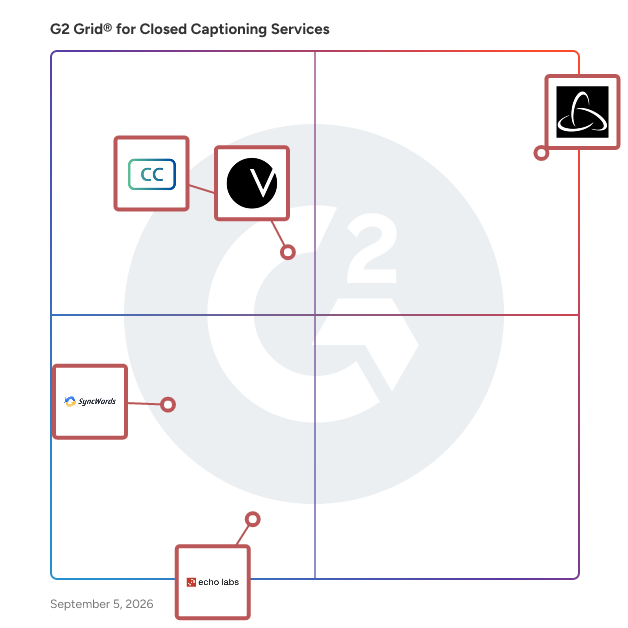
Highlighted products: 3Play Media, Adobe Closed Captioning, Videolinq, SyncWords, and Echo Labs.
Underlying data: [Grid® JSON](https://www.g2.com/categories/closed-captioning-services/grids.json?focus%5B%5D=3play-media&focus%5B%5D=adobe-closed-captioning&focus%5B%5D=videolinq&focus%5B%5D=syncwords&focus%5B%5D=echo-labs)
Vanan Captioning offers closed captioning services online.
Video Caption Corporation provides closed captioning, subtitling, and audio description services.
Elevate Your Global Presence with Wordsburg Translations: Your Premier Translation and Localization Partner At Wordsburg, we redefine communication by seamlessly bridging linguistic and cultural divides. With a strong dual presence in Singapore and the UK, we fuse the vibrant innovation of Asia with the storied heritage of Europe. If you're a discerning B2B client seeking unparalleled Translation and Localization services, your search ends here. Our Distinctive Proficiency Fluency is more than words; it's about encapsulating the true essence of a message across boundaries. Our seasoned team of linguists and subject matter experts excel in not just translating content, but meticulously preserving its core authenticity. Be it technical manuals, marketing campaigns, software interfaces, or legal documents, we ensure your content resonates seamlessly with your target audience, wherever they may be. Why Choose Wordsburg Translations? 1. Cultural Proficiency: We understand that every language comes with its own set of cultural nuances. Our professionals are not only language experts but also culture enthusiasts who immerse themselves in the local context to ensure your message strikes the right chords with your audience. Vertical Mastery: We take pride in catering to a multitude of industries, from the intricacies of IT and healthcare to the complexities of finance, medical, Gaming, and e-commerce. Our familiarity with industry-specific jargon and trends guarantees precision and contextual accuracy. Cutting-edge Technology: In an era where swiftness and precision are paramount, we integrate avant-garde translation tools and technologies to enhance efficiency without compromising on quality. This empowers us to meet even the most stringent deadlines. Global Nexus: With strategic hubs in both Singapore and the UK, we offer an authentic global perspective. Our grasp of regional preferences empowers you to tailor your message to captivate various markets effectively. Client-centric Approach: Your partnership is our priority. We emphasize open channels of communication and collaborative endeavors. Your triumph is our triumph, and we remain committed to surpassing your expectations. Our Suite of Services Translation: Our linguistic virtuosos ensure meticulous and accurate content translation while preserving its nuances, tone, and purpose. Localization: We adeptly adapt your content to local sensibilities, forging a personal connection with your target demographic. Transcreation: Beyond translation, we metamorphose your content to evoke equivalent emotions and impact across diverse languages. Multilingual SEO: Conquer new markets with our SEO-optimized content, primed to dominate global search rankings. Video Translation and Subtitling: In the era of visual communication, we recognize the power of videos to convey messages. Our skilled team excels in translating and subtitling videos, ensuring that your visual content retains its essence and connects with audiences across languages. Whether it's corporate videos, training materials, marketing campaigns, or entertainment content, we ensure your videos resonate globally, enhancing your reach and impact. Interpretation: Our adept interpreters facilitate seamless cross-cultural dialogues at conferences, meetings, and beyond. Collaborate with Wordsburg Translations: Unleash your global potential with unwavering confidence. Let Wordsburg stand as your reliable ally in surmounting language barriers, nurturing connections, and expanding your horizons immeasurably. Reach out to us now and unveil how our Translation and Localization prowess can propel your business toward unprecedented success. Empowering Global Expansion, One Impeccable Translation at a Time.
Average Rating: 5.0/5.0
Total Reviews: 1
Rating: 5.0/5.0 stars
— Kimberly L.
