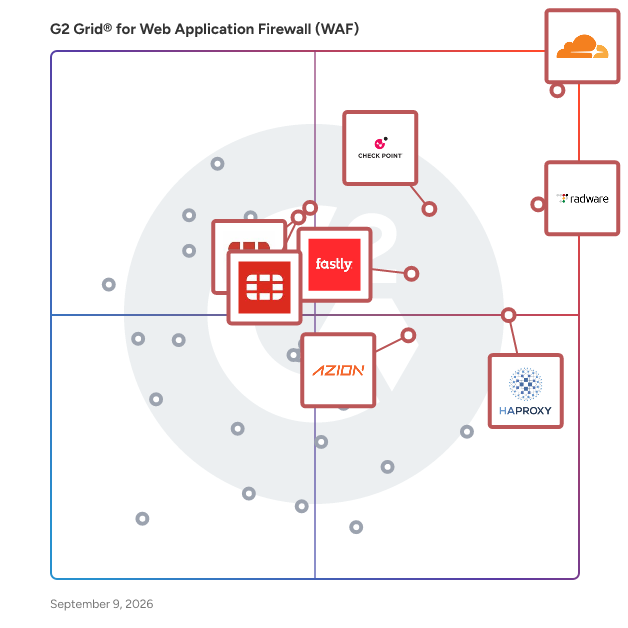
Best Web Application Firewalls (WAF)

Researched and written by Lauren Worth

Web application firewalls (WAF) are designed to protect web applications by filtering and monitoring incoming traffic. These tools analyze the hypertext transfer protocol (HTTP) traffic as it comes in, identifying traffic anomalies and blocking potentially malicious traffic.

Companies use these tools in conjunction with additional application security software to protect operational web applications better. These tools differ from traditional firewall software, which controls traffic between servers by filtering traffic and content attempting to access a specific web-based application.

To qualify for inclusion in the Web Application Firewalls (WAF) category, a product must:

  • Inspect traffic flow at the application level
  • Filter HTTP traffic for web-based applications
  • Block attacks such as SQL injections and cross-site scripting (XSS)

How Many Web Application Firewalls (WAF) Products Does G2 Track?

Total Products under this Category: 90

Category Stats (Jun 2026)

  • Average Rating: 4.43/5 The average rating of products in this category, based on all submitted ratings
  • New Reviews This Quarter: 29
  • Buyer Segments: Small-Business 44% │ Mid-Market 32% │ Enterprise 24% Represents the distribution of reviewers across all products in this category.
  • Top Trending Product: Check Point WAF (formerly CloudGuard WAF) (+0.023) - Among all products in this category, Check Point WAF (formerly CloudGuard WAF) recorded the largest rating increase compared to last month

Last updated: June 01, 2026

How Does G2 Rank Web Application Firewalls (WAF) Products?

Why You Can Trust G2's Software Rankings:

  • 30 Analysts and Data Experts
  • 2,800+ Authentic Reviews
  • 90+ Products
  • Unbiased Rankings

G2's software rankings are built on verified user reviews, rigorous moderation, and a consistent research methodology maintained by a team of analysts and data experts. Each product is measured using the same transparent criteria, with no paid placement or vendor influence. While reviews reflect real user experiences, which can be subjective, they offer valuable insight into how software performs in the hands of professionals. Together, these inputs power the G2 Score, a standardized way to compare tools within every category.

Featured Web Application Firewalls (WAF) At A Glance

G2 Advertising
Sponsored
G2 Advertising
Get 2x conversion than Google Ads with G2 Advertising!
G2 Advertising places your product in premium positions on high-traffic pages and on targeted competitor pages to reach buyers at key comparison moments.

How Do You Choose the Right Web Application Firewalls (WAF)?

What You Should Know About Web Application Firewall (WAF) Software


What is Web Application Firewall (WAF) Software?

WAF software products are used to protect web applications and websites from threats or attacks. The firewall monitors traffic between users, applications, and other internet sources. They're effective in defending against cross-site forgery, cross-site scripting (XSS attacks), SQL injection, DDoS attacks, and many other kinds of attacks.

These software solutions provide automatic defense and allow administrative control over rule sets and customization since some applications may have unique traffic trends, zero-day threats, or web application vulnerabilities. These tools also provide logging features to document and analyze attacks, incidents, and normal application behaviors.

Companies with web applications should use WAF tools to ensure all weak spots in the application itself are filled. Without WAF, many threats may go undetected, and data leakage may occur. They have truly become an obligatory component of any business-critical web application containing sensitive information.

Key Benefits of Web Application Firewall (WAF) Software

  • Protection against web-based threats
  • Historical documentation of incidents and events
  • Elastic, scalable web application protection


Why Use Web Application Firewall (WAF) Software?

There are a variety of benefits associated with WAF tools and ways they can boost security of applications deployed online. Most of the reasoning behind WAF usage is the generally accepted belief that web-based threats should be a concern for all businesses. Therefore, all businesses deploying web-based applications should be sure they are doing all they can to defend against the myriad cyberthreats that exist today.

Some of the numerous threats WAF products can help defend against include:

  • Cross-Site Scripting (XSS) — Cross-site scripting (XSS) is an attack where a malicious script is injected into websites using a web application to send malicious code. Malicious scripts can be used to access information such as cookies, session tokens, and other sensitive data collected by web browsers.
  • Injection Flaws — Injection flaws are vulnerabilities which allow attackers to send code through an application to another system. The most common type is a SQL injection. In this scenario, an attacker finds a point in which the web application passes through a database, executes their code, and can begin querying whatever information they want.
  • Malicious File Execution — Malicious file execution is accomplished when an attacker is able to input malicious files that are uploaded to the web server or application server. These files can be executed upon upload and completely compromise an application server.
  • Insecure Direct Object Reference — Insecure direct object reference occurs when user input can directly access an application's internal components. These vulnerabilities can allow attackers to bypass security protocols and access resources, files, and data directly.
  • Cross-Site Request Forgery (CSRF) — CSRF attacks force users to execute actions on a web application the user has permission to access. These actions can force users to unwillingly submit requests that may damage the web application or change their credentials to something the attacker can reuse to gain access to an application at a future date.
  • Information Leakage — Information leakage can occur when unauthorized parties are able to access databases or visit URLs that are not linked from the site. Attackers may be capable of accessing sensitive files such as password backups or unpublished documents.
  • Improper Error Handling — Error handling refers to preprogrammed measures that allow applications to dismiss unexpected events without exposing sensitive information. Improper error handling leads to a number of various issues, including the release of data, vulnerability exposure, and application failure.
  • Broken Authentication — Broken authentication is the result of improper credential management functions. If authentication measures fail to function, attackers can walk by security measures without the valid identification. This can lead to attackers gaining direct access to entire networks, servers, and applications.
  • Session Management — Session management errors occur when attackers manipulate or capture the tokenized ID provided to authenticated visitors. Attackers can impersonate generic users or target privileged users to gain access control and hijack an application.
  • Insecure Cryptographic Storage — Cryptographic storage is used to authenticate and protect communications online. Attackers may identify and obtain unencrypted or poorly encrypted resources that may contain sensitive information. Proper encryption typically protects against this, but poor key storage, weak algorithms, and flawed key generation may put sensitive data at risk.
  • Insecure Communications — Insecure communications occur when messages exchanged between clients and servers becomes visible. Poor network firewalls and network security policies can lead to easy access for attackers by gaining access to a local network or carrier device or installing malware on a device. Once applications are exploited, individual user information and other sensitive data becomes extremely vulnerable.
  • Failure to Restrict URL Access — Applications may fail to restrict URL access to unauthorized parties who attempt to visit unlinked URLs or files without permission. Attackers may bypass security by directly accessing URLs containing sensitive information or data files. URL restriction can be accomplished by utilizing page tokens or encrypting URLs to restrict access unless they visit restricted pages through approved navigational paths.


Who Uses Web Application Firewall (WAF) Software?

The actual individuals using application firewalls are software developers and security professionals. The developer will typically build and implement the firewall, while it is maintained and monitored by security operations teams. Still, there are a few industries that may be more inclined to use WAF tools for various purposes.

Internet Businesses — Internet businesses are a natural fit for WAF tools. They often have one or multiple public-facing web applications and various internal web apps for employee use. Both of these kinds of applications should be guarded by some kind of firewall, as well as additional layers of security. While nearly all modern businesses use web applications in some capacity, internet-centric businesses are more susceptible to attacks simply because they likely possess more web apps.

E-Commerce Professionals — E-commerce professionals and e-commerce businesses that build their own online tools should be using WAF technology. Many e-commerce applications are managed by some kind of SaaS provider, but custom-built tools are incredibly vulnerable without an application firewall. E-commerce businesses who fail to protect their applications put the data of their visitors, customers, and business on the line.

Compliant-Required Industries — Industries that require a higher level of compliance for data security should use a web application firewall for any application that communicates with a server or network with access to sensitive information. The most common business types with increased compliance requirements include health care, insurance, and energy industries. But many countries and localities have expanded IT compliance requirements across industries to prevent data breaches and the release of sensitive information.


Web Application Firewall (WAF) Software Features

Some WAF products may be geared toward specific applications, but most share a similar set of core security features and capabilities. The following are a handful of common features to look for when considering the adoption of WAF tools.

Logging and Reporting — Provides required reports to manage the business. Provides adequate logging to troubleshoot and support auditing.

Issue Tracking — Tracks security issues as they arise and manages various aspects of the mitigation process.

Security Monitoring — Detects anomalies in functionality, user accessibility, traffic flows, and tampering.

Reporting and Analytics — Provides documentation and analytical capabilities for data gathered by the WAF product.

Application-Layer Control — Gives user-configurable WAF rules, such as application control requests, management protocols, and authentication policies, to increase security.

Traffic Control — Limits access to suspicious visitors and monitors for traffic spikes to prevent overloads like DDoS attacks.

Network Control — Lets users provision networks, deliver content, balance loads, and manage traffic.


Software and Services Related to Web Application Firewall (WAF) Software

There are a number of security tools that provide similar functionality to web application firewall software but operate in a different capacity. Similar technologies used to protect against web-based threats include:

Firewall SoftwareFirewalls come in many forms. For example, a network firewall is used to restrict access to a local computer network. Server firewalls restrict access to a physical server. There are a number of firewall varieties designed to protect against various threats, attacks, and vulnerabilities, but WAF software is specifically designed to protect web applications and the various databases, networks, and servers they communicate with.

DDoS Protection SoftwareDDoS attacks refer to the bombardment of a website with enormous loads of malicious traffic, typically in the form of a botnet. DDoS protection tools monitor traffic for abnormalities and restrict access when malicious traffic is detected. These tools protect websites from a specific kind of attack but do not protect web applications from a number of different attacks.

Application Shielding SoftwareApplication shielding technology is used to increase security at an application’s core. Like an application firewall, these tools can help prevent against malicious code injections and data leakage events. But these tools are typically used as an additional layer of application security to protect against threats and keep applications secure if the firewall has been bypassed.

Bot Detection and Mitigation SoftwareBot detection and mitigation tools are used to protect against bot-based attacks, similar to DDoS protection tools. But bot detection products typically add a level of detection for fraudulent transactions and other bot activity in addition to DDoS protection.These tools can prevent unauthorized network access and activity, like a firewall, but limit detection to bot-based threats.

Website Security SoftwareWebsite security tools often include a web application firewall in addition to a few other security tools meant to protect websites. They are often paired with an application-level antivirus, secure content delivery network, and DDoS protection tools.