Introducing G2.ai, the future of software buying.Try now

Vulnerability Assessment

by Kelly Fiorini
A vulnerability assessment finds and prioritizes weak points in an application, system, or network. Learn the basic steps, benefits, and best practices.

What is a vulnerability assessment?

A vulnerability assessment is discovering and evaluating weaknesses in an application, computer system, or network. The procedure catches bugs, software design flaws, security procedure gaps, or problems with internal controls and suggests protections to keep a company or individual safe from hackers.

Security teams use various manual and automatic techniques and scans during a vulnerability assessment to identify security issues. When they find potential problems, they rate the severity to help the organization prioritize fixes.

Security information and event management (SIEM) tools help identify vulnerabilities and provide continuous monitoring for behavior anomalies in IT systems. They also aggregate and store security data to meet regulatory compliance requirements.

Vulnerability assessment types

Vulnerability assessments vary in scope. Depending on their unique IT needs, an organization might use one or more of the following:

  • Network scans focus on weaknesses within the network infrastructure. It involves scanning network devices like routers or firewalls to find possible attack points, such as open ports and outdated firmware.
  • Application scans are performed by security experts who evaluate mobile and web applications to find weaknesses. They scan the front end, examine the application’s source code, and run dynamic testing to uncover issues like improper input validation or poor data storage practices.
  • Host-based scans look for vulnerabilities in individual systems, such as servers or workstations. They scan the operating system and configuration settings, looking for missing patches or problematic settings.
  • Wireless network scans help experts spot vulnerabilities in the infrastructure, access points, and security mechanisms. For example, they may discover rogue access points and weak encryption that compromise the network’s security.
  • Database scans concern themselves with issues in the organization’s databases. Vulnerabilities introduce the possibility that bad actors could gain control of servers or access and modify sensitive data.

Basic steps in a vulnerability assessment

A vulnerability assessment takes a systematic approach to ensure businesses discover and address all security gaps.
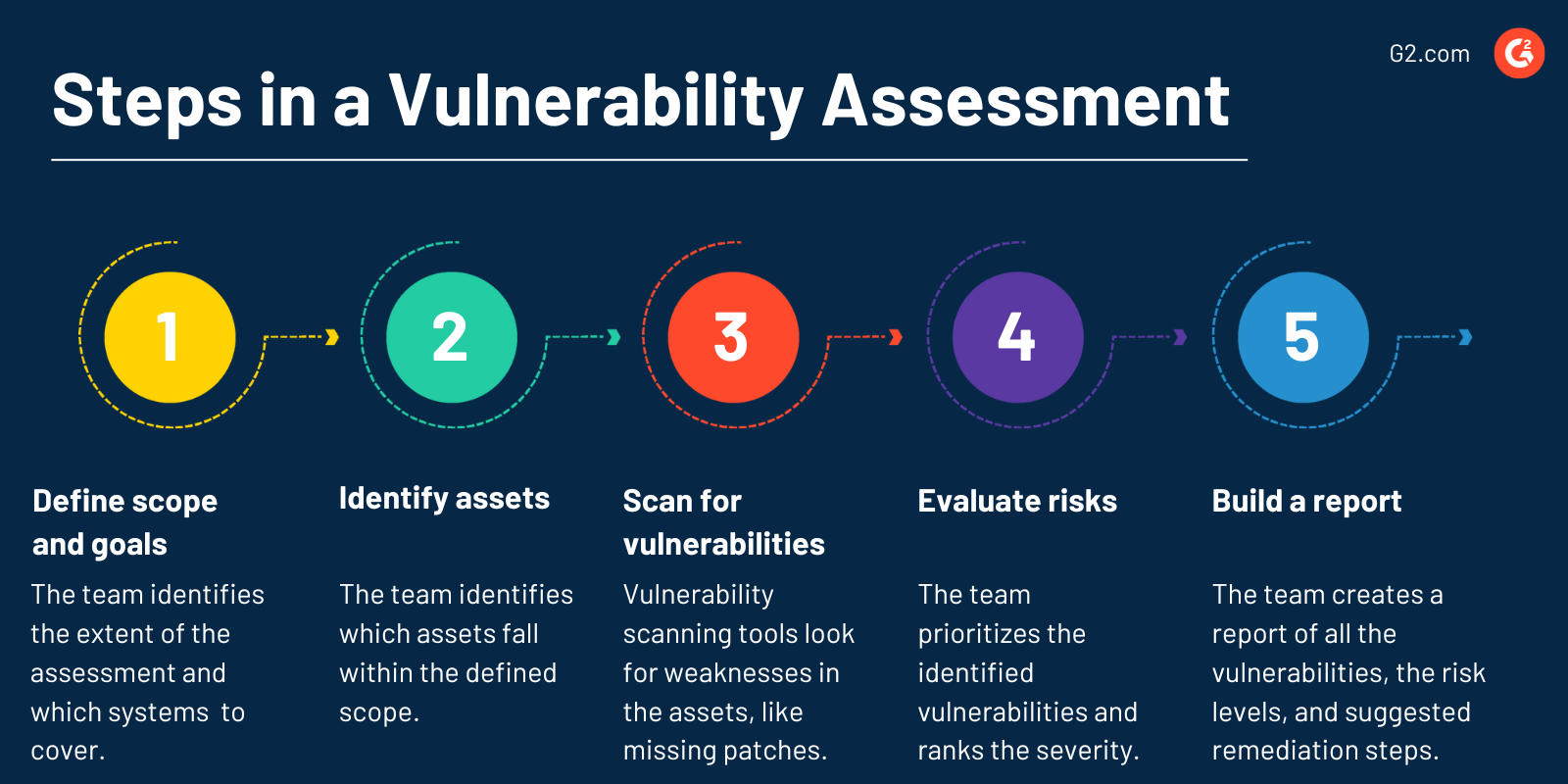
Steps in a Vulnerability Assessment

The process has five main steps:

  • Define scope and goals. The security expert or team starts by identifying the extent of the assessment and which systems, networks, or applications to cover. Based on their size, risk tolerance, and business goals, some organizations focus on specific areas while others conduct a broader test.
  • Identify assets. The team identifies which assets fall within the defined scope at this step. This includes cataloging hardware devices, software, and configurations.
  • Scan for vulnerabilities. Vulnerability scanning tools automatically look for weaknesses in the identified assets, like incorrect configurations or missing patches. Security experts then manually check the weak points to validate their existence and determine their root causes.
  • Evaluate risks. Then, the team prioritizes the identified vulnerabilities. They rank the severity of each issue based on factors like the ease of an attack or the at-risk data.
  • Build a report. Ultimately, the team creates a report documenting the vulnerabilities, evaluating risk levels, and suggesting remediation steps. For example, the team may suggest new security procedures, adopt new software, or develop and implement patches.

Benefits of a vulnerability assessment

Businesses of all sizes run vulnerability scans to identify security flaws and improve their cybersecurity. Some specific advantages include: 

  • Understanding and mitigating risk. Vulnerability assessments give organizations a clear view of their overall security posture so they can make informed decisions and take action to reduce harm.
  • Achieving compliance. Regulatory frameworks often require companies to assess system vulnerabilities. By conducting the scans, companies lower the chance of penalties and legal consequences for non-compliance.
  • Reassuring customers and stakeholders. Customers entrust companies with sensitive data, such as health records and credit card information. Vulnerability assessments demonstrate that businesses care about protecting their client’s privacy. Plus, the organization gains a reputation for trustworthiness, which investors and stakeholders appreciate.

Vulnerability assessment best practices

Vulnerability assessments help a company preserve its reputation and protect itself and its customers. To get the most out of vulnerability assessments, companies should:

  • Conduct assessments regularly. Security threats and weaknesses evolve, so companies must regularly assess vulnerability. Organizations should also conduct scans after major infrastructure or application changes.
  • Communicate with team members. Vulnerability assessment is a joint effort between outside security experts and internal IT teams. Make sure that all team members and stakeholders have the opportunity to view the assessment report and share their insights when creating the mitigation plan. 
  • Select the right tools. Many types of vulnerability assessment software are available. Companies should look for an easy-to-use tool that produces accurate, comprehensive reports and uses automation to reduce repetitive tasks. 

Choose the best vulnerability scanner for your organization.

Kelly Fiorini
KF

Kelly Fiorini

Kelly Fiorini is a freelance writer for G2. After ten years as a teacher, Kelly now creates content for mostly B2B SaaS clients. In her free time, she’s usually reading, spilling coffee, walking her dogs, and trying to keep her plants alive. Kelly received her Bachelor of Arts in English from the University of Notre Dame and her Master of Arts in Teaching from the University of Louisville.

Vulnerability Assessment Software

This list shows the top software that mention vulnerability assessment most on G2.

From the beginning, we've worked hand-in-hand with the security community. We continuously optimize Nessus based on community feedback to make it the most accurate and comprehensive vulnerability assessment solution in the market. 20 years later and we're still laser focused on community collaboration and product innovation to provide the most accurate and complete vulnerability data - so you don't miss critical issues which could put your organization at risk. Tenable is a 2021 Gartner Representative Vendor in Vulnerability Assessment.

Discover, assess, prioritize, and patch critical vulnerabilities in real time and across your global hybrid-IT landscape — all from a single solution.

Burp Suite is a toolkit for web application security testing.

AlienVault USM (from AT&T Cybersecurity) is a platform that provides five essential security capabilities in a single console to manage both compliance and threats, understanding the sensitive nature of IT environments, include active, passive and host-based technologies to match the requirements of each particular environment.

Acronis Cyber Protect Cloud unites backup and next-generation, AI-based anti-malware, antivirus, and endpoint protection management in one solution. Integration and automation provide unmatched ease for service providers — reducing complexity while increasing productivity and decreasing operating costs. Acronis Cyber Protect Cloud is the single service provider solution that combines backup, anti-malware (including anti-virus, anti-ransomware, and anti-cryptojacking) and security and management capabilities such as vulnerability assessments, patch management, URL filtering and more. Now, service providers can eliminate complexity and make security a centerpiece of their offerings while increasing SLAs, decreasing churn, and generating more recurring revenue. Get upgraded security with integrated AI-based defenses that protect clients from modern threats, make smarter use of resources so your team can focus on clients, and earn new recurring revenue and higher margins that strengthen your business. Enriched with next-gen, full-stack anti-malware protection and comprehensive yet simple management tools, built on top of our industry-leading backup and data recovery solution, Acronis Cyber Protect Cloud simplifies onboarding, daily operations, and reporting, and combats advanced attacks with new use cases enabled by integration. Acronis Cyber Protect Cloud makes it easy to deliver the modern cyber protection your clients seek.

A platform of Tools for endpoint security and systems management needs. Saner Platform queries systems to find aberrations, and helps systems to retain normality. Saner Queries and Monitors Endpoints, Analyzes the Security Posture, and Responds to Bring Endpoints to an Approved State.

Tenable, Inc. is the Cyber Exposure company that provides solutions on reducing cyber risk

Scans your data environment to detect vulnerabilities and suggest remedial actions

Cisco Vulnerability Management (formerly Kenna.VM), the original SaaS risk-based vulnerability management platform, prioritizes vulnerabilities that pose a real risk, enabling Security and IT teams to focus their limited resources and remediate more efficiently. Cisco’s data science-driven prioritization evaluates both enterprise data and a wealth of data on real-world exploit activity and translates that context into actionable intelligence to guide remediation.

Tenable.io is the only cybersecurity company that empowers customers to gain control of their risk by knowing and prioritizing vulnerabilities across their entire attack surface including traditional, cloud, mobile and DevOps environments.

Kali Linux is an open-source, Debian-based distribution tailored for advanced penetration testing and security auditing. It offers a comprehensive suite of tools and configurations, enabling users to focus on their security tasks without the need for extensive setup. Kali Linux is accessible across multiple platforms and is freely available to information security professionals and enthusiasts. Key Features and Functionality: - Extensive Toolset: Provides hundreds of pre-installed tools for various information security tasks, including penetration testing, security research, computer forensics, reverse engineering, vulnerability management, and red team testing. - Multi-Platform Support: Compatible with various platforms, ensuring flexibility and adaptability for different user needs. - Cloud Integration: Available as an Amazon Machine Image on AWS Marketplace, allowing users to deploy Kali Linux instances in the cloud efficiently. Primary Value and User Solutions: Kali Linux addresses the critical need for a robust and comprehensive security testing environment. By offering a vast array of tools and configurations out of the box, it enables security professionals to conduct thorough assessments, identify vulnerabilities, and strengthen defenses without the overhead of manual tool integration. Its availability on platforms like AWS further enhances its utility by providing scalable and on-demand access to a powerful security testing environment.

Acunetix by Invicti automatically crawls and scans off-the-shelf and custom-built websites and web applications for SQL Injection, XSS, XXE, SSRF, Host Header Attacks & over 3000 other web vulnerabilities. It also provides a wide variety of reports to help developers and business owners alike to quickly identify a web application’s threat surface, detect what needs to be fixed, and ensure conformance with several compliance standards.

Hybrid Cloud Security solution, powered by XGen security, delivers a blend of cross-generational threat defense techniques that have been optimized to protect physical, virtual, and cloud workloads.

Beagle Security is a web application penetration testing tool that helps you to identify vulnerabilities on your web application before hackers exploit them.

ThreatWorx is a next-gen vulnerability management platform that allows DevOps teams to assess code repositories, containers and infrastructure without scanner appliances or bulky agents

OpenVAS is a framework of several services and tools offering a comprehensive and powerful vulnerability scanning and vulnerability management solution.

Parrot Security (ParrotSec) is a Security GNU/Linux distribution designed for the Cyber-Security (InfoSec) field. It includes a full portable laboratory for security and digital forensics experts.

Pentest-Tools.com helps security professionals find, validate, and communicate vulnerabilities faster and with greater confidence - whether they’re internal teams defending at scale, MSPs juggling clients, or consultants under pressure. With comprehensive coverage across network, web, API, and cloud assets, and built-in exploit validation, it turns every scan into credible, actionable insight. Trusted by over 2,000 teams in 119 countries and used in more than 6 million scans annually, it delivers speed, clarity, and control - without bloated stacks or rigid workflows.

Wiz is a CNAPP that consolidates CSPM, KSPM, CWPP, vulnerability management, IaC scanning, CIEM, DSPM, and container and Kubernetes security into a single platform.