
Sagar Joshi
Sagar Joshi is a former content marketing specialist at G2 in India. He is an engineer with a keen interest in data analytics and cybersecurity. He writes about topics related to them. You can find him reading books, learning a new language, or playing pool in his free time.
What is marketing analytics?
Marketing analytics is the process of collecting, measuring, and analyzing data from channels like websites, social media, email, ads, CRM systems, and community platforms to understand marketing performance and customer behavior. It helps businesses see which campaigns, messages, and channels influence engagement, conversions, and revenue.
Many teams use marketing analytics software to track attribution, monitor key metrics, identify trends, and improve decision-making. With these insights, businesses can invest more in what works, fix underperforming efforts, and build smarter growth strategies.
TL;DR: Marketing analytics definition, use case, benefits
Marketing analytics helps businesses use data from campaigns, channels, and customer interactions to understand performance and make better decisions. It supports smarter strategy, stronger personalization, more efficient budget allocation, and improved ROI by showing what is working and where to optimize.


What are the core components of marketing analytics?
Marketing analytics relies on a few core building blocks that turn raw data into useful insights. These components include data collection, reporting, attribution, forecasting, and optimization, and together they help marketers measure performance and improve results over time.
- Data collection and integration: Marketing analytics starts with gathering data from websites, ad platforms, CRM systems, email marketing tools, and social channels. Bringing these sources together creates a more complete picture of marketing performance.
- Measurement and reporting: Teams use dashboards, reports, and scorecards to track campaign results, channel performance, and audience engagement. This makes it easier to spot changes and communicate results clearly.
- Attribution and analysis: Attribution models help identify which channels, campaigns, or touchpoints influenced a conversion. This helps marketers understand contribution rather than relying on guesswork.
- Forecasting and prediction: Historical performance data can be used to estimate future outcomes such as lead volume, conversion rates, or campaign revenue. This supports smarter planning and budgeting.
- Optimization and action: The final component is using insights to improve targeting, messaging, budget allocation, and campaign design. Analytics is most valuable when it leads to measurable action.
What are the types of marketing analytics?
The main types of marketing analytics are descriptive, diagnostic, predictive, prescriptive, customer, and campaign analytics. Together, they help businesses understand what happened, why it happened, what may happen next, and what actions to take.
- Descriptive analytics: Shows what happened in the past by analyzing historical campaign and channel data.
- Diagnostic analytics: Explains why a specific outcome happened, such as a traffic drop or conversion increase.
- Predictive analytics: Forecasts future results using patterns in historical data and statistical models.
- Prescriptive analytics: Suggests the best actions to take based on predictions and optimization models.
- Customer analytics: Focuses on customer behaviors, preferences, and interactions across touchpoints.
- Campaign analytics: Measures the performance of individual campaigns using engagement and conversion metrics.
What are the benefits of marketing analytics?
Marketing analytics gives teams a practical way to measure impact instead of relying on guesswork. When used well, it improves decision-making, clarifies resource allocation, and helps marketers prove how their work supports business growth.
- Improved decision-making: Marketing analytics turns campaign and customer data into insights that teams can act on with more confidence. Instead of relying on assumptions, marketers can compare performance and prioritize strategies based on evidence.
- Higher return on investment (ROI): By showing which channels, messages, and audiences deliver the strongest results, marketing analytics helps teams spend more efficiently. This reduces wasted budget and improves the return generated from marketing investments.
- Stronger customer insights: Marketing analytics reveals how customers discover, evaluate, and engage with a brand over time. These insights can shape messaging, content, service improvements, and product decisions that better match customer expectations.
- Better competitive positioning: Analytics helps businesses identify what is working in their own programs and where gaps may exist in the market. That visibility can support faster optimization and smarter differentiation from competitors.
- Improved marketing performance: Teams can use analytics to find weak points in the funnel, underperforming channels, or low-converting campaigns. This creates a repeatable process for testing, learning, and improving overall performance.
- More effective resource allocation: Marketing analytics helps teams decide where time, budget, and effort should go for the greatest business impact. It supports clearer planning by revealing which programs deserve more investment and which can be scaled back.
What are the key metrics in marketing analytics?
Marketing analytics depends on a set of metrics that show how campaigns, channels, and audiences are performing. Important metrics include traffic, engagement, conversion, acquisition cost, customer value, and return on investment.
- Traffic and reach metrics: Metrics such as website sessions, impressions, and audience reach show how visible a campaign is. They are useful for understanding awareness and top-of-funnel performance.
- Engagement metrics: Click-through rate, time on page, social engagement, and email opens help show whether the message is resonating. These metrics often reveal content quality and audience interest.
- Conversion metrics: Conversion rate, lead volume, form fills, and purchases measure how well traffic turns into action. These are central metrics for campaign effectiveness.
- Efficiency and cost metrics: Customer acquisition cost, cost per lead, and cost per click help teams understand how efficiently the budget is being used. They are critical for optimization decisions.
- Value and return metrics: Customer lifetime value, revenue attribution, and marketing ROI show long-term business impact. These metrics help justify investment and guide future spend.
What is the impact of marketing analytics on business growth?
The impact of marketing analytics goes beyond reporting dashboards. It shapes how businesses plan campaigns, understand buyers, improve efficiency, and connect marketing activity to revenue and long-term growth.
- Clearer revenue visibility: Marketing analytics helps teams see how campaigns and channels influence pipeline, customer acquisition, and recurring revenue. This makes it easier to connect marketing performance to business results.
- Faster optimization cycles: With timely performance data, teams can adjust creative, targeting, budget allocation, or channel mix before problems become expensive. This creates a more agile marketing function.
- Better alignment across teams: Shared data helps marketing, sales, and leadership work from the same performance signals and goals. That alignment improves planning, reporting, and cross-functional accountability.
- More consistent customer experiences: Analytics reveals how customers move across touchpoints and where friction appears in the journey. Businesses can use those insights to create smoother, more relevant experiences.
- Smarter growth planning: By understanding what drives efficient acquisition and retention, teams can scale the right programs with more confidence. This supports sustainable growth instead of reactive decision-making.
What are marketing analytics best practices?
Strong marketing analytics depends on clear goals, reliable data, useful metrics, and continuous optimization. The best practices below help businesses build a more effective analytics program and turn reporting into meaningful action.
- Define clear goals first so the analytics program is tied to outcomes like revenue growth, retention, or spend efficiency. Clear objectives make it easier to choose the right reports and success metrics.
- Use reliable, connected data sources from systems like CRM platforms, website analytics tools, surveys, and campaign software. Better data quality leads to more accurate analysis and fewer misleading conclusions.
- Choose the right metrics based on business priorities instead of tracking everything equally. Metrics such as customer acquisition cost, lifetime value, conversion rate, and attribution performance are often more actionable.
- Segment and visualize data to uncover patterns by audience, behavior, geography, or funnel stage. Dashboards and charts make insights easier to understand and share with stakeholders.
- Continuously monitor and optimize through testing, reporting, and regular review cycles. A strong data-driven culture helps teams act on insights instead of treating analytics as a one-time exercise.
What is the difference between marketing analytics and customer analytics?
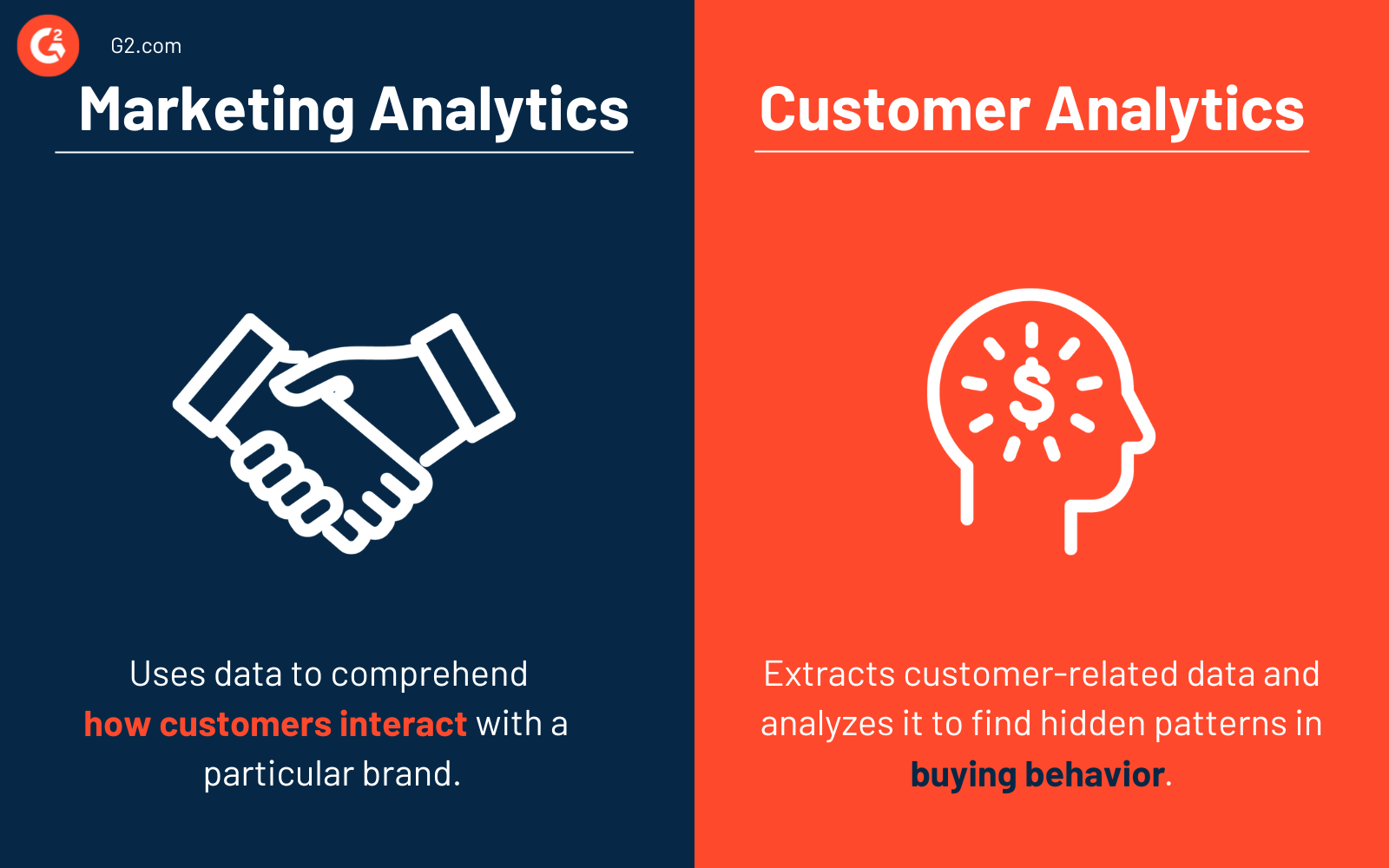
Marketing analytics and customer analytics are closely related, but they answer different questions. Marketing analytics focuses on campaign and channel performance, while customer analytics focuses more deeply on buyer behavior, preferences, and patterns across the customer lifecycle.
| Marketing analytics | Customer analytics |
| Measures how marketing channels, campaigns, and messaging perform across the funnel. | Analyzes customer behavior, preferences, and interactions to understand buying patterns and lifecycle trends. |
| Improving campaign performance, attribution, spend efficiency, and growth outcomes. | Understanding who customers are, how they behave, and what influences retention, loyalty, or purchase decisions. |
Related resources
Frequently asked questions about marketing analytics
Have unanswered questions? Find the answers below.
Q1. What skills are needed for marketing analytics?
Marketing analytics requires a mix of analytical, technical, and business skills. The most important ones include data interpretation, reporting, problem-solving, and the ability to connect results to business goals.
Marketers also benefit from knowing how to use analytics platforms, spreadsheets, dashboards, and testing tools. Communication is just as important, since insights need to be explained clearly to stakeholders and turned into action.
Q2. What are examples of marketing analytics?
Examples of marketing analytics include tracking website traffic, measuring email click-through rates, comparing paid campaign performance, and analyzing conversion rates by channel.
Businesses also use it to evaluate lead quality, customer acquisition cost, and return on investment. Other common examples include segmenting audiences based on behavior, identifying the best-performing content, and using attribution models to understand which touchpoints influenced a conversion.
Q3. What qualifications do you need to be a market analyst?
Most market analysts have a background in marketing, business, economics, statistics, or a related field. Employers usually look for strong research skills, comfort with data analysis, and experience using reporting or analytics tools.
Practical experience can matter as much as formal education. Internships, research projects, spreadsheet skills, dashboard experience, and knowledge of customer or campaign analysis can all help someone qualify for the role.
Learn more about customer journey analytics software and how it automates and manages customer experience across all channels.


