# Best Human Services Software - Page 6

  *By [Emma Stein](https://research.g2.com/insights/author/emma-stein)*

   Human services software manages nonprofit cases, acting as the central repository for client- and case-related information. These solutions, sometimes called nonprofit case management software, are leveraged by nonprofits as operational tools for field agents.

Human services software is meant to be used across a variety of social services organizations. These solutions manage client data, conduct assessments, facilitate case planning, and include progress tracking. Human services software is designed to be a full-cycle solution for human services organizations, from client intake to outcome reporting and everything in between.

Human services software falls under the umbrella of nonprofit software, often integrating with [nonprofit CRM software](https://www.g2.com/categories/nonprofit-crm) or providing similar features to solutions in that category.

To qualify for inclusion in the Human Services category, a product must:

- Contain client intake tools
- Store client data
- Provide field agent data collection features
- Analyze program outcomes and impact


## Category Overview

**Total Products under this Category:** 83


## Trust & Credibility Stats

**Why You Can Trust G2's Software Rankings:**

- 30 Analysts and Data Experts
- 1,200+ Authentic Reviews
- 83+ Products
- Unbiased Rankings

G2's software rankings are built on verified user reviews, rigorous moderation, and a consistent research methodology maintained by a team of analysts and data experts. Each product is measured using the same transparent criteria, with no paid placement or vendor influence. While reviews reflect real user experiences, which can be subjective, they offer valuable insight into how software performs in the hands of professionals. Together, these inputs power the G2 Score, a standardized way to compare tools within every category.


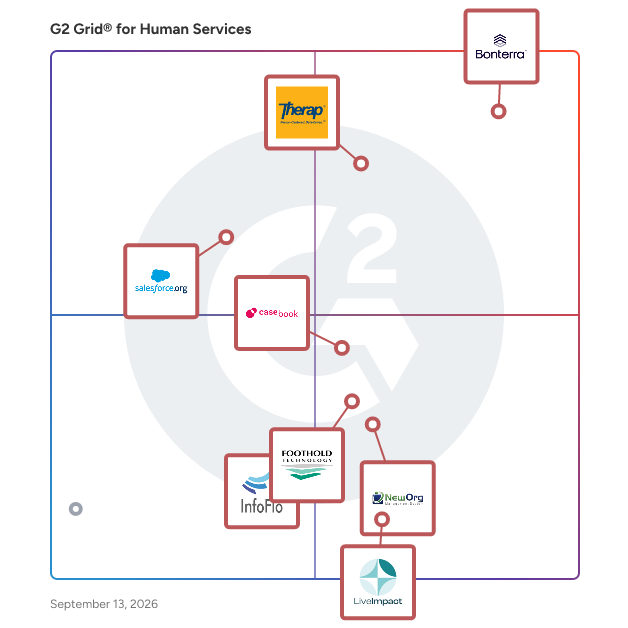
## Best Human Services Software At A Glance

- **Leader:** [Bonterra Apricot](https://www.g2.com/products/bonterra-apricot/reviews)
- **Highest Performer:** [Casebook](https://www.g2.com/products/casebook/reviews)
- **Easiest to Use:** [Bonterra Apricot](https://www.g2.com/products/bonterra-apricot/reviews)
- **Top Trending:** [Casebook](https://www.g2.com/products/casebook/reviews)
- **Best Free Software:** [CharityTracker](https://www.g2.com/products/charitytracker/reviews)


---

**Sponsored**

### LiveImpact

LiveImpact: The Only AI-Powered Case Management and Donor Management Platform Built for Nonprofits LiveImpact is a cloud-based, affordable nonprofit software platform that brings together powerful Case Management Software, Donor Management Software, and a fully integrated Nonprofit CRM—designed specifically for the needs of mission-driven organizations. Our Case Management Software helps nonprofits streamline client intake, documentation, service delivery, outcomes tracking, and reporting—while ensuring compliance with funder and grant requirements. Whether you’re managing direct services, coordinating referrals, or running multi-program initiatives, LiveImpact gives you the tools to keep every case organized, track progress in real time, and demonstrate your impact with ease. What sets LiveImpact apart is our private, secure, and nonprofit-specific AI—the first of its kind in this space. Purpose-built for nonprofit workflows, our AI transforms how teams work by eliminating the need to run complex reports or dig through data. Simply ask a question, and LiveImpact generates real-time charts, trends, and insights—helping program staff, fundraisers, and leadership make faster, smarter decisions. Our team works closely with nonprofits to customize the platform to your unique needs, ensuring a smooth and supportive onboarding experience. With enterprise-grade security, exceptional customer support, and a pricing model that works for nonprofits, LiveImpact helps you scale your mission with confidence—powered by AI, built for impact.


[Visit website](https://www.g2.com/external_clickthroughs/record?secure%5Bad_program%5D=ppc&amp;secure%5Bad_slot%5D=category_product_list&amp;secure%5Bcategory_id%5D=1911&amp;secure%5Bdisplayable_resource_id%5D=1911&amp;secure%5Bdisplayable_resource_type%5D=Category&amp;secure%5Bmedium%5D=sponsored&amp;secure%5Bplacement_reason%5D=page_category&amp;secure%5Bplacement_resource_ids%5D%5B%5D=1911&amp;secure%5Bprioritized%5D=false&amp;secure%5Bproduct_id%5D=24772&amp;secure%5Bresource_id%5D=1911&amp;secure%5Bresource_type%5D=Category&amp;secure%5Bsource_type%5D=category_page&amp;secure%5Bsource_url%5D=https%3A%2F%2Fwww.g2.com%2Fcategories%2Fhuman-services%3Fpage%3D6&amp;secure%5Btoken%5D=61c68f9224163d38df56b79547506484ec09eb83739bea63d8a9474c313e81aa&amp;secure%5Burl%5D=https%3A%2F%2Fwww.liveimpact.org&amp;secure%5Burl_type%5D=company_website)

---


## Parent Category

[Nonprofit Software](https://www.g2.com/categories/nonprofit)


## Related Categories

- [Nonprofit CRM Software](https://www.g2.com/categories/nonprofit-crm)


---

## Buyer Guide

### What You Should Know About Human Services Software

### What is Human Services Software?

Nonprofit organizations that provide social services need to manage sensitive program and service data on top of their usual donor and volunteer records. Standard [nonprofit CRM software](https://www.g2.com/categories/nonprofit-crm) and [donor management software](https://www.g2.com/categories/donor-management) lack the features to track, monitor, and report on client data (“clients&quot; refers to people receiving services or participating in programs at a nonprofit social service agency). Human services software solves this by improving operational efficiency, maintaining compliance, and tracking outcomes for all individuals served by a nonprofit agency.

Many nonprofits use human services solutions to store client intake forms, manage program rosters, evaluate client progress for grant reporting, and streamline billing. These solutions, also called nonprofit case management software, possess some of the functionality of health care solutions like [clinical documentation software](https://www.g2.com/categories/clinical-documentation) and [patient case management software.](https://www.g2.com/categories/patient-case-management) However, social service nonprofits typically focus on one particular service and community, and do not need all the features of software optimized for the health care industry, especially when used by nonprofit organizations like youth development and food banks. Human services products carry lower costs and focus on the core functions a nonprofit needs to conduct business and maintain data integrity. Nonprofits providing any range of individual and group services can benefit from human services software.

Key Benefits of Human Services Software

- Centralize client data into one accessible hub
- Automate client intake and survey processes, reducing human error
- Evaluate client progress toward goals for treatment plans and funding reports
- Streamline insurance reimbursement and client billing
- Improve care coordination for clients enrolled in multiple programs and services

### Why Use Human Services Software?

Social service nonprofits must maintain accurate client data for internal and external purposes. Human services software gathers data in a centralized repository, reducing administrative burden while prioritizing clients.

**Improve client outcomes —** Program staff rely on these products to track forms and surveys completed by clients and assess shifts in reported progress over time. This allows staff to recommend revisions to a client’s treatment plan and work toward achieving outcomes. Nonprofits receiving public funding often have strict outcomes tied to their grants, and therefore must ensure they meet metrics.

**Automate tasks and optimize workflow —** Without human services software, nonprofits manually maintain a large, vulnerable collection of paper files with sensitive client data. Staff can create form and survey templates in the software, uploading necessary documentation to individual client records. Interdepartmental communication improves due to centralized access to client data, improving efficiency and reducing repetition. These systems create reminders for billing and scheduling, eliminating the need to remind coworkers or manually enter invoices.

**Eliminate administrative errors —** These solutions automate many administrative functions that detract from service delivery, while reducing data entry errors. Nonprofits need software that can flag errors in coding, documentation, and insurance eligibility. Reimbursement denials caused by incorrect billing increases late payments, which impacts the nonprofit’s operating budget.

### Who Uses Human Services Software?

A variety of social services nonprofits rely on human services software to manage service impact. This includes nonprofits focused on: behavioral health and crisis intervention services, substance abuse treatment, youth development, workforce development, transitional and homelessness services, violence prevention and restorative justice, and food assistance, among others.

While mental health service providers utilize all features of solutions software, other social service nonprofits depend on the core features to manage their daily operations. For example, youth development agencies may not need billing functionality, but rely on case management and program data tracking features. Food banks might use the referral system for non-clinical purposes, recording when clients receive food from partner sites or enroll in demographic-specific food delivery services (youth and elderly, typically).

The staff who typically use human services software include:

**Service delivery —** Service delivery staff use this technology to assist with case management. Human services software digitizes all client data, allowing quick access. Therapists and mental health services providers rely on these solutions to track billable hours for grant reimbursement, an important component for maintaining compliance. Supervisors and managers use this technology to manage workflow and task assignments. As clients are sometimes referred to multiple services in an agency, service delivery staff monitor all client enrollments and gain a holistic picture of a client’s treatment plan.

**Program —** Program staff need to store important documents such as attendance rosters, pre- and post-surveys, and permission slips. Staff can access client biographical data to find a parent or guardian’s phone number in case of emergency. These solutions improve interdepartmental communication with service delivery staff, strengthening care coordination. Program staff may rely on this product to monitor their work hours for grant reimbursement.

**Data and evaluation —** While service delivery and program staff input client data into human services solutions, data and evaluation staff use this information for internal audits, external requests, and grant reporting. They often facilitate survey and form creation, collaborating with program and service staff to ensure the appropriate data is captured.

### Human Services Software Features

Human services software offers a range of features to help nonprofits improve operational efficiency, maintain compliance, and deliver positive client engagement.

**Documentation —** Agencies can upload and manage documents such as surveys, intake and release forms, case notes, and digital signatures. Human services software enables staff to build form and survey templates directly in the system, allowing staff to capture client details digitally from any location. This information covers a client’s first communication with an agency until their discharge or program completion, and all authorized staff can access these details at any time.

**Case management —** It’s important for nonprofits to record ongoing communication with clients, assess service enrollments, identify referrals, and monitor client progress towards established goals. For clinical staff, these products capture client involvement with external parties such as law enforcement and the justice system.

**Scheduling —** Program staff have the ability to schedule and manage client sessions, program cycles, interdepartmental supervision, meetings, and related events. Some human service platforms possess the functionality to send email and SMS reminders to clients about upcoming sessions, further reducing administrative burden.

**Billing —** Users can create invoices for client payments and record billable hours for Medicaid, insurance claims, and grant funding. Some platforms may help monitor grant allotments as well.

**Workflow automation —** Nonprofits can enable features such as digital signatures, alerts, and task assignments, to ensure efficiency. Appropriate staff are flagged to complete the next step in a client’s care cycle.

**Compliance and security—** This software ensures compliance with regulatory policies at the local, state, and federal level, a necessary feature for any nonprofits providing social work services. Human service platforms provide compliance integration for common regulatory legislation such as the Health Insurance Portability and Accountability Act (HIPAA) and the Family Educational Rights and Privacy Act (FERPA), and others as they pertain to a nonprofit’s service area. HIPAA protects sensitive health information, while FERPA protects educational records. Additionally, nonprofits can configure permissions for viewing specific documents, and ensure no duplicate records are made for preexisting clients. These systems flag users when violations are made, such as trying to approve client documents lacking signatures.

**Reporting —** Organizations can run reports for a range of data, including client demographics, number of service delivery hours, client outcomes, referrals, and billing. These inform internal reviews and provide funders with all the required information about program progress.

**Dashboards —** Agencies can gain insight on all program and service deliverables. They can visualize client data to identify areas for achievement and improvement. Program and service staff assess historical client data to identify opportunities for internal and external referrals, and inspire changes in program and service delivery design.

#### Additional Human Services Software Features

**Cloud hosting—** Organizations might establish additional security through encryption and constant back-up creation compared to on-premises solutions. When staff travel offsite, they still have access to client data. Behavioral health and crisis intervention therapists benefit from this feature, given the unpredictable nature of client incidents.

**Client portal —** Social services might engage clients in their program and service enrollment plan through a client portal. This feature is typically only included in robust human services platforms. Client portals allow clients access to their records, and enable communication with their service providers. Clients can create profiles to track progress, receive updates, and check their balance.

### Trends Related to Human Services Software

**Predictive analytics —** Nonprofits often use data for reporting or to catch compliance errors after the fact. Social service agencies can leverage technology in a proactive way, analyzing data to target their resources strategically using predictive analytics. Predictive analytics enable agencies to see which programs and services are effective, and develop preventive approaches before clients worsen. Predictive analytics build smarter programs that serve high-need communities.

**Conversational intelligence —** Tools such as [bot platforms](https://www.g2.com/categories/bot-platforms) improve client experience when navigating websites and client portals. When dealing with at-risk populations, trust correlates to successful outcomes. Therefore, agencies need to prioritize the client experience. Conversational intelligence provides automated customer support without adding administrative burden to nonprofits operating on limited resources.

**Geospatial intelligence—** Similar to predictive analytics, geospatial intelligence informs agencies about location-specific trends within the communities they serve. Armed with this knowledge, agencies can tailor specific interventions to address root issues. These trends can range from addiction, to violence and crime rates, to food insecurity. There is no one-size-fits-all approach to interventions; different localities need different services to address their specific risk factors.

### Potential Issues with Human Services Software

**Cost —** Although these solutions are designed with nonprofit budgetary limitations in mind, many agencies still struggle to afford a product that fits all their needs. Instead, agencies often skimp on features and purchase products that add more administrative burden to staff. Additionally, cheaper products often lack all compliance integrations that ensure agencies are administering programs and services in accordance with regulations. Some solutions lack billing integration, creating more administrative work and potential for human error. Incorrect billing submission delays reimbursement or sometimes results in no reimbursement at all.

**Interoperability—** Unlike some of their health care counterparts, human services software can leave client data siloed, unable to be shared with all ancillary care providers. If clients need referrals to external services, most human services platforms do not have the capability to transmit client data to other agency systems. For social workers, this often requires extra communication to external parties to talk through a client’s history. Interoperabile systems can circumvent tedious communication issues.

### Software and Services Related to Human Services Software

[Medical practice management](https://www.g2.com/categories/medical-practice-management) — Human services software offers much of the same functionality as medical practice management software. Both solutions serve as agency-wide operational management tools, handling administrative workflow such as scheduling and billing while also storing client information and performing analytics on captured data.

[**Patient case management**](https://www.g2.com/categories/patient-case-management) **—** Like patient case management software, human services platforms allow quick access to client data across clients’ entire engagement period. These solutions track and monitor client performance, and store relevant documentation and scheduling records. These solutions improve interdepartmental communication to ensure clients receive the full spectrum of care that they need.

[**Electronic health record (EHR)**](https://www.g2.com/categories/ehr) **—** For social services agencies invested in mental health services, EHR solutions might be considered over human services platforms. EHRs allow for real-time access to client data. They facilitate sharing that data with all relevant providers, including hospitals, psych wards, laboratories, and pharmacies. These solutions create a holistic picture of a client, no matter where they are accessing care. Human services software shares the real-time data access functionality, but EHRs excel at allowing all care providers to access a client’s record, allowing highly informed decisions to be made with regard to treatment.

[**Medical billing**](https://www.g2.com/categories/medical-billing) **—** Most human services platforms have medical billing integration to streamline claim processes, monitor grants, and create invoices for clients. Not all human services solutions have the ability to verify a client’s insurance coverage; this is when integration or interoperability between human services systems and medical billing systems is helpful.


